
GKC1825L50 - Electric saw BLACK & DECKER - Free user manual and instructions
Find the device manual for free GKC1825L50 BLACK & DECKER in PDF.


| Product type | Cordless electric chainsaw |
| Brand | Black & Decker |
| Model | GKC1825L50 |
| Rated voltage | 18 V DC |
| Guide bar length | 250 mm |
| Maximum cut length | 250 mm |
| Chain speed (no load) | 3.5 m/s |
| Oil tank capacity | 55 ml |
| Weight (without battery) | 3.3 kg |
| Battery type | Li-Ion 18 V (compatible with BL1518, BL2018, BL2518 batteries, etc.) |
| Recommended charger | Black & Decker charger (BDC1A, BDC2A, etc.) |
| Sound pressure level (LpA) | 79.0 dB(A) |
| Sound power level (LwA) | 90.5 dB(A) measured / 93.0 dB(A) guaranteed |
| Vibrations (total value) | 3.3 m/s² |
| Power source | Rechargeable battery (cordless) |
| Chain lubrication | Automatic, integrated reservoir |
| Chain tension | Tool-free adjustment via tensioning ring |
| Safety | Chain brake, kickback protection, two-hand switch, chain guard |
| Intended use | Cutting and pruning wood for domestic use |
| Routine maintenance | Regular cleaning of bar and chain, tension check, chain sharpening if necessary |
| Warranty | 2 years |
| Spare parts | Available from authorized Black & Decker dealers (chain, bar, battery, etc.) |
Frequently Asked Questions - GKC1825L50 BLACK & DECKER
User questions about GKC1825L50 BLACK & DECKER
0 question about this device. Answer the ones you know or ask your own.
Ask a new question about this device
Download the instructions for your Electric saw in PDF format for free! Find your manual GKC1825L50 - BLACK & DECKER and take your electronic device back in hand. On this page are published all the documents necessary for the use of your device. GKC1825L50 by BLACK & DECKER.
USER MANUAL GKC1825L50 BLACK & DECKER
Your BLACK+DECKER™, CS1825ST1, GKC1825L20, GKC1825LST, GKC1825L50 Chainsaw has been designed for light duty cutting and pruning. This tool is intended for consumer use only.
Safety instructions
General power tool safety warnings

Warning! Read all safety warnings and all instructions. Failure to follow the warnings and instructions listed below may result in electric shock, fire and/or serious injury.
Save all warnings and instructions for future reference. The term "power tool" in all of the warnings listed below refers to your mains operated (corded) power tool or battery operated (cordless) power tool.
1. Work area safety
a. Keep work area clean and well lit. Cluttered or dark areas invite accidents.
b. Do not operate power tools in explosive atmospheres, such as in the presence of flammable liquids, gases or dust. Power tools create sparks which may ignite the dust or fumes.
c. Keep children and bystanders away while operating a power tool. Distractions can cause you to lose control.
2. Electrical safety
a. Power tool plugs must match the outlet. Never modify the plug in any way. Do not use any adapter plugs with earthed (grounded) power tools. Unmodified plugs and matching outlets will reduce risk of electric shock.
b. Avoid body contact with earthed or grounded surfaces such as pipes, radiators, ranges and refrigerators. There is an increased risk of electric shock if your body is earthed or grounded.
c. Do not expose power tools to rain or wet conditions. Water entering a power tool will increase the risk of electric shock.
d. Do not abuse the cord. Never use the cord for carrying, pulling or unplugging the power tool. Keep cord away from heat, oil, sharp edges or moving parts. Damaged or entangled cords increase the risk of electric shock.
e. When operating a power tool outdoors, use an extension cord suitable for outdoor use. Use of a cord suitable for outdoor use reduces the risk of electric shock.
f. If operating a power tool in a damp location is unavoidable, use a residual current device (RCD) protected supply. Use of an RCD reduces the risk of electric shock.
3. Personal safety
a. Stay alert, watch what you are doing and use common sense when operating a power tool. Do not use a power tool while you are tired or under the influence of drugs, alcohol or medication. A moment of inattention while operating power tools may result in serious personal injury.
b. Use personal protective equipment. Always wear eye protection. Protective equipment such as dust mask, non-skid safety shoes, hard hat, or hearing protection used for appropriate conditions will reduce personal injuries.
c. Prevent unintentional starting. Ensure the switch is in the off-position before connecting to power source and/or battery pack, picking up or carrying the tool. Carrying power tools with your finger on the switch or energising power tools that have the switch on invites accidents.
d. Remove any adjusting key or wrench before turning the power tool on. A wrench or a key left attached to a rotating part of the power tool may result in personal injury.
e. Do not overreach. Keep proper footing and balance at all times. This enables better control of the power tool in unexpected situations.
f. Dress properly. Do not wear loose clothing or jewellery. Keep your hair, clothing and gloves away from moving parts. Loose clothes, jewellery or long hair can be caught in moving parts.
g. If devices are provided for the connection of dust extraction and collection facilities, ensure these are connected and properly used. Use of dust collection can reduce dust-related hazards.
h. Do not let familiarity gained from frequent use of tools allow you to become complacent and ignore tool safety principles. A careless action can cause severe injury within a fraction of a second.
4. Power tool use and care
a. Do not force the power tool. Use the correct power tool for your application. The correct power tool will do the job better and safer at the rate for which it was designed.
b. Do not use the power tool if the switch does not turn it on and off. Any power tool that cannot be controlled with the switch is dangerous and must be repaired.
c. Disconnect the plug from the power source and/or the battery pack from the power tool before making any adjustments, changing accessories, or storing power tools. Such preventive safety measures reduce the risk of starting the power tool accidentally.
d. Store idle power tools out of the reach of children and do not allow persons unfamiliar with the power tool or these instructions to operate the power tool.
Power tools are dangerous in the hands of untrained users.
e. Maintain power tools. Check for misalignment or binding of moving parts, breakage of parts and any other condition that may affect the power tools operation. If damaged, have the power tool repaired before use. Many accidents are caused by poorly maintained power tools.
f. Keep cutting tools sharp and clean. Properly maintained cutting tools with sharp cutting edges are less likely to bind and are easier to control.
g. Use the power tool, accessories and tool bits etc. in accordance with these instructions, taking into account the working conditions and the work to be performed. Use of the power tool for operations different from those intended could result in a hazardous situation.
h. Keep handles and grasping surfaces dry, clean and free from oil and grease. Slippery handles and grasing surfaces do not allow for safe handling and control of the tool in unexpected situations.
- Battery tool use and care
a. Recharge only with the charger specified by the manufacturer. A charger that is suitable for one type of battery pack may create a risk of fire when used with another battery pack.
b. Use power tools only with specifically designated battery packs. Use of any other battery packs may create a risk of injury and fire.
c. When battery pack is not in use, keep it away from other metal objects, like paper clips, coins, keys, nails, screws, or other small metal objects, that can make a connection from one terminal to another. Shorting the battery terminals together may cause burns or a fire.
d. Under abusive conditions, liquid may be ejected from the battery; avoid contact. If contact accidentally occurs, flush with water. If liquid contacts eyes, additionally seek medical help. Liquid ejected from the battery may cause irritation or burns.
e. Do not use a battery pack or tool that is damaged or modified. Damaged or modified batteries may exhibit unpredictable behaviour resulting in fire, explosion or risk of injury.
f. Do not expose a battery pack or tool to fire or excessive temperature. Exposure to fire or temperature above 130°C may cause explosion.
g. Follow all charging instructions and do not charge the battery pack or tool outside the temperature range specified in the instructions. Charging improperly or at temperatures outside the specified range may damage the battery and increase the risk of fire.
- Service
a. Have your power tool serviced by a qualified repair person using only identical replacement parts. This will ensure that the safety of the power tool is maintained.
b. Never service damaged battery packs. Service of battery packs should only be performed by the manufacturer or authorised service providers.
Additional power tool safety warnings

Warning! Additional safety warnings for chainsaws
Hold power tool by insulated gripping surfaces when performing an operation where the cutting tool may contact hidden wiring or its own cord. Contact with a "live" wire will also make exposed metal parts of the power tool "live" and give the operator an electric shock.
Keep all parts of the body away from the saw chain when the chainsaw is operating. Before you start the chainsaw, make sure the saw chain is not contacting anything. A moment of inattention while operating chain saws may cause entanglement of your clothing or body with the chain saw.
Always hold the chainsaw with your right hand on the rear handle and your left hand on the front handle. Holding the chainsaw with a reversed hand configuration increases the risk of personal injury and should never be done.
Wear safety glasses and hearing protection. Further protective equipment for head, hands, legs and feet is recommended. Adequate protective clothing will reduce personal injury by flying debris or accidental contact with the saw chain.
Do not operate a chainsaw in a tree. Operation of a chainsaw while up in a tree may result in personal injury.
Always keep proper footing and operate the chain saw only when standing on fixed, secure and level surface. Slippery or unstable surfaces such as ladders may cause a loss of balance or control of the chainsaw.
- When cutting a limb that is under tension be alert for spring back. When the tension in the wood fibres is released the spring loaded limb may strike the operator and/or throw the chain saw out of control.
Use extreme caution when cutting brush and saplings. The slender material may catch the saw chain and be whipped toward you or pull you off balance.
Carry the chain saw by the front handle with the chain saw switched off and away from your body. When transporting or storing the chainsaw always fit the guide bar cover. Proper handling of the chain saw will reduce the likelihood of accidental contact with the moving saw chain.
Follow instructions for lubricating, chain tensioning and changing accessories. Improperly tensioned or lubricated chain may either break or increase the chance for kickback
- Keep handles dry, clean, and free from oil and grease. Greasy, oily handles are slippery causing loss of control.
Cut wood only. Do not use chainsaw for purposes not intended. For example: do not use the chainsaw for cutting plastic, masonry or non-wood building materials. Use of the chainsaw for operations different than intended could result in a hazardous situation.
The spiked bumper may become sharp during the life of the product. Handle with care.
When handling the product the chain bar may become hot, handle with care.
Additional power tool safety warnings

Warning! Additional safety warnings for compact chainsaws.
The intended use is described in this instruction manual. Do not use the tool for purposes not intended; for example do not use the tool to fell trees. The use of any accessory or attachment or performance of any operation with this tool other than those recommended in this instruction manual may present a risk of personal injury.
Wear close fitting and protective clothing including a safety helmet with visor/goggles, ear protectors, non-skid safety footwear, protective bib trousers and strong leather gloves.
Always position yourself out of the path of falling branches.
- The safe distance between a branch to be felled and bystanders, buildings and other objects is at least 2 1/2 times the length of the branch. Any bystander, building or object within this distance is at risk from being struck by the falling branch.
Pre-plan a safe exit from falling branches. Ensure the exit route is clear of obstacles that would prevent or hinder movement. Remember wet grass and freshly cut bark is slippery.
Ensure someone is nearby (but at a safe distance) in case of an accident.
Do not use the tool while standing in a tree, on a ladder or on any other unstable surface.
Keep proper footing and balance at all times.
Hold the tool firmly with both hands when the motor is running.
Do not let the moving chain contact any object at the tip of the guide bar.
Start cutting only with the chain moving at full speed.
Do not attempt to enter a previous cut. Always make a fresh cut.
Watch for shifting branches or other forces that could close a cut and pinch or fall into the chain.
Do not attempt to cut a branch when the diameter of the branch exceeds the cutting length of the tool.
Always remove the battery from the tool and place the chain cover assembly over the chain when storing or transporting the tool.
Keep the saw chain sharp and properly tensioned. Check the tension at regular intervals.
Switch the tool off, allow the chain to stop and remove the battery from the tool before carrying out any adjustment, servicing or maintenance.
Only use genuine replacement parts and accessories.
Causes and operator prevention of kickback
Kickback may occur when the nose or tip of the guide bar touches an object, or when the wood closes in and pinches the saw chain in the cut.
Tip contact in some cases may cause a sudden reverse reaction, kicking the guide bar up and back towards the operator.
Pinching the saw chain along the top of the guide bar may push the guide bar rapidly back towards the operator.
Either of these reactions may cause you to lose control of the chainsaw which could result in serious personal injury. Do not rely exclusively upon the safety devices built into your chainsaw. As a chainsaw user, you should take several steps to keep your cutting jobs free from accident or injury.
Kickback is the result of tool misuse and / or incorrect operating procedures or conditions and can be avoided by taking proper precautions as given below:
Maintain a firm grip, with thumbs and fingers encircling the chainsaw handles. With both hands on the chainsaw, position your body and arm to allow you to resist kickback forces. Kickback forces can be controlled by the operator, if proper precautions are taken. Do not let go of the chainsaw.
Do not overreach and do not cut above shoulder height. This helps prevent unintended tip contact and enables better control of the chainsaw in unexpected situations.
- Only use replacement guide bars and chains specified by the manufacturer. Incorrect replacement guide bars and chains may cause chain breakage and/ or kickback.
Follow the manufacturer's sharpening and maintenance instructions for the saw chain.
Decreasing the depth gauge height can lead to increased kickback.
Safety recommendations for the chainsaw
We strongly recommend that first time users obtain practical instruction in the use of the chainsaw and protective equipment from an experienced user.
ENGLISH
(Original instructions)
Initial practice should be completed sawing logs on a saw horse or cradle.
We recommend that when carrying the chainsaw that you remove the battery and make sure that the saw chain is facing backwards.
Maintain your chainsaw when not in use. Do not store your chainsaw for any length of time without first removing the saw chain and guide bar which should be kept immersed in oil. Store all parts of your chainsaw in a dry, secure place out of reach of children.
We recommend you drain the oil reservoir prior to storage.
Be sure of your footing and pre-plan a safe exit from a falling tree or branches.
Use wedges to help control felling and prevent binding the guide bar and saw chain in the cut.
Saw chain care. Keep the saw chain sharp and snug on the guide bar. Ensure the saw chain and guide bar are clean and well oiled. Keep handles dry, clean and free from oil and grease.
Kickback can be caused by:
Striking branches or other objects accidentally with a tip of the saw while the saw chain is moving.
Striking metal, cement or any other hard material near the wood, or buried in the wood.
A dull or loose chain.
Cutting above shoulder height.
- Lack of attention when holding or guiding the chainsaw while cutting.
Over-reaching. Keep proper footing and balance at all times and do not overreach.
Do not try to insert into a previous cut. As this could cause kickback. Make a fresh cut every time.
We strongly recommend you do not attempt to operate your chainsaw while in a tree, on a ladder or on any other unstable surface. If you decide to do so, be advised that these positions are extremely dangerous.
When cutting a branch that is under tension, be alert for spring back so that you will not be struck when the tension is released.
Avoid cutting:
Prepared timber.
Into the ground.
Into wire fences, nails. etc.
Into small sized brush and saplings because slender material may catch the saw chain and be whipped towards you, or pull you off balance.
Do not use your chainsaw above shoulder height.
Ensure someone is nearby (but at a safe distance) in case of an accident.
If for any reason you have to touch the saw chain, make sure your chainsaw is disconnected from the mains.
The noise from this product can exceed 80 dB(A). We therefore recommend you take appropriate measures for the protection of hearing
Residual risks
Additional residual risks may arise when using the tool which may not be included in the enclosed safety warnings. These risks can arise from misuse, prolonged use etc.
Even with the application of the relevant safety regulations and the implementation of safety devices, certain residual risks can not be avoided. These include:
Injuries caused by touching any rotating/moving parts.
Injuries caused when changing any parts, blades or accessories.
Injuries caused by prolonged use of a tool. When using any tool for prolonged periods ensure you take regular breaks.
Impairment of hearing.
Health hazards caused by breathing dust developed when using your tool (example:- working with wood, especially oak, beech and MDF.)
Vibration
The declared vibration emission values stated in the technical data and the declaration of conformity have been measured in accordance with a standard test method provided by EN 60745 and may be used for comparing one tool with another. The declared vibration emission value may also be used in a preliminary assessment of exposure.
Warning! The vibration emission value during actual use of the power tool can differ from the declared value depending on the ways in which the tool is used. The vibration level may increase above the level stated.
When assessing vibration exposure to determine safety measures required by 2002/44/EC to protect persons regularly using power tools in employment, an estimation of vibration exposure should consider, the actual conditions of use and the way the tool is used, including taking account of all parts of the operating cycle such as the times when the tool is switched off and when it is running idle in addition to the trigger time.
Labels on tool
The following pictograms are shown on the tool along with the date code:


Warning! To reduce the risk of injury, the user must read the instruction manual.
Wear safety glasses or goggles when operating this tool.
Wear ear protection when operating this tool.


Do not expose the tool to rain or high humidity.
Directive 2000/14/EC guaranteed sound power.

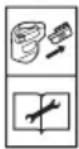
Caution: Do not over tighten. Tighten by hand. Finger tight only.
Switch the tool off. Before performing any maintenance on the tool, remove the battery from the tool.
Additional safety instructions for batteries and chargers
Batteries
Never attempt to open for any reason.
Do not expose the battery to water.
Do not expose the battery to heat.
Do not store in locations where the temperature may exceed 40°C
Charge only at ambient temperatures between 10°C and 40°C .
Charge only using the charger provided with the appliance/tool. Using the wrong charger could result in an electric shock or overheating of the battery.
When disposing of batteries, follow the instructions given in the section "Protecting the environment".
Do not damage/deform the battery pack either by puncture or impact, as this may create a risk of injury and fire.
Do not charge damaged batteries.
Under extreme conditions, battery leakage may occur. When you notice liquid on the batteries, carefully wipe the liquid off using a cloth. Avoid skin contact. In case of skin or eye contact, follow the instructions below.
Warning! The battery fluid may cause personal injury or damage to property. In case of skin contact, immediately rinse with water. If redness, pain or irritation occurs seek medical attention. In case of eye contact, rinse immediately with clean water and seek medical attention.
Chargers
Warning! Your charger has been designed for a specific voltage. Always check that the mains voltage corresponds to the voltage on the rating plate. Warning! Never attempt to replace the charger unit with a regular mains plug.
Use your BLACK+DECKER charger only to charge the battery in the appliance/tool with which it was supplied.
Other batteries could burst, causing personal injury and damage.
Never attempt to charge non-rechargeable batteries.
- If the supply cord is damaged, it must be replaced by the manufacturer or an authorised BLACK+DECKER Service Centre in order to avoid a hazard.
Do not expose the charger to water.
Do not open the charger.
Do not probe the charger.
The charger must be placed in a well ventilated area when charging.
Labels on the charger
The following symbols are found on your charger:

The charger is intended for indoor use only.
Read the instruction manual before use.
Electrical safety

Your charger is double insulated; therefore no earth wire is required. Always check that the mains voltage corresponds to the voltage on the rating plate. Never attempt to replace the charger unit with a regular mains plug.
- If the supply cord is damaged, it must be replaced by the manufacturer or an authorised BLACK+DECKER Service Centre in order to avoid a hazard.
Features
- On/off switch
- Lock-off button
- Oil cap
- Front guard
- Chain tension adjustment ring
- Chain
- Guide bar
- Chain sheath
- Chain adjust locking knob
10Chain cover assembly - Oil level indicator
12.Battery
Assembly

Warning! Always wear protective gloves when working on your chainsaw.

Warning! Before performing any assembly or maintenance on power tools, switch off and remove the battery.

Warning! Remove the cable tie that attaches the chain to the chainbar before assembly.
Fitting the guide bar and chain. (fig. A - L)
Place the chainsaw onto a stable surface (fig. A).
Fully loosen the chain adjust locking knob (9) (fig. B).
Remove the chain cover assembly (10) (fig. C).
Turn the tension adjust ring (5) anti-clockwise as far as it will go so the arrow on the tension adjust ring (5) lines up with the marker on the chain cover assembly (13) (fig. D).
Place the chain (6) over the guide bar (7) making sure that the saw chain cutters on the upper part of the guide bar (7) face towards the front (fig. E).
Guide the chain (6) around the guide bar (7) and pull it to create a loop to one side at the rear end of the guide bar (7).
Guide the chain (6) around the drive sprocket (14). Place the guide bar (7) onto the bar location studs (15) (fig. F & G).
Place the chain cover assembly (10) onto the chainsaw (fig. H) making sure the arrows are aligned (fig. I).
Turn the chain adjust locking knob (9) clockwise to attach the chain cover assembly (10) and lightly tighten (fig. I). to release the tension (fig J).
Turn the chain adjust locking knob (9) 180 degrees anticlockwise to release the tension (fig J).
Turn the chain tension adjust ring (5) clockwise until the chain (6) is tight. Make sure that the chain (6) is snug around the guide bar (7) (fig. K).
Check the tension as described below. Do not overtighten.
Tighten the chain adjust locking knob (9) (L).
Checking and adjusting the chain tension (fig. K)
Before use and after every 10 minutes of use, you must check the chain tension.
Remove the battery (12).
Lightly pull on the chain (6) as shown (inset fig. K). The tension is correct when the chain (6) snaps back after being pulled 3mm away from the guide bar (7). There should be no "sag" between the guide bar (7) and the chain (6) on the underside.
Note: Do not over-tension the chain as this will lead to excessive wear and will reduce the life of the guide bar and the chain.
Note: When the chain is new, check the tension frequently (after disconnecting from the mains) during the first 2 hours of use because a new chain stretches slightly.
To increase the tension (fig. J, K & L)
Turn the chain adjust locking knob (9) 180 degrees anticlockwise to release the tension. (fig. J).
Tension the chain using the chain tension adjusting ring (5), turn clockwise to tighten (fig K).
Tighten the chain adjust locking knob (9) (fig. L).
Fitting and removing the battery (fig. M)
To fit the battery (12), line it up with the receptacle on the tool. Slide the battery into the receptacle and push until the battery snaps into place.
To remove the battery, push the release buttons (16) while at the same time pulling the battery out of the receptacle.
Use
Warning! Let the tool work at its own pace. Do not overload.
Charging the battery (fig. N)
The battery needs to be charged before first use and whenever it fails to produce sufficient power on jobs that were easily done before. The battery may become warm while charging; this is normal and does not indicate a problem.
Warning! Do not charge the battery at ambient temperatures below 10°C or above 40°C . Recommended charging temperature: approx. 24°C .
Note: The charger will not charge a battery if the cell temperature is below approximately 10°C or above 40°C . The battery should be left in the charger and the charger will begin to charge automatically when the cell temperature warms up or cools down.
To charge the battery (12), insert it into the charger (19). The battery will only fit into the charger in one way. Do not force. Be sure that the battery is fully seated in the charger.
Plug in the charger and switch on at the mains. The charging indicator (18) will blink.
The charge is complete when the charging indicator (18) switches to continuously on. The charger and the battery can be left connected indefinitely. The charging indicator will switch on as the charger occasionally tops up the battery charge.
- Charge discharged batteries within 1 week. Battery life will be greatly diminished if stored in a discharged state.
Leaving the battery in the charger
The charger and battery pack can be left connected with the charger indicator glowing indefinitely. The charger will keep the battery pack fresh and fully charged.
Charger diagnostics
If the charger detects a weak or damaged battery, the charging indicator (18) will flash red at a fast rate. Proceed as follows:
Re-insert the battery (12).
If the charging indicators continue flashing red at a fast rate, use a different battery to determine if the charging process works properly.
- If the replaced battery charges correctly, the original battery is defective and should be returned to a service centre for recycling.
- If the new battery gives the same indication as the original battery, take the charger to be tested at an authorised services centre.
Note: It may take as long as 30 minutes to determine that the battery is defective. If the battery is too hot or too cold, the charger indicator will alternately blink red, fast and slow, one flash at each speed and repeat.
Filling the oil reservoir (fig. O)
Remove the oil cap (3) and fill the reservoir with the recommended chain oil. You can see the oil level in the oil level indicator (11). Refit the oil cap (3).
Periodically switch off and check the oil level indicator (11); if it is less than a quarter full, remove the battery from the chainsaw and refill with the correct oil.
Oiling the chain
We recommend that you use only Black & Decker oil during the lifetime of your chainsaw because mixtures of different oils could lead to the oil becoming degraded, which can drastically shorten the lifetime of the saw chain and create additional risks.
Never use waste oil, thick oil or very thin sewing machine oil. These may damage your chainsaw.
The saw chain (6) must be oiled before each use and after cleaning using only the correct grade of oil (cat. no. A6023-QZ).
Lubricate the saw chain (6) by slowly pressing the bulb (17) (fig. O) on the oil cap (3) four time before making each cut. Hold the bulb down for 1 second each time.
Switching on (fig. O)
Grip your chainsaw firmly with both hands. Pull the lock-off button (2) with your thumb and then push the on/off switch (1) to start.
When the motor starts, remove your thumb from the lockoff button (2) and grip the handle firmly.
Do not force the tool, allow the tool to do the work. It will do a better and safer job at the speed for which it is designed.
Excessive force will stretch the saw chain (6).
If the saw chain (6) or guide bar (7) becomes jammed
Switch the tool off.
Remove the battery (12).
Open the cut with wedges to relieve the strain on the guide bar (7). Do not try to wrench the chainsaw free.
Start a fresh cut.
Felling (fig. P, Q & R)
Inexperienced users should not attempt to fall trees. The user may suffer injury or cause damage to property as a result of failure to control the direction of fall, the tree may splinter or damaged/dead branches may fall during cutting:
The safe distance between a tree to be felled and bystanders, buildings and other objects is at least 2 1/2 times the height of the tree. Any bystander, building or object within this distance is at risk from being struck by the tree when felled.
Before attempting to fell a tree:
Make sure that there are no local by-laws or regulations that would prohibit or control the felling of the tree.
Consider all conditions that may affect the direction of fall, including:
The intended direction of fall.
The natural lean of the tree:
Any unusual heavy limb structure or decay.
Surrounding trees and obstacles including overhead lines and underground drains.
The wind speed and direction.
Pre-plan a safe exit from falling trees or branches. Make sure that the exit route is clear of obstacles that would prevent or hinder movement. Remember that wet grass and freshly cut bark is slippery.
Do not attempt to fell trees where the tree diameter is greater than the cutting length of the chainsaw:
Cut a direction notch to determine the direction of fall.
Make a horizontal cut to a depth of between 1/5th and 1/3rd of the diameter of the tree, perpendicular to the line of fall at the base of the tree (fig. P).
Make a second cut from above to intersect with the first and make a notch of about 45° .
Make a single horizontal felling cut from the other side 25 mm to 50 mm above the centre of the direction notch. (fig. Q). Do not cut through to the direction notch, you could lose control of the direction of fall.
Drive a wedge or wedges into the felling cut to open it and drop the tree (fig. R).
Pruning trees
Make sure that there are no local by-laws or regulations that would prohibit or control the pruning of the tree limbs. Pruning should only be undertaken by experienced users there is an increased risk of the saw chain pinching and kick back.
Before pruning consideration should be given to conditions affecting the direction of fall including:
The length and weight of the branch to be cut.
Any unusual heavy limb structure or decay.
Surrounding trees and obstacles including overhead.
The wind speed and direction:
The branch being intertwined with other branches.
The operator should consider access to the tree limb and the direction of fall. The tree branch is liable to swing towards the tree trunk. In addition to the user bystanders, objects and property below the branch will be at risk.
To avoid splintering, make the first cut in an upward direction to a maximum depth of one third the diameter of the branch.
Make the second cut downwards to meet the first.
Logging (fig. S, T & U)
How you should cut depends on how the log is supported. Use a saw horse whenever possible.
Always start a cut with the saw chain running and the spiked bumper (20) in contact with the wood (fig. S). To complete the cut use a pivoting action of the spiked bumper against the wood.
When supported along its whole length:
Make a downward cut, but avoid cutting the earth as this will blunt your saw chain quickly.
When supported at both ends:
First, cut one third down to avoid splintering and second, cut up to meet the first cut.
When supported at one end:
First cut one third up to avoid splintering and second, cut down to prevent splintering.
When on a slope:
Always stand on the uphill side.
When attempting to cut a log on the ground (fig. T):
Secure the workpiece using chocks or wedges. The user or a bystander should not steady the log by sitting or standing on it. Make sure that the saw chain does not contact the ground.
When using a saw horse (fig. U):
This is strongly recommended whenever possible.
Position the log in a stable position. Always cut on the outside of the saw horse arms. Use clamps or straps to secure the workpiece.
Limbing (fig. V)
Removing the branches from a fallen tree. When limbs, leave larger lower limbs to support the log off the ground.
Remove the small limbs in one cut. Branches under tension should be cut from the bottom of the branch towards the top to avoid binding the chain saw.
Trim limbs from opposite side keeping tree stem between you and saw. Never make cuts with saw between your legs or straddle the limb to be cut.
Troubleshooting
| Problem Possible cause | Possible solution | |
| Tool will not start Lock bucton not pressed | Press the lock button | |
| Battery not fitted Fit the ba ttery | Remove then re-fit the battery | |
| Battery not charged Charge the battery | Remove then re-fit the battery | |
| Battery not fitted correctly | ||
| Chain does not stop within 2 seconds when the tool is switched off | Chain tension is too slack | Check chain tension |
| Bar/chain appear hot/ smoking | Oil tank empty Check oil tank level | Clean oil holes (21 - fig. E) and clear the groove around the edge of the chainbar. |
| Chain tension is too tight | Check chain tension | |
| Guide bar sprocket nose needs greasing | Oil the guide bar sprocket nose | |
| Chainsaw does not cut well | Chain on backwards Check/modify chain direction | Sharpen |
| Chainsaw not using oil | Debris in tank Empty oil from tank and replace | remove debris from hole |
| Oil hole in cap blocked Remo | debris and clean the chain bar | |
| Debris in chain bar Remo | debris | |
| Debris in oil outlet Remove debris | debris | |
| Chainsaw stops suddenly during use | Battery depleted Re-charge battery if required | battery if required |
| Battery too hot Leave the battery to cool for atleast 30 minutes before proceeding or charging | battery to cool for atleast 30 minutes before proceeding or charging | |
| Voltage limit protection Re-start the chainsaw. Let the tool work at its own pace. Do not overload | start the chainsaw. Let the tool work at its own pace. Do not overload |
Maintenance
Regular maintenance ensures a long effective life for the tool. We recommend you make the following checks on a regular basis.
Warning! Before performing any maintenance on power tools:
Switch off and disconnect the tool from the mains supply.
Oil level
The level in the reservoir should not be allowed to fall below a quarter full.
Saw chain and guide bar
After every few hours of use and before storage, remove the guide bar (7) and the saw chain (6) and clean them thoroughly.
Make sure that the guard is clean and free from debris.
Oil sprocket nose and chain bar via the sprocket lubrication holes (21) (fig. E). This ensures an even distribution of wear around the guide bar rails.
Saw chain sharpening
If you are to get the best possible performance from the tool it is important to keep the teeth of the saw chain sharp. Guidance for this procedure is found on the sharpener package.
Replacing worn out saw chains
Replacement saw chains are available through retailers or Black & Decker service agents. Always use genuine spare parts.
Saw chain sharpness
The saw chain cutters will blunt immediately if they touch the ground or a nail while cutting.
Saw chain tension
Regularly check the saw chain tension.
What to do if your chainsaw needs repair.
What to do if your chainsaw needs repair. Your chainsaw is manufactured in accordance with the relevant safety requirements. Repairs should only be carried out by a qualified person using original spare parts otherwise this may result in considerable danger to the user. We recommend you keep this user manual in a safe place.
Protecting the environment

Separate collection. Products and batteries marked with this symbol must not be disposed of with normal household waste
Products and batteries contain materials that can be recovered or recycled reducing the demand for raw materials. Please recycle electrical products and batteries according to local provisions. Further information is available at www.2helpU.com
Technical data
| CS1825 H2 - GKC1825L H1 | ||
| Voltage | VDC | 18 |
| Bar length mm 250 | ||
| Max bar length mm 250 | ||
| Chain speed (No-load) m/s m 3.5 | ||
| Max cutting length mm 250 | ||
| Oil capacity ml 55 | ||
| Weight | kg 3.1 | |
| Batteries Charger (minutes) | |||||||||
| Cat# | Vdc | Ah | WeightKg | Cat# 905 | 0287° N5173 | 8° BDC1A B | C2A BDC | A36 | |
| Amps | 400mA | 1A | 1A | 2A | 1.35A | ||||
| BL1518 | 18 | 1.5 | 0.38 | BL1518 | 225 | 90 | 90 | 25 | X |
| BL1518ST | 18 | 1.5 | 0.38 | BL1518ST | 225 | 90 | 90 | 45 | X |
| BL2018 | 18 | 2.0 | 0.39 | BL2018 | 300 | 120 | 120 | 60 | X |
| BL2018ST | 18 | 2.0 | 0.39 | BL2018ST | 300 | 120 | 120 | 60 | X |
| BL2518 | 18 | 2.5 | 0.43 | BL2518 | 380 | 150 | 150 | 75 | X |
| BL4018 | 18 | 4.0 | 0.64 | BL4018 | 600 | 240 | 240 | 120 | X |
| BL5018 | 18 | 5.0 | 0.7 | BL5018 | 750 | 300 | 300 | 135 | X |
| BL20362 | 36 | 2.0 | 0.64 | BL20362 | X | X | X | X | 90 |
| BL2536 | 36 | 2.5 | 0.68 | BL2536 | X | X | X | X | 110 |
| BL1554 | 18/54 | 1.5 | 1.08 | BL1554 | 225 | 90 | 90 | 45 | X |
| BL2554 | 18/54 | 2.5 | 1.2 | BL2554 | 380 | 150 | 150 | 75 | X |
*Not sold as an accessory
| Guaranteed sound pressure level measured according to EN60745: |
| LpA (sound pressure) 79.0 dB(A), uncertainty (K) 3 dB(A) LwA (sound power) 90.5 dB(A), uncertainty (K) 1.8 dB(A) |
| Vibration total values (triax vector sum) according to EN 60745: |
| Vibration emission value (a_h) = 3.3 m/s², uncertainty (K) = 1.5 m/s² |
EC declaration of conformity
MACHINERY DIRECTIVE
OUTDOOR NOISE DIRECTIVE

CS1825ST1, GKC1825L20, GKC1825LST, GKC1825L50 - Chainsaw
Black & Decker declares that these products described under "technical data" are in compliance with:
EN 60745-1:2009 +A11:2010, EN 60745-2-13:2009 +A1:2011
2006/42/EC, Chain Saw, Annex IV
ENGLISH
(Original instructions)
DEKRA Certification B.V. Meander 1051 / P.O. Box 5185 6825 MJ ARNHEM / 6802 ED ARNHEM, Netherlands Notified Body ID No.: 0344
Level of acoustic power according to 2000/14/EC (Article 13, Annex III): LWA (measure sound power) 90.5 dB(A) LWA (guaranteed sound power) 93.0 dB(A)
These products also comply with Directive 2006/42/EC, 2014/30/EU and 2011/65/EU.
For more information, please contact Black & Decker at the following address or refer to the back of the manual.
The undersigned is responsible for compilation of the technical file and makes this declaration on behalf of
Black & Decker.
Becky Cotsworth
Director - Outdoor Products Group
Black & Decker Europe, 270 Bath Road, Slough,
Berkshire, SL1 4DX
United Kingdom
03/03/2020
Guarantee
Black & Decker is confident of the quality of its products and offers consumers a 24 month guarantee from the date of purchase. This guarantee is in addition to and in no way prejudices your statutory rights. The guarantee is valid within the territories of the Member States of the European Union and the European Free Trade Area.
To claim on the guarantee, the claim must be in accordance with Black & Decker Terms and Conditions and you will need to submit proof of purchase to the seller or an authorised repair agent. Terms and conditions of the Black&Decker 2 year guarantee and the location of your nearest authorised repair agent can be obtained on the Internet at www.2helpU.com, or by contacting your local Black & Decker office at the address indicated in this manual.
Please visit our website www.blackanddecker.co.uk to register your new Black & Decker product and receive updates on new products and special offers.
Black & Decker Europe, 270 Bath Road, Slough,
Berkshire, SL1 4DX
Abattage (figures P, Q et R)
Black & Decker Europe, 270 Bath Road, Slough,
Berkshire, SL1 4DX
Royaume-Uni
03/03/2020
Garantie
Black & Decker Europe, 270 Bath Road, Slough,
Berkshire, SL1 4DX
Regno Unito
03/03/2020
Garanzia
Director - Outdoor Products Group
Black & Decker Europe, 270 Bath Road, Slough,
Berkshire, SL1 4DX
Verenigd Koninkrijk
03/03/2020
Garantie
Diretor - Outdoor Products Group
Black & Decker Europe, 270 Bath Road, Slough,
Berkshire, SL1 4DX
Reino Unido
03/03/2020
Garantia
Removing the branches from a fallen tree. When limbs, leave larger lower limbs to support the log off the ground.
Remove the small limbs in one cut. Branches under tension should be cut from the bottom of the branch towards the top to avoid binding the chain saw.
Trim limbs from opposite side keeping tree stem between you and saw. Never make cuts with saw between your legs or straddle the limb to be cut.
Felsökning
2000/14/EC (Article 13, Annex III):
Black & Decker Europe, 270 Bath Road, Slough,
Berkshire, SL1 4DX
Storbritannien
03/03/2020
Garanti
*Not sold as an accessory
Level of acoustic power according to 2000/14/EC (Article 13, Annex III):
LWA (measure sound power) 90,5 dB(A)
LNA (guaranteed sound power) 93,0 dB(A)
Black & Decker Europe, 210 Bath Road, Slough,
Berkshire, SL1 3YD
Storbritannia
03/03/2020
Garanti
Black & Decker er trygg på kvaliteten av produitene sine og tilbyr en 24 maneders garanti fra kjopsdato. Denne garantierklageringen kommer i tilegg til dine lovbestemte rettigheter og er ikke i konflikt medppe. Garantien er gyldig innen omrade ne tilhorende medlemslandene i den Europeiske Union (EU) og det Europeiske Frihandelsomraret (EFTA).
For à ta garantien i bruk mä kravet vare i samsvar med kjopsbetingelsene fra Black&Decker og du mä vise kjopskvittering til forhandleren eller til et autorisert serviceverksted.
Betingelsene for Black&Deckers 2 Års garanti og adressen til dinærmeste autoriserte serviceverksted kan du finne på internett under www.2helpU.com, eller ved Å kontakte ditt lokale Black & Decker kontor, adressen er angitt i denen braksanvisningen.
*Not sold as an accessory
Black & Decker Europe, 270 Bath Road, Slough,
Berkshire, SL1 4DX
Iso-Britannia
03/03/2020
Garanti
*Not sold as an accessory
Black & Decker Europe, 270 Bath Road, Slough,
Berkshire, SL1 4DX
Iso-Britannia
03/03/2020
Takuu
Aiiies kai aTOOuyn KLOTOnmuToC
Mtopei va Tapaatnpnthei kIoToIma otav n uTn n to akpo Tns
mnapac oBnyou ePte iEe Taipn me eva avtkeieveo n otav to
Eulo Tepiaigkai paKwoei Tnv aluaioda poea otyn ton.
H eTiaopn tou akpou eEv avtkeieveo mtopei o epiaueves
TepiTTWOEIGs va Tpokaaleoi atotoun avtiotpoqn kivnon,
KLOTAWVTAc Tny mTapa obnyou Tpoc ta Tavw KAI TPOC TA
TIOW TPOC TO Mepoc Tou Xeipiotn.
To maykwa ta nca aauoiaac Tou epyaieou kata mkoctou Tavw mepous ts mtapac oynou utopei va otipwey npya poc ta tiow tnv mtapa ohyonc TpoC to mepos Tou xepiotn.
Mia aio autc Tc avtbpaoic mtopei va oac kavei va xaeTE TOV eleyxTOAUauoTpiovou ME KIVUVO Oaapou tpaumatoou. Mn BaoiCEote ATOKAEOTIKA OTIG diataeic aoaaieiac Tou diathetai To auaoTpiovocag. Qs xpnoTNC auaoTpiovou, 0a PpETeVA Taipvete opioeves TPOqualaeeis yia va atooyete TA atuxnata KAI Touc Tpaumatioouc katn diapkeia wv epyaowkotnc Tous EKTEAEITE.
To kIoToMa aIOTeAei OuvETeia Evoc eoVaLevou n EAAITn Xeipioou Tou aUoOpiovou.
Mtopevi va atoepuythetake kataaannaa Tpoanntikacetpa, oTWC auta Tou Tepiypavovta npakatw.
Kpatate yepa to aluootpiovo,mu touc avtxeipcs kai ta daxtuva nepikleiouv tnu lah tonou aluooptiovou. Na kpatate to aluootpiovo kai e Ta duo oac xepia kai va divete oTo oWma kai otous bpaxiovesc oac mia theon, otnv ontoia tha mtopeote va atiuetwiote tuxov atibpaotikec duvaueic (knotnata). Otav exouv anqthetai katalnnaa Tpoanntika metra, o xeiipotnc mtopevi va atiuetwiote i eTTituxia to klotonma. Mny apnvte ELeUepeo to aluostpivo.
Mnv TeVTWVEOTe KAI mNV KOBETE TAVW aTTO UPOCS TO WPOU OAC. Auto BOnthei OTNV aTTOPOUYn TNS aTheIaNc ETTaPns TO AKPOU ME AALO AVTIKEIEV O Ka IETPETTEI TOKALUTePO EAEYxo TO ALUOSOTPIOV O cATPOOTTEC KATAOTAOEIC.
Xpnoiioie aTOKkEIOtikacVATAAAKTEc paooukai aluoidcTou katoovtaTTOV KAaOeuaotn.AkataaAanAeavtaAakTKEcptapeo odnyoi kai aluoidc mtopeiv a TpokaEouv to aoio tnc aluoiaq h/kai To kIoToMa Tou epyaleiou.
Na akoLoueite Tavta Tc obnyies Tou kataoKEuaotn oxetikau To aKovioa Kai Tn ouvtnpnTns aluoidac tou epyaleiou.
H µiωon tou uouc tou puthetairotn baoouc kottnc mtopei va oynnoe i e augnon tou kotoanatoc.
2006/42/EC, Chain Saw, Annex IV
Black & Decker Europe, 270 Bath Road, Slough, Berkshire, SL1 4DX




- Safety instructions
- General power tool safety warnings
- Work area safety
- Electrical safety
- Personal safety
- Power tool use and care
- Additional power tool safety warnings
- Warning! additional safety warnings for chainsaws
- Causes and operator prevention of kickback
- Safety recommendations for the chainsaw
- English
- (Original instructions)
- Kickback can be caused by
- Avoid cutting
- Residual risks
- Vibration
- Labels on tool
- Additional safety instructions for batteries and chargers
- Batteries
- Chargers
- Labels on the charger
- Electrical safety
- Features
- Assembly
- Fitting the guide bar and chain. (fig. a - l)
- Checking and adjusting the chain tension (fig. k)
- To increase the tension (fig. j, k & l)
- Fitting and removing the battery (fig. m)
- Use
- Charging the battery (fig. n)
- Leaving the battery in the charger
- Charger diagnostics
- Filling the oil reservoir (fig. o)
- Oiling the chain
- Switching on (fig. o)
- If the saw chain (6) or guide bar (7) becomes jammed
- Felling (fig. p, q & r)
- Before attempting to fell a tree
- Pruning trees
- Before pruning consideration should be given to conditions affecting the direction of fall including
- Logging (fig. s, t & u)
- When supported along its whole length
- When supported at both ends
- When supported at one end
- When on a slope
- When attempting to cut a log on the ground (fig. t)
- When using a saw horse (fig. u)
- Limbing (fig. v)
- Maintenance
- Oil level
- Saw chain and guide bar
- Saw chain sharpening
- Replacing worn out saw chains
- Saw chain sharpness
- Saw chain tension
- What to do if your chainsaw needs repair
- Protecting the environment
- Ec declaration of conformity
- Machinery directive
- Outdoor noise directive
- Guarantee
- Abattage (figures p, q et r)
- Garantie
- Garanzia
- Garantia
- Garanti
- Takuu
- Aiiies kai atoouyn klotonmutoc
Brand : BLACK & DECKER
Model : GKC1825L50
Category : Electric saw