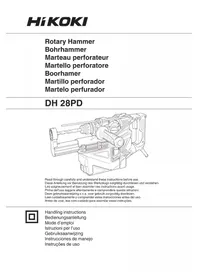
DH28PD - Hammer HiKOKI - Free user manual and instructions
Find the device manual for free DH28PD HiKOKI in PDF.


| Brand | HiKOKI |
| Model | DH28PD |
| Product type | Rotary hammer |
| Rated power input | 720 W |
| Supply voltage | 110-240 V ~ (depending on region) |
| No-load speed | 0-1050 min⁻¹ |
| Full load impact rate | 0-4000 min⁻¹ |
| Drilling capacity - Concrete | 4-28 mm |
| Drilling capacity - Steel | 13 mm |
| Drilling capacity - Wood | 32 mm |
| Tool holder | SDS-plus |
| Operating modes | Hammer drilling, drilling without impact, chiseling |
| Weight (EPTA 01/2014) | 4.1 kg |
| Sound pressure level (LpA) | 91 dB(A) |
| Sound power level (LwA) | 102 dB(A) |
| Vibrations - Drilling concrete | 15.9 m/s² (uncertainty K=2.5 m/s²) |
| Vibrations - Chiseling | 14.3 m/s² (uncertainty K=2.0 m/s²) |
| Delivery contents | Carrying case, side handle, depth stop, cover, rubber cap |
| Max. drilling depth with dust extractor | 85 mm |
| Dust tank capacity | 0.4 L |
| Lubrication | Periodic grease replacement (25 g of HiKOKI A grease) |
Frequently Asked Questions - DH28PD HiKOKI
User questions about DH28PD HiKOKI
0 question about this device. Answer the ones you know or ask your own.
Ask a new question about this device
Download the instructions for your Hammer in PDF format for free! Find your manual DH28PD - HiKOKI and take your electronic device back in hand. On this page are published all the documents necessary for the use of your device. DH28PD by HiKOKI.
USER MANUAL DH28PD HiKOKI
Rotary Hammer
Bohrhammer
Martreau perforateur
Martello perforatore
Boorhamer
Martillo perforador
Martelo perforador
DH 28PD
Read through carefully and understand these instructions before use.
These Anleitung vor Benutzung des Werkzeugs sorgfältig durchlesen und verstehen.
Lire soigneusement et bien assimiler ces instructions avant usage.
Prima dell'uso leggere attentamente e comprende queste istruzioni.
Deze geleuksaanwijzing s.v.p. voor geleuik zorgvuldig doorlezen.
Leer cuidadosamente y comprende estas instrucciones antes del uso.
Antes de usar, leia com:cuidado para assimilar estas instruções.

Handling instructions Bedienungsanleitung Mode d'emploi Istruzioni per l'uso Gebruiksaanwijzing Instrucciones de manejo Instruções de uso
1
2
3
4
5
6
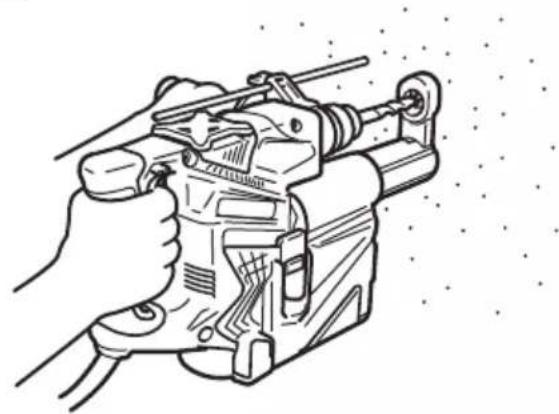
7
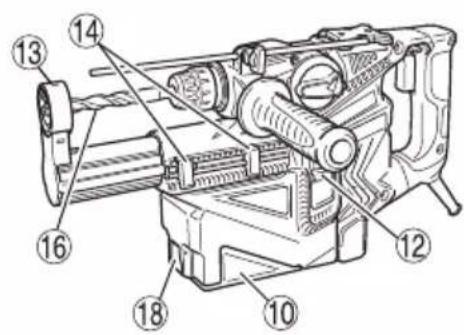
8
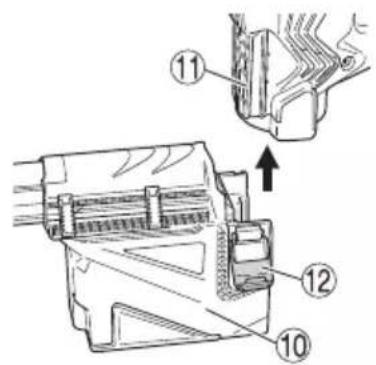
9
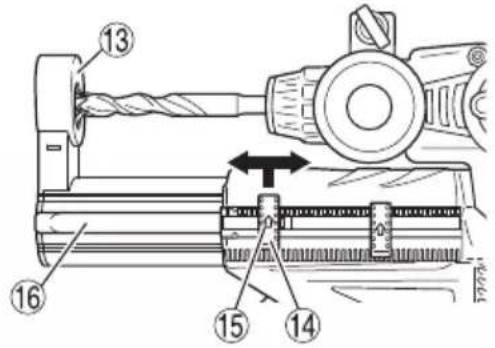
10
1112
13 14
15 16
17 18
1920
21 22
23 24
25 26
27 28
2930
31
32

| English Deutsch Français Italiano | |||
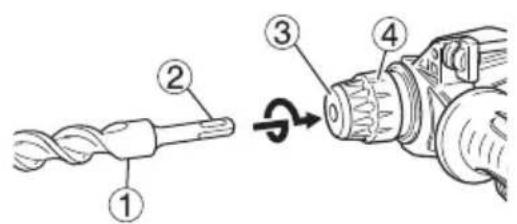
| 1 | Drill bit Bohrer Foret de percage Punta del trapano | ||
| 2 | Part of SDS-plus shank Teii des SDS-plus Schaftes Elément de la tige SDS plus Parte | dell'asta SDS plus | |
| 3 | Front cap Vordere Abdeckung Capuchon avant Protezione davanti | ||
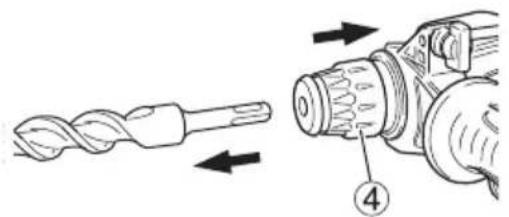
| 4 | Grip Spannbacke Attache coulissante Presa davanti | ||
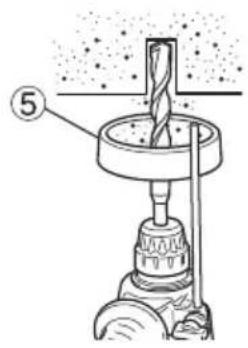
| 5 | Dust cup Staubschale Gode à poussière Contente a polvere | ||
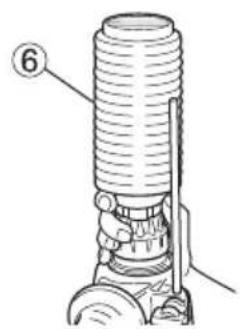
| 6 | Dust collector (B) Staufänger (B) | Collecteur à poussière (B) | Camera a polvere (B) |
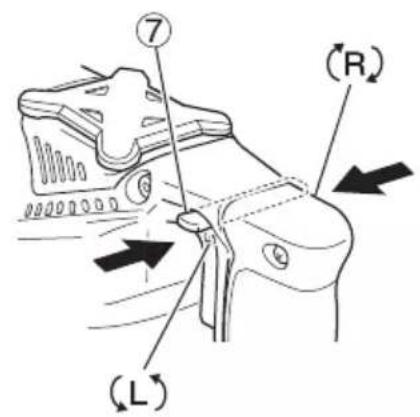
| 7 | Push button Druckschalter Bouton-poussoir Pulsante | ||
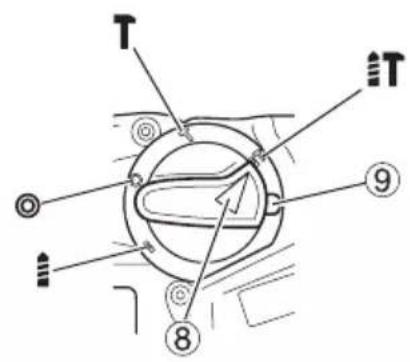
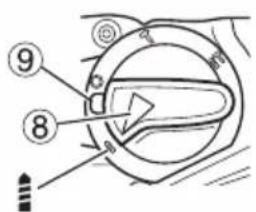
| 8 | Change lever Wahlhebel | Sélecteur | Leva di selezione |
| 9 | Push button Druckschalter Bouton-poussoir Pulsante | ||
| 10 | Dust-collecting unit Staufänger | Unité de récapération de la poussière | Unità raccoglipolverve |
| 11 | Rail Strebe | Pince | Binario |
| 12 | Latch Verschluss | Loquet | Chiusura a scatto |
| 13 | Nozzle Duse | Canule | Ugello |
| 14 | Adjuster Einstellvorrichtung Organe de réglage | Regolatore | |
| 15 | Arrow Pfeil Flèche Freccia | ||
| 16 | Adjuster rod Einstellstab | Tige de l'organe de réglage | Asta del regulator |
| 17 | Lever Hebel | Levier | Leva |
| 18 | Dust box Staubgefäß Boîte à poussière | Scatola portapolvere | |
| 19 | Nozzle seal Dusendichtung | Joint de la canule | Guarnizione dell'ugello |
| 20 | Rubber cap Gummikappe | Bouchon en caoutchouc | Protezione in gomma |
| 21 | Lip Lasche Lèvre | Tagliente | |
| 22 | Groove Rille | Rainure Scanalatura | |
| 23 | Groove between nozzle and nozzle seal Rille zwischen Duse und Dusensitz | Rainure entre la canule et le joint de la canule | Scanalatura tra l'ugello e la guarnizione dell'ugello |
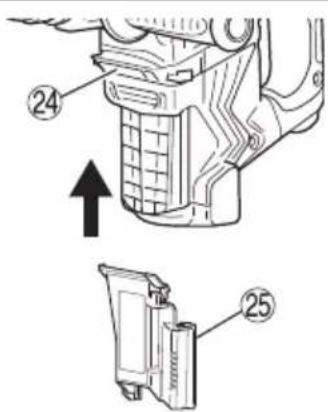
| 24 | Attachment hole Befestigungslsoch Orifice de fixation | Foro di attacco | |
| 25 | Cover Abdeckung Couvercle | Coperchio | |
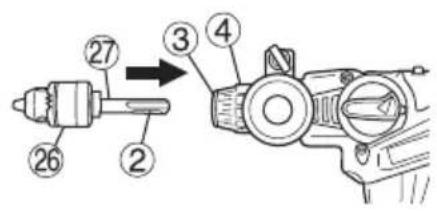
| 26 | Drill chuck Bohrfutter Mandrin porte-foret | Mandrino | |
| 27 | Chuck adapter Bohrfutteradapter Raccord de mandrin | Adattatore per mandrino | |
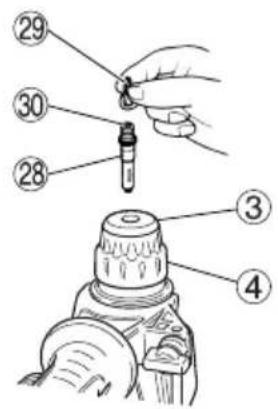
| 28 | Chuck adapter (D) Bohrfutteradapter (D) | Raccord (D) de mandrin | Adattatore (D) per mandrino |
| 29 | Bit Bohrerspitze Mèche | Punta | |
| 30 | Socket Fassung Prise | Presa | |
| 31 | Side handle Handgriff Poignée laterale | Laterale | |
| 32 | Stopper Anschlag Butée | Fermo | |
| 33 | Mounting hole Befestigungsföffnung Orifice de montage | Foro d'inserimento della bacchetta di arresto | |
| 34 | Wing bolt Flügelschraube Boulon à oreilles Bullone a galletto | ||
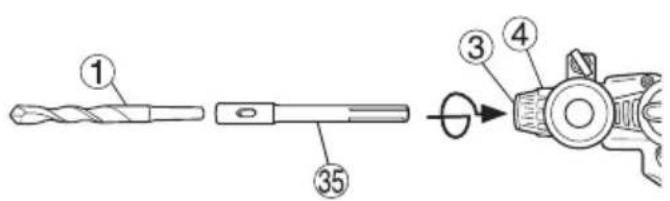
| 35 | Tape shank adapter Kegelschaftadapter Raccord de queu conique | Adattatore per gambo conico | |
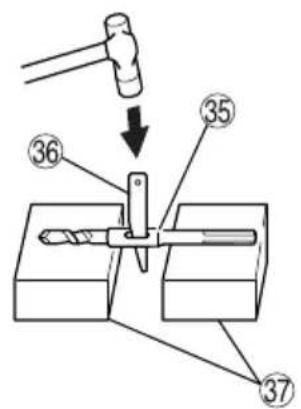
| 36 | Cotter Dorn Clavette | Coppiglia | |
| 37 | Rest Auflage Support | Appoggio | |
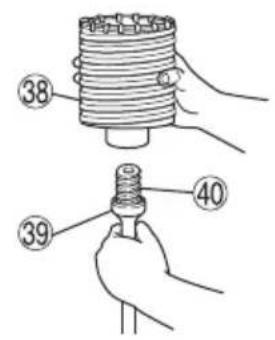
| 38 | Core bit Bohrkrone Couronne Corona | ||
| 39 | Core bit shank Bohrkronenzapfen Queue de couronne | Gambo della corona | |
| 40 | Thread Gewinde Filetage | Filettatura | |
| 41 | Center pin Mittelstift Goujon central | Punta della corona | |
| 42 | Guide plate Führungsplatte Plaque de guidage | Piastra guida | |
| 43 | Core bit tip Bohrkronenspitze Bout de couronne Punta della corona | ||
| 44 | Crank cover Kurbeldeckel Couvercle de manivelle | Coperchio dell'incastellatura | |
| Nederland Espanol Português | |||
| 1 | Boorstuk | Broca | Broca |
| 2 | Onderdeel van SDS plus schacht Parte del SDS plus vástago Cabo de peça | SDS-plus | |
| 3 | Voorkap Cubierta frontal Tampa da fronte | ||
| 4 | Greep Sujetador Mordente | ||
| 5 | Stofvangkap Capa de polvo Receptação do para poira | ||
| 6 | Stofverzamelaar (B) Colector de polvo | (B) Colector de poira (B) | |
| 7 | Drukknop Tecla Botão de pressão | ||
| 8 | Keuzeschakelaar | Palanquita seleção | Seletor |
| 9 | Drukknop Tecla Botão de pressão | ||
| 10 | Stofverzamelaar Colector de polvo | União de recolhao do pó | |
| 11 | Klemrand Riel | Carril | |
| 12 | Vergrendeling | Seguro | Trinco |
| 13 | Mondstuk Boquilla | Injector | |
| 14 | Afsteller | Ajustador | Ajustador |
| 15 | Pijl | Flecha | Seta |
| 16 | Afstelstang | Varilla del ajustador | Haste do ajustador |
| 17 | Hendel | Palanca | Alavanca |
| 18 | Stofverzameldoos | Caja para el polvo | Caixa do pó |
| 19 | Mondstukafdichting | Junta de la boquilla | Vedante do bico |
| 20 | Rubber dop | Cubierta de goma | Tampa de borracha |
| 21 | Lip | Borde | Lábio |
| 22 | Groef | Ranura | Ranhura |
| 23 | Groefussen mondstuk en mondstukafdichting | Ranura entre la boquilla y la junta de la boquilla | Ranhura entre o bico e o vedante do bico |
| 24 | Bevestigingsopening | Orício de instalación | Orício de fixação |
| 25 | Afdekking | Tapa | Tampa |
| 26 | Boorkop | Portabocas | Mandril |
| 27 | Boorkopadaptor | Adaptador del portabocas | Adaptador do mandril |
| 28 | Boorkopadaptor (D) | Adaptador (D) del portabocas | Adaptador do mandril (D) |
| 29 | Boorstuk | Broca | Palhetão |
| 30 | Aansluithuls | Cubo | Encaixe |
| 31 | Zijgreep | Mango lateral | Empunhadura lateral |
| 32 | Stopper | Retanedor | Bloqueador |
| 33 | Montagegat | Agujero de montaje | Orício de montagem |
| 34 | Vleugelmoer Paaso do palomilla | Parafuso tipo borboleta | |
| 35 | Vernauwde schachtadaptor | Adaptador de la espiga ahusada | Adaptador de cabo cônico |
| 36 | Cotter | Chaveta | Cavilha |
| 37 | Steun | Apoyo | Suporte |
| 38 | Kernstuk Barrena tubular Coroia | ||
| 39 | Kernstukschacht | Espiga de la barrena tubular | Cabo de coroa |
| 40 | Schroefdraad | Rosca | Rosca |
| 41 | Middenpin | Pasador central | Pino central |
| 42 | Pasplaatje | Placa guía | Placa-guía |
| 43 | Top van Kernstuk | Punta de barrena tubular | Cabo da coroa |
| 44 | Bedekking | Cubierta del motor | Tampa do carter |
| Symbols WARNING The following show symbols used for the machine. Be sure that you understand their meaning before use. | Symbole WARNING Die folgenden Symbole werden für diese Maschine verwendet. Achten Sie darauf, diese vor der Verwendung zu verstehen. | Symboles AVERTISSEMENT Les symboles suivants sont utilisés pour l'util. Bien se familiarisier avec leur signifi cation avant d'utiliser l'util. | Simboli AVVERTENZA Di seguito mostriamo i simboli usati per la macchina. Assicurarsi di comprendire il significato primo dell'uso. | |
| To reduce the risk of injury, user must read instruction manual. Failure to follow the warnings and instructions may result in electric shock, fi re and/or serious injury. | Der Anwender muss die Bedienungsanleitung lesen, um das Risiko einer Verletzung zu verringn. Wenn die Warnungen und Anweisungen nicht befoigt werden, kann es zu Stromschlag, Brand und/oder ernsthalten Verletzungenkommen. | Pour réduire les risques de blessures, l'utiliseur doit dire le manuel d'utilisation. Tout manquement à observer ces avertissements et instructions peut engender des choses électriques, des incendes et/ou des blessures graves. | Per ridurre l rischio di lesions, l'utente deve gaggere il manuale delle istruzioni. La mancata osservanza degli avertimenti e delle istruzioni potrebè esserecause di scosse elettriche, incendi e/o gravi lesioni. | |
| Only for EU countries Do not dispose of electric tools together with household waste material! In observance of European Directive 2012/19/EU on waste electrical and electronic equipment and its implementation in accordance with national law, electric tools that have reached the end of their life must be collected separately and returned to an environmentally compatible recycling facility. | Nur für EU-Länder Werfen Sie Elektronerkzeuge nicht in den Hausmüll! Gemäß Europäischer Richtlinie 2012/19/EU über Elektro- und Elektronik-Altergeäne und Umsetzung in nationales Recht müssen verbrauchte Elektronwerkzeuge getreten gesammelt und einer umweltgerechten Wiederverwertung zugeführten werden. | Pour les pays europeens uniquement Ne pas jeter les apparilés électriques dans les ordres ménagères! Conformément à la directive européenne 2012/19/UE relative aux déchets d'équipements électriques ou Electroniques (DEEE), et à sa transposition dans la législation nationale, les apparilés électriques doivent être collectés à part et être soumifs à un recyclage respectueux de l'environnement. | Solo par Paesi UE Non gettare le apparécchiatre elettriche tra i rifi uti domestici. Seconda la Direttiva Europea 2012/19/EU sui rifi uti di apparécchiatre elettriche ed elettroniche e la sua attuazione in conformità alle norme nazionali, le apparécchiatre elettriche esauste devono essere raccolte separamente, al fi ne di essere reimpiegate in modo eco-compatible. | |
| Symbolen WAARSCHUUNG Hieronder staan symbolen aufgebeeld die van toepassing zich op unsere machine. U moet de betekenis hiervan begrijpen voor gebruik. | Símbolos ADVERTENCIA A continuación se meustran los symbolos usados para la这其中. Asegúrese de comprehender su signifi cado antes del uso. | Símbolos AVISO A suivir aparecem os simbólos realizados pela这其中. Assimile bem seu signifi cados antes do uso. | ||
| Om het risico op verwondingen te verminderen, moet de gebruiker de instructiehandleiding lezen. Nalating om de waarschuwingen en instructies op te volgen kan in een elektrische schok, branden/of ernstig letsel resulteren. | Para reducir el risgo de lesiones, el usuario deben leel manual de instrucciones. Si no se siguen las advertencias e instrucciones,oulda producirse una descarga electrica, un incendio y/o daños graves. | Para reduzar o risico de lesão, o utiliser dever lo manual de instruções. Se não将持续as as instruções e os avisos, pode provocar umchoque eletrico, incendio e/ou ferimentos graves. | ||
| Alleen voor EU-landen Geef elektrisch gereedschap Niet met het huisvuiel mee! Volgens de Europese rechtelijk 2012/19/EU inzake oude elektrische en elektronische apparaten en de toepassing waarvan binnen de nationale wetgeving, dendigebruikt elektrisch gereedschap geschieren te worden ingezameld en te worden algevoerd waar een recycle bedrijf dat voldoet aan de geldende milieu-eisen. | Sólo para paises de la Unión Europea jNo deseche los aparatos electricos Jointo con los residuos domesticos! De conformidad con la Directive Europa 2012/19/UE sobre sus residuos de aparatos electricos y electrónicos y su aplicación de acuero con la legislación nacional, las herraminas electricas cuya vidautility有關 to a su vihnspecifique y recogener por separado y trasladar a una planta de reciclaje que cumpla con las exigencies ecologicas. | Apenas para paises da UE Não deite ferramentas electricas no lixo dométrico! De acordo com a directiva europea 2012/19/UE sobre ferramentas electricas e electrónicas usadas e a transposão para as leis nacionais, as ferramentas electricas usadas devem ser recolhidas em separado e encaminhadas a uma instalação de reciclagem dos materiais ecológica. |
GENERAL POWER TOOL SAFETY WARNINGS
WARNING
Read all safety warnings, instructions, illustrations and specific cations provided with this power tool.
Failure to follow all instructions listed below may result in electric shock, fire and/or serious injury.
Save all warnings and instructions for future reference.
The term "power tool" in the warnings refers to your mains-operated (corded) power tool or battery-operated (cordless) power tool.
1) Work area safety
a) Keep work area clean and well lit.
Cluttered or dark areas invite accidents.
b) Do not operate power tools in explosive atmospheres, such as in the presence of flammable liquids, gases or dust.
Power tools create sparks which may ignite the dust or fumes.
c) Keep children and bystanders away while operating a power tool.
Distractions can cause you to lose control.
2) Electrical safety
a) Power tool plugs must match the outlet. Never modify the plug in any way. Do not use any adapter plugs with earthed (grounded) power tools. Unmodified plugs and matching outlets will reduce risk of electric shock.
b) Avoid body contact with earthed or grounded surfaces, such as pipes, radiators, ranges and refrigerators.
There is an increased risk of electric shock if your body is earthed or grounded.
c) Do not expose power tools to rain or wet conditions.
Water entering a power tool will increase the risk of electric shock.
d) Do not abuse the cord. Never use the cord for carrying, pulling or unplugging the power tool.
Keep cord away from heat, oil, sharp edges or moving parts.
Damaged or entangled cords increase the risk of electric shock.
e) When operating a power tool outdoors, use an extension cord suitable for outdoor use.
Use of a cord suitable for outdoor use reduces the risk of electric shock.
f) If operating a power tool in a damp location is unavoidable, use a residual current device (RCD) protected supply.
Use of an RCD reduces the risk of electric shock.
3) Personal safety
a) Stay alert, watch what you are doing and use common sense when operating a power tool.
Do not use a power tool while you are tired or under the influence of drugs, alcohol or medication.
A moment of inattention while operating power tools may result in serious personal injury.
b) Use personal protective equipment. Always wear eye protection.
Protective equipment such as a dust mask, non-skid safety shoes, hard hat or hearing protection used for appropriate conditions will reduce personal injuries.
c) Prevent unintentional starting. Ensure the switch is in the off-position before connecting to power source and/or battery pack, picking up or carrying the tool.
Carrying power tools with your finger on the switch or energising power tools that have the switch on invites accidents.
d) Remove any adjusting key or wrench before turning the power tool on.
A wrench or a key left attached to a rotating part of the power tool may result in personal injury.
e) Do not overreach. Keep proper footing and balance at all times.
This enables better control of the power tool in unexpected situations.
f) Dress properly. Do not wear loose clothing or jewellery. Keep your hair and clothing away from moving parts.
Loose clothes, jewellery or long hair can be caught in moving parts.
g) If devices are provided for the connection of dust extraction and collection facilities, ensure these are connected and properly used.
Use of dust collection can reduce dust-related hazards.
h) Do not let familiarity gained from frequent use of tools allow you to become complacent and ignore tool safety principles.
A careless action can cause severe injury within a fraction of a second.
4) Power tool use and care
a) Do not force the power tool. Use the correct power tool for your application.
The correct power tool will do the job better and safer at the rate for which it was designed.
b) Do not use the power tool if the switch does not turn it on and off.
Any power tool that cannot be controlled with the switch is dangerous and must be repaired.
c) Disconnect the plug from the power source and/ or remove the battery pack, if detachable, from the power tool before making any adjustments, changing accessories, or storing power tools.
Such preventive safety measures reduce the risk of starting the power tool accidentally.
d) Store idle power tools out of the reach of children and do not allow persons unfamiliar with the power tool or these instructions to operate the power tool.
Power tools are dangerous in the hands of untrained users.
e) Maintain power tools and accessories. Check for misalignment or binding of moving parts, breakage of parts and any other condition that may affect the power tool's operation. If damaged, have the power tool repaired before use.
Many accidents are caused by poorly maintained power tools.
f) Keep cutting tools sharp and clean.
Properly maintained cutting tools with sharp cutting edges are less likely to bind and are easier to control.
g) Use the power tool, accessories and tool bits etc. in accordance with these instructions, taking into account the working conditions and the work to be performed.
Use of the power tool for operations diff erent from those intended could result in a hazardous situation.
h) Keep handles and grasping surfaces dry, clean and free from oil and grease.
Slippery handles and grasping surfaces do not allow for safe handling and control of the tool in unexpected situations.
5) Service
a) Have your power tool serviced by a qualified repair person using only identical replacement parts.
This will ensure that the safety of the power tool is maintained.
PRECAUTION
Keep children and infirm persons away.
When not in use, tools should be stored out of reach of children and infirm persons.
ROTARY HAMMER SAFETY WARNINGS
Safety instructions for all operations
- Wear ear protectors
Exposure to noise can cause hearing loss.
- Use auxiliary handle(s), if supplied with the tool.
Loss of control can cause personal injury.
- Hold the power tool by insulated gripping surfaces, when performing an operation where the cutting accessory may contact hidden wiring or its own cord.
Cutting accessory contacting a "live" wire may make exposed metal parts of the power tool "live" and could give the operator an electric shock.
Safety instructions when using long drill bits with rotary hammers
- Always start drilling at low speed and with the bit tip in contact with the workpiece.
At higher speeds, the bit is likely to bend if allowed to rotate freely without contacting the workpiece, resulting in personal injury.
- Apply pressure only in direct line with the bit and do not apply excessive pressure.
Bits can bend causing breakage or loss of control, resulting in personal injury.
SPECIFICATIONS
| Voltage (by areas)* | (110 V, 115 V, 120 V, 127 V, 220 V, 230 V, 240 V) \( \sim \) |
| Power Input 720 W | |
| No-load speed 0-1050 min | -1 |
| Full-load impact rate 0-4000 min | -1 |
| Capacity: concrete steel wood | 4-28 mm 13 mm 32 mm |
| Weight** 4.1 kg | |
| Dust collecting adapter Max. hole-drilling depth: Diameter of drill: Max. length of drill (eff ective length): | 85 mm (adjustment possible between 0 and 85 mm) 4-18 mm 100 mm |
| Dust box capacity: 0.4 liters |
- Be sure to check the nameplate on product as it is subject to change by areas.
** According to EPTA-Procedure 01/2014.
STANDARD ACCESSORIES
(1) Plastic case. 1
(2) Side handle. 1
(3) Stopper 1
(4) Cover 1
(5) Rubber cap (replacement) 1
Standard accessories are subject to change without notice.
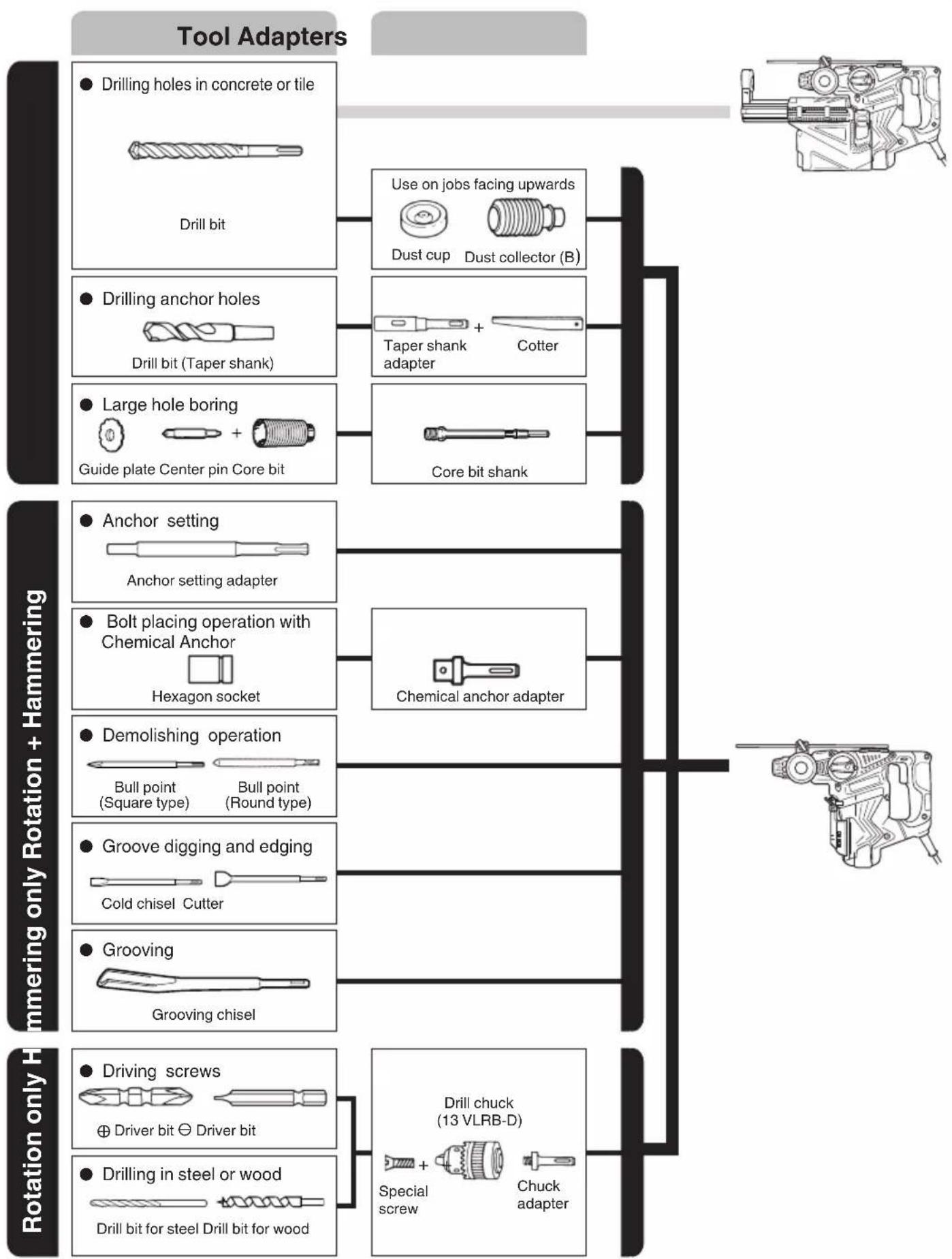
OPTIONAL ACCESSORIES (sold separately)
- Drilling holes in concrete or tile
| SDS-plus Drill bit | ||
| Outer dia. Overall length Eff ective | length | |
| 4.0 mm 110 mm 50 mm | ||
| 5.0 mm | 110 mm 50 mm | |
| 160 mm 100 mm | ||
| 5.5 mm 110 mm 50 mm | ||
| 6.5 mm 160 mm 100 mm | ||
| 7.0 mm 160 mm 100 mm | ||
| 8.0 mm 160 mm 100 mm | ||
| 8.5 mm 160 mm 100 mm | ||
| 9.0 mm 160 mm 100 mm | ||
| 12.0 mm | 166 mm 100 mm | |
| 260 mm 200 mm | ||
| 12.7 mm 166 mm 100 mm | ||
| 14.0 mm 166 mm 100 mm | ||
| 15.0 mm 166 mm 100 mm | ||
| 16.0 mm | 166 mm 100 mm | |
| 260 mm 200 mm | ||
| 17.0 mm 166 mm 100 mm | ||
| 19.0 mm 260 mm 200 mm | ||
| 20.0 mm 250 mm 200 mm | ||
| 22.0 mm 250 mm 200 mm | ||
| 25.0 mm 450 mm 400 mm | ||
Drilling anchor holes
| Taper shank adapter Taper mode |
| Morse taper No.1 |
| Morse taper No.2 |
| A-Taper |
| B-taper |
Large hole boring
| Core bit Outer dia. | Center pin | Core bit shank Overall length |
| 25 mm* | Not applicable | 105 mm 300 mm |
| 29 mm* | ||
| 32 mm | (A)35 mm | |
| 38 mm | ||
| 45 mm | (B) 300 mm | |
| 50 mm | ||
| 65 mm | ||
| 80 mm |
- Anchor setting
| Anchor setting adapter Anchor size |
| W 1/4" |
| W 5/16" |
| W 3/8" |
| W 1/2" |
| W 5/8" |
Optional accessories are subject to change without notice.
APPLICATIONS
Rotation and hammering function
Drilling anchor holes
Drilling holes in concrete
Drilling holes in tile
Rotation only function
Drilling in steel or wood
(with optional accessories)
O Tightening machine screws, wood screws (with optional accessories)
Hammering only function
Light-duty chiselling of concrete, groove digging and edging.
PRIOR TO OPERATION
1. Power source
Ensure that the power source to be utilized conforms to the power requirements specified on the product nameplate.
2. Power switch
Ensure that the power switch is in the OFF position. If the plug is connected to a power receptacle while the power switch is in the ON position, the power tool will start operating immediately, which could cause a serious accident.
3. Extension cord
When the work area is removed from the power source, use an extension cord of sufficient thickness and rated capacity. The extension cord should be kept as short as practicable.
4. Mounting the drill bit (Fig. 1)
CAUTION
To prevent accidents, make sure to turn the switch off and disconnect the plug from the receptacle.
NOTE
When using tools such as bull points, drill bits, etc., make sure to use the genuine parts designated by our company.
(1) Clean the shank portion of the drill bit.
(2) Insert the drill bit in a twisting manner into the tool holder until it latches itself. (Fig. 1)
(3) Check the latching by pulling on the drill bit.
(4) To remove the drill bit, fully pull the grip in the direction of the arrow and pull out the drill bit. (Fig. 2)
5. Installation of dust cup or dust collector (B) (Optional accessories) (Fig. 3, Fig. 4)
When using a rotary hammer for upward drilling operations attach a dust cup or dust collector (B) to collect dust or particles for easy operation.
Installing the dust cup
Use the dust cup by attaching to the drill bit as shown in Fig. 3.
When using a bit which has big diameter, enlarge the center hole of the dust cup with this rotary hammer.
Installing dust collector (B)
When using dust collector (B), insert dust collector (B) from the tip of the bit by aligning it to the groove on the grip. (Fig. 4)
CAUTION
The dust cup and dust collector (B) are for exclusive use of concrete drilling work. Do not use them for wood or metal drilling work.
-
Insert dust collector (B) completely into the chuck part of the main unit.
-
When turning the rotary hammer on while dust collector (B) is detached from a concrete surface, dust collector (B) will rotate together with the drill bit. Make sure to turn on the switch after pressing the dust cup on the concrete surface. (When using dust collector (B) attached to a drill bit that has more than 190mm of overall length, dust collector (B) cannot touch the concrete surface and will rotate. Therefore please use dust collector (B) by attaching to drill bits which have 166mm , 160mm , and 110mm overall length.)
Dump particles after every two or three holes when drilling.
Please replace the drill bit after removing dust collector (B).
6. Selecting the driver bit
Screw heads or bits will be damaged unless a bit appropriate for the screw diameter is employed to drive in the screws.
7. Confirm the direction of bit rotation (Fig. 5)
The bit rotates clockwise (viewed from the rear side) by pushing the R-side of the push button. The L-side of the push button is pushed to turn the bit counterclockwise.
8. Selecting the function mode
You can switch functions to the 3 modes of "hammering only, "rotation ^+ hammering", and "rotation only" by turning the change lever while pressing the push button. Set the mark position of the change lever to that of the mode to be used.
CAUTION
Before operating the change lever, check and make sure that the motor has stopped.
A failure can occur if it is operated while the motor is running.
To operate the change lever, press the push button, and release the lock of the change lever. Also, check and make sure after operation that the push button has returned and that the change lever has been locked.
- Switch the change lever without mistake. If it is used at a position halfway, there is a fear that the service life of the switching mechanism may be shortened.
HOW TO USE
CAUTION
To prevent accidents, make sure to turn the switch off and disconnect the plug from the receptacle when the drill pits and other various parts are installed or removed. The power switch should also be turned off during a work break and after work.
NOTE
Ensure that the wing bolt in the side handle is properly tightened before using the tool.
1. Switch operation
The rotation speed of the drill bit can be controlled steplessly by varying the amount that the trigger switch is pulled. Speed is low when the trigger switch is pulled slightly and increases as the switch is pulled more.
However, the switch trigger can only be pulled in halfway during reverse and rotates at half the speed of forward operation.
2. Rotation + hammering
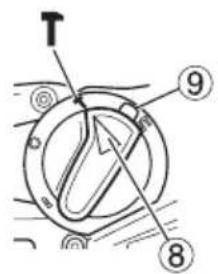
This rotary hammer can be set to rotation and hammering mode by pressing the push button and turning the change lever to the T mark. (Fig. 6)
Turn the grip slightly and confirm that the clutch has been engaged with a click.
(1) Mount the drill bit.
(2) Pull the trigger switch after applying the drill bit tip to the drilling position. (Fig. 7)
(3) Pushing the rotary hammer forcibly is not necessary at all. Pushing slightly so that drill dust comes out gradually is sufficient.
CAUTION
When the drill bit touches construction iron bar, the bit will stop immediately and the rotary hammer will react to revolve. Therefore grip the side handle and handle tightly as shown in Fig. 7.
3. Using the dust-collecting unit
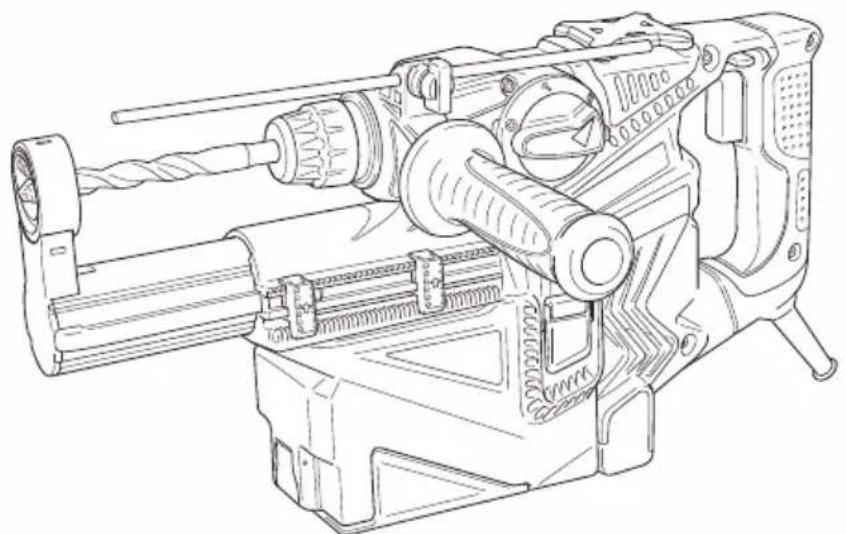
Using the rotary hammer with the dust-collecting unit attached creates a more hygienic working environment free of flying dust (Fig. 8).
(1) Attaching the dust-collecting unit
Insert the dust-collecting unit along the rail on the rotary hammer. When it is inserted as far as it will go, fix it to the rotary hammer with the two latches (Fig. 9).
CAUTION
The dust-collecting unit is designed for use when drilling concrete. Do not use for drilling holes in metal or wood.
(2) Adjusting the dust-collecting unit
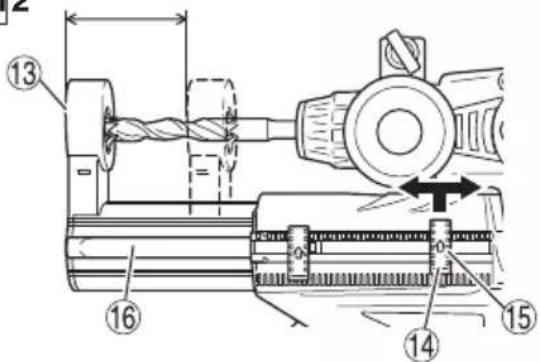
(a) Adjusting the position of the dust-collecting nozzle
Push the nozzle in and adjust to the desired position.
Pull the adjuster on the nozzle in the direction of the arrow to release the lock and move until it contacts with the adjuster rod. Push the adjuster in the opposite direction to the arrow to lock (Fig. 10).
(b) Setting the hole-drilling depth
Pull the adjuster on the handle in the direction of the arrow to release the lock, move to the desired position to determine the stroke, and push the adjuster in the opposite direction to the arrow to lock.
The nozzle travel distance when the tip of the nozzle matches the tip of the drill bit is the hole-drilling depth. (Fig. 11)
The maximum hole-drilling depth when using the dust-collecting unit is 85mm
When using the dust-collecting unit, it is possible to use HiKOKI drill bits between 4mm and 18mm in diameter and up to 100mm in effective length.
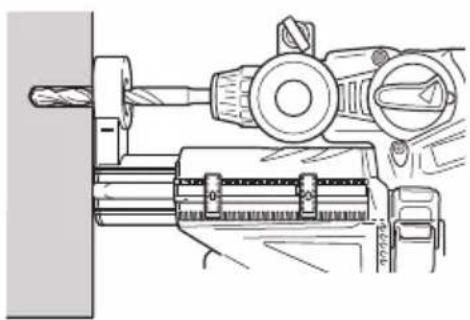
(3) Drilling holes
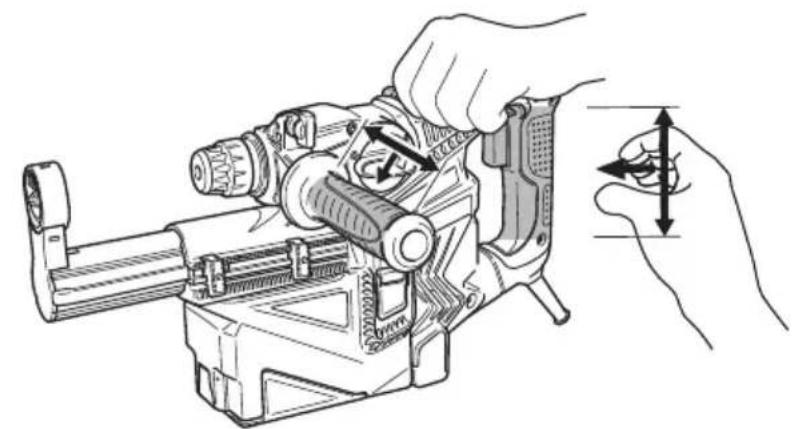
When drilling holes, hold the rotary hammer so that the tip of the nozzle contacts with the concrete surface. Dust-collecting effectiveness is reduced if the unit is not in contact with the surface (Fig. 12).
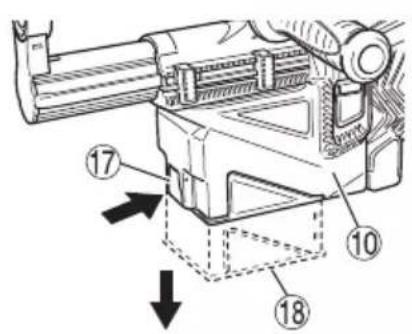
(4) Removing dust
Excessive dust in the dust box will reduce dust-collecting effectiveness. Empty the dust box regularly.
Push the lever to remove the dust box from the dust-collecting unit, and empty and clean the box (Fig. 13).
Dust-collecting effectiveness is reduced if the filter in the dust box becomes blocked.
Use the table below as a guide to replacement of the dust box.
| Dust box capacity Drill diameter of 6 mm / depth of 28 mm: 130 holes Drill diameter of 8 mm / depth of 30 mm: 75 holes Drill diameter of 12 mm / depth of 50 mm: 20 holes | |
| Guide to replacement of dust box | Dust box has been filled and emptied 100 times |
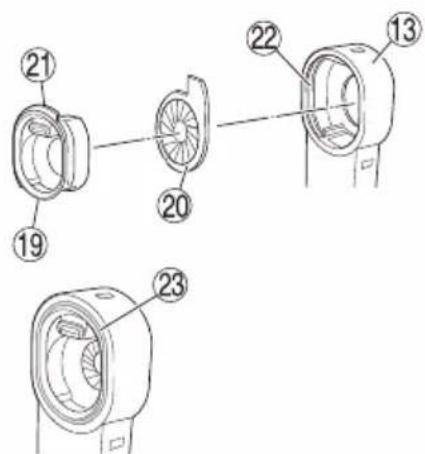
(5) Replacing the rubber cap
Wear of the rubber cap will reduce dust-collecting effectiveness.
Replace the rubber cap when it becomes worn.
How to replace the rubber cap (Fig. 14)
(1) Remove the nozzle seal from the nozzle.
(2) Replace the rubber cap with a new cap.
Fit the rubber cap making sure that it is correctly oriented.
(3) Attach the nozzle seal.
Insert the lip of the nozzle seal securely into the groove of the nozzle.
At this time, make sure that the groove between the nozzle and the nozzle seal is uniform all the way round.
4. When not using the dust-collecting unit
When using the rotary hammer without the dust-collecting unit, attach the provided cover in the unit attachment hole (Fig. 15).
CAUTION
If no cover is attached, dust or other particles may be sucked up from the hole, causing damage to the motor.
5. Rotation only
NOTE
The dust-collecting unit cannot be used. Remove the unit and attach the provided cover in the unit attachment hole.
CAUTION
If no cover is attached, dust or other particles may be sucked up from the hole, causing damage to the motor.
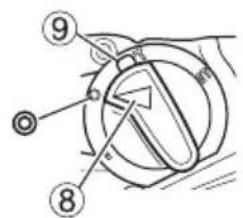
This rotary hammer can be set to rotation only mode by pressing the push button and turning the change lever to the mark. (Fig. 16)
Turn the grip slightly and confirm that the clutch has been engaged with a click.
To drill wood or metal material using the drill chuck and chuck adapter (optional accessories), proceed as follows.
Installing drill chuck and chuck adapter: (Fig. 17)
(1) Attach the drill chuck to the chuck adapter.
(2) The part of the SDS-plus shank is the same as the drill bit. Therefore, refer to the item of "Mounting the drill bit" for attaching it.
CAUTION
Application of force more than necessary will not only expedite the work, but will deteriorate the tip edge of the drill bit and reduce the service life of the rotary hammer in addition.
- Drill bits may snap off while withdrawing the rotary hammer from the drilled hole. For withdrawing, it is important to use a pushing motion.
- Do not attempt to drill anchor holes or holes in concrete with the machine set in the rotation only function.
Do not attempt to use the rotary hammer in the rotation and hammering function with the drill chuck and chuck adapter attached. This would seriously shorten the service life of every component of the machine.
6. When driving machine screws (Fig. 18)
First, insert the bit into the socket in the end of chuck adapter (D).
Next, mount chuck adapter (D) on the main unit using procedures described in 4 (1), (2), (3), put the tip of the bit in the slots in the head of the screw, grasp the main unit and tighten the screw.
CAUTION
Exercise care not to excessively prolong driving time, otherwise, the screws may be damaged by excessive force.
Apply the rotary hammer perpendicularly to the screw head when driving the screw; otherwise, the screw head or bit will be damaged, or driving force will not be fully transferred to the screw.
Do not attempt to use the rotary hammer in the rotation and hammering function with the chuck adapter and bit attached.
7. When driving wood screws (Fig. 18)
(1) Selecting a suitable driver bit
Employ plus-head screws, if possible, since the driver bit easily slips off the heads of minus-head screws.
(2) Driving in wood screws
Prior to driving in wood screws, make pilot holes suitable for them in the wooden board. Apply the bit to the screw head grooves and gently drive the screws into the holes.
After rotating the rotary hammer at low speed for a while until the wood screw is partly driven into the wood, squeeze the trigger more strongly to obtain the optimum driving force.
CAUTION
Exercise care in preparing a pilot hole suitable for the wood screw taking the hardness of the wood into consideration. Should the hole be excessively small or shallow, requiring much power to drive the screw into it, the thread of the wood screw may sometimes be damaged.
8. Hammering only
NOTE
The dust-collecting unit cannot be used. Remove the unit and attach the provided cover in the unit attachment hole.
CAUTION
If no cover is attached, dust or other particles may be sucked up from the hole, causing damage to the motor.
This rotary hammer can be set to hammering only mode by pressing the push button and turning the change lever to the T mark (Fig. 19).
(1) Mount the bull point or cold chisel.
(2) Press the push button and set the change lever to mark. (Fig. 20)
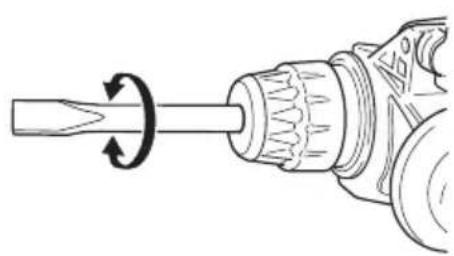
The rotation is released, turn the tool and adjust the tool to desired position. (Fig. 21)
(3) Turn the change lever to T mark. (Fig. 19)
Then bull point or cold chisel is locked.
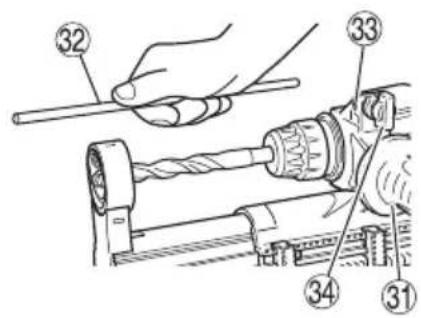
9. Using the stopper (Fig. 22)
(1) Loosen the wing bolt and insert the stopper into the mounting hole on the side handle.
(2) Adjust the stopper position according to the depth of the hole and tighten the wing bolt securely.
- How to use the drill bit (taper shank) and the taper shank adapter
(1) Mount the taper shank adapter to the rotary hammer. (Fig. 23)
(2) Mount the drill bit (taper shank) to the taper shank adapter. (Fig. 23)
(3) Turn the switch ON, and drill a hole in prescribed depth.
(4) To remove the drill bit (taper shank), insert the cotter into the slot of the taper shank adapter and strike the head of the cotter with a hammer supporting on a rests. (Fig. 24)
- Make sure to securely hold the tool as shown in Fig. 31 during operation.
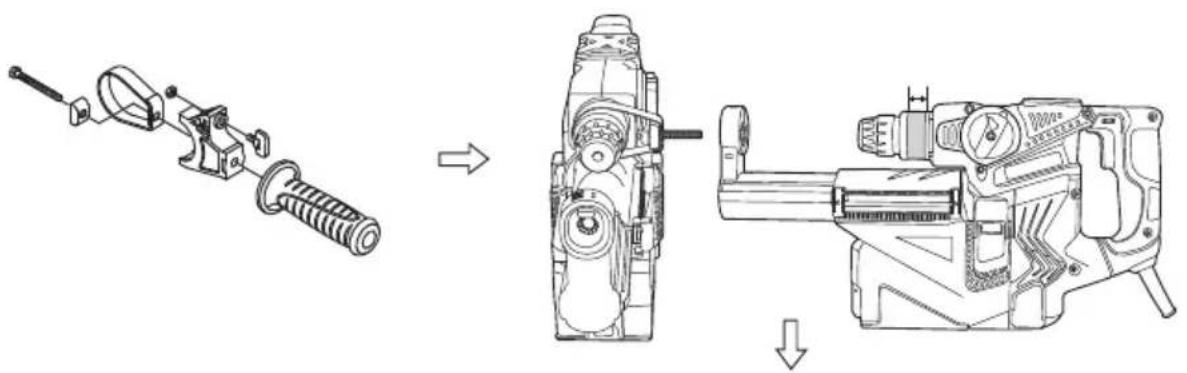
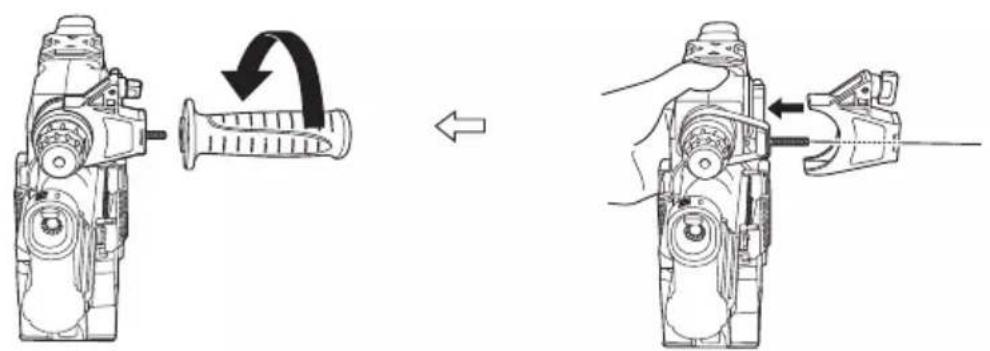
12. Using the side handle
When you wish to change a position of the side handle, turn grip of the side handle counterclockwise to loosen it, and then fasten it firmly. (Fig. 32)
CAUTION
When boring a hole, there can be a case where the machine attempts to rotate by the reaction at the time of penetrating a concrete wall and/or when a tip of the blade comes in contact with the rebar.
Firmly fasten the side handle and hold the machine with both of your hands. Unless you hold it securely, an accident can occur.
HOW TO USE THE CORE BIT (FOR LIGHT LOAD)
When boring penetrating large holes use the core bit (for light loads). At that time use with the center pin and the core bit shank provided as optional accessories.
1. Mounting
CAUTION
Be sure to turn power OFF and disconnect the plug from the receptacle.
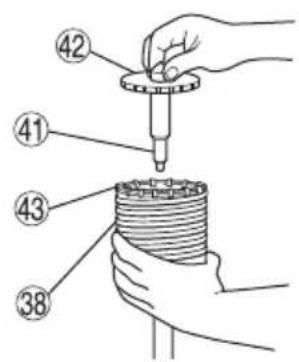
(1) Mount the core bit to the core bit shank (Fig. 25). Lubricate the thread of the core bit shank to facilitate disassembly.
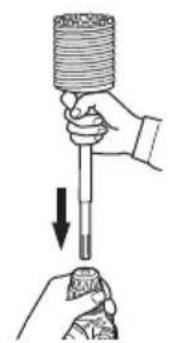
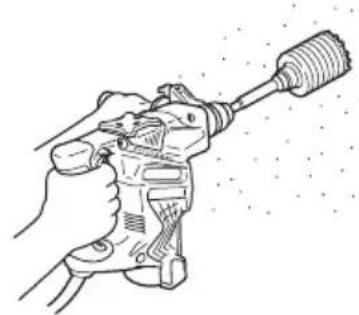
(2) Mount the core bit to the rotary hammer (Fig. 26).
(3) Insert the center pin into the guide plate until it stops.
(4) Engage the guide plate with the core bit, and turn the guide plate to the left or the right so that it does not fall even if it faces downward (Fig. 27).
2. How to bore (Fig. 28)
(1) Connect the plug to the power source.
(2) A spring is installed in the center pin.
Push it lightly to the wall or the floor straight.
Connect the core bit tip flush to the surface and start operating.
(3) When boring about 5mm in depth the position of the hole will be established. Bore after that removing the center pin and the guide plate from core bit.
(4) Application of excessive force will not only expedite the work, but will deteriorate the tip edge of the drill bit, resulting in reduced service life of the rotary hammer.
CAUTION
When removing the center pin and the guide plate, turn OFF the switch and disconnect the plug from the receptacle.
3. Dismounting (Fig. 29)
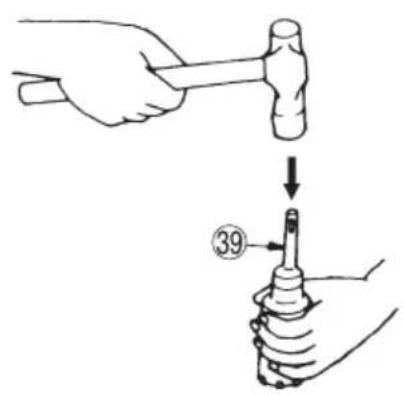
Remove the core bit shank from the rotary hammer and strike the head of the core bit shank strongly two or three times with a hammer holding the core bit, then the thread becomes loose and the core bit can be removed.
GREASE REPLACEMENT
This Rotary Hammer is of full air-tight construction to protect against dust. This machine can be used without grease replenishment for an extended period of time. However, perform the grease replacement to extend the service life. Replace the grease as described below.
1. Grease Replacement Period
You should look at the grease when you change the carbon brush. (See item 4 in the section MAINTENANCE AND INSPECTION.)
Ask for grease replacement at the nearest authorized HiKOKI Service Center.
In the case that you are forced to change the grease by yourself, please follow the following points.
2. How to replace grease
CAUTION
Before replacing the grease, turn the power off and pull out the plug from the receptacle.
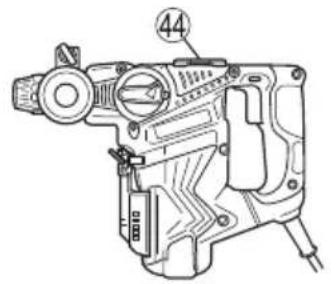
(1) Disassemble the crank cover and thoroughly wipe off the old grease inside. (Fig. 30)
(2) Supply 25g of HiKOKI Electric Hammer Grease A (standard accessory, contained in tube) in the crank case.
(3) After replacing the grease, reassemble the crank cover securely. At this time, do not damage or lose the oil seal. NOTE
The HiKOKI Electric Hammer Grease A is of the low viscosity type. When the grease is consumed, purchase from the authorized HiKOKI Service Center.
MAINTENANCE AND INSPECTION
1. Inspecting the drill bits
Since use of a dull tool will cause motor malfunctioning and degraded efficiency, replace the drill bit with new ones or resharpen them without delay when abrasion is noted.
2. Inspecting the mounting screws
Regularly inspect all mounting screws and ensure that they are properly tightened. Should any of the screws be loose, retighten them immediately. Failure to do so could result in serious hazard.
3. Maintenance of the motor
The motor unit winding is the very "heart" of the power tool. Exercise due care to ensure the winding does not become damaged and/or wet with oil or water.
4. Inspecting the carbon brushes
For your continued safety and electrical shock protection, carbon brush inspection and replacement on this tool should ONLY be performed by a HiKOKI Authorized Service Center.
5. Replacing supply cord
If the replacement of the supply cord is necessary, it has to be done by HiKOKI Authorized Service Center to avoid a safety hazard.
CAUTION
In the operation and maintenance of power tools, the safety regulations and standards prescribed in each country must be observed.
GUARANTEE
We guarantee HiKOKI Power Tools in accordance with statutory/country specific regulation. This guarantee does not cover defects or damage due to misuse, abuse, or normal wear and tear. In case of complaint, please send the Power Tool, undismantled, with the GUARANTEE CERTIFICATE found at the end of this Handling instruction, to a HiKOKI Authorized Service Center.
NOTE
Due to HiKOKI's continuing program of research and development, the specifications herein are subject to change without prior notice.
IMPORTANT:
Correct connection of the plug
The wires of the mains lead are coloured in accordance with the following code:
Blue: -Neutral
Brown:-Live
As the colours of the wires in the mains lead of this tool may not correspond with the coloured markings identifying the terminals in your plug proceed as follows:
The wire coloured blue must be connected to the terminal marked with the letter N or coloured black. The wire coloured brown must be connected to the terminal marked with the letter L or coloured red. Neither core must be connected to the earth terminal.
NOTE:
This requirement is provided according to BRITISH
STANDARD 2769:1984.
Therefore, the letter code and colour code may not be
applicable to other markets except The United Kingdom.
Information concerning airborne noise and vibration
The measured values were determined according to
EN62841 and declared in accordance with ISO 4871.
Measured A-weighted sound power level: 102 dB (A).
Measured A-weighted sound pressure level: 91 dB (A).
Uncertainty KpA: 3 dB (A).
Wear ear protection.
Vibration total values (triax vector sum) determined according to EN62841.
Hammer drilling into concrete:
Vibration emission value a_h HD = 15.9m / s^2
Uncertainty K = 2.5m / s^2 (A)
Equivalent chiselling value:
Vibration emission value a_h , CHeq = 14.3 m/s²
Uncertainty K = 2.0m / s^2 (A)
The declared vibration total value and the declared noise emission value have been measured in accordance with a standard test method and may be used for comparing one tool with another.
They may also be used in a preliminary assessment of exposure.
WARNING
The vibration and noise emission during actual use of the power tool can differ from the declared total value depending on the ways in which the tool is used especially what kind of workpiece is processed; and
- Identify safety measures to protect the operator that are based on an estimation of exposure in the actual conditions of use (taking account of all parts of the operating cycle such as the times when the tool is switched off and when it is running idle in addition to the trigger time).
2. Rotation + percussion
VOORZORGSGMAATREGELEN
| Ankerstellingsadaptor Anker formaat |
| W 1/4" |
| W 5/16" |
| W 3/8" |
| W 1/2" |
| W 5/8" |
Siemensring 34, 47877 willich, Germany
Tel: +49 2154 49930
Fax: +49 2154 499350
URL: http://www.hikoki-powertools.de
Hikoki Power Tools Netherlands B.V.
Brabanthaven 11, 3433 PJ Nieuwegein, The Netherlands
Tel: +31 30 6084040
Fax: +31 30 6067266
URL: http://www.hikoki-powertools.nl
Hikoki Power Tools (U.K.) Ltd.
25 Majestic Road, Southampton, SO16 OYT,
United Kingdom
Tel: +44 1908 660663
Fax: +44 1908 606642
URL: http://www.hikoki-powertools.uk
Hikoki Power Tools France S.A.S.
Hikoki Power Tools Belgium N.V./S.A.
Koningin Astridlaan 51, B-1780 Wemmel, Belgium
Tel: +32 2 460 1720
Fax: +32 2460 2542
URL http://www.hikoki-powertools.be
Hikoki Power Tools Italia S.p.A
Via Piave 35, 36077, Altavilla Vicentina (VI), Italy
Tel: +39 0444 548111
Fax: +39 0444 548110
URL: http://www.hikoki-powertools.it
Hikoki Power Tools Ibérica, S.A.
C/ Puigbarral, 26-28, Pol. Ind. Can Petit, 08227 Terrassa
(Barcelona), Spain
Tel: +34 93 735 6722
Fax: +34 93 735 7442
URL: http://www.hikoki-powertools.es