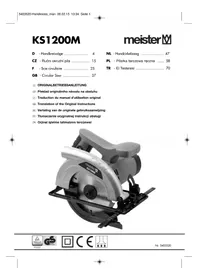
KS1200M - Saw Meister Craft - Free user manual and instructions

Find the device manual for free KS1200M Meister Craft in PDF.

📄 82 pages English EN 💬 AI Question 9 questions ⚙️ Specs
Notice Meister Craft KS1200M - page 37
Technical Specifications Circular saw, 1200 W power, 185 mm blade diameter, no-load speed 5000 rpm
Usage Ideal for cutting wood, particle boards, and similar materials
Maintenance and Repair Regularly check the blade condition, clean sawdust residues, lubricate moving parts
Safety Use safety glasses, gloves, and dust mask; do not remove blade guards
General Information Weight 4.2 kg, 2-year warranty, CE standards complied with

Frequently Asked Questions - KS1200M Meister Craft

How do I assemble the Meister Craft KS1200M saw?
To assemble the Meister Craft KS1200M saw, start by carefully reading the provided instruction manual. Ensure all parts are present, then follow the assembly steps using the recommended tools.
What is the maximum cutting depth of the saw?
The maximum cutting depth of the Meister Craft KS1200M saw is 65 mm at a 90-degree angle.
How do I change the saw blade?
To change the saw blade, unplug the machine, then use the supplied wrench to loosen the blade bolt. Remove the worn blade and install the new blade, ensuring the correct rotation direction, then tighten the bolt.
What types of materials can I cut with this saw?
The Meister Craft KS1200M saw is designed to cut various materials such as wood, plywood, and certain plastics. Avoid cutting metal or very hard materials.
How do I maintain my Meister Craft KS1200M saw?
To maintain your saw, regularly clean the blade and cutting table, check screws and bolts to ensure they are tight, and lubricate moving parts as recommended in the manual.
What should I do if the saw does not start?
If the saw does not start, first check that the machine is properly plugged in and the switch is in the "on" position. If the problem persists, check the power cord and outlet, or contact customer service.
What is the warranty for the Meister Craft KS1200M saw?
The Meister Craft KS1200M saw is generally covered by a 2-year warranty from the date of purchase, provided the usage and maintenance conditions specified in the manual are followed.
How do I adjust the cutting angle?
To adjust the cutting angle, unlock the angle adjustment mechanism, set the saw tilt to the desired angle, then lock the mechanism again.
Where can I get replacement parts?
Replacement parts for the Meister Craft KS1200M saw can be ordered from your local dealer or directly via the official Meister Craft website.

User questions about KS1200M Meister Craft

0 question about this device. Answer the ones you know or ask your own.

Ask a new question about this device

L'email reste privé : il sert seulement à vous prévenir si quelqu'un répond à votre question.

No questions yet. Be the first to ask one.

Download the instructions for your Saw in PDF format for free! Find your manual KS1200M - Meister Craft and take your electronic device back in hand. On this page are published all the documents necessary for the use of your device. KS1200M by Meister Craft.
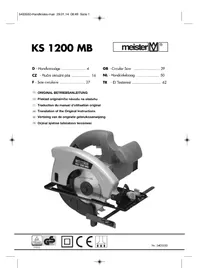
USER MANUAL KS1200M Meister Craft

natural_image Exterior view of a Meister M1 CS1200M power tool with visible blade and mounting bracket (no text or symbols on the device itself)

Meister Craft KS1200M - 1

2

Meister Craft KS1200M - 2

text_image Abb. 2 4 45° B 90° A 11

Meister Craft KS1200M - 3

text_image Abb. 3 9 3

Meister Craft KS1200M - 4

text_image Abb. 4 2 45° B

Meister Craft KS1200M - 5

text_image Abb. 5 12 meister 51 KS1200M 13 7 6

Meister Craft KS1200M - 6

text_image Abb. 6 10a 10b

Meister Craft KS1200M - 7

Operating instructions & safety hints

Meister Craft KS1200M - Operating instructions & safety hints - 1

WARNING! To reduce the risk of injury, please read the operating instructions through carefully before using the device, and then store with the machine! When passing the device on to another user, these operating instructions must also be included!

Contents

PagePage
1 - Scope of delivery377 - Installation and setting44
2 - Technical information378 - Operation45
3 - Components389 - Mode of operation45
4 - Correct use3810 - Maintenance and environmental protection45
5 - General safety instructions39
6 - Safety instructions relating specifically to the equipment4111 - Service instructions46

1 - Scope of delivery

• 1 Circular Saw
• 1 Parallel stopper
- 1 Blade
• 1 Adapter for external dust extractor
• 2 Adjustment keys
- Operating Instructions
- Guarantee

2 - Technical information

Technical data

Power voltage230-240 V~/50 Hz
Power consumption1200 W
Idle revolutions n_0 = 4800 min^-1
Cutting depth at 0°/90°max. 55 mm
Cutting depth at 0°/45°max. 38 mm
Saw blade max.∅ 160 x 20 mm
Master blade thickness/tooth width1.4/2.0 mm mm

Technical changes reserved.

Noise emission/vibration

Noise emission

L_pA : 98,83 dB(A)

L_WA : 109,83 dB(A)

Measuring inaccuracy:

Measured values determined in accordance with EN 60745-1, EN 60745-2-5.

The specified vibration emission value was measured in accordance with a normed test procedure and can be used in order to compare one electrical tool with another.

The specified vibration emission value can also be used for an introductory evaluation of the influence.

CAUTION! The vibration emission value may fluctuate from the specified value during use of the power tool. These fluctuations will depend on the way in which the power tool is used.

Safety measures must be taken in order to protect the operator. As a result, the evaluation of the influence must be made whilst taking account of the actual conditions of use. (All parts of the operating cycle must be taken into account for this purpose. This also includes times in which the power tool is switched off and times in which it is switched on, but is running without load.)

CAUTION! A certain amount of noise is unavoidable when using this device. Ensure you carry out noise-intensive work during permitted times. Maintain the quiet periods and limit your work to the absolute minimum.

CAUTION! The effects of noise may cause damage to the hearing. Only ever work with suitable ear defenders. Anybody else in the vicinity should thus also wear ear defenders.

3 - Components

1 Handle
2 Cutting angle setting
3 Saw bench
4 Locking screw for parallel stopper
5 Pendulum protective cover
6 Flange
7 Hexagonal screw
8 Connection for dust extractor
9 Cutting depth setting
10a On/Off switch

10b Switch-on safety mechanism

11 Parallel stopper

12 Flange wrench

13 Pin wrench

14 Adapter for external dust extractor

4 - Correct use

This circular saw is strictly a hand-operated tool and the saw blade that comes with it is suited for making straight cuts in wood and wooden materials according to the specifications in this instruction manual.

This unit may not be used by people (including children) with reduced physical, sensory or mental capacities, with a lack of experience and without the appropriate knowledge, unless they are supervised by someone who is responsible for their safety or have been instructed by such a person with regard to how the unit is to be operated. Children should be supervised to ensure that they do not play with the device.

The machine is intended only for use in the household.

Improper use of the product

All applications carried out with the device that are not listed in the "Proper use" chapter will be considered improper use.

Uses for which the tool is not designed may cause risks and injury. Do not use accessories that are not intended specifically for this electrical tool.

The external diameter, drill diameter and thickness of the tool must match the dimensional specifications of your power tool.

Incorrectly dimensioned tools cannot be sufficiently shielded or controlled.

There is a risk of injury. The user of the device is liable for all property and personal damages occurring as the result of incorrect use.

If other components or non-original components are used with the machine, the manufacturer guarantee is voided.

Remaining risks:

The operating instructions for this electrical tool contains comprehensive tips for the safe handling of electrical tools. However, every electrical tool has a certain level of remaining risks which cannot be excluded by the protective mechanisms on the device. Only operate electrical tools always with necessary care.

Remaining risks may be, for example:

  • Touching rotating parts or tools.
  • Injury caused by flying tools or tool parts.
  • Risk of fire with insufficient ventilation of the motor.
  • Adverse effects on the hearing caused by working without ear defenders.

The ability to work safely is dependant on the familiarity of the operator when it comes to handling the given electrical tool. Appropriate knowledge of the machinery and careful behaviour when working help to minimise the remaining risks.

WARNING! During operation, this power tool generates an electro magnetic field. This field may, under certain circumstances, influence active or passive medical implants. In order to reduce the risk of serious or deadly injuries, we recommend persons with such a medical implant to consult their doctor and the manufacturer of the medical implant before using the power tool.

5 – General safety instructions for handling power tools

WARNING! Read all safety warnings and all instructions.

Failure to follow the warnings and instructions may result in electric shock, fire and/or serious injury.

Save all warnings and instructions for future reference.

The term "power tool" in the warnings refers to your mains operated (corded) power tool or battery-operated (cordless) power tool.

1 Work area

a Keep work area clean and well lit. Cluttered and dark areas invite accidents.
b Do not operate power tools in explosive atmospheres, such as in the presence of flammable liquids, gases or dust. Power tools create sparks which may ignite the dust or fumes.
c Keep children and bystanders away while operating a power tool. Distractions can cause you to lose control.

2 Electrical Safety

a Power tool plugs must match the outlet. Never modify the plug in any way. Do not use any adapter plugs with earthed (grounded) power tools. Unmodified plugs and matching outlets will reduce risk of electric shock.

b Avoid body contact with earthed or grounded surfaces, such as pipes, radiators, ranges and refrigerators. There is an increased risk of electric shock if your body is earthed or grounded.

c Do not expose power tools to rain or wet conditions. Water entering a power tool will increase the risk of electric shock.

d Do not abuse the cord. Never use the cord for carrying, pulling or unplugging the power tool. Keep cord away from heat, oil, sharp edges or moving parts. Damaged or entangled cords increase the risk of electric shock.

e When operating a power tool outdoors, use an extension cord suitable for outdoor use. Use of a cord suitable for outdoor use reduces the risk of electric shock.

f If it is not possible to avoid using the electrical tool in a damp environment, use a residual current circuit-breaker. The use of a residual current circuit-breaker reduces the risk of an electrical shock.

3 Personal safety

a Stay alert, watch what you are doing and use common sense when operating a power tool. Do not use a

power tool while you are tired or under the influence of drugs, alcohol or medication. A moment of inattention while operating power tools may result in serious personal injury.

b Use personal protective equipment. Always wear eye protection. Protective equipment such as dust masks, non-skid safety shoes, hard hat, or hearing protection used for appropriate conditions will reduce personal injuries.

c Prevent unintentional starting. Ensure the switch is in the off-position before connecting to power source and/or battery pack, picking up or carrying the tool. Carrying power tools with your finger on the switch or energising power tools that have the switch on invites accidents.

d Remove any adjusting key or wrench before turning the power tool on. A wrench or a key left attached to a rotating part of the power tool may result in personal injury.

e Do not overreach. Keep proper footing and balance at all times. This enables better control of the power tool in unexpected situations.

f Dress properly. Do not wear loose clothing or jewellery. Keep your hair, clothing and gloves away from moving parts. Loose clothes, jewellery or long hair can be caught in moving parts.

g If devices are provided for the connection of dust extraction and collection facilities, ensure these are connected and properly used. Use of these devices can reduce dust related hazards.

4 Power tool use and care

a Do not force the power tool. Use the correct power tool for your application. The correct power tool will do the job better and safer at the rate for which it was designed.

b Do not use the power tool if the switch does not turn it on and off. Any power tool that cannot be controlled with the switch is dangerous and must be repaired.

c Disconnect the plug from the power source before making any adjustments, changing accessories, or storing power tools. Such preventive safety measures reduce the risk of starting the power tool accidentally.

d Store idle power tools out of the reach of children and do not allow persons unfamiliar with the power tool or these instructions to operate the power tool. Power tools are dangerous in the hands of untrained users.

e Maintain power tools. Check for misalignment or binding of moving parts, breakage of parts and any other condition that may affect the power tool's operation. If damaged, have the power tool repaired before use. Many accidents are caused by poorly maintained power tools.

f Keep cutting tools sharp and clean. Properly maintained cutting tools with sharp cutting edges are less likely to bind and are easier to control.

g Use the power tool, accessories and tool bits etc. in accordance with these instructions, taking into

account the working conditions and the work to be performed. Use of the power tool for operations different from those intended could result in a hazardous situation.

5 Service

a Have your power tool serviced by a qualified repair person using only identical replacement parts. This will ensure that the safety of the power tool is maintained.

6 – Safety instructions relating specifically to the equipment

Safety notes for all saws/sawing procedures

a) DANGER: Keep hands away from the cutting area and blade. Hold the additional handle or the engine housing with your other hand. If both hands are holding the saw, the saw blade will not be able injure them.

b) Do not reach underneath the work piece. The protective cover is not able to protect you from the saw blade if your hands are under the work piece.

c) Adjust the cutting depth to the thickness of the work piece. Less than a full tooth height below the work piece should be visible.

d) Never hold the work piece that is being cut in your hands or across your leg. Secure the work piece to a stable platform. It is important to support the work properly to minimise body exposure, blade binding, or loss of control.

e) Hold the power tool only by the insulated gripping surfaces when performing an operation where the cutting tool may make contact with hidden wiring or its own cord. Contact with a "live" wire will also make exposed metal parts of the power tool "live" and electrocute the operator.

f) When making a longitudinal cut, always use a stopper or straight edge guide. This improves the accuracy of the cut and reduces the possibility of the saw blade jamming.

g) Always use blades of the correct size and with the appropriate shape (star-shaped versus round) of arbour holes. Saw blades that do not correspond to the assembly parts of the saw will run unevenly and will lead to a loss of control.

h) Never use damaged or incorrect blade washers or bolts. The saw blade washers and screws have been designed specifically for your saw in order to ensure optimum performance and operating safety.

Additional saw safety notes

Causes of kickback and the appropriate safety notes

Kickback is a sudden reaction to a pinched, bound or misaligned saw blade, causing an uncontrolled saw to lift up and out of the work piece toward the operato;

- If the blade is pinched or bound tightly by the kerf closing down, the blade stalls and the motor reaction drives the unit rapidly back toward the operator.

- If the blade becomes twisted or misaligned in the cut, the teeth at the back edge of the blade can dig into the top surface of the wood causing the blade to move out of the kerf and jump back toward the operator.

A kickback is a consequence of incorrect or faulty use of the saw. It can be prevented by the use of suitable measures, as described below:

a) Maintain a firm grip on the saw and position your arms to resist kickback forces. Always position yourself to the side of the blade, never have the blade in line with your body. Kickback could cause the saw to jump backwards, but kickback forces can be controlled by the operator if proper precautions are taken.

b) When the blade is binding, or when interrupting a cut for any reason, release the trigger and hold the saw motionless in the material until the blade comes to a complete stop. Never attempt to remove the saw from the work or pull the saw backward while the blade is in motion or kickback may occur. Investigate and take corrective actions to eliminate the cause of blade binding.

c) When restarting a saw in the work piece, centre the saw blade in the kerf and check that saw teeth are not engaged into the material. If the blade is jammed, it may jump out of the work piece or cause a kickback when the saw is restarted.

d) Support large panels to minimise the risk of blade pinching and kickback. Large panels/boards may bend under their own weight.

Supports must be placed under the panel on both sides, near the line of cut and near the edge of the panel.

e) Do not use dull or damaged blades. Blades with blunt or incorrectly oriented teeth will, as a result of a sawn gap that is too narrow, cause increased friction and jamming of the blade as well as kickback.
f) Tighten all the cutting depth and angle settings before sawing. If the settings change during the sawing process, this may lead to the blade jamming and can cause kickback.
g) Be very careful when sawing in existing walls or in other areas that are difficult to see. The plunging blade may become blocked by hidden objects and cause kickback.

Function of the lower protective cover

a) Check before each use that the lower protective cover closes without problems. Do not use the saw if the lower protective cover does not move freely and does not close immediately. Never clamp or fix the lower protective cover in an open position. If the saw should accidentally fall to the ground, the lower protective cover may be deformed. Open the protective cover with the pullback lever and ensure that it moves freely and that it does not touch either the blade nor other parts at all cutting angles and depths.
b) Check the functionality of the springs on the lower protective cover. If the guard and the spring are not operating properly, they must be serviced before use. The protective cover may operate sluggishly due to damaged parts,

sticky deposits or a build-up of debris.

c) Open the lower protective cover by hand only when carrying out special cuts such as "plunge" and "angled" cuts. Open the lower protective cover with the pullback lever and release the lever as soon as the blade has penetrated the work piece. For every other type of sawing, the lower protective cover should function automatically.
d) Never put the saw down on the workbench or on the floor without ensuring that the lower protective cover is protecting the blade. An unprotected, switched off but still moving blade will move the saw in the direction opposite to the cutting direction and will cut everything in its path. Be aware of the time it takes for the blade to stop after the switch is released

Additional notes

a) Do not use grinding discs!
b) Only use saw blades with diameters in accordance with the labelling on the saw.
c) Observe the instructions for correct use of the dust extraction system.
d) Always wear a dust protection mask.
e) Only use the recommended saw blades.

f) Always wear ear defenders.
g) Always check the functionality of the protective cover before use.
- Saw blades made of high-speed steel may not be used.

  • Saw blades that do not correspond to the characteristic data specified in this operating manual may not be used.
  • Ensure that all of the moving parts of the saw blade protector are able to move without catching.
  • The splitting wedge should always be used and be set correctly, except when carrying out insertion cuts.
  • Only use sharp saw blades and suitable accessories.
  • Fix small wooden items in place firmly before processing. Never hold them by hand.
  • Do not use flanges/flange nuts with drilled holes that are larger or smaller than those of the saw blade.
  • Do not brake the saw blade by hand.
  • The machine is not to be used for stationary operation.
  • If connection cables are damaged, they must – in order to reduce the risks – be replaced by the manufacturer or by their customer service representative.

Safety marking

The symbols on the housing mean the following:

Meister Craft KS1200M - Safety marking - 1

Do not dispose of with domestic waste!

Meister Craft KS1200M - Safety marking - 2

Important! Observe operating instructions!

Meister Craft KS1200M - Safety marking - 3

„Tested Safety“ voluntary quality mark

Meister Craft KS1200M - Safety marking - 4

CE Mark (conformity to European safety standards)

Meister Craft KS1200M - Safety marking - 5

Housing is double insulated

Meister Craft KS1200M - Safety marking - 6

Wear safety goggles!

Meister Craft KS1200M - Safety marking - 7

Wear ear defenders!

7 – Installation and setting

Parallel cutting (Figure 2)

  1. Undo the locking screw (4).
  2. Adjust the parallel stopper (11) according to the scale, pay attention to the width of the saw blade

Meister Craft KS1200M - Parallel cutting (Figure 2) - 1

CAUTION! Produce a test cut using a piece of waste wood.

Notch A – vertical cut 90° Notch B – angled cut 45°

Cutting depth (Figure 3)

  1. Undo the screws for the cutting depth setting (9).
  2. Swivel the saw bench (3) down.
  3. Set the cutting depth using the scale. Tooth tips must protrude approximately 2 mm out of the wood.
  4. Tighten the screws for the cutting depth setting (9).

Adjusting the saw bench (angled cut) (Figure 4)

  1. Undo the screws for the cutting depth setting (2).
  2. Set the saw bench (3) to the required number of degrees 0 - 45°.
  3. Tighten the screws for the cutting depth setting (2).

Changing the saw blade (Figure 5)

  1. Open the pendulum protective cover (5) and hold firmly.
  2. Hold the flange (6) with the flange wrench (12).
  3. Undo the hexagonal screw (7) with the pin wrench (13) in an anti-clockwise direction.
  4. Remove the flange and blade by pulling downwards.
  5. Clean the flange then insert a new blade. Pay attention to the direction the blade runs in (see the arrow on the protective cover).
  6. Tighten the hexagonal screw in a clockwise direction and pay attention to concentricity.

8 - Operation

Switching on and off (Figure 6)

The machine has a two-button protective-circuit: The tool can only be put into operation when the handle (1) is held firmly and the switch-on safety mechanism (10b) and the On/Off

switch (10a) are pressed at the same time. When the handle is released, the machine turns off automatically, preventing any unintentional operation.

9 - Mode of operation

  • The pendulum cover is automatically pushed back by the work piece.
    • Gently and evenly push the circular saw forwards.
  • The waster piece should be located on the right-hand side of the circular saw to ensure that the largest piece is lying fully on the table.

Dust extractor (8)

The vacuum connection enables you to extract the dust using a vacuum cleaner. If necessary, use the adapter for external dust extraction (14). Breathing in dust is dangerous, and you should therefore always work with the vacuum system activated.

10 - Maintenance and environmental protection

The ventilation slots on the engine housing should be kept free and clean. Blow the build up from the slots from time to time.

CAUTION! Electrical and battery operated units that no longer work should not be disposed of in the household waste! They are to be collected separately, in accordance with the 2012/19/EU

Meister Craft KS1200M - - Maintenance and environmental protection - 1

directive for the disposal of electrical and electronic waste, and sent for proper and environmentally-friendly recycling.

Please discard power tools no longer usable at a local collection point. Collection and disposal of packaging materials separately by types complying with local rules and regulations. For details, please contact your municipal authority concerned.

11 - Service instructions

  • Store the machine, operating instructions and where necessary the accessories in the original packaging. In this way you will always have all the information and parts ready to hand.
  • Meister devices are to a large extent maintenancefree, a damp cloth being sufficient to clean the casing. Do not drop electrical machines in water. Please note additional hints given in the operating instructions.
  • Meister devices are subject to stringent quality control. If however a functional fault should occur, send the device to our servicing address. The repairs will be carried out in a short time.

  • A brief description of the defect speeds up the faulttracing and repair time. If within the guarantee period, please enclose the guarantee document and the proof of purchase.

  • In so far as a repair under guarantee is not concerned, we will charge the repair costs to your account.

PLEASE NOTE! Opening of the device invalidates the guarantee claim!

IMPORTANT! We point out expressly that in accordance with the Product Liability Act we do not take responsibility for any damage caused by our appliances, in so much that said damage is caused by improper repair, or original parts or parts released by us not being used when parts are changed, or repairs not being conducted by Meister Werkzeuge GmbH, Customer Service or an authorised specialist! The same applies analogously to the accessories used.

  • Pack the device well or use the original packaging in order to avoid transit damage.
  • Even after the expiry of the guarantee period, we would like to help you and carry out any repairs at a favourable price.

Meister Craft KS1200M - - Service instructions - 1

GB - The object of the declaration described above is in conformity with Directive 2011/65/EU of the European Parliament and of the Council of 8 June 2011 on the restriction of the use of certain hazardous substances in electrical and electronic equipment.

GB - Authorized person for storing the technical documentation

Manual assistant
Powered by Anthropic
Waiting for your message
Product information

Brand : Meister Craft

Model : KS1200M

Category : Saw