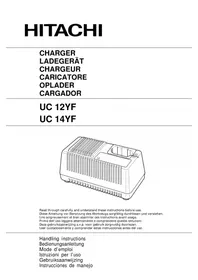
UC 12YF - Battery charger HITACHI - Free user manual and instructions
Find the device manual for free UC 12YF HITACHI in PDF.



| Product type | Battery charger |
| Brand | Hitachi |
| Model | UC 12YF |
| Charge voltage | 7.2 - 12 V |
| Charging time | Approximately 45 to 60 minutes |
| Weight | 1.3 kg |
| Compatible batteries | Hitachi EB7, EB7G |
| Indicator light | Yes, red/green indicator |
| Thermal protection | Yes, shutdown in case of overheating |
| Recommended charging temperature | 0 °C to 40 °C |
| Power supply | Mains (wall outlet) |
| Safety features | Protection against short circuits, overcharge, and reverse polarity |
| Maintenance and cleaning | Wipe with a soft, dry cloth or cloth moistened with soapy water |
| Spare parts | Use only original HITACHI parts |
| Repairability | Repair by an authorized HITACHI service center only |
| General information | Manual available in multiple languages (FR, DE, EN, ES, IT, NL) |
Frequently Asked Questions - UC 12YF HITACHI
User questions about UC 12YF HITACHI
0 question about this device. Answer the ones you know or ask your own.
Ask a new question about this device
Download the instructions for your Battery charger in PDF format for free! Find your manual UC 12YF - HITACHI and take your electronic device back in hand. On this page are published all the documents necessary for the use of your device. UC 12YF by HITACHI.
USER MANUAL UC 12YF HITACHI
Parts are subject to possible modification without notice due to improvements.
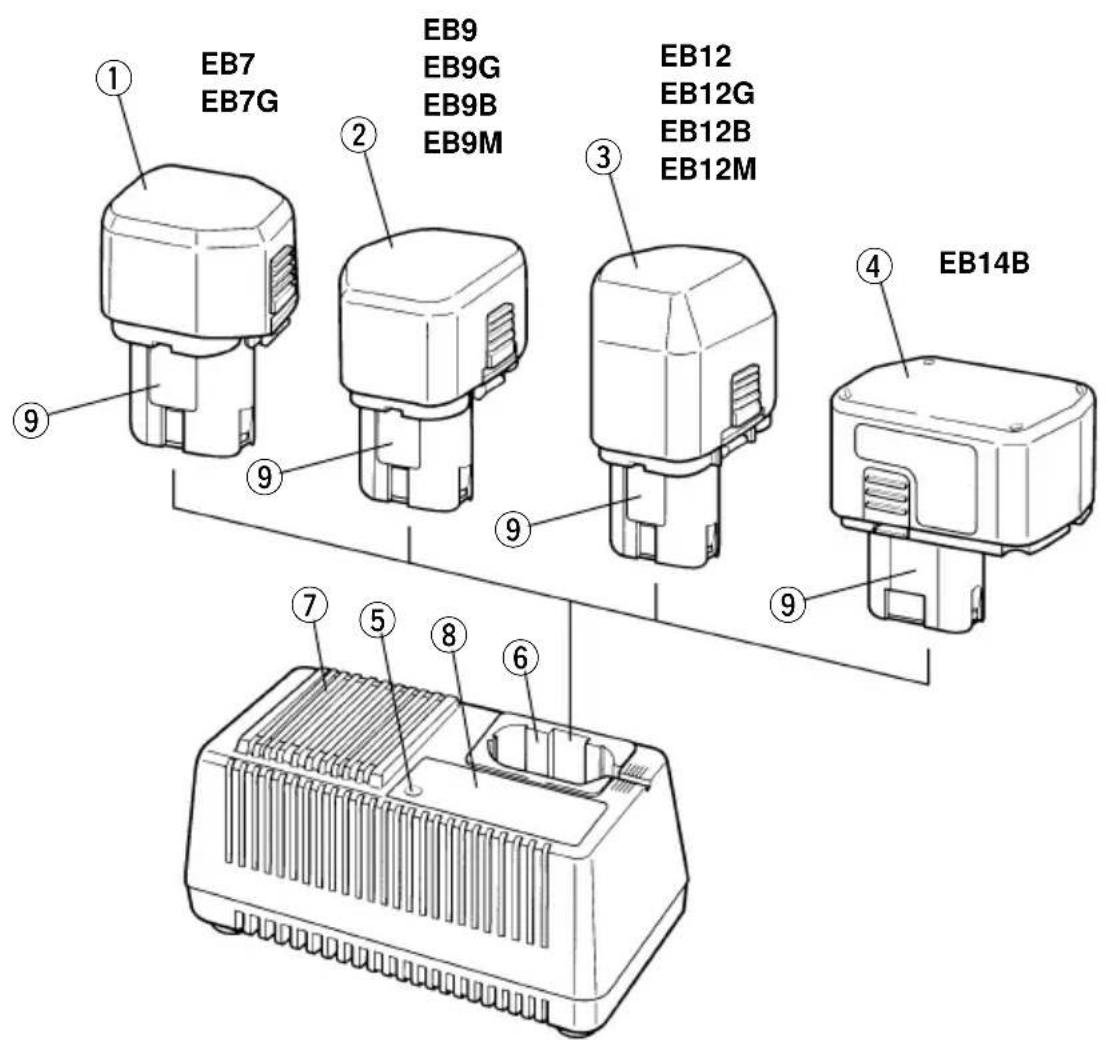
The drawing and the list are parts structural drawing and parts list of model UC14YF.
For model UC12YF refer to the drawing and the list.
1
| English | Deutsch | François | |
| ① | Rechargeable battery (EB7, EB7G) (EB7, EB7G) (EB7, EB7G) | Akkumulator | Batterie rechargeable |
| ② | Rechargeable battery (EB9, EB9G, EB9B, EB9M) (EB9, EB9G, EB9B, EB9M) (EB9, EB9G, EB9B, EB9M) | Akkumulator | Batterie rechargeable |
| EB9G, EB9B, EB9M) (EB9, EB9G, EB9B, EB9M) | EB9M) | ||
| ③ | Rechargeable battery (EB12, EB12G, EB12B, EB12M) (EB12, EB12G, EB12B, EB12M) (EB12, EB12G, EB12B, EB12M) | Akkumulator | Batterie rechargeable |
| 12, EB12G, EB12B, EB12M) (EB12, EB12G, EB12B, EB12M) | 12G, EB12B, EB12M) | ||
| ④ | Rechargeable battery (EB14B) | Akkumulator (EB14B) | Batterie rechargeable (EB14B) |
| ⑤ | Pilot lamp | Kontrollampe | Lampe tímoin |
| ⑥ | Hole for connecting the rechargeable battery | Anschlußloch für Akkumulator | Orifice de raccordement de la batterie rechargeable |
| ⑦ | Ventilation slot | Ventilator Ventilateur | |
| ⑧ | Caution plate | Warnschild | Plaque d'advertissement |
| ⑨ | Nameplate | Typenschild | Plaque signalétique |
| Italiano Nederlands Espanol | ||
| ① | Batteria ricaricabile Oplaadbare batterij Batería recargable (EB7, EB7G) (EB7, EB7G) (EB7, EB7G) | |
| ② | Batteria ricaricabile Oplaadbare batterij Batería recargable (EB9, EB9G, EB9B, EB9M) (EB9, EB9G, EB9B, EB9M) (EB9, EB9G, EB9B, EB9M) (EB9, EB9G, EB9B, EB9M) (EB9, EB9G, EB9B, EB9M) | |
| ③ | Batteria ricaricabile Oplaadbare batterij Batería recargable (EB12, EB12G, EB12B, EB12M) (EB12, EB12G, EB12B, EB12M) (EB12, EB12G, EB12B, EB12M) | |
| ④ | Batteria ricaricabile (EB14B) Oplaadbare batterij (EB14B) Battería recargable (EB14B) | |
| ⑤ | Spia Controleampje Lámpara piloto | |
| ⑥ | Foro di collegamento della Aanslu batteria ricaricabile batterij bateria i | ting voor oplaadbare Agujero para conectar la recargable |
| ⑦ | Ventola Ventilator Ventilador | |
| ⑧ | Etichetta delle precauzioni Waarschuwingslabel Placa de precaución | |
| ⑨ | Etichetta del nome | Naamplaatje |
GENERAL OPERATIONAL PRECAUTIONS
- Keep work area clean. Cluttered areas and benches invite accidents.
- Avoid dangerous environment. Don't expose power tools and charger to rain. Don't use power tools and charger in damp or wet locations. And keep work area well lit. Never use power tools and charger near flammable or explosive materials. Do not use tool and charger in presence of flammable liquids or gases.
- Keep children away. All visitors should be kept safe distance from work area.
- Store idle tools and charger. When not in use, tools and charger should be stored in dry, high or locked-up place — out of reach or children. Store tools and charger in a place in which the temperature is less than 40^ .
- Don't abuse cord. Never carry charger by cord or yank it to disconnect from receptacle. Keep cord from heat, oil and sharp edges.
- When the charger is not in use or when being maintained and inspected, disconnect the power cord of the charger from the receptacle.
- To avoid danger, always use only the specified charger.
- Use only genuine HITACHI replacement parts.
- Do not use power tools and charge for applications other than those specified in the Handling Instructions.
- To avoid personal injury, use only the accessories or attachment recommended in these handling instructions or in the HITACHI catalog.
- If the supply cord of this charger is damaged, the charger must be returned to the HITACHI authorized service center for the cord to be replaced. Let only the authorized service center do the repairing. The Manufacture will not be responsible for any damages or injuries caused by repair by the unauthorized persons or by mishandling of the tool.
- To ensure the designed operational integrity of power tools and charger, do not remove installed covers or screws.
- Always use the charger at the voltage specified on the nameplate.
-
Always charge the battery before use.
-
Never use a battery other than that specified. Do not connect a usual dry cell, a rechargeable battery other than that specified or a car battery to the power tool.
- Do not use a transformer containing a booster.
- Do not charge the battery from an engine electric generator or DC power supply.
- Always charge indoors. Because the charger and battery heat slightly during charging, charge the battery in a place not exposed to direct sunlight; where the humidity is low and the ventilation good.
- Use the exploded assembly drawing on this handling instructions only for authorized servicing.
PRECAUTIONS FOR CHARGER
- Always charge the battery at an ambient temperature of 0 - 40^ . A temperature of less than 0^ will result in over charging which is dangerous. The battery cannot be charged at a temperature greater than 40^ . The most suitable temperature for charging is that of 20 - 25^ .
- Do not use the charger continuously. When one charging is completed, leave the charger for about 15 minutes before the next charging of battery.
- Do not allow foreign matter to enter the hole for connecting the rechargeable battery.
- Never disassemble the rechargeable battery or charger.
- Never short-circuit the rechargeable battery. Short-circuiting the battery will cause a great electric current and overheat. It results in burn or damage to the battery.
- Do not dispose of the battery in fire. If the battery is burnt, it may explode.
- Using an exhausted battery will damage the charger.
- Bring the battery to the shop from which it was purchased as soon as the post-charging battery life becomes too short for practical use. Do not dispose of the exhausted battery.
- Do not insert objects into the air ventilation slots of the charger. Inserting metal objects or flammable into the charger air ventilation slots will result in an electrical shock hazard or damage to the charger.
SPECIFICATION
CHARGER
| Model UC12YF UC14YF | ||
| Charging time Approx. 45 ~ 60 minutes | Approx. 45 ~ 60 minutes | |
| Charging voltage 7.2 - 12 V 7.2 - 14 V | ||
| Weight 1.3 kg 1.3 kg |
APPLICATION
For charging the HITACHI BATTERY
OEB7, EB7G
EB9, EB9G, EB9B, EB9M
EB12, EB12G, EB12B, EB12M
EB14B
CHARGING
Before using the power tool, charge the battery as follows.
- Connect the charger's power cord to the receptacle. When connecting the plug of the charger to a receptacle, the pilot lamp will blink in red. (At 1-second intervals).
- Insert the battery into the charger. Firmly insert the battery into the charger till it contacts the bottom of the charger and checking the polarities as shown in Fig. 1.
CAUTION:
If the batteries are inserted in the reverse direction, not only recharging will become impossible, but it may also cause problems in the charger such as a deformed recharging terminal.
3. Charging When inserting a battery in the charger, the pilot lamp will light up continuously in red. When the battery becomes fully recharged, the pilot lamp will blink in red. (At 1-second intervals.) (See Table 1)
(1) Pilot lamp indication The indications of the pilot lamp will be as shown in Table 1, according to the condition of the charger or the rechargeable battery.
Table 1
| Indications of the pilot lamp | ||||
| The pilot lamp lights or blinks in red. | Before charging | Blinks | Lights for 0.5 seconds. Does not light for 0.5 seconds. (off for 0.5 seconds) | |
| While charging | Lights | Lights continuously | ||
| Charging complete | Blinks | Lights for 0.5 seconds. Does not light for 0.5 seconds. (off for 0.5 seconds) | ||
| Charging impossible | Flickers | Lights for 0.1 seconds. Does not light for 0.1 seconds. (off for 0.1 seconds) | Malfunction in the battery or the charger | |
| The pilot lamp lights in green. | Charging impossible | Lights | Lights continuously | The battery temperature is high, making recharging impossible. |
(2) Regarding the temperature of the rechargeable battery. The temperatures for rechargeable batteries are as shown in the table below, and batteries that have become hot should be cooled for a while before being recharged.
Table 2 Recharging of batteries that have become hot
| Rechargeable batteries | Temperatures at which the battery can be recharged |
| EB7, EB9 | -5°C ~ 40°C |
| EB12 | |
| EB7G | |
| EB9G, EB9B, EB9M | -5°C ~ 60°C |
| EB12G, EB12B, EB12M | |
| EB14B |
(3) Regarding recharging time
Table 3 shows the recharging time required according to the type of battery.
Table 3 Recharging time (approx. min.) at 20^
| Battery voltage (V) | Battery capacity (mAh) | |||||||
| 1,300 mAh 1,700 mAh 2,000 mAh | ||||||||
| 7.2 V EB7 45 min. | EB7G 55 min. | UC12YF | UC14YF | |||||
| 9.6 V EB9 45 min. | EB9G 55 min. | EB9B 60 min. | EB9M 60 min. | |||||
| 12 V EB12 45 min. | EB12G 55 m | n. EB12B 60 min. | EB12M 60 min. | |||||
| 14.4 V EB14B 60 min. | ||||||||
NOTE: The recharging time may vary according to the ambient temperature and the power supply voltage.
- Disconnect the charger's power cord from the receptacle.
- Hold the charger firmly and pull out the battery.
Regarding electric discharge in case of new batteries, etc.
As the internal chemical substance of new batteries and batteries that have not been used for an extended period is not activated, the electric discharge might be low when using them the first and second time. This is a temporary phenomenon, and normal time required for recharging will be restored by recharging the batteries 2-3 times.
How to make the batteries perform longer.
(1) Recharge the batteries before they become completely exhausted.
When you feel that the power of the tool becomes weaker, stop using the tool and recharge its battery. If you continue to use the tool and exhaust the electric current, the battery may be damaged and its life will become shorter.
(2) Avoid recharging at high temperatures.
A rechargeable battery will be hot immediately after use. If such a battery is recharged immediately after use, its internal chemical substance will deteriorate, and the battery life will be shortened. Leave the battery and recharge it after it has cooled for a while.
CAUTION
If the battery is charged while it is heated because it has been left for a long time in a location subject to direct sunlight or because the battery has just been used, the pilot lamp of the charger lights up green. In such a case, first let the battery cool, then start charging.
When the pilot lamp flickers in red (at 0.2-seconds intervals), check for and take out any foreign objects in the charger's battery installation hole. If there are no foreign objects, it is probable that the battery or charger is malfunctioning. Take it to your authorized Service Center.
Since the built-in micro computer takes about 3 seconds to confirm that the battery being charged with UC12YF/UC14YF is taken out, wait for a minimum of 3 seconds before reinserting it to continue charging. If the battery is reinserted within 3 seconds, the battery may not be properly charged.
MAINTENANCE AND INSPECTION
1. Inspecting the mounting screws:
Regularly inspect all mounting screws and ensure that they are properly tightened. Should any of the screws be loose, retighten them immediately. Failure to do so could result in serious hazard.
2. Cleaning of the charger
When the charger is stained, wipe with a soft dry cloth or a cloth moistened with soapy water. Do not use chloric solvents, gasoline or paint thinner, for they melt plastics.
3. Store idle charger
When not in use, the charger should be stored in dry, high or locked-up place — out of reach of children.
NOTE
Due to HITACHI's continuing program of research and development, the specifications herein are subject to change without prior notice.
IMPORTANT
Correct connecting of the plug
The wires of the mains lead are coloured in accordance with the following code:
Blue: -Neutral
Brown: -Live
As the colours of the wires in the mains lead of this tool may not correspond with the coloured markings identifying the terminals in your plug proceed as follows: The wire coloured blue must be connected to the terminal marked with the letter N or coloured black.
The wire coloured brown must be connected to the terminal marked with the letter L or coloured red. Neither core must be connected to the earth terminal. NOTE
This requirement is provided according to BRITISH STANDARD 2769:1984.
Therefore, the letter code and colour code may not be applicable to other markets except United Kingdom.
EB9, EB9G, EB9B, EB9M
EB12, EB12G, EB12B, EB12M
EB14B
LADEN
EB9, EB9G, EB9B, EB9M
EB12, EB12G, EB12B, EB12M
EB14B
CHARGE
EB9, EB9G, EB9B, EB9M
EB12, EB12G, EB12B, EB12M
EB14B
RICARICA
EB9, EB9G, EB9B, EB9M
EB12, EB12G, EB12B, EB12M
EB14B
OPLADEN
EB9, EB9G, EB9B, EB9M
EB12, EB12G, EB12B, EB12M
EB14B