 ManualGo.com
 C 7UY - Saw HiKOKI - Free user manual and instructions
Find the device manual for free C 7UY HiKOKI in PDF.



Download the instructions for your Saw in PDF format for free! Find your manual C 7UY - HiKOKI and take your electronic device back in hand. On this page are published all the documents necessary for the use of your device. C 7UY by HiKOKI.
USER MANUAL C 7UY HiKOKI
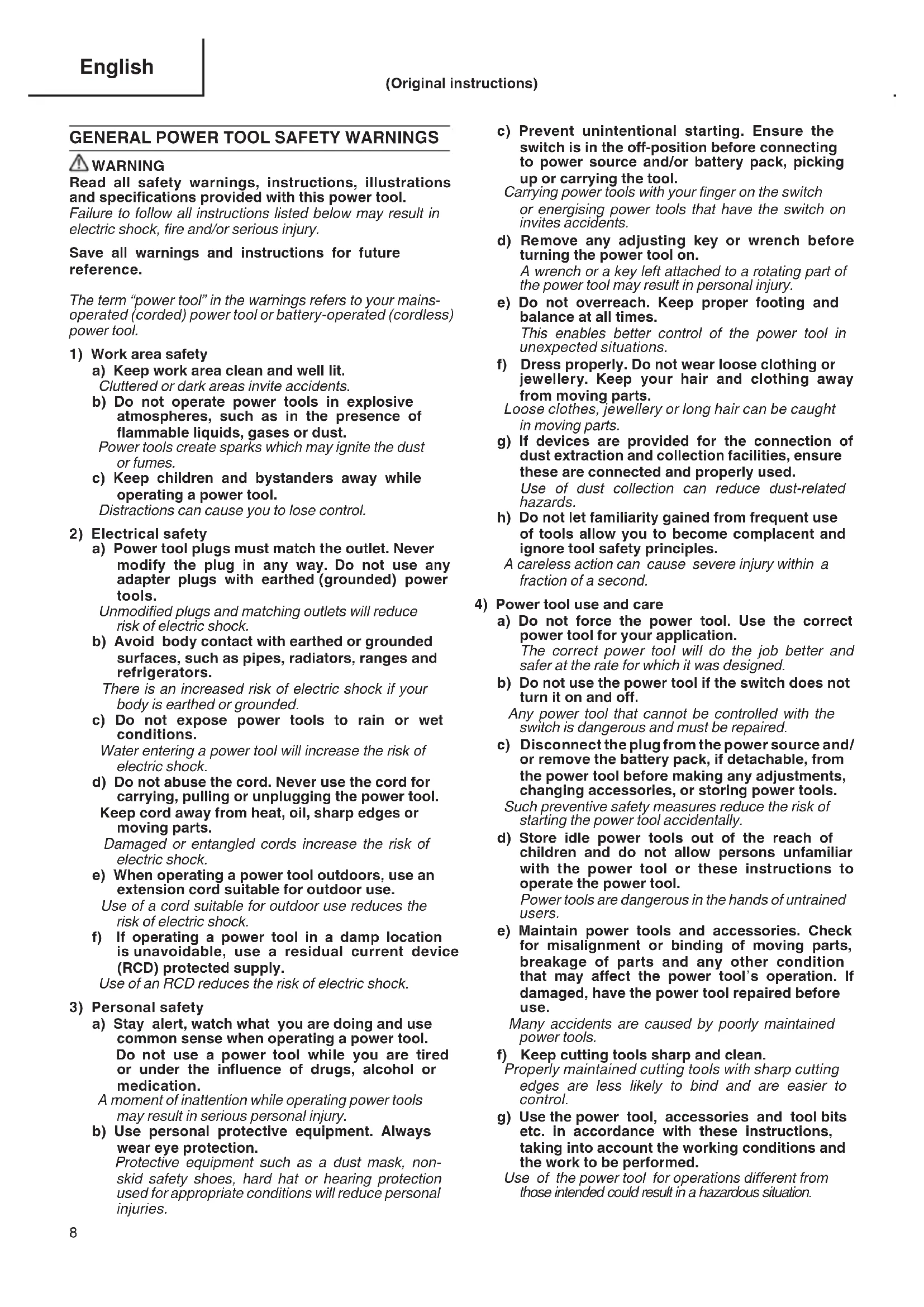
WARNING Read all safety warnings, instructions, illustrations and specications provided with this power tool. Failure to follow all instructions listed below may result in electric shock, re and/or serious injury. Save all warnings and instructions for future reference. The term “power tool” in the warnings refers to your mains- operated (corded) power tool or battery-operated (cordless) power tool.
a) Keep work area clean and well lit. Cluttered or dark areas invite accidents. b) Do not operate power tools in explosive atmospheres, such as in the presence of ammable liquids, gases or dust. Power tools create sparks which may ignite the dust or fumes. c) Keep children and bystanders away while operating a power tool. Distractions can cause you to lose control.
2) Electrical safety
a) Power tool plugs must match the outlet. Never modify the plug in any way. Do not use any adapter plugs with earthed (grounded) power tools. Unmodied plugs and matching outlets will reduce risk of electric shock. b) Avoid body contact with earthed or grounded surfaces, such as pipes, radiators, ranges and refrigerators. There is an increased risk of electric shock if your body is earthed or grounded. c) Do not expose power tools to rain or wet conditions. Water entering a power tool will increase the risk of electric shock. d) Do not abuse the cord. Never use the cord for carrying, pulling or unplugging the power tool. Keep cord away from heat, oil, sharp edges or moving parts. Damaged or entangled cords increase the risk of electric shock. e) When operating a power tool outdoors, use an extension cord suitable for outdoor use. Use of a cord suitable for outdoor use reduces the risk of electric shock. f) If operating a power tool in a damp location is unavoidable, use a residual current device (RCD) protected supply. Use of an RCD reduces the risk of electric shock.
a) Stay alert, watch what you are doing and use common sense when operating a power tool. Do not use a power tool while you are tired or under the inuence of drugs, alcohol or medication. A moment of inattention while operating power tools may result in serious personal injury. b) Use personal protective equipment. Always wear eye protection. Protective equipment such as a dust mask, non- skid safety shoes, hard hat or hearing protection used for appropriate conditions will reduce personal injuries. c) Prevent unintentional starting. Ensure the switch is in the o-position before connecting to power source and/or battery pack, picking up or carrying the tool. Carrying power tools with your nger on the switch or energising power tools that have the switch on invites accidents. d) Remove any adjusting key or wrench before turning the power tool on. A wrench or a key left attached to a rotating part of the power tool may result in personal injury. e) Do not overreach. Keep proper footing and balance at all times. This enables better control of the power tool in unexpected situations. f) Dress properly. Do not wear loose clothing or jewellery. Keep your hair and clothing away from moving parts. Loose clothes, jewellery or long hair can be caught in moving parts. g) If devices are provided for the connection of dust extraction and collection facilities, ensure these are connected and properly used. Use of dust collection can reduce dust-related hazards. h) Do not let familiarity gained from frequent use of tools allow you to become complacent and ignore tool safety principles. A careless action can cause severe injury within a fraction of a second.
4) Power tool use and care
a) Do not force the power tool. Use the correct power tool for your application. The correct power tool will do the job better and safer at the rate for which it was designed. b) Do not use the power tool if the switch does not turn it on and o. Any power tool that cannot be controlled with the switch is dangerous and must be repaired. c) Disconnect the plug from the power source and/ or remove the battery pack, if detachable, from the power tool before making any adjustments, changing accessories, or storing power tools. Such preventive safety measures reduce the risk of starting the power tool accidentally. d) Store idle power tools out of the reach of children and do not allow persons unfamiliar with the power tool or these instructions to operate the power tool. Power tools are dangerous in the hands of untrained users. e) Maintain power tools and accessories. Check for misalignment or binding of moving parts, breakage of parts and any other condition that may aect the power toolʼs operation. If damaged, have the power tool repaired before use. Many accidents are caused by poorly maintained power tools. f) Keep cutting tools sharp and clean. Properly maintained cutting tools with sharp cutting edges are less likely to bind and are easier to control. g) Use the power tool, accessories and tool bits etc. in accordance with these instructions, taking into account the working conditions and the work to be performed. Use of the power tool for operations dierent from those intended could result in a hazardous situation. (Original instructions) 0000Book_C7UY.indb 8 2019/01/30 9:40:559 English h) Keep handles and grasping surfaces dry, clean and free from oil and grease. Slippery handles and grasping surfaces do not allow for safe handling and control of the tool in unexpected situations.
a) Have your power tool serviced by a qualied repair person using only identical replacement parts. This will ensure that the safety of the power tool is maintained. PRECAUTION Keep children and inrm persons away. When not in use, tools should be stored out of reach of children and inrm persons.
DANGER: Keep hands away from cutting area
and the blade. Keep your second hand on auxiliary handle, or motor housing. If both hands are holding the saw, they cannot be cut by the blade. b) Do not reach underneath the workpiece. The guard cannot protect you from the blade below the workpiece. c) Adjust the cutting depth to the thickness of the workpiece. Less than a full tooth of the blade teeth should be visible below the workpiece. d) Never hold the workpiece in your hands or across your leg while cutting. Secure the workpiece to a stable platform. It is important to support the work properly to minimize body exposure, blade binding, or loss of control. e) Hold the power tool by insulated gripping surfaces, when performing an operation where the cutting tool may contact hidden wiring or its own cord. Contact with a “live” wire will also make exposed metal parts of the power tool “live” and could give the operator an electric shock. f) When ripping, always use a rip fence or straight edge guide. This improves the accuracy of cut and reduces the chance of blade binding. g) Always use blades with correct size and shape (diamond versus round) of arbour holes. Blades that do not match the mounting hardware of the saw will run o-centre, causing loss of control. h) Never use damaged or incorrect blade washers or bolt. The blade washers and bolt were specially designed for your saw, for optimum performance and safety of operation. Kickback causes and related warnings kickback is a sudden reaction to a pinched, jammed or misaligned saw blade, causing an uncontrolled saw to lift up and out of the workpiece toward the operator; when the blade is pinched or jammed tightly by the kerf closing down, the blade stalls and the motor reaction drives the unit rapidly back toward the operator; if the blade becomes twisted or misaligned in the cut, the teeth at the back edge of the blade can dig into the top surface of the wood causing the blade to climb out of the kerf and jump back toward the operator. Kickback is the result of saw misuse and/or incorrect operating procedures or conditions and can be avoided by taking proper precautions as given below. a) Maintain a rm grip with both hands on the saw and position your arms to resist kickback forces. Position your body to either side of the blade, but not in line with the blade. Kickback could cause the saw to jump backwards, but kickback forces can be controlled by the operator, if proper precautions are taken. b) When blade is binding, or when interrupting a cut for any reason, release the trigger and hold the saw motionless in the material until the blade comes to a complete stop. Never attempt to remove the saw from the work or pull the saw backward while the blade is in motion or kickback may occur. Investigate and take corrective actions to eliminate the cause of blade binding. c) When restarting a saw in the workpiece, centre the saw blade in the kerf so that the saw teeth are not engaged into the material. If a saw blade binds, it may walk up or kickback from the workpiece as the saw is restarted. d) Support large panels to minimise the risk of blade pinching and kickback. Large panels tend to sag under their own weight. Supports must be placed under the panel on both sides, near the line of cut and near the edge of the panel. e) Do not use dull or damaged blades. Unsharpened or improperly set blades produce narrow kerf causing excessive friction, blade binding and kickback. f) Blade depth and bevel adjusting locking levers must be tight and secure before making the cut. If blade adjustment shifts while cutting, it may cause binding and kickback. g) Use extra caution when sawing into existing walls or other blind areas. The protruding blade may cut objects that can cause kickback. Lower guard function a) Check the lower guard for proper closing before each use. Do not operate the saw if the lower guard does not move freely and close instantly. Never clamp or tie the lower guard into the open position. If the saw is accidentally dropped, the lower guard may be bent. Raise the lower guard with the retracting handle and make sure it moves freely and does not touch the blade or any other part, in all angles and depths of cut. b) Check the operation of the lower guard spring. If the guard and the spring are not operating properly, they must be serviced before use. Lower guard may operate sluggishly due to damaged parts, gummy deposits, or a build-up of debris. c) The lower guard may be retracted manually only for special cuts such as “plunge cuts” and “compound cuts”. Raise the lower guard by the retracting handle and as soon as the blade enters the material, the lower guard must be released. For all other sawing, the lower guard should operate automatically. d) Always observe that the lower guard is covering the blade before placing the saw down on bench or oor. An unprotected, coasting blade will cause the saw to walk backwards, cutting whatever is in its path. Be aware of the time it takes for the blade to stop after switch is released. 0000Book_C7UY.indb 9 2019/01/30 9:40:5510 English Riving knife function a) Use the appropriate saw blade for the riving knife. For the riving knife to function, the body of the blade must be thinner than the riving knife and the cutting width of the blade must be wider than the thickness of the riving knife. b) Adjust the riving knife as described in this instruction manual. Incorrect spacing, positioning and alignment can make the riving knife ineective in preventing kickback. c) Always use the riving knife except when plunge cutting. The riving knife must be replaced after plunge cutting. The riving knife causes interference during plunge cutting and can create kickback. d) For the riving knife to work, it must be engaged in the workpiece. The riving knife is ineective in preventing kickback during short cuts. e) Do not operate the saw if the riving knife is bent. Even a light interference can slow the closing rate of a guard.
3. Do not use saw blades which are deformed or cracked.
4. Do not use saw blades made of high speed steel.
5. Do not use saw blades which do not comply with the
characteristics specied in these instructions.
6. Do not stop the saw blades by lateral pressure on the
7. Always keep the saw blades sharp.
8. Ensure that the lower guard smoothly and freely.
9. Never use the circular saw with its lower guard xed in
10. Ensure that the retraction mechanism of the guard
system operates correctly.
11. The saw blades body must be thinner than the riving
knife and the width of cut, or kerf (with teeth set) must be greater than the thickness of the riving knife.
12. Never operate the circular saw with the saw blade
turned upward or to the side.
13. Ensure that the material is free of foreign matters such
14. The riving knife should always be used except when
plunging in the middle of the workpiece.
15. For model C7UY, the saw blades range should be from
185 mm to 190 mm. Body thickness: up to 1.5 mm, tip width: at least 1.9 mm Riving knife thickness: 1.8 mm
16. Disconnect the plug from the receptacle before carrying
out any adjustment, servicing or maintenance.
17. Check that there are no nicks or scratches in the cord.
18. Check the exterior and ensure that there is no damage.
19. Use a saw blade with a displayed rotational speed
equal to or higher than the rotational speed of the tool.
20. Use a saw blade that suits each dierent cutting
21. Do not leave the saw placed on top of the guide rail.
22. Always hold handle of the tool rmly.
Weight (without cord)** 4.5 kg
Ensure that the power source to be utilized conforms to the power requirements specied on the product nameplate.
Ensure that the power switch is in the OFF position. If the plug is connected to a receptacle while the power switch is in the ON position, the power tool will start operating immediately, which could cause a serious accident.
When the work area is removed from the power source, use an extension cord of sucient thickness and rated capacity. The extension cord should be kept as short as practicable.
4. Prepare a wooden workbench (Fig. 1)
Since the saw blade will extend beyond the lower surface of the lumber, place the lumber on a workbench when cutting. If a square block is utilized as a workbench, select level ground to ensure it is properly stabilized. An unstable workbench will result in hazardous operation. CAUTION To avoid possible accident, always ensure that the portion of lumber remaining after cutting is securely anchored or held in position.
ADJUSTING THE SAW PRIOR TO USE
1. Adjusting the cutting depth
As shown in Fig. 2, hold the handle with one hand while loosening the knob with the other. The cutting depth can be adjusted by moving the base to the desired position. In such manner adjust the cutting depth and then securely retighten the knob.
2. Adjusting the riving knife
First tighten the knob and rmly secure the saw cover. (Fig. 2) 0000Book_C7UY.indb 10 2019/01/30 9:40:5511 English Loosen the ange bolt (2 pcs.) used to clamp the riving knife, adjust the riving knife so that the distance between the riving knife and the rim of the blade is not more than 5 mm, and the rim of the blade does not extend more than 5 mm beyond the lowest edge of the riving knife (Fig. 3) and securely retighten the ange bolt (2 pcs.).
3. Adjusting the angle of inclination
As shown in Fig. 4 (A), Fig. 4 (B) by loosening the lever on the incline gauge and the wing-bolt on the base, the saw blade may be inclined to a maximum angle of 45° in relation to the base. After having completed the adjustment, reconrm that the lever and the wing-bolt are rmly tightened.
4. Regulating the guide
Loosen the clamp lever at the front and back of the base and detach the guide rail adapter from the main unit. (Fig. 5) NOTE Be informed that for some products the knob and the guide rail adapter can collide when the guide rail adapter is removed. Under such a circumstance, remove the guide rail adapter after slightly reducing the cutting depth of the body. (Fig. 6) The cutting position can be regulated by moving the guide to the left or right after loosening its clamp lever. The guide may be mounted on either the right or left side of the tool. (Fig. 7)
5. Fine tuning of parallelism
It is possible to ne-tune the parallelism of the saw blade to the base using the parallelism adjustment screw. Adjustment has already been made at the time of shipment from the factory. However, in the unlikely event of parallelism being faulty, adjust as follows. (1) Unfasten only the mounting screws of the saw cover hinge portion (Fig. 8). (2) Retract the lower guard into the saw cover. (3) Insert wood chip in the rear side of the saw blade base, and mark the position on the base (Fig. 9). (4) Move the marked wood chip to the front of the base, and turn the parallelism adjustment screw so that the marking corresponds to the base side (Fig. 10). (5) After adjustment, fasten the mounting screws tightly in place. NOTE Parallelism may be slightly faulty if the cutting depth is adjusted after parallelism adjustment.
6. Adjusting the guide piece
On the circular saw, it is possible to make ne adjustment of the xing position of the guide piece, where the saw blade and the premarked line are to be aligned. When the saw is shipped from the factory, the linear portion of a front scale on the guide piece is aligned with the central position of the saw blade (Fig. 11). Loosen the xed M4 screw on the guide piece, should the xing position be wrong, and make necessary adjustment of the position.
7. Using the guide rail
Pass the guide rail adapter through the base square socket, and clamp the clamp lever at the position where the guide rail adapter and the surface of the base side come in contact. (Fig. 5) NOTE Be informed that for some products the knob and the guide rail adapter can collide when the guide rail adapter is installed. Under such a circumstance, install the guide rail adapter after slightly reducing the cutting depth of the body. (Fig. 6) (1) Loosen the wing bolt. Adjust the position of the rail bar according to the guide rail to be used, and x it with the wing bolt. (Fig. 13) (2) Place the body on the guide rail so that the protrusion of the guide rail can t into the groove of the guide rail adapter. (Fig. 14) (3) Loosen the clamp lever, adjust the position of the saw blade, and then clamp the clamp lever again. (4) In this condition, you can start o cutting operation. NOTE ○ When performing cutting operation using the guide rail, remember that the cutting depth decreases as the thickness of the guide rail increases. ○ This guide rail adapter can be used for the guide rails of BOSCH, FESTO, and MAKITA. ○ When the guide rail is used at a 45 degree inclination, the position of the saw blade does not agree with the notch provided on the tip of the base.
8. Using the dust collector
To use the vacuum cleaner to gather up saw dust, attach the suction hose to the dust collector which is attached to the main unit by M4 screw. (Fig. 15)
9. Adjusting the position of the clamp lever
Depressing the clamp lever disengages it from the bolt head, leaving it free to rotate. After securely xing the guide and the guide rail, depress the clamp lever and rotate it to a position in which it will not interfere with cutting operation. (Fig. 16) CUTTING PROCEDURES
1. Place the base on the material, then align the premarked
line and the sawblade with the guide piece front scale section at the front of the base (Fig. 11). When the base is not slanted, use the large cutout as the guide (Fig. 11, Fig. 12 (A)). If the base is slanted (45 degrees), use the small front scale as the guide (Fig. 11, Fig. 12 (B)).
2. Ensure that the switch is turned to the ON position
before the saw blade comes in contact with the lumber. The switch is turned ON when the trigger is squeezed; and OFF when the trigger is released.
3. Moving the saw straight at a constant speed will
produce optimum cutting. CAUTION Prior to cutting operation, make sure the material you are going to cut. If the material to be cut is expected to generate harmful / toxic dusts, make sure the dust bag or appropriate dust extraction system is connected with dust outlet tightly. Wear the dust mask additionally, if available. A coating of PFTE is applied to the bases. Be careful not to press too hard on the unit body since this tends to place a heavy load on the motor. Using a gentle pressure will make the piece slide easier and allow cutting with less force. Trying to cut wood that is covered with hard particle material such as sand or metal chips tends to easily scratch damage the surface coating so use caution. ○ Before starting to saw, ensure that the saw blade has reached full speed revolution. ○ Should the saw blade be stopped or made an abnormal noise during operation, turn o the switch immediately. ○ Always take care in preventing the power cord from coming near the revolving saw blade. ○ Using the circular saw with the saw blade facing upwards or sideways is very hazardous. Such uncommon applications should be avoided. ○ When cutting materials, always wear protective glasses. ○ When nished with a job, pull out the plug from the receptacle. 0000Book_C7UY.indb 11 2019/01/30 9:40:5512 English
MOUNTING AND DISMOUNTING THE SAW
BLADE CAUTION To avoid serious accident, ensure the switch is in the OFF position, and the power source is disconnected.
1. Dismounting the saw blade
(1) Loosen the knob and slightly reduce the cutting depth from maximum. (Fig. 2) (2) Place the Circular Saw as shown in Fig. 17. (3) Depress the lock lever, lock the spindle, and remove the hexagonal-head bolt with the box wrench. (4) While holding the lower guard lever to keep the lower guard fully retracted into the saw cover, remove the saw blade.
2. Mounting the Saw Blade
(1) Loosen the knob and slightly reduce the cutting depth from maximum. (Fig. 2) (2) Thoroughly remove any sawdust which has accumulated on the spindle, bolt and washers. (3) As shown in Fig. 18, the side of Washer (A) with a projected center the same diameter as the inner diameter of the saw blade and the concave side of Washer (B) must be tted to the saw blade sides. (4) To assure proper rotation direction of the saw blade, the arrow direction on the saw blade must coincide with the arrow direction on the saw cover. (5) Using the ngers, tighten the hexagonal-head bolt retaining the saw blade as much as possible. Then depress the lock lever, lock the spindle, and thoroughly tighten the bolt. CAUTION After having attached the saw blade, reconrm that the lock lever is rmly secured in the prescribed position.
MAINTENANCE AND INSPECTION
1. Inspecting the saw blade
Since use of a dull saw blade will degrade eciency and cause possible motor malfunction, sharpen or replace the saw blade as soon as abrasion is noted.
2. Inspecting the mounting screws
Regularly inspect all mounting screws and ensure that they are properly tightened. Should any of the screws be loose, retighten them immediately. Failure to do so could result in serious hazard.
3. Inspecting the carbon brushes (Fig. 19)
The motor employs carbon brushes which are consumable parts. Since an excessively worn carbon brush can result in motor trouble, replace the carbon brushes with new ones having the same carbon brush No. shown in the gure when it becomes worn to or near the “wear limit”. In addition, always keep carbon brushes clean and ensue that they slide freely within the brush holders. CAUTION When replacing the new carbon brushes, always use genuine HiKOKI carbon brushes with the number specied in the drawing.
4. Replacing carbon brushes
Disassemble the brush caps with a slotted-head screwdriver. The carbon brushes can then be easily removed.
5. Replacing supply cord
If the supply cord of Tool is damaged, the Tool must be returned to HiKOKI Authorized Service Center for the cord to be replaced.
6. Adjusting the base and saw blade to maintain
perpendicularity The angle between the base and the saw blade has been adjusted to 90°, however should this perpendicularity be lost for some reason, adjust in the following manner: (1) Turn the base face up (Fig. 20) and loosen the lever and wing-bolt. (Fig. 4 (A), Fig. 4 (B)) (2) Apply a square to the base and the saw blade and turning the slotted set screw with a slotted-head screwdriver, shift the position of the base to produce the desired right angle.
7. Motor unit maintenance
The motor winding is an important part of this tool. Avoid damaging and be careful to avoid contact with cleaning oil or water. After 50 hours of use, clean the motor by blowing into the ventilation holes of the motor housing with dry air from an air gun or other tool (Fig. 21). Dust or particle accumulation in the motor can result in damage.
8. Inspecting and maintaining the lower guard
Always make sure that the lower guard moves smoothly. In the event of any malfunction, immediately repair the lower guard. For cleaning and maintenance, use an air gun or other tool to blow clean the space between the lower guard and gear cover as well as the rotation part of the lower guard with dry air (Fig. 21). Doing so is eective for the emission of chips or other particles. Accumulation of chips or other particles around the lower guard may result in malfunction or damage. WARNING To prevent dust inhalation or eye irritation, wear protective safety goggles and a dust mask when using an air gun or other tool to clean the lower guard, ventilation holes or other parts of the product. Ensure smooth movement of lower guard Rotation part of the lower guard Housing vent Space between lower guard and gear cover Air gun Fig. 21 CAUTION In the operation and maintenance of power tools, the safety regulations and standards prescribed in each country must be observed. GUARANTEE We guarantee HiKOKI Power Tools in accordance with statutory/country specic regulation. This guarantee does not cover defects or damage due to misuse, abuse, or normal wear and tear. In case of complaint, please send the Power Tool, undismantled, with the GUARANTEE CERTIFICATE found at the end of this Handling instruction, to a HiKOKI Authorized Service Center. 0000Book_C7UY.indb 12 2019/01/30 9:40:5513 English NOTE Due to HiKOKI’s continuing program of research and development, the specications herein are subject to change without prior notice. IMPORTANT Correct connection of the plug The wires of the main lead are coloured in accordance with the following code: Blue: — Neutral Brown: — Live As the colours of the wires in the main lead of this tool may not correspond with the coloured markings identifying the terminals in your plug proceed as follows: The wire coloured blue must be connected to the terminal marked with the letter N or coloured black. The wire coloured brown must be connected to the terminal marked with the letter L or coloured red. Neither core must be connected to the earth terminal. NOTE This requirement is provided according to BRITISH STANDARD 2769: 1984. Therefore, the letter code and colour code may not be applicable to other markets except The United Kingdom. Information concerning airborne noise and vibration The measured values were determined according to EN 62841 and declared in accordance with ISO 4871. C7UY Measured A-weighted sound power level: 106 dB(A) Measured A-weighted sound pressure level: 95 dB(A) Uncertainty KpA: 3 dB(A) Wear hearing protection. Vibration total values (triax vector sum) determined according to EN62841. Cutting chipboard: Vibration emission value
The declared vibration total value has been measured in accordance with a standard test method and may be used for comparing one tool with another. It may also be used in a preliminary assessment of exposure. WARNING ○ The vibration emission during actual use of the power tool can dier from the declared total value depending on the ways in which the tool is used. ○ Identify safety measures to protect the operator that are based on an estimation of exposure in the actual conditions of use (taking account of all parts of the operating cycle such as the times when the tool is switched o and when it is running idle in addition to the trigger time). 0000Book_C7UY.indb 13 2019/01/30 9:40:5514 Deutsch
EC DECLARATION OF CONFORMITY
WedeclareunderoursoleresponsibilitythatCircularSaw,identied by type and specic identication code *1), is in conformity with all relevant requirements of the directives *2) and standards *3). Technicalleat*4)–Seebelow. The European Standard Manager at the representative oce in Europeisauthorizedtocompilethetechnicalle. ThedeclarationisapplicabletotheproductaxedCEmarking.
Code No. C99179076 F Printed in China 0000Book_C7UY.indb 60 2019/01/30 9:41:03