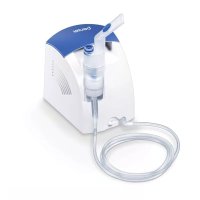
IH 26 - Inhaler BEURER - Free user manual and instructions
Find the device manual for free IH 26 BEURER in PDF.



| Product type | Inhaler / Nebulizer for upper and lower respiratory tract |
| Brand | Beurer |
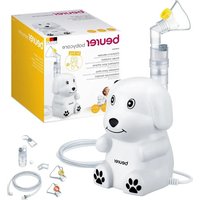
| Model | IH 26 (Kids) |
| Dimensions (L x H x P) | 166 x 141 x 148 mm |
| Weight | 1.4 kg |
| Power supply | 230 V~, 50 Hz (240 V~, 50 Hz; 220 V~, 60 Hz for Saudi Arabia) |
| Working pressure | Approx. 0.8 – 1.45 bar |
| Nebulizer filling volume | 2 ml (min.) – 8 ml (max.) |
| Medication flow rate | Approx. 0.3 ml/min |
| Nasal douche filling volume | 2 ml (min.) – 10 ml (max.) |
| Main functions | Nebulization of liquid medications, inhalation of respiratory tract, nasal douche (optional accessory) |
| Expected lifespan | 1,000 hours |
| Particle size (MMAD) | 3.07 μm |
| Included accessories | Nebulizer, compressed air hose, mouthpiece, baby silicone mask, child silicone mask, elbow, giraffe figurine, connector, replacement filter, storage pouch, manual |
| Care and cleaning | Clean with hot water after each use; disinfect with vinegar after the last daily use; do not wash in dishwasher |
| Safety | Automatic shut-off after 30 minutes of use; overcurrent protection; protection class II, type BF |
| Spare parts and repairability | Yearpack IH 26 Kids (ref. 601.19): mouthpiece, masks, nebulizer, hose, filter; other accessories available (nasal douche, PVC baby mask, etc.); repair only by authorized service |
| General information | Domestic use; 5-year warranty; CE standards, EN13544-1; compatible with prescribed medications and isotonic saline solutions |
Frequently Asked Questions - IH 26 BEURER
User questions about IH 26 BEURER
0 question about this device. Answer the ones you know or ask your own.
Ask a new question about this device
Download the instructions for your Inhaler in PDF format for free! Find your manual IH 26 - BEURER and take your electronic device back in hand. On this page are published all the documents necessary for the use of your device. IH 26 by BEURER.
USER MANUAL IH 26 BEURER
natural_image
Beuner inhaler device with a giraffe-shaped connector and tubing (no visible text or symbols)DE Inhalator
Gebrauchsanweisung ....2
EN Nebuliser
Instructions for use....14
FR Inhalateur
Mode d'emploi .....25
ES Inhalador
Instrucciones de uso ....37
IT Inalatore
Istruzioni per l'uso ....49
TR Nebulizatör
Kullanımkılavuzu ....61
RU Ингалятор
Инструкция по применению .....72
PL Inhalator
Instrukcja obsługi 85
DEUTSCH
Inhalt
text_image
Labeled diagram of a medical or laboratory device with numbered parts including tubing, connectors, and a coiled cable.text_image
Technical diagram showing numbered mechanical parts with labels 14, 15, 16, and 17
i Hinweis
natural_image
Line drawings showing two hand positions: one holding a small bird-like object, the other holding a tool with a pointed tip (no text or symbols)natural_image
Line drawing of a hand operating a mechanical device with a coiled cable, no text or symbols presentNetzanschluss
natural_image
Illustration of a hand holding a dropper with liquid spilling out (no text or symbols)natural_image
Diagram of a mechanical device with a numbered label '5' and a circular component, no readable text or symbols present.i Hinweis
- Getting to know your device ....14
- Signs and symbols....14
- Warnings and safety notes....15
- Description of the device and accessories .....16
- Initial use....17
- Operation....17
- Changing the filter 20
- Cleaning and disinfection....20
- Disposal....22
- Troubleshooting....22
- Technical specifications .....22
- Replacement parts and wearing parts .....23
- Warranty and service....23
Included in delivery
See Description of the device and accessories, page 16.
- Nebuliser
- Atomiser
- Removable "giraffe"
- Adapter
- Compressed air hose
- Mouthpiece
- Silicone baby mask
- Silicone children's mask
- Angled fitting
- Replacement filter
- Storage bag
• These instructions for use
1. Getting to know your device
Dear customer,
Thank you for choosing a product from our range. Our name stands for high-quality, thoroughly tested products for applications in the areas of heat, weight, blood pressure, body temperature, pulse, gentle therapy, massage and air.
Please read these instructions for use carefully and keep them for later use. Be sure to make them accessible to other users and observe the information they contain.
With kind regards,
Your Beurer team
Application area
This nebuliser is an inhalation device for atomising liquids and liquid medication (aerosols) and for the treatment of the upper and lower airways.
By nebulising and inhaling the medication prescribed/recommended by your doctor, you can prevent
diseases affecting the airways, or in the case that you contract such an illness, you can alleviate symptoms and speed up your recovery. Ask your doctor or pharmacist for further information about the potential applications.
The device is suitable for domestic use. Inhaler medication should only be used following your doctor's instructions. Ensure you are calm and relaxed when inhaling the medication and breathe slowly and deeply to ensure that the medication reaches right down to the fine, lower bronchi. Breathe out normally.
Once it has been properly prepared, the device can be used again. Preparation involves replacing all the accessories, including the atomiser and air filter, and disinfecting the surface of the device using a standard disinfectant. Please note that all accessories should be replaced if the device is used by more than one person.
We recommend that you replace the atomiser and other accessories after one year.
The device does not need to be calibrated.
2. Signs and symbols
The following symbols appear in these instructions for use.

Warning
Warning instruction indicating a risk of injury or damage to health.

Important
Safety note indicating possible damage to the device/accessory.

Note Note on important information.
The following symbols are used on the packaging and on the type plate for the device and accessories.
| Application part, type BF | |
| Observe the instructions for use | |
| Protection class 2 device | |
| Manufacturer | |
| I | On |
| O | Off |
| SN | Serial number |
| 30 ON/30 OFF | 30 minutes of operation, then 30 minutes break before operating again. |
| IP 21 | Protected against foreign objects ≥ 12.5 mm in diameter and against vertically falling drops of water. |
| CE0483 | The CE labelling certifies that the product complies with the essential requirements of Directive 93/42/EEC on medical devices. |
 | Dispose of packaging in an environmentally friendly manner |
3. Warnings and safety notes

Warning
- Before use, ensure that there is no visible damage to the device or accessories. If you have any doubts, do not use the device and contact your retailer or the specified Customer Service address.
- In the event of device faults, please see Chapter "10. Troubleshooting".
- The device is not a substitute for medical consultation and treatment. Always consult your doctor first if you are experiencing any pain or are suffering from an illness.
- If you have health concerns of any kind, consult your GP!
- Please note the general hygiene measures when using the atomiser.
- You should always follow the instructions of your doctor regarding the type of medication to use, the dosage, and the frequency and duration of inhalation.
- Only use medication prescribed or recommended by your doctor or pharmacist.
Please note:
For treatment, only use parts indicated by your doctor according to the particular diagnosis.
- Check whether there are contraindications for use with the usual systems for aerosol treatment on the medication instruction leaflet.
- If the device does not work properly, or you feel unwell or experience pain, stop using it immediately.
- Keep the device away from your eyes when it is in use, as the mist of medication could be harmful.
- Never use the device near flammable gases, oxygen or nitrogen oxide.
-
This device is not intended for use by children or people with restricted physical, sensory (e.g. reduced sensitivity to pain) or mental skills or a lack of experience and/or lack of knowledge, unless they are supervised by a person who is responsible for their safety or who are instructed by such a person in how to use the device.
-
Check the leaflet of the medication for any contraindications for use with the usual systems for aerosol treatment.
- The device must be switched off and the plug pulled out before every cleaning and/or maintenance procedure.
- Keep packaging material away from children (risk of suffocation).
- To avoid the risk of entanglement and strangulation, store cables and air lines out of the reach of small children.
- Do not use any additional parts that are not recommended by the manufacturer.
- The device must only be connected to the mains voltage that is specified on the type plate.
- Never submerge the device in water or other liquids and do not use it in the bathroom. Under no circumstances may liquid enter the device.
- Protect the device from heavy impacts.
- Never touch the mains cable with wet hands, as you could get an electric shock.
- Do not pull the mains plug out of the socket using the mains cable.
- Do not crush or bend the mains cable, pull it over sharp-edged objects or leave it dangling down, and protect it from sources of heat.
- We recommend that the power cable is completely unrolled to avoid dangerous overheating.
- If the mains connection cable of this device is damaged, it must be disposed of. If it cannot be removed, the device must be disposed of.
- If the device is opened, there is a risk of electric shock. Disconnection from the power supply network is only guaranteed if the mains plug is unplugged.
- Making modifications to the device or accessories is not permitted.
- If the device has been dropped, exposed to high levels of moisture or suffered any other damage, it must no longer be used. If in doubt, contact Customer Services or the retailer.
- The IH 26 Kids nebuliser may only be operated with compatible Beurer atomisers and with the appropriate Beurer accessories. The use of atomisers and accessories made by other companies may result in less efficient treatment and could damage the device.
- Store the device and accessories out of the reach of children and pets.

Important
- Power cuts, sudden interferences or other unfavourable conditions could lead to the device becoming inoperable. We therefore recommend that you obtain a replacement device or medication (the latter should be agreed with your doctor).
- Should you require an adapter or extension lead, this must meet the applicable safety requirements. The power limit and the maximum output specified on the adapter must not be exceeded.
- Never store the device or the power cable near to sources of heat.
- Do not use the device in a room in which a spray has previously been used. Air the room before carrying out the treatment.
- Do not allow objects to get into the cooling vents.
- Never use the device if it is making an abnormal sound.
- For hygiene reasons, it is essential that every user uses their own accessories.
- Always disconnect the mains plug from the mains socket after use.
- Store the device in a location protected against climatic influences. The device must be stored in the environmental conditions specified.
PROTECTION
- The device is fitted with an overcurrent protection device. This may only be replaced by authorised specialist personnel.
General notes

Important
- The device is only to be used:
- for use on people,
- for the purpose for which it is designed (aerosol inhalation) and in the manner specified in these instructions for use.
- Any form of improper use can be dangerous.
- In the event of an acute emergency, the provision of first aid has top priority.
- Apart from the medication, only use distilled water or a saline solution. Other liquids may cause a fault in the nebuliser or atomiser.
- This device is not intended for commercial or clinical use; it is designed exclusively for self-treatment in a private home!
Prior to initial use

Important
- Remove all packaging material before using the device.
- Protect the device against dust, dirt and humidity and never cover the device while it is in use.
- Do not operate the device in a very dusty area.
- Switch the device off immediately if it is faulty or not working properly.
- The manufacturer is not liable for damage resulting from improper or incorrect use.
Repairs
i Note
- Under no circumstances should you open or repair the device yourself, as faultless functionality can no longer be guaranteed thereafter. Failure to comply with this instruction will void the warranty.
- For repairs, please contact Customer Services or an authorised retailer.
- The device is maintenance-free.
4. Description of the device and accessories
Overview of nebuliser

text_image
1 Carrying handle 2 On/Off switch (back) 3 Mains connector cable 4 Hose connector 5 Filter cap with filter 6 Holder for atomiserOverview of atomiser and accessories

text_image
7 Compressed air hose 8 Atomiser 9 Atomiser insert 10 Valve 11 Medication container 12 Mouthpiece 13 Silicone children's mask 14 Silicone baby mask 15 Angled fitting 16 Removable "giraffe" 17 Adapter 18 Replacement filteri Note
The IH 26 Kids can also be used by adults. Adults have the option of using a nasal douche and a separate accessory (includes mouthpiece, nosepiece, adult mask, children's mask, atomiser, compressed air hose, filter) for your nebuliser. Neither are included in delivery of the IH 26 Kids [not available = n/a]. Nevertheless, the appropriate use of the nasal douche, nosepiece, etc. is described below. You can find an overview of all replacement items in section "12. Replacement parts and wearing parts".
5. Initial use
Setting up the device
Take the device out of the packaging.
Place the device on a flat surface.
Make sure that the vents are free from obstructions.
Before using the device for the first time
i Note
Clean and disinfect the atomiser and accessories before using them for the first time. See “Cleaning and disinfection” on page 20.
- The adapter [17] with the Removable "giraffe" [16] can optionally be attached to the atomiser.
- Connect the compressed air hose [7] to the bottom of the medication container [11].

natural_image
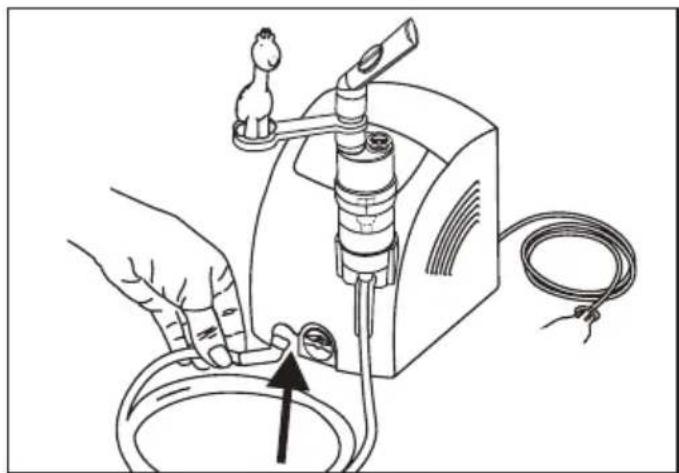
Line drawings of two hands performing a manual tool manipulation (no text or symbols present)- Connect the other end of the compressed air hose [7] to the nebuliser hose connection [4] by turning it slightly.
natural_image
Line drawing of a laboratory apparatus with a hand holding a test tube and a coiled wire, no text or symbols present.Mains connection
The device must only be connected to the mains voltage that is specified on the type plate.
- Insert the mains plug of the mains connector cable [3] into a suitable socket.
- To connect to the mains, fully insert the mains plug into the socket.
i Note
- Ensure that there is a mains socket close to the setup area.
- Arrange the mains connector cable so that no-one will trip over it.
- To disconnect the nebuliser from the mains after inhalation, first switch off the device and then pull the mains plug out of the socket.
6. Operation
Important
- For hygiene reasons, it is essential to clean the atomiser [8] and the accessories after each treatment and to disinfect them after the last treatment of the day.
- The accessories may only be used by one person; use by several people is not recommended.
- If the treatment involves inhaling several different medications one after the other, please be aware that the atomiser [8] must be rinsed under warm tap water following every usage. See “Cleaning and disinfection” on page 20.
- Please observe the notes on changing the filter in these instructions for use.
- Check that hose connectors are firmly attached to the nebuliser [4] and the atomiser [8] before each use of the device.
- Before use, check the device is working correctly by briefly switching on the nebuliser (together with the connected atomiser, but without medication). If air comes out of the atomiser [8], the device is working.
6.1 Installing the atomiser insert
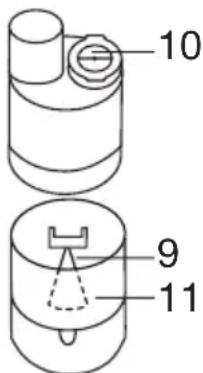
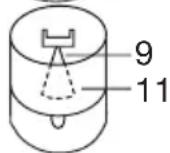
- Open the atomiser [8] by twisting the top anticlockwise against the medication container [11]. Place the atomiser insert [9] into the medication container [11].
- Ensure that the cone for administering medication fits well on the cone for the air duct inside the atomiser [8].
6.2 Filling the atomiser
- Fill with an isotonic saline solution or pour the medication directly into the medication container [11]. Avoid overfilling. The maximum recommended filling quantity is 8 ml.
- Use medication only as instructed by your doctor and ask about the appropriate inhalation period and quantity for you.
- If the prescribed quantity of medication is less than 2 ml, top this up to at least 4 ml with isotonic saline solution. Dilution is also necessary with viscous medications. Here too, please observe the instructions of your doctor.
text_image
10 9 116.3 Closing the atomiser
- Close the atomiser [8] by twisting the top clockwise against the medication container [11]. Ensure that the connection is correct.
6.4 Inserting the valve
- Press the valve [10] into the opening intended for this purpose on the upper side of the atomiser [8].
i Note
The valve system ensures better delivery of the medication to the lungs. Only use the valve [10] with the mouthpiece [12], never with the masks [13, 14] or the nosepiece [n/a.].
6.5 Connecting accessories to the atomiser
- Attach the desired accessory to the atomiser [8]. The mouthpiece [12] or nosepiece [n/a] can be directly attached. The children's mask [13] and baby mask [14] must be attached to the atomiser using the angled fitting [15].
i Note
The most effective form of nebulisation is by using the mouthpiece. Nebulisation using a mask is only recommended if it is not possible to use a mouthpiece (e.g. for children who are not yet able to inhale using a mouthpiece).
When using a mask to inhale, take care to ensure the mask fits well and the eyes are unobstructed.
- Before the treatment, pull the atomiser [8] upwards out of the holder [6].
- Start the nebuliser using the On/Off switch [2].
- Spray mist pouring out of the atomiser indicates that the device is operating correctly.
6.6 Treatment
- Hold or place the baby or infant to be treated in the most upright position possible. Do not use the device when the baby or infant to be treated is lying down.
- When inhaling, older children and adults should sit upright and relaxed at a table and not in an armchair to avoid compressing the airways and therefore impairing the effectiveness of the treatment.
- Breathe in the atomised medication deeply.

Important
The device is not suitable for continuous operation; after 30 minutes of operation it must be switched off for 30 minutes.
i Note
During the treatment, hold the atomiser straight (vertically), otherwise the atomisation will not work and faultless functionality is not guaranteed.

Important
Essential oils, cough syrups, gargling solutions and drops to be used as a rub or in a steam bath are wholly unsuitable for inhalation using a nebuliser. These additives are often viscous and can impair the correct functioning of the device and therefore the effectiveness of the application in the long term. For individuals with a hypersensitive bronchial system, medications containing essential oils may under certain conditions cause an acute bronchospasm (a sudden cramp-like restriction of the bronchi with shortness of breath). Consult your doctor or pharmacist in relation to this matter.
6.7 Stopping inhalation
Once the mist is only coming out in an irregular flow or if the sound changes when inhaling, you can stop the treatment.
- Switch off the nebuliser after treatment using the On/Off switch [2] and disconnect it from the mains.
- Place the atomiser [8] back in its holder [6] after the treatment.
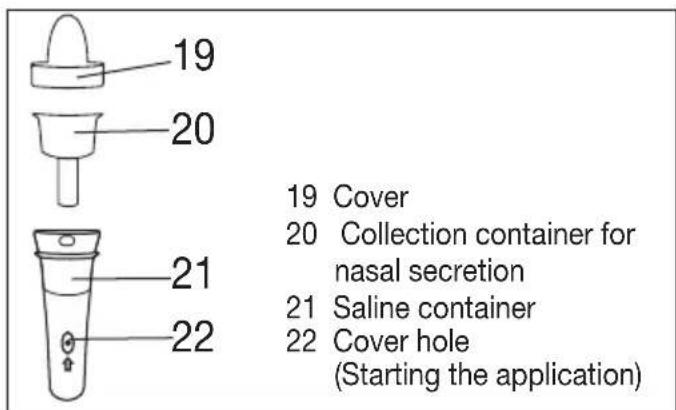
6.8 Nasal douche
The nasal douche is not included in delivery [not available = n/a] with the IH 26 Kids.
You can find an overview of all replacement items in section "12. Replacement parts and wearing parts".
text_image
19 Cover 20 Collection container for nasal secretion 21 Saline container 22 Cover hole (Starting the application)You can use the nasal douche to clean your nasal cavities. The nasal douche creates a fine jet of liquid for treating respiratory tract problems or for moistening the nasal mucous membranes.
We recommend using the nasal douche for colds, dryness inside the nose, dust exposure, pollen allergies, chronic inflammation of the sinuses or upon the advice of your doctor.

Warning
- Do not use the nasal douche in combination with other medication or essential oils.

Important
- Only use the nasal douche with isotonic saline solutions.
- Replace the nasal douche after a year.
The maximum volume of the nasal douche is 10 ml. If you are unsure about the correct dilution of the saline solution, please consult your pharmacist.
6.9 Using the nasal douche
To use the nasal douche correctly, proceed as follows:
| 1. Twist the cover [19] 90° anticlockwise and remove it in an upward direction.2. Lift the collection container [20] out. |  |
| 3. Fill the saline container [21] with saline solution. | 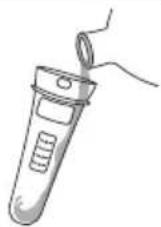 |
| 4. Place the collection container [20] into the saline container [21].5. Place the cover [19] on the saline container [21]. Twist the cover [19] in a clockwise direction until it clicks firmly into place. | 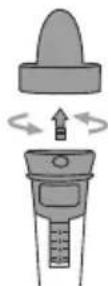 |
| 6. Connect the compressed air hose [7] to the saline container [21] from below. | 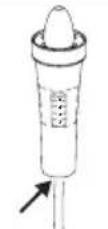 |
| 7. Position the cover [19] carefully inside one of your nostrils. Breathe through the nose. |  |
- Press the On/Off switch [2] on the back of the nebuliser. To start the application, place one finger over the cover hole [22] on the container.
i Note
During the application, breathe slowly and evenly through the nose. Tilt your head slightly in the opposite direction to the nostril being treated so that the saline solution can flow deep into the nose.
-
To pause or stop the application, take your finger off the cover hole [22] on the saline container [21].
-
Once your nose feels clear again, you can stop the application. The application should be stopped at the latest once the maximum filling quantity has been used.

natural_image
Illustration of a hand holding a dropper with liquid droplets (no text or symbols)6.10 Cleaning
See "Cleaning and disinfection" on page 20.
7. Changing the filter
In normal operating conditions, the air filter must be replaced after approx. 500 operating hours or one year. Please check the air filter regularly (after 10-12 nebulisation procedures). Replace the used filter if it is very dirty or clogged. If the filter has become damp, it must also be exchanged for a new filter.

Important
- Do not attempt to clean the used filter and reuse it.
- Only use the manufacturer's original filter, otherwise your nebuliser may become damaged and sufficiently effective treatment cannot be guaranteed.
- Do not repair or maintain the air filter while it is in use.
- Never operate the device without a filter.
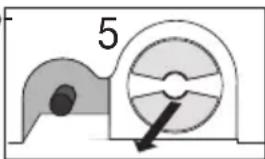
To replace the filter, proceed as follows:

Important
- First switch the device off and disconnect it from the mains.
-
Allow the device to cool down.
-
Pull off the filter cap [5] towards the front.
natural_image
Diagram of a mechanical device with a numbered label '5' and a directional arrow (no readable text or symbols)i Note
If the filter remains in the device after the cap has been removed, take the filter out of the device, e.g. with tweezers or similar.
- Re-insert the filter cap [5] with a new filter.
- Ensure that it is securely in place.
8. Cleaning and disinfection
Atomiser and accessories

Warning
Adhere to the following hygiene instructions to avoid health risks.
- The atomiser [8] and accessories are designed for multiple use. Please note that different areas of application involve different requirements in terms of cleaning and hygienic preparation.
Notes:
- Do not clean the atomiser or the accessories mechanically using a brush or similar device, as this could cause irreparable damage and it will mean that the best treatment results can no longer be guaranteed.
- Please consult your doctor about the additional requirements in terms of the hygienic preparation required (hand care, handling of medication/inhalation solutions) for high-risk groups (e.g. patients with cystic fibrosis).
- Ensure thorough drying after each cleaning or disinfection process. Residual moisture or wetness can represent an increased risk of bacterial growth.
Preparation
- Immediately after each treatment, all parts of the atomiser [8] and the accessories used must be cleaned of residual medication and contamination.
- To do this, dismantle the atomiser [8], the masks [13, 14] and the nasal douche [n/a] into their individual parts.
- Remove the mouthpiece [12], masks [13, 14] or the nosepiece [n/a] from the atomiser.
- Dismantle the nosepiece [n/a] if you have used it with the comfort attachment.
- Dismantle the atomiser by twisting the top anticlockwise against the medication container [11].
- Remove the atomiser insert [9] from the medication container [11].
- Remove the valve [10] by pulling it out of the atomiser [8].
- Reassembly is carried out in reverse order.

Cleaning

Important
The device must be switched off, disconnected from the mains and allowed to cool down each time before cleaning.
The atomiser and the accessories used such as the mouthpiece, mask, etc. must be washed with hot but not boiling water after each use. Dry the parts carefully using a soft cloth. Put the parts together again when they are completely dry and place them in a dry, sealed container or disinfect them.
When cleaning, ensure that any residue is removed. Never use any substances for cleaning that could potentially be toxic if they came into contact with the skin or mucous membranes, or if they were swallowed or inhaled.
Use a soft, dry cloth and non-abrasive cleaning products to clean the device.
Do not use any abrasive cleaning products and never submerge the device in water.

Important
- Ensure that no water gets inside the device.
- Do not clean the device or accessories in the dishwasher.
- Do not touch the device with wet hands when it is plugged in and do not allow water to spray on the device. Only operate the device if it is completely dry. Do not spray any liquid into the vents! If liquid penetrates the device this could cause damage to the electrics or other nebuliser parts and lead to a malfunction.
Condensation, hose care
Condensation may form in the hose depending on the ambient conditions. It is essential to remove the moisture to prevent bacterial growth and ensure proper treatment. To do so, proceed as follows:
- Remove the compressed air hose [8] from the atomiser [8].
- The hose must remain connected to the nebuliser [4].
- Operate the nebuliser until the moisture is removed by the air passing through.
- In the event of heavy contamination, replace the hose.
Disinfection
Please carefully observe the points below when disinfecting your atomiser and accessories. We recommend disinfecting the individual parts on a daily basis after the last usage as a minimum measure.
(All you need for this is a little white vinegar and distilled water.)
- First, clean the atomiser and accessories as described in the “Cleaning” section.
- Place the disassembled atomiser [8] and nasal douche [n/a], the mouthpiece [12], the silicone masks [13, 14] and the disassembled nosepiece [n/a] in boiling water for 5 minutes.
- For the remaining accessories, use a vinegar solution consisting of 14 vinegar and 34 distilled water. Make sure that the volume is sufficient to fully submerse parts, such as the PVC masks [n/a] and hose [7], in the solution. Accessories that can be boiled can also be disinfected in this way.
- Leave the parts in the vinegar solution for 30 minutes.
- Rinse the parts with water and dry them carefully with a soft cloth.

Important
Do not boil or autoclave the compressed air hose or the PVC masks [n/a].
- Put the parts together again when they are completely dry and place them in a dry, sealed container.

Note
Please ensure that the parts are completely dried after cleaning, otherwise the risk of bacterial growth is increased.
Drying
- Place the individual parts on a clean, dry and absorbent surface and leave them to dry completely (at least 4 hours).
Durability of materials
- As with any plastic parts, atomisers and their accessories are affected by a certain amount of wear and tear when used and hygienically prepared on a frequent basis. Over time, this can lead to a change in the aerosol, which can have a negative effect on the efficiency of the treatment. We therefore recommend that you replace the atomiser and other accessories after a year.
- The following point should be observed when selecting the cleaning product or disinfectant: only use a mild cleaning product or disinfectant in the concentration and volume prescribed by the manufacturer.
Storage
- Do not store in damp conditions (such as in a bathroom) and do not transport with any damp items.
- When storing and transporting, protect from prolonged direct sunlight.
- The accessories can be stowed securely in the accessory compartment. Store the device in a dry place, ideally in the original packaging.
9. Disposal
For environmental reasons, do not dispose of the device in the household waste.
Please dispose of the device in accordance with EC Directive – WEEE (Waste Electrical and Electronic Equipment).
If you have any questions, please contact the local authorities responsible for waste disposal.
10. Troubleshooting
| Problem/ question | Possible cause/remedy |
| The atomiser produces no or too little aerosol. | 1. Too much or too little medication in the atomiser. Minimum: 2 ml, Maximum: 8 ml. |
| 2. Check nozzle for blockages. Clean nozzle if necessary (e.g. by rinsing out). Then start using the atomiser again. IMPORTANT: Carefully pierce the fine holes from the underside of the nozzle only. | |
| 3. Atomiser not held vertically. | |
| The atomiser produces no or too little aerosol. | 4. Unsuitable medication fluid added for nebulisation (e.g. too viscous). The medication fluid should be prescribed by the doctor. |
| The output is too low. | Kinked hose, clogged filter, too much inhalation solution. |
| What medications are suitable for inhaling? | Please consult your doctor in relation to this matter. As a rule, all medication that is suitable and approved for device inhalation can be inhaled. |
| There is inhalation solution residue in the atomiser. | This is normal and is due to technical reasons. Stop inhalation once the atomiser starts to make a notably different sound. |
| What should be taken into account when using the device with infants and children? | 1. On infants and children, the mask should cover the mouth and nose to ensure effective inhalation. |
| Problem/question | Possible cause/remedy |
| 2. On children, the mask should also cover both the nose and mouth. It is not very useful to carry out nebulisation next to someone who is sleeping, as in this case not enough of the medication will reach the lungs. | |
| Note: Inhalation should only be carried out under the supervision of an adult and with their assistance and the child should not be left alone. | |
| Why should the atomiser be replaced regularly? | There are two reasons for this:1. To ensure a therapeutically effective particle spectrum, the nozzle hole must not exceed a specific diameter. Due to mechanical and thermal stresses, the plastic is subject to a certain degree of wear. The atomiser insert [9] is particularly sensitive. This can also alter the composition of the aerosol droplets, which directly affects the effectiveness of the treatment.2. Regularly changing the atomiser is also recommended for hygiene reasons. |
| Should each person have their own atomiser? | Yes, this is absolutely essential for hygiene reasons. |
11. Technical specifications
| Model | IH 26 Kids |
| Type | IH 25/2 |
| Dimensions(W x H x D) 166 x 141 x 148 mm | |
| Weight | 1.4 kg |
| Operating pressure approx. 0.8 to 1.45 bar | |
| Atomiser filling volume | Min. 2 mlMax. 8 ml |
| Medication flow rate approx. 0.3 ml/min | |
| Nasal douche filling volume | Min. 2 mlMax. 10 ml |
| Sound pressure approx. 52 dBA(acc. to DIN EN 13544-1 section 26) | |
| Mains connection 230 V~; 50 Hz; 230 VA | |
| UK: 240 V~; 50 Hz; 240 VA | |
| Saudi Arabia: 220 V~; 60 Hz; 220 VA | |
| Expected service life | 1000 h |
| Operating conditions | Temperature: +10 °C to +40 °CRelative humidity: 10% to 95%Ambient pressure: 700 to 1060 hPa |
| Storage and transportation conditions | Temperature: 0 °C to +60 °CRelative humidity: 10% to 95%Ambient pressure: 500 to 1060 hPa |
| Aerosol properties | 1) Flow: 5.3 l/min2) Aerosol delivery: 0.326 ml3) Aerosol delivery rate: 0.132 ml/min4) Particle size (MMAD): 3.07 μm |
The serial number is located on the device or in the battery compartment.
Subject to technical changes.
Particle size diagram

line
| Particle Size (µm) | Cumulative Undersize (%) | | ------------------ | ------------------------ | | 1 | 10 | | 2 | 20 | | 5 | 50 | | 10 | 95 |Measurements were performed using a sodium fluoride solution with a “Next Generation Impactor” (NGI). The diagram may therefore not be applicable to suspensions or highly viscous medications. You can obtain more detailed information from the manufacturer of your medication.
- Replacement parts and wearing parts
| Designation Material REF | ||
| IH 26 Kids year pack (contains mouthpiece, silicone children's mask, silicone baby mask, atomiser, compressed air hose, filter) | PP/PVC/silicone | 601.19 |
| Standard IH 26 year pack (contains mouthpiece, nose-piece, adult mask, children's mask, atomiser, compressed air hose, filter) | PP/PVC 60 | 1.28 |
| Nasal douche PP 601.37 | ||
| Baby mask PVC 601.31 | ||
| Removable “giraffe” | PP/PVC | 164.182 |
i Note
If the device is not used according to the instructions specified, perfect functionality cannot be guaranteed! We reserve the right to make technical changes to improve and develop the product. This device and its accessories comply with the European standards EN60601-1 and EN60601-1-2 (CISPR 11, IEC61000-3-2, IEC61000-3-3, IEC61000-4-2, IEC61000-4-3, IEC61000-4-4, IEC61000-4-5, IEC61000-4-6, IEC61000-4-7, IEC61000-4-8, IEC61000-4-11) as well as EN13544-1 and are subject to particular precautions with regard to electromagnetic compatibility. This device meets the requirements of European Directive 93/42/EEC for medical devices, as well as those of the Medizinproduktegesetz (German Medical Devices Act).
NOTES ON ELECTROMAGNETIC COMPATIBILITY
- The device is suitable for use in all environments listed in these instructions for use, including domestic environments.
- The use of the device may be limited in the presence of electromagnetic disturbances. This could result in issues such as error messages or the failure of the display/device.
- Avoid using this device directly next to other devices or stacked on top of other devices, as this could lead to faulty operation. If, however, it is necessary to use the device in the manner stated, this device as well as the other devices must be monitored to ensure they are working properly.
13. Warranty and service
Beurer GmbH, Söflinger Straße 218, 89077 Ulm, Germany (hereinafter referred to as "Beurer") provides a warranty for this product, subject to the requirements below and to the extent described as follows.
The warranty conditions below shall not affect the seller's statutory warranty obligations which ensue from the sales agreement with the buyer. The warranty shall apply without prejudice to any mandatory statutory provisions on liability.
Beurer guarantees the perfect functionality and completeness of this product.
The worldwide warranty period is 5 years, commencing from the purchase of the new, unused product from the seller.
The warranty only applies to products purchased by the buyer as a consumer and used exclusively for personal purposes in the context of domestic use. German law shall apply.
During the warranty period, should this product prove to be incomplete or defective in functionality in accordance with the following provisions, Beurer shall carry out a repair or a replacement delivery free of charge, in accordance with these warranty conditions.
If the buyer wishes to make a warranty claim, they should approach their local retailer in the first instance: see the attached “International Service” list of service addresses.
The buyer will then receive further information about the processing of the warranty claim, e.g. where they can send the product and what documentation is required.
A warranty claim shall only be considered if the buyer can provide Beurer, or an authorised Beurer partner, with
– a copy of the invoice/purchase receipt, and
– the original product.
The following are explicitly excluded from this warranty:
– deterioration due to normal use or consumption of the product;
- accessories supplied with this product which are worn out or used up through proper use (e.g. batteries, rechargeable batteries, cuffs, seals, electrodes, light sources, attachments and nebuliser accessories);
- products that are used, cleaned, stored or maintained improperly and/or contrary to the provisions of the instructions for use, as well as products that have been opened, repaired or modified by the buyer or by a service centre not authorised by Beurer;
– damage that arises during transport between manufacturer and customer, or between service centre and customer;
– products purchased as seconds or as used goods;
– consequential damage arising from a fault in this product (however, in this case, claims may exist arising from product liability or other compulsory statutory liability provisions).
Repairs or an exchange in full do not extend the warranty period under any circumstances.
FRANÇAIS
Sommaire
text_image
Labeled diagram of a medical or laboratory device with numbered parts including tubing, connector, and cable.natural_image
Line drawings of two hands holding a mechanical device, one with a bird-like object and the other a small tool (no text or symbols)natural_image
Line drawing of a hand operating a mechanical device with a coiled cable, no text or symbols presentnatural_image
Illustration of a hand holding a dropper with liquid spilling out (no text or symbols)6.10. Nettoyage
natural_image
Diagram of a mechanical device with a numbered label '5' and a circular component, no readable text or symbols present.i Remarque
text_image
Labeled diagram of a medical or laboratory device with numbered parts including tubing, connector, and cable.text_image
Technical diagram showing numbered components of a mechanical assembly, including a 3D part and three views with numbered labels.i Nota
natural_image
Line drawings of two hands performing a manual tool manipulation (no text or symbols present)natural_image
Illustration of a hand using a handheld device to interact with a coiled cable, no text or symbols presentConexión eléctrica
natural_image
Illustration of a hand holding a dropper with liquid droplets (no text or symbols)i Nota
natural_image
Diagram of a mechanical device with a numbered label '5' and a circular component, no readable text or symbols present.i Nota
natural_image
Line drawings of two hands performing a manual tool manipulation (no text or symbols present)natural_image
Line drawing of a medical or laboratory procedure showing hands operating a device with tubing and a coiled cable (no text or symbols)natural_image
Illustration of a dropper tip with liquid droplets and a finger pointing to it (no text or symbols)i Indicazione
natural_image
Diagram of a mechanical device with a numbered label '5' and a circular component, no readable text or symbols present.i Indicazione
natural_image
Line drawings of two hands holding a mechanical device, one with a handle and the other with a tool (no text or symbols)natural_image
Line drawing of a hand operating a mechanical device with a coiled cable and a bulb, no text or symbols present.Elektrik bağlantısı
natural_image
Illustration of a dropper tip with liquid level indicator (no text or symbols)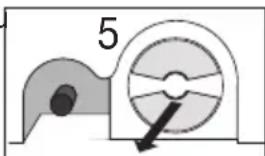
natural_image
Diagram of a mechanical device with a circular component and arrow indicating motion (no text or symbols)i Not
text_image
Technical diagram of a medical or laboratory device with numbered components and labeled partsnatural_image
Line drawings of two hands performing a manual tool manipulation (no text or symbols present)natural_image
Line drawing of a hand operating a medical or laboratory device with a coiled cable, no text or symbols presentПодключение к сети
natural_image
Diagram of a mechanical device with a labeled component (5), showing internal components and a directional arrow (no text or symbols beyond the number)