PE1200HKS - Saw Pattfield - Free user manual and instructions
Find the device manual for free PE1200HKS Pattfield in PDF.



| Product type | Circular saw |
| Brand | Pattfield |
| Model | PE1200HKS |
| Rated voltage | 230 V - 50 Hz |
| Rated power | 1200 W |
| No-load speed | 4700 rpm |
| Saw blade | 160 mm x 20 mm x 18 teeth |
| Maximum cutting depth (90°) | 55 mm |
| Maximum cutting depth (45°) | 35 mm |
| Bevel cutting angle | 0 - 45° |
| Laser class | 2 (max. 1 mW, 650 nm) |
| Sound pressure level (LpA) | 86 dB(A) (K=3 dB(A)) |
| Sound power level (LWA) | 97 dB(A) (K=3 dB(A)) |
| Vibration emission (ahw) | 4.26 m/s² (K=1.5 m/s²) |
| Protection class | II (double insulation) |
| Laser power supply | 2 AAA 1.5 V batteries |
| Parallel guide | Yes, adjustable |
| Dust extraction | 35 mm port for vacuum |
| Lower blade guard | Yes, automatic closing |
| Maintenance | Clean with a soft, damp cloth, lubricate moving parts |
| Warranty | 3 years |
Frequently Asked Questions - PE1200HKS Pattfield
User questions about PE1200HKS Pattfield
0 question about this device. Answer the ones you know or ask your own.
Ask a new question about this device
Download the instructions for your Saw in PDF format for free! Find your manual PE1200HKS - Pattfield and take your electronic device back in hand. On this page are published all the documents necessary for the use of your device. PE1200HKS by Pattfield.
USER MANUAL PE1200HKS Pattfield
CAUSE PER IL CONTRACCOLPO E AVVER- TENZE RELATIVE
VEILIGHEIDSWAARSCHUWING VOOR DE LASER
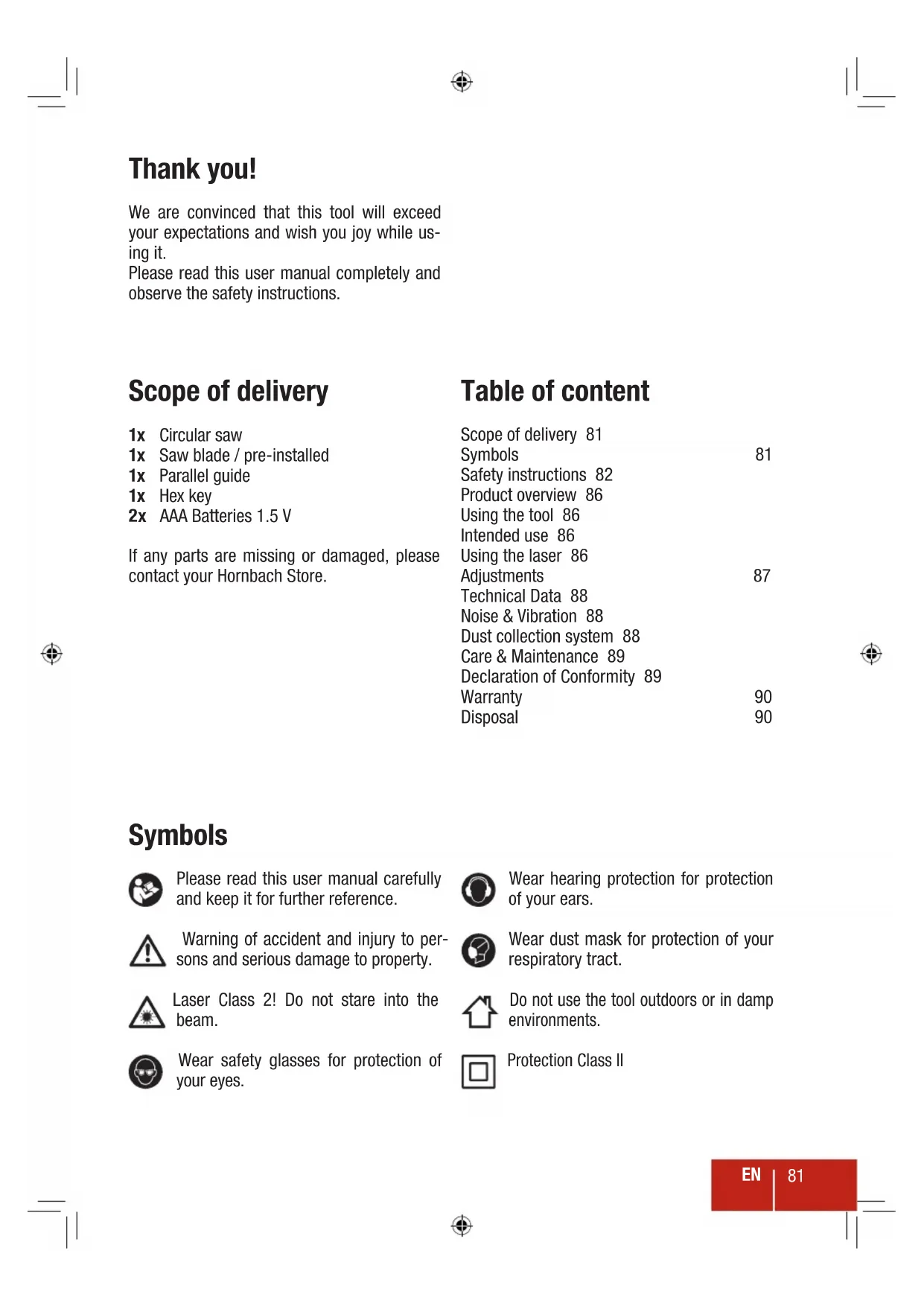
We are convinced that this tool will exceed your expectations and wish you joy while using it.
Please read this user manual completely and observe the safety instructions.
Scope of delivery
1x Circular saw
1x Saw blade / pre-installed
1x Parallel guide
1x Hex key
2x AAA Batteries 1.5 V
If any parts are missing or damaged, please contact your Hornbach Store.
Table of content
Scope of delivery 81
Symbols 81
Safety instructions 82
Product overview 86
Using the tool 86
Intended use 86
Using the laser 86
Adjustments 87
Technical Data 88
Noise & Vibration 88
Dust collection system 88
Care & Maintenance 89
Declaration of Conformity 89
Warranty 90
Disposal 90
Symbols

Please read this user manual carefully and keep it for further reference.

Wear hearing protection for protection of your ears.

Warning of accident and injury to persons and serious damage to property.

Wear dust mask for protection of your respiratory tract.

Laser Class 2! Do not stare into the beam.

Do not use the tool outdoors or in damp environments.

Wear safety glasses for protection of your eyes.

Protection Class II
Safety Instructions
GENERAL POWER TOOL SAFETY WARNINGS

WARNING Read all safety warnings and all instructions. Failure to follow
the warnings and instructions may result in electric shock, fire and/or serious injury.
Save all warnings and instructions for future reference.
The term „power tool“ in the warnings refers to your mains-operated (corded) power tool or battery-operated (cordless) power tool.
1 WORK AREA SAFETY
a) Keep work area clean and well lit. Cluttered or dark areas invite accidents.
b) Do not operate power tools in explosive atmospheres, such as in the presence of flammable liquids, gases or dust. Power tools create sparks which may ignite the dust or fumes.
c) Keep children and bystanders away while operating a power tool. Distractions can cause you to lose control.
2 ELECTRICAL SAFETY
a) Power tool plugs must match the outlet. Never modify the plug in any way. Do not use any adapter plugs with earthed (grounded) power tools. Unmodified plugs and matching outlets will reduce risk of electric shock.
b) Avoid body contact with earthed or grounded surfaces, such as pipes, radiators, ranges and refrigerators. There is an increased risk of electric shock if your body is earthed or grounded.
c) Do not expose power tools to rain or wet conditions. Water entering a power tool will increase the risk of electric shock.
d) Do not abuse the cord. Never use the cord for carrying, pulling or unplugging the power tool. Keep cord away from heat, oil, sharp edges or moving parts. Damaged or entangled cords increase the risk of electric shock.
e) When operating a power tool outdoors, use an extension cord suitable for outdoor use. Use of a cord suitable for outdoor use reduces the risk of electric shock.
f) If operating a power tool in a damp location is unavoidable, use a residual current device (RCD) protected supply. Use of an RCD reduces the risk of electric shock.
3 PERSONAL SAFETY
a) Stay alert, watch what you are doing and use common sense when operating a power tool. Do not use a power tool while you are tired or under the influence of drugs, alcohol or medication. A moment of inattention while operating power tools may result in serious personal injury.
b) Use personal protective equipment. Always wear eye protection. Protective equipment such as dust mask, non-skid safety shoes, hard hat, or hearing protection used for appropriate conditions will reduce personal injuries.
c) Prevent unintentional starting. Ensure the switch is in the off-position before connecting to power source and/or battery pack, picking up or carrying the tool. Carrying power tools with your finger on the switch or energising power tools that have the switch on invites accidents.
d) Remove any adjusting key or wrench before turning the power tool on. A wrench or a key left attached to a rotating part of the power tool may result in personal injury.
e) Do not overreach. Keep proper footing and balance at all times. This enables better control of the power tool in unexpected situations.
f) Dress properly. Do not wear loose clothing or jewellery. Keep your hair, clothing and gloves away from moving parts. Loose clothes, jewellery or long hair can be caught in moving parts.
g) If devices are provided for the connection of dust extraction and collection facilities, ensure these are connected and properly used. Use of dust collection can reduce dust-related hazards.
4 POWER TOOL USE AND CARE
a) Do not force the power tool. Use the correct power tool for your application. The correct power tool will do the job better and safer at the rate for which it was designed.
b) Do not use the power tool if the switch does not turn it on and off. Any power tool that cannot be controlled with the switch is dangerous and must be repaired.
c) Disconnect the plug from the power source and/or the battery pack from the power tool before making any adjustments, changing accessories, or storing power tools. Such preventive safety measures reduce the risk of starting the power tool accidentally.
d) Store idle power tools out of the reach of children and do not allow persons unfamiliar with the power tool or these instructions to operate the power tool. Power tools are dangerous in the hands of untrained users.
e) Maintain power tools. Check for misalignment or binding of moving parts, breakage of parts and any other condition that may affect the power tool's operation. If damaged, have the power tool repaired before use. Many accidents are caused by poorly maintained power tools.
f) Keep cutting tools sharp and clean. Properly maintained cutting tools with sharp cutting edges are less likely to bind and are easier to control.
g) Use the power tool, accessories and tool bits etc. in accordance with these instructions, taking into account the working conditions and the work to be performed. Use of the power tool for operations different from those intended could result in a hazardous situation.
5 SERVICE
a) Have your power tool serviced by a qualified repair person using only identical replacement parts. This will ensure that the safety of the power tool is maintained.
MACHINE SPECIFIC SAFETY WARNINGS FOR CIRCULAR SAWS
a) DANGER: Keep hands away from cutting area and the blade. Keep your second hand on auxiliary handle, or motor housing. If both hands are holding the saw, they cannot be cut by the blade.
b) Do not reach underneath the workpiece. The guard cannot protect you from the blade below the workpiece.
c) Adjust the cutting depth to the thickness of the workpiece. Less than a full tooth of the blade teeth should be visible below the workpiece.
d) Never hold piece being cut in your hands or across your leg. Secure the workpiece to a stable platform. It is important to support the work properly to minimize body exposure, blade binding, or loss of control.
e) Hold the power tool by insulated gripping surfaces only, when performing an operation where the cutting tool may contact hidden wiring or its own cord. Contact with a "live" wire will also make exposed metal parts of the power tool "live" and could give the operator an electric shock.
f) When ripping, always use a rip fence or straight edge guide. This improves the accuracy of cut and reduces the chance of blade binding.
g) Always use blades with correct size and shape (diamond versus round) of arbour holes. Blades that do not match the mounting hardware of the saw will run eccentrically, causing loss of control.
h) Never use damaged or incorrect blade washers or bolt. The blade washers and bolt were specially designed for your saw, for optimum performance and safety of operation.
KICKBACK CAUSES AND RELATED WARNINGS
- Kickback is a sudden reaction to a pinched, bound or misaligned saw blade, causing an uncontrolled saw to lift up and out of the workpiece toward the operator;
- when the blade is pinched or bound tightly
by the kerf closing down, the blade stalls and the motor reaction drives the unit rapidly back toward the operator;
- if the blade becomes twisted or misaligned in the cut, the teeth at the back edge of the blade can dig into the top surface of the wood causing the blade to climb out of the kerf and jump back toward the operator.
Kickback is the result of saw misuse and/or incorrect operating procedures or conditions and can be avoided by taking proper precautions as given below.
a) Maintain a firm grip with both hands on the saw and position your arms to resist kickback forces. Position your body to either side of the blade, but not in line with the blade. Kickback could cause the saw to jump backwards, but kickback forces can be controlled by the operator, if proper precautions are taken.
b) When blade is binding, or when interrupting a cut for any reason, release the trigger and hold the saw motionless in the material until the blade comes to a complete stop. Never attempt to remove the saw from the work or pull the saw backward while the blade is in motion or kickback may occur. Investigate and take corrective actions to eliminate the cause of blade binding.
c) When restarting a saw in the workpiece, centre the saw blade in the kerf and check that saw teeth are not engaged into the material. If saw blade is binding, it may walk up or kickback from the workpiece as the saw is restarted.
d) Support large panels to minimise the risk of blade pinching and kickback. Large panels tend to sag under their own weight. Supports must be placed under the panel on both sides, near the line of cut and near the edge of the panel.
e) Do not use dull or damaged blades. Unsharpened or improperly set blades produce narrow kerf causing excessive friction, blade binding and kickback.
f) Blade depth and bevel adjusting locking
levers must be tight and secure before making cut. If blade adjustment shifts while cutting, it may cause binding and kickback.
g) Use extra caution when sawing into existing walls or other blind areas. The protruding blade may cut objects that can cause kickback.
LOWER GUARD FUNCTION
a) Check lower guard for proper closing before each use. Do not operate the saw if lower guard does not move freely and close instantly. Never clamp or tie the lower guard into the open position. If saw is accidentally dropped, lower guard may be bent. Raise the lower guard with the retracting handle and make sure it moves freely and does not touch the blade or any other part, in all angles and depths of cut.
b) Check the operation of the lower guard spring. If the guard and the spring are not operating properly, they must be serviced before use. Lower guard may operate sluggishly due to damaged parts, gummy deposits, or a build-up of debris.
c) Lower guard may be retracted manually only for special cuts such as „plunge cuts“ and „compound cuts“. Raise lower guard by retracting handle and as soon as blade enters the material, the lower guard must be released. For all other sawing, the lower guard should operate automatically.
d) Always observe that the lower guard is covering the blade before placing saw down on bench or floor. An unprotected, coasting blade will cause the saw to walk backwards, cutting whatever is in its path. Be aware of the time it takes for the blade to stop after switch is released.
SAFETY WARNING FOR THE LASER
a) Do not stare directly at the laser beam. A hazard may exist if you deliberately stare into the beam.
b) The laser shall be used and maintained in accordance with the manufacturer's instructions.
c) Never aim the beam at any person or an ob
ject other than the work piece.
d) The laser beam shall not be deliberately aimed at another person and shall be prevented from being directed towards the eye of a person for longer than 0.25 seconds.
e) Always ensure the laser beam is aimed at a sturdy work piece without reflective surfaces, e.g wood or rough coated surfaces are acceptable. Bright shiny reflective sheet steel or similar is not suitable for laser applications as the reflective surface may direct the laser beam back at the operator.
f) Do not change the laser device with a different type. Repairs must be carried out by the manufacturer or an authorized agent.
g) CAUTION: Use of controls or adjustments other than those specified herein may result in hazardous radiation exposure.
FOR USE OF BATTERIES
a) CAUTION! Danger of explosion if batteries are incorrectly replaced. Replace only with the same or equivalent type. Observe correct polarity.
b) Batteries (battery pack or batteries installed) shall not be exposed to excessive heat such as sunshine, fire or the like. Protect from mechanical shock. Keep dry and clean. Keep away from children.
c) Do not open, dismantle, shred or short-circuit batteries. Do not mix old and new batteries.
d) Dispose of properly. Pay attention to environmental aspects of battery disposal. Do not dispose of in household waste.
e) Refer to safety and other instructions on the battery or its packaging.
f) In case of battery leakage, remove the batteries and clean the battery compartment thoroughly. Avoid contact with skin and eyes.
Product overview
1 On / Off switch
2 Dust extraction port
3 Saw blade guard knob
4 Saw blade clamp washer
5 Saw blade / pre-installed
6 Saw blade safety guard
7 Laser On / Off switch
8 Laser battery compartment
9 Laser
10 Parallel guide clamping knob
11 Parallel guide slide in
12 Auxiliary handgrip
13 Spindle lock pin
14 Angle protractor guide
15 Angle clamping knob
16 Base plate
17 Depth protractor guide
18 Safety lock switch
19 Power cord
20 Depth clamping knob
Intended Use
The tool is intended for sawing longitudinal, cross and metre cuts in firmly supported solid wood, plywood, plastic and lightweight nonferrous construction materials. The tool is not intended for commercial use.
Any other use (e.g. abrasive wheels) or modification to the tool is considered as improper use and could cause considerable dangers. The pre-installed saw blade is intended for use with wood only!
Using the tool
- Check the correct function of the saw blade safety guard 6 using the saw blade guard knob 3.
- To switch on the tool, press and hold the on / off switch 1. To lock the on / off switch 1 in position, press the safety lock switch 18 while the on / off switch 1 is pressed.
- Start working, when the tool is at maximum speed. While holding it firmly with both hands, slowly push the tool forward through the safely fixed workpiece.
- To switch off the tool, press and release the on/off switch 1.

Caution! Do not overheat the blade tips of the saw blade.
Using the laser
- To activate the laser press the laser on / off switch 7.
- The laser generates a visible red line on the surface of the workpiece. The tool will cut along this line.
- To deactivate the laser press the laser on / off switch 7 again.

Caution! Never stare directly into the laser beam and do not point it at dy.
LASER SET-UP
1 Open the laser battery compartment 8 with a cross-head screwdriver.
2
Insert two AAA Batteries 1.5V as indicated. Afterwards close the laser battery compartment 8 with a crosshead screwdriver.

Remove the batteries after each use.
PARALLEL GUIDE
1 SetSlide theparalstaside intothighptanlal guide slide in 11.
2
the parallel guide clamping knob 10.
CUTTING DEPTH
Open the depth clamping knob 20.
2
Set the desired cutting depth and tighten the depth clamping knob 20 securely.
MITRE CUTS
Open the angle clamping knob 15.
2
Set the desired angle and tighten the angle clamping knob 15 securely.
SAW BLADE REPLACEMENT
1 Press the spindle lock pin 13 and loosen the saw blade clamp washer 4 with the hex key.
2
Open the saw blade safety guard 6 with the saw blade guard knob 3 and remove the saw blade 5.

Caution! Make sure the tool is switched off and unplugged and protective gloves.
3 Place a new saw blade in the tool and close the saw blade safety guard 6.
4
Press the spindle lock pin 13 again and tighten the saw blade clamp washer 4 with the hex key.

Caution! Observe that the rotation direction of the saw blade corresponds with the tool.

Caution! The mounting flange of the big washer must point outwards.
Technical Data
Nominal voltage 230V / 50Hz
Rated power 1200 W
No-load speed (_0) 4700/min
Blade 160mm× 20mm× 18T
Max. cutting depth (Wood) 90^ = 55 ~mm / 45^ = 35 ~mm
Bevel degree 0 - 45°
Protection Class / II
Laser class 2 (Max. rad. 1 mW, 650 nm)
Sound pressure level (L_pA) 86 dB(A) / Uncertainty K = 3 dB(A)
Sound power level (L_WA) 97 dB(A)/ Uncertainty K = 3 dB(A)
Max. vibration emission (a_hw) 4.26 m/s ^2 / Uncertainty K = 1.5 m/s²
The values given are valid for nominal voltages U of 230 V. For lower voltage and models for specific countries, these values may vary.
Please observe the article number on the type plate of the tool. The trade names of the individual tool may vary.
Noise & Vibration
The values given in these instructions have been measured in accordance with a standardized measurement procedure specified in EN 60745 and can be used to compare tools. It may be used for a preliminary assessment of exposure. The declared vibration data represents the main applications of the tool, but different uses of the tool or poor maintenance can result in different vibration data. This may significantly increase the vibration level over the total working period.
An estimation of the vibration level should also take into account the intervening periods, when the tool is switched off or it running but is not actually in use. This can result in a much lower vibration load over the whole working period.
Additional safety measure can be taken to protect the user from effects of vibration: Maintain the tool and its accessories, keep the hands warm and organize work patterns.
Dust collection system
Use of dust collection can reduce dust-related hazards.
To prevent personal injuries, make sure to connect a suitable vacuum cleaner to the dust extraction port 2. The port is capable of a connector of 35mm
Care & Maintenance

Caution! Make sure the tool is switched off and unplugged.
- Always keep the tool clean, dry and free of oil or grease.
- Wear safety glasses to protect your eyes whilst cleaning.
- For safe and proper working, always keep the machine and ventilation slots clean.
- Regularly check to see if any dust or foreign matter has entered the grills near the motor and around the on/off switch. Use a soft brush to remove any accumulated dust.
- If the body of the tool needs cleaning, wipe it with a soft damp cloth. A mild detergent can be used but nothing like alcohol, petrol or other cleaning agent.
- Never use caustic agents to clean plastic parts.
- Lubricate all moving parts at regular intervals.
- Periodically clean the laser generator from sawdust.
- Periodically check all fixings. These could become loose with time due to vibration.

Caution! If the supply cord is damaged, it must be replaced by the
manufacturer or its service agent or similarly qualified person in order to avoid hazard.
Declaration of conformity
We declare, that the product described in Technical Data:

ERGO TOOLS
1200 W Circular saw PE-1200HKS
manufactured for:
Hornbach Baumarkt AG
Hornbachstraße 11
76879 Bornheim / Germany
is in conformity with the following directives:
Machinery Directive 2006/42/EC
EMC Directive 2004/108/EC
and in accordance to the following applicable harmonized standards:
EN 60745-1:2009+A11:2010
EN 60745-2-5:2010
EN 55014-1/A2:2011
EN 55014-2/A2:2008
EN 61000-3-2/A2:2009
EN 61000-3-3:2008
EN 60825-1:2007
A. Judas' faxe
Andreas Back
Head of Quality Assurance
In case of malfunctions, which are pointing out material or manufacturing faults, please contact your Hornbach store:
- These conditions are ruling additional warranty performances and are free of charge. The warranty rules given by law will remain untouched.
- The warranty performance is limited on material or manufacturing faults and the elimination of those or alternatively exchange of the product. As our products are not constructed for professional use, we see the warranty contract as not valid, if the product is used under those circumstances. Excluded are warranty claims for transportation damages, damages coming from non-observation of the installation or user manual (like connection to wrong voltage or wrong electricity), unprofessional installation, abuse or incorrect use (like overstressing the product or usage of not approved tools or accessories), non-observation of the maintenance and safety rules, infiltration of foreign objects (like sand, stones or dust), wrong force or man inducted events (like damages by falling down) plus normal accepted attrition (like battery packs, blades and so on). The warranty claim expires if intrusions were already done.
- The warranty period is three years and is starting with the date of purchase of the product. Warranty claims must be raised within two weeks after realising the defect. Warranty claims coming later are excluded. The warranty period is neither extended after repair or exchange nor a new warranty period is started for the product or possible spare parts.
- To enforce warranty claims contact your Hornbach store and show your bill as an original or another dated buying proof. Therefore keep your receipt accurately. Explain the reason of your claims as good as
possible. Is the defect part of our warranty performance, you will get a repaired or new product at once.
Disposal
The crossed-out wheeled bin logo requires the separate collection of waste electric and electronic equipment (WEEE). Such equipment may be dangerous and hazardous substances tools must be returned to a desig collection point for the recycling of and must not be disposed as unsorted coal waste. By doing so, you will help to be resources and protect the environment your local authorities for more tion.
Children must not play with plastic bags and packaging material, due to possible injury or danger of suffocation. Store such material safely or dispose of environmentally friendly.
Used batteries must be disposed of properly. Battery selling stores and municipal collection points offer special containers for battery disposal.