EasyManual
KHA 3618 LTX 32 - Drill METABO - Free user manual and instructions
Find the device manual for free KHA 3618 LTX 32 METABO in PDF.



| Technical Specifications | METABO KHA 3618 LTX 32 cordless drill, 18V voltage, drilling capacity in concrete up to 32 mm. |
|---|---|
| Motor Type | Brushless motor for better energy efficiency and longer lifespan. |
| No-load Speed | 0 - 1,200 rpm. |
| Impact Frequency | 0 - 4,800 bpm. |
| Weight | Approximately 3.2 kg. |
| Usage | Ideal for drilling in concrete, masonry, and metal, as well as for screwing. |
| Included Accessories | Comes with a chuck, a battery, and a charger. |
| Maintenance | Regularly check the battery condition and clean air filters if applicable. |
| Safety | Wear safety glasses and gloves during use. Do not use in wet environments. |
| General Information | 3-year warranty on METABO power tools subject to registration. |
Frequently Asked Questions - KHA 3618 LTX 32 METABO
User questions about KHA 3618 LTX 32 METABO
0 question about this device. Answer the ones you know or ask your own.
Ask a new question about this device
Download the instructions for your Drill in PDF format for free! Find your manual KHA 3618 LTX 32 - METABO and take your electronic device back in hand. On this page are published all the documents necessary for the use of your device. KHA 3618 LTX 32 by METABO.
USER MANUAL KHA 3618 LTX 32 METABO
natural_image
Two metalworking cylindrical drillers with visible branding and control knobs (no text or symbols on the main body)
de Originalbetriebsanleitung 5
en Original instructions 11
fr Notice d'utilisation originale 17
nl Oorspronkelijke gebruiksaanwijzing 24
it Istruzioni per l'uso originali 30
es Manual original 37
pt Manual original 44
sv Bruksanvisning i original 50
fi Alkuperäinen käyttöopas 56
text_image
metabo NMTM metabo 15 1836 V...2,6 Ah ...6.25583
36 V...5,2 Ah ...6.25529
etc.
KHA 36-18 LTX 32
text_image
1. metabo 18 2. 1518 V...3,0 Ah ...6.25594
18 V...3,1 Ah ...6.25343
18 V...3,5 Ah ...6.25346
18 V...4,0 Ah ...6.25591
18 V...5,2 Ah ...6.25592
18 V...5,5 Ah ...6.25342
18 V...6,2 Ah ...6.25341
18 V...7,0 Ah ...6.25345
etc.

 | KHA 36 LTX KHA 36-18 LTX 32*1) Serial Number: 00795... | *1) Serial Number: 00796... | ||
| UV 36 36 | ||||
 | n_1 | /minrpm | 0 - 1100 0 - 1100 | |
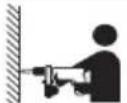 | n_2 | /minrpm | 925 925 | |
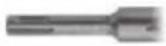 | SDS-plus | ✓ | ✓ | |
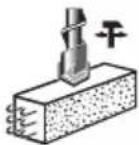 | ø max. | mm(in) | 32 ( 1^1/_4 ) 32 (1 | ^1/_4 |
| s max. | /minbpm | 4500 4500 | ||
| W(EPTA (05/2009) J | 3,1 3,1 | |||
| S J/s 226 226 | ||||
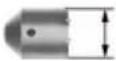 | ø max. | mm(in) | 68 ( 2^11/_16 ) | 68 ( 2^11/_16 ) |
 | ø max. | mm(in) | 30 ( 1^3/_16 ) | 30 ( 1^3/_16 ) |
 | ø max. | mm(in) | 13 ( ^1/_2 ) | 13 ( ^1/_2 ) |
 | m | kg(lbs) | 4,5 (9.9) 5,3 (11.7) | |
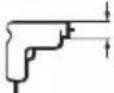 | D | mm(in) | 50 ( 1^31/_32 ) | 50 ( 1^31/_32 ) |
| a_h,HD/K_h,HD | m/s ^2 | 13,0 / 1,5 | 13,0 / 1,5 | |
| a_h,Cheq/K_h,Cheq | m/s ^2 | 10,5 / 1,5 | 10,5 / 1,5 | |
 | L_pA/K_pA | dB (A) | 88 / 3 | 88 / 3 |
| L_WA/K_WA | dB (A) | 99 / 3 | 99 / 3 | |

*2) 2014/30/EU, 2006/42/EC, 2011/65/EU
*3) EN 62841-1:2015, EN IEC 62841-2-6:2020/A11:2020, EN IEC 63000:2018
2023-02-06, Bernd Fleischmann
Original instructions
1. Declaration of Conformity
We declare under our sole responsibility: These cordless hammers, identified by type and serial number *1), comply with all relevant requirements of the directives *2) and standards *3). Technical file at *4) - see page 4.
For UK only:
UK CA We as manufacturer and authorized person to compile the technical file, see *4) on page 3, hereby declare under sole responsibility that these drilling and chisel hammer, identified by type and serial number *1) on page 3, fulfill all relevant provisions of following UK Regulations *2) S.I. 2016/1091, S.I. 2008/1597, S.I. 2012/3032 and Designated Standards *3) on page 3.
2. Specified Use
With the appropriate accessories, the machine is suitable for work with hammer drill bit and chisels in concrete, stone and similar materials and with core cutters in tiles and similar materials, as well as for non-impact drilling into metal, wood etc. and for driving screws.
The user bears sole responsibility for any damage caused by improper use.
Generally accepted accident prevention regulations and the enclosed safety information must be observed.
3. General safety instructions

For your own protection and for the protection of your power tool, pay attention to all parts of the text that are marked with this symbol!

WARNING – Reading the operating instructions will reduce the risk of injury.
Pass on your power tool only together with these documents.
General Power Tool Safety Warnings

WARNING Read all safety warnings, instructions, illustrations and specifics provided with this power tool. Failure to w all instructions listed below may result in elech-hock, fire and/or serious injury.
Save all warnings and instructions for future reference. The term "power tool" in the warnings refers to your mainsoperated (corded) power tool or battery-operated (cordless) power tool.
3.1 Work area safety
a) Keep work area clean and well lit. Cluttered or dark areas invite accidents.
b) Do not operate power tools in explosive atmospheres, such as in the presence of flammable liquids, gases or dust. Power tools create sparks which may ignite the dust or fumes.
c) Keep children and bystanders away while operating a power tool. Distractions can cause you to lose control.
3.2 Electrical safety
a) Power tool plugs must match the outlet. Never modify the plug in any way. Do not use any adapter plugs with earthed (grounded) power tools. Unmodified plugs and matching outlets will reduce risk of electric shock.
b) Avoid body contact with earthed or grounded surfaces, such as pipes, radiators, ranges and refrigerators. There is an increased risk of electric shock if your body is earthed or grounded.
c) Do not expose power tools to rain or wet conditions. Water entering a power tool will increase the risk of electric shock.
d) Do not abuse the cord. Never use the cord for carrying, pulling or unplugging the power tool. Keep cord away from heat, oil, sharp edges or moving parts. Damaged or entangled cords increase the risk of electric shock.
e) When operating a power tool outdoors, use an extension cord suitable for outdoor use. Use of a cord suitable for outdoor use reduces the risk of electric shock.
f) If operating a power tool in a damp location is unavoidable, use a residual current device (RCD) protected supply. Use of an RCD reduces the risk of electric shock.
3.3 Personal safety
a) Stay alert, watch what you are doing and use common sense when operating a power tool. Do not use a power tool while you are tired or under the influence of drugs, alcohol or medication. A moment of inattention while operating power tools may result in serious personal injury. b) Use personal protective equipment. Always wear eye protection. Protective equipment such as a dust mask, non-skid safety shoes, hard hat or hearing protection used for appropriate conditions will reduce personal injuries.
c) Prevent unintentional starting. Ensure the switch is in the off-position before connecting to power source and/or battery pack, picking up or carrying the tool. Carrying power tools with your finger on the switch or energising power tools that have the switch on invites accidents.
d) Remove any adjusting key or wrench before turning the power tool on. A wrench or a key left attached to a rotating part of the power tool may result in personal injury.
e) Do not overreach. Keep proper footing and balance at all times. This enables better control of the power tool in unexpected situations.
f) Dress properly. Do not wear loose clothing or jewellery. Keep your hair and clothing away from moving parts. Loose clothes, jewellery or long hair can be caught in moving parts.
g) If devices are provided for the connection of dust extraction and collection facilities, ensure these are connected and properly used. Use of
ENGLISHen
dust collection can reduce dust-related hazards.
h) Do not let familiarity gained from frequent use of tools allow you to become complacent and ignore tool safety principles. A careless action can cause severe injury within a fraction of a second.
3.4 Power tool use and care
a) Do not force the power tool. Use the correct power tool for your application. The correct power tool will do the job better and safer at the rate for which it was designed.
b) Do not use the power tool if the switch does not turn it on and off. Any power tool that cannot be controlled with the switch is dangerous and must be repaired.
c) Disconnect the plug from the power source and/or remove the battery pack, if detachable, from the power tool before making any adjustments, changing accessories, or storing power tools. Such preventive safety measures reduce the risk of starting the power tool accidentally.
d) Store idle power tools out of the reach of children and do not allow persons unfamiliar with the power tool or these instructions to operate the power tool. Power tools are dangerous in the hands of untrained users.
e) Maintain power tools and accessories. Check for misalignment or binding of moving parts, breakage of parts and any other condition that may affect the power tool's operation. If damaged, have the power tool repaired before use. Many accidents are caused by poorly maintained power tools.
f) Keep cutting tools sharp and clean. Properly maintained cutting tools with sharp cutting edges are less likely to bind and are easier to control.
g) Use the power tool, accessories and tool bit etc. in accordance with these instructions, taking into account the working conditions and the work to be performed. Use of the power tool for operations different from those intended could result in a hazardous situation.
h) Keep handles and grasping surfaces dry, clean and free from oil and grease. Slippery handles and grasping surfaces do not allow for safe handling and control of the tool in unexpected situations.
3.5 Battery tool use and care
a) Recharge only with the charger specified by the manufacturer. A charger that is suitable for one type of battery pack may create a risk of fire when used with another battery pack.
b) Use power tools only with specifically designated battery packs. Use of any other battery packs may create a risk of injury and fire.
c) When battery pack is not in use, keep it away from other metal objects, like paper clips, coins, keys, nails, screws or other small metal objects, that can make a connection from one terminal to another. Shorting the battery terminals together may cause burns or a fire.
d) Under abusive conditions, liquid may be ejected from the battery; avoid contact. If contact accidentally occurs, flush with water. If liquid contacts eyes, additionally seek medical
help. Liquid ejected from the battery may cause irritation or burns.
e) Do not use a battery pack or tool that is damaged or modified. Damaged or modified batteries may exhibit unpredictable behaviour resulting in fire, explosion or risk of injury.
f) Do not expose a battery pack or tool to fire or excessive temperature. Exposure to fire or temperature above 130 °C may cause explosion.
g) Follow all charging instructions and do not charge the battery pack or tool outside the temperature range specified in the instructions. Charging improperly or at temperatures outside the specified range may damage the battery and increase the risk of fire.
3.6 Service
a) Have your power tool serviced by a qualified repair person using only identical replacement parts. This will ensure that the safety of the power tool is maintained.
b) Never service damaged battery packs.
Service of battery packs should only be performed by the manufacturer or authorized service providers.
4. Special Safety Instructions
4.1 Safety instructions for all operations
a) Wear ear protectors. Exposure to noise can cause hearing loss.
b) Use auxiliary handle(s), if supplied with the tool. Loss of control can cause personal injury.
c) Hold the power tool by insulated gripping surfaces, when performing an operation where the cutting accessory or fasteners may contact hidden wiring. Cutting accessory contacting a "live" wire may make exposed metal parts of the power tool "live" and could give the operator an electric shock.
4.2 Safety instructions when using long drill bits with rotary hammers
a) Always start drilling at low speed and with the bit tip in contact with the workpiece. At higher speeds, the bit is likely to bend if allowed to rotate freely without contacting the workpiece, resulting in personal injury.
b) Apply pressure only in direct line with the bit and do not apply excessive pressure. Bits can bend, causing breakage or loss of control, resulting in personal injury.
4.3 Further Safety instructions
Work only with the additional handle correctly installed.
Always hold the machine with both hands using the handles provided, stand securely and concentrate.
Wear personal protective equipment and always wear safety glasses. Protective equipment such as dust mask, non-skid safety shoes, protective gloves, hard hat, or hearing protection used for appropriate conditions will reduce personal injuries.
Ensure that the spot where you wish to work is free of power cables, gas lines or water pipes (e.g. by using a metal detector).
If the safety coupling responds, switch off the machine immediately.
Do not touch the rotating tool!
Secure the workpiece against slipping, e.g. with the help of clamping devices.
Remove chips and similar material only when the machine is at a standstill.
Caution when carrying out hard screwdriving (driving of screws with either a metric or an imperial thread into steel)! The head of the screw may be ripped off or high restoring torques may occur on the handle.
Safety coupling: If the tool jams or catches, the power supply to the motor is restricted. Due to the strong force which can arise, always hold the machine with both hands using the handles provided, stand securely and concentrate.
A damaged or cracked additional handle must be replaced. Never operate a machine with a defective additional handle.
Remove the battery pack from the machine before any adjustments, conversions or servicing are performed.

Protect battery packs from water and moisture!
Do not expose battery packs to naked flame!
Do not use faulty or deformed battery packs! open battery packs!
Do not open battery packs!
Do not touch or short-circuit battery packs!

Slightly acidic, flammable fluid may leak from defective li-ion battery packs!

If battery fluid leaks out and comes into contact with your skin, rinse immediately with plenty of water. If battery fluid leaks out
and comes into contact with your eyes, wash them with clean water and seek medical attention immediately.
If the machine is defective, remove the battery pack from the machine.
Transport of li-ion battery packs:
The shipping of li-ion battery pack is subject to laws related to the carriage of hazardous goods (UN 3480 and UN 3481). Inform yourself of the currently valid specifications when shipping li-ion battery packs. If necessary, consult your freight forwarder. Certified packaging is available from Metabo.
Only send the battery pack if the housing is intact and no fluid is leaking. Remove the battery pack from the machine for sending. Prevent the contacts from short-circuiting (e.g. by protecting them with adhesive tape).
Reducing dust exposure:

WARNING - Some dust created by power sanding, sawing, grinding, drilling, and other truction activities contains chemicals known to cause cancer, birth defects or other reproductive harm. Some examples of these chemicals are:
- Lead from lead-based paints,
- Crystalline silica from bricks and cement and other masonry products, and
- Arsenic and chromium from chemically treated lumber.
Your risk from these exposures varies, depending on how often you do this type of work. To reduce your exposure to these chemicals: work in a well ventilated area, and work with approved safety equipment, such as those dust masks that are specially designed to filter out microscopic particles.
This also applies to dust from other materials such as some timber types (like oak or beech dust), metals, asbestos. Other known diseases are e.g. allergic reactions, respiratory diseases. Do not let dust enter the body.
Observe the relevant guidelines and national regulations for your material, staff, application and place of application (e.g. occupational health and safety regulations, disposal).
Collect the particles generated at the source, avoid deposits in the surrounding area.
Use suitable accessories for special work. In this way, fewer particles enter the environment in an uncontrolled manner.
Use a suitable extraction unit.
Reduce dust exposure with the following measures:
- do not direct the escaping particles and the exhaust air stream at yourself or nearby persons or on dust deposits,
- use an extraction unit and/or air purifiers,
- ensure good ventilation of the workplace and keep clean using a vacuum cleaner. Sweeping or blowing stirs up dust.
- Vacuum or wash the protective clothing. Do not blow, beat or brush.
5. Overview
See page 2.
1 Keyless chuck *
2 Keyless chuck sleeve *
3 Chuck lock
4 Tool lock
5 SDS chuck
6 Spindle
7 Additional handle
8 Depth stop
9 Metabo VibraTech (MVT)
10 Trigger switch
11 Handle
12 Lock
13 Switch button (for changing the operating mode)
14 Rotation selector switch
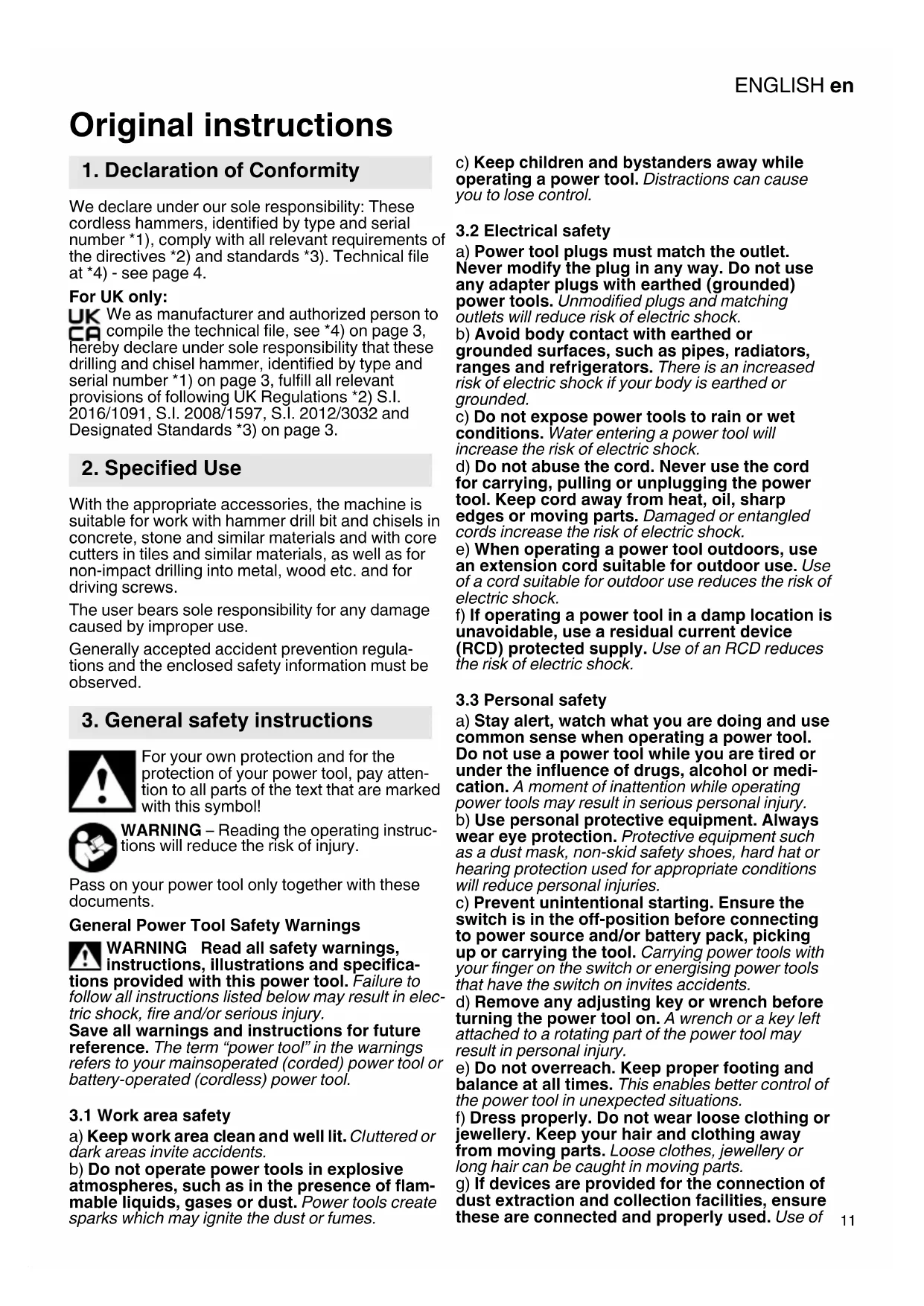
15 Battery pack release button
16 Capacity indicator button
17 Capacity and signal indicator
18 Battery pack
ENGLISHen
* depending on model
6. Initial Operation
6.1 Assembly of the additional handle

For safety reasons, always use the additional handle supplied.
Open the clamping ring by turning the additional handle (7) anticlockwise. Push the additional handle onto the collar of the machine. Insert the depth stop (8). Securely tighten the additional handle at the angle required for the application.
6.2 Battery pack
Charge the battery pack (18) before use.
Recharge the battery pack if performance diminishes.
Instructions on charging the battery pack can be found in the operating instructions of the Metabo charger.
Battery packs have a capacity and signal display (17) (depends on design variant):
- Press the button (16); the LEDs indicate the charge level.
- The battery pack is almost flat and must be recharged if one LED is flashing.
KHA 36-18 LTX 32:
- Use always two Metabo 18-Volt slide-on battery packs.
- Recommended capacity 3.0 Ah and greater.
- We recommend the use of battery packs with identical item number.
- The use of battery packs with different capacity (Ah) is permitted. In this case, the battery pack with the smaller capacity (Ah) determines the useful life.
6.3 Removing and inserting the battery pack
See illustration Eon page 3.
Removing:
Press the battery pack release (15) button and remove the battery pack (18).
Inserting:
Slide in the battery pack (18) until it engages.
7. Use
7.1 Depth Stop Setting
Loosen the additional handle (7). Set depth stop (8) to the desired drilling depth and retighten additional handle. (7)
7.2 Switching On and Off
To start the machine, press the trigger (10). The speed can be changed at the trigger.
Release the trigger (10) to switch off.
7.3 Operating mode selection
Press (12) the lock and turn the thumbwheel (13).

Drilling

Hammer drilling (only set if using (5) SDS chuck)
Setting the chiselling position With this setting, turn the chisel to the required position. Then select "Chiselling" to secure the chisel and prevent it from twisting.

Chiselling (only set if using SDS chuck (5))

When a chisel is fitted, only operate the machine in the chiselling operating mode.

Avoid levering with the machine when a chisel is fitted.
7.4 Adjusting the chisel position
- Insert the chisel.
- Turn the switch button (13) to position N
- Turn the chisel to the required position.
- Turn the switch button (13) to position
- Turn the chisel until it engages.

When a chisel is fitted, only operate the machine in the chiselling operating mode

[Non-Text]
7.5 Selecting the direction of rotation

Do not activate the direction switch (14) unless the motor has completely stopped.
Selecting the direction of rotation:
R = Clockwise (for drilling, hammer drilling, chis-elling, inserting screws)
L = Counter-clockwise (for extracting screws)
7.6 Drill chuck change

When changing chucks, make sure that the spindle is clean. (6) Apply a light coating of use to the spindle. (Special grease: Order No.: 300)

Only attach the Metabo chuck provided.
Removing the chuck:
See page 2, fig. C.
- Turn chuck lock (3) as far as it will go (a) in the direction indicated by the arrow, and remove chuck (b).
Replacing the chuck:
See page 2, fig. D.
- Place chuck onto spindle (6) (a).
- Turn chuck lock (3) in the direction indicated by the arrow (b) until chuck slides fully onto the spindle. Then release the chuck lock.
- Check to see that the chuck is properly seated.
Note: To prevent the spindle from turning while chucks are being changed, set the switch button (13) to ohiselling mode.
7.7 Tool change with SDS chuck

Before fitting, clean tool shank and apply special grease (accessories order no.
6.31800)! Use only SDS-Plus tools.
Inserting tools:
- Turn tool and insert until it engages. The tool is locked automatically.
Removing the tool:
See page 2, fig. A.
- Pull tool lock (4) backwards in direction indicated by arrow (a) and remove tool (b).
7.8 Tool change with keyless chuck
Use the keyless chuck when non-impact drilling in metal, wood etc. and driving screws.
Tighten the tool (see page 2, fig. B):
Turn sleeve (2) in direction "AUF, RELEASE" (a). Insert tool as deeply as possible (b) and turn sleeve in the opposite direction, until any perceptible mechanical resistance is overcome (c). Caution!
The chuck is not yet fully tightened!
Keep turning the sleeve (it must "click" when turning) until it cannot be turned any further - only now is the tool securely clamped.
With a soft tool shank, retightening may be required after a short period of operation.
Note: The grating sound that may be heard after the drill chuck is opened is purely functional; it is stopped by turning the sleeve in the opposite direction.
If the chuck is very securely tightened: Unplug. Hold drill chuck using an open-end spanner at the flats on its head, and turn the sleeve (2) vigourously in the direction of "AUF, OPEN".
7.9 Metabo VibraTech (MVT)
For reduced vibrations and less stress on the hands.
Always apply a moderate amount of pressure to the handle when pushing down the machine and do not force. Vibrations are reduced most effectively at the central position (9).
8. Maintenance, cleaning
- Ventilation slits:
Clean the ventilation slits on the machine occasionally.
- Remove the battery pack periodically and wipe the contact area of the battery pack and machine with a dry cloth and remove drilling dust.
- Always keep the spindle (6) clean and apply a light coating of grease. (Special grease: Order No.: 6.31800)
- Keyless chuck (1) cleaning:
After prolonged use, hold the chuck vertically, with the opening facing down, and fully close it and open it several times. The dust collected falls from the opening. The application of cleaning spray to the jaws and jaw openings at regular intervals is recommended.
9. Accessories
Use only original Metabo or CAS (Cordless Alliance System) battery packs and accessories. Use only accessories that fulfil the requirements and specifications listed in these operating instructions.
Fit accessories securely. If the machine is operated in a holder: secure the machine well. Loss of control can cause personal injury.
Chargers: ASC 145, ASC 55, etc.
For a complete range of accessories, see www.metabo.com or the catalogue.
10. Repairs

Repairs to electrical tools must ONLY be carried out by qualified electricians!
Contact your local Metabo representative if you have Metabo power tools requiring repairs. For addresses see www.metabo.com.
You can download a list of spare parts from www.metabo.com.
11. Environmental Protection
Observe national regulations on environmentally compatible disposal and on the recycling of disused machines, packaging and accessories.
Packaging materials must be disposed of according to their labelling in accordance with municipal guidelines. Further information can be found at www.metabo.com in the “Service” section.
Battery packs may not be disposed of with regular waste. Return faulty or used battery packs to your Metabo dealer!
Do not allow battery packs to come into contact with water!

Only for EU countries: never dispose of power tools in your household waste! According to European Directive 2012/19/EU
on Waste from Electric and Electronic Equipment and implementation in national law, used power tools must be collected separately and recycled in an environmentally-friendly manner.
Discharge the battery pack in the power tool before disposal. Prevent the contacts from short-circuiting (e.g. by protecting them with adhesive tape).
12. Technical Specifications
Explanation of details on page 3. Subject to changes serving technical progress.
U = Voltage of battery pack
n_1 = No-load speed
n_2 = Load speed
dia.max = Maximum drill diameter
s_max = Maximum impact rate
W = Single impact force
S = Impact performance
m = Weight with smallest battery pack
D = D=Collar diameter
Measured values determined in conformity with EN 62841.
Permitted ambient temperature during operation:
-20 °C (-4°F) to 50 °C (120°F) (limited performance
ENGLISHen
with temperatures below 0 °C (32°F)). Permitted ambient temperature for storage: 0 °C (32°F) to 30 °C (86°F).
--- Direct current
The technical specifications quoted are subject to tolerances (in compliance with the relevant valid standards).

Emission values
Using these values, you can estimate the emissions from this power tool and compare these with the values emitted by other power tools. The actual values may be higher or lower, depending on the particular application and the condition of the tool or power tool. In estimating the values, you should also include work breaks and periods of low use. Based on the estimated emission values, specify protective measures for the user - for example, any organisational steps that must be put in place.
Vibration total value (vector sum of three directions) determined in accordance with EN 62841:
$$ \begin{array}{r l} {a _ {h, H D}} & {= \text { Vibration emission value (hammer }} \ & {\text { drilling into concrete) }} \end{array} $$
$$ a _ {h, \text { Cheq }} = \text { Vibration emission value (chiselling) } $$
$$ K _ {h, H D / C h e q} = \text { Uncertainty (vibration) } $$
Typical A-effective perceived sound levels::
$$ L _ {p A} = \text { Sound pressure level } $$
$$ L _ {W A} = \text { Acoustic power level } $$
$$ K _ {p A}, K _ {W A} = \text { Uncertainty } $$
During operation the noise level can exceed 80 dB(A).

Wear ear protectors!
Voir page 3, figure E.
Retrait :
Perçage sans percussion