ManualGo.com
BSGL32386 - Vacuum Cleaner BOSCH - Free user manual and instructions
Find the device manual for free BSGL32386 BOSCH in PDF.



Download the instructions for your Vacuum Cleaner in PDF format for free! Find your manual BSGL32386 - BOSCH and take your electronic device back in hand. On this page are published all the documents necessary for the use of your device. BSGL32386 by BOSCH.
USER MANUAL BSGL32386 BOSCH
Alle in dieser Anweisung nicht genauer beschriebenen Verfahren wurden auf Basis der Norm EN 60312-1:2017* ausgeführt. *Da der Lebensdauertest für den Motor bei leerem Staubbehälter durchgeführt wird, muss die angege- bene Motorlebensdauer für Prüfung mit halbgefülltem Staubbehälter um 10% erhöht werden. Please keep this instruction manual. When passing the vacuum cleaner on to a third party, please also pass on this instruction manual. Intended use This appliance is intended for domestic use only. This appliance is intended for use up to a maximum height of 2000 metres above sea level. Only use this vacuum cleaner in accordance with the instructions in this ins- truction manual. In order to prevent injuries and damage, the vacuum cleaner must not be used for: Vacuum-cleaning persons or animals Vacuuming up: − hazardous, sharp-edged, hot or glowing substances. − damp or liquid substances. − highly flammable or explosive substances and gases. − ash, soot from tiled stoves and central heating sys- tems. − toner dust from printers and copiers. Spare parts, accessories, dust bags Our original spare parts, original (special) accessories and original dust bags are designed to work with the features and requirements of our vacuum cleaners. We therefore recommend that you only use our original spa- re parts, original (special) accessories and original dust bags. This will ensure that your vacuum cleaner has a long service life and that the quality of its cleaning per- formance will remain consistently high throughout.
Please note Using unsuitable or inferior-quality spare parts, (special) accessories and dust bags can damage your vacuum cleaner. Damage caused by the use of such products is not covered by our guarantee. en4 Safety information This vacuum cleaner complies with the recognised rules of technology and the relevant safety regulations. The appliance may be used by children over the age of 8 years and by persons with reduced physical, sensory or mental capacity or by per- sons with a lack of experi- ence or knowledge if they are supervised or have been inst- ructed on the safe use of the appliance and the have un- derstood the potential dan- gers of using the appliance. Children must never play with the appliance. Cleaning and user mainte- nance must never be carried out by children without su- pervision. Plastic bags and films must be kept out of the reach of children before disposal. >= Risk of suffocation. Proper use Only connect and use the vacuum cleaner in ac- cordance with the specifications on the rating plate. Never vacuum without the dust bag or dust container, motor protection or exhaust filter. >= This may damage the vacuum cleaner. Always keep the vacuum cleaner away from your head when using nozzles and tubes. >= This could cause injury! When vacuuming stairs, the appliance must always be positioned below the user. Do not use the power cord or the hose to carry or transport the vacuum cleaner. For safety reasons, if this appliance's mains power cable becomes damaged, it must be replaced by the manufacturer, their after-sales service department or a similarlyqualified person. If using the appliance for longer than 30 minutes, pull out the power cord completely. When disconnecting the appliance from the mains, pull on the plug itself to remove it; do not pull on the power cord. Do not pull the power cord over sharp edges or allow it to become trapped. When the cable is being automatically rewound, en- sure that the mains plug is not thrown towards per- sons, body parts, animals or objects. >= Use the mains plug to guide the power cord. Pull out the mains plug before carrying out any work on the vacuum cleaner. Do not operate the vacuum cleaner if it is damaged. Unplug the appliance from the mains if a fault is de- tected. For safety reasons, only authorised after-sales service personnel are permitted to carry out repairs and fit replacement parts to the vacuum cleaner. Protect the vacuum cleaner from the weather, moistu- re and sources of heat. Do not pour flammable substances or substances con- taining alcohol onto the filters (dust bag, motor pro- tection filter, exhaust filter, etc.). The vacuum cleaner is not suitable for use on con- struction sites. >= Vacuuming up building rubble could damage the appliance. When not in use, switch off the appliance and pull out the mains plug. At the end of its life, the appliance should immediately be rendered unusable, then disposed of in an appro- priate manner.
Please note The mains socket must be protected by at least a 16 amp circuit breaker. If a circuit breaker is tripped when you switch on the vacuum cleaner, this may be because other electrical appliances which have a high current draw are connected to the same power circuit. To prevent the circuit breaker from tripping, select the lowest power setting before switching the appliance on, and increase the power only once it is running. Disposal information Packaging The packaging is designed to protect the vacuum cleaner from being damaged during transportation. It is made of environmentally friendly materials and can therefore be recycled. Dispose of packaging that is no longer required at an appropriate recyc- ling point. Old appliance Old appliances still contain many valuable mate- rials. Therefore, please take appliances that have reached the end of their service life to your retailer or recycling centre so that they can be recycled. For current disposal methods, please enquire at a retailer or your local council.5 Disposal of filters and dust bags Filters and dust bags are manufactured from environmentally friendly materials. Provided they do not contain substances that are not permitted in household waste, you can dispose of them with your normal household waste. Notes on the energy label This vacuum cleaner is a general purpose vacuum clea- ner with a primary hose. These appliances can be operated with either a dust bag or a dust box in the dust compartment. The stated values refer to the appliance when used with a dust bag. To achieve the best possible energy efficiency on carpet and hard floor, please use the interchangeable universal nozzle. These calculations are based on the Commission Dele- gated Regulation (EU) No. 665/2013 of 3rd May 2013 supplementing Directive 2010/30/EU. Unless otherwise stated, all the procedures refer- red to in these instructions were carried out in ac- cordance with the EN 60312-1:2017* standard. *As the motor service test is carried out with the dust collector empty, the stated motor service life must be increased by 10% for tests with the dust collector half filled.
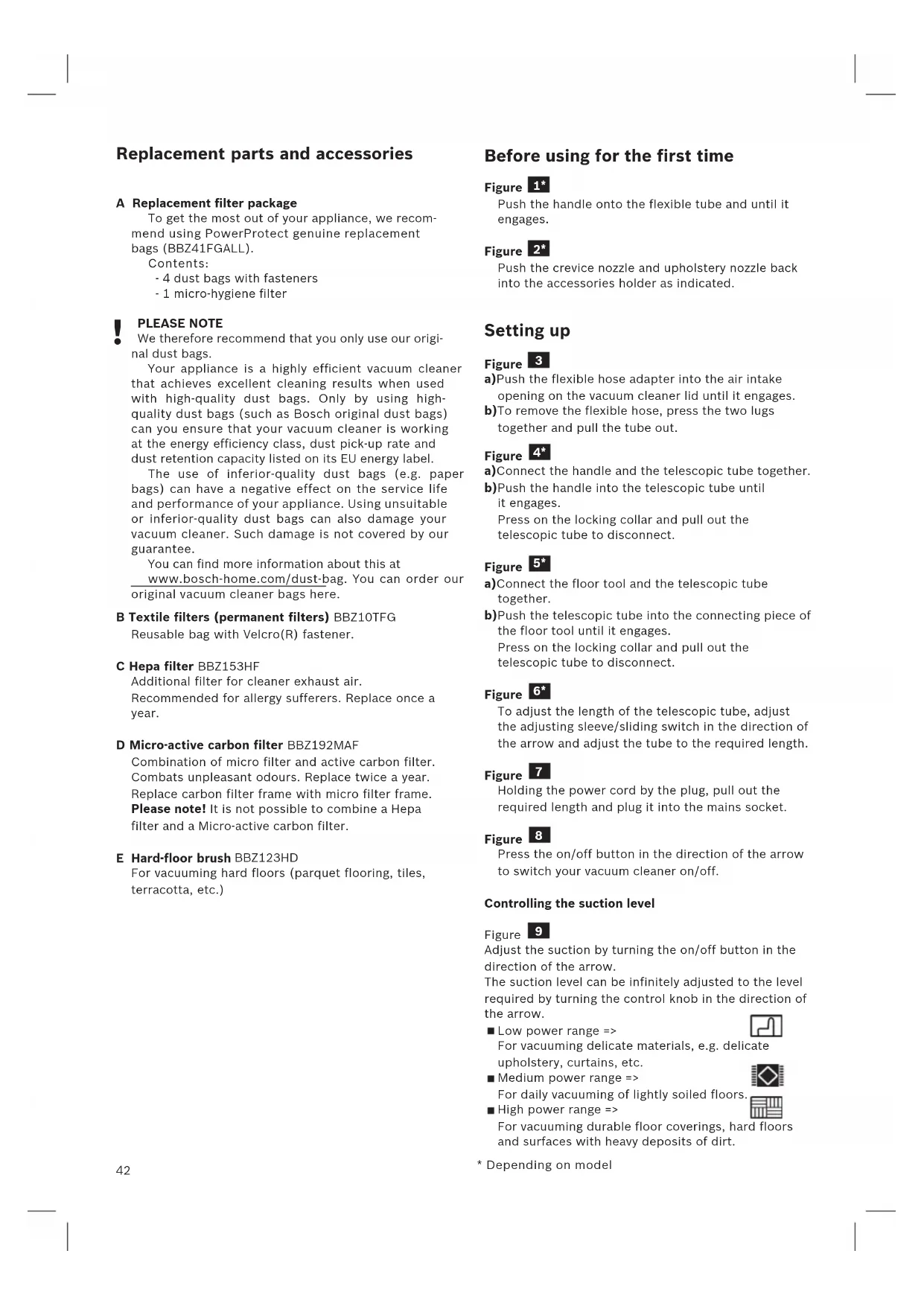
- Depending on model Replacement parts and accessories Before using for the first time Figure Push the handle onto the flexible tube and until it engages. Figure Push the crevice nozzle and upholstery nozzle back into the accessories holder as indicated. Setting up Figure a)Push the flexible hose adapter into the air intake opening on the vacuum cleaner lid until it engages. b)To remove the flexible hose, press the two lugs together and pull the tube out.
Figure a)Connect the handle and the telescopic tube together. b)Push the handle into the telescopic tube until it engages. Press on the locking collar and pull out the telescopic tube to disconnect. Figure a)Connect the floor tool and the telescopic tube together. b)Push the telescopic tube into the connecting piece of the floor tool until it engages. Press on the locking collar and pull out the telescopic tube to disconnect. Figure To adjust the length of the telescopic tube, adjust the adjusting sleeve/sliding switch in the direction of the arrow and adjust the tube to the required length. Figure Holding the power cord by the plug, pull out the required length and plug it into the mains socket. Figure Press the on/off button in the direction of the arrow to switch your vacuum cleaner on/off. Controlling the suction level Figure Adjust the suction by turning the on/off button in the direction of the arrow. The suction level can be infinitely adjusted to the level required by turning the control knob in the direction of the arrow. Low power range => For vacuuming delicate materials, e.g. delicate upholstery, curtains, etc. Medium power range => For daily vacuuming of lightly soiled floors. High power range => For vacuuming durable floor coverings, hard floors and surfaces with heavy deposits of dirt.
A Replacement filter package To get the most out of your appliance, we recom- mend using PowerProtect genuine replacement bags (BBZ41FGALL). Contents: - 4 dust bags with fasteners - 1 micro-hygiene filter
PLEASE NOTE We therefore recommend that you only use our origi- nal dust bags. Your appliance is a highly efficient vacuum cleaner that achieves excellent cleaning results when used with high-quality dust bags. Only by using high- quality dust bags (such as Bosch original dust bags) can you ensure that your vacuum cleaner is working at the energy efficiency class, dust pick-up rate and dust retention capacity listed on its EU energy label. The use of inferior-quality dust bags (e.g. paper bags) can have a negative effect on the service life and performance of your appliance. Using unsuitable or inferior-quality dust bags can also damage your vacuum cleaner. Such damage is not covered by our guarantee. You can find more information about this at www.bosch-home.com/dust-bag. You can order our original vacuum cleaner bags here. B Textile filters (permanent filters) BBZ10TFG Reusable bag with Velcro(R) fastener. C Hepa filter BBZ153HF Additional filter for cleaner exhaust air. Recommended for allergy sufferers. Replace once a year. D Micro-active carbon filter BBZ192MAF Combination of micro filter and active carbon filter. Combats unpleasant odours. Replace twice a year. Replace carbon filter frame with micro filter frame. Please note! It is not possible to combine a Hepa filter and a Micro-active carbon filter. E TURBO-UNIVERSAL
brush for upholstery BBZ42TB Hard-floor brush BBZ123HD For vacuuming hard floors (parquet flooring, tiles, terracotta, etc.)43
- Depending on model Vacuuming Figure Adjusting the floor tool: Rugs and carpets => Hard surfaces => Caution! Floor tools are subject to a certain amount of wear, depending on the type of hard floors you have (e.g. rough, rustic tiles). Therefore, you must check the underside of the floor tool at regular intervals. Worn undersides of floor tools may have sharp edges that can damage sensitive hard floors, such as parquet or linoleum. The manufacturer does not accept any responsibility for damage caused by worn floor tools. 10* Figure Remove the upholstery nozzle and crevice nozzle from the accessories holder as illustrated. Figure Vacuuming with accessories Attach the nozzles to the suction pipe or handle as required: a)Crevice nozzle for vacuuming crevices and corners, etc. b)Upholstery nozzle for vacuuming upholstered furniture, curtains, etc. Figure After use, push the crevice nozzle and upholstery nozzle back into the accessories holder as indicated
Figure 䡲 Secure the drill dust nozzle to the handle and then place against the wall, so that the nozzle drill hole opening sits directly over where the hole will be drilled. 䡲 Select the lowest power setting and then switch on the vacuum cleaner. 䡲 Suction holds the drill dust nozzle in the required position. Depending on the surface of the wall to be drilled, it may be necessary to readjust the power to a high- er setting to ensure the drill dust nozzle is firmly attached. Any fine particles are automatically vacuumed up.
Caution: the drill dust nozzle should only be used in conjunction with the dust container since fine drill dust can impair the function of the dust bag. Turbo brush If your vacuum cleaner is equipped with a turbo brush, please consult the accompanying instruction manual for notes on use and maintenance. 14*
Figure Pet hair tool Floor tool for easy, thorough removal of pet hair To clean the nozzle, simply vacuum it using the fixed / telescopic tube Hard-floor brush Figure For vacuuming hard floor coverings (tiles, parquet flooring, etc.) Cleaning the hard-floor brush Figure a)Vacuum from below to clean the brushes. b)Cut through threads and hairs wound round the rollers using scissors. Vacuum threads and hairs with the crevice nozzle. 17* 16* 15* Figure You can use the parking aid on the side of the vacuum cleaner if you wish to stop vacuuming for a short time. Once you have switched off the vacuum cleaner, slide the catch on the floor tool into the groove on the side of the appliance. Figure The appliance can also be carried using one of the two handles when vacuuming steps, for example. When the work is done Figure Unplug the vacuum cleaner. Tug the power cord briefly and let go. The cable then rewinds automatically. Figure To store or transport the vacuum cleaner, use the storage aid on the underside of the vacuum cleaner. Stand the vacuum cleaner up on its end. Slide the catch on the floor tool into the groove on the under- side of the appliance. You have purchased a floor vacuum cleaner which can vacuum up any type of dry dirt using the dust contain- er or dust bag. We recommend that you use: – the dust container, particularly for DIY-related clean- ing, e.g. to vacuum up wood shavings, etc. – the dust bag principally for everyday household cleaning.
Caution: The dust bag change indicator only works in conjunction with a dust bag. Figure Set the power setting to maximum for the best results when vacuuming. We recommend that you reduce the setting only when vacuuming very delicate materials. Emptying the dust filter To achieve an optimal result when vacuuming, the dust container should be emptied each time the vacuum cleaner is used. Figure Turn the dust compartment locking lever in the direction of the arrow to open the dust compartment cover. Figure Remove the dust container from the appliance.
Figure 䡲 Release the two snap locks on the bottom flap in the direction of the arrow, open the flap until it clicks into the stop position and the container will then empty the dirt in a downwards direction. 䡲 When closing the bottom flap, please ensure that there is no dirt around the edges. Clean if neces- sary. 䡲 Close the bottom flap, making sure that you hear it click into place. Figure Put the dust container back into the appliance and close the dust container lid.
Caution: the inside of the dust container may become scratched with use and start to look opaque. This does not, however, affect the perfor- mance of the vacuum cleaner in any way, i.e. it will continue to function as normal. Cleaning the permanent filter and Microsan filter in the dust container The filters must be cleaned (wash out the filter sys- tem): 䡲 After any malfunctions, i.e. after a blockage is cleared. 䡲 At least every six months. Figure 䡲 Press in the locking tab on the rear side of the con- tainer and remove the Microsan filter from the con- tainer. 䡲 Remove the permanent filter from the bottom plate of the container.
Wash the Microsan and permanent filters. The filters must then be left to dry for at least 24 hours.
After cleaning, insert the permanent filter into the bottom plate of the container. Put the Microsan filter onto the container and fix it in place by pushing in the direction of the arrow. You will hear the tab snap into place. Malfunctions Removing a blockage in the dust container. Figure 䡲 Empty the container (see figure 25) 䡲 Loosen the blockage, e.g. with a screwdriver, and tap it out. 䡲 Close the bottom flap, making sure that you hear it click into place.
Using dust bags If necessary, a dust bag may be used instead of the dust container. Figure 䡲 Open the dust bag compartment lid. 䡲 Remove the dust container and insert a dust bag. 䡲 Close the vacuum cleaner lid. You have bought an extremely powerful device. The highest suction setting is therefore only recommended for heavily soiled, short-pile carpets and hard floors. The required suction power can be selected by adjusting the suction regulator (see Figure 9). 䡲 Low suction range: For vacuuming delicate fabrics, e.g. curtains. 䡲 Middle suction range: For daily vacuuming of lightly soiled floors. 䡲 High suction range: For vacuuming durable floor coverings, hard floors and for heavily soiled surfaces. Changing the dust bag Replacing the dust bag Figure a)If the dust bag change indicator is completely yellow when the floor tool is lifted from the floor and the highest suction power is selected, the dust bag must be changed. In this case it is essential to change the dust bag due to the type of material it contains. The nozzle, suction pipe and flexible tube must not be blocked, as this would also cause the dust bag change indicator to be triggered.
If the dust bag change indicator in the lid is filled completely when the floor tool is lifted from the floor with the highest suction level selected, the dust bag must be changed, even though it may not yet be full. Even if the dust bag is not full, it may still need changing, due to the type of dust which has been vacuumed. First check that the nozzle, suction pipe and flexible hose are not blocked, as this would also lead to the dust bag change indica- tor being triggered.
- Depending on model45 Figure Open the lid by moving the locking lever in the direction of the arrow. Figure a)Seal the dust bag by pulling the sealing strip and then remove it. b)Slide the new dust bag into the holder to the stop.
Caution: The lid only closes with a dust bag inserted. Cleaning the motor protection filter The motor protection filter should be cleaned regularly by knocking out the dirt and rinsing. Figure Open the dust bag compartment lid (see Fig. 23). Pull out the motor protection filter in the direction of the arrow. Clean the motor protection filter by tapping it out. If it is very dirty, the motor protection filter should be rinsed. The filter must then be left to dry for at least 24 hours.
After cleaning, slide the motor protection filter into the vacuum cleaner and close the dust bag compartment lid.
Caution: The vacuum cleaner must not be operated without the motor protection filter. Replacing the micro-hygiene filter The motor protection filter should be changed: when starting a newpack of bags Figure Open the dust bag compartment lid (see Figure 23). Release the filter holder by moving the locking lever in the direction of the arrow. Remove the micro-hygiene filter. Insert the new micro-hygiene filter into the vacuum cleaner. Reinsert the filter holder and clip into place. Replacing the micro active carbon filter If your vacuum cleaner is equipped with a micro active carbon filter, this should be replaced every six months. Figure Open the dust bag compartment lid (see Figure 23). Release the filter holder by moving the locking lever in the direction of the arrow. Remove the micro active-carbon filter. Insert the new micro-active carbon filter. Reinsert the filter holder and clip into place. 36* 35* Care Always switch off the vacuum cleaner and disconnect the power cord from the mains before cleaning the appliance. The vacuum cleaner and plastic accessories can be cleaned with a commercial plastic cleaner.
Do not use a scourer, glass-cleaning agent or all- purpose cleaning product. Never immerse the vacuum cleaner in water. The dust compartment can, if necessary, be cleaned with a second vacuum cleaner or simply wiped with a a dry cloth or dusting brush. Subject to technical modifications.
- Depending on model Cleaning the (H)EPA* exhaust filter The (H)EPA* filter is designed so that it does not need to be replaced, provided the appliance is used as intended in the household. To ensure that the vacuum cleaner is working at its optimum power level, the (H)EPA* filter should be rinsed out after one year. The filtering action of the filter remains intact, even if the filter surface becomes discoloured. Fig. 30*
Unlock the (H)EPA* filter by moving the locking tab in the direction of the arrow, and remove it from the appliance.
Tap out the filter unit and rinse it under running water. Alternatively, the unit can be cleaned in a washing machine at max. 30 °C using a gentle programme and the lowest spin speed. TIP: To protect other laundry items, put the filter unit into a laundry bag.
Once the (H)EPA* filter has dried completely (at least 24 hours), insert it back into the appliance and lock it in place.
(XURSHDQ7UDGH&HQWHU%XLOGLQJWKÀRRU
(JRPL1LNRVLD/HINRVLD
PDLOWR&$8%RVFK#EVKJFRP
%6++RPH$SSOLDQFHV/LPLWHG
8QLWUG)ORRU North Block, Skyway House,
PDLOWRDONDWUHV]UHQGHOHV#EVKKX
www.bosch-home.com/hu IE Republic of Ireland
- Mo-Sa: 8.00am to 8.00pm
0D0DDGKHOL0DMHHGKHH0DJX
- Mo-Fr: 8.30am to 4.00pm
BOSCH Service centre,