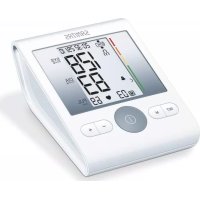
SBM 22 - Blood pressure monitor SANITAS - Free user manual and instructions
Find the device manual for free SBM 22 SANITAS in PDF.



| Product type | Automatic upper arm blood pressure monitor |
| Dimensions | L 134 mm x W 103 mm x H 60 mm |
| Weight | Approx. 367 g (without batteries, with cuff) |
| Power supply | 4 AA LR6 1.5 V batteries |
| Memory | 4 x 30 positions with date and time |
| Measurement range – Pressure | 0-300 mmHg (pressure in the cuff) |
| Measurement range – Systolic pressure | 50-280 mmHg |
| Measurement range – Diastolic pressure | 30-200 mmHg |
| Measurement range – Pulse | 40-199 beats/min |
| Indicator accuracy | Systolic/diastolic: ±3 mmHg; pulse: ±5% of displayed value |
| Cuff size | 22 to 36 cm (standard included) |
| Main functions | WHO risk indicator, arrhythmia detection, alarm, user memory, average calculation |
| Care and cleaning | Clean with a slightly damp cloth; do not use detergent or solvent; do not immerse |
| Safety | Internal power supply, IP21, type BF; automatic shut-off; electromagnetic compatibility |
| Spare parts | Standard cuff (ref. 163.912) available |
| Repairability | Repairs exclusively by authorized customer service |
| Warranty | 2 years |
| Operating conditions | +10°C to +40°C, 10-85% RH non-condensing |
| Storage conditions | -20°C to +55°C, 10-90% RH, 800-1050 hPa |
Frequently Asked Questions - SBM 22 SANITAS
User questions about SBM 22 SANITAS
0 question about this device. Answer the ones you know or ask your own.
Ask a new question about this device
Download the instructions for your Blood pressure monitor in PDF format for free! Find your manual SBM 22 - SANITAS and take your electronic device back in hand. On this page are published all the documents necessary for the use of your device. SBM 22 by SANITAS.
USER MANUAL SBM 22 SANITAS
Quelle: WHO, 1999 (World Health Organization)
service@sanitas-online.de
Read these instructions for use carefully and keep them for later use, be sure to make them accessible to other users and observe the information they contain.
Contents
- Included in delivery 22
- Signs and symbols 23
- Intended use 24
4.Warnings and safety notes 24 - Device description 27
- Initial use 28
- Usage 30
- Cleaning and maintenance 35
- Accessories and replacement parts 36
10.What if there are problems? 36 - Disposal 37
- Technical specifications 37
13.Warranty/Service 38
1. Included in delivery
Check that the exterior of the cardboard delivery packaging is intact and make sure that all contents are present. Before use, ensure that there is no visible damage to the device or accessories and that all packaging material has been removed. If you have any doubts, do not use the device and contact your retailer or the specified Customer Service address.
Blood pressure monitor
- Upper arm cuff
- 4 x 1.5 V LR6 AA batteries
- Storage bag
- Instructions for use
2. Signs and symbols

Signs and symbols
The following symbols are used in these instructions for use, on the packaging and on the type plate for the device and the accessories:
| WARNING indicates a hazardous situation which, if not avoided, could result in death or serious injury. | |
| CAUTION indicates a hazardous situation which, if not avoided, may result in minor or moderate injury. | |
| Product information Note on important information | |
| Observe the instructions Read the instructions before starting work and/or operating devices or machines | |
| Isolation of applied parts, type BF Galvanically isolated application part (F stands for “floating”); meets the requirements for leakage currents for type BF |
| - - - | Direct current The device is suitable for use with direct current only |
| Disposal in accordance with EC Directive WEEE (Waste Electrical and Electronic Equip- ment) | |
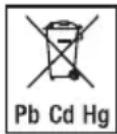
| Pb Cd Hg | Do not dispose of batteries containing haz- ardous substances with household waste |
| 21 PAP | Disposition of packaging in an environmen- tally friendly manner |
| Manufacturer | |
| Temperature limit The temperature limit values to which the medical device can safely be exposed are indicated. | |
| % | Humidity, limit Indicates the humidity range to which the medical device can safely be exposed. |
| Atmospheric pressure, limit Indicates the range of atmospheric pres-sures to which the medical device can be safely exposed. | |
| IP21 | Protected against solid foreign objects 12.5 mm in diameter and larger, and against vertically falling drops of water |
| SN | Serial number |
| CE0483 | CE labelling This product satisfies the requirements of the applicable European and national directives. |
3. Intended use
Intended use
The blood pressure monitor is intended for the fully automatic, non-invasive measurement of arterial blood pressure and pulse values on the upper arm.
Target group
It is designed for self-measurement by adults in the home environment and is suitable for users whose upper arm circumference is within the range printed on the cuff.
Indication/clinical benefits
The user can record their blood pressure and pulse values quickly and easily using the device. The recorded values are classified according to internationally applicable guidelines and evaluated graphically. Furthermore, the device can detect any irregular heart beats that occur during measurement and inform the user via a symbol in the display. The device saves the recorded measurements and can also output average values of previous measurements. The recorded data can provide healthcare service providers with support during the diagnosis and treatment of blood pressure problems, and therefore plays a part in the long-term monitoring of the user's health.
4.Warnings and safety notes

Contraindications
- Do not use the blood pressure monitor on newborns, children or pets.
- People with restricted physical, sensory or mental skills should be supervised by a person responsible for their safety and receive instructions from this person on how to use the device.
-
If you have any of the following conditions, it is essential you consult your doctor before using the device: cardiac arrhythmia, circulatory problems, diabetes, pregnancy, pre-eclampsia, hypotension, chills, shaking.
-
People with pacemakers or other electrical implants should consult their doctor before using the device.
- The blood pressure monitor must not be used in connection with a high-frequency surgical unit.
- Do not use the cuff on people who have undergone a mastectomy.
- Do not place the cuff over wounds as this may cause further injury.
- Make sure that the cuff is not placed on an arm in which the arteries or veins are undergoing medical treatment, e.g. intravascular access or intravascular therapy, or an arteriovenous (AV) shunt.

General warnings
- The measured values taken by you are for your information only - they are no substitute for a medical examination. Discuss the measured values with your doctor and never make your own medical decisions based on them (e.g. regarding dosages of medicines).
- The device is only intended for the purpose described in these instructions for use. The manufacturer is not liable for damage resulting from improper or incorrect use.
-
Using the blood pressure monitor outside your home environment or whilst on the move (e.g. whilst travelling in a car, ambulance or helicopter, or whilst undertaking physical activity such as playing sport) can influence the measurement accuracy and cause incorrect measurements.
-
Cardiovascular diseases may lead to incorrect measurements or have a detrimental effect on measurement accuracy.
- Do not use the device at the same time as other medical electrical devices (ME equipment). This could lead to a malfunction of the device and/or an inaccurate measurement.
- Do not use the device outside of the specified storage and operating conditions. This could lead to incorrect measurements.
- Only use the cuffs included in delivery or cuffs described in these instructions for use for the device. Using another cuff may lead to measurement inaccuracies.
- Please note that when inflating the cuff, the functions of the limb in question may be impaired.
- Do not perform measurements more frequently than necessary. Due to the restriction of blood flow, some bruising may occur.
- During the blood pressure measurement, the blood circulation must not be stopped for an unnecessarily long time. If the device malfunctions remove the cuff from the arm.
- Place the cuff on your upper arm only. Do not place the cuff on other parts of the body.
- Small parts may present a choking hazard for small children if swallowed. They should therefore always be supervised.

General precautions
- The blood pressure monitor is made from precision and electronic components. The accuracy of the measurements and service life of the device depend on its careful handling.
- Protect the device from impacts, humidity, dirt, marked temperature fluctuations and direct sunlight.
- Ensure the device is at room temperature before measuring. If the measuring device has been stored close to the maximum or minimum storage and transport temperatures and is placed in an environment with a temperature of 20^ , it is recommended that you wait approx. 2 hours before using the measuring device.
- Do not drop the device.
- Do not use the device in the vicinity of strong electromagnetic fields and keep it away from radio systems or mobile telephones.
- We recommend that the batteries be removed if the device is not to be used for a prolonged period of time.
- Avoid any mechanical restriction, compression or bending of the cuff line.
Measures for handling batteries

- If your skin or eyes come into contact with battery fluid, rinse the affected areas with water and seek medical assistance.
- Choking hazard! Small children may swallow and choke on batteries. Therefore, store batteries out of the reach of small children.
- Risk of explosion! Do not throw batteries into a fire.
- If a battery has leaked, put on protective gloves and clean the battery compartment with a dry cloth.
- Do not disassemble, open or crush the batteries.

- Observe the plus (+) and minus (-) polarity signs.
- Protect the batteries from excessive heat.
- Do not charge or short-circuit batteries.
- If the device is not to be used for a relatively long period, take the batteries out of the battery compartment.
- Use identical or equivalent battery types only.
Always replace all batteries at the same time. - Do not use rechargeable batteries!

Notes on electromagnetic compatibility
- The device is suitable for use in all environments listed in these instructions for use, including domestic environments.
- The use of the device may be limited in the presence of electromagnetic disturbances. This could result in issues such as error messages or the failure of the display/device
- Avoid using this device directly next to other devices or stacked on top of other devices, as this could lead to faulty operation. If, however, it is necessary to use the device in the manner stated, this device as well as the other devices must be monitored to ensure they are working properly.
- The use of accessories other than those specified or provided by the manufacturer of this device can lead to an increase in electromagnetic emissions or a decrease in the device's electromagnetic immunity; this can result in faulty operation.
- Failure to comply with the above can impair the performance of the device.
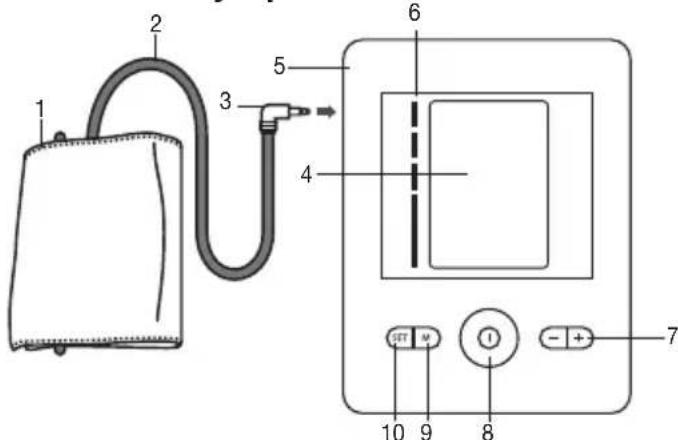
5. Device description
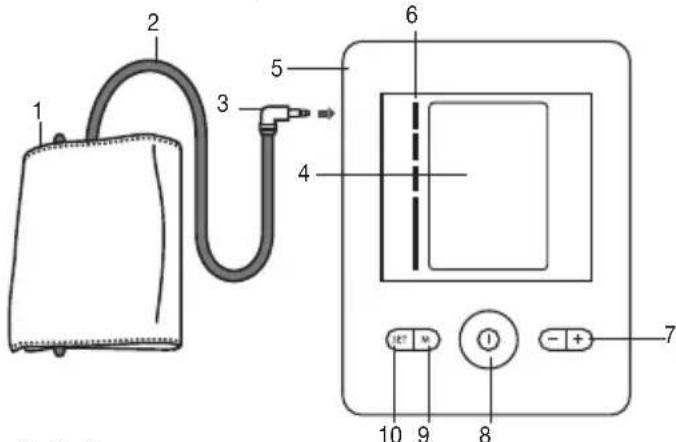
1.Cuff
2. Cuff line
3. Cuff connector
4. Display
5. Connection for cuff connector
6. Risk indicator
7. Function buttons +/-
8. START/STOP button ①
9. Memory button M
10. Setting button SET
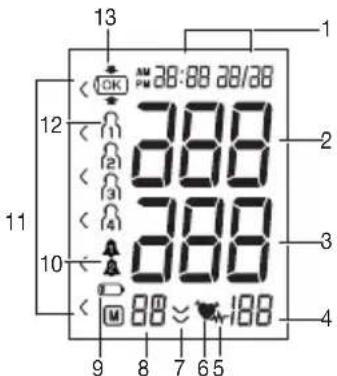
Information on the display:
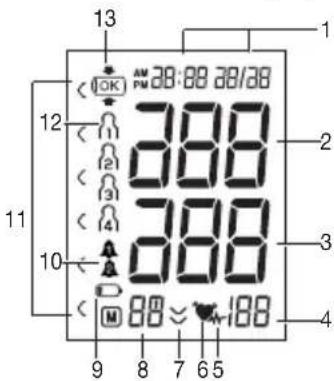
- Time and date
- Systolic pressure
- Diastolic pressure
- Calculated pulse value
5.Cardiac arrhythmia symbol - Pulse symbol
- Release air
- Memory display: average value (R), morning (R), evening (P), memory space number
- Battery replacement symbol
- Alarm function
- Risk indicator
- User memory
- Cuff position control
6. Initial use
Inserting the batteries
- Remove the battery compartment lid on the rear of the device.
- Insert four 1.5 V AA (alkaline type LR6) batteries. Make sure that the batteries are inserted the correct way round.
- Close the battery compartment lid again carefully.
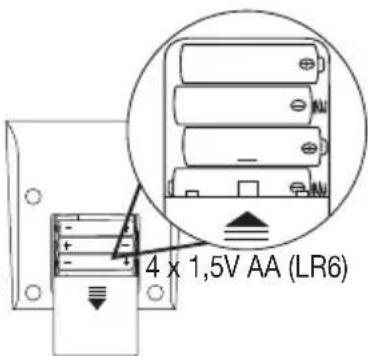
If the battery replacement symbol is permanently displayed, you can no longer perform any measurements and must replace all batteries. Once the batteries have been removed from the device, the date and time must be set again. Any saved measurements are retained.
Making settings
You must make sure that the device has the correct settings before use in order to be able to make full use of all functions. Only by doing so can your measurements with associated date and time be saved and accessed later by you.
There are two different ways to access the menu from which you can adjust the settings:
- Before initial use and after each time you replace the battery: When inserting batteries into the device, you will be taken to the relevant menu automatically.
- If the batteries have already been inserted: Press and hold the settings button SET on the device when switched off for approx. 5 seconds.
In this menu you can adjust the following settings in succession:

The hour format now flashes on the display.
- Using the +/- setting buttons, select your desired hour format and confirm with the SET memory button.

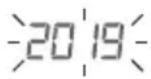
The year flashes on the display.
- Using the + / - setting buttons, select your desired number for the year and confirm with the SET memory button.
Date
The month flashes on the display.
- Using the +/- setting buttons, select your desired month and confirm with the SET memory button.
The day flashes on the display. - Using the +/- setting buttons, select your desired day and confirm with the SET memory button.
The hour flashes on the display.
- Using the +/- setting buttons, select your desired number for the hour and confirm with the SET memory button.
The minute flashes on the display. - Using the +/- setting buttons, select your desired number for the minute and confirm with the SET memory button.

You can set 2 different alarm times to remind yourself to take the measurement. To set the alarm, proceed as follows:
- Press and hold the function buttons - and + simultaneously for 5 seconds.
- Alarm shown in the display, "on" or "off" flashes at the same time. With the function buttons +/-, choose whether Alarm should be activated ("on" flashes) or deactivated ("off" flashes) and confirm with the setting button SET.
- If Alarm A deactivated ("off") you automatically switch to setting Alarm B.
- If Alarm activated, the hours flash on the display. Select the desired hour using the function buttons +/- and confirm with SET. The minutes flash on the display. Select the desired minute using the function buttons +/- and confirm with SET.
- Alarm is shown in the display, "on" or "off" flashes at the same time. To set, proceed as for Alarm 1. The blood pressure monitor switches itself off automatically.
User
Now select the desired user memory 1,2or3 4 by pressing the memory button M.
- If you do not select a user memory, the measurement is stored in the most recently used user memory.
- To switch off, press the START/STOP button ① If you forget to turn off the device, it will switch itself off automatically after approx. 3 minutes.
7. Usage
General rules when measuring blood pressure yourself
- In order to generate as informative a profile of the progression of your blood pressure as possible and ensure that the measured values can be compared, you should measure your blood pressure regularly and always at the same times of day. It is recommended that you measure your blood pressure twice a day: once in the morning after getting up and once in the evening.
- You should always carry out the measurement when you are sufficiently physically rested. You should therefore avoid taking measurements during stressful periods.
- Do not take a measurement within 30 minutes of eating, drinking, smoking or exercising.
-
Before the initial blood pressure measurement, make sure always to rest for 5 minutes.
-
Furthermore, if you want to take several measurements in succession, make sure always to wait for at least 1 minute between the individual measurements.
- Repeat the measurement if you are unsure of the measured value.
Attaching the cuff
- Fundamentally, blood pressure can be measured on both arms. Certain deviations between the measured blood pressure on the right arm and left arm are due to physiological causes and completely normal. You should always perform the measurement on the arm with the highest blood pressure values. Before starting self-measurement, consult your doctor in this regard. From this point on, always take measurements on the same arm.
- The device may only be operated with one of the following cuffs. This should be selected in accordance with your upper arm circumference. The fit should be checked before measurement using the index mark described below.
| Ref. no. | Designation Arm circumference |
| 163.912* Standard cuff 22-36 cm |
- Included in standard delivery
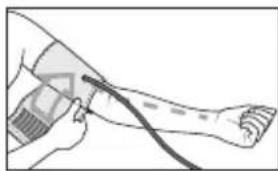
Pass your bare upper arm through the tube-shaped cuff.
- The cuff must be placed on the upper arm so that the bottom edge is positioned 2 - 3cm above the elbow and over the artery. The line should point to the centre of the palm.
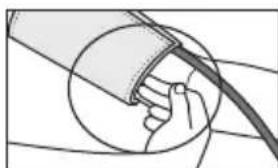
- Now tighten the free end of the cuff, but make sure that it is not too tight around the arm and close the hook-and-loop fastener. The cuff should be fastened so that two fingers can fit under the cuff.
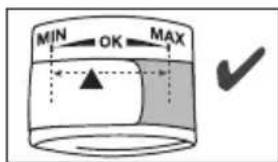
- This cuff is suitable for you if the index mark () is within the OK range after fitting the cuff on the upper arm.
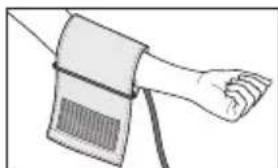
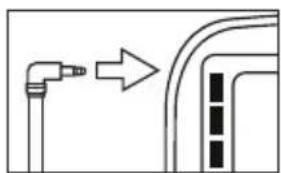
- Now insert the cuff line into the connection for the cuff connector.
Adopting the correct posture
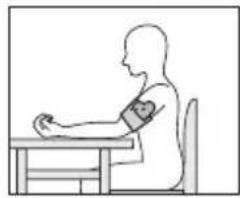
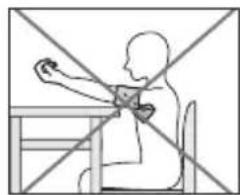
- To carry out a blood pressure measurement, make sure you are sitting upright and comfortably. Lean back and place your arm on a surface. Do not cross your legs. Place your feet next to each other flat on the floor.
Always make sure that the cuff is at heart level. - To avoid distorting the measurement, you should remain as still as possible during the measurement and not speak.
Performing the blood pressure measurement
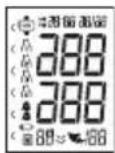
To start the blood pressure monitor, press the Start/stop button All display elements are briefly displayed.
N
After the full-screen display, the respective alarm symbols are displayed if alarm is activated.
- The blood pressure monitor will begin the measurement automatically after approx. 3 seconds.
- The cuff inflates automatically while the actual measuring process starts. As soon as a pulse is found, the pulse symbol displayed.
- The remaining air is released quickly once the measurement is complete.
- The systolic pressure, diastolic pressure and pulse rate measurements are displayed.
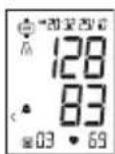
- E_- appears if the measurement could not be performed properly. In this case, please read the section "What if there are problems?".
- The cuff position control symbol is displayed throughout the entire measurement. If the cuff is applied too tightly or too loosely, then and "E3" are displayed. In such cases, the measurement is cancelled after approx. 5 seconds and the device switches itself off. Apply the cuff correctly and take a new measurement.
Evaluating the results
General information about blood pressure
- Blood pressure is the force with which the bloodstream presses against the arterial walls. Arterial blood pressure constantly changes in the course of a cardiac cycle.
-
Blood pressure is always stated in the form of two values:
-
The highest pressure in the cycle is called systolic blood-pressure. This arises when the heart muscle contracts and blood is pumped into the blood vessels.
-
The lowest is diastolic blood pressure, which is when the heart muscle has completely stretched back out and theheart fills with blood.
-
Fluctuations in blood pressure are normal. Even during repeat measurements, considerable differences between the measured values may occur. One-off or irregular measurements therefore do not provide reliable information about the actual blood pressure. Reliable assessment is only possible when you perform the measurement regularly under comparable conditions.
Cardiac arrhythmia:
This device can identify any cardiac rhythm disturbances as part of the analysis of your recorded pulse signal during blood pressure measurement. In this case, after the measurement, the device will indicate any irregularities in your pulse by displaying the symbol in the display. This can be an indicator for arrhythmia. Arrhythmia is an illness in which the heart rhythm is abnormal because of flaws in the bioelectrical system that regulates the heartbeat. The symptoms (skipped or premature heart beats, pulse being slow or too fast) can be caused by factors such as heart disease, age, physical disposition, excess alcohol and tobacco, stress or lack of sleep. If the symbol appears on the display after the measurement, the measurement must be repeated as the measurement accuracy may be impaired. To assess your blood pressure, only use the results that have been recorded without corresponding irregularities in your pulse. If the symbol appears frequently, please consult
your doctor. Only they can establish the existence of an arrhythmia during a checkup, using their means of diagnosis.
Risk indicator:
The World Health Organization (WHO) has defined the internationally recognised classification for the evaluation of measured blood pressure values listed in the table below:
| Measured blood pressure value range | Classification | Colour of the risk indicator | |
| Systole (in mmHg) | Diastole (in mmHg) | ||
| ≥180≥110 | High blood pressure stage 3 (severe) | Red | |
| 160–179100–109 | High blood pressure stage 2 (moderate) | Orange | |
| 140–15990–99 | High blood pressure stage 1 (mild) | Yellow | |
| 130–13985–89 | Normal Green | ||
| 120–12980–84 | Green | ||
| <120<80 | |||
Source: WHO, 1999 (World Health Organization)
The risk indicator (the arrow in the display and the associated scale on the device) shows which category the recorded blood pressure values fall into. If the measured values are in
two different classifications (e.g. systole in the high normal category and diastole in the normal category), the risk indicator then always shows you the higher category - "high normal" in the example described.
Please be aware that these standard values can only serve as a general guideline, as the individual blood pressure varies in different people and different age groups, etc.
Furthermore, it must be noted that measurements taken yourself while at home are generally lower than those that are taken by the doctor. For this reason, it is important that you regularly consult your doctor for advice. Only they are able to give you your personal target values for controlled blood pressure – in particular if you receive medicinal therapy.
Saving, displaying and deleting measured values
User memory
The results of every successful measurement are stored together with the date and time. If there are more than 30 measurements, the oldest measurements are lost.
-
Press the memory button M. Select the desired user memory (A)... by pressing the memory button M again.
-
If you press the function button +, the average value Rof all the stored measured values in the user memory will be displayed.
If you press the function button ^+ again, the average value of the morning measurements for the last 7 days will be displayed (morning:5 a.m.-9 a.m., display R)
If you press the function button ^+ again, the average value of the evening measurements for the last 7 days will be displayed (evening: 6 p.m. - 8 p.m., display Pm - If you continue to press the function button +, the most recent individual measured values are displayed in turn with the date and time.
- To switch off, press the START/STOP button ①.
-
If you forget to switch off the device, it will switch itself off automatically after 30 seconds.
-
If you want to delete the whole memory for a specific user, press the memory button M. Press and hold down the memory button M and the setting button SET simultaneously for 5 seconds.
8. Cleaning and maintenance
- Clean the device and cuff carefully using a slightly damp cloth only.
- Do not use any cleaning agents or solvents.
- Under no circumstances hold the device and cuff under water, as this can cause liquid to enter and damage the device and cuff.
- If you store the device and cuff, do not place heavy objects on the device and cuff. Remove the batteries. The cuff line should not be bent sharply.
9. Accessories and replacement parts
Accessories and replacement parts are available from the corresponding service address (according to the service address list). Please state the corresponding order number.
| Designation Item number and/or | order number |
| Standard cuff (22-36 cm) 163.912 |
10. What if there are problems?
| Error mes-sage | Possible cause | Solution |
| ΕΙ | Unable to re-cord a pulse. | Please wait one minute and repeat the measurement.Ensure that you do not speak or move during the measure-ment. |
| ΕΙΙ | You moved or spoke during the measure-ment. | |
| ΕΙΙΙ | The cuff was not attached correctly. | Please observe the informa-tion in chapter “Attaching the cuff”. |
| Error mes-sage | Possible cause \$olution | |
| E4 | An error oc-curred during the measure-ment. | Please wait one minute and repeat the measurement.Ensure that you do not speak or move during the measure-ment. |
| ES | The inflation pressure is higher than 300 mmHg. | Please take another meas-urement to check whether the cuff can be correctly inflated.Make sure that neither your arm nor other heavy objects are pressing on the line, and that the line is not bent. |
| E6 | There is a sys-tem error. | If this error message ap-pears, please contact Cus-tomer Services. |
|  | The batteries are almost empty. | Insert new batteries into the device. |
11.Disposal

Repairing and disposing of the device
- Do not repair or adjust the device yourself. Proper operation can no longer be guaranteed in this case.
- Do not open the device. Failure to comply will invalidate the warranty.
- Repairs must only be carried out by Customer Services or authorised retailers. Before making a claim, please check the batteries first and replace them if necessary.
- For environmental reasons, do not dispose of the device in household waste at the end of its service life. Dispose of the device at a suitable local collection or recycling point in your country. Dispose of the device in accordance with EC Directive - WEEE (Waste Electrical and Electronic Equipment). If you have any questions, please contact the local authorities responsible for waste disposal.

Disposing of the batteries
-
The empty, completely flat batteries must be disposed of through specially designated collection boxes, recycling points or electronics retailers. You are legally required to dispose of the batteries.
-
The codes below are printed on batteries containing harmful substances:
Pb = Battery contains lead,
Cd = Battery contains cadmium,
Hg = Battery contains mercury.
12. Technical specifications
Model No. SBM 22
| Measurement method | Oscillometric, non-invasive blood pres-sure measurement on the upper arm |
| Measurement range | Cuff pressure 0-300 mmHg,Systolic 50-280 mmHg,Diastolic 30-200 mmHg,Pulse 40-199 beats/minute |
| Display accuracy Systolic ± 3 mmHg, Diastolic ± 3 mmHg,Pulse ± 5% of the value shown | |
| Measurement inaccuracy | Max. permissible standard deviation according to clinical testing:Systolic 8 mmHg /Diastolic 8 mmHg |
| Memory 4 x 30 memory spaces | |
| Dimensions L 134 mm x W 103 mm x H 60 mm | |
| Weight Approximately 367 g (withoutbatteries, with cuff) | |
| Cuff size | 22 to 36 cm |
| Permissible operat-ting conditions | +10°C to +40°C, 10 to 85% relative humidity (non-condensing) |
| Permissible sto-rage conditions | -20°C to +55°C, 10-90% relative humi-dity, 800-1050 hPa ambient pressure |
| Power supply 4 x 1.5 V | —— AA batteries |
| Battery life For approx. 300 measurements, depen-ding on levels of blood pressure and pump pressure | |
| Classification Internal supply, IP21, no AP or APG, continuous operation, application part type BF | |
The serial number is located on the device or in the battery compartment.
Technical information is subject to change without notification to allow for updates.
- This device complies with European Standard EN 60601-1-2 (In accordance with CISPR 11, IEC 61000-3-2, IEC 61000-3-3, IEC 61000-4-2, IEC 61000-4-3, IEC 61000-4-4, IEC 61000-4-5, IEC 61000-4-6, IEC 61000-4-7, IEC 61000-4-8, IEC 61000-4-11, EN 55024) and is subject to particular precautions with regard to electromagnetic compatibility.
Please note that portable and mobile HF communication systems may interfere with this unit.
- The device complies with the EU Medical Devices Directive 93/42/EEC, the German Medical Devices Act (Medizinproduktgesetz) and the standards EN 1060-3 (Non-invasive sphygmomanometers - Part 3: Supplementary requirements for electro-mechanical blood pressure measuring systems) and IEC 80601-2-30 (Medical electrical equipment - Part 2 - 30: Particular requirements for the basic safety and essential performance of automated non-invasive sphygmomanometers).
- The accuracy of this blood pressure monitor has been carefully checked and developed with regard to a long useful life. If using the device for commercial medical purposes, it must be regularly tested for accuracy by appropriate means. Precise instructions for checking accuracy may be requested from the service address.
13. Warranty / Service
Hans Dinslage GmbH, Riedlinger Straße 28, 89524 Uttenweiler, Germany (hereinafter referred to as "HaDi") provides a warranty for this product, subject to the requirements below and to the extent described as follows.
The warranty conditions below shall not affect the seller's statutory warranty obligations which ensue from the sales agreement with the buyer.
The warranty shall apply without prejudice to any mandatory statutory provisions on liability.
HaDi guarantees the perfect functionality and completeness of this product.
The worldwide warranty period is 2 years, commencing from the purchase of the new, unused product from the seller.
The warranty only applies to products purchased by the buyer as a consumer and used exclusively for personal purposes in the context of domestic use. German law shall apply.
During the warranty period, should this product prove to be incomplete or defective in functionality in accordance with the following provisions, HaDi shall carry out a repair or a replacement delivery free of charge, in accordance with these warranty conditions.
If the buyer wishes to make a warranty claim, they should approach their local retailer in the first instance: see the attached "International Service" list of service addresses.
The buyer will then receive further information about the processing of the warranty claim, e.g. where they can send the product and what documentation is required.
A warranty claim shall only be considered if the buyer can provide HaDi, or an authorised HaDi partner, with
- a copy of the invoice/purchase receipt, and
- the original product.
The following are explicitly excluded from this warranty:
- deterioration due to normal use or consumption of the product;
- accessories supplied with this product which are worn out or used up through proper use (e.g. batteries, rechargeable batteries, cuffs, seals, electrodes, light sources, attachments and nebuliser accessories);
- products that are used, cleaned, stored or maintained improperly and/or contrary to the provisions of the instructions for use, as well as products that have been opened, repaired or modified by the buyer or by a service centre not authorised by HaDi;
- damage that arises during transport between manufacturer and customer, or between service centre and customer;
- products purchased as seconds or as used goods;
- consequential damage arising from a fault in this product (however, in this case, claims may exist arising from product liability or other compulsory statutory liability provisions).
Repairs or an exchange in full do not extend the warranty period under any circumstances.
FRANÇAIS

2. Consels important

Symboles utilisés
Mesures relatives aux piles

Yka3aHnno 6paueHnIO c 6aTapeKamn

- Pn nnonaHnn KndKoCTn 3aKKyMyJrTopa HaKOxy NIN B rIa3a Heo6xOIMo IpombITb COOTBETCTByUOuY uactOK 60JIbUIMK OJIInueCTBOM BObl I O6paNTbc K BpaCy.
- Onachoctb nporlaatbIBaHnMaIeKnx DeTanei! MaJIeHbKne Detn MOrT npOrIOTnB 6batapeKn I NOdABNTbcra MM. NTo3tomy 6batapeKn Heo6xOIMXpaHTb B HeoCTyHOM dIra DeTeMecTe!
- OnachocTb B3pbIbA! He 6pocaiTe 6aTapeKnB OROHb.
- Ecni 6aTapeiKa noTeKNa, ouNCTne OTCeK nIra 6aTapeek cyxO caFpeTKoN, npedBapuTeJbHO HaeB3aUHTbIe nepuaTkN.
- He pa3bupaTe, He otKpbBaIte n He pa3bBaIte 6aTapeiKn.

- Ośpɑaŋte BHNMaHne Ha 3HaKn IOnJaPHoCTn: IJIIOc (+) u MInHyc (-).
3aunuatae 6atapeyn ot nepepeba. - He 3apjaKaTe 6aTapeiKn n He 3ambikaTe nx Ha-KopOTko.
- Ecn np6op dnteBHOe Bpem He nCnOJIb3yeTcra, n3BLeKeIte 6aTapeuKu.
-
IVcNoJIb3yIe 6aTapeKn OdHOro Tnna NJIpaPaBHO-ueHHbIX TINOB.
-
3amehnTe BCE 6aTapeKn cpa3y.
- He nCnoJIb3yIte nepe3apJxJaEMbIe akKMyJIrTopbI!

Yka3aHnNo 3JIeKtpOMaHHTHO COBmecTmOCTN
-Пиборпретна3нандяразьВуслOBnx,пер
чслелнblB HabToaSeHnCTpyKuIN NO npIMHeHIO,
В TOMЧИСЕВДOMaSHNxУCSLOBnx.
-Пинанчилджгрмогнгьхnomex BO3MOXHOCTNИСПОЛБ3OBAHЯпибopa могут 6ыITb orpaHnueHbI.В ATOM CNYaee BO3MOXHbI, K npIMepy, coo6uEHHa 06 OwIN6kax NII NBIXOД n3 CTPOJ DnCnpeY INI CaMOrO npi6opa.
He nCnoB3yIte daHbI np6op pIaOM cpyrMn yCTpoIcTBAMN He ycTaHaBnBaIe erO Ha dpyrne np60pbl. 3TO MOKET npNBecTN K c6oM B pa6ote. EcIn np6Op BCE JepxOuNTcN CNOJb3ObaTb B ONcaHHbx Bbiue ycIOBnX, CNeDyeT H6JIoDaTb 3a Hm N dpyrMn yCTpoIcTBAMN, YTO6bl y6eIITbcra, YTO OHI pa6otaOT NaIIexKaUIM o6pa3OM.
-ПиMuMeHHeIпинадлeЖнocTeI,OTJINuAIOUxCxOу yKa3aHHbIX npoN3BOIDTeIeM nII npiJaRaEmbIX K daHHOMy npi6OpY,MOKET npiBecTn K poCTy 3JIeKTPomarHHTbIX NOMex nII Ocna6JIeHIO NOMEXOyCToMHBOcTn npi6opaN TEM caMbIM BbI3BaTb C60N B erO pa6Ote.
- HecobioeHne daHHoro yka3aHn moKeT OTpuCaTeIbHo cka3aTbcra Ha pa6oUx xapaKTePncTikax np6opa.
5.Описане устpoиства
- MaHxeta
- LlaHr MaHKeTbI
- LTekep MaXkeTbI
4.Диспелей - Pa3bEmДЯшTeKepa MaHxKeTbI
6.Индикатор рнсka
7.ФyHKUMOHaJIbHbIe KHOKN+/- - Khonka BKJ./BbIKJ. ①
- Khonka coxpaheHnM
- Khonka HacptpoKu SET
HnkaaHa dnncnlee:
1.Bpemn ndata
2.CnCTOJIuYeCKoe DaBHeHne
3.ДиactoJIuYeCKoe daBHeHne
4.ИЗмeperнhoeЗачehипульca
5.CmB0J HApUeHnCepDeyHOro pntMa
6. Symbol tetna
7. Cnyck BO3dyxa n3 MaHKeTbI
8. INDnkaunna namrtn: cpeHne 3naueHne (R), ytpom (R), Beepom (P), HOMep JyeKu narn
9.CmboJI Heo6xOuMoCTn 3aMeHbI 6aTapeek
10. Tpeboxha CnHaHn3aun
11.Инданкатор риска
12. Nolb3OBaTeJIbcka naMaTb
13. IpoBepKa nocaKm MaHKeTbI

- Read these instructions for use carefully and keep them for later use, be sure to make them accessible to other users and observe the information they contain.
- Contents
- Included in delivery
- Signs and symbols
- Signs and symbols
- Intended use
- Intended use
- Target group
- Indication/clinical benefits
- 4.Warnings and safety notes
- Contraindications
- General warnings
- General precautions
- Measures for handling batteries
- Notes on electromagnetic compatibility
- Device description
- Information on the display:
- Initial use
- Inserting the batteries
- Making settings
- Date
- User
- Usage
- Attaching the cuff
- Adopting the correct posture
- Performing the blood pressure measurement
- N
- Evaluating the results
- Cardiac arrhythmia:
- Risk indicator:
- Saving, displaying and deleting measured values
- User memory
- Cleaning and maintenance
- Accessories and replacement parts
- What if there are problems?
- 11.Disposal
- Repairing and disposing of the device
- Disposing of the batteries
- Technical specifications
- Warranty / Service
- The warranty shall apply without prejudice to any mandatory statutory provisions on liability.
- If the buyer wishes to make a warranty claim, they should approach their local retailer in the first instance: see the attached "International Service" list of service addresses.
- FRANÇAIS
- Consels important
- Symboles utilisés
- Mesures relatives aux piles
- Yka3aHnno 6paueHnIO c 6aTapeKamn
- Yka3aHnNo 3JIeKtpOMaHHTHO COBmecTmOCTN
- 5.Описане устpoиства
- HnkaaHa dnncnlee:
Brand : SANITAS
Model : SBM 22
Category : Blood pressure monitor