ManualGo.com
MultiScanner Plus - Measuring equipment Laserliner - Free user manual and instructions
Find the device manual for free MultiScanner Plus Laserliner in PDF.



Frequently Asked Questions - MultiScanner Plus Laserliner
Download the instructions for your Measuring equipment in PDF format for free! Find your manual MultiScanner Plus - Laserliner and take your electronic device back in hand. On this page are published all the documents necessary for the use of your device. MultiScanner Plus by Laserliner.
USER MANUAL MultiScanner Plus Laserliner
2. Securing to prevent system being switched on again,
3. Checking zero potential, two-pole, 4. Earthing and short-
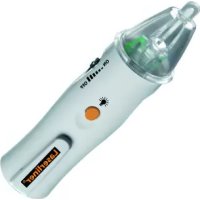
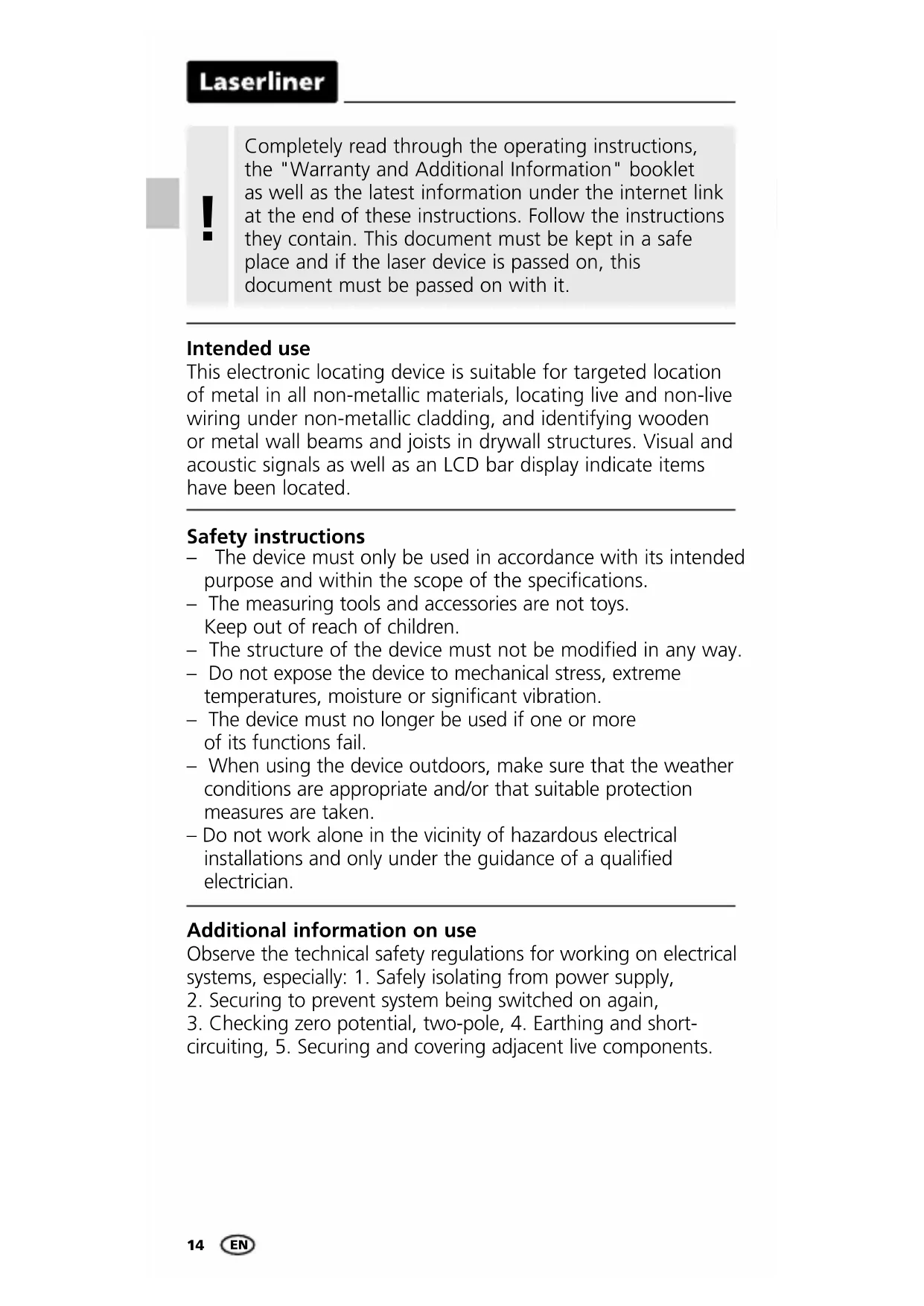
circuiting, 5. Securing and covering adjacent live components. This electronic locating device is suitable for targeted location of metal in all non-metallic materials, locating live and non-live wiring under non-metallic cladding, and identifying wooden or metal wall beams and joists in drywall structures. Visual and acoustic signals as well as an LCD bar display indicate items have been located. Intended use Completely read through the operating instructions, the "Warranty and Additional Information" booklet as well as the latest information under the internet link at the end of these instructions. Follow the instructions they contain. This document must be kept in a safe place and if the laser device is passed on, this document must be passed on with it.
Safety instructions Dealing with electromagnetic radiation – The measuring device complies with electromagnetic compatibility regulations and limit values in accordance with EMC-Directive 2014/30/EU. – Local operating restrictions – for example, in hospitals, aircraft, petrol stations or in the vicinity of people with pacemakers – may apply. Electronic devices can potentially cause hazards or interference or be subject to hazards or interference. – The measuring accuracy may be affected when working close to high voltages or high electromagnetic alternating elds. – Precautions: Do not use any other MultiScanner Plus devices within a radius of less than 5 metres. Do not use any electronic transmitters or electric motors in the vicinity. EN16 USB-C
Red: Live wire warning Red: Metal or live wire is nearby Green: No metal or live wiring nearby 3 Symbols 2 Operation Switch on: Briefly press the On/Off button (c). Switch off: Briefly press the On/Off button (c). AutoShutOff: The device will automatically switch itself off about 5 minutes after the last measurement. – Use the power supply/charger unit only in closed rooms; do not expose to moisture or rain otherwise risk of electric shock. – Ensure the device’s battery is fully charged before using the device. – Connect the power pack/charger to the mains power supply and the socket on the device‘s battery pack. Please only use the power pack/charger supplied. Using any other power pack/charger will invalidate the warranty. – The LED of the battery on the device lights red while the battery is charging. The LED changes to green when charging is complete. The device has a replaceable battery. Contact your distributor or the UMAREX-LASERLINER service department.
Use of lithium-ion rechargeable battery EN17 MultiScanner Plus
The device and the wall must maintain contact during calibration in STUD-SCAN mode and throughout the entire measurement process. A hand should remain at the device the entire time as well.
Manual calibration Pressing the CAL button (d) manually calibrates the device. This allows measurements to be restarted and objects to be isolated more precisely. Maximum sensitivity is achieved when the device is held in the air while calibrating. This can be useful for METAL and AC-SCAN measurements. Auto-Calibration The automatic calibration is performed in METAL-SCAN and AC-SCAN measurement immediately when the device is switched on and when the measuring mode is switched. Auto-Cal Plus When an object has been found, the device performs another automatic calibration in METAL-SCAN measurement. This simplifies the process of isolating objects to be measured and adjusting the device to different surfaces. Calibration Centre of object found. Edge of object found. Metal or wiring found. Metal, wiring or object nearby. EN18
Measuring in METAL-SCAN mode The tool is able to detect hidden metal in all non-metallic materials, e.g. brick, con- crete, screed, wood, plaster fibreboard, gas concrete, ceramic and mineral buil- ding materials. The device shows whether the metal is magnetic or non-magnetic and displays the depth. The depth display appears as soon as the object has been clearly identified. – Select METAL-SCAN (button e). – As soon as “CAL OK” disappears, you can move the device. – MOVE: Move the tool slowly across the surface. Briefly press the Mode button (e). METAL-SCAN: Detecting metal in all non-metallic materials with a depth gauge up to 10 cm (non-magnetic) and up to 12 cm (magnetic). AC-SCAN: Locating live wiring up to 2 cm directly under non-metallic cladding. STUD-SCAN: Detecting wooden wall beams and joists as well as metal up to 4 cm in drywall structures under non-metallic cladding. Select measurement mode EN19 MultiScanner Plus
Isolate an object to be measured by passing over it several times. Manual calibration Isolate an object to be measured by passing over it several times. EN20
For localising live wires directly beneath the plaster or behind wooden panels and other non- metallic panelling. It is not possible to detect live wires in dry walls with metal studs. – Select AC-SCAN (button e). – MOVE: Move the tool slowly across the surface. AC-SCAN Tip 1: The position between the two markings is the mid-point of the metal object. Through the high measuring sensitivity, thick metal objects appear broader than they are in real life. Therefore move the device over the newly found object as shown in Image B. The device is calibrated automatically during this process. Manual calibration should be performed near the place found last as shown in Image C. Repeat this step as needed. Tip 2: The position where you start is important: First place the device in a position where you know there is no metal. Tip 3: In the case of complicated applications, e.g. ribbed steel, scan the surface both horizontally and vertically. Tip 4: Flexible floor and wall heating pipes which contain a metal foil and are located near the surface may also be detected. Test for this function in places where you know the position of such pipes. Note: If an object is deep inside a wall, the device may not indicate it clearly. EN21 MultiScanner Plus
Isolate an object to be measured by passing over it several times. Manual calibration Manual calibration EN22 8 Measuring in STUD-SCAN mode Detecting wooden wall beams and joists as well as metal in drywall structures, e.g. under gypsum fibreboard, wood panels or other non-metallic cladding. – Select STUD-SCAN (button e). – Now follow the instructions on the VTN display. – ON WALL: Place the tool against the wall. – PRESS CAL: Press the calibration button (d) and wait until calibration is completed: CAL OK – MOVE: Move the tool slowly across the surface. Wires which are at a depth of more than 20 mm may not be detected.
Tip 1: Manual calibration should be performed near the place found last as shown in Image B/C. Repeat this step as needed. Tip 2: Because of static charges, electric fields may be detected at the side of the actual position of the wire. To carry away these charges, lay your free hand on the wall. Tip 3: Move the tool slowly as friction can generate interfering electric charges. Tip 4: If you suspect that wires must be present but cannot find any, this may be because they are shielded in conduits. Use METAL-SCAN in order to localise conduits. Tip 5: Metal in walls (e.g. metal studs) transmit electrical fields and may therefore cause interference. In this case, switch to METAL-SCAN in order to find the wire. Tip 6: The position where you start is important: To achieve maximum sensitivity, start by placing the device in a position which is known not to be near live wires. Note: If an object is deep inside a wall, the device may not indicate it clearly. EN23 MultiScanner Plus If electric wires or metal or plastic pipes are located near or in contact with a plaster fibreboard panel, they may be identified by the MultiScanner Plus as studs.
Tip 1: The device indicates the edge of the beam with “EDGE” and the centre of the beam with “CENTER”. Tip 2: The position where you start is important: First place the tool in a position where you know there is no stud. Otherwise, the message “ERROR” will appear in the display. To remedy: Move the tool to another position a few centimetres away and start measuring again. Tip 3: To avoid interference while scanning, keep your free hand and other objects at least 15 cm away from the MultiScanner Plus. Tip 4: The MultiScanner Plus will only find the outside edge of double studs and headers which may be fitted around doors, windows and corners. Tip 5: Ensure that you have really detected a stud. To do so, check on both sides whether other studs are present at equal distances, usually at 30, 40 or 60 cm. Also check that it is a stud by scanning at several places directly above and below the position of the first find. Tip 6: Textured ceilings: The ceiling must be covered with cardboard to protect it. Note: If an object is deep inside a wall, the device may not indicate it clearly. Manual calibration EN24
Information on maintenance and care Calibration Clean all components with a damp cloth and do not use cleaning agents, scouring agents and solvents. Store the device in a clean and dry place. The device needs to be calibrated and tested on a regular basis to ensureit produces accurate measurement results. We recommend carrying out calibration once a year. Contact your authorised dealer or else the UMAREX-LASERLINER Service Department. Always switch off the power supply when working near electric wires.