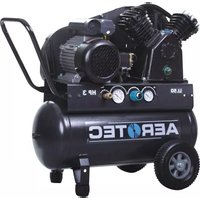
Mobilpack 2 - Air compressor Aerotec - Free user manual and instructions
Find the device manual for free Mobilpack 2 Aerotec in PDF.


| Product Type | Portable Air Compressor |
| Brand | Aerotec |
| Model | Mobilpack 2 |
| Tank Capacity | 2 L |
| Air Flow | 40 L/min |
| Maximum Air Pressure | 6.9 bar |
| Net Weight | 6.5 kg |
| Power Supply | Mains 230 V ~ 50 Hz or battery (sold separately) |
| Rated Current | 10 A |
| Motor Speed | 4600 rpm |
| Working Temperature | +5 to +40 °C |
| Ambient Humidity | < 50 % |
| Maximum Altitude | ≤ 1000 m |
| Pump | Oil-free |
| Applications | Pneumatic tools, inflation, spraying |
| Noise Level | Not specified (hearing protection recommended) |
| Safety | Safety valve, automatic shut-off, overload protection |
| Maintenance | Daily tank draining, valve check |
Frequently Asked Questions - Mobilpack 2 Aerotec
User questions about Mobilpack 2 Aerotec
0 question about this device. Answer the ones you know or ask your own.
Ask a new question about this device
Download the instructions for your Air compressor in PDF format for free! Find your manual Mobilpack 2 - Aerotec and take your electronic device back in hand. On this page are published all the documents necessary for the use of your device. Mobilpack 2 by Aerotec.
USER MANUAL Mobilpack 2 Aerotec
Read and understand tool labels and manual. Failure to follow could result in death or serious injury.
Save these instructions.
1. WORK AREA SAFETY
a. Keep your work area clean and well lit. Cluttered areas and benches invite accidents. Floor must not be slippery from wax or dust.
b. Do not operate power tools in explosive atmospheres, such as in the presence of flammable liquids, gases, or dust. Power tools create sparks which may ignite the dust or fumes.
c. Keep bystanders, children, and visitors away while operating tools.
d. Power tools create sparks which may ignite the dust or fumes. Keep bystanders, children, and visitors away while operating tools. Distractions can cause you to lose control.
e. Operate air compressor in an open area at least 457 mm away from any wall or object that could restrict the flow of fresh air to ventilation openings.
2. ELECTRICAL SAFETY
a. Avoid body contact with grounded surfaces such as pipes, radiators, ranges, and refrigerators. There is an increased risk of electric shock if your body is grounded.
b. Do not expose power tools to rain or wet conditions. Water entering a power tool will increase the risk of electric shock.
c. Do not abuse cord. Never use the cord to carry the tool or pull the plug from an outlet. Keep cord away from heat, oil, sharp edges, or moving parts. Replace damaged cords immediately. Damaged cords increase the risk of electric shock.
d. When operating a power tool outside, use an outdoor extension cord marked "W-A" or "W". These cords are rated for outdoor use and reduce the risk of electric shock.
3. PERSONAL SAFETY
a. Use safety equipment. Always wear eye protection. Dust mask, nonskid safety shoes, hard hat, or hearing protection must be used for appropriate conditions.
b. Always wear eye protection with side shields, along with hearing protection. Failure to do so could result in objects being thrown into your eyes and other possible serious injuries.
c. The employer and/or user must ensure that proper eye protection is worn.
d. We recommend a wide vision safety mask for use over eyeglasses or standard safety glasses that provide protection against flying particles both from the front and side.
e. Ensure compatibility of accessories before using.
f. Read and understand the operating manual for any accessories or air tools before using.
g. Additional safety protection will be required in some environments. For example, the working area may include exposure to a noise level which can lead to hearing damage. The employer and user must ensure that any necessary hearing protection is provided and used by the operator and others in the work area. Some environments will require the use of head protection equipment.
h. Stay alert, watch what you are doing, and use common sense when operating a tool. Do not use tool while tired or under the influence of drugs, alcohol or medication. A moment of inattention while operating power tools may result in serious personal injury.
i. Dress properly. Do not wear loose clothing or jewellery. Contain long hair. Keep your hair, clothing, and gloves away from moving parts. Loose clothes, jewellery, or long hair can be caught in moving parts.
j. Do not overreach. Keep proper footing and
English
balance at all times. Proper footing and balance enables better control of the tool in unexpected situations.
k. Do not use on a ladder or unstable support. Stable footing on a solid surface enables better control of the tool in unexpected situations.
- TOOL USE AND CARE
a. Do not exceed the pressure rating of any component in the system.
b. Protect material lines and air lines from damage or puncture. Keep hose and power cord away from sharp objects, chemical spills, oil, solvents, and wet floors.
c. Check hoses for weak or worn condition before each use, making certain all connections are secure. Do not use if defect is found.
d. Purchase a new hose or notify an authorized service center for examination or repair.
e. Release all pressures within the system slowly. Dust and debris may be harmful.
f. Store idle tools out of the reach of children and other untrained persons. Tools are dangerous in the hands of untrained users.
g. Maintain tools with care. Follow maintenance instructions. Properly maintained tools are easier to control.
h. Check for misalignment or binding of moving parts, breakage of parts, and any other condition that may affect the operation of the tool. If damaged, have the tool serviced before using.
i. Many accidents are caused by poorly maintained tools. j. Never point any tool toward yourself or others.
k. Keep the exterior of the air compressor dry, clean, and free from oil and grease. Always use a clean cloth when cleaning. Never use brake fluids, gasoline, petroleum-based products, or any strong solvents to clean the unit. Following this rule will reduce the risk of deterioration of the enclosure plastic
5. SERVICE
a. Tool service must be performed only by qualified repair personnel. Service or maintenance performed by unqualified personnel may result in a risk of injury.
b. Disconnect power supply, open drain valve to decompress tank and allow water to drain, and allow air compressor to become cool to the touch before servicing. Turn pressure regulator knob fully counterclockwise after shutting off compressor.
c. When servicing, use only identical replacement parts. Follow instructions in the Maintenance section of this manual. Use of unauthorized parts or failure to follow Maintenance instructions may create a risk of injury.
SPECIAL SAFETY RULES
-
Know your air compressor. Read operation manual carefully. Learn its applications and limitations, as well as the specific potential hazards related to this tool. Following this rule will reduce the risk of electric shock, fire, or serious injury.
-
Drain tank of moisture after use each day. If unit will not be used for a while, it is best to leave drain valve open until such time as it is to be used. This will allow moisture to completely drain out and help prevent corrosion on the inside of tank.
-
Risk of fire or explosion. Do not spray flammable liquids in a confined area. Spray area must be well ventilated. Do not smoke while spraying or spray where spark or flame is present. Keep compressors as far from the spraying area as possible, at least 4.6 m from the spraying area and all explosive vapors.
-
Risk of bursting. Do not adjust regulator to result in output pressure greater than marked maximum pressure of attachment and/or the item being inflated. Never use at pressure greater than 9.3 bar.
-
Use an air pressure gauge periodically while inflating an item to check the air pressure.
-
The machine shall be connected to a circuit protection device (fuse or circuit breaker). The protection device shall be set at 2 A current, and the user shall do necessary test according to clause 18.2.2 of EN 60204-1:2006 to check if the protection device is suitable for use.
-
To reduce the risk of electric shock, do not expose the machine to rain (water) or dust; store it indoors.
-
Inspect tank yearly for rust, pin holes, or other imperfections that could cause it to become unsafe. Never weld or drill holes in the air tank.
-
Make sure the hose is free of obstructions or snags. Entangled or snarled hoses can cause loss of balance or footing and may become damaged.
-
Use the air compressor only for its intended use. Do not alter or modify the unit from the original design or function.
-
Always be aware that misuse and improper handling of this tool can cause injury to yourself and others.
-
Never step or stand on the work seat. Following this rule will reduce the risk of serious personal injury.
English
-
Never leave a tool unattended with the coil air hose attached.
-
Do not operate this tool if it does not contain a legible warning label.
-
Do not continue to use a tool or hose that leaks air or does not function properly.
-
Always disconnect the air supply and power supply before making adjustments, servicing a tool, or when a tool is not in use.
-
Do not attempt to pull or carry the air compressor by the hose.
-
Your tool may require more air consumption than this air compressor is capable of providing.
-
Always follow all safety rules recommended by the manufacturer of your air tool, in addition to all safety rules for the air compressor. Following this rule will reduce the risk of serious personal injury.
-
Never direct a jet of compressed air toward people or animals. Take care not to blow dust and dirt towards yourself or others. Following this rule will reduce the risk of serious injury.
-
Do not use this air compressor to spray chemicals. Your lungs can be damaged by inhaling toxic fumes. A respirator may be necessary in dusty environments or when spraying paint. Do not carry while painting.
-
Inspect tool cords and hoses periodically and, if damaged, have repaired at your nearest authorized service center. Constantly stay aware of cord location. Following this rule will reduce the risk of electric shock or fire.
-
Never use an electrical adaptor with this grounded plug.
-
Check damaged parts. Before further use of the air compressor or air tool, a guard or other part that is damaged should be carefully checked to determine that it will operate properly and perform its intended function.
-
Check for alignment of moving parts, binding of moving parts, breakage of parts, mounting, and any other conditions that may affect its operation. A guard or other part that is damaged should be properly repaired or replaced by an authorized service center. Following this rule will reduce the risk of shock, fire, or serious injury.
-
Make sure your extension cord is in good condition. When using an extension cord, be sure to use one heavy enough to carry the current your product will draw. A wire gauge size at least 1 mm ^2 is recommended for an extension cord 7.6 m or less in length.
A cord exceeding 15 m is not recommended. If in doubt, use the next heavier gauge. The smaller the gauge number, the heavier the cord. An undersized cord will cause a drop in line voltage, resulting in loss
of power and overheating.
-
This equipment incorporates parts, such as snap switches, receptacles, and the like that tend to produce arcs or sparks and, therefore, when located in a garage, it should be in a room or enclosure provided for the purpose, or should be 460 mm or more above the floor.
-
Never store tool with air connected. Storing the tool with air connected can result in unexpected firing and possible serious personal injury.
-
Protect your lungs. Wear a face or dust mask if the operation is dusty. Following this rule will reduce the risk of serious personal injury.
-
Do not operate coiled air hoses above the rated pressure. Following this rule will reduce the risk of serious personal injury.
-
If the power supply cord is damaged, it must be replaced only by the manufacturer or by an authorized service center to avoid risk.
-
Save these instructions. Refer to them frequently and use them to instruct others who may use this tool. If you loan someone this tool, loan them these instructions also.
-
Operate the machine in front of the control panel
-
When the machine is in operation, many parts of machine may cause a high temperature. Use necessary personal protection equipment such as gloves to avoid injuries resulting from a high temperature.
SPECIFICATIONS
Air tank capacity 2 L
Air flow 40L/min
Air pressure 6.9 bar max
Tank pressure gauge 40 mm diameter
Regulatory pressure 40 mm diameter gauge
Net weight 6.5 kg
Working environment +5\~40 °C
Humidity < 50 %
Altitude ≤ 1000 m
Storage environment -25\~+55 °C
Rated current 10 A
Short current rate 8 kA
Motor speed 4600 rpm
EnglishEnglish
KNOW YOUR AIR Compressor
See figure 1.
The safe use of this product requires an understanding of the information on the product and in this operating manual as well as a knowledge of the project you are attempting. Before using this product, familiarize yourself with all operating features and safety requirements.
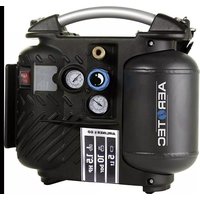
Carrying handle
The air compressor has a carrying handle for easy transport.
Drain valve
The drain valve on the tank is for draining condensation to help prevent tank corrosion.
Oil-free pump
The oil-free pump reduces the need for maintenance.
Pressure regulator knob
Use the pressure regulator knob to adjust the amount of air being delivered through the hose.
Quick coupler
The air compressor has a quick connect coupler located on the side of the unit.
Regulatory pressure gauge
The current line pressure is displayed on the regulatory pressure gauge. This pressure can be adjusted by rotating the pressure regulator knob.
Safety valve
The safety valve is designed to automatically release air if the air tank pressure exceeds the preset maximum.
Tank pressure gauge
The tank pressure gauge indicates the pressure of the air in the tank.
Vertical storage
The air compressor has been designed to safely stow in the horizontal or upright position.
OPERATION
ATTACHING AIR HOSE TO COMPRESSOR
- Using your left hand push quick connect towards the body of the compressor.
- Firmly press fit the male quick connect portion on the air hose into the female quick connect and release female
quick connect locking hose in place.
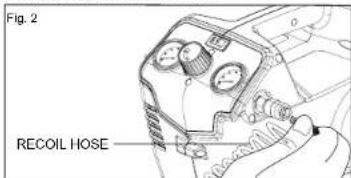
text_image
Fig. 2 RECOIL HOSENOTE: When connecting or disconnecting air hose remove air from tank.
OPERATION
BATTERY(sold separately)
IMPORTANT! The battery pack is not charged when it is purchased. Before using the air compressor for the first time, place the battery pack in the battery charger and charge. Make sure to read all safety precautions, and follow the instructions in the Battery Charger section.(sold separately)
To install (See Figure 2.)
- Align the tongue (3) of the battery pack with the cavity (4) in the air compressor housing.(sold separately)
- Grasp the air compressor (2) firmly.
- Push the battery pack into the handle until the latch locks into place.(sold separately)
- Do not use force when inserting the battery pack. It should slide into position and "click" (sold separately)
To remove (See Figure 2.) - Press the latch button (1) on the battery pack down and hold.(sold separately)
- Grasp the air compressor (2) firmly, and pull the battery pack out of the housing.(sold separately)
NOTE: The battery pack fits into the handle snugly in order to prevent accidental dislodging. It may require a strong pull to remove it.(sold separately)
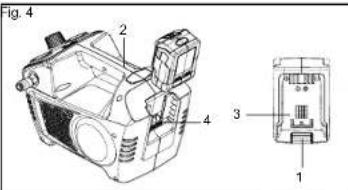
text_image
Fig. 4 2 4 3 1WARNING
- Replace the battery pack or the charger immediately if the battery case or charger cord is damaged.(sold separately)
- Verify that the switch is in the OFF position before
inserting or removing the battery pack.(sold separately) - Verify that the battery pack is removed and the switch
is in the OFF position before inspecting, adjusting, or
performing maintenance on any part of the blower. - Read, understand, and follow the instructions contained in the section entitled Charging Procedure.
STARTUP
- Before each startup, make sure the power switch is in the OFF position
- Place air compressor on a flat, level surface.
- Release pressure from the system. Drain moisture from the air tank by slowly opening the air tank drain valve by turning clockwise. Once all the moisture has drained out, close the fitting securely.
NOTE: Air tank will not pressurize while drain valve is open.
4.Turn the pressure regulator knob fully counterclockwise to close airflow from air outlet port. - Attach air hose and accessories.
WARNING
Too much air pressure causes a hazardous risk of bursting. Check the manufacturer's maximum pressure rating for air tools and accessories. The regulator outlet pressure must never exceed the maximum pressure rating.
- Insert the battery pack to the air compressor securely. (sold separately)
7.Tum the compressor ON by moving the switch to the AUTO/
ON position and allow the tank pressure to build. Once the air pressure reaches the maximum preset pressure("cut-out" pressure) it will automatically shut off.
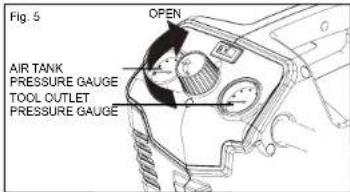
- Slowly turn the pressure regulator knob clockwise to open airflow from air outlet port until desired output pressure is reached.
text_image
Fig. 5 OPEN AIR TANK PRESSURE GAUGE TOOL OUTLET PRESSURE GAUGENOTE: The air compressor will automatically restart once the pressure in the air tank drops below the minimum preset pressure ("cut-in" pressure).
DANGER
Do not disassemble check valve, tank drain valves or safety relief valve with air in tank — bleed tank. Failure to depressurize tank could result in explosion and/or serious personal injury.
WARNING
Always wear eye protection with side shields. Failure to do so could result in objects being thrown into your eyes and other possible serious injuries.
WARNING
This equipment incorporates parts, such as snap switches, receptacles, and the like that tend to produce arcs or sparks and, therefore, when located in a garage, it should be in a room or enclosure provided for the purpose, or should be 460 mm or more above the floor
WARNING
Do not attach any tools to the open end of the hose until start-up has been completed. Attaching a tool prematurely could result in accidental operation causing serious injury.
EnglishEnglish
WARNING
Do not use in an environment that is dusty or otherwise contaminated. Using the air compressor in this type of environment may cause damage to the unit.
APPLICATIONS
Air compressors are utilized in a variety of air system applications. Match hoses, connectors, air tools, and accessories to the capabilities of the air compressor. You may use this product for the purposes listed below: - operating some air-powered tools - operating air accessories such as air nozzles and inflators
• operates some air powered paint spraying products TRANSPORTING THE AIR Compressor
To move the air compressor:
Ensure auto/off switch is in the off position (O) Grasp the handle firmly with one hand.
AUTO/OFF
Turn the power switch to the auto position (I) to power the compressor on. To turn the air compressor off, turn the power switch to the off position (O).
NOTE: When the compressor is in the auto position (I), the air compressor will automatically turn back on when the tank air pressure drops below the preset pressure limit. It will also shut off again when the max pressure is reached. RESETTING THE AIR Compressor
When amperage into the air compressor exceeds the specified amperage, the air compressor will automatically shut off.
-
Turn the air compressor off.
-
Allow unit to cool and to trigger reset.
NOTE: If the overload protector is actuated, the motor must be allowed to cool down for 30 minutes.
- Turn the air compressor on.
WARNING
Never exceed the pressure rating of the tool as recommended by the manufacturer. When using this air compressor as an inflation device, always follow the maximum inflation guidelines stated by the manufacturer of the item being inflated.
WARNING
Always ensure the switch is in the off position (O) and the regulatory pressure gauge reads zero bar before changing air tools or disconnecting the hose from the air outlet. Failure to do so could result in possible serious personal injury.
COMPRESSOR
When connecting a pneumatic air nailer or other air tool always follow the manufacturer's recommended start-up procedure. When connecting/disconnecting a hose to the air compressor always do the following.
-
Ensure auto/off switch is in the off position (O)
-
Confirm that the outlet pressure is at zero bar by fully turning the regulator knob counterclockwise to fully reduce air pressure at the outlet.
NOTE: Turning the knob clockwise increases air pressure at the outlet. Turning counterclockwise reduces air pressure at the outlet.
- Attach coiled air hose to coupler on the side of the air compressor.
4.Tum power switch to the auto position (I).
-
Allow unit to reach max pressure as indicated on the tank pressure gauge.
-
Set regulator to desired pressure by rotating pressure regulator knob. The regulator pressure will appear on the gauge marked as outlet.
To disconnect a coiled air hose:
- Confirm that the outlet pressure is at zero bar.
- When disconnecting a hose from quick coupler, always firmly hold release end of hose.
- Pull back on the release sleeve on the quick coupler.
-
With a firm grip, pull out the quick-connect air fitting that is attached to the quick coupler.
-
Attaching or disconnecting pneumatic tools from the air compressor.
NOTE: Each tool is different. Refer to the instructions of the manufacturer before operating a tool in the seated position.
WARNING
Risk of bursting. Do not adjust regulator to result in output pressure greater than marked maximum pressure of attachment and/or the item being inflated. Never use at pressure greater than 6.9 bar. Failure to heed this could result in possible serious personal injury.
WARNING
Air powered tools may require more air consumption than this air compressor is capable of providing. Check the tool manual to avoid damage to the tool or risk of personal injury.
- Connecting hoses to the air compressor.
- Control the amount of air flow with the pressure regulator knob. Turning the knob fully counterclockwise will completely stop the flow of air.
NOTE: Always use the minimum amount of pressure necessary for your application. Using a higher pressure than needed will drain air from the tank more rapidly and cause the unit to cycle on more frequently. - When finished, always drain the tank
- To help prevent tank corrosion and keep moisture out of the air used, the air tank of the compressor should be drained daily.
- Turn the air compressor off.
- Pull the ring on the safety valve to release until pressure gauge reads less than 1.4 bar.
- Release the ring.
- Rotate drain valves counterclockwise to open.
- Tilt tank to drain moisture from tank into a suitable container.
NOTE: Condensate is a polluting material and should be disposed of in compliance with local regulations. - If drain valve is clogged, release all air pressure, remove and clean valve, then reinstall.
DRAINING THE TANK
WARNING
Shutdown the air compressor and release all air from the tank before servicing. Failure to depressurize tank before attempting to remove valve can cause serious personal injury.
- Rotate drain valve clockwise until tightly closed.
CHECKING THE SAFETY VALVE
DANGER
Do not attempt to tamper with the safety valve. Anything loosened from this device could fly up and hit you. Failure to heed this could result in death or serious personal injury.
The safety valve will automatically release air if the air tank pressure exceeds the preset maximum. The valve should be checked before each day of use by pulling the ring by hand.
-
Turn the air compressor on and allow the tank to fill. The compressor will shut off when the pressure reaches the preset maximum.
-
Turn the air compressor off.
-
Pull the ring on the safety valve to release air for three to five seconds to allow pressurized air to escape. Release the ring. The safety release valve must reset and hold pressure before all compressed air is exhausted from the tank/pressure vessel.
-
Any continued loss of air after performing the above steps indicates a problem with the safety valve. Discontinue use and seek service before continued use of the air compressor.
WARNING
If air leaks after the ring has been released or if the valve is stuck and cannot be actuated by the ring, do not use the air compressor until the safety valve has been replaced. Use of the air compressor in this condition could result in serious personal injury.
WARNING
When servicing, use only identical replacement parts. Use of any other parts may create a hazard or cause product damage.
WARNING
Always wear eye protection during maintenance. If operation is dusty, also wear a dust mask.
WARNING
Always release all pressure, and allow unit to cool to the touch before cleaning or making repairs on the air compressor.
English
GENERAL MAINTENANCE
Avoid using solvents when cleaning plastic parts. Most plastics are susceptible to damage from various types of commercial solvents and may be damaged by their use. Use clean cloths to remove dirt, dust, oil, grease, etc. Any continued loss of air after performing the above steps indicates a problem with the safety valve. Discontinue use and seek service before continued use of the air compressor. If air leaks after the ring has been released or if the valve is stuck and cannot be actuated by the ring, do not use the air compressor until the safety valve has been replaced. Use of the air compressor in this condition could result in serious personal injury.
WARNING
Do not at any time let brake fluids, gasoline, petroleum based products, penetrating oils, etc., come in contact with plastic parts. Chemicals can damage, weaken or destroy plastic which may result in serious personal injury. Electric tools used on fiberglass material, wallboard, spackling compounds, or plaster are subject to accelerated wear and possible premature failure because the fiberglass chips and grindings are highly abrasive to bearings, brushes, commutators, etc. Consequently, we do not recommend using this product for extended work on these types of materials. However, if you do work with any of these materials, it is extremely important to clean the product using compressed air.
LUBRICATION
All of the bearings in this product are lubricated with a sufficient amount of high grade lubricant for the life of the unit under normal operating conditions. Therefore, no further lubrication is required.
ENVIRONMENTAL PROTECTION
Recycle raw materials instead of disposing of as waste. The machine, accessories and packaging should be sorted for environmental-friendly recycling.
TECHNICAL DATA
Maximum running pressure: 8 bar Maximum working pressure: 6 bar
| HP /W RPM DB(A) | ||
| 0,4 / 300 | 4600 92 |
The sound pressure level measured in a free range at a distance of 4 mt. at the maximum working pressure. The value of the sound level may increase from 1 to 10 dB(A) depending on the environment in which the compressor is installed.
SYMBOLS
| SYMBOL NAME | |
 | Safety Alert |
| [ZTGS] | CE Conformity |
 | Please read the instructions carefully before starting the product. |
 | Wear ear protection |
 | Always wear eye protection. |
| [DZX8] | Wear eye protection |
 | Risk of injury. Do not direct air stream at body.Do not use compressed air for breathing. Do not carry while painting. |
| [382A] | Risk of fire or explosion. |
 | Risk of bursting. |
 | To reduce the risk of electric shock, do not expose to rain. Store indoors. |
 | Risk of electrical shock.Hazardous voltage. |
 | Hot surface: Risk of burn-Do not touch! |
 | Remotely start: The unit is remotely controlledand may start without warning. |
 | Waste electrical products should not be disposed of with household waste. Please recycle where facilities exist.Check with your local authority or retailer for recycling advice. |
Français
DESCRIPTION
- POIGNEE DE REGLAGE PRESSION DE SORTIE
2.SOUPAPE DE SECURITE
3.MANOMETRE DU RESERVOIR D'AIR
4.MANOMETRE DE SORTIE D'OUTIL
5.RACCORD RAPIDE FEMELLE
6.AUTO-INTERRUPTEUR MARCHE-ARRET - BATTERIE 24V AU LITHIUM-ION (vendu séparément)
8.RESERVOIR D'AIR
9.VANNE DE PURGE DU RESERVOIR D'AIR
10.CHARGEUR (vendu séparément)
RÈGLES GÉNÉRALES DE SÉCURITÉ
AVERTISSEMENT
Tank Manometer 40 mm diameter
Manometer 40 mm Durchmesser
Wicht 6,5 kg
MACHEN SIE SICH MIT DEM LUFTKOMPRESSOR
VERTRAUT
Siehe Abbildung 1.
text_image
Technical diagram of a mechanical device with numbered components and a close-up view of the internal structure.WARNUNG
natural_image
Line drawing of a hand holding a camera module with adjustment knobs (no text or symbols)text_image
Technical diagram of a mechanical device with numbered components and labeled partsAVVERTENZE
text_image
Technical diagram of a mechanical device with numbered components and a close-up view labeled 1, 2, 3.ADVARSEL
text_image
Fig. 5 ABNE LUFTBEHOLDER TRYKMÄLER VJERKTÖJ UDGANGSTRYKMÄLERBEM/ERK: luftkompressoren genstarter automatisk så snart trykket i luftbeholderen falder under det minimale forudindstillede tryk (indkoblingstryk).