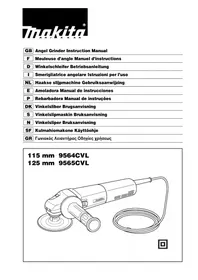
9564CVL - Garden shredder MAKITA - Free user manual and instructions
Find the device manual for free 9564CVL MAKITA in PDF.



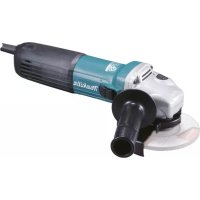
| Product Type | Angle Grinder |
| Brand | Makita |
| Model | 9564CVL |
| Disc Diameter | 115 mm |
| Spindle Thread | M14 |
| No Load Speed | 2000 - 6800 min⁻¹ |
| Speed Adjustment | Adjustment Dial (positions 1 to 5) |
| Overall Length | 311 mm |
| Net Weight | 1.8 kg |
| Power Supply | Single-phase, double insulation (no earth connection) |
| Rated Power | 1400 W |
| Electronic Functions | Soft start, constant speed control, overload protection |
| Safety | Double insulation, spindle lock button, protective guard |
| Supplied Accessories | Side handle, pin spanner, sanding pad |
| Maintenance | Regular cleaning of ventilation slots after use |
| Repairability | Repairs by Makita authorized service center |
| Noise Level | Sound pressure 86 dB(A), sound power 99 dB(A) |
| Vibration | Weighted acceleration 5 m/s² |
Frequently Asked Questions - 9564CVL MAKITA
User questions about 9564CVL MAKITA
0 question about this device. Answer the ones you know or ask your own.
Ask a new question about this device
Download the instructions for your Garden shredder in PDF format for free! Find your manual 9564CVL - MAKITA and take your electronic device back in hand. On this page are published all the documents necessary for the use of your device. 9564CVL by MAKITA.
USER MANUAL 9564CVL MAKITA
The following show the symbols used for the tool. Be sure that you understand their meaning before use.
Symboles
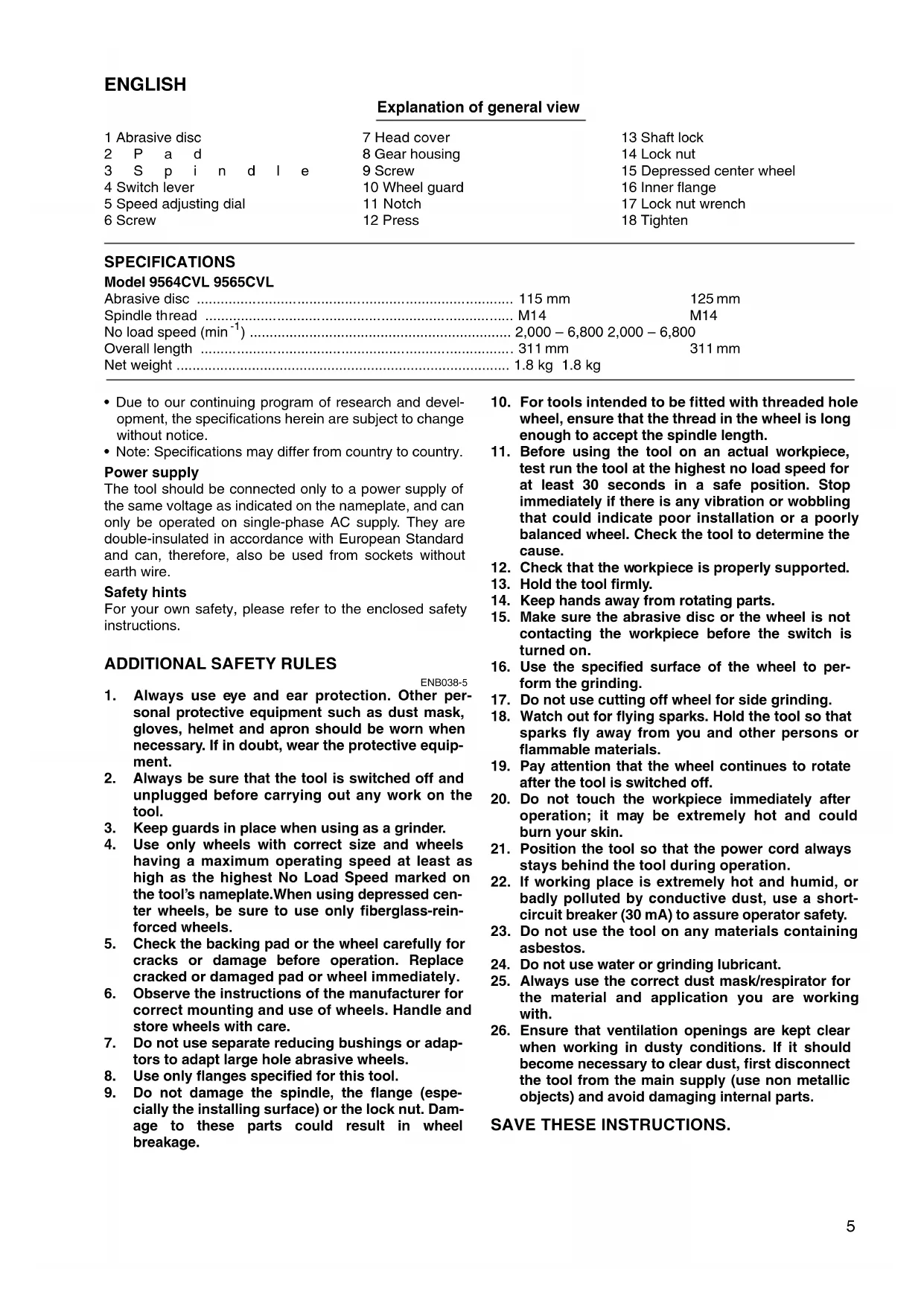
Explanation of general view
| 1 Abrasive disc | 7 Head cover | 13 Shaft lock |
| 2 P a d | 8 Gear housing | 14 Lock nut |
| 3 S p i n d l e | 9 Screw | 15 Depressed center wheel |
| 4 Switch lever | 10 Wheel guard | 16 Inner flange |
| 5 Speed adjusting dial | 11 Notch | 17 Lock nut wrench |
| 6 Screw | 12 Press | 18 Tighten |
SPECIFICATIONS
Model 9564CVL 9565CVL
| Abrasive disc | 115 mm | 125 mm |
| Spindle thread | M14 | M14 |
| No load speed (min-1) | 2,000 - 6,800 | 2,000 - 6,800 |
| Overall length | 311 mm | 311 mm |
| Net weight | 1.8 kg | 1.8 kg |
- Due to our continuing program of research and development, the specifications herein are subject to change without notice.
Note: Specifications may differ from country to country.
Power supply
The tool should be connected only to a power supply of the same voltage as indicated on the nameplate, and can only be operated on single-phase AC supply. They are double-insulated in accordance with European Standard and can, therefore, also be used from sockets without earth wire.
Safety hints
For your own safety, please refer to the enclosed safety instructions.
ADDITIONAL SAFETY RULES
ENB038-5
- Always use eye and ear protection. Other personal protective equipment such as dust mask, gloves, helmet and apron should be worn when necessary. If in doubt, wear the protective equipment.
- Always be sure that the tool is switched off and unplugged before carrying out any work on the tool.
- Keep guards in place when using as a grinder.
- Use only wheels with correct size and wheels having a maximum operating speed at least as high as the highest No Load Speed marked on the tool's nameplate.When using depressed center wheels, be sure to use only fiberglass-reinforced wheels.
- Check the backing pad or the wheel carefully for cracks or damage before operation. Replace cracked or damaged pad or wheel immediately.
- Observe the instructions of the manufacturer for correct mounting and use of wheels. Handle and store wheels with care.
- Do not use separate reducing bushings or adaptors to adapt large hole abrasive wheels.
- Use only flanges specified for this tool.
-
Do not damage the spindle, the flange (especially the installing surface) or the lock nut. Damage to these parts could result in wheel breakage.
-
For tools intended to be fitted with threaded hole wheel, ensure that the thread in the wheel is long enough to accept the spindle length.
- Before using the tool on an actual workpiece, test run the tool at the highest no load speed for at least 30 seconds in a safe position. Stop immediately if there is any vibration or wobbling that could indicate poor installation or a poorly balanced wheel. Check the tool to determine the cause.
- Check that the workpiece is properly supported.
- Hold the tool firmly.
- Keep hands away from rotating parts.
- Make sure the abrasive disc or the wheel is not contacting the workpiece before the switch is turned on.
- Use the specified surface of the wheel to perform the grinding.
- Do not use cutting off wheel for side grinding.
- Watch out for flying sparks. Hold the tool so that sparks fly away from you and other persons or flammable materials.
- Pay attention that the wheel continues to rotate after the tool is switched off.
- Do not touch the workpiece immediately after operation; it may be extremely hot and could burn your skin.
- Position the tool so that the power cord always stays behind the tool during operation.
- If working place is extremely hot and humid, or badly polluted by conductive dust, use a short-circuit breaker (30 mA) to assure operator safety.
- Do not use the tool on any materials containing asbestos.
- Do not use water or grinding lubricant.
- Always use the correct dust mask/respirator for the material and application you are working with.
- Ensure that ventilation openings are kept clear when working in dusty conditions. If it should become necessary to clear dust, first disconnect the tool from the main supply (use non metallic objects) and avoid damaging internal parts.
SAVE THESE INSTRUCTIONS.
OPERATING INSTRUCTIONS
Installing side grip (auxiliary handle) (Fig. 1 & 2)
Important:
Always be sure that the tool is switched off and unplugged before installing or removing the side grip.
Remove one of the screws which secure gear housing and head cover.
Screw the side grip on the tool securely. The side grip can be installed on either side of the tool. Always be sure that the side grip is installed securely.
Installing and removing abrasive disc (Fig. 3 & 4)
CAUTION:
Always be sure that the tool is switched off and unplugged before removing or installing accessories.
Installing abrasive disc
Remove all dirt or foreign matter from the pad.
Screw the pad onto the spindle pressing the shaft lock. Attach the disc to the pad carefully while so that the edges of disc and pad overlap each other without protruding.
Removing abrasive disc
Remove the paper from the pad by pulling up from its edge.
Switch action (Fig. 5)
CAUTION:
Before plugging in the tool, always check to see that the switch actuates properly and returns to the "OFF" position when the side of the switch lever is depressed.
To start the tool, slide the switch lever to "I" position.
For continuous operation, depress the front of the switch lever and then slide to "I" position as above. The switch is locked on the position for continuous operation. To stop the tool from the locked position, slide the switch lever to "O" position by depressing the rear of the switch lever.
Speed adjusting dial (Fig. 6)
The rotating speed can be changed by turning the speed adjusting dial to a given number setting from 1 to 5.
Higher speed is obtained when the dial is turned in the direction of number 5. And lower speed is obtained when it is turned in the direction of number 1. Refer to the table below for the relationship between the number settings on the dial and the approximate rotating speed.
| Number min | -1 (R.P.M.) |
| 1 | 2 |
| 2 | 3 |
| 3 | 4 |
| 4 | 6 |
| 5 6,800 |
CAUTION:
- If the tool is operated continuously at low speeds for a long time, the motor will get overloaded and heated up.
- The speed adjusting dial can be turned only as far as 5 and back to 1. Do not force it past 5 or 1, or the speed adjusting function may no longer work.
The tools equipped with electronic function are easy to operate because of the following features.
- Constant speed control Electronic speed control for obtaining constant speed. Possible to get fine finish, because the rotating speed is kept constant even under load condition.
- Soft start feature Safety and soft start because of suppressed starting shock.
Overload protector When the tool would be employed over the admissible load, it will stop automatically to protect the motor and wheel. When the load will come to the admissible level again, the tool can be started automatically.
Sanding operation (Fig. 7)
CAUTION:
Always wear safety glasses or a face shield during operation.
In general, keep the abrasive disc at an angle of about 15^ to the workpiece surface.
Apply slight pressure only. Excessive pressure will result in poor performance and premature wear to the abrasive disc.
CAUTION:
Never run the tool without the abrasive disc. You may seriously damage the pad.
IF USED AS A GRINDER
Removing head cover (Fig. 8 & 9)
CAUTION:
Always be sure that the tool is switched off and unplugged before removing or installing the accessories.
Installing or changing accessories with the tool plugged in could cause serious injury.
Remove the head cover by loosening the screw.
Pull off the head cover while pulling out its corners.
Installing wheel guard (Fig. 10)
Important:
Always be sure that the tool is switched off and unplugged before installing or removing the wheel guard.
When installing a depressed center wheel or an abrasive cut-off wheel, always use a wheel guard. Mount the wheel guard with the tab on the wheel guard band aligned with the notch on the bearing box. Then rotate the wheel guard 180 degrees counterclockwise. Be sure to tighten the screw securely.
Installing side grip (auxiliary handle) (Fig. 11)
Important:
Always be sure that the tool is switched off and unplugged before installing or removing the side grip.
Always install the side grip on the tool securely before operation. The side grip can be installed on either side of the tool, whichever is convenient and keeps the guard properly positioned. Always hold the tool's switch handle and the side grip firmly with both hands during operation.
Shaft lock (Fig. 12)
Press the shaft lock to prevent spindle rotation when installing or removing accessories.
CAUTION:
Never actuate the shaft lock when the spindle is moving. The tool may be damaged.
Installing or removing depressed center wheel (Fig. 13 & 14)
Important:
Always be sure that the tool is switched off and unplugged before installing or removing the wheel.
Mount the inner flange onto the spindle. Fit the wheel on over the inner flange and screw the lock nut onto the spindle.
To tighten the lock nut, press the shaft lock firmly so that the spindle cannot revolve, then use the lock nut wrench and securely tighten clockwise. To remove the wheel, follow the installation procedure in reverse.
Operation (Fig. 15)
CAUTION:
After operation, always switch off the tool and wait until the wheel has come to a complete stop before putting the tool down.
Hold the tool firmly with both hands. Turn the tool on and then apply the wheel or disc to the workpiece. In general, keep the edge of the wheel or disc at an angle of about 15^ - 30^ to the workpiece surface. During the break-in period with a new wheel, do not work the tool in the B direction or it will cut into the workpiece. Once the edge of the wheel has been rounded off by use, the wheel may be worked in both A and B directions.
WARNING:
- It should never be necessary to force the tool. The weight of the tool applies adequate pressure. Forcing and excessive pressure could cause dangerous wheel breakage.
- Continued use of a worn-out wheel may result in wheel explosion and serious personal injury.
MAINTENANCE
CAUTION:
Always be sure that the tool is switched off and unplugged before carrying out any work on the tool.
Repair and maintenance
The tool and its opening vents for cooling air have to be always kept clean. When foreign matters (dust etc.) enter such parts, they have to be removed. Clean regularly depending on how much dust has been made and entered tool.
When head cover is installed on the tool, remove it with referring to "Removing head cover".
To maintain product safety and reliability, repairs, maintenance or adjustment should be carried out by a Makita Authorized Service Center.
Descriptif
1 Disque abrasif
EC-DECLARATION OF CONFORMITY
The undersigned, Yasuhiko Kanzaki, authorized by
Makita Corporation, 3-11-8 Sumiyoshi-Cho, Anjo, Aichi 446-8502 Japan declares that this product
(Serial No.: series production)
manufactured by Makita Corporation in Japan is in compliance with the following standards or standardized documents,
HD400, EN50144, EN55014, EN61000
in accordance with Council Directives, 73/23/EEC, 89/336/EEC and 98/37/EC.
ITALIANO
HD400, EN50144, EN55014, EN61000.
NEDERLANDS
EG-VERKLARING VAN CONFORMITEIT
Michigan Drive, Tongwell, Milton Keynes,
Bucks MK15 8JD, ENGLAND
PORTUGUES
DECLARACAO DE CONFORMIDADE DA CE
de accordo com as directivas 73/23/CEE, 89/336/CEE e 98/37/CE do Conselho.
DANSK
EU-DEKLARATION OM KONFORMITET
Undertegnede, Yasuhiko Kanzaki, med fuldmagt fra Makita Corporation, 3-11-8 Sumiyoshi-Cho, Anjo, Aichi 446-8502 Japan, erklærhermed, at dette produit (Lobenummer: serieproduktion)
(AuEwAp: npaywyn oipac)
kataokvuao evo ano tv Etaipexia Makita otnv Ianwvia, piokei o eouphiwa u ta akoloutheta npotuna n tunonoi eva yypaa,
HD400, EN50144, EN55014, EN61000
Michigan Drive, Tongwell, Milton Keynes,
Bucks MK15 8JD, ENGLAND
ENGLISH
Noise and Vibration of Model 9564CVL/9565CVL
The typical A-weighted noise levels are
sound pressure level: 86 dB (A)
sound power level: 99 dB (A)
Wear ear protection.
The typical weighted root mean square acceleration value is 5m / s^2