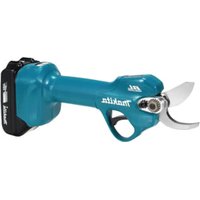
JS1602 - Scissors MAKITA - Free user manual and instructions
Find the device manual for free JS1602 MAKITA in PDF.


| Product Type | Electric Shear (sheet metal scissors) |
| Brand | Makita |
| Model | JS1602 |
| Cutting capacity (mild steel up to 400 N/mm²) | 1.6 mm (16 ga) |
| Cutting capacity (hard steel up to 600 N/mm²) | 1.2 mm (18 ga) |
| Cutting capacity (stainless steel up to 800 N/mm²) | 0.8 mm (22 ga) |
| Cutting capacity (aluminum up to 200 N/mm²) | 2.5 mm (13 ga) |
| Minimum cutting radius | 30 mm |
| Strokes per minute | 4,000 min⁻¹ |
| Overall length | 255 mm |
| Net weight (according to EPTA 01/2014) | 1.6 kg |
| Power supply | Single-phase, mains voltage (see rating plate) |
| Double insulation | Yes (class II) |
| Safety category | ☐/II (double insulation) |
| Sound pressure level (LpA) | 79 dB(A) (uncertainty K=3 dB(A)) |
| Vibration level (sheet metal cutting) | 7.0 m/s² (uncertainty K=1.5 m/s²) |
| Applications | Cutting sheet metal and stainless steel sheet |
| Blade maintenance | Rotating or replacing blades (8 cutting edges) |
| Included accessories | Hex wrench, wrench holder |
| Repairability | Use only Makita parts at an authorized service center |
| Blade materials | Hardened steel (details not specified) |
| Handle type | Insulated handle (double insulation) |
| Switch | Slide switch with lock for continuous operation |
| Maximum cutting width | 100 mm (mild steel 1.6 mm) or 80 mm (stainless steel 1.2 mm) for length ≤1800 mm |
Frequently Asked Questions - JS1602 MAKITA
User questions about JS1602 MAKITA
0 question about this device. Answer the ones you know or ask your own.
Ask a new question about this device
Download the instructions for your Scissors in PDF format for free! Find your manual JS1602 - MAKITA and take your electronic device back in hand. On this page are published all the documents necessary for the use of your device. JS1602 by MAKITA.
USER MANUAL JS1602 MAKITA
Explanation of general view
1 Slide switch
2 Gauge for stainless: 1.2 mm (3/64")
3 Gauge for mild steel: 1.6 mm (1/16")
4 Hex wrench
5 Loosen
6 Upper blade securing bolt
7 Lower blade
8 Upper blade
9 Blade holder
10 Thin washer
11 Tighten
12 No gap allowed
13 Yoke
14 Lower blade positioning screw
15 Cutting line
SPECIFICATIONS
| Model JS1602 | ||
| Max. cutting capacities | Steel up to 400 N/mm² | 1.6 mm (16 ga.) |
| Steel up to 600 N/mm² | 1.2 mm (18 ga.) | |
| Steel up to 800 N/mm² | 0.8 mm (22 ga.) | |
| Aluminum up to 200 N/mm² | 2.5 mm (13 ga.) | |
| Min. cutting radius 30 mm | ||
| Strokes per minute (min-¹) 4,000 | ||
| Overall length 255 mm | ||
| Net weight 1.6 kg | ||
| Safety class /II | 回 | |
- Due to our continuing programme of research and development, the specifications herein are subject to change without notice.
- Specifications may differ from country to country.
Weight according to EPTA-Procedure 01/2014
ENE037-1
Intended use
The tool is intended for cutting sheet steel and stainless sheet steel.
ENF002-2
Power supply
The tool should be connected only to a power supply of the same voltage as indicated on the nameplate, and can only be operated on single-phase AC supply. They are double-insulated and can, therefore, also be used from sockets without earth wire.
GEA010-2
General Power Tool SafetyWarnings
WARNING Read all safety warnings, instructions, illustrations and specifications provided with this power tool. Failure to follow all instructions listed below may result in electric shock, fire and/or serious injury.
Save all warnings and instructions for future reference.
The term "power tool" in the warnings refers to your mains-operated (corded) power tool or battery-operated (cordless) power tool.
GEB027-3
SHEAR SAFETY WARNINGS
- Hold the tool firmly.
- Secure the workpiece firmly.
- Keep hands away from moving parts.
- Edges and chips of the workpiece are sharp. Wear gloves. It is also recommended that you put on thickly bottomed shoes to prevent injury.
- Do not put the tool on the chips of the workpiece. Otherwise it can cause damage and trouble on the tool.
- Do not leave the tool running. Operate the tool only when hand-held.
- Always be sure you have a firm footing. Be sure no one is below when using the tool in high locations.
- Do not touch the blade or the workpiece immediately after operation; they may be extremely hot and could burn your skin.
- Avoid cutting electrical wires. It can cause serious accident by electric shock.
- Do not operate the tool at no-load unnecessarily.
SAVE THESE INSTRUCTIONS.
WARNING:
DO NOT let comfort or familiarity with product (gained from repeated use) replace strict adherence to safety rules for the subject product. MISUSE or failure to follow the safety rules stated in this instruction manual may cause serious personal injury.
FUNCTIONAL DESCRIPTION
CAUTION:
- Always be sure that the tool is switched off and unplugged before adjusting or checking function on the tool.
Switch action (Fig. 1)
CAUTION:
- Before plugging in the tool, always check to see that the slide switch actuates properly and returns to the "OFF" position when the rear of the slide switch is depressed.
- Switch can be locked in "ON" position for ease of operator comfort during extended use. Apply caution when locking tool in "ON" position and maintain firm grasp on tool.
To start the tool, slide the slide switch toward the "I (ON)" position. For continuous operation, press the front of the slide switch to lock it.
To stop the tool, press the rear of the slide switch, then slide it toward the "O (OFF)" position.
Permissible shearing thickness (Fig. 2)
The groove on the yoke serves as a thickness gauge for shearing mild or stainless steel plate. If the material fits within the groove, it is shearable.
The thickness of materials to be sheared depends upon the type (strength) of the material. The maximum shearing thickness is indicated in the table below in terms of various materials. Attempting to shear materials thicker than indicated will result in tool breakdown and/or possible injury. Keep within the thickness shown in the table.
| Material | Tensile Strength (N/mm2) | Max. cutting thickness (mm) |
| Mild steel (A) 40 | 0 1.6 (16 ga) | |
| Hard steel (B) 60 | 0 1.2 (18 ga) | |
| Stainless steel 80 | 0 0.8 (22 ga) | |
| Aluminum plate 200 | 0 2.5 (13 ga) |
006425
ASSEMBLY
CAUTION:
- Always be sure that the tool is switched off and unplugged before carrying out any work on the tool.
Blade inspection
Before using the tool, check the blades for wear. Dull, worn blades will result in poor shearing action, and the service life of the tool will be shortened.
Rotating or replacing blades (Fig. 3, 4, 5, 6, 7 & 8) Both the upper and lower blades have four cutting edges on each side (the front and back). When the cutting edge becomes dull, rotate both the upper and the lower blades 90^ to expose new cutting edges.
When all eight edges are dull on both the upper and lower blades, replace both blades with new ones. Each time blades are rotated or replaced, proceed as follows.
Remove the blade securing bolts with the hex wrench provided and then rotate or replace the blades.
Some tools have one washer between the upper blade and the blade holder. When the tool has the washer, be sure to use the thin washer when reassembling.
NOTE:
- No thin washers are used for the lower blade.
Install the upper blade and tighten the upper blade securing bolt with the hex wrench. Press up on the upper blade while tightening it.
After securing the upper blade, be sure that there is no gap left between the upper blade and the beveled surface of the blade holder.
When installing the lower blade onto the yoke, the lower blade should be pressed against the yoke so as to be contacting the beveled portions A and B of the yoke and the tip C of the lower blade positioning screw while you tighten the lower blade securing bolt. There must be no clearance between A, B and C during installation.
NOTE:
- The lower blade positioning screw is factory-assembled. Do not tamper with it.
OPERATION
Holding material and shearing method (Fig. 9)
WARNING:
- Before operating the tool, be sure to firmly tighten the upper blade securing bolt and the lower blade securing bolt. Loosen bolts may cause blades coming off, resulting in a serious injury.
- When cutting, always place the shear on the workpiece so that the material cut away is positioned on the right side to the operator.
The materials for cutting should be fastened to the workbench by means of workholders.
Always hold the tool firmly with one hand on housing. Do not touch the metal part.
Keep the shear moving parallel with the material.
Maximum cutting width (Fig. 10)
Stay within the specified maximum cutting width (A): Case of length 1,800 mm.
| Mild steel (thickness) | 1.6 mm Under 1.2 mm |
| Max. cutting width (A) | 100 mm No limit |
| Stainless (thickness) 1.2 mm Under 1.0 mm |
| Max. cutting width (A) 30 mm No limit |
006430
Minimum cutting radius
Minimum cutting radius is 30mm when cutting 1.0mm mild steel.
MAINTENANCE

CAUTION:
- Always be sure that the tool is switched off and unplugged before attempting to perform inspection or maintenance.
- Never use gasoline, benzine, thinner, alcohol or the like. Discoloration, deformation or cracks may result.
To maintain product SAFETY and RELIABILITY, repairs, carbon brush inspection and replacement, any other maintenance or adjustment should be performed by Makita Authorized Service Centers, always using Makita replacement parts.
OPTIONAL ACCESSORIES

CAUTION:
- These accessories or attachments are recommended for use with your Makita tool specified in this manual. The use of any other accessories or attachments might present a risk of injury to persons. Only use accessory or attachment for its stated purpose.
If you need any assistance for more details regarding these accessories, ask your local Makita Service Center.
- Shear blades
- Hex wrench
Wrench holder
NOTE:
- Some items in the list may be included in the tool package as standard accessories. They may differ from country to country.
ENG905-1
Noise
The typical A-weighted noise level determined according to EN62841-2-8:
Sound pressure level (L_pA) : 79 dB (A)
Uncertainty (K): 3 dB (A)
The noise level under working may exceed 80 dB (A).
ENG907-1
NOTE:
- The declared noise emission value(s) has been measured in accordance with a standard test method and may be used for comparing one tool with another.
- The declared noise emission value(s) may also be used in a preliminary assessment of exposure.

WARNING:
- Wear ear protection.
- The noise emission during actual use of the power tool can differ from the declared value(s) depending on the ways in which the tool is used especially what kind of workpiece is processed.
- Be sure to identify safety measures to protect the operator that are based on an estimation of exposure in the actual conditions of use (taking account of all parts of the operating cycle such as the times when the tool is switched off and when it is running idle in addition to the trigger time).
ENG900-1
Vibration
The vibration total value (tri-axial vector sum) determined according to EN62841-2-8:
Work mode: cutting sheet metal
Vibration emission (a_b) : 7.0~m / s^2
Uncertainty (K): 1.5m / s^2
ENG901-2
NOTE:
- The declared vibration total value(s) has been measured in accordance with a standard test method and may be used for comparing one tool with another.
- The declared vibration total value(s) may also be used in a preliminary assessment of exposure.
WARNING:
- The vibration emission during actual use of the power tool can differ from the declared value(s) depending on the ways in which the tool is used especially what kind of workpiece is processed.
- Be sure to identify safety measures to protect the operator that are based on an estimation of exposure in the actual conditions of use (taking account of all parts of the operating cycle such as the times when the tool is switched off and when it is running idle in addition to the trigger time).
EC DECLARATION OF CONFORMITY
For European countries only
The EC declaration of conformity is included as Annex A to this instruction manual.