1920 - Rice cooker PRINCESS - Free user manual and instructions
Find the device manual for free 1920 PRINCESS in PDF.



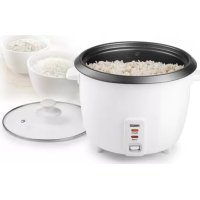
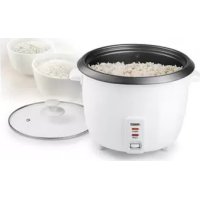
| Product type | Rice cooker and steamer |
| Brand | Princess |
| Model | 1920 |
| Capacity | Up to 10 cups of uncooked rice (100 g per cup), yielding about 2 L of cooked rice |
| Supply voltage | 220-230 V, 50 Hz |
| Rated power | 600 W |
| Main functions | Rice cooking (white, brown, pre-cooked), steaming (vegetables, meat, fish), soups, slow cooking, poached eggs, pasta, automatic keep warm |
| Included accessories | Non-stick inner pot, steamer basket with handle, steam rack with handle, poaching dish, transparent lid, measuring cup (100 g rice / 175 ml water), rice paddle |
| Safety | Safety device preventing dry heating, automatic shut-off after cooking, automatic keep warm, toggle cooking switch |
| Inner pot material | Non-stick coating (do not use vinegar or direct salt) |
| Cleaning and maintenance | Wipe the outer pot with a damp cloth; other parts washable in warm soapy water (except outer pot and cord) |
| Warranty | 1 year for manufacturing defects or material defects (subject to vendor stamp) |
| Domestic use | Yes, for household use only |
Frequently Asked Questions - 1920 PRINCESS
User questions about 1920 PRINCESS
0 question about this device. Answer the ones you know or ask your own.
Ask a new question about this device
Download the instructions for your Rice cooker in PDF format for free! Find your manual 1920 - PRINCESS and take your electronic device back in hand. On this page are published all the documents necessary for the use of your device. 1920 by PRINCESS.
USER MANUAL 1920 PRINCESS
natural_image
Symbolic emblem of a crown with a vertical line above it, enclosed in an oval frame (no text or numbers present)PRINCESS®
Gebruiksaanwijzing
Instructions for use
Mode d'emploi
Anleitung
natural_image
Symbolic emblem of a leaf with a vertical line inside an oval frame (no text or numbers)NL Gebruiksaanwijzing 4
UK Instructions for use 7
F Mode d'emploi 11
D Anleitung 15
E Instrucciones de Uso....19
I Istruzioni d'uso 23
S Bruksanvisning 26
DK Brugsanvisning 30
N Bruksanvisning 34
SF Käyttöohje 37
P Instruções de utilização ....41
GARANTIEKAART/GUARANTEE CARD/CARTE DE GARANTIE/ GARANTIEKARTE CERTIFICADO DI GARANTÍA /CARTOLINA DI GARANZIA/GARANTIKORT/ GARANTIBEVIS/GARANTIKORT/TAKUUTODISTUS 45-46
PRINCESS RICE COOKER FOOD STEAMER ART. 1920n
VOOR HET GEBRUIK
natural_image
Symbolic emblem of a crown inside an oval frame (no text or numbers)natural_image
Symbolic emblem of a leaf with a vertical line above it, enclosed in an oval frame (no text or numbers present)natural_image
Symbolic icon of a leaf with a stem, enclosed in an oval frame (no text or numbers)Koken van pasta
Read these instructions thoroughly first and keep them for future reference. Check that the network voltage in the house matches that of the appliance (220-230 Volt). Only connect the appliance to an earthed socket.
Clean all components before use (except for the outer pan and the cord) in warm soapy water and rinse thoroughly.
DESCRIPTION OF THE PRINCESS RICE COOKER FOOD STEAMER
Apart from boiling rice, this Princess kitchen miracle is suitable for many other applications, such as steaming vegetables, meat, fish and poultry and for making soup and casseroles. It is also perfect for keeping food warm.

natural_image
Symbolic emblem of a leaf with a vertical line inside an oval frame (no text or numbers)The Princess Rice Cooker Food Steamer consists of an outer pan containing all technical components (heating element, temperature sensor) and an inner pan with various accessories. The operation is as follows:
- First attach the cord to the pan, only then connect the plug to the socket.
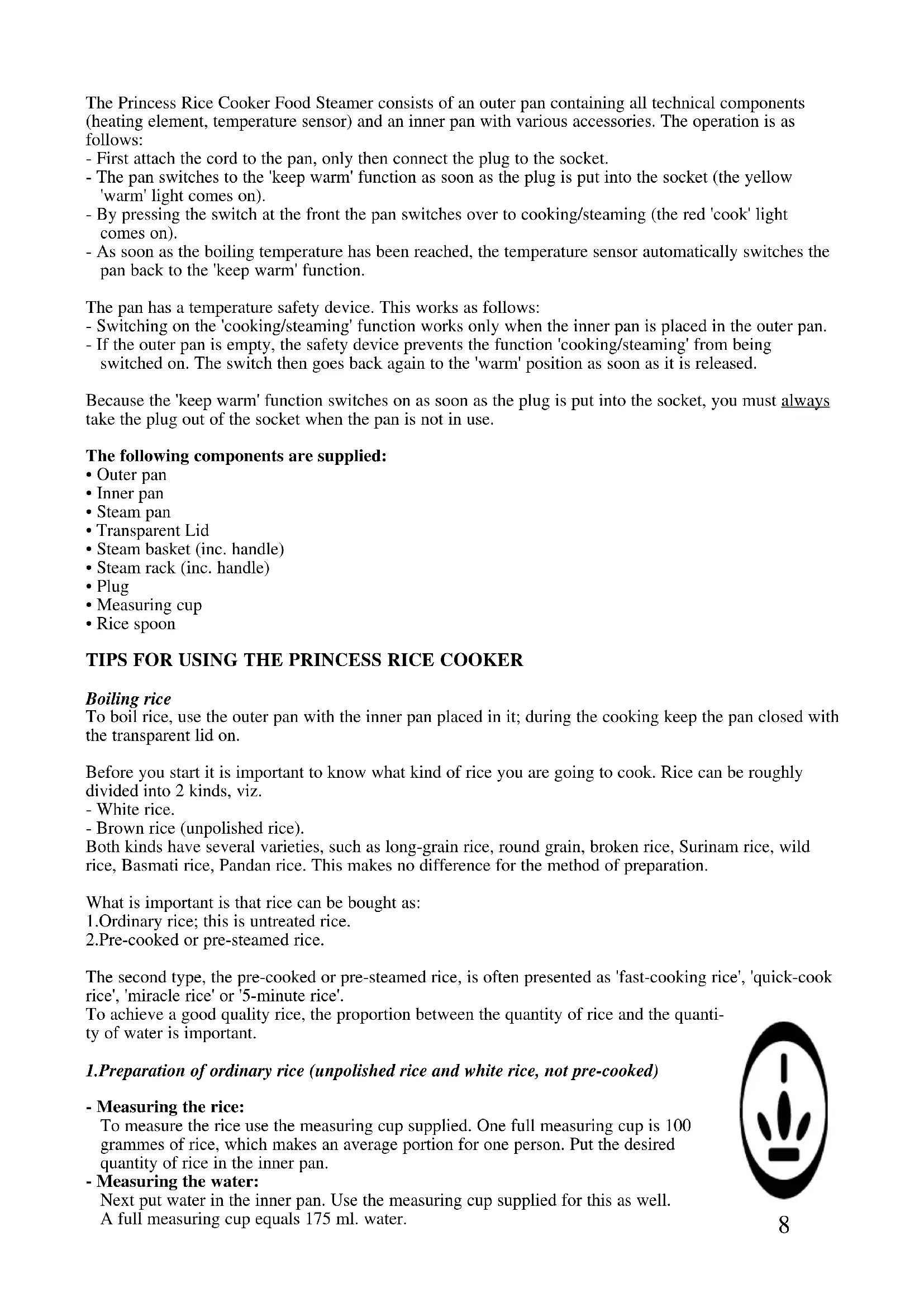
- The pan switches to the 'keep warm' function as soon as the plug is put into the socket (the yellow 'warm' light comes on).
- By pressing the switch at the front the pan switches over to cooking/steaming (the red 'cook' light comes on).
- As soon as the boiling temperature has been reached, the temperature sensor automatically switches the pan back to the 'keep warm' function.
The pan has a temperature safety device. This works as follows:
- Switching on the 'cooking/steaming' function works only when the inner pan is placed in the outer pan.
- If the outer pan is empty, the safety device prevents the function 'cooking/steaming' from being switched on. The switch then goes back again to the 'warm' position as soon as it is released.
Because the 'keep warm' function switches on as soon as the plug is put into the socket, you must always take the plug out of the socket when the pan is not in use.
The following components are supplied:
- Outer pan
- Inner pan
- Steam pan
- Transparent Lid
- Steam basket (inc. handle)
- Steam rack (inc. handle)
- Plug
- Measuring cup
- Rice spoon
TIPS FOR USING THE PRINCESS RICE COOKER
Boiling rice
To boil rice, use the outer pan with the inner pan placed in it; during the cooking keep the pan closed with the transparent lid on.
Before you start it is important to know what kind of rice you are going to cook. Rice can be roughly divided into 2 kinds, viz.
- White rice.
- Brown rice (unpolished rice).
Both kinds have several varieties, such as long-grain rice, round grain, broken rice, Surinam rice, wild rice, Basmati rice, Pandan rice. This makes no difference for the method of preparation.
What is important is that rice can be bought as:
- Ordinary rice; this is untreated rice.
- Pre-cooked or pre-steamed rice.
The second type, the pre-cooked or pre-steamed rice, is often presented as 'fast-cooking rice', 'quick-cook rice', 'miracle rice' or '5-minute rice'.
To achieve a good quality rice, the proportion between the quantity of rice and the quantity of water is important.
1. Preparation of ordinary rice (unpolished rice and white rice, not pre-cooked)
- Measuring the rice:
To measure the rice use the measuring cup supplied. One full measuring cup is 100 grammes of rice, which makes an average portion for one person. Put the desired quantity of rice in the inner pan.
- Measuring the water:
Next put water in the inner pan. Use the measuring cup supplied for this as well.
A full measuring cup equals 175 ml. water.

natural_image
Symbolic emblem of a crown with a vertical line above it, enclosed in an oval frame (no text or numbers present)The table below gives a survey of the correct proportions and the resulting volume of boiled rice.
WATER/RICE RATIO TABLE
| Uncooked rice Water (measured with Water level Resulting volume measuring cup supplied) inner pan of boiled rice | |||
| 1 cup 1 | ^1/_2 cups Line 1 2 cups | ||
| 2 cups 2 | ^1/_2 cups Line 2 4 cups | ||
| 3 cups 3 | ^1/_2 cups Line 3 6 cups | ||
| 4 cups 4 | ^1/_2 cups Line 4 8 cups | ||
| 5 cups 5 | ^1/_2 cups Line 5 10 cups | ||
| 6 cups 6 | ^1/_2 cups Line 6 12 cups | ||
| 7 cups 7 | ^1/_2 cups Line 7 14 cups | ||
| 8 cups 8 | ^1/_2 cups Line 8 16 cups | ||
| 9 cups 9 | ^1/_2 cups Line 9 18 cups | ||
| 10 cups 10 | ^1/_2 cups | Line 10 | 20 cups |
1 cup equals 175 ml. water or 100 grammes of uncooked rice
- Next, put the plug into the socket and switch the rice cooker in the 'cook' position by pressing the switch.
- After some time the rice cooker will automatically switch over to the 'warm' position. Allow the rice to stand in this position 5-10 more minutes with lid closed to allow it to cook through
Some 'rice - tips':
- if you wish, you can wash the rice first. Washed rice sticks to the pan less, but also some of the nutritional value will be lost.
- If the rice sticks to the pan (with some kinds of rice this is almost unavoidable), you can oil the inner pan lightly with e.g.. salad oil, olive oil or other vegetable oil.
- To achieve a softer rice the uncooked rice can be soaked for 5-10 minutes in the water in the inner pan, before the rice cooker is switched on.
2. Method of preparation for pre-cooked rice (quick-cook rice).
The method of preparation is the same as for ordinary rice, but the proportion of the quantities of water and rice is different. For this no rule of thumb can be given, because rice producers all use different pre-cooking times and methods. For the quantity of water and rice you must therefore follow the instructions on the packaging of the rice. After that proceed as follows:
- Put the specified quantity of water in the pan and set the pan to the 'cook' position. Add the rice as soon as the water is boiling.
- Allow the rice to cook for the time indicated on the packaging. Switch the rice cooker off after that by pulling the plug from the socket.
- For the rest, follow the instructions on the packaging. Usually one must allow the rice to stand for approx. 15 more minutes, sometimes with the lid closed, after which the rice is strained.
Steaming (only for Rice Cooker with steam-pan accessories)
Steaming can be used to cook vegetables, meat, fish and poultry. By steaming food fewer nutrients are lost than with other methods of preparation.
For steaming the steam-pan is put on the inner pan. The transparent lid fits onto the steampan.
The food goes into the steam-pan. A measured quantity of water is put into the inner pan to produce the steam. The pan is switched on by pressing the button ('cook' position). The table below shows how much water is needed and what the cooking time will be (approximately). The quantity of water is to be measured with the plastic cup/measuring cup.

natural_image
Symbolic emblem of a leaf with a vertical line above it, enclosed in an oval frame (no text or numbers present)TABLE FOR THE STEAMING OF INGREDIENTS
| Vegetables Quantity of water Steaming time | ||
| Meat, fish & poultryAsparagesBroccoliCabbage 1 cup 15 minutesCarrots 1 cup 15 minutesCauliflower 1 cup 15 minutesCorn 1 cup 10 minutesAubergine 1Broad beansGreen peasSpinach | ^1/_2 cups per 100 grammes Depending on the quantity ^1/_2 cup 10 minutes ^1/_4 cup 5 minutes ^1/_4 cup ^1/_2 cup 10 minutes ^1/_2 cup 10 minutes | 20 minutes |
1 cup equals 175 ml. water
Some more 'steam - tips':
- When steaming vegetables the amount of water need not be adjusted to the amount of vegetables.
- Keep the lid on the pan during steaming. If you lift the lid, heat and steam will escape, as a result of which cooking will take longer. If the lid must nevertheless be lifted for a brief instant, some extra water can be poured into the inner pan to adjust the cooking time again.
- The suggested steaming times are approximate. By increasing or reducing the amount of water one can adjust the preparation times.
Making soups and casseroles
For this the inner pan is used with the lid. Simply put the required ingredients in the pan and switch to the 'cook' position. Soups and casseroles must 'simmer' for some time. For this the 'warm' position of the Princess Rice Cooker Food steamer is highly suitable.
Poaching eggs
If you want to poach eggs with the Princess Rice Cooker Food Steamer we advise that you use medium-sized eggs. Before you begin poaching the eggs, you should always grease the poaching dish.
Add no more than 0.8 litres of water to the pan and crack open the eggs before putting them into the poaching dish. Now put the lid onto the appliance and switch it on. The water will take around 8 minutes to boil.
Once the water reaches the boil, the eggs will take another 2 to 3 minutes to poach.
Cooking pasta
The Princess Rice Cooker Food Steamer is also ideal for cooking small quantities of pasta. When cooking pasta, you should bear in mind the following:
1 cup of pasta (approx. 100g) to every 2 cups of water.
Please note: you cannot cook more than 200g of pasta at any one time.
Bring the water to the boil before adding the pasta. To ensure the pasta is properly cooked, you should wait until the water has evaporated and the appliance emits a signal to indicate that the pasta is ready. If you prefer your pasta 'al dente' or slightly less cooked, you should reduce the cooking time rather than waiting for the 'ready' signal.
CLEANING
FIRST UNPLUG THE CORD FROM THE SOCKET
The outer pan can be cleaned with a damp cloth. Make sure that the pan is thoroughly dry before re-connecting the cord to the socket. If necessary, dry the electrical connection on the side of the appliance further with, for instance, kitchen paper.
The other components can be cleaned in warm soapy water. Do not use abrasive cleaning agents or a scouring pad for this.

natural_image
Symbolic emblem of a leaf with a vertical line above it, enclosed in an oval frame (no text or numbers present)Cleaning tip: pour a cupful of water and a small dash of washing-up liquid in the inner pan. Set the pan to the 'cook' position and leave the pan switched on for 10 minutes or so. After that switch off and rinse thoroughly.
PRINCESS TIPS
- Never put water in the outer pan.
- Make sure that the inner pan does not boil over, as then water will get into the outer pan. If this should nevertheless happen, then first pull the plug from the socket, take the inner pan out of the outer pan using kettle-holders or oven-gloves, pour the water out of the outer pan and let it cool down.
- Never immerse the outer pan or the cord in water or other liquids.
- Always pull the plug from the socket before cleaning and when there is a failure. Also take the plug out of the socket when the pan is not in use.
- The pan and the various components will get very hot: take care that children cannot get at it and also be careful when handling it yourself. Only lift and hold the pan by the handles.
- Make sure the appliance is not so close to the edge of the table, worktop and the like that someone could knock it off; also ensure that the cord is not trailing in such a way that someone could trip over it or get caught by it.
- Do not use the appliance if it is damaged or if the cord is damaged. Instead, send it to our service department.
- Do not place the appliance on or in the direct vicinity of a hot cooking plate or similar.
- Only connect the pan to a socket that is earthed.
- This pan is intended for domestic use only.
- Do not use vinegar or salt in the inner pan, as this will affect the coating.
U.K. WIRING INSTRUCTIONS
The wires in the mains lead are coloured in accordance with the following code:
$$ \text { BLUE } = \text { NEUTRAL }, \text { BROWN } = \text { LIVE }, \text { GREEN - YELLOW } = \text { EARTH } $$
As the colours of the wire in the mains lead of this appliance may not correspond with the colour markings identifying the terminals on your plug, proceed as follows:
The wire which is coloured BLUE must be connected to the terminal which is marked with the letter N or coloured black.
The wire which is coloured BROWN must be connected to the terminal which is marked with the letter L or coloured red.
The wire which is coloured GREEN-YELLOW must be connected to the earth terminal which is marked with the letter E or ± or coloured green and yellow.
With this appliance, if a 13 amp plug is used a 13 amp fuse should be fitted. If any other type of plug is used a 15 amp fuse must be fitted either in the plug or at the distribution board.
MODE D'EMPLOI DU PRINCESS RICE COOKER FOOD STEAMER ART. 1920n
AVANT L'EMPLOI
natural_image
Symbolic emblem of a leaf with a vertical line inside an oval frame (no text or numbers)Fonctionnement :
natural_image
Symbolic emblem of a crown inside an oval frame (no text or numbers)natural_image
Symbolic emblem of a leaf with a central dot, enclosed in an oval frame (no text or numbers)TABLEAU POUR LA CUISSON A LA VAPEUR DES INGRÉDIENTS
natural_image
Symbolic emblem of a leaf with a stem, enclosed in an oval frame (no text or numbers)natural_image
Symbolic emblem of a leaf with a vertical line inside an oval frame (no text or numbers)natural_image
Symbolic emblem of a leaf with a vertical line inside an oval frame (no text or numbers)natural_image
Symbolic emblem of a leaf with a vertical line inside an oval frame (no text or numbers)CONSEJOS DE USO DEL HERVIDOR DE ARROZ PRINCESS RICE COOKER FOOD STEAMER
Hervir arroz.
natural_image
Symbolic emblem of a leaf with a vertical line inside an oval (no text or numbers)natural_image
Symbolic emblem of a leaf with a vertical line inside an oval frame (no text or numbers)ISTRUZIONI PER L'USO DEL PRINCESS RICE COOKER FOOD STEAMER ART. 1920n
PRIMA DELL'USO
natural_image
Symbolic emblem of a leaf with a vertical line inside an oval frame (no text or numbers)natural_image
Symbolic emblem of a leaf with a central dot, enclosed in an oval frame (no text or numbers)natural_image
Symbolic emblem of a leaf with a central dot, enclosed in an oval frame (no text or numbers)Cottura della pasta
natural_image
Symbolic emblem of a leaf with a vertical line inside an oval frame (no text or numbers)natural_image
Symbolic emblem of a leaf with a vertical line inside an oval frame (no text or numbers)FÖRHÅLLANDETABELL VATTEN/RIS
| Okokat ris Vatten (mätt med den Vattennivå Slutgiltig bifogade måttbägaren) innerpanna volym kookat ris | |
| 1 kopp 1 ^1/_2 koppar Streck 1 2 koppar2 koppar 2 ^1/_2 koppar Streck 2 4 koppar3 koppar 3 ^1/_2 koppar Streck 3 6 koppar4 koppar 4 ^1/_2 koppar Streck 4 8 koppar5 koppar 5 ^1/_2 koppar Streck 5 10 koppar6 koppar 6 ^1/_2 koppar Streck 6 12 koppar7 koppar 7 ^1/_2 koppar Streck 7 14 koppar8 koppar 8 ^1/_2 koppar Streck 8 16 koppar9 koppar 9 ^1/_2 koppar Streck 9 18 koppar10 koppar 10 ^1/_2 koppar Streck 10 | 20 koppar |
natural_image
Symbolic emblem of a leaf with a vertical line above it, enclosed in an oval frame (no text or numbers present)TABELL FÖR ÅNGKOKNING AV INGREDIENSER
natural_image
Symbolic emblem of a leaf with a trident, enclosed in an oval frame (no text or numbers)natural_image
Symbolic emblem of a leaf with a vertical line above it, enclosed in an oval frame (no text or numbers present)natural_image
Symbolic emblem of a leaf with a vertical line inside an oval (no text or numbers)natural_image
Symbolic emblem of a leaf with a diagonal line above it, enclosed in an oval frame (no text or numbers present)BRUKSANVISNING PRINCESS RICE COOKER FOOD STEAMER ART. 1920n
F∅R BRUK
natural_image
Symbolic emblem of a leaf with a vertical line inside an oval frame (no text or numbers)natural_image
Symbolic emblem of a leaf with a diagonal line inside an oval (no text or numbers)Dampkoking (kun for Rice Cooker Food Steamer med tilbehør for dampkokepanne)
natural_image
Symbolic emblem of a leaf with a vertical line inside an oval frame (no text or numbers)RENGJ∅RING
TREKK ST∅PSELET UT AV STIKKONTAKTEN F∅RST
natural_image
Symbolic emblem of a leaf with a vertical line inside an oval frame (no text or numbers)natural_image
Symbolic emblem of a leaf with a vertical line inside an oval frame (no text or numbers)MANUAL DE INSTRUÇÕES DA PANELAA VAPOR DE COZINHAR ARROZ E COMIDA DA PRINCESS ART.1920n
ANTES DE UTILIZAR
natural_image
Symbolic emblem of a leaf with a vertical line inside an oval frame (no text or numbers)natural_image
Symbolic emblem of a leaf with a vertical line inside an oval frame (no text or numbers)2. Preparar o arroz pré-cozinhado (de cozedura rápida).
natural_image
Symbolic emblem of a leaf with a stem inside an oval frame (no text or numbers)Para escalfar ovos
natural_image
Symbolic emblem of a leaf with a vertical line inside an oval frame (no text or numbers)GARANTIEKAART GUARANTEE CARD CARTE DE GARANTIE GARANTIEKARTE GARANTIE CERTIFICADO DE GARANTÍA TARJA DE GARANTIA CARTOLINA DI GARANZIA GARANTIKORT GARANTIBEVIS GARANTIKORT TAKUUTODISTUS GARANCIJSKI LIST ÁBYGADARSKÍRTEINI ZÁRU/NÍ LIST Κά στα εγγυήσης
PRINCESS®
Datum van aankoop
Date of Purchase
Date d'achat
Kaufdatum
Fecha de compra
Data de compra
Data di acquisto
Inköpsdatum
Købs-dato
Innkjøpsdato
Ostopäivä
Datum nakupa
Hvenær keypt
Datum nákupu
Ηκεροσηνία αγο ρας
Dealer Revendeur Händler Haendler/commercant Vendedor Comprador Rivenditore Återförsäljare Forhandler Jälleenmyyjä Zastopnik Söluadili Προχηθευτης

TYPE

Koper
Buyer
Acheteur
Käufer
Kaeufer
Comprador
Comerç
Acquirente
Köpare
Køber
Kjøper
Ostaja
Kupec
Kaupandi
Kupujci
Αγοθαστης
NEDERLANDS: GARANTIEVOORWAARDEN
For 1 year in respect of defects found to be due to faulty workmanship or material. The guarantee is only valid with a complete filled in guarantee card. There is no guarantee on appliances found to be defective due to wrongful use, disassembling or accidental breakage.
FRANÇAIS: CONDITIONS DE LA GARANTIE
natural_image
Grid of identical gray circular icons with leaf symbols, arranged in rows and columns (no text or labels)
PRINCESS HOUSEHOLD APPLIANCES BV
Baronielaan 1, 4818 PA Breda. P.O. Box 4722, 4803 ES Breda, The Netherlands.
Tel. +31 (0)76 - 521 77 16, Fax +31 (0)76 - 521 71 16
Internet http://www.princess.nl, E-mail: info@princess.nl