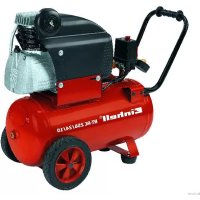
RTAC 2502410 - Air compressor EINHELL - Free user manual and instructions
Find the device manual for free RTAC 2502410 EINHELL in PDF.

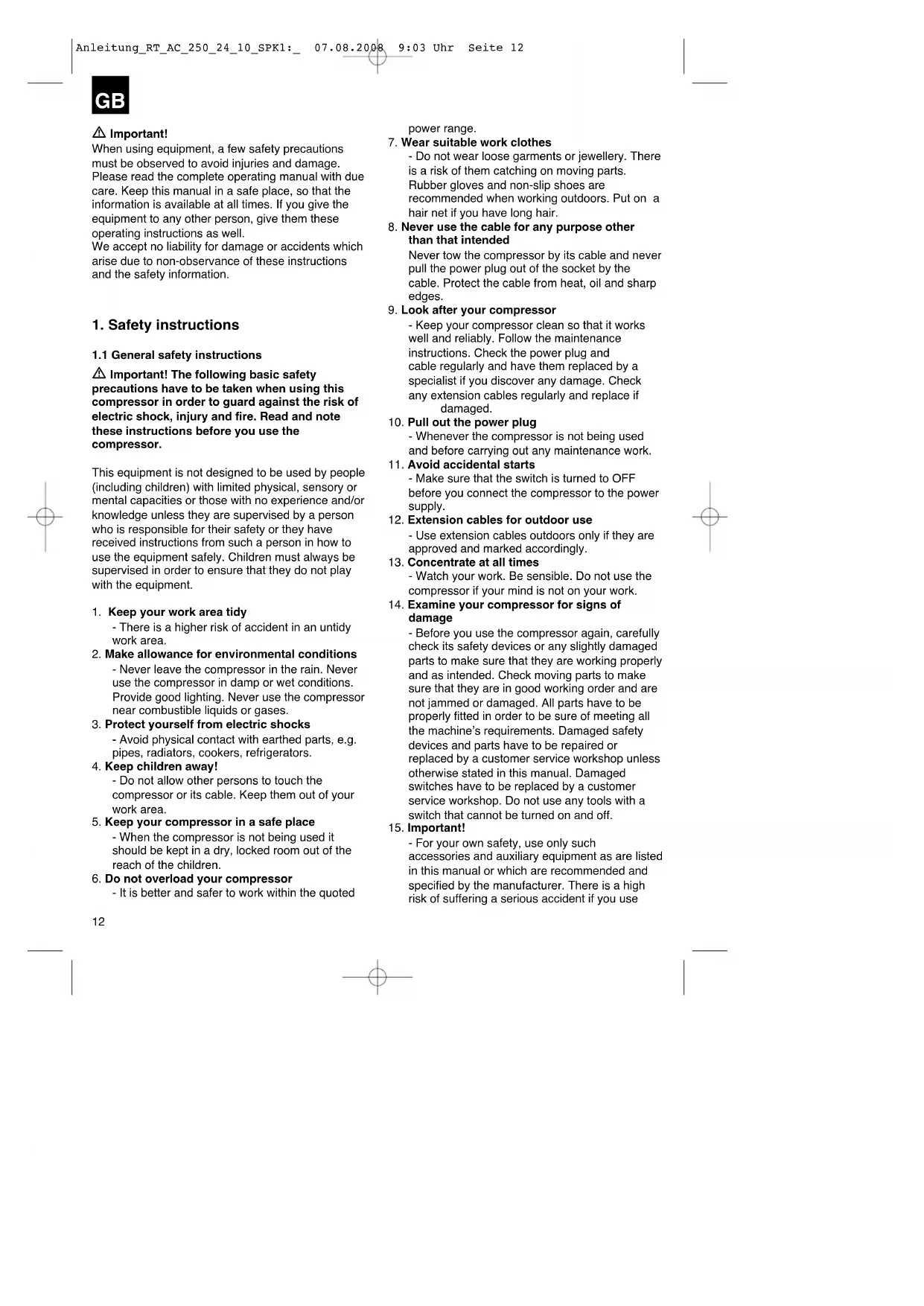


| Product type | Air compressor |
| Brand | Einhell |
| Model | RTAC 2502410 |
| Supply voltage | 230 V ~ 50 Hz |
| Motor power | 1.6 kW / 2.2 PS |
| Operating mode | S3 50% (10 minutes) |
| Rotational speed | 2850 min⁻¹ |
| Max. working pressure | 10 bar |
| Tank capacity | 24 liters |
| Theoretical air flow | 250 l/min |
| Sound power level | 92.4 dB(A) |
| Sound pressure level | 72.4 dB(A) |
| Protection type | IP20 |
| Weight | 26 kg |
| Recommended oil | SAE 15W/40 or equivalent |
| First oil change | After 100 hours of service |
| Subsequent oil change | Every 500 hours of service |
| Air filter cleaning | Every 300 hours of service |
| Condensed water drainage | Daily |
| Pressure switch trigger pressure | 6 bar (ON) / 8 bar (OFF) |
Frequently Asked Questions - RTAC 2502410 EINHELL
User questions about RTAC 2502410 EINHELL
0 question about this device. Answer the ones you know or ask your own.
Ask a new question about this device
Download the instructions for your Air compressor in PDF format for free! Find your manual RTAC 2502410 - EINHELL and take your electronic device back in hand. On this page are published all the documents necessary for the use of your device. RTAC 2502410 by EINHELL.
USER MANUAL RTAC 2502410 EINHELL
When using equipment, a few safety precautions must be observed to avoid injuries and damage. Please read the complete operating manual with due care. Keep this manual in a safe place, so that the information is available at all times. If you give the equipment to any other person, give them these operating instructions as well.
We accept no liability for damage or accidents which arise due to non-observation of these instructions and the safety information.
1. Safety instructions
1.1 General safety instructions
Important! The following basic safety precautions have to be taken when using this compressor in order to guard against the risk of electric shock, injury and fire. Read and note these instructions before you use the compressor.
This equipment is not designed to be used by people (including children) with limited physical, sensory or mental capacities or those with no experience and/or knowledge unless they are supervised by a person who is responsible for their safety or they have received instructions from such a person in how to use the equipment safely. Children must always be supervised in order to ensure that they do not play with the equipment.
1. Keep your work area tidy
- There is a higher risk of accident in an untidy work area.
2. Make allowance for environmental conditions
- Never leave the compressor in the rain. Never use the compressor in damp or wet conditions. Provide good lighting. Never use the compressor near combustible liquids or gases.
3. Protect yourself from electric shocks
- Avoid physical contact with earthed parts, e.g. pipes, radiators, cookers, refrigerators.
4. Keep children away!
- Do not allow other persons to touch the compressor or its cable. Keep them out of your work area.
5. Keep your compressor in a safe place
- When the compressor is not being used it should be kept in a dry, locked room out of the reach of the children.
6. Do not overload your compressor
- It is better and safer to work within the quoted
power range.
7. Wear suitable work clothes
- Do not wear loose garments or jewellery. There is a risk of them catching on moving parts. Rubber gloves and non-slip shoes are recommended when working outdoors. Put on a hair net if you have long hair.
8. Never use the cable for any purpose other than that intended
Never tow the compressor by its cable and never pull the power plug out of the socket by the cable. Protect the cable from heat, oil and sharp edges.
9. Look after your compressor
- Keep your compressor clean so that it works well and reliably. Follow the maintenance instructions. Check the power plug and cable regularly and have them replaced by a specialist if you discover any damage. Check any extension cables regularly and replace if damaged.
10. Pull out the power plug
- Whenever the compressor is not being used and before carrying out any maintenance work.
11. Avoid accidental starts
- Make sure that the switch is turned to OFF before you connect the compressor to the power supply.
12. Extension cables for outdoor use
- Use extension cables outdoors only if they are approved and marked accordingly.
13. Concentrate at all times
- Watch your work. Be sensible. Do not use the compressor if your mind is not on your work.
14. Examine your compressor for signs of damage
- Before you use the compressor again, carefully check its safety devices or any slightly damaged parts to make sure that they are working properly and as intended. Check moving parts to make sure that they are in good working order and are not jammed or damaged. All parts have to be properly fitted in order to be sure of meeting all the machine's requirements. Damaged safety devices and parts have to be repaired or replaced by a customer service workshop unless otherwise stated in this manual. Damaged switches have to be replaced by a customer service workshop. Do not use any tools with a switch that cannot be turned on and off.
15. Important!
- For your own safety, use only such accessories and auxiliary equipment as are listed in this manual or which are recommended and specified by the manufacturer. There is a high risk of suffering a serious accident if you use
tools or accessories which are not listed in this manual or in the catalogue of recommended tools and accessories.
16. Have an electrician carry out repairs
- Repairs are to be carried out only by a qualified electrician. If not, the user may suffer serious accidents.
17. Noise
Use ear muffs when you use the compressor.
18. Replacing the power cable
To prevent injury, damaged power cables may only be replaced by the manufacturer or a qualified electrician.
1.2 Safety instructions for working with copressed air and blasting guns
- Compressors and lines reach high temperatures during operation. Avoid contact! Risk of burns!
Gases or vapours drawn in by the compressor have to be kept free of constituents that may cause fire or explosions inside the compressor. - When you disconnect the hose coupling, hold the coupling element in your hand to prevent injury from the whiplashing hose.
Wear goggles when working with the blow-out gun. Injuries may easily result from foreign bodies and blasted parts. - Never point the blow-out gun at other persons and never use it to clean clothes that are still being worn.
1.3.Safety information for paint spraying
- Never process paints or solvents with a flash point below 55°C .
- Never heat paints or solvents.
It is imperative to use filtering equipment (face masks) when processing harmful liquids. Note also the information concerning safety precautions published by the manufacturers of these liquids.
Smoking is prohibited during the spraying operation and in the work room. Paint vapours are highly flammable.
Make sure there are no open fires or open lights in the work room. Sparking machines are not to be used.
Do not keep or consume food and drink in the work room. Paint vapours are harmful.
The details and designations of the Ordinance on Hazardous Substances, which are displayed on the outer packaging of the processed material, must be observed. Additional protective measures are to be undertaken if necessary, particularly the wearing of suitable clothing and masks.
The work room has to be bigger than 30m3 and
have sufficient ventilation for spraying and drying. Never spray into the wind. It is always imperative to observe the regulations of your local police authorities when spraying combustible or hazardous substances.
- Never process media such as white petroleum spirit, butyl alcohol and methylene chloride with the PVC pressure hose (reduced life span).
1.4 Operating pressure vessels
An operator of a pressure vessel is required to keep the pressure vessel in good working order, to operate it properly, to supervise its use, to carry out essential maintenance and repair work immediately, and to introduce essential safety measures according to requirements.
The supervisory authorities may order essential safeguards from case to case.
A pressure vessel may not be operated if it has any defects which constitute a danger to employees or third parties.
The pressure vessel must be regularly inspected for damage, e.g. rust. If you discover any damage, then please contact the customer service workshop.
Keep these safety instructions in a safe place.
2. Layout
- Intake air filter
- Pressure vessel
3.Wheel - Supporting foot
- Quick-lock coupling (regulated compressed air)
- Pressure gauge (for reading the preset tank pressure)
- Pressure regulator
- ON/OFF switch
- Transportation handle
- Safety valve
- Drainage screw for condensation water
- Pressure gauge (for reading the tank pressure)
- Quick-lock coupling (unregulated compressed air)
- Oil dipstick (oil filler opening)
- Oil drainage screw
GB
3. Scope of use
The compressor is designed for generating compressed air for tools operated by compressed air.
Please note that our equipment has not been designed for use in commercial, trade or industrial applications. Our warranty will be voided if the machine is used in commercial, trade or industrial businesses or for equivalent purposes.
The machine is to be used only for its prescribed purpose. Any other use is deemed to be a case of misuse. The user / operator and not the manufacturer will be liable for any damage or injuries of any kind caused as a result of this.
4. Technical data
Power supply: 230 50Hz
Motor rating in kW/HP: 1.6/2.2
Operating mode S3 50% 10 min
Compressor speed in rpm: 2850
Operating pressure in bar: 10
Pressure vessel volume in litre: 24
Theoretical intake rate in l/min.: 250
Sound power level LWA in dB: 92.4
Sound pressure level LpA in dB: 72.4
Protection type: IP 20
Machine weight in kg: 26
Operating mode S3 - 50% - 10min: S3 = Intermittent mode without influencing the starting process. This means that during a period of 10 min the max. operating time is 50% (5 min).
5. Points to note when setting up the compressor
Examine the machine for signs of transit damage. Report any damage immediately to the company which delivered the compressor.
The compressor should be set up near the working consumer.
- Avoid long air lines and long supply lines (extensions).
Make sure the intake air is dry and dust-free.
Do not set up the compressor in damp or wet rooms.
The compressor may only be used in suitable rooms (with good ventilation and an ambient temperature from +5°C to +40°C ). There must be no dust, acids, vapors, explosive gases or inflammable gases in the room.
The compressor is designed to be used in dry rooms. It is prohibited to use the compressor in areas where work is conducted with sprayed water.
The oil level in the compressor pump has to be checked before putting the equipment into operation.
6. Assembly and starting
Important!
You must fully assemble the appliance before using it for the first time.
6.1 Fitting the wheels (3)
Fit the supplied wheels as shown in Fig. 5.
6.2 Fitting the supporting feet (4)
Fit the supplied supporting feet (4) as shown in Fig. 6.
6.3. Fitting the air filter (1)
Remove the transportation stop with a screwdriver or similar and screw the air filter (1) securely to the equipment. (Fig. 7)
6.4. Replacing the oil sealing plug (14)
Remove the transportation cover from the oil filler opening with a screwdriver and insert the supplied oil dipstick (14) into the oil filler opening. (Fig. 8)
6.5 Fitting the transport handle (9)
Screw the transport handle (9) to the compressor as shown in Figures 9 to 10.
6.6 Voltage
The compressor is equipped with a mains cable with shock-proof plug. This can be connected to any 230V 50Hz shock-proof socket which is protected by a 16 A fuse. Before you use the machine, make sure that the mains voltage complies with the specifications on the rating plate. Long supply cables, extensions, cable reels etc. cause a drop in voltage and can impede motor start-up. In the case of low temperatures below +5°C motor start-up is jeopardized as a result of stiffness.
6.7 On/Off switch (8)
To switch on the compressor, pull out the red knob (8).
To switch off the compressor, press the red knob (8) in again. (Fig. 2)
6.8 Adjusting the pressure: (Fig. 1)
You can adjust the pressure on the pressure gauge (6) using the pressure regulator (7).
The set pressure can be taken from the quicklock coupling (5).
6.9 Setting the pressure switch
The pressure switch is set at the factory.
Switch-on pressure 6 bar
Switch-off pressure 8 bar
7. Cleaning and maintenance
Important!
Pull the power plug before doing any cleaning and maintenance work on the appliance.
Important!
Wait until the compressor has completely cooled down. Risk of burns!
Important!
Always depressurize the tank before carrying out any cleaning and maintenance work.
7.1 Cleaning
- Keep the safety devices free of dirt and dust as far as possible. Wipe the equipment with a clean cloth or blow it with compressed air at low pressure.
We recommend that you clean the appliance immediately after you use it.
Clean the appliance regularly with a damp cloth and some soft soap. Do not use cleaning agents or solvents; these may be aggressive to the plastic parts in the appliance. Ensure that no water can get into the interior of the appliance. - You must disconnect the hose and any spraying tools from the compressor before cleaning. Do not clean the compressor with water, solvents or the like.
7.2 Condensation water
The condensation water must be drained off each day by opening the drain valve (11) (on the floor of the pressure vessel).
Important! The condensation water from the pressure vessel will contain residual oil. Dispose of the condensation water in an
environmentally compatible manner at the appropriate collection point.
7.3 Safety valve (10)
The safety valve has been set for the highest permitted pressure of the pressure vessel. It is prohibited to adjust the safety valve or remove its seal. Actuate the safety valve from time to time to ensure that it works when required. Pull the ring with sufficient force until you can hear the compressed air being released. Then release the ring again.
7.4 Check the oil level at regular intervals
Place the compressor on a level and straight surface. Unscrew the oil dipstick (Fig. 8/Item 14) by turning it counter-clockwise and wipe the dipstick. Screw the dipstick back into the filler opening as far as it will go, screw out again and hold it horizontally to read off the oil level. The oil level must be between the two marks MAX and MIN on the oil dipstick (Fig. 8). Changing the oil: Recommended hydraulic oil: SAE 15W/40 or an alternative of the same quality. It should be refilled for the first time after 100 hours of operation. Thereafter the oil should be drained and refilled after every 500 hours in service.
7.5 Changing the oil
Switch off the engine and pull the mains plug out of the socket. After releasing any air pressure you can unscrew the oil drainage screw (15) from the compressor pump. To prevent the oil from running out in an uncontrolled manner, hold a small metal chute under the opening and collect the oil in a vessel. If the oil does not drain out completely, we recommend tilting the compressor slightly.
Dispose of the old oil at a drop-off point for old oil.
When the oil has drained out, re-fit the oil drainage screw (15). Fill new oil through the oil filler opening (14) until it comes up to the required level. Then re-insert the oil dipstick (14).
7.6 Cleaning the intake filter (1)
The intake filter prevents dust and dirt being drawn in. It is essential to clean this filter after at least every 300 hours in service. A clogged intake filter will decrease the compressor's performance dramatically. Remove the filter from the compressor and undo the thumb screw on the air filter. You can then remove the filter from the two halves of the plastic housing, tap it to remove the dirt, blast it down with low-pressure compressed air (approx. 3 bar) and re-insert it. (Fig. 11)
GB
7.7 Storage
Important!
Pull the mains plug out of the socket and ventilate the appliance and all connected pneumatic tools. Switch off the compressor and make sure that it is secured in such a way that it cannot be started up again by any unauthorized person.

Important!
Store the compressor only in a dry location which is not accessible to unauthorized persons. Always store upright, never tilted!
7.8 Ordering replacement parts
Please quote the following data when ordering replacement parts:
Type of machine
Article number of the machine
- Identification number of the machine
Replacement part number of the part required For our latest prices and information please go to www.isc-gmbh.info
8. Disposal and recycling
The unit is supplied in packaging to prevent its being damaged in transit. This packaging is raw material and can therefore be reused or can be returned to the raw material system.
The unit and its accessories are made of various types of material, such as metal and plastic. Defective components must be disposed of as special waste. Ask your dealer or your local council.
9. Possible causes of failure
| Problem Cause Solution | ||
| The compressor does not start 1. | No supply voltage 1. Check the supply voltage, the power plug and the socket-outlet. | |
| 2. Insufficient supply voltage 2. Make sure that the extension cable is not too long. Use an extension cable with large enough wires. | ||
| 3. Outside temperature is too low 3. Never operate with an outside temperature of below +5°C. | ||
| 4. Motor is overheated 4. Allow the motor to cool down. If necessary, remedy the cause of the overheating. | ||
| The compressor starts but there is no pressure | 1. Leak in the non-return valve 1. Replace the non-return valve | |
| 2. The seals are damaged. 2. Check the seals and have any damaged seals replaced by a service center | ||
| 3. The drainage screw for condensation water (11) leaks. 3. Tighten the screw by hand. Check the seal on the screw and replace if necessary. | ||
| The compressor starts, pressure is shown on the pressure gauge, but the tools do not start. | 1. Loose hose connections 1. Check the compressed air hose and tools and replace if necessary. | |
| 2. Leak in a quick-lock coupling 2. Check the quick-lock coupling and replace if necessary. | ||
| 3. Insufficient pressure set on the pressure regulator. 3. Open the pressure regulator further. |
F
Attention!
6.5 Montering at transportgreb (9)
Skru transportgrebet (9) pKa kompressoren som vist pa fig. 9 - 10.
6.6 Nettilslutning
6.7 Taend/Sluk-knap (8)
7.8. Bestilling at reservedele
Ved bestilling af reservationele skal falgende oplyses:
Savens type.
Savens artikelnummer.
Savens identifikationsnummer.
-Nummeret pa den nodvendige reservedel.
Aktuelle priser og øvrige ophysninger finder du pa internetadressen www.isc-gmbh.info
DK/N
CTaCTaHdapTAMN,HHHMMnDnDaHOroTObApy
deklareerib vastavuse jargnevatele EL dire
dele ja normidele
Subject to change without notice

Nur fur EU-Lander
For EU countries only
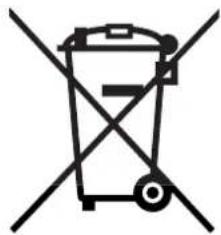
Never place any electric tools in your household refuse.
To comply with European Directive 2002/96/EC concerning old electric and electronic equipment and its implementation in national laws, old electric tools have to be separated from other waste and disposed of in an environment-friendly fashion, e.g. by taking to a recycling depot.
Recycling alternative to the demand to return electrical devices:
As an alternative to returning the electrical device, the owner is obliged to cooperate in ensuring that the device is properly recycled if ownership is relinquished. This can also be done by handing over the used device to a returns center, which will dispose of it in accordance with national commercial and industrial waste management legislation. This does not apply to the accessories and auxiliary equipment without any electrical components which are included with the used device.
The reprinting or reproduction by any other means, in whole or in part, of documentation and papers accompanying products is permitted only with the express consent of ISC GmbH.
F
All of our products undergo strict quality checks to ensure that they reach you in perfect condition. In the unlikely event that your device develops a fault, please contact our service department at the address shown on this guarantee card. Of course, if you would prefer to call us then we are also happy to offer our assistance under the service number printed below. Please note the following terms under which guarantee claims can be made:
- These guarantee terms cover additional guarantee rights and do not affect your statutory warranty rights. We do not charge you for this guarantee.
- Our guarantee only covers problems caused by material or manufacturing defects, and it is restricted to the rectification of these defects or replacement of the device. Please note that our devices have not been designed for use in commercial, trade or industrial applications. Consequently, the guarantee is invalidated if the equipment is used in commercial, trade or industrial applications or for other equivalent activities. The following are also excluded from our guarantee: compensation for transport damage, damage caused by failure to comply with the installation/assembly instructions or damage caused by unprofessional installation, failure to comply with the operating instructions (e.g. connection to the wrong mains voltage or current type), misuse or inappropriate use (such as overloading of the device or use of non-approved tools or accessories), failure to comply with the maintenance and safety regulations, ingress of foreign bodies into the device (e.g. sand, stones or dust), effects of force or external influences (e.g. damage caused by the device being dropped) and normal wear resulting from proper operation of the device.
The guarantee is rendered null and void if any attempt is made to tamper with the device.
- The guarantee is valid for a period of 2 years starting from the purchase date of the device. Guarantee claims should be submitted before the end of the guarantee period within two weeks of the defect being noticed. No guarantee claims will be accepted after the end of the guarantee period. The original guarantee period remains applicable to the device even if repairs are carried out or parts are replaced. In such cases, the work performed or parts fitted will not result in an extension of the guarantee period, and no new guarantee will become active for the work performed or parts fitted. This also applies when an on-site service is used.
- In order to assert your guarantee claim, please send your defective device postage-free to the address shown below. Please enclose either the original or a copy of your sales receipt or another dated proof of purchase. Please keep your sales receipt in a safe place, as it is your proof of purchase. It would help us if you could describe the nature of the problem in as much detail as possible. If the defect is covered by our guarantee then your device will either be repaired immediately and returned to you, or we will send you a new device.
Of course, we are also happy offer a chargeable repair service for any defects which are not covered by the scope of this guarantee or for units which are no longer covered. To take advantage of this service, please send the device to our service address.
BULLETIN DE GARANTIE
Chere Cilente, Cher Client
eeppeeppeeppeeppeeppeeppeeppeeppeeppeeppeeppeeppeeppeeppeeppeeppeeppeeppeeppeeppeeppeeppeeppeeppeeppeeppeeppeeppeeppeeppeeppeeppeeppeeppeeppeeppeeppeeppeeppeeppeeppe
WnE /N-Baepne NEN 1
- SAFETY INSTRUCTIONS
- 1.1 GENERAL SAFETY INSTRUCTIONS
- KEEP YOUR WORK AREA TIDY
- MAKE ALLOWANCE FOR ENVIRONMENTAL CONDITIONS
- PROTECT YOURSELF FROM ELECTRIC SHOCKS
- KEEP CHILDREN AWAY
- KEEP YOUR COMPRESSOR IN A SAFE PLACE
- DO NOT OVERLOAD YOUR COMPRESSOR
- WEAR SUITABLE WORK CLOTHES
- NEVER USE THE CABLE FOR ANY PURPOSE OTHER THAN THAT INTENDED
- LOOK AFTER YOUR COMPRESSOR
- PULL OUT THE POWER PLUG
- AVOID ACCIDENTAL STARTS
- EXTENSION CABLES FOR OUTDOOR USE
- CONCENTRATE AT ALL TIMES
- EXAMINE YOUR COMPRESSOR FOR SIGNS OF DAMAGE
- IMPORTANT
- HAVE AN ELECTRICIAN CARRY OUT REPAIRS
- NOISE
- REPLACING THE POWER CABLE
- 1.2 SAFETY INSTRUCTIONS FOR WORKING WITH COPRESSED AIR AND BLASTING GUNS
- 1.3.SAFETY INFORMATION FOR PAINT SPRAYING
- 1.4 OPERATING PRESSURE VESSELS
- KEEP THESE SAFETY INSTRUCTIONS IN A SAFE PLACE
- LAYOUT
- GB
- SCOPE OF USE
- TECHNICAL DATA
- POINTS TO NOTE WHEN SETTING UP THE COMPRESSOR
- ASSEMBLY AND STARTING
- 6.1 FITTING THE WHEELS (3)
- 6.2 FITTING THE SUPPORTING FEET (4)
- FITTING THE AIR FILTER (1)
- REPLACING THE OIL SEALING PLUG (14)
- 6.5 FITTING THE TRANSPORT HANDLE (9)
- 6.6 VOLTAGE
- 6.7 ON/OFF SWITCH (8)
- 6.8 ADJUSTING THE PRESSURE: (FIG. 1)
- 6.9 SETTING THE PRESSURE SWITCH
- CLEANING AND MAINTENANCE
- 7.1 CLEANING
- 7.2 CONDENSATION WATER
- 7.3 SAFETY VALVE (10)
- 7.4 CHECK THE OIL LEVEL AT REGULAR INTERVALS
- 7.5 CHANGING THE OIL
- DISPOSE OF THE OLD OIL AT A DROP-OFF POINT FOR OLD OIL
- 7.6 CLEANING THE INTAKE FILTER (1)
- 7.7 STORAGE
- 7.8 ORDERING REPLACEMENT PARTS
- DISPOSAL AND RECYCLING
- POSSIBLE CAUSES OF FAILURE
- F
- ATTENTION
- 6.5 MONTERING AT TRANSPORTGREB (9)
- 6.6 NETTILSLUTNING
- 6.7 TAEND/SLUK-KNAP (8)
- BESTILLING AT RESERVEDELE
- DK/N
- NUR FUR EU-LANDER
- FOR EU COUNTRIES ONLY
- BULLETIN DE GARANTIE
- CHERE CILENTE, CHER CLIENT
Brand : EINHELL
Model : RTAC 2502410
Category : Air compressor