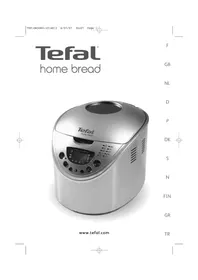
Home Bread OW3000 - Bread maker TEFAL - Free user manual and instructions
Find the device manual for free Home Bread OW3000 TEFAL in PDF.



| Product Type | Bread Machine |
| Brand | TEFAL |
| Model | Home Bread OW3000 |
| Power Supply | 220-240 V ~ 50/60 Hz |
| Automatic Programs | 10 programs: basic, french, whole wheat, sweet, super quick, dough, fresh pasta, yogurt bread, jam, bake only |
| Bread Weight Setting | 750 g or 1000 g |
| Crust Color Setting | Light, medium, dark |
| Timer | Up to 15 hours |
| Keep Warm Function | 1 hour automatic after baking |
| Non-stick Pan | Yes, removable with handle |
| Kneading Paddle(s) | 1 removable paddle |
| Viewing Window | Yes (porthole) |
| Digital Display | Yes, with timer and cycle indicators |
| Maximum Pan Capacity | 1000 g bread, do not exceed 1000 g dough |
| Included Accessories | Pan, paddle, measuring cup, double measuring spoon (teaspoon and tablespoon) |
| Cleaning | Body and pan: damp sponge. Pan and paddle washable in hot water. Do not wash in dishwasher. Do not immerse the body. |
| Safety | Earth connection required. 7-minute power cut protection. Do not use if cord damaged. |
| After-sales Service | Spare parts available, repair by approved center |
| Dimensions (approx.) | Approximately 30 x 25 x 35 cm |
| Weight (approx.) | Approximately 5 kg |
Frequently Asked Questions - Home Bread OW3000 TEFAL
User questions about Home Bread OW3000 TEFAL
0 question about this device. Answer the ones you know or ask your own.
Ask a new question about this device
Download the instructions for your Bread maker in PDF format for free! Find your manual Home Bread OW3000 - TEFAL and take your electronic device back in hand. On this page are published all the documents necessary for the use of your device. Home Bread OW3000 by TEFAL.
USER MANUAL Home Bread OW3000 TEFAL
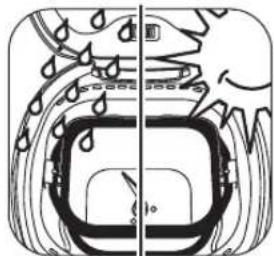
A slight odour may be given off when used for the first time
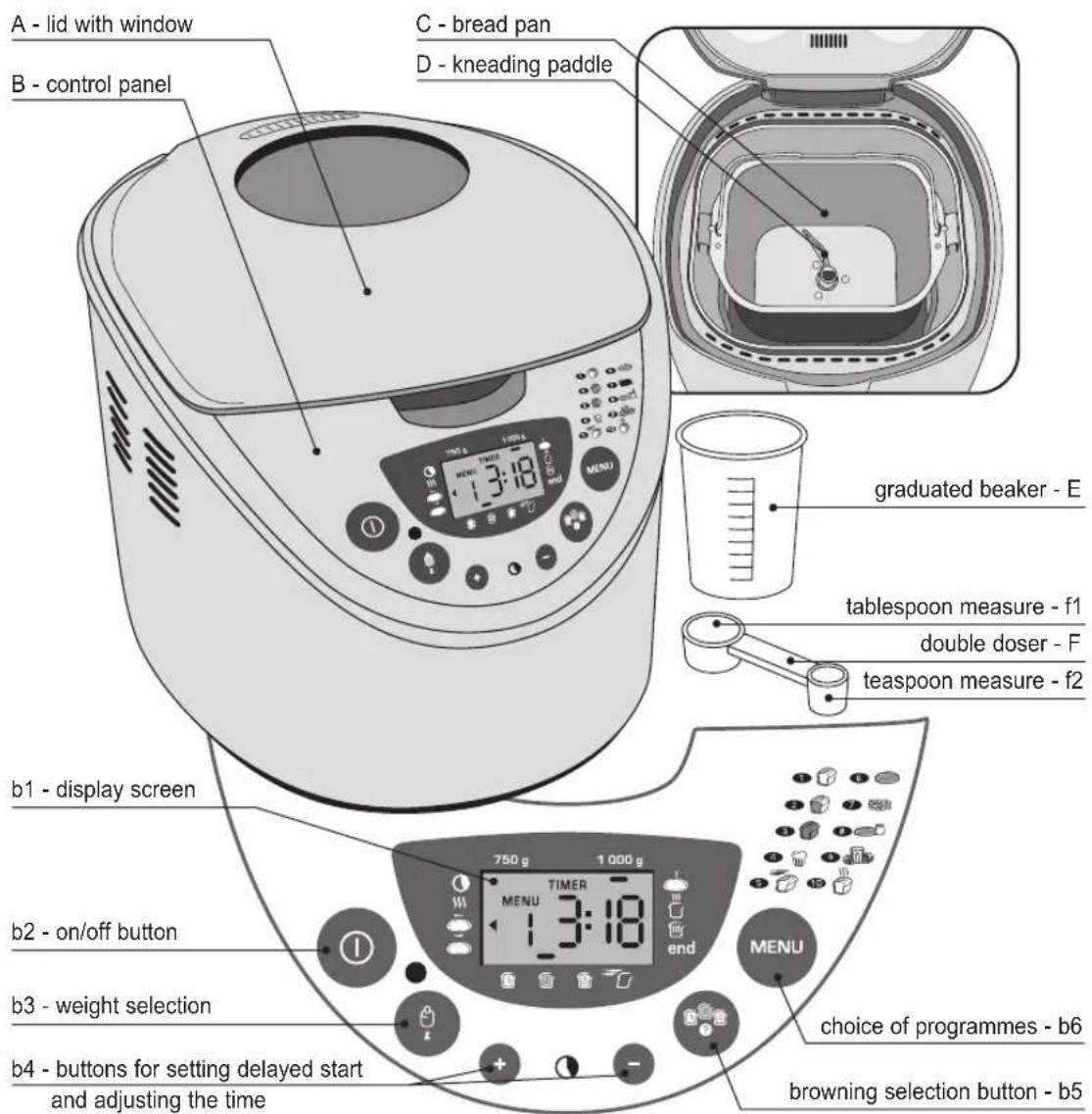
GETTING TO KNOW YOUR BREADMAKER
INTRODUCTION
Bread plays an important role in our nutrition.
Who has never dreamed of making their own freshly baked bread at home?
Now you can using a breadmaker.
Whether you are a beginner or an expert, all you have to do is add the ingredients and the breadmaker does the rest. You can easily make bread, bread dough, pizza dough, brioche, pasta and jam effortlessly. However be aware that to make the most of your breadmaker a certain learning curve is necessary. Take the time to get to know it and don't be disappointed if your first attempts aren't quite perfect. But if you're impatient to make your first loaf, one of the recipes in the quick-start paragraph will help you take your first steps. Note that the texture of the bread you'll get is more compact than bread from a bakery.
Also, remember that all baked loaves have a hole underneath where the kneading paddle is positioned while the bread is baking in the pan.
FIRST STEPS
Tips for making good bread

Read the instructions carefully and use the recipes: breadmaking using this appliance is not the same as breadmaking by hand!

All the ingredients used must be at room temperature and should be weighed precisely. Measure liquids with the graduated beaker supplied. Use the double doser supplied to measure teaspoons on one side and tablespoons on the other. All spoon measures are level and not heaped. Incorrect measurements give bad results.

For successful bread making using the correct ingredients is critical (see page 20 & 21). Use ingredients before their use-by date and keep them in a cool, dry place.

It is important to measure the quantity of flour precisely. That is why you should weigh out flour using a kitchen scale. Use packets of flaked dried yeast (sold in the UK as Easy Bake or Fast Action Yeast). Unless otherwise indicated in the recipe, do not use baking powder. Once a packet of yeast has been opened, it should be sealed, stored in a cool place and used within 48 hours.

To avoid disturbing the preparation while it is rising, we recommend that you place all the ingredients into the pan at the beginning and do not open the lid during use. Carefully follow the order of ingredients and quantities indicated in the recipes. First the liquids, then the solids. Yeast should not come into contact with liquids, sugar or salt.
General order to be followed:
Liquids (butter, oil, eggs, water, milk)
Salt
Sugar
Flour, first half
Powdered milk
Specific solid ingredients
Flour, second half
Yeast
QUICK-START
To get to know your breadmaker, we suggest trying the BASIC BREAD recipe for your first loaf.
BASIC
BROWNING > MEDIUM
WHITE BREAD
WEIGHT >1000g
(programme 1)
TIME >3:18
OIL >1.5 tablespoons
WATER >300 ml
SALT
1.5 teaspoons
SUGAR
1 tablespoon
POWDERED MILK
2 tablespoons
WHITE BREAD FLOUR
1.5 teaspoons
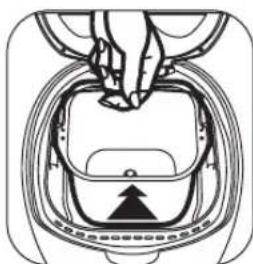
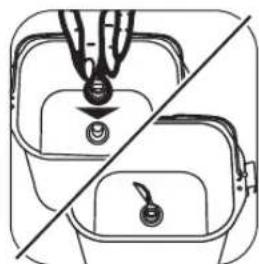
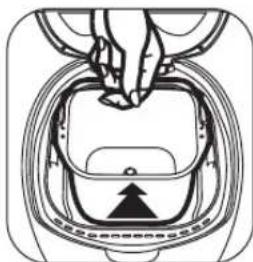
Remove the bread pan by lifting the handle and firmly pulling upward.
Then insert the kneading paddle.
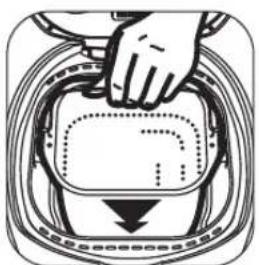
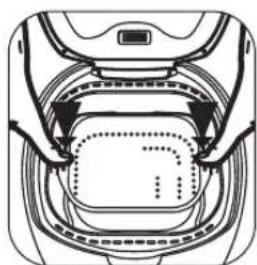
Place the bread pan in the breadmaker. Press down on both sides of the pan so that it clips well to both sides of the breadmaker and engages the drive. NOTE: If the baking pan is incorrectly fitted the paddle with not operate.
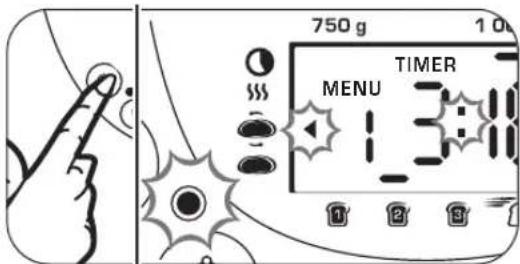
Press the (口) button.
The indicator light comes on facing the stage the program has reached.
The timer colon flashes. and the timer will count down. The operating indicator lights up.
When baking has finished a beep sounds.
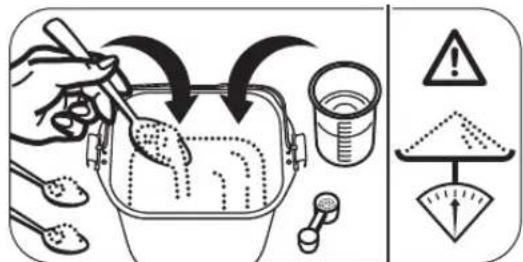
Put the ingredients in the pan in exactly the order recommended.
Make sure that all ingredients are weighed with precision.
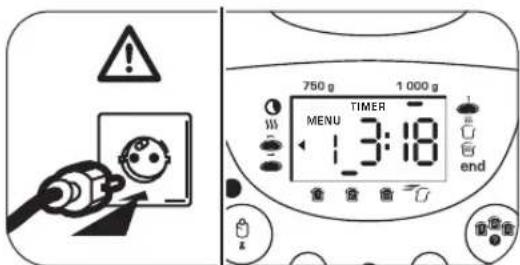
Close the lid. Plug in the breadmaker and switch it on. After you hear the beep, programme 1 settings are displayed by default, i.e. 1000g medium browning.

Unplug the breadmaker at the end of the cooking or warming cycle. Lift the bread pan out of the breadmaker by pulling on the handle. Always use oven gloves as the pan handle is hot, as is the inside of the lid. Turn out the hot bread and place it on a rack for at least 1 hour to cool.
Choosing a programme triggers a series of steps which are carried out automatically one after another.

The MENU button enables you to choose a certain number of different programmes. The time corresponding to the programme is displayed. Every time you press the (MEN) button, the number on the display panel advances to the next programme, from 1 to 10:
1 >basic white bread
2 > French bread
3 >wholemeal bread
4 >sweet bread
5 > super fast bread
6 >leavened dough (pizza for example)
7 >fresh pasta
8 > yoghurt bread
9 > jams and compotes
10 cooking only
1 The Basic Bread programme is used to make most bread recipes using white wheat flour.
2 The French Bread programme corresponds to a traditional French crusty white bread recipe.
3 The Wholemeal Bread programme should be selected when using wholemeal bread flour.
4 The Sweet Bread programme is suited to recipes which contain more fat and sugar.
5 The Super Fast Bread programme is specific to the SUPER FAST bread recipe (see page 24).
6 The Leavened Dough programme does not bake. It is a kneading and rising programme for all leavened doughs such as pizza dough, rolls, sweet buns.
7 Programme 7 only kneads. It is for unleavened pasta, like noodles for example.
8Yoghurt bread is a speciality with an acidic taste,with medium browning, 1000g only.
9 The Jams programme automatically cooks jams and compotes (stewed fruits) in the pan.
10 The Cooking Only programme is used to cook for 60 min. It can be selected alone and used:
a) with the Leavened Dough programme,
b) to reheat cooked and cooled breads or to make them crusty,
c) to finish cooking in case of a prolonged electricity cut during a bread baking cycle.
The breadmaker should not be left unattended when using programme 10.
When the crust has browned to the colour you want, manually stop the programme by pressing the (1) button for several seconds.
SELECTING THE WEIGHT OF THE BREAD
The bread weight is set by default at 1000 g. This weight is shown for informational purposes. See the recipes for more details. Programmes 6, 7, 8 and 9 do not have weight settings. Press the button to set the desired weight of 750 g or 1000 g. The indicator light against the selected setting comes on.
SELECTING THE COLOUR OF THE CRUST (BROWNING)
By default, the colour of the crust is set at MEDIUM.
Programmes 6, 7, 8 and 9 do not have a colour setting.
Three choices are possible: LIGHT/MEDIUM/DARK.
If you want to change the default setting, press the button until the indicator light facing the desired setting comes on.
SELECTING FAST MODE
Recipes 1, 2, 3 and 4 can be made in FAST mode, thus reducing baking time.
Press on the button 4 times to select FAST mode.
The colour of the crust cannot be set in FAST mode.
START/STOP
Press the ① button to switch the appliance on. The countdown begins.
To stop the programme or to cancel delayed programming, hold down on the ① button for 5 seconds.
CYCLES
The indicator light comes on facing the cycle that the breadmaker has reached.
A table (page 26-27) indicates the breakdown of the various cycles for the programme chosen.
SSS
Preheating
Used for programmes 3 and 8 to let the dough rise better.

Kneading
For forming the dough's structure so that it can rise better.

Rest
Allows the dough to rest to improve kneading quality.

Rising
Time during which the yeast works to let the bread rise and to develop its aroma.
5

Ba

king
Transforms the dough into bread and gives it a golden, crusty crust.

Warming
Keeps the bread warm after baking. It is recommended that the bread should be turned out promptly after baking, however.
Preheating: only activated for programmes 3 and 8. The kneading paddle does not operate during this period. This step accelerates yeast activity and thus encourages rising in breads made of flours which tend not to rise well.

Kneading: the dough is in the 1st or 2nd kneading cycle or in a stirring period between rising cycles.
During this cycle, and for programmes 1, 3, 4 and 8, you can add ingredients: dried fruit or nuts, olives, bacon pieces, etc.
A beep indicates when you can intervene. See the summary table for preparation times (page 26-27) and the "extra" column.
This column indicates the time that will be displayed on your appliance's screen when the beep sounds.
For more precise information on how long before the beep sounds, subtract the "extra" column time from the total baking time.
For example: "extra" = 2:51 and "total time" = 3:13, the ingredients can be added after 22 min.

Rising: the dough is in the 1st, 2nd or 3rd rising cycle.

Baking: the bread is in the final baking cycle.

Warming: for programmes 1, 2, 3, 4, 5, 8 and 10, you can leave your preparation in the appliance.
A one-hour warming cycle automatically follows baking.
The display remains at 0:00 for one hour of warming. The appliance beeps at regular intervals. At the end of the cycle, it stops automatically after 3 beeps. To stop the warming programme, unplug the appliance.
20

DELAYED START PROGRAMME
You can programme the appliance up to start 15 hours in advance to have your preparation ready at the time you want. This function cannot be used on programmes 5,6,7,9,10.
This step comes after selecting the programme, browning level and weight. The programme time is displayed. Calculate the time difference between the moment when you start the programme and the time at which you want your preparation to be ready.
The machine automatically includes the duration of the programme cycles.
Using the and buttons, display the calculated time (up and down).
Short presses change the time by intervals of 10min + a short beep.
Holding the button down gives continuous scrolling of 10-min intervals.
For example, it is 8 pm and you want your bread to be ready for 7 am the next morning. Programme 11:00 using the + and - buttons.
Press the button. A beep is emitted. The facing indicator light switches on and the timer colon blinks. The countdown begins. The ON light switches on.
If you make a mistake or want to change the time setting, hold down the ① button until it makes a beep.
The default time is displayed. Start the operation again.
With the delayed start programme do not use recipes which contain fresh milk, eggs, soured cream, yoghurt, cheese or fresh fruit as they could spoil or stale overnight.
PRACTICAL ADVICE
If there is a power cut: if, during the cycle, the programme is interrupted by a power cut or mishandling, the machine has a 7-min protection time during which the settings are saved. The cycle starts again where it stopped. Beyond that time, the settings are lost.
If you plan to run a second programme bake a second loaf, open the lid and wait 1 hour before beginning the second preparation.
INGREDIENTS
Fats and oils: fats make the bread softer and tastier. It also stores better and longer. Too much fat slows down rising. If you use butter, cut it into tiny pieces so that it is distributed evenly throughout the preparation, or soften it. You can substitute 15g butter for 1 tablespoon of oil. Do not add hot butter. Keep the fat from coming into contact with the yeast, as fat can prevent yeast from rehydrating. Do not use low fat spreads or butter substitutes.
Eggs: eggs make the dough richer, improve the colour of the bread and encourage the development of the soft, white part. If you use eggs, reduce the quantity of liquid you use proportionally. Break the egg and top up with the liquid until you reach the quantity of liquid indicated in the recipe. Recipes are designed for 50g size eggs; if your eggs are bigger, add a little flour; if they are smaller, use less flour.
Milk: recipes use either fresh or powdered milk. If using powdered milk, add the quantity of water stated in the recipe. It enhances the flavour and improves the keeping qualities of the bread. For recipes using fresh milk, you can substitute some of it with water but the total volume must equal the quantity stated in the recipe. Semi-skimmed or skimmed milk is best to avoid bread having a close texture. Milk also has an emulsifying effect which evens out its airiness, giving the soft, white part a better aspect.
Water: water rehydrates and activates the yeast. It also hydrates the starch in the flour and helps the soft, white part to form. Water can be totally or partially replaced with milk or other liquids. Use liquids at room temperature.
Flour: the weight of the flour varies significantly depending on the type of flour used. Depending on the quality of the flour, baking results may also vary. Keep flour in a hermetically sealed container, as flour reacts to fluctuations in atmospheric conditions, absorbing moisture or losing it. Use "French T55 flour", "strong flour", "bread flour" or "baker's flour" rather than standard flour, unless otherwise indicated in the recipe.
Adding oats, bran, wheat germ, rye or whole grains to the bread dough will give a smaller, heavier loaf of bread.
Sifting the flour during manufacture also affects the results: the more the flour is whole (i.e. the more of the outer envelope of the wheat it contains), the less the dough will rise and the denser the bread.
You can also find ready-to-use bread preparations or bread mixes on the market.
Follow the manufacturer's instructions when using these preparations. Usually, the choice of the programme will depend on the preparation used. For example: Wholemeal bread - Programme 3.
Sugar: use white sugar, brown sugar or honey. Do not use unrefined sugar or lumps. Sugar acts as food for the yeast, gives the bread its good taste and improves browning of the crust. Artificial sweeteners cannot be substituted for sugar as the yeast will not react with them.
Salt: salt gives taste to food and regulates the yeast's activity. It should not come into contact with the yeast. Thanks to salt, the dough is firm, compact and does not rise too quickly. It also improves the structure of the dough. Use ordinary table salt. Do not use coarse salt or salt substitutes.
Yeast: yeast is what makes the dough rise. Use flaked dried yeast (in the UK sold as Easy Bake or Fast Action Yeast). The quality of yeast can vary, and it does not always rise in the same way. Bread can therefore come out differently depending on the yeast used. Old or poorly stored yeast will not work as well as a freshly opened packet of dry yeast.
The proportions indicated are for flaked dried yeast. If you use fresh yeast, multiply the quantity by 3 (in weight) and dilute the yeast in a small amount of warm water with a little sugar for more effective action.
There are dry yeasts in the form of small granular pellets that have to be rehydrated with a small amount of warm water with a little sugar. These are used in the same proportions as flaked dry yeast, but we recommend the latter as it is easier to use.
Additives (olives, bacon pieces, etc.): you can add a personal touch to your recipes by adding whatever ingredients you want, taking care:
to add following the beep for additional ingredients, especially those that are fragile such as dried fruit,
to add the most solid grains (such as linseed or sesame) at the start of the kneading process to facilitate use of the machine (delayed starting, for example),
to thoroughly drain moist ingredients (olives),
to lightly flour fatty ingredients for better blending,
not to add too large a quantity of additional ingredients, especially cheese, fresh fruit and fresh vegetables, as they can affect the development of the dough,
to finely chop nuts as they can cut through the loaf structure and reduce the cooked height.
PRACTICAL ADVICE
Bread preparation is very sensitive to temperature and humidity conditions. In case of high heat, use liquids that are cooler than usual. Likewise, if it is cold, it may be necessary to warm up the water or milk (never exceeding 35^ ). Any liquid used should be tepid, about 20 to 25 C (except for Super Fast Bread which should be 35 to 40 C max.).
It can also sometimes be useful to check the state of the dough during the second kneading: it should form an even ball which comes away easily from the walls of the pan.
if not all of the flour has been blended into the dough, add a little more water,
if the dough is too wet and sticks to the sides, you may need to add a little flour.
Such corrections should be undertaken very gradually (no more than 1 tablespoon at a time) and wait to see if there is an improvement before continuing.
A common error is to think that adding more yeast will make the bread rise more. Too much yeast makes the structure of the bread more fragile and it will rise a lot and then fall while baking. You can determine the state of the dough just before baking by touching it lightly with your fingertips: the dough should be slightly resistant and the fingerprint should disappear little by little.
RECIPES
For each recipe, add the ingredients in the exact order indicated.
Depending on the recipe chosen and the corresponding programme, you can take a look at the summary table of preparation times (page 26-27) and follow the breakdown for the various cycles. Do not alter the quantities or omit ingredients as it can upset the critical balance of the recipe.
tsp > teaspoon - tbsp > tablespoon
PROGRAMME 1
BASIC WHITE BREAD
| 750 g 1000 g | 750 g 1000 g |
| Sunflower oil 1 tsp 1.5 tsp | Butter, softened, diced 50 g 60 g |
| Water 245 ml 300 ml | Salt 1.5 tsp 2 tsp |
| Salt 1 tsp 1.5 tsp | Sugar 2 tsp 2.5 tsp |
| Sugar 3 tsp 1 tsp | Liquid milk 260 ml 310 ml |
| Powdered milk 1 tsp 2 tsp | White Bread Flour 400 g 470 g |
| White Bread Flour 455 g 550 g | Yeast* 1 tsp 5 g |
| Yeast* 1 tsp 5 g | |
| or 1.5 tsp | or 1.5 tsp |
PROGRAMME 2
| FRENCH BREAD ** | FARMHOUSE LOAF | ||||
| 750 g 1000 g | 750 g 1000 g | ||||
| Water 270 ml 360 ml | Water 270 ml 360 ml | ||||
| Salt 1.5 tsp 2 tsp | Salt 1.5 tsp 2 tsp | ||||
| White Bread Flour 460 g 620 g | White Bread Flour 370 g 500 g | ||||
| Yeast | 5 g | 2 tsp | Rye flour | 90 g 120 g | |
| or 1.5 tsp | Yeast | 5 g | 2 tsp | ||
| or 1.5 tsp | |||||
PROGRAMME 3
| WHOLEMEAL LOAF | PEASANT BREAD |
| 750 g 1000 g | 750 g 1000 g |
| Sunflower oil 2 tsp 1 tbsp | Sunflower oil 2 tsp 1 tbsp |
| Water 270 ml 360 ml | Water 270 ml 360 ml |
| Salt 1.5 tsp 2 tsp | Salt 1.5 tsp 2 tsp |
| Sugar 2 tsp 1 tbsp | Sugar 2 tsp 1 tbsp |
| Flour 225 g 300 g | Flour 230 g 300 g |
| Wholemeal flour 225 g 300 g | Rye flour 110 g 150 g |
| Yeast* 1 tsp 5 g | Wholemeal flour 110 g 150 g |
| or 1.5 tsp | Yeast* 1 tsp 5 g |
| or 1.5 |
- = Flaked dried type. In UK us e"Easy Bake" or "Fast Action" yeast.
^** = Sugar is not included in the recipe, instead the yeast feeds on the natural starches and sugars in the flour.
*** = Add when machine beeps.
tsp > teaspoon - tbsp > tablespoon
PROGRAMME 4
BRIOCHE
750g1000g
Eggs 23
Butter 150 g 175 g
Liquid milk 60 ml 70 ml
Salt 1 tsp 1.5 tsp
Sugar 3 tbsp 4 tbsp
White Bread Flour,
type 55 360 g 440 g
Yeast* 2 tsp 2.5 tsp
Optional: 1 teaspoon orange blossom water.
PROGRAMME 5
SUPER FAST BREAD
750g1000g
Sunflower oil 1 tbsp 1.5 tbsp
Water (35 to 40^ max.) 270 ml 360 ml
Salt 1 tsp 1.5 tsp
Sugar 1 tbsp 1 tbsp
Powdered milk 1 tbsp 2 tbsp
White Bread Flour 430 g 570 g
Yeast* 3 tsp 3.5 tsp
PROGRAMME 6
PIZZA DOUGH
750g1000g
Olive oil
1 tbsp 1.5 tbsp
Water
240 ml 320 ml
Salt 1.5 tsp 2 tsp
White Bread Flour 480 g 640 g
Yeast*1 tsp 5 g
or 1.5 tsp
PROGRAMME 7
FRESH PASTA
1000 g
Eggs 5
Water 60 ml
Flour (in UK Plain Flour) 600 g
Salt 1 tsp
24
KUGELHOPF
750g1000g
Eggs 2 3
Butter 140 g 160 g
Liquid milk 80 ml 100 ml
Salt 1/2 tsp 1 tsp
Sugar 4 tbsp 5 tbsp
White Bread Flour 350 g 420 g
Yeast* 2 tsp 2.5 tsp
Raisins*** 100 g 150 g
Optional: soak the raisins in a light syrup (50% sugar 50% water) or alcohol such as schnapps or grape eau de vie.
Optional: place whole almonds on the top of the dough at the end of the last kneading cycle.
PROGRAMME 8
YOGHURT BREAD
1000 g
Water 200 ml
Plain yoghurt 1 (125 g)
Salt 2 tsp
Sugar 1 tbsp
White Bread Flour 480g
Rye flour 70g
Yeast* 2.5 tsp
PROGRAMME 9
JAMS AND COMPOTES
Cut or chop up the fruit of your choice before putting in the breadmaker.
Strawberry, peach, rhubarb or apricot jam:
580 g fruit, 360 g sugar, juice of 1 lemon.
Orange marmalade:
500 g fruit, 400 g sugar.
Apple/rhubarb compote:
750 g fruit, 4.5 tbsp sugar
Rhubarb compote:
750 g fruit, 4.5 tbsp sugar.
Note: When making jam never exceed the quantity in the recipe otherwise it could boil over.
TROUBLESHOOTING GUIDE
Not getting the expected results? This table will help you.
| Bread rises too much | Bread falls after rising too much | Bread does not rise enough | Crust not golden enough | Sides brown but bread not fully cooked | Top and sides floury | |
| The ① button was pressed during baking | ● | |||||
| Not enough flour | ● | |||||
| Too much flour | ● | ● | ||||
| Not enough yeast | ● | |||||
| Too much yeast | ● | ● | ||||
| Not enough water | ● | ● | ||||
| Too much water | ● | ● | ||||
| Not enough sugar | ● | |||||
| Poor quality flour | ● | ● | ||||
| Wrong proportions of ingredients (too much) | ● | |||||
| Water too hot | ● | |||||
| Water too cold | ● | |||||
| Wrong programme | ● | ● |
TECHNICAL TROUBLESHOOTING GUIDE
| PROBLEMS SOLUTIONS | |
| The kneading paddle is stuck in the pan The kneading paddle is stuck • Lightly oil in the bread to the pan After pressing on Ⓞ, nothing happens After pressing on Ⓞ, the motor is on • The but no kneading takes place • Kneading piddle After a delayed start, • You forgot to press on after programming. Ⓞ the bread has not risen enough • The yeast has come into contact with salt and/or water. or nothing happens • Kneading paddle missing. Burnt smell • Some of the ingredients have fallen outside the pan: let the machine cool down and clean the inside of the machine with a damp sponge and without any cleaning product. • The preparation has overflowed: the quantity of ingredients used is too great, notably liquid. Follow the proportions given in the recipe. | • Let it soak before removing it. the kneading paddle before adding the ingredients • The machine is too hot. Wait 1 hour between 2 cycles. • A delayed start has been programmed. • The programme includes preheating pan has not been correctly inserted. paddle missing or not installed properly. on after programming. • The preparation has overflowed: the quantity of ingredients used is too great, notably liquid. Follow the proportions given in the recipe. |
| PROGRAMME | WEIGHT | BROWNTIME(h) | INGTOTAL(mn) | 1 PRENEARING2 | 1RISING | 3RISING | 4RISING | 3RISING | |||||||
| KNEADING(mn) | (kn) | KNEADING(mn) | (kn) | KNEADING(sec) | RISING(mn) | (kn) | RISING(sec) | (kn) | RISING(mn) | WARM(mn) | |||||
| 1Basic White Bread | 750 | 1 | 3.13 | 5 | 5 | 20 | 39 | 10 | 26 | 15 | 50 | 48 | 60 | 2.51 | |
| 2 | 3.13 | 5 | 5 | 20 | 39 | 10 | 26 | 15 | 50 | 48 | 60 | 2.51 | |||
| 3 | 3.13 | 5 | 5 | 20 | 39 | 10 | 26 | 15 | 50 | 48 | 60 | 2.51 | |||
| Fast | 2.12 | 5 | 5 | 20 | 15 | 10 | 9 | 10 | 30 | 48 | 60 | 1.50 | |||
| 1 | 3.18 | 5 | 5 | 20 | 39 | 10 | 26 | 15 | 50 | 53 | 60 | 2.56 | |||
| 2 | 3.18 | 5 | 5 | 20 | 39 | 10 | 26 | 15 | 50 | 53 | 60 | 2.56 | |||
| 3 | 3.18 | 5 | 5 | 20 | 39 | 10 | 26 | 15 | 50 | 53 | 60 | 2.56 | |||
| Fast | 2.17 | 5 | 5 | 20 | 15 | 10 | 9 | 10 | 30 | 53 | 60 | 1.55 | |||
| 2French Bread | 750 | 1 | 3.30 | 5 | 5 | 20 | 39 | 10 | 31 | 10 | 60 | 50 | 60 | 3.30 | |
| 2 | 3.30 | 5 | 5 | 20 | 39 | 10 | 31 | 10 | 60 | 50 | 60 | 3.30 | |||
| 3 | 3.30 | 5 | 5 | 20 | 39 | 10 | 31 | 10 | 60 | 50 | 60 | 3.30 | |||
| Fast | 2.30 | 5 | 5 | 20 | 15 | 10 | 16 | 10 | 39 | 50 | 60 | 2.30 | |||
| 1 | 3.32 | 5 | 5 | 20 | 39 | 10 | 31 | 10 | 60 | 52 | 60 | 3.32 | |||
| 2 | 3.32 | 5 | 5 | 20 | 39 | 10 | 31 | 10 | 60 | 52 | 60 | 3.32 | |||
| 3 | 3.32 | 5 | 5 | 20 | 39 | 10 | 31 | 10 | 60 | 52 | 60 | 3.32 | |||
| Fast | 2.32 | 5 | 5 | 20 | 15 | 10 | 16 | 10 | 39 | 52 | 60 | 2.32 | |||
| 3Wholemeal Bread | 750 | 1 | 3.43 | 30 | 5 | 5 | 15 | 49 | 10 | 26 | 10 | 45 | 48 | 60 | 2.56 |
| 2 | 3.43 | 30 | 5 | 5 | 15 | 49 | 10 | 26 | 10 | 45 | 48 | 60 | 2.56 | ||
| 3 | 3.43 | 30 | 5 | 5 | 15 | 49 | 10 | 26 | 10 | 45 | 48 | 60 | 2.56 | ||
| Fast | 2.28 | 5 | 5 | 5 | 15 | 24 | 10 | 11 | 10 | 35 | 48 | 60 | 2.06 | ||
| 1 | 3.45 | 30 | 5 | 5 | 15 | 49 | 10 | 26 | 10 | 45 | 50 | 60 | 2.58 | ||
| 2 | 3.45 | 30 | 5 | 5 | 15 | 49 | 10 | 26 | 10 | 35 | 50 | 60 | 2.58 | ||
| 3 | 3.45 | 30 | 5 | 5 | 15 | 49 | 10 | 26 | 10 | 45 | 50 | 60 | 2.58 | ||
| Fast | 2.30 | 5 | 5 | 5 | 15 | 24 | 10 | 11 | 10 | 35 | 50 | 60 | 2.08 | ||
- Time on display to add extra infredients egg, dried fruit, nuts, olives, etc.
| PROGRAMME | WEIGHT | BROWNTIME(h) | BROWNTOTAL(mn) | "PREKNEADING(mn) | EARBOG2(mn) | 1ndKNEADING(mn) | 1stRISING(mn) | 3rdKNEADING(sec) | 2ndRISING(mn) | 4thKNEADING(sec) | 3rdRISING(mn) | COOKING(mn) | KEEP EXTRAWARM(mn) | ||
| 4Sweet Bread | 750 | 1 | 3.17 | 5 | 5 | 20 | 39 | 10 | 26 | 5 | 52 | 50 | 60 | 2.55 | |
| 2 | 3.17 | 5 | 5 | 20 | 39 | 10 | 26 | 5 | 52 | 50 | 60 | 2.55 | |||
| 3 | 3.17 | 5 | 5 | 20 | 39 | 10 | 26 | 5 | 52 | 50 | 60 | 2.55 | |||
| Fast | 2.37 | 5 | 5 | 20 | 25 | 10 | 16 | 5 | 36 | 50 | 60 | 2.55 | |||
| 1 | 3.22 | 5 | 5 | 20 | 39 | 10 | 26 | 5 | 52 | 55 | 60 | 2.15 | |||
| 2 | 3.22 | 5 | 5 | 20 | 39 | 10 | 26 | 5 | 52 | 55 | 60 | 3.00 | |||
| 3 | 3.22 | 5 | 5 | 20 | 39 | 10 | 26 | 5 | 52 | 55 | 60 | 3.00 | |||
| Fast | 2.42 | 5 | 5 | 20 | 25 | 10 | 16 | 5 | 36 | 55 | 60 | 2.20 | |||
| 5Super Fast Bread | 750 | 1 | 1.17 | 2 | 10 | 20 | 45 | 60 | |||||||
| 2 1.17 | 2 | 10 20 | 45 60 | ||||||||||||
| 3 1.17 | 2 | 10 20 | 45 60 | ||||||||||||
| 1 | 1.20 | 2 | 10 | 20 | 48 | 60 | |||||||||
| 2 1.20 | 2 | 10 20 | 48 60 | ||||||||||||
| 3 1.20 | 2 | 10 20 | 48 60 | ||||||||||||
| 6Dough | 1.30 | 5 | 5 | 20 60 | |||||||||||
| 7Pasta | 0.14 | 3 | 11 | ||||||||||||
| 8Yoghurt Bread | 1000 g | 3.55 | 30 | 5 | 10 | 20 | 39 | 10 | 26 | 10 | 45 | 60 | 60 | 2.58 | |
| 9Jam | 1.05 | 5 | 10 50 | ||||||||||||
| 10Bake only | 1000 g | 1 | 1 | 60 | 60 | ||||||||||
| 2 | 1 | 60 60 | |||||||||||||
| 3 | 1 | 60 60 | |||||||||||||
Comment: the total duration does not include warming time for programmes 1, 2, 4, 5, 8 and 10.
CLEANING AND MAINTENANCE
- Unplug the appliance and let it cool down.
- Clean the body of the appliance and the inside of the pan with a damp sponge. Dry thoroughly.
- Wash the pan and kneading paddle in hot water.
If the kneading paddle remains stuck in the pan, let it soak for 5 to 10min
- Remove the lid to clean it with hot water.
- Do not wash any part in a dishwasher.
- Do not use household cleaning products, scouring pads or alcohol. Use a soft, damp cloth.
- Never immerse the body of the appliance or the lid.
SAFETY RECOMMENDATIONS

Let's help to protect the environment!
1 Your appliance contains many materials that can be reused or recycled.
Take it to a collection point so it can be processed.
- This appliance is not intended to be operated using an external timer or separate remote control system.
- For your safety, this appliance conforms with applicable standards and regulations (Directives on low voltage, electromagnetic compatibility, materials in contact with foodstuffs, environment, etc.)
- Carefully read the instructions before using your appliance for the first time: the manufacturer does not accept responsibility for use that does not comply with the instructions.
- This appliance is not designed to be used by people (including children) with a physical, sensory or mental impairment, or people without knowledge or experience, unless they are supervised or given prior instructions concerning the use of the appliance by someone responsible for their safety. Children must be supervised to ensure that they do not play with the appliance.
- Make sure that the power it uses corresponds to your electrical supply system. Any error in connection will cancel the guarantee.
- Your appliance must be plugged into an earthed socket. If this is not the case, an electric shock may be received, should a fault develop. For your safety, earthing must correspond to the electrical system standards applicable in your country.
- This product has been designed for domestic use only. Any commercial use, inappropriate use or failure to comply with the instructions, the manufacturer accepts no responsibility and the guarantee will not apply.
- Unplug the appliance when you have finished using it and when you clean it.
-
Do not use the appliance if:
-
the supply cord is defective or damaged,
-
the appliance has fallen to the floor and shows visible signs of damage or does not function correctly. In either case, the appliance must be sent to the nearest approved service centre to eliminate any risk. See the guarantee documents.
-
All interventions other than cleaning and everyday maintenance by the customer must be performed by an authorised service centre.
- Do not immerse the appliance, power cord or plug in water or any other liquid.
-
Do not leave the power cord hanging within reach of children.
-
The power cord must never be close to or in contact with the hot parts of your appliance, near a source of heat or over a sharp corner.
- Do not use the appliance if the power cord or plug is damaged. The power cord must be replaced by an authorised service centre to avoid any danger (see the list in the service booklet).
- Do not touch the viewing window during and just after operation. The window can reach a high temperature.
- Do not pull on the supply cord to unplug the appliance.
- Only use an extension cord that is in good condition, has an earthed socket and is suitably rated.
- Do not place the appliance on other appliances.
- Do not use the appliance as a source of heating.
- Do not place paper, card or plastic in the appliance and place nothing on it.
- Should any part of the appliance catch fire, do not attempt to extinguish it with water. Unplug the appliance. Smother flames with a damp cloth.
- For your safety, only use accessories and spare parts designed for your appliance.
- All appliances undergo strict quality control. Practical usage tests are performed on randomly selected appliances, which would explain any slight traces of use.
- At the end of the programme, always use oven gloves to handle the pan or hot parts of the appliance. The appliance gets very hot during use.
- Never obstruct the air vents.
- Be very careful, steam can be released when you open the lid at the end of or during the programme.
- When using programme No. 9 (jam, computes) watch out for steam and hot spattering when opening the lid.
- Caution, if the dough overflows the baking cavity and touches the heating element, it can catch fire, therefore: - do not exceed the quantities indicated in the recipes. - do not exceed a total of 1000g of dough.
- The measured noise level of this product is 64 dBA.
Vloeistoffen (boter, olie, eieren, water, melk)
Zout
Suiker
Meel eerste helft
Melkpoeder
Speciale vaste ingredienten
Meel tweede helft
Gist
SNEL STARTEN
BASRECEPT (program 1)
FARG > MEDIUM
SALT SOCKER
1,5tsk 1msk
STORLEK >1000g
VETEMJOL JAST
550g
TID > 3:18 TORRMJOLKSPULVER > 2 msk
5g ellerr1,5 tsk
OLJA >1,5 msk VATTEN 300 ml
tsk > tesked - msk > matsked
PROGRAM 1
BASRECEPT
| 750 g 1000 g | |
| Olja 1 msk 1,5 msk | |
| Vatten 245 ml 300 ml | |
| Salt 1 tsk 1,5 tsk | |
| Socker 3 tsk 1 msk | |
| Tormjölkspulver 1 msk 2 msk | |
| Vetemjöl 455 g 550 g | |
| Torrjäst 1 tsk 5 g |
BRÖD MED MJÖLK
| 750 g 1000 g | |
| Rumsterpererat | |
| tärnat smör 50 g 60 g | |
| Salt 1,5 tsk 2 tsk | |
| Socker 2 msk 2,5 msk | |
| Färeskmjölk | 260 ml 310 ml |
| Vetenjöl 400 g 470 g | |
| Torrjäst 1 tsk 5 g | |
PROGRAM 2
FRANSKBRÖD
Vatten 270 ml 360 ml
Salt 1,5 tsk 2 tsk
tsk > tesked - msk > matsked
PROGRAM 4
BRIOCHE
750g1000g
Agg 23
Smor 150 g 175 g
Farsk mjolk 60 ml 70 ml
Salt 1 tsk 1,5 tsk
Socker 3 msk 4 msk
Vetemjoll 360 g 440 g
Torrjast 2 tsk 2,5 tsk
Vaeske (smør, olje, egg, vann, melk)
Salt
Sukker
Programmet for tidsinnstilling kan/DDIKE brukes for programmene 5/6/7/9/10.
Denne etappenkommenettera ha valgtprogrammet,gyilenhetsgrad ogvekt.Programtidenvisesp skjernen.Beregn tiden mellom tidspunktet du setter i gang programmet og klokkeslettet du onsker at maten skal vare fertig.Maskinen inkluderer automatisk syklustiden for programmet.
RENGJØRING OG VEDLIKEHOLD
KTK>KOUTaKaTou KαΦε-KO>KOUTaλia Oounta
IPOIPTPAMMA1
NOAY TPHFOPO M I
750g1000g
Aδ1K0 1,5K0
Nepo (35 eS 40C eY.) 270 ml 360 ml
AAa1KTK 1,5KTK
Zaxapn 1K0 1K0
1K 2K
Aεu430g570g
Maya 3KTK 3,5KTK
IPOI PAMMA 6
ZYMH IIA NITSA
750g1000g
Eλaioλδo 1Kσ 1,5Kσ
Nepo 240 ml 320 ml
Aa1 1,5KTK 2KTK
Aεu480g640g
Maya 1KTK 5g 1,5KTK
IPOI PAMMA 7
IPOΓPAMMA7
1000g
Auyá 5
Nepo 60 ml
Aεu600g
Aa1 1KTK
128
KOYFKEAKONIΦ
750g1000g
Auyà 23
Boutupo 140 g 160 g
Yypo yaλa 80 ml 100 ml
Aa1 1/2KTK 1KTK
Zaxapn 4K0 5K0
Aεu350g420g
Mayia 2KTK 2,5KTK
Σταριδες 100g150g
Pnoapetika: Boutate Tc otapidec meoa oe ealappu apom (50% zayapn 50% vepo) n oe akloooux noTo tunou paknc ano pouta n otapuaia.
Ppoapetik: BaTe Olokpana quyda naov ctn zunmuTov TEALKO KUko Qmuwatoc.
PPOPAMMA8
M I M E TIAOYPTI
1000g
Nepo 200 ml
ΣKéTO yiaOuPTI 1(125g)
Aa 2K
Zaxapn 1K0
Aεuρi 480g
Aεμi oikαης 70g
Mayia 2,5KTK
PPOPAMMA9
KOMIOOTES KAI MAPMEA△E
KoBETe OE xovtpa KoumuTia n yIauKObETe Ta opuuta Oac, avaloya e TIC npotuHoeic oac, npiv ta baleTe eo aTo uXavmaoc.
MapeAa 4paoulaoc,poakivou,paevtiou n Bepikokou:
580gppoTo,360gzaxapn,xuio1aevoviou.
Mapελδαπορτοκαλιου: