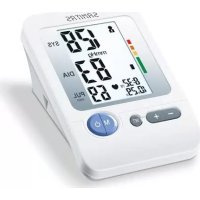
SBM 21 - Blood pressure monitor SANITAS - Free user manual and instructions
Find the device manual for free SBM 21 SANITAS in PDF.


| Product Type | Electronic upper arm blood pressure monitor |
| Brand | Sanitas |
| Model | SBM 21 |
| Measurement method | Oscillometric, non-invasive |
| Measurement range - Cuff pressure | 0 to 300 mmHg |
| Measurement range - Systolic pressure | 60 to 280 mmHg |
| Measurement range - Diastolic pressure | 30 to 200 mmHg |
| Measurement range - Pulse | 30 to 180 beats/min |
| Accuracy | Systolic ±3 mmHg, diastolic ±3 mmHg, pulse ±5% |
| Memory | 4 x 30 slots (4 users) |
| Dimensions (L x W x H) | 155 x 110 x 70 mm |
| Weight (without batteries) | Approx. 395 g |
| Compatible arm circumference | 22 to 36 cm |
| Power supply | 4 AA alkaline batteries 1.5 V |
| Battery life | Approx. 180 measurements |
| Key functions | Blood pressure and pulse measurement, arrhythmia detection, WHO classification, average of last 3 measurements calculation, 4 user memories, automatic shut-off |
| Care and cleaning | Clean with a slightly damp cloth; do not use solvents or immerse |
| Safety | Do not use on newborns, in case of pre-eclampsia, or with HF devices; consult a doctor if in doubt |
| Spare parts and repairability | Use only original cuffs; repairs only by authorized service center |
| General information | Compliant with European directives (MDD 93/42/EEC, EN60601-1-2, EN1060) |
Frequently Asked Questions - SBM 21 SANITAS
User questions about SBM 21 SANITAS
0 question about this device. Answer the ones you know or ask your own.
Ask a new question about this device
Download the instructions for your Blood pressure monitor in PDF format for free! Find your manual SBM 21 - SANITAS and take your electronic device back in hand. On this page are published all the documents necessary for the use of your device. SBM 21 by SANITAS.
USER MANUAL SBM 21 SANITAS
Blood pressure monitor
Instructions for use 12-20
Tensiometre
Mode d'emploi 21-30
- Getting to know your instrument 12
- Important information 12
- Unit description 15
4.Prepare measurement 16 - Measuring blood pressure 16
Please read these instructions for use carefully and keep them for later use, be sure to make them accessible to other users and observe the information they contain.
1. Getting to know your instrument
The upper arm blood pressure monitor is used for non-invasive measurement and monitoring of adults' arterial blood pressure. You can use it to measure your blood pressure quickly and easily, storing the results and displaying the progression of readings together with the average.
A warning is issued for anyone suffering from cardiac arrhythmia.
The recorded values are classified and evaluated graphically.
Keep these instructions carefully for further use and also let other users have access to them.
2. Important information

Signs and symbols
The following symbols are used in these instructions for use, on the packaging and on the type plate for the device and accessories:
- Saving, retrieving and deleting results 19
- Cleaning and storing the instrument 19
- Error messages/troubleshooting 19
- Specifications 19
| ! | Caution |
| i | Note Note on important information |
| Follow instructions for use | |
| Type BF applied part | |
| = = = | Direct current |
| Disposal in accordance with EC Directive – WEEE (Waste Electrical and Electronic Equipment) | |
| Manufacturer | |
| Storage -10°C 55°C RH <85% | Permissible storage temperature and humidity |
| Operating 5°C 40°C RH <95% | Permissible operating temperature and humidity |
| IP22 | Protected against foreign objects equal to or greater than 12.5 mm in diameter and against drops of water falling at up to 15° from vertical |
| SN Serial | number |
| CE 0483 | The CE labelling certifies that the product complies with the essential requirements of Directive 93/42/EEC on medical products |

Advice on use
- In order to ensure comparable values, always measure your blood pressure at the same time of day.
Before every measurement, relax for about five minutes. - If you want to perform several measurements on the same person, wait five minutes between each measurement.
- Do not take a measurement within 30 minutes after eating, drinking, smoking or exercising.
- Repeat the measurement if you are unsure of the measured value.
- The measurements taken by you are for your information only - they are not a substitute for a medical examination! Discuss the measurements with your doctor, and never base
any medical decisions on them (e.g. medicines and their administration)!
- Do not use the blood pressure monitor on newborns or patients with preeclampsia. We recommend consulting a doctor before using the blood pressure monitor during pregnancy.
- Cardiovascular diseases may lead to incorrect measurements or have a detrimental effect on measurement accuracy. The same also applies to very low blood pressure, diabetes, circulatory disorders and arrhythmias as well as chills or shaking.
- The blood pressure monitor must not be used in connection with a high-frequency surgical unit.
- Only use the device on people who have the specified upper arm measurement for the device.
- Please note that when inflating, the functions of the limb in question may be impaired.
- During the blood pressure measurement, blood circulation must not be stopped for an unnecessarily long time. If the device malfunctions, remove the cuff from the arm.
- Avoid any mechanical restriction, compression or bending of the cuff line.
- Do not allow sustained pressure in the cuff or frequent measurements. The resulting restriction of the blood flow may cause injury.
- Ensure that the cuff is not placed on an arm in which the arteries or veins are undergoing medical treatment, e.g. intravascular access or therapy, or an arteriovenous (AV) shunt.
- Do not use the cuff on people who have undergone a mastectomy.
-
Do not place the cuff over wounds as this may cause further injury.
-
The blood pressure monitor can only be operated with batteries.
- To conserve the batteries, the monitor switches off automatically if no buttons are pressed for 3 minutes.
- The device is only intended for the purpose described in these instructions for use. The manufacturer is not liable for damage resulting from improper or careless use.

Storage and Care
- The blood pressure monitor is made up of precision electronic components. Accuracy of readings and the instrument's service life depend on careful handling.
- You should protect the device from impact, moisture, dirt, major temperature fluctuations and direct exposure to the sun's rays.
- Never drop the device.
- Do not use near strong electromagnetic fields, i.e. keep it away from any radio systems and mobile phones.
- Only ever use the cuffs provided with the monitor or original replacement cuffs. Otherwise erroneous results will be recorded.
- Do not press any buttons until the cuff is in position.
- If the instrument is not used for any length of time, we recommend removing the batteries.

Notes on handling batteries
-
If your skin or eyes come into contact with battery fluid, flush out the affected areas with water and seek medical assistance.
-
Choking hazard! Small children may swallow and choke on batteries. Store the batteries out of the reach of small children.
- Observe the plus (+) and minus (-) polarity signs.
- If a battery has leaked, put on protective gloves and clean the battery compartment with a dry cloth.
-
Protect the batteries from excessive heat.
-
Risk of explosion! Never throw batteries into a fire.
- Do not charge or short-circuit batteries.
- If the device is not to be used for a long period, take the batteries out of the battery compartment.
- Use identical or equivalent battery types only.
Always replace all batteries at the same time. - Do not use rechargeable batteries.
- Do not disassemble, split or crush the batteries.

Repair and disposal
- Batteries do not belong in domestic refuse. Used batteries should be disposed of at the collection points provided.
- Never open the instrument. If these instructions are not heeded, the warranty will be null and void.
- Never attempt to repair the instrument or adjust it yourself. We can no longer guarantee perfect functioning if you do.
- Repairs may only be performed by Customer Service or authorized dealers. However, always check the batteries and replace them if necessary prior to making any complaint.
- For environmental reasons, do not dispose of the device in the household waste at the end of its useful
life. Dispose of the unit at a suitable local collection or recycling point. Dispose of the device in accordance with

EC Directive - WEEE (Waste Electrical and Electronic Equipment). If you have any questions, please contact the local authorities responsible for waste disposal.
3. Unit description
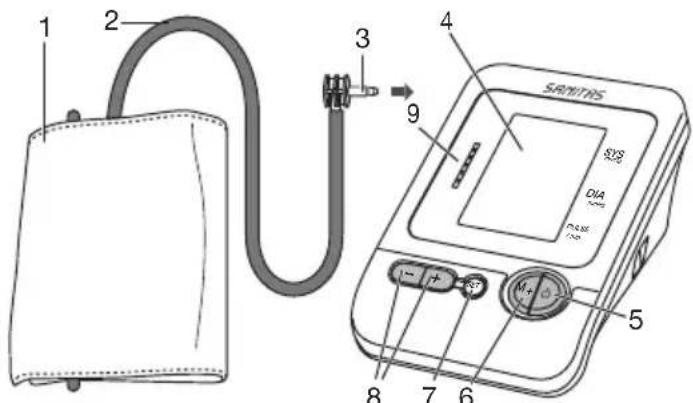
1.Cuff
2. Cuff line
3. Cuff connector
4. Display
5. START/STOP button
- Memory button M+
- SET button
- Function buttons - / +
- Scale for classifying the measurements
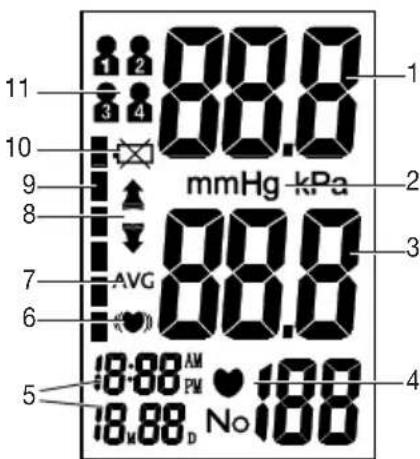
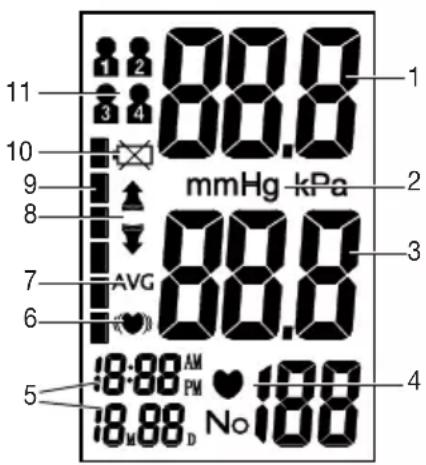
Icons in the display:
- Systolic pressure
- Unit in mmHg
- Diastolic pressure
- Pulse symbol and calculated pulse value
- Time and date
6.Cardiac arrhythmia symbol - Average values of the 3 most recent measurements - AVG
- Pump up, release air (arrow)
- Classification of measurements
- Battery replacement symbol
- Symbol for users 1, 2, 3 and 4
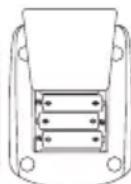
4. Prepare measurement Inserting battery
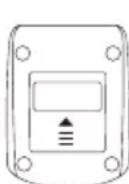
- Remove the battery cover from the back of the monitor.
- Insert four AA 1.5 V alkaline batteries. Making absolutely sure that you insert them with the correct polarity as marked. Never use rechargeable bat erie
- Replace the battery cover carefully.
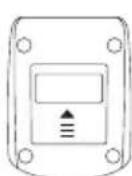
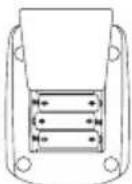
4xAA(LP06)1,5V
If 4 warning tones have been sounded and the symbol appears simultaneously on the display, it is no longer possible to perform a measurement and all batteries must be replaced. Once the batteries have been removed from the device, the time must be set again.
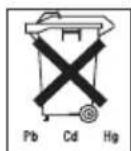
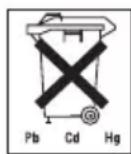
The empty, completely flat batteries must be disposed of through specially designated collection boxes, recycling points or electronics retailers. You are legally required to dispose of the batteries.
The codes below are printed on batteries containing harmful substances:
Pb = Battery contains lead, Cd = Battery contains cadmium, Hg = Battery contains mercury.
Setting date and time
You should set the date and time without fail. Otherwise, you will not be able to save your measured values correctly with a date and time and to access them again later. The time is shown in 12-hour format i.e. the time from 13:00 is displayed as 01:00 PM.
Proceed as follows to set the date and time:
- Confirm twice using the SET button.
- Use the + or - buttons to first set the month 1-12, and then confirm using the SET button.
- Set the day/hour/minute and confirm each using the SET button.
Press the button to exit the settings mode.
5. Measuring blood pressure Positioning cuff
Fit the cuff round your bare left upper arm. Blood circulation in the arm should not be restricted by tight clothing or other objects.
The cuff should be placed on the upper arm so that the lower edge is 2 to 3cm above the bend of the elbow and above the artery. The tube should be in line with the centre of the palm.
Now place the free end of the cuff snugly, but not too tightly, around the arm, and fix it with the Velcro fastener. The cuff should be fitted tight enough to allow just two fingers to fit beneath the cuff. Insert the cuff tubing into the socket for the cuff attachment.
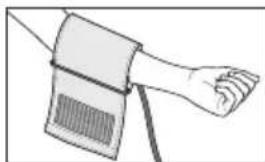

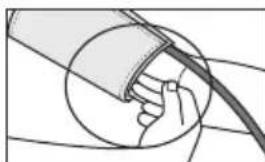
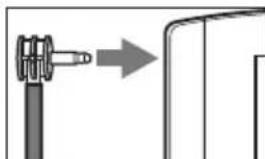
Important: The instrument should only be operated with the original cuff. The cuff is suitable for an arm circumference of 22 to 36~cm
Correct posture
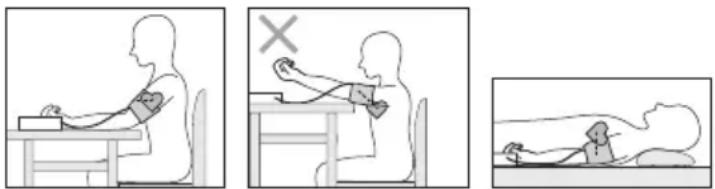
- Rest for approx. 5 minutes before each measurement. Otherwise there may be divergences.
- You can perform the measurement either sitting or lying down. Always make sure that the cuff is on a level with your heart.
- To carry out a blood pressure measurement, make sure you are sitting comfortably with your arms and back leaning on something. Do not cross your legs. Place your feet flat on the ground.
- In order not to distort the result, it is important to keep still during the measurement and not talk.
Select memory
Press the SET button. Select the desired storage space by pressing the - / + function buttons. You have 4 memories with 30 spaces each to store the measurements of 4 different people separately or to separate measurements taken in the morning and at night. Confirm your selection with the button
Measuring blood pressure
- Put on the cuff as described previously and assume the position in which you want to carry out the measurement.
- Start the measurement by holding the button after checking the display, during which all numbers light up, the cuff pumps up automatically. Whilst the cuff is pumping up, the device already calculates measurements for estimating the necessary pump pressure.
If this pressure is insufficient, the device automatically pumps more pressure.
- Then the pressure in the cuff is slowly released and the pulse is measured.
- When the measurement has been completed, the remain ing air pressure is released very quickly. The pulse, the systolic and the diastolic blood pressure are displayed.
- Measuring can be cancelled at any time by pressing the button
- If a higher pump pressure is always required, you can bypass the additional pumping process by holding the M+ button shortly after the pumping process starts until the desired cuff pressure is reached. This should be approx. 30mmHg above the systolic value.
- The Err icon appears if it has not been possible to perform the measurement properly. Observe the section in these instructions on error messages/troubleshooting and repeat the measurement.
- The device switches off automatically after 3 minutes.
Wait at least 5 minutes before taking another measurement!
Evaluating results
Cardiac arrhythmia:
This instrument can identify possible cardiac arrhythmia disorders during measurement and if necessary indicates the measurement with the flashing icon
This may be an indicator for arrhythmia. Arrhythmia is a condition where the heart rhythm is abnormal as a result of defects in the bioelectrical system controlling the heart beat. The symptoms (omitted or premature heart beats, slow or excessively fast heart rate) may be caused, among other things, by heart disease, age, physical predisposition, excessive use of stimulants, stress or lack of sleep. Arrhythmia can only be ascertained through examination by your doctor.
Repeat the measurement if the flashing icon displayed after the measurement. Please note that you should rest for 5 minutes between measurements and not talk or move during the measurement. If the icon pears often, please contact your doctor. Any self-diagnosis and treatment based
on the test results may be dangerous. It is vital to follow your doctor's instructions.
Classification of measurements:
The measurements can be classified and evaluated in accordance with the following table.
However, these standard values serve only as a general guideline, as the individual blood pressure varies in different people and different age groups etc.
It is important to consult your doctor regularly for advice. Your doctor will tell you your individual values for normal blood pressure as well as the value above which your blood pressure is classified as dangerous.
The bar graph in the display and the scale on the unit indicate the range of the blood pressure which has been recorded. If the values for systolic and diastolic pressure are in two different ranges (e.g. systolic in the high-normal range and diastolic pressure in the normal range) the graphic classification on the unit indicates the higher range (high-normal in the example described).
| Range of blood pressure values | Systolic (in mmHg) | Diastolic (in mmHg) | Measure |
| Grade 3: Severe hypertension ≥=180 | ≥110 Seek medical advice | ||
| Grade 2: Moderate hypertension 160 | -179 100–109 Seek medical advice | ||
| Grade 1: Mild hypertension 140–159 | 90–99 Have it checked regularly by doctor | ||
| High-normal 130–139 85–89 Have it checked regularly by doctor | |||
| Normal 120–129 80–84 Check it yourself | |||
| Optimal <120<80 Check it yourself |
Source: WHO, 1999
6. Saving, retrieving and deleting results
- The results of each successful measurement are stored together with date and time. With more than 30 items of measured data, the earliest items of data measured are lost.
- Use the SET button and then the - / + buttons to select the desired user memory and confirm using the button Pressing the M+ button displays the average value AVG of the 3 most recent measurements stored in the user memory. By pressing the + button, the most recent measurements are displayed; by pressing the - button, the oldest are displayed
- The average value AVG can only be displayed if there are 3 saved values in the respective user memory.
- To clear the memory, you must first select a user memory. Hold the SET button pressed for approx. 3 seconds. All the values in the current user memory are deleted after 3 brief beeps are output.
- If you wish to change the user memory, see "Select memory".
7. Cleaning and storing the instrument
- Clean your device and cuff carefully only with a slightly moistened cloth.
- Do not use detergents or solvents.
- On no account must you immerse the computer in water, otherwise liquid can enter it and cause demage.
- When storing the device, make sure that no heavy objects are placed on top of it. Remove the batteries. The cuff tube should not have any sharp kinks.
8. Errormessages/troubleshooting
In case of faults, the Er r message appears in the display.
Error messages can occur when
- inflation pressure is higher than 300mmHg
- blood pressure is unusually high or low,
- you move or talk during the measurement.
In the above cases, you must repeat the measurement. Make sure that the cuff tube is properly inserted and that you do not move or talk. Re-insert the batteries if necessary, or else replace them.
9. Specifications
Model no. SBM 21
| Measurement method | Oscillometric, non-invasive blood pres-sure measurement on the upper arm |
| Measurement range | Cuff pressure 0–300 mmHg,systolic 60–280 mmHg,diastolic 30–200 mmHg,Pulse 30–180 beats/minute |
| Display accuracy | Systolic ± 3 mmHg, diastolic ± 3 mmHg,pulse ± 5 % of the value shown |
| Measurement inaccuracy | Max. permissible standard deviation according to clinical testing:systolic 8 mmHg /diastolic 8 mmHg |
| Memory 4 x 30 memory spaces | |
| Dimensions L 155 mm x W 110 mm x H 70 mm | |
| Weight Approx. 395 g (without batteries) | |
| Cuff size 22 to 36 cm | |
| Permissible operating conditions | +5°C to +40°C, <85% relative air humidity (non-condensing) |
| Permissible storage conditions | -10°C to +55°C, <95% relative air humidity, 800-1060 hPa ambient pressure |
| Power supply | 4x1,5V AA alkaline batteries. |
| Battery life For approx. | 180 measurements, depending on the blood pressure level and/or pump pressure |
| Accessories Instruction for use, 4x1.5VAAalkaline batteries., storage pouch | |
| Classification Internal supply, continuous operation, type BF applied part, IP22, no AP or APG | |
Technical information is subject to change without notification to allow for updates.
- This unit is in line with European Standard EN 60601-1-2 and is subject to particular precautions with regard to electromagnetic compatibility (EMC). Please note that portable and mobile HF communication systems may interfere with this unit. More details can be requested from the stated Customer Service address or found at the end of the instructions for use.
- This device is in line with the EU Medical Devices Directive 93/42/EC, the „Medizinproduktegesetz“ (German Medical Devices Act) and the standards EN 1060-1 (non-invasive sphygmomanometers, Part 1: General requirements), EN 1060-3 (non-invasive sphygmomanometers, Part 3: Supplementary requirements for electro-mechanical blood
pressure measuring systems) and IEC 80601-2-30 (Medical electrical equipment - Part 2 - 30: Particular requirements for the safety and essential performance of automated noninvasive blood pressure monitors).
- The accuracy of this blood pressure monitor has been carefully checked and developed with regard to a long useful life. If using the device for commercial medical purposes, it must be regularly tested for accuracy by appropriate means. Precise instructions for checking accuracy may be requested from the service address.
FRANÇAIS
Sommaire
He HaximMaTb Ha KHONK, NOKa He HaTe MaHXKeTa.
- Ecnn Bbl dntteBHOe Bpem He nolb3yeTecb np6opom, pekomehnyetc BblHyt b6aTapeKn.
O6paueHne c 3JIeMeHTaMn nITaHn
- PnI NpIaHmJXuKoCTn I3 aKkyMylTopa Ha Koxy IIN B rla3a Heo6xOIMMO IpombITb COOTBeTCTByIOUm yAcTOK 60JIbIIM KOJIuYeCTBOM BOIbI O6paTntbcr K BpaHy.
Onachocb nporlaTbIBaHnMeJIKx Yacte!MaJIeHbKne Detn MOrTy nporIOTHTb 6atapeKu IN NOdaBNTcR NMI.103tOMy 6atapeKu Heo6XoIMO XpaHNTb B HeoCTyNHomdIaTei MeCTe! -
06paaTe BnMaHne Ha o6o3HaueHne nOJaPHocTn: pIIOc (+) mMHyc (-).
-
Ecn6batapeuKa noteKla, ounCTnte OTdeneHne d8batapeek cyxon canfeTKo, naeb 3aunTHbIe nepaTkn.
3aunuauTe 6atapeuKo OT Upe3MePHO BO3JeCTBnTeTIIa.
Onachocb B3pbIb! He 6pocaTe 6aTapeKn B orOHb.
He 3apjaTe n He 3ambikaTe 6aTapeKn HAKOPOTko. - Ecln np6op dntteBHOe Bpem He nCnoJb3yeTc, n3BleKnte n3 Hero 6aTapeKn.
IcnoJb3yTe 6aTapeKu TOJIbKO OJHO Tnna nn paBHO- ceHHbIX TINOB.
3aMeHnTe Bce 6aTapeKn cpa3y.
He nCnoB3yIte nepe3apxkaemble akkymyIaTOpbl! - He pa36npaIte, He otKpbIbAIte n He pa36nbAIte 6aTapeiKn.
i yka3aHnnopeMOHTy uytJIN3aun
- BaTapeKn 3aPpeuaeTcBbIbpaCbIBaTb B 6bITOBO Mycop. YTNIN3pyNe IcNOJIb3OBAHHBe 6TaTapeKu yepe3 COOTBETCTByIOU INyHKT c6opA OTXODOB.
He OTKpbBaIe np6Op. HecobJeHne BeTe K nOtepe rapaHTn.
3aPpeaaeTcramocToTeBHO pEmOnHtnpoBaTnI nperyPiPoBaT np6Op. B 3OM cIyae 60JIbWe He rapaHTnpyeTc8e3ynpeHOCb pa60Tbl. - Pemont pa3peaetc BbINOJIHTb TOJbKO cnyk6e TexHueckoro o6ecneueHn qnpMbI Nn ABTOpN3uPObAHbIM cepBCHbIM opraHn3aumr. Ho nepeiIO6bIMn peKlmaunmBhauane npOBepbTe 6aTapeKn n, pni Heo6xOUMocTN, 3ameHnte nx.
B INHTepecax 3aunTbOkpykaIOuecpeblno OKOHuaHn Cpoka CnyK6bl CneJeYtynuN3npOBaTb np60p OTdeJbHOOTbTOBOrO Mycopa.YtnuN3aun
dOJIKNHa IPOU3BOIDTbCcpe3 COOTBETCTBYIOUe NYHKtI c6opa B BaWei CtpaHe. Pn6bop CneJeY Tynl3uPoBaT b corJaacHO DnpeKTIbe EC nO OTxoam 3JekTpueckoro n 3JIeKTPoHOrO o6OpyOBAHn - WEEE (Waste Electrical and Electronic Equipment). B cnlyae Bonpocob obpaauTeCb B MeCTHyIO KOMMyHaJIbHyIO CnyX6y, OTBeTCTBeHHyIO 3a yTuIN3aCuHIO OTOxOOB.
3.Описанne npибopa

- MaHxketa
2.卍naHr MaHxKetbl
3.LTeKepeMaHKeTbI
4.Дисгел - Khonka START/STOP
- KhoIIka coXpaHHeMn M+
- KhoNka SET
8.ФyHKUHOHaJIbHbIe KHOKN-/+ - Lka oeykpe3yJbTaTOB n3MepeHn
HnkaaHa ducnnee:
1.CuCTOJIHueCKoe DaBHeHne
2. EduHnua MM pTyTHOrO cToJI6a
3.ДиacToJIuYeCKoeДaJIbIeHne
4.CmBON npIbca n3MepeHHoe 3NaueHne npIbca
5.BpemnndaT
6.CmBON hapyuweHn cepdeuHoro puTMa
7. CpeHnne 3HaueHnna nocJeHHnx 3 n3MepeHn yacToTbI cepDeuHbIX cokpaueHn (AVG).
8.HaKaHbAHHe, BbInyckaHHe BO3dyxa (CTpeJka)
9.OueHka pe3yIbTaTob n3MepeHn
10.CIMBOI INHDAKauIN CMeHb6aTapeeKN
11.CmB0J nIy noJIb3ObaTeTn 1,2,3,4
4. NodrotOBka K n3MepeHnU OyctahOBka 6aTapeKu
CHIMMTE KpbIuKy C 6aTapeHoro OTCEKa Ha 3aHHe cTeHKe annapata.
- YCTaHOBtPe 4 aKanHOBbIX 6bTapeKu TnA AA 1,5 B. CneIte 3a TEM, yTo6bl 6bTaapeKu 6bJIN BCTABJIeHbICo6HIODeHEm IIOJRAPOCTN.
3apkaembie aKKyMyIaTopHbIe 6aTapeu nCnoJIb3OBA Tb HeJIb3r.
- AkkypaTHo 3akpoTKe KpbIuKy 6aTapeHoro oTceKa.
Ecn pa3daIOTc4 3ByKOBbIX CnHaJa I OndHOBpeMeHHO HaDCnJIeepoRbIeTcraCIMBOJ, H3MepeHne 6OJIbIe HeBO3MOxHO, Heo6XoDmO 3aMeHITb BCE 6aTaapeIKN . Pocne N3BJeEHn6 6aTaapeek Bpemr Heo6XoDmO yCTaHaBnBaTb 3aHOBO.
Bb6paCbBAIteNCN0JIb3OBAHHbe,NOJHOCTbIO pa3pXeHHbIE 6aTapeKn B CNEUmaJIbHbIe KOHTeHepbl, CdaBaITe B nyHKtbl npEema CneLcOTxOIOB ININ B MaRa3INHbI 3JIeKTPOo6OpyDOBAHnA. 3aKOH O6ra3bIbaet NOLb3OBATeJe O6ecNeHTb yTuJIN3aCuIO
6aTaapeek.
3TN 3HaKNI ppeDynpexKaIO T O HAIINH B 6aTaPeiKax TOKCHHBIX BeLectB:
Pb = CBNHHeU, Cd = KaMmH, Hg = pTyTb.
HactpoKa DaTbI IN BpeMeHH
Bam Heo6xOJMo yCTaHOuTb DaTy u BpeM. ToIbKO TaK Bbl cMOXeTe npabUlbHo COxpaHryb B nAmrTu N3MepeHHble Bam 3NaueHncaToN v BpeMeHem N 3aTe M BbIOuNTb IV
4×AA(LP06)1.5V
Ha 3kpan. Bpemr oTo6paXaetcB 12-ycobom fOpMaTe, t.e. Bpemr noCte 13:00 yacob oTo6paXaetcKa k01:00 PM.
HacpoKa DaTbI IN BpemeHn Ipon3BOuNTcra CneDyUOM 06pa3OM:
- PoiTBePdIte, DBaXbI HaxKaB Ha KHOnKy SET.
- Chahana c NOMOUIK HONOK + JIN - yCTAHOBITE MECR (1-12), 3aTEM NOITBEPNTE HAXATNEH KONIK SET.
HactpoTeJeHb/Yac/MnHyTb,KaKdbpa3noTBePckdAHa-CTpoKy KhoNkoN SET.
HaKMTe Ha KONky OTO6bI BbInu n3 peXkMa HAcTpoKn.
IpeepnpoBeHnEMHOBOrIO3MepeHnCJIeNyETBbIXdaTbHe MeHee 5 MmHyT!
OueHka pe3yIbTaTOB
HapyeHnA cepdeHoro pHTMa:
AnHHb annapaT MoXeT BO BpeMn3MepeHn NDeHTnNUPoBaTb BO3MOxHbIe HapUeHn CepDeHOrO uNKla N B NOo6Hom Cnyae yKa3bIbAe THa 3TO NIKTORpAMMo
3TO MOKET Cnykntb INHnKaTOpOM apITMN. ApITMN-3TO 3a6oJIeBaHHe, npN KOTOPOM cepdeHbI pHTM HApUHaetcra n3-3a NopOKOB B 6nO3NeKTPnueCKoCnCTeMe, KOtOPaYnpabJnRE TcePdEHHbIMCokpaUeHNMa. CmTTOMbl (pOnyUeHHbIE IINI PpeXdEBpeMeHHbIe cepdeHbIe cokpaUeHNr, MeDInEHbI ININ CnUHKOM 6bICTpbI pybc) MOrYT BbIsBaTbcR, CpeIN npOyeo, 3a6oJIeBaHnAIMn cepua, Bo3paTOM, fN3NoIOnrHu
CKO INpeepacnoJoxeHHocTbU, Ype3MepHbIM yNOTpe6JIeHNEM TOHn3npyuOux IN BO36yXdaIOxIN PPOyKTOB, CTpeccOM NIN HeoCbIaHMe. ApITMN MoXeT 6bITb ObHapYKeHa ToIbKO npn OcneDobAHm BpaOM.
IobTOPte n3MepeHne,ecn NIKTORpamMa 1BJIeTcHa dncnnee noCle n3MepeHn. YUHTe, YTO nepei n3MepeHnEM BbydoJXhbl5 MNHyT OTDOxHyTb,a BO BpeMn3MepeHnHe doJXhbl rOBOpNTbN DBnraTbcr. Ecn NIKTORpamMa IONBJIaETcra qacto, o6paNTecb K BpaCy. CamOJaHocTnKa ncamoleueHne Ha OCHOBaHm pe3yIbTaTOB n3MepeHn MOYT 6bIb onacbIMn. Ob3aTeJIbHO BbINOHNYe yka3AHn Bpaua.
OueHka pe3yIbTaTOB n3MepeHn:
OceHky pe3yIbTaTOB n3MepeHn MOxHO npOBcTn C nomOu bIO Ta6Ncbl, npEcdTabHeHNO HIXe.
06paTne BHMaHne, YTO 3TO yCpeHHeBHe 3HaueHnI n ClyXaT TOJIbKO IINI npNIOIN3NTeJbHOrO opNeHTnpOBaHnI, TAK KaK INDIBNDAJbHBe 3HaueHnI apTePnaJbHOr OaBJeHnI MOyT BApNbPOBaTcBcR B 3AbNCIMOCtN OT pNHaNDJeKHOCTN K ToI INN
HNOB BO3pactHOI rpynne, a TaKKe IpyrNX INHINBnDyalbHbIX Oco6eHHocTei.
Baxho perylnrho KOncylbTnpoBaTbC C BpaHOM. BpaonpeIeIT Baun nHnBnDyalbHbIe 3HaueHn HOpMaJIbHoro apTeepnaJIbHOrO daBHeHn, a TaKKe 3HaueHn, KOTOpbIe MOryt 6bIb DnBac OnaChbIMN.
NITKOrpMaHa Ha NcIeH NkAHa aannapate yKa3bIBAIOT, B KaKOM dHaNa3OHe HaxoNTcH 3MepeHHoe KPOBraHOE daJIeHHe.
Ecn 3NaueHnI DnI CnCTOJIbI NnIaCTOJIbI HxOJaTcB BDbYX pa3NnHbIX DnIaNA3oHax No KLnaccnΦnKaun (HaNPmEp, CnCTOJIbI DnIaNA3OHe «BbICOKOE HopMaJIbHOe », a DnIaCTOJIa B DnIaNA3OHe «HopMaJIbHOe »), To rpaNk B annapate Bcerda yka3bIbaet 6oJee BbICOKn DnIaNA3OH, B OINcaHHOM npIMpe - «BbICOKOE HopMaJIbHOe »
6. CoхpaHeHne, Bbl3OB n ydaJIeHne pe3yIbTaTOB n3MepeHn
- Pe3yNbTaTbI KaKdOro ycNeuHoro n3MepEnra CoXpaHnOTcB namr BmecTe C dToi N BpeMeHem. Pnp 6oJee Yem 30 pe3yNbTaTax cambi CTapbi pe3yNbTa T nepeNcBiBaETcR.
BbIbepuTE C NOMOuBIO KHOJKN SET u 3aTeM KHOJOK-+ JKeJaEMyIO RaeyKU NaMAtu INoTBePdTe BbIbOp HaxaTmE MHOJKN EcIN HaXaTB KHOJky M+,OTo6pa3NTcR cpeHHe 3NaueHHe YacToTb cepDeuHbIX CokpaueHn (AVG) n3 NoCleHnX 3 CoXpaHeHHbIX B daHHoN NOJIb3OBaTeMbckOi NaMAtu N3MepeHHbIX 3NaueHn. PnHaxaTmN KHOJKn + OTO6paKaOTcRA NoCleHnpe3yNbTaTb N3MepeHn, PnHaKATn KHOJKN - camble paHHne.
CpeHHe 3NaHHe N acToBt cepDeHbIX cokpaueHn (AVG) MOKeT OTo6paKaTbCra TOnbKO npu Hauuun 3 n 6oJee coXpaHeHHbIX 3NaHEn B COOTBeTCTByUoJe NOnb3ObaTeJIbCKOINaMRTN. - Yo6bO uHCTnTb NaM8Tb, BbI6epNTe Chauana NoJIb3OBaTeNbCKyIO NaM8Tb. YdePknBaIte KhoNky SET HaKaToB TeueHne npImepHO 3 cekyHd. BCE 3NaueHnB B bbl6paHNo IOnb3OBaTeNbckOu NaM8Tu 6ydy T ydaJeHb IocNe 3 KopOTKnx 3ByKObIX CNHaJIOB.
- Ecni Bby xOTnTE cMeHnTb nonb3oBaTeNbckne yaeKn, To co6bnJouaIte yKa3aHn, npuBeHeHHBle B pa3dene «Bb6op 3Y».
7. OuInCTka n xpaHeHne npnbopa
- Octopoxho ouhctnte npnbop mHaXkety cnerka CMOeHHOI TpIKNo.
3aPpeuaeTcNcNoIb3OBAHHe YnCTaX CpeIcTBnn paTbOpnten.
He npyskaTe nonaHaHne np6opBa B Ody, T.K. B pe3yIbTaTe B Hero MOKeT npOHKnHyTb XnKocTb N NobpeDnTb npu-6op.
- Pn xpaHEn H annapata Ha Hero HeIb3a CTaBt TB TAgKeIbIe npedMeTbI. 3anpeaetcra CInbHO nepern6aTb CoeHNHTeJIb-HyTO Tpy6ky MaHKeTbI.
8. Coo6eHnO HeNCpPaBHOCTaX/ YcTpaHeHne HeNCpPaBHOCTeN
Pn HncnpaBHOCTx Ha nCnIe NOBnEeTc COo6eHne Err. CoO6eHnO HncnpaBHOCTx MOyT NOBnTbC, ECJN
1.ДаьненеHaKaHbAHnЯпрБышaET300MMpT.CT.,
2. 3haueHne apTepeHbHorO daBHeHna Heo6bUHO BbICOKoe HIN HN3KOE,
3. BO Bpemn 13MepeHn Bbl DnBraeTeCb nIpa3roBaPnBaTe.
B 3tix cnyaix noBtopnTe n3mepeHne. CneDnte 3a Tem, yTO-6bl IJIaHr MaXKeTbI 6bl npabNlbo BCTabIeH n YTO6bl Bbl He DnIRaINCb H e pa3roBapNBaII. Pn HEO6xOJIMoCTn, 3aHOBO yCTaHOBnTE 6batapeKn nn 3ameHnTE CTapble.
9. TexHnueckne daHHbIe
MoIeB N SBM 21
| Guidance and manufacture's declaration - electromagnetic emissions | ||
| The SBM 21 is intended for use in the electromagnetic environment specified below.The customer or the user of the SBM 21 should assure that it is used in such an environment. | ||
| Emissions test | Compliance | Electromagnetic environment - guidance |
| RF emissions CISPR 11 | Group 1 | The SBM 21 uses RF energy only for its internal function. Therefore, its RF emissions are very low and are not likely to cause any interference in nearby electronic equipment. |
| RF emissions CISPR 11 | Class B | The SBM 21 is suitable for use in all establishments other than domestic and those directly connected to the public low-voltage power supply network that supplies buildings used for domestic purposes. |
| Harmonic emissions IEC 61000-3-2 Not applicable | ||
| Voltage fluctuations/flicker emissions IEC 61000-3-3 | Not applicable | |
Table 2
| Guidance and manufacturer's declaration - electromagnetic immunity | |||
| The SBM 21 is intended for use in the electromagnetic environment specified below. The customer or the user of the SBM 21 should assure that it is used in such an environment. | |||
| IMMUNITY test | IEC 60601 test level | Compliance level | Electromagnetic environment - guidance |
| Electrostatic discharge (ESD) IEC 61000-4-2 | ±6 kV contact ±8 kV air | ±6 kV contact ±8 kV air | Floors should be wood, concrete or ceramic tile. If floors are covered with synthetic material, the relative humidity should be at least 30%. |
| Power frequency (50/60 Hz) magnetic field IEC 61000-4-8 | 3 A/m 3 A/m | Power frequency magnetic fields should be at levels characteristic of a typical location in a typical commercial or hospital environment. | |
| NOTE: Ur is the a.c. mains voltage prior to application of the test level. | |||
Table 3
| Guidance and manufacturer's declaration - electromagnetic immunity | |||
| The SBM 21 is intended for use in the electromagnetic environment specified below. The customer or the user of the SBM 21 should assure that it is used in such an environment. | |||
| IMMUNITY test | IEC 60601 test level | Compliance level | Electromagnetic environment - guidance |
| Conducted RF IEC 61000-4-6 Radiated RF IEC 61000-4-3 | 3Vrms 150 kHz to 80 MHz 3V/m 80 MHz to 2.5 GHz | Not applicable 3V/m | Portable and mobile RF communications equipment should be used no closer to any part of the SBM 21, including cables, than the recommended separation distance calculated from the equation applicable to the frequency of the transmitter.Recommended separation distance: d = 1.2 √80 MHz to 800 MHz d = 2.3 √800 MHz to 2.5 GHz Where P is the maximum output power rating of the transmitter in watts (W) according to the transmitter manufacturer and d is the recommended separation distance in meters (m). Field strengths from fixed RF transmitters, as determined by an electromagnetic site survey, a should be less than the compliance level in each frequency range. b Interference may occur in the vicinity of equipment marked with the following symbol: |
| NOTE 1 At 80 MHz and 800 MHz, the higher frequency range applies. NOTE 2 These guidelines may not apply in all situations. Electromagnetic propagation is affected by absorption and reflection from structures, objects and people. | |||
| aField strengths from fixed transmitters, such as base stations for radio (cellular/cordless) telephones and land mobile radios, amateur radio, AM and FM radio broadcast and TV broadcast cannot be predicted theoretically with accuracy. To assess the electromagnetic environment due to fixed RF transmitters, an electromagnetic site survey should be considered. If the measured field strength in the location in which the SBM 21 is used exceeds the applicable RF compliance level above, the SBM 21 should be observed to verify normal operation. If abnormal performance is observed, additional measures may be necessary, such as re-orienting or relocating the SBM 21. bOver the frequency range 150 kHz to 80 MHz, field strengths should be less than 3 V/m. | |||
Table 4 For ME EQUIPMENT and ME SYSTEMS that are not LIFE-SUPPORTING
| Recommended separation distances between portable and mobile RF communications equipment and the SBM 21 | |||
| The SBM 21 is intended for use in an electromagnetic environment in which radiated RF disturbances are controlled. The customer or the user of the SBM 21 can help prevent electromagnetic interference by maintaining a minimum distance between portable and mobile RF communications equipment (transmitters) and the SBM 21 as recommended below, according to the maximum output power of the communications equipment. | |||
| Rated maximum output power of transmitter(W) | Separation distance according to frequency of transmitter(m) | ||
| 150 kHz to 80 MHzd=1.2 √P | 80 MHz to 800 MHzd=1.2 √P | 800 MHz to 2.5 GHzd=2.3 √P | |
| 0.01-0.12 0.23 | |||
| 0.1-0.38 0.73 | |||
| 1-1.2 2.3 | |||
| 10-3.8 7.3 | |||
| 100-12 23 | |||
| For transmitters rated at a maximum output power not listed above, the recommended separation distance d in meters (m) can be determined using the equation applicable to the frequency of the transmitter, where P is the maximum output power rating of the transmitter in watts (W) according to the transmitter manufacturer.NOTE 1 To calculate the recommended separation distance of transmitters in the frequency range of 80 MHz and 800 MHz to 2.5 GHz, an additional factor of 10/13 has been used in order to reduce the probability of a mobile/portable communications device unintentionally introduced into the patient area causing a fault.NOTE 2 These guidelines may not apply in all situations. Electromagnetic propagation is affected by absorption and reflection from structures, objects and people. | |||

- Getting to know your instrument
- Important information
- Signs and symbols
- Advice on use
- Storage and Care
- Notes on handling batteries
- Repair and disposal
- Unit description
- Icons in the display:
- Prepare measurement Inserting battery
- Setting date and time
- Measuring blood pressure Positioning cuff
- Correct posture
- Select memory
- Measuring blood pressure
- Evaluating results
- Cardiac arrhythmia:
- Classification of measurements:
- Saving, retrieving and deleting results
- Cleaning and storing the instrument
- Errormessages/troubleshooting
- Specifications
- FRANÇAIS
- Sommaire
- O6paueHne c 3JIeMeHTaMn nITaHn
- i yka3aHnnopeMOHTy uytJIN3aun
- 3.Описанne npибopa
- HnkaaHa ducnnee:
- NodrotOBka K n3MepeHnU OyctahOBka 6aTapeKu
- HactpoKa DaTbI IN BpeMeHH
- OueHka pe3yIbTaTOB
- HapyeHnA cepdeHoro pHTMa:
- OueHka pe3yIbTaTOB n3MepeHn:
- CoхpaHeHne, Bbl3OB n ydaJIeHne pe3yIbTaTOB n3MepeHn
- OuInCTka n xpaHeHne npnbopa
- Coo6eHnO HeNCpPaBHOCTaX/ YcTpaHeHne HeNCpPaBHOCTeN
- TexHnueckne daHHbIe
Brand : SANITAS
Model : SBM 21
Category : Blood pressure monitor