
UM1 Micro - Hi-fi system SAMSON - Free user manual and instructions
Find the device manual for free UM1 Micro SAMSON in PDF.



| Product type | UHF wireless diversity microphone system |
| Brand | Samson |
| Model | UM1 Micro |
| Frequency band | 801 - 805 MHz (UHF) |
| Number of channels | 6 selectable channels |
| Diversity technology | True Diversity (automatic switching between two antennas) |
| Maximum range | Up to 100 meters (under optimal conditions) |
| Receiver power | 9V alkaline battery or external 6-13V DC power supply |
| Battery life (receiver) | Over 12 hours (depending on headphone and display usage) |
| Transmitter power | 9V alkaline battery (UT1L/UT1G/UH1) |
| Battery life (transmitter) | Over 12 hours (typical use) |
| Bodypack transmitter weight | Less than 120 g (with 9V battery) |
| Audio outputs | Balanced (mini-XLR, 600 ohms) and unbalanced (3.5 mm jack, 1 kohm) |
| Selectable output level | -30 dBm (mic), -20 dBm, -10 dBm (line) |
| Headphone jack | 3.5 mm stereo jack, max level 240 mW into 30 ohms |
| Noise reduction | Built-in (compander) |
| Anti-pop function | Cuts the audio signal while leaving the carrier |
| LED indicators | RF level, battery status, saturation (Peak), antenna A/B activity |
| Squelch adjustment | Yes, with included plastic screwdriver |
| Included accessories | Plastic screwdriver, Velcro strap, 9V battery (depending on version) |
| Recommended use | Videography, live audio production, concerts, conferences |
| Transmitter compatibility | UT1L (lavalier/headset mic), UT1G (instrument), UH1 (handheld mic) |
| Maintenance | Clean with a dry cloth; avoid moisture and impacts |
| Safety | Do not reverse battery polarity; use only 9V batteries |
Frequently Asked Questions - UM1 Micro SAMSON
User questions about UM1 Micro SAMSON
0 question about this device. Answer the ones you know or ask your own.
Ask a new question about this device
Download the instructions for your Hi-fi system in PDF format for free! Find your manual UM1 Micro - SAMSON and take your electronic device back in hand. On this page are published all the documents necessary for the use of your device. UM1 Micro by SAMSON.
USER MANUAL UM1 Micro SAMSON
Guided Tour - UM1 Receiver and Frequency Conversion Chart 5
Guided Tour - UT1L / UT1G Beltpack Transmitter 7
Guided Tour - UH1 Handheld Microphone Transmitter 9
Setting Up and Using the Series One System 10
Appendix A: UT1L Multipin Wiring Guide and Chart 43
Specifications 44
FRANCAIS
Produced by On The Right Wavelength for Samson Technologies Corp.
Copyright 1998, Samson Technologies Corp.
Printed August 1998
Samson Technologies Corp.
575 Underhill Blvd.
P.O. Box 9031
Syosset, NY 11791-9031
Phone: 1-800-3-SAMSON (1-800-372-6766)
Fax: 516-364-3888
Introduction / System Features
Congratulations on purchasing the Samson UM1 micro diversity receiver—part of our renowned UHF Series One Wireless System! Although this product is designed for easy operation, we suggest you first take some time to go through these pages so you can fully understand how we've implemented a number of unique features.
Every wireless system consists of at least two components—a transmitter and a receiver, both of which must be tuned to the same channel (that is, the same radio frequency) in order to operate correctly.* The Samson UM1 system you have purchased operates in the 801 - 805 MHz frequency range and contains a UM1 micro diversity receiver and one of three Series One transmitters: a UT1L belt-pack transmitter (for lavalier microphone or headset applications); a UT1G belt-pack transmitter (for instrument applications); or a UH1 hand-held microphone transmitter (available in a wide variety of popular capsules).
The UM1 system is specially designed to enable the production of professional audio tracks to accompany your video shoot or live broadcast. The use of a handheld mic transmitter or lavalier microphone connected to a beltpack transmitter effectively isolates the performer from unwanted ambient sounds such as video camera motor noise or room sounds made by the camera operator or video crew. Because the UM1 receiver is extremely small and lightweight, it can be attached easily to any video camera using the supplied strip of velcro, and can even be powered directly by the camera's own 12-volt power supply, if available.
In this manual, you'll find a more detailed description of the features of the UM1 system, as well as a guided tour through all components, step-by-step instructions for setting up your system, wiring diagrams and tables, and full specifications. If your UM1 system was purchased in the United States, you'll also find a warranty card enclosed—don't forget to fill it out and mail it! This will enable you to receive online technical support and will allow us to send you updated information about this and other Samson products in the future. If your UM1 system was purchased outside of the U.S., contact your local distributor for warranty details.
SPECIAL NOTE for U.S. purchasers: Should your UM1 system ever require servicing, a Return Authorization number (RA) is necessary. Without this number, the unit will not be accepted. If your UM1 system was purchased in the United States, please call Samson at 1-800-372-6766 for a Return Authorization number prior to shipping your unit. If possible, return the unit in its original carton and packing materials. If your UM1 system was purchased outside of the U.S., contact your local distributor for servicing information.
* Your receiver and transmitter have been factory preset to utilize the same channel. A listing of the six available channels and their corresponding UHF frequencies can be found on page 4 of this manual.
System Features
Designed for use in both live sound and sound contracting applications, the Samson UM1 system provides a high performance, cost effective solution, utilizing state-of-the-art technology in wireless communications. Main features include:
- Six different available channels, all operating in the less crowded UHF bandwidth, and all designed for simultaneous use. This means that you can use multiple UM1 systems (each tuned to a different channel) in the same location without interference.
System Features
- Optimized for use in videography applications, the UM1 system is highly customizable, combining a UHF “walkaround” receiver with your choice of Samson Series One beltpack or handheld microphone transmitters.
- Using the supplied velcro strip, the compact, lightweight UM1 receiver can be easily attached to any video camera and can even derive 12 volt power from the camera (if available), making it easy to integrate into any traveling or fixed installation video system.
- The UM1 micro diversity receiver includes a pair of tuned antennas and provides both balanced and unbalanced outputs (with a three-position output level switch) and a headphone monitor output with continuously adjustable level control. The receiver also includes an audio peak LED, dual receiver indicators, and an RF strength meter.
- All components use standard 9-volt batteries, with battery life of more than 12 hours, ^* and feature a convenient three-segment multicolor Battery Strength LED meter (which in the UM1 can also be used as an RF level meter), allowing you to monitor the remaining power in the installed battery.
- True Diversity technology maximizes active range (up to 300 feet) and reduces potential interference problems through automatic switching between two independent receivers.
•Built-in companding noise reduction in all components for crystal-clear sound with minimized background noise and hiss. - Transmitters provide “popless” muting, which turns off the audio signal while leaving the carrier signal on.
- Incredibly compact “beeper-sized” UT1L and UT1G belt-pack transmitters are extremely lightweight (less than 4 ounces with a 9-volt battery installed). The UT1G comes prewired with permanent connection to a standard 1/4" jack (for use with instruments such as electric guitar or bass), while the UT1L provides a Switchcraft TB3M mini-XLR jack for connection to a variety of popular headsets and lavalier microphones, including:
Samson QE headset
Samson QV headset
AKG C-410 headset
Audio-Technica ATM-75 headset
Audio-Technica MT-350 lavalier
Audio-Technica Pro-35X wind microphone
Audio-Technica AT-831 lavalier
Countryman IsoMax headset
Crown CM-311(E) headset
Samson ECM-40 lavalier
Sennheiser MKE-2 lavalier
Sony ECM-44 lavalier
Sony ECM-55 lavalier
Sony ECM-77 lavalier
- The UH1 hand-held microphone transmitter is available in a selection of popular mic capsules, including:
Samson QMIC dynamic
Electro Voice ND 757A N/DYM dynamic
Electro Voice ND 857A N/DYM dynamic
* Typical usage. Actual battery life in the UM1 may vary depending upon headphone and metering usage and headphone output level.
Guided Tour - UM1
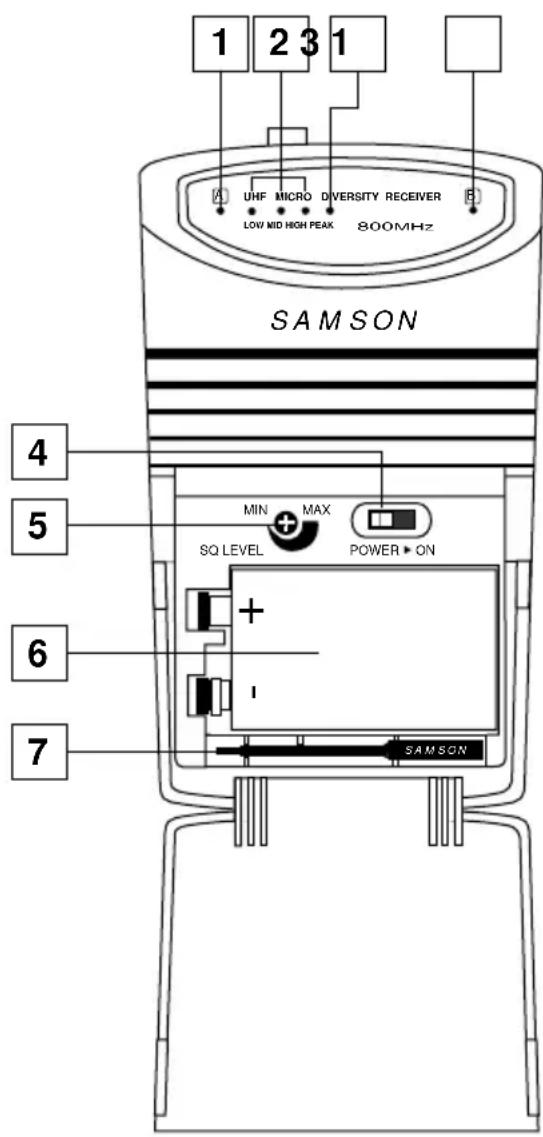
1: A/B Receiver LEDs - When signal is being received, one of these will be lit orange, showing you whether the (left) "A" or (right) "B" receiver is currently being used. The UM1 constantly scans its two antennas and automatically selects whichever is receiving the strongest, clearest signal. This True Diversity switching is completely inaudible, but it effectively increases overall range while virtually eliminating potential interference and phase cancellation problems.
2: Meter - This set of three multicolor LEDs acts as a meter, indicating either battery power or the strength of the incoming RF signal. This meter can also be disabled altogether to conserve battery power. See #15 on the next page for more information.
3: Peak LED - This LED lights red when output signal from the UM1 is at the onset of clipping (that is, when it is on the verge of being distorted). If you see this light during operation, move the microphone further away or lower the output level of your instrument or transmitter. For more information, see the section entitled "Setting Up and Using the UM1 System" on page 8 in this manual.
4: Power switch - Use this to turn the UM1 power on and off.
5: SQ (Squelch) Level control - This control determines the maximum range of the UM1 before audio signal dropout. Although it can be adjusted using the supplied plastic screwdriver, it should normally be left at its factory setting. See the "Setting Up and Using the UM1 System" section on page 8 in this manual for more information.
6: Battery holder - Insert a standard 9-volt alkaline battery here, being sure to observe the plus and minus polarity markings shown. We recommend the Duracell MN 1604 type battery. Although rechargeable Ni-Cad batteries can be used, they do not supply adequate current for more than four hours. WARNING: Do not insert the battery backwards; doing so can cause severe damage to the UM1 and will void your warranty.
7: Plastic screwdriver - Specially designed for use in adjusting the UM1 Squelch Level control (see #4 above). See the "Setting Up and Using the UM1 System" section on page 8 in this manual for more information.
8: Antennas (A and B) - The antenna mountings allow full rotation for optimum placement. In normal operation, both antennas should be placed in a vertical position. Both antennas can be folded inward for convenience when transporting the UM1. See the "Setting Up and Using the UM1" section on page 8 in this manual for more information.
Guided Tour - UM1
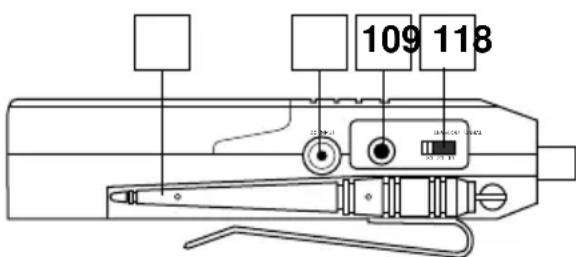
9: DC input - This jack will accept a DC input voltage of 6 - 13 volts (inner connection [tip] positive, outer connection [sleeve] ground) from your video camera, if available. Connect the optional Samson AC300R adapter here to charge a rechargeable 9-volt Ni-Cad battery.
10: Unbalanced output* - Use this unbalanced (1K Ohm max.) 1/8" (3.5 mm) mini-phone jack when connecting the UM1 to consumer (-10) audio equipment. Wiring is as follows: tip hot, sleeve ground. If your video camera has stereo audio inputs, you'll need to use a Y-adapter that has a 1/8" (3.5 mm) mini-phone plug at one end and dual male RCA-type plugs at the other end.
11: Audio Output Level switch - Sets the audio output level of both the balanced and unbalanced outputs (see #10 above and #14 below) to -30 dBm (mic level), -20 dBm, or -10 dBm (line level). See the "Setting Up and Using the UM1 System" section on page 8 in this manual for more information.
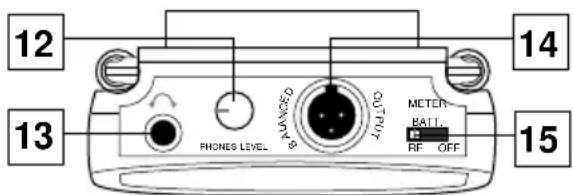
12: Level control - This knob sets the level of the audio signal being sent to the headphones output (see #13 below).
13: Headphones output - Connect a stereo headphone to this standard 1/8" (3.5 mm) mini-phone jack in order to monitor the
signal being output by the UM1. We recommend the use of 30 ohm headphones. The level of the headphone signal can be set by adjusting the Level control (see #12 above). Maximum output is 240 mW @ 30 ohms).
14: Balanced output* - Use this electronically balanced low impedance (600 Ohm) mini-XLR jack when connecting the UM1 to professional (+4) audio equipment. Pin wiring is as follows: Pin 1 ground, Pin 2 high (hot), and Pin 3 low (cold).
15: Meter switch - This three-position switch determines the function of the front-panel UM1 meter (see page #2 on previous page). In the left "RF" position, the meter indicates the strength of the incoming RF signal. In the center "BATTERY" position, the meter indicates relative battery power, showing whether the installed battery is at low (red), mid (yellow) or high (green) strength. (Note: When the red "low" indicator lights, performance is degraded and the battery needs to be replaced). In the right "OFF" position, the meter is disabled altogether, thus conserving battery power.
* If required, both the unbalanced and balanced outputs can be used simultaneously.
UM1 Frequency Conversion Chart
| Channel Frequency | |
| U1 801.3 | 75 MHz |
| U2 801.8 | 75 MHz |
| U3 803.1 | 25 MHz |
| U4 803.7 | 50 MHz |
| U5 804.5 | 00 MHz |
| U6 804.7 | 50 MHz |
Guided Tour - UT1L / UT1G
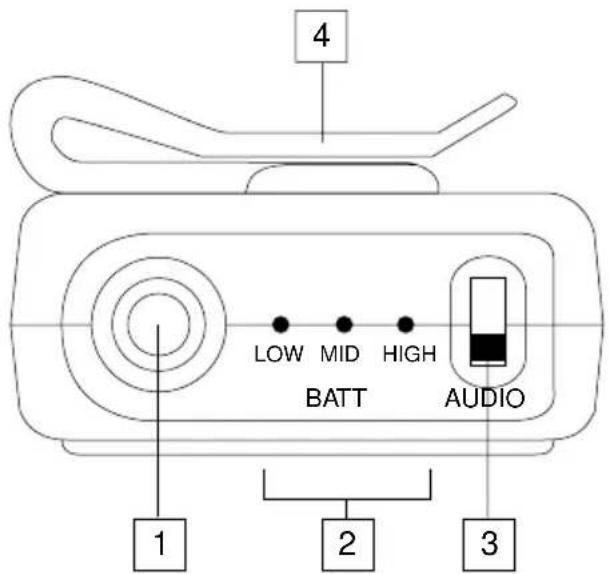
1: Input connector - The input device is connected here. The UT1L is supplied with either a lavalier or headset microphone (connected via a Switchcraft mini-XLR jack), while the UT1G is supplied with a permanently connected 1/4" jack cable.
2: Battery level meter - This set of three multicolor LEDs indicates relative battery power, indicating whether the installed battery is at low (red), mid (yellow) or high (green) strength. One of these will light whenever the UT1L or UT1G is powered on (see #8 on the next page). When the red "low" indicator lights, RF performance is degraded and the battery needs to be replaced.
3: Audio on-off switch - When set to the "on" position, audio signal is transmitted. When set to the "off" position, the audio signal is muted. Because the carrier signal remains during muting, no "pop" or "thud" will be heard. Note that turning this off does not turn off the transmitter power—it is simply a way to temporarily mute the transmission of audio signal. If you don't plan on using the transmitter for extended periods, turn off the transmitter power by using the power on-off switch (see #8 on the next page).
4: Belt clip - Use this clip to fasten the UT1L or UT1G to a belt. The position of the clip
can be rotated to the desired position after loosening its center screw or can be removed entirely by removing the center screw.
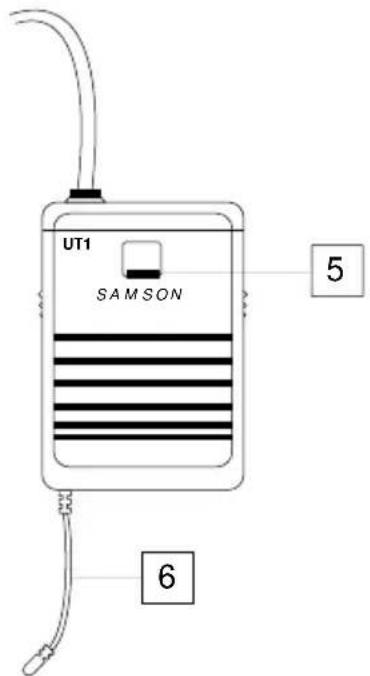
5: Battery cover release - Slide the release lever down to open the UT1 battery cover.
6: Antenna - This permanently attached transmitter "pig tail" antenna should be fully extended for normal operations. See the "Setting Up and Using the UM1 System" section on page 8 in this manual for more information about antenna positioning.
7: Battery holder - Insert a standard 9-volt alkaline battery here, being sure to observe the plus and minus polarity markings shown. We recommend the Duracell MN 1604 type battery. Although rechargeable Ni-Cad batteries can be used, they do not supply adequate current for more than four hours. WARNING: Do not insert the battery backwards; doing so can cause severe damage to the UT1L / UT1G and will void your warranty.
Guided Tour - UT1L / UT1G
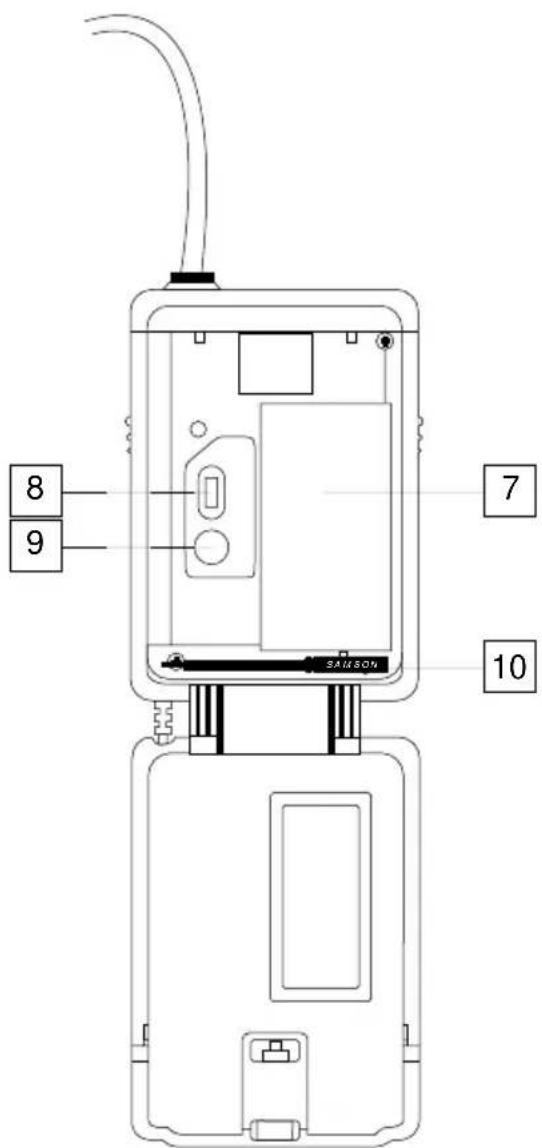
8: Power on-off switch* - Use this to turn the UT1L / UT1G on or off (to conserve battery power, be sure to leave it off when not in use).
9: Audio Input Level control (trimpot) - This input sensitivity control has been factory preset to provide optimum level for the particular lavalier or headset model being used (in the case of the UT1G, it is preset for optimum instrument level) and so we recommend that this not be adjusted manually. If necessary, however, you can use the supplied plastic screwdriver (see #10 below) to raise or lower the UT1L / UT1G input level. See the "Setting Up and Using the UM1 System" section on page 8 in this manual for more information.
10: Plastic screwdriver - Specially designed for use in adjusting the UT1L / UT1G Audio Input Level control (see #8 above) and/or UM1 Squelch control (see #7 on page 3). See the "Setting Up and Using the UM1 System" section on page 8 in this manual for more information.
* Be sure to mute the audio signal at your external mixer or amplifier before turning transmitter power on or off, or an audible pop may result.
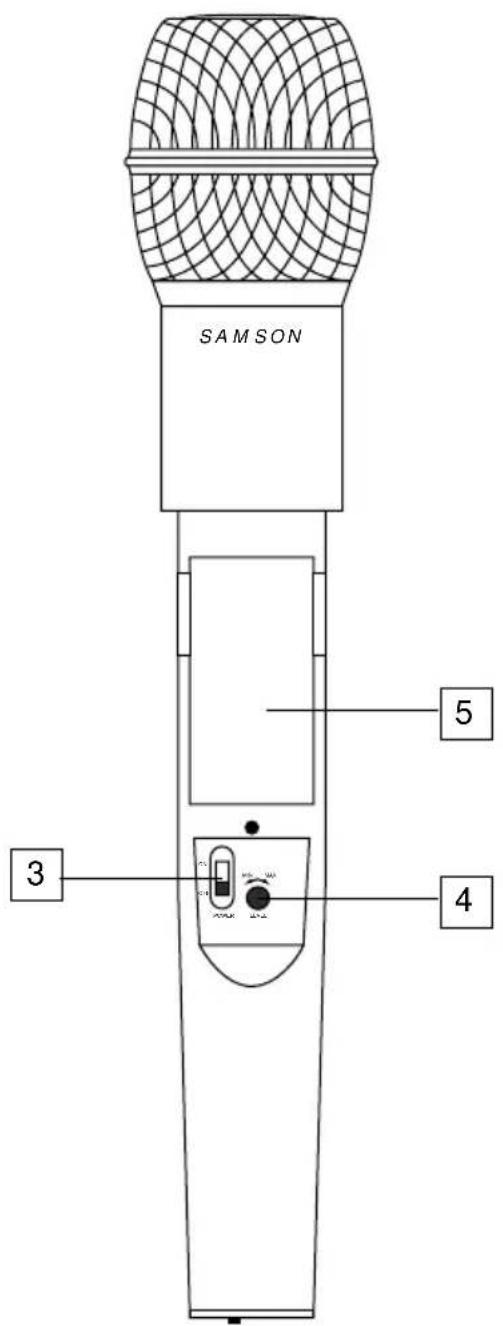
Guided Tour - UH1
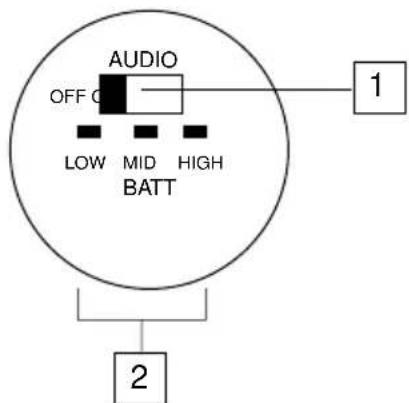
1: Audio on-off switch - When set to the "on" position, audio signal is transmitted. When set to the "off" position, the audio signal is muted. Because the carrier signal remains during muting, no "pop" or "thud" will be heard. Note that turning this off does not turn off the transmitter power—it is simply a way to temporarily mute the transmission of audio signal. If you don't plan on using the transmitter for extended periods, turn off the transmitter power by using the power on-off switch (see #3 below).
2: Battery level meter - This set of three multicolor LEDs indicates relative battery power, indicating whether the installed battery is at low (red), mid (yellow) or high (green) strength. One of these will light whenever the UH1 is powered on (see #3 below). When the red "low" indicator lights, RF performance is degraded and the battery needs to be replaced.
3: Power on-off switch* - Use this to turn the UH1 on or off (to conserve battery power, be sure to leave it off when not in use).
4: Microphone Input Level control (trimpot) -
This input sensitivity control has been factory
preset to provide optimum level for the particular microphone capsule provided with your UM1 system and so we recommend that this not be adjusted manually. If necessary, however, you can use the supplied plastic screwdriver to raise or lower the input level. See the "Setting Up and Using the UM1 System" section on page 8 in this manual for more information.
5: Battery holder - Insert a standard 9-volt alkaline battery here, being sure to observe the plus and minus polarity markings shown. We recommend the Duracell MN 1604 type battery. Although rechargeable Ni-Cad batteries can be used, they do not supply adequate current for more than four hours. WARNING: Do not insert the battery backwards; doing so can cause severe damage to the UH1 and will void your warranty.
Setting Up and Using Your UM1 System
The basic procedure for setting up and using your UM1 Wireless System takes only a few minutes:
- For the UM1 system to work correctly, both the receiver and transmitter must be set to the same channel. Remove all packing materials (save them in case of need for future service) and check to make sure that the supplied UM1 receiver and UT1L, UT1G or UH1 transmitter are set to the same channel. If these channels do not match, contact your distributor or, if purchased in the United States, Samson Technical Support at 1-800-372-6766.
2a. If you are using a 9-volt battery to power the UM1, press gently down on the battery door release (on the front of the UM1, on the word "Open") and swing the door open in order to access the battery compartment. Note that the door is hinged and is not intended to be removed from the receiver case. Insert a 9-volt battery, being careful to observe the polarity markings. Warning: Reversing the battery polarity may cause permanent damage to your receiver. Turn the power switch "On" and set the Meter switch to "BATTERY." The green "HIGH" meter LED will light if the battery is sufficiently strong. Once you've verified battery strength, turn the power switch "Off" again.
2b. If you are using the optional Samson AC300R adapter or your video camera's 12-volt power supply to power the UM1, connect it to the UM1 DC input jack. On the front of the UM1, press gently down on the battery door release (on the word "Open") and swing the door open note that the door is hinged and is not intended to be removed from the receiver case). Make sure the power switch is set to "Off."
3a. If your system contains a UT1L or UT1G belt-pack transmitter, locate the battery cover release and slide the lever down to open the battery door, which is hinged and not intended to be removed from the transmitter case. Please use care when opening this door as undue force will destroy the hinge.
3b. If your system contains a UH1 handheld transmitter, unscrew the bottom section of the microphone by turning it counterclockwise and then slide it off. - Place a fresh 9-volt alkaline battery in the transmitter battery holder, taking care to observe the polarity markings. If you are using a UT1L or UT1G belt-pack transmitter, gently replace the battery door by swinging it up and pressing until it clicks. If you are using a UH1 handheld transmitter, replace the bottom section of the microphone by sliding it on and then screwing it back on. Whichever transmitter you are using, leave it off for the moment.
- Next, make the physical cable connection between the output of your UM1 receiver and the audio input of your video camera or audio amplifier or mixer, being careful to set the Audio Output Level switch so that the signal is strong but not distorting. Normally, it should be set to the “-30” position when connecting to a mic-level input and to the “-20” or “-10” position when connecting to a line-level input. If required, both the balanced and unbalanced outputs can be used simultaneously. Leave your amplifier (and/or mixer) off at this time.
- Turn the power to the UM1 "On" and close the battery door.
- Extend both "A" and "B" antennas from the UM1 and place both in a vertical position.
- Turn on the power to the UT1L, UT1G or UH1 transmitter; the green "HIGH" Battery strength LED will light if the battery is sufficiently strong. At this point, either the "A" or "B" orange LED on the front of the UM1 will light (depending upon which antenna is receiving the stronger signal).
Setting Up and Using Your UM1 System
- Set the UM1 Meter switch to "RF." One or more segments in the UM1 meter should light. If the "HIGH" segment lights, the UM1 is receiving an optimally strong RF signal and is placed and positioned correctly. If the "LOW" segment lights (indicating a relatively weak RF signal), try relocating the UM1 or changing the position of one or both of its antennas.
- If you want to use headphones to monitor the transmission, connect a standard "Walkman"-type 30 ohm headphone to the UM1 headphone output and adjust the Level control until the desired level is reached.
- Turn on your connected amplifier and/or mixer but keep its volume all the way down. Next, make sure that your transmitter is unmuted by setting its Audio switch to "On." If you are using the UH1 transmitter or if you are using the UT1L transmitter with a connected lavalier microphone or headset, speak or sing into the mic at a normal performance level while slowly raising the volume of your amplifier/mixer until the desired level is reached. If you are using the UT1G transmitter with a connected instrument, play the instrument at normal performance level while slowly raising the volume of your amplifier/mixer until the
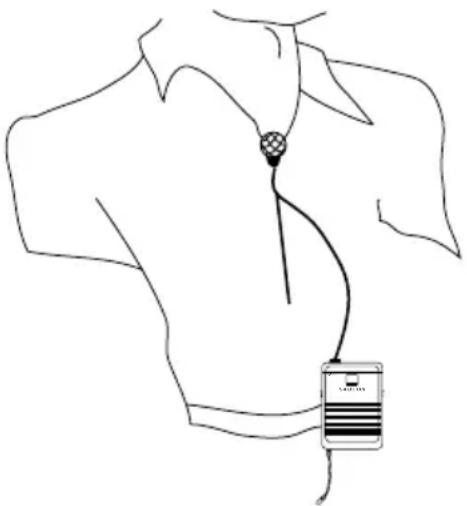
desired level is reached. If you are using a UT1L belt-pack transmitter equipped with a lavalier microphone, note that correct lavalier placement is critical to sound quality. We recommend that you place it as shown in the illustration on the right—as close to your mouth as possible but off to one side (to minimize nasality) and unobstructed by clothing. Bear in mind also that omni microphones (mics which pick up signal from all directions) are more prone to feedback problems than unidirectional (cardioid or hypercardioid) ones; in general, you can avoid feedback by taking care not to use any microphone directly in front of a PA speaker (if this is unavoidable, try using an equalizer to attenuate those high- or mid-range frequencies which are causing the feedback “squealing”).
natural_image
Line drawing of a person wearing a long-sleeve shirt with a patterned neck and a small card attached (no text or symbols)-
If you hear distortion at the desired volume level, first check to see whether the red "Peak" LED on the UM1 is lit. If it is not, make sure that the gain structure of your audio system is correctly set (consult the owners manual of your mixer and/or amplifier for details). If the red "Peak" LED is lit, do the following:
-
If you are using a UH1 transmitter, use the supplied plastic screwdriver to turn its Microphone Input Level control (trimpot) slowly counterclockwise (towards the "Min" position) until the distortion disappears.
- If you are using a UT1L transmitter with connected lavalier microphone or headset, its Audio Input Level control has been factory preset to provide optimum level for the particular lavalier or headset model being used and so no adjustment should be necessary. Any distortion present should therefore simply be a matter of the microphone being too close to the mouth; try moving it further away. If this does not solve the problem, use the supplied plastic screwdriver to turn the Audio Input Level control (trimpot) on the UT1L slowly counterclockwise until the distortion disappears.
- If you are using a UT1G transmitter with an instrument such as electric guitar or bass, lower the output level of the instrument until the distortion disappears. Alternatively, you can use the supplied plastic screwdriver to turn the Level control (trimpot) on the UT1G slowly counterclockwise until the distortion disappears.
Setting Up and Using Your UM1 System
-
Conversely, if you hear a weak, noisy signal at the desired volume level, again make sure that the gain structure of your audio system is correctly set (consult the owners manual of your mixer and/or amplifier for details). If it is and the signal coming from the UM1 is still weak and/or noisy, do the following:
-
If you are using a UH1 transmitter, use the supplied plastic screwdriver to turn the Level control (trimpot) on the transmitter slowly clockwise (towards the "Max" position) until the signal reaches an acceptable level.
- If you are using a UT1L transmitter with connected lavalier microphone or headset, its Level control has been factory preset to provide optimum level for the particular lavalier or headset model being used and so no adjustment should be necessary. Any weakness of signal should therefore simply be a matter of the microphone being too far from the mouth; try moving it closer. If this does not solve the problem, use the supplied plastic screwdriver to turn the Level control (trimpot) on the UT1L slowly clockwise until the signal reaches an acceptable level.
-
If you are using a UT1G transmitter with an instrument such as electric guitar or bass, raise the output level of the instrument until a good signal is achieved. Alternatively, you can use the supplied plastic screwdriver to turn the Level control (trimpot) on the UT1G slowly clockwise until the signal reaches an acceptable level.
-
Temporarily turn down the level of your mixer/amplifier system and turn off the power to your transmitter, leaving the UM1 on. Then restore the previously set level of your mixer/amplifier. With the transmitter off, the receiver output should be totally silent—if it is, skip ahead to the next step. If it isn't (that is, if you hear some noise), you may need to adjust the UM1 SQ (squelch) control, located in the battery compartment. When the SQ control is at its minimum setting, the UM1 system always provides maximum range without dropout; however, depending upon the particular environment your system is used in, you may need to reduce that range somewhat in order to eliminate band noise when the transmitter is turned off. To do so, use the provided screwdriver to rotate the SQ control completely counterclockwise (to the "Min" position), then slowly turn it clockwise until the noise disappears. If no noise is present at any position, leave it at its fully counterclockwise "Min" position (so as to have the greatest overall range available).
-
When first setting up the UM1 system in a new environment, it's always a good idea to do a walkaround in order to make sure that coverage is provided for your entire performance area. Accordingly, turn on both the transmitter and UM1 receiver. If you are using a video camera, use the supplied velcro strip to attach the UM1 to the side of the camera. If not, physically place the UM1 in the position in which it will be used. Next, with the transmitter unmuted, walk through the entire area that will need to be covered while speaking, singing, or playing your instrument. As you do so, you will find that the orange "A" and "B" LEDs on the UM1 occasionally switch on or off, always showing you which antenna is receiving the stronger signal. The basic rule of thumb for all wireless audio systems is to always try to minimize the distance between transmitter and receiver as much as possible and also to try to maintain "line of sight" between the two (that is, the person using the transmitter should be able to see the receiver). Always try to minimize the distance between transmitter and receiver as much as possible so that the strongest possible signal is received from all planned transmission points.
If you have followed all the steps above and are experiencing difficulties, contact your local distributor or, if purchased in the United States, call Samson Technical Support (1-800-372-6766) between 9 AM and 5 PM EST.
Audio-Technica MT-350 cravate
Audio-Technica Pro-35X microphone vent
Audio-Technica AT-831 cravate
Sennheiser MKE-2 cravate
Sony ECM-44 cravate
Sony ECM-55 cravate
Sony ECM-77 cravate
natural_image
Line drawing of a shirt with a patterned neck and a small card attached (no text or symbols)natural_image
Line drawing of a shirt with a neck strap and a small object attached (no text or symbols)natural_image
Line drawing of a shirt with a patterned collar and a small badge attached (no text or symbols)Procedure for wiring UT1L connector: Unscrew rubber boot 1 and pass wire through 1 and 2. Solder wire to 3 after removing from 4 (use chart above). Reinsert 3 to 4 with attached wire (3 is keyed to fit 4). Plug 2 into 3 again (2 is keyed to 3) and crimp wire. Rescrew rubber boot 1 to 4.
Specifications
System Specifications:
Channels 6
Frequency Type F3
Modulation Type FM
Noise Reduction Type Compander/Expander
Distance 300 feet
Transmitter (UH1, UT1L, UT1G):
Oscillation Type Direct PLL
Pre-emphasis 50 ∝ sec
Antenna
UH1 Integral Antenna
UT1L / UT1G 1/4 Wave Length Wire (Pig Tail)
Input (UT1L) TB3M Switchcraft Connector
Maximum Input Level 3 V p-p
Battery Duracell MN1604 9-volt alkaline
Operating Temperature
Switches / Controls Power ON/OFF, Audio ON/OFF
UH1 Mic Level Volume
UT1L / UT1G Audio Level
Display (LED)
Battery Low/Mid/High (corresponds to <5.3 V / 5.3 - 7 V / >7V)
Operating Voltage
9 Volts +20% / -40%
Current Consumption
47 mA
RF Power
10 mW
Frequency Stability
±20 kHz
Spurious Ratio 2.5 nW
Deviation
20 kHz (16.5 kHz - 23.5 kHz)
T.H.D. (Overall)
0.5% (3% max) (@AF 1 kHz, RF 46 dBu)
AF Frequency Response
50 Hz - 15 kHz (±3 dB overall)
Battery life
12 hours typical
Receiver (UM1):
Oscillation Type
Crystal Controlled
Receiving Method
Single Super Heterodyne / True Diversity
De-emphasis
50 ∝ sec
IF Frequency
10.7 MHz
Local Frequency
70 MHz Range (79 - 79.5 MHz)
Antenna
1/4 Wavelength Rod
In/Out
5.5 DC Inlet, Balanced Output (Switchcraft TA3F mini-XLR),
Unbalanced Output (3.5 mm phone jack), Headphone Output (3.5 mm phone jack)
Display (LED)
Receiver A/B (Orange), Peak (Red), RF Level / Battery Strength (3 pc)
Peak LED lighting point
AF output level approx. +4 dB
Controls
Audio Level swtitch, Squelch volume,
Headphone volume, Meter function switch
0^ / 55^
Operating Temperature
AC adapter DC 6 - 13 Volts, 9 volts battery
60 mA (no signal, all LEDs off)
801 - 805 MHz
17 dB×v ±4 dB
Operating Voltage
Current Consumption
Receiving Frequency Range
Squelch Sensitivity
T.H.D. (Overall)
Dynamic Range
AF Frequency Response
Audio Output Level
Audio Output Impedance
Headphone Output Impedance
Battery life
1% Max (@AF 1 kHz, RF 56 dBuv)
95 dB (w/IHF-A Filter)
50 Hz - 15 kHz (±3 dB overall)
0 dBv ±2 dB (Maximum +9 dBV ±3 dB @ 3% THD)
1 k Ohms max. (Unbalanced), 600 Ohms (Balanced)
32 Ohms
12 hours typical
FCC Rules and Regulations
Samson wireless systems are type accepted under FCC rules parts 90, 74 and 15.
Licensing of Samson equipment is the user's responsibility and licensability depends on the user's classification, application and frequency selected.
This device complies with RSS-210 of Industry & Science Canada.
Operation is subject to the following two conditions:
(1) this device may not cause harmful interference and (2) this device must accept any interference received, including interference that may cause undesired operation.
- FRANCAIS
- Introduction / System Features
- System Features
- Samson QE headset
- Samson QV headset
- Samson QMIC dynamic
- Guided Tour - UM1
- UM1 Frequency Conversion Chart
- Guided Tour - UT1L / UT1G
- Guided Tour - UH1
- Setting Up and Using Your UM1 System
- Specifications
- System Specifications:
- Transmitter (UH1, UT1L, UT1G):
- Receiver (UM1):
- FCC Rules and Regulations
Brand : SAMSON
Model : UM1 Micro
Category : Hi-fi system