
Modul Bisel 2G - Cooker FRANKE - Free user manual and instructions
Find the device manual for free Modul Bisel 2G FRANKE in PDF.
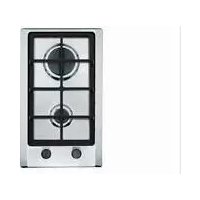



| Product type | Built-in gas hob |
| Brand | Franke |
| Model | Modul Bisel 2G |
| Number of burners | 2 (auxiliary and rapid) |
| Burner types | Auxiliary (1.00 kW), Rapid (3.00 kW) |
| Gas supply | Natural gas (G20) or LPG (G30/G31), adjustable |
| Electrical supply | 220-240 V, 50-60 Hz |
| Maximum power | Approximately 4.0 kW (depending on burners) |
| Dimensions (W x D x H) | 300 x 510 x 50 mm |
| Weight | Approximately 8 kg |
| Ignition | Integrated ignition in knob |
| Safety | Automatic safety valves (gas cut-off if flame goes out) |
| Material | Stainless steel and enamel |
| Cleaning | Soapy water, no dishwasher or abrasives |
| Spare parts | Injectors, caps, grates, gaskets |
| Repairability | Franke authorized after-sales service |
| Standards | CE (90/396/EEC, 73/23/EEC, 89/336/EEC) |
| Warranty | See warranty certificate |
Frequently Asked Questions - Modul Bisel 2G FRANKE
User questions about Modul Bisel 2G FRANKE
0 question about this device. Answer the ones you know or ask your own.
Ask a new question about this device
Download the instructions for your Cooker in PDF format for free! Find your manual Modul Bisel 2G - FRANKE and take your electronic device back in hand. On this page are published all the documents necessary for the use of your device. Modul Bisel 2G by FRANKE.
USER MANUAL Modul Bisel 2G FRANKE
User and installation instructions 10
Built-in hob

Introduction 10 A close view. Use 12 Hob cleaning and maintenance 12 Support 13 Safety warnings 13 Installation 15 Connection to the gas supply. 16 Electrical connection 17 Replacing injectors 17 Minimum flame adjustment 17 Technical data. 18
Introduction
Thank you for choosing a Franke product. Before using the appliance, please read all the instructions and advice contained in this manual. In this way you will be able to make best use of the appliance and also ensure its lasting efficiency. Keep this booklet for further reference.
A close view
A Control Panel B Hobs
A Control panel FHM 301 ITC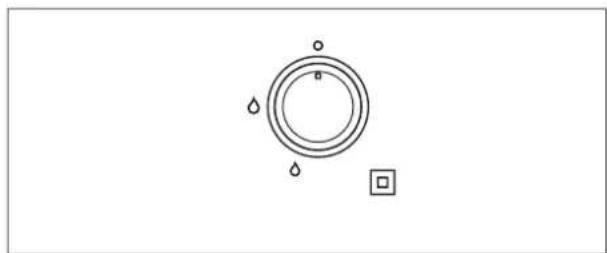
Control panel FHM 302 2G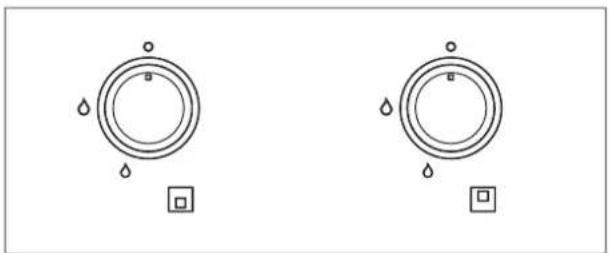
B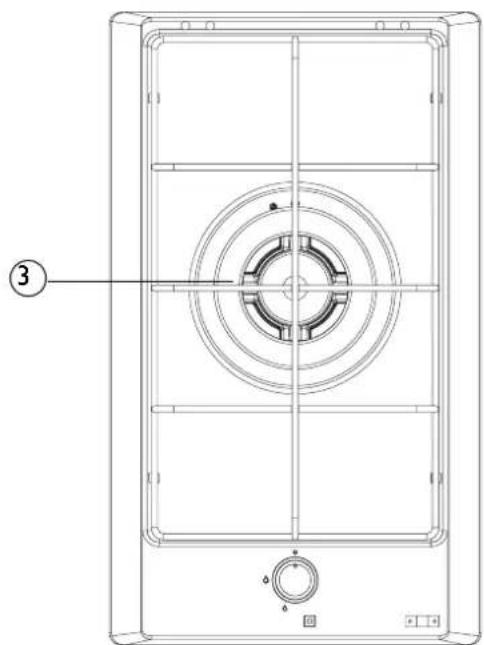
FHM 302 2GFHM 301 ITC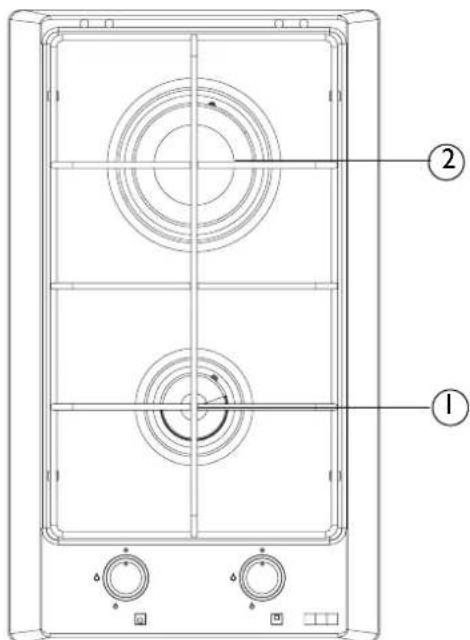
1) Auxiliary 2) Rapid 3) Triple crown
Lighting the burners
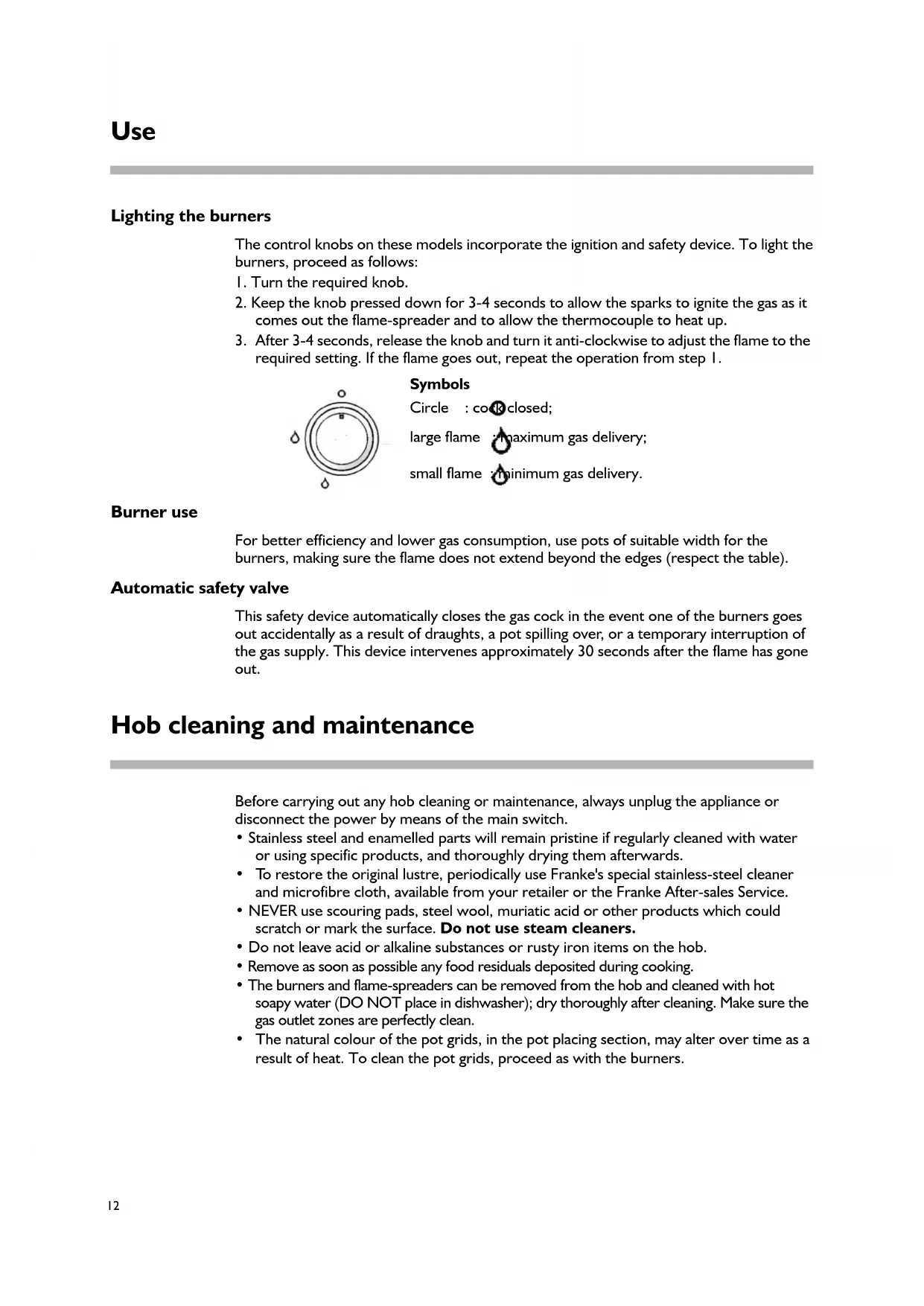
The control knobs on these models incorporate the ignition and safety device. To light the burners, proceed as follows:
- Turn the required knob.
- Keep the knob pressed down for 3-4 seconds to allow the sparks to ignite the gas as it comes out the flame-spreader and to allow the thermocouple to heat up.
- After 3-4 seconds, release the knob and turn it anti-clockwise to adjust the flame to the required setting. If the flame goes out, repeat the operation from step 1.
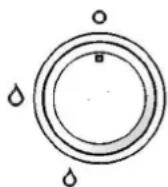
Symbols
Circle: closed;
large flame maximum gas delivery;
small flame minimum gas delivery.
Burner use
For better efficiency and lower gas consumption, use pots of suitable width for the burners, making sure the flame does not extend beyond the edges (respect the table).
Automatic safety valve
This safety device automatically closes the gas cock in the event one of the burners goes out accidentally as a result of draughts, a pot spilling over, or a temporary interruption of the gas supply. This device intervenes approximately 30 seconds after the flame has gone out.
Hob cleaning and maintenance
Before carrying out any hob cleaning or maintenance, always unplug the appliance or disconnect the power by means of the main switch.
- Stainless steel and enamelled parts will remain pristine if regularly cleaned with water or using specific products, and thoroughly drying them afterwards.
- To restore the original lustre, periodically use Franke's special stainless-steel cleaner and microfibre cloth, available from your retailer or the Franke After-sales Service.
- NEVER use scouring pads, steel wool, muriatic acid or other products which could scratch or mark the surface. Do not use steam cleaners.
- Do not leave acid or alkaline substances or rusty iron items on the hob.
- Remove any food residues deposited during cooking as soon as possible.
- The burners and flame-spreaders can be removed from the hob and cleaned with hot soapy water (DO NOT place in dishwasher); dry thoroughly after cleaning. Make sure the gas outlet zones are perfectly clean.
- The natural colour of the pot grids, in the pot placing section, may alter over time as a result of heat. To clean the pot grids, proceed as with the burners.
In case of possible operating problems, contact a Franke Service Centre (see attached list). Never make use of unauthorised technicians.
Specify:
- Type of fault;
- Appliance model (Art.);
- Serial number (S.N.);
This information is given on the appliance dataplate on the warranty certificate.
Safety warnings
Always contact qualified personnel in the following cases:
- installation (see installation section); -doubts regarding operation.
Contact an Authorised Service Centre in the following cases:
- immediately after unpacking, in case of doubts about the condition of the appliance;
- replacing or damaged power cable;
- appliance malfunction or poor operation, requesting original spare parts.
General instructions
To ensure safe and efficient operation of this appliance: - only contact authorised service centres; - always demand the use of original spare parts; - the appliance is designed for non-professional, domestic use; do not modify its characteristics; - the dataplate gives the symbols indicating the countries for which the instructions apply; - appliance electrical safety is guaranteed only when it is connected to an earthing system in compliance with the current regulations; - do not touch the pot grids during use, since they become very hot. Keep children away from the appliance; - only use the appliance for cooking food; - before any cleaning or maintenance operations, or in case of malfunction, disconnect the appliance from the mains power supply; - always check that the control knobs are in the off position when the appliance is not in use.
Do not allow children to touch:
- the controls and the appliance in general;
- the packing elements (bags, polystyrene, staples, etc.);
- the appliance, during and immediately after use, since the hob becomes very hot;
- an unused appliance (make any potentially hazardous parts safe).
Do not:
- touch the appliance with wet parts of the body;
- use the appliance when barefoot;
- pull the appliance or power cable to unplug it;
- carry out improper or hazardous operations;
- leave the power cables of other electric appliances on hot parts of the appliance;
- expose the appliance to atmospheric agents;
- use the appliance as a support top;
- use flammable liquids near the appliance;
- use adapters, multi-sockets or extension leads;
- allow anyone except qualified personnel to install or repair the appliance.
Important
- Do not place unstable or deformed pots on the burners, since they may tip over or cause spills.
- If the appliance has a lid, make sure the burners are cold before closing it.
- Close the gas cock when the hob is not in use.
- Before installation, make sure the gas supply is compatible with appliance specifications. The type of gas for which the appliance is arranged is specified on the dataplate on the bottom of the drawer. This appliance is not connected to a fume extraction device and must be installed and connected in compliance with the current regulations. Pay particular attention to the applicable regulations on ventilation. The use of a gas cooking appliance produces heat and humidity in the room where it is installed. Ensure the room is adequately ventilated: keep natural ventilation openings open, or install a mechanical ventilation device (extractor hood with exhaust duct). In case of intensive or prolonged use of the appliance, it may be necessary to provide additional ventilation, for example by opening a window, or more efficient ventilation, by increasing the extractor hood speed.
The manufacturer declines any liability for damage or injury due to: incorrect installation, improper, incorrect or unreasonable use.
Detailed below are all the procedures to be followed for the installation of your appliance, including gas and electrical connections. These procedures must be carried out exclusively by a qualified technician, in accordance with current regulations, since installation by an unqualified person may constitute a health hazard.
The manufacturer declines all liability for injury to persons or animals or damage to property resulting from failure to comply with these regulations. The gas connection must conform to the current legislation in the country at the time of installation.
Preparing the cabinet
This handbook refers to a class 3 built-in hob.
Prepare the opening in the top according to the measurements given in fig. I in case of combined installation of more than one cooking hob, or according to the diagram in fig. 2 in case of single installation.
In any case, it is essential to make the opening in the most convenient position, bearing in mind that the gas pipe must not come into contact with the sides of a possible oven under the hob.
COMBINED INSTALLATION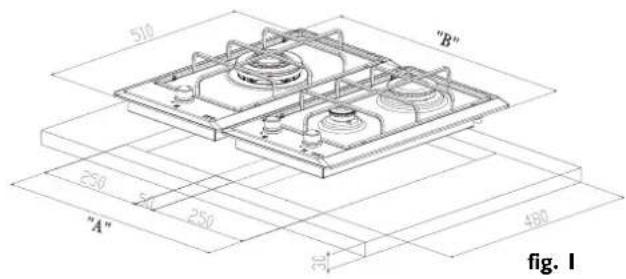
SINGLE INSTALLATION fig. 2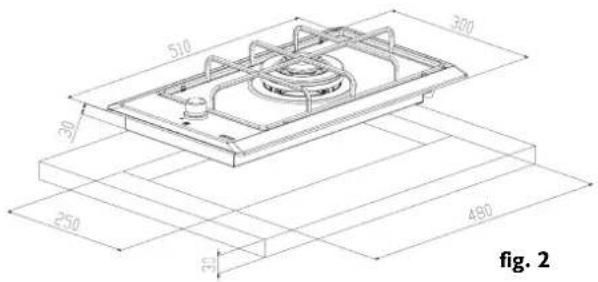
Opening for 2 hobs Domino FHM "A" = 550mm ("B" = 600mm)
Opening for 3 hobs Domino FHM "A" = 850mm ("B" = 900mm)
Opening for 4 hobs Domino FHM "A" = 1150mm ("B" = 1200mm)
In case of combined installation of more than one cooking hob it is advisable to make a separate opening for each hob, leaving a 50 mm strip between each opening. In this way the hobs will be next to each other without any spaces.
To fit the hobs with spaces between them (recommended min. 10 mm), the width of the strip on the cabinet must be 50 mm plus the space required between hobs.
Fitting in the cabinet
After carrying out the necessary connections, position the sealing strip all around the cutout and fit the hob. Carefully tighten the fixing hooks. Remove any excess sealing strip.
Important
These are "Y"-type appliances regarding protection rating against the risk of fire, and can therefore be installed near wooden walls higher than the tops in which they are installed, provided the following minimum distances from the edges of the appliances are maintained: 50 mm for side walls, 30 mm for the rear wall; any wall units above must be at least 700 mm from the hob.
If there are drawers under the cooking hob, it is advisable to insert a separator plate (with suitable openings made for the electrical/gas connections) so that the items in the drawer do not come into contact with the bottom part of the hob.
Connection to the gas supply
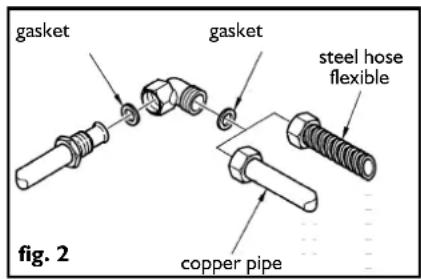
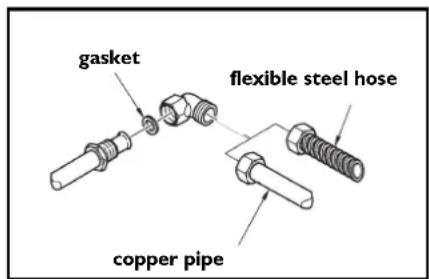
Check that the appliance is suited to the gas type before connecting it to the gas supply in conformance with current legislation. If this is not the case, carry out the operations described in the paragraph on "replacing injectors" (page 17). For a liquid gas supply use pressure regulators which comply with current legislation. Connection to the gas supply may be made in two ways:
A Connect the gas hob using a 12 mm diameter rigid copper pipe, as shown in fig. 2. To prevent any risk of leaks, use the rubber gasket supplied. B Connect the hob using a continuous-surface steel hose. Once again, in this case, prevent any risk of leaks by using the gasket supplied. Note that installation must be carried out in compliance with current regulations pertaining to gas installations.
Having completed the connection to the gas supply, use soapy water to check the connection for leaks.
For United Kingdom, Northern Ireland and Republic of Ireland
Ventilation of installation area
Make sure that the room where the appliance is installed has permanent ventilation openings on an outside wall or ventilation ducts, in order to ensure adequate air flow as prescribed by current legislation. All openings must:
1. have a minimum working section of 100 cm²; 2. be made in such a way as to prevent them being blocked in any manner, from inside or outside; 3. be provided with suitable protection to ensure the size of the ventilation opening is not reduced; 4. be positioned at such a height from floor level as not to interfere with the discharge of combustion fumes.
If openings are made in the wall of an adjacent room, the latter must have direct ventilation and must not be:
1. a bedroom; 2. a common area of the building in question; 3. a fire hazard area.
Before testing and inspecting the appliance check that the adjacent room, which shares the wall in which the ventilation opening has been made, does not have low pressure due to another user; moreover, ensure adequate air flow between the two rooms is guaranteed by permanent, unobstructed openings, for example by increasing the gap between the bottom of the door and the floor. Discharge of combustion products must be guaranteed by means of a hood which, in turn, must be connected to a chimney, a flue, or directly to the outside.
Accessing the hob
To access the box containing the functional parts, proceed as follows:
- remove the grids, burner caps and flame-spreaders;
- remove the knobs, pulling them off their pins;
- remove the screws that fix the burners to the hob;
- lift the hob.
Electrical connection
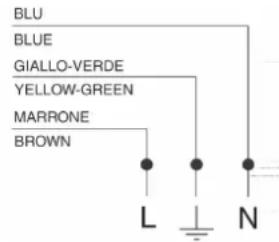
The FRANKE cooking hob comes with a 3-core power cable with free terminals.
If the hob is permanently connected to the power supply, install a circuit breaker having a contact opening distance (at least 3 mm) that allows complete disconnection in the conditions of overvoltage category III. Make sure:
a) the plug and socket are suitable for a 16A current b) both are easily accessible and positioned so that no live part can be accessed when inserting or removing the plug c) the plug can be inserted without difficulty d) that when the plug is inserted, the hob is not resting on it when installed in the cabinet e) the terminals of two appliances are not connected to the same plug f) if the power cable needs to be replaced use a 3 x 1.5 mm2 cable type H05VV-F
g) to respect the polarities of the free terminals (Brown=Live Blue=Neutral Yellow/Green=Earth)
NB: Make sure the characteristics of your household electrical system (voltage, maximum power and current) are compatible with those of your FRANKE hob.
Replacing injectors
NB: All the appliances are factory-set for G20 natural gas (methane).
If a different type of gas is to be used, change the injectors as follows:
I. remove the grids, burner caps and flame-spreaders; 2. unscrew and remove the injectors and replace them with those supplied, suitable for the gas supply, making sure the marking matches that given in the table (page 18); 3. refit the flame-spreaders, burner caps and grids; 4. these burners do not require air adjustment.
Important
When converting the appliance to a different type of gas, place the corresponding self-adhesive label (supplied as an accessory) in the special space on the dataplate. For operation with LPG. (G30 or G31), the minimum flame screw must be fully screwed down. These appliances are supplied in cat. II 2H3+
Minimum flame adjustment
- Remove the knobs (push-on type).
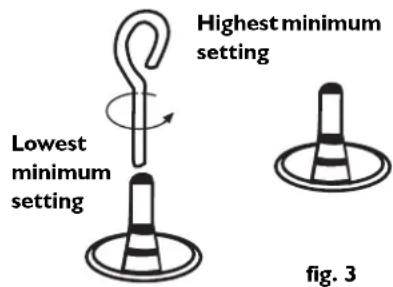
- Light the burners and adjust the minimum flame by turning the adjustment screw clockwise to reduce the flame and anticlockwise to increase it (fig. 3). The screwdriver for adjustment is supplied with the accessories.
Appliance cat. II 2H3+
| Type of gas Burner | Injector marking | Rated heat capacity in kW | Heat capacity reduced in kW | Rated consumption |
| Natural gas (methane) | auxiliary | 72 | 1.000 | 0.380 |
| rapid | 115 | 3.000 | 0.800 | |
| G20 | triple crown | 140 | 3.300 | 1.600 |
| 20 mbar | ||||
| Liquified petroleum gas | auxiliary | 50 | 1.000 | 0.380 |
| rapid | 85 | 3.000 | 0.800 | |
| (LPG) | triple crown | 91 | 3.300 | 1.600 |
| G30-G31 | ||||
| 30/37 mbar | ||||
| Table of recommended pots | ||||
| Burner Ø Pots in cm | ||||
| Auxiliary | from Ø 8 to Ø 14 | |||
| Rapid | from Ø 22 to Ø 24 | |||
| Triple crown | from Ø 24 to Ø 28 | |||
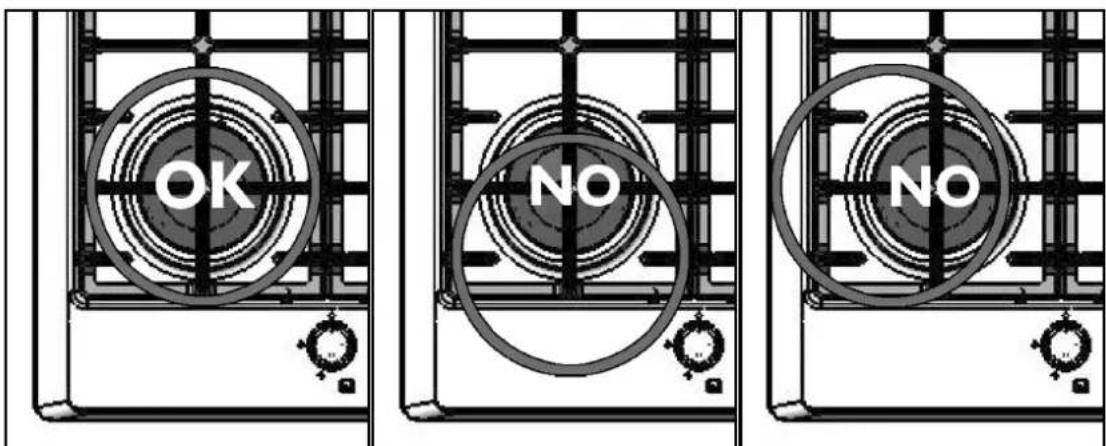
The use of larger pots than those specified can cause excessive overheating of the knobs and top. Franke declines any liability for damage due to such incorrect use.
Total heat capacity: see dataplate on the bottom of the hob.
Air necessary for combustion: 2m3 /h per kW of installed power - see dataplate.
Power supply voltage 220/240 V 50-60 Hz.
C
The appliance complies with the following EEC Directives:
-90/396/EEC (Gas): - 73/23/EEC dated 19/02/73 (Low Voltage); - 89/336/EEC dated 03/05/89 (Electromagnetic Compatibility); - 93/68/EEC dated 22/07/93 as amended.
Maximum power:
Materials:

Maximum power.
Use of burners
To reduce gas consumption and increase the efficiency of the hob, it is recommended to use pots with a diameter that matches the diameter of the burner, so as to prevent the flame from extending beyond the edge of the pot (see table).
Automatic safety shut-off valve
This device automatically closes the valve if the flame goes out, preventing gas from escaping from the cookware or in the event of a gas supply interruption. The device activates approximately 30 seconds after the flame goes out.
Cleaning and maintenance of the cooktop
Before performing any maintenance on the cooktop, unplug the appliance from the electrical outlet or disconnect it by switching off the main circuit breaker.
- Parts made of stainless steel or enameled steel will always look like new if you wash them with water or special products and then dry them thoroughly. To restore the original shine, periodically use a special paste (e.g., Franke Cream) and a microfiber cloth (Franke Microfiber Cloth), which can be purchased from your dealer or at the Franke service center. It is strictly forbidden to use metal sponges, hydrochloric acid, or other agents that could scratch or damage the surface. Also, do not use steam cleaning devices. Do not leave acidic, alkaline, or metallic residues on the cooktop. Remove food residues that accumulate on the cooktop during cooking as quickly as possible. The grates and flame spreaders can be removed from the cooktop and washed in hot water with soap (they must not be washed in a dishwasher); before putting them back, dry them thoroughly. Check that the gas openings are completely clean. The color of the grates may change over time due to heat exposure. Clean the grates in the same way as the burners.
In case of malfunction or failure of the cooktop, contact the after-sales service center. The list of service centers is attached to this manual. Never contact unauthorized technicians.
Please provide:
- the malfunction;
- Model of the cooktop (Art.);
- Serial number (S.N.);
This information is on the rating plate and on the warranty card.
Safety warnings
In the following cases, contact qualified technicians:
5 before installation (see section "Installation"); 5 if in doubt about the correct operation of the pressure cooker.
Contact service centers authorized by the manufacturer in the following cases:
5 immediately after unpacking the product in case of doubt about its integrity; 5 for replacement or if the power cord is damaged; 5 in the event of malfunctions or in case of poor operation of the pressure cooker; require the use of only original spare parts in this case.
General instructions
To ensure effective and safe operation of this household appliance: 5 contact only authorized technical service centers; 5 always require the use of original spare parts; 5 this appliance is intended for non-professional, household use; do not change its characteristics; 5 the manual and the factory plate show the country symbol for which this instruction is valid; 5 the electrical safety of the appliance is ensured only when it is connected to an effective grounding system, installed in accordance with current standards; - be careful not to touch the grills-supports of the pressure cooker during its operation, as they heat up to high temperatures; keep children at a safe distance; 5 while preparing dishes, do not perform other operations; 5 before performing any maintenance operation on the pressure cooker, as well as in case of malfunction, disconnect the appliance from the power supply; 5 always check that the control knobs are in the off position when the pressure cooker is not in use.
Do not allow children to touch:
5 the control elements and the appliance in general; 5 almost all materials (including the pressure cooker) during operation and immediately after switching off, due to high temperature; 5 the appliance in operation (in this case, parts that may pose a danger must be brought into a safe state).
It is strictly forbidden to:
5 touch the appliance with wet hands; 5 use the appliance while standing barefoot on the floor; 5 pull the cord to disconnect the appliance from the socket; 5 perform operations not provided for or dangerous; 5 leave the power cords of other electrical appliances on the hot parts of this appliance; 5 expose the appliance to atmospheric agents; 5 use the appliance as a support surface; 5 use flammable liquids near the appliance; 5 use adapters, multiple sockets, extension cords, etc.; 5 entrust the installation and repair of the appliance to unqualified technicians.
Attention
5. Secure the hob to the countertop to prevent it from tipping over or spilling its contents onto the surface. 5. If the hob is equipped with a lid, before closing it, make sure the burners are off. 5. Close the gas supply valve when the hob is not in use. 5. Before starting installation, verify that the gas supply characteristics meet the requirements of this appliance. Instructions for converting the hob to another type of gas are provided on the data plate located on the hob. The appliance is not equipped with a device for removing combustion products; its installation and connection must be carried out in accordance with applicable standards. Particular attention should be paid to ventilation requirements. Use of gas hobs leads to the generation of heat and humidity in the room where it is installed. In this room, good ventilation must be ensured, for example: keep ventilation openings open, ensure natural ventilation, or install a mechanical ventilation device (exhaust hood with exhaust duct). Intensive or prolonged use of the appliance may require additional ventilation of the room (e.g., opening a window) or increasing the power of the mechanical exhaust ventilation device, if available.
The manufacturer disclaims all liability for damage that may occur as a result of: incorrect installation; improper, erroneous, or inappropriate methods of use.
This section describes the operations necessary for installing the appliance and connecting it to the gas supply and electrical networks. Such work must be carried out in accordance with applicable standards and performed by qualified specialists, as improper execution by persons without the necessary experience may create a dangerous situation. The manufacturer disclaims all liability for damage to persons or property resulting from failure to follow the instructions above. When connecting to the gas supply network, it is necessary to comply with the standards in force in the country at the time of installation.
Furniture preparation
These instructions apply to built-in gas hobs of class 3. Make the cutout in the worktop according to the dimensions shown in Fig. 1 for combined installation of several hobs according to the scheme shown in Fig. 2, or for single hob installation.
In any case, it is necessary to make the cutout in the most convenient place, taking into account that the gas supply pipe must not touch the walls of the oven, which may be installed under the hob.
COMBINED INSTALLATION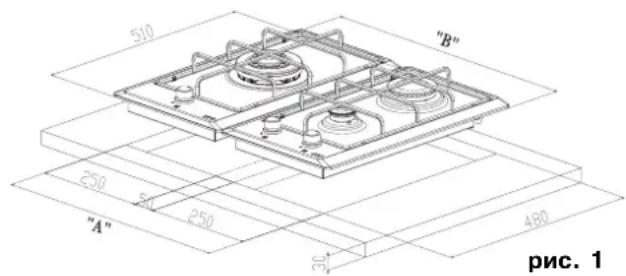
SINGLE INSTALLATION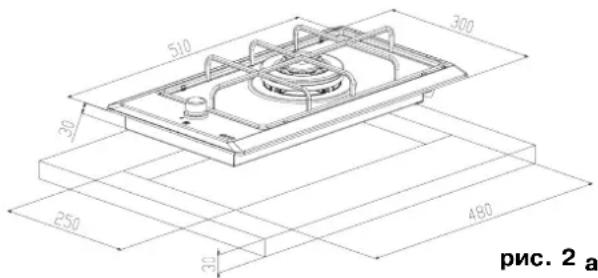
Dimensions for installation of 2 hobs Domino FHM “A” = 550 mm (“B” = 600 mm)
Dimensions for installation of 3 hobs Domino FHM “A” = 850 mm (“B” = 900 mm)
Dimensions for installation of 4 hobs Domino FHM “A” = 1150 mm (“B” = 1200 mm)
When installing several panels together, it is recommended to perform not a single hole for their installation, but several holes, the number of which should correspond to the number of panels to be installed, leaving a gap of 50 mm between them. In this case, the steam panels will appear installed tightly against each other, and there will be no gap between them.
If you want to leave some distance between the steam panels, it is recommended that the minimum value be 10 mm, and the width of the separating strip should be equal to 5 mm plus the distance you want to leave between the panels.
Installing kitchen furniture
After completing the connection, run the sealant along the edge of the opening and insert the steam panel. Carefully tightening, tighten the fasteners. Remove the protruding parts of the sealing tape.
Attention
These devices have a degree of fire resistance. Therefore, they can be installed near the walls of wooden furniture located next to the hob (and above it), into which these devices are built, provided that the distances from the edge of the device are not less than: 50 mm for the side wall and 30 mm for the rear wall. The distance from the hanging cabinet (if any) to the steam panel must be at least 700 mm. It should be noted that if there are shelves for accessories above the steam panel, it is advisable to install a separating partition (with appropriate holes for electrical and gas connections) so that the accessories do not touch the lower parts of the steam panel.
Access to the steam panel
To access the internal parts of the panel, proceed as follows:
- Remove the grilles, overlays, and the burner divider;
- Remove the knobs from the corresponding rods;
- Remove the screws securing the burners to the panel;
- Lift the panel.
Connection to the electrical network
The FRANKE steam panel is supplied with a three-pole power cable, the cores of which have free ends.
In the case of a fixed connection of the steam panel to the electrical network, it is necessary to provide a disconnection device with a distance between open contacts (at least 3 mm) that ensures complete disconnection of the device from the network under overvoltage category III. Check the following:
a) The plug and socket must be rated for a current of 16 A. b) The plug and socket must be easily accessible and installed so as to prevent contact with live parts when inserting or disconnecting the plug. c) The plug must insert without the use of force. d) After installing the plug in the socket, the hob must not rest on it when built into furniture. e) Only one appliance must be connected to a single socket. f) If the power cord is replaced, a cable of type H05VV-F with a cross-section of 3 x 1.5 mm2 must be used.
g) When connecting the free ends, the correct polarity must be observed (brown = phase, blue = neutral, yellow-green = earth).
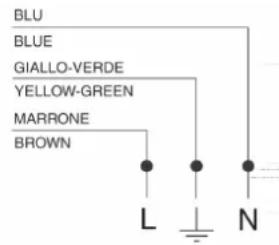
NOTE: Make sure that the characteristics
of your home electrical system (voltage, maximum power and current)
match the rated characteristics of the purchased FRANKE hob.
Replacing the injectors
Preliminary warning. All units manufactured by the factory are set for operation with natural gas (G20).
If using a different gas, replace the injectors as follows:
- Remove the grids, the burner caps and the flame spreaders;
- Unscrew and remove the injectors; replace them with injectors suitable for the gas used, checking that their markings match those indicated in the table (page 6); 3. Reinstall the flame spreaders, the burner caps and the grids;
- These burners do not require air adjustment.
Preliminary warning
If the hob is converted to another gas, in the place provided for this purpose on the appliance, the corresponding adhesive label supplied as an accessory must be applied. When operating on liquefied petroleum gas (G30 or G31), the minimum flame adjustment screw must be tightened fully. These appliances comply with category II 2H3+.
Minimum flame adjustment
- Remove the knobs (of the push-on type).
- Turn the knob, then set the minimum flame by turning the adjusting screw clockwise to reduce the flame, or counterclockwise to increase it (Fig. 3). The screwdrivers for this adjustment are included in the set supplied with the control panel of the burner.
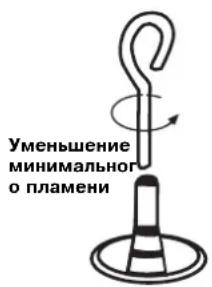
Setting the minimum flame Fig. 3
Device category II 2H3+
- INTRODUCTION
- A CLOSE VIEW
- LIGHTING THE BURNERS
- SYMBOLS
- BURNER USE
- AUTOMATIC SAFETY VALVE
- HOB CLEANING AND MAINTENANCE
- SPECIFY
- SAFETY WARNINGS
- ALWAYS CONTACT QUALIFIED PERSONNEL IN THE FOLLOWING CASES
- CONTACT AN AUTHORISED SERVICE CENTRE IN THE FOLLOWING CASES
- GENERAL INSTRUCTIONS
- DO NOT ALLOW CHILDREN TO TOUCH
- DO NOT
- IMPORTANT
- PREPARING THE CABINET
- FITTING IN THE CABINET
- CONNECTION TO THE GAS SUPPLY
- FOR UNITED KINGDOM, NORTHERN IRELAND AND REPUBLIC OF IRELAND
- VENTILATION OF INSTALLATION AREA
- ACCESSING THE HOB
- ELECTRICAL CONNECTION
- REPLACING INJECTORS
- MINIMUM FLAME ADJUSTMENT
- C
- USE OF BURNERS
- AUTOMATIC SAFETY SHUT-OFF VALVE
- CLEANING AND MAINTENANCE OF THE COOKTOP
- PLEASE PROVIDE
- IN THE FOLLOWING CASES, CONTACT QUALIFIED TECHNICIANS
- CONTACT SERVICE CENTERS AUTHORIZED BY THE MANUFACTURER IN THE FOLLOWING CASES
- IT IS STRICTLY FORBIDDEN TO
- ATTENTION
- FURNITURE PREPARATION
- INSTALLING KITCHEN FURNITURE
- ACCESS TO THE STEAM PANEL
- CONNECTION TO THE ELECTRICAL NETWORK
- REPLACING THE INJECTORS
- PRELIMINARY WARNING
Brand : FRANKE
Model : Modul Bisel 2G
Category : Cooker