
SCD464 - Baby monitors PHILIPS - Free user manual and instructions
Find the device manual for free SCD464 PHILIPS in PDF.
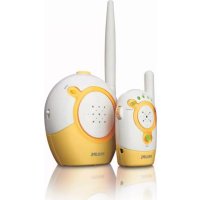



| Product type | Baby monitor |
| Brand | Philips |
| Model | SCD464 |
| Mains power | Mains adapter 230 V~ 50 Hz, output voltage 9 V DC, 200 mAh (two adapters included) |
| Battery power (baby unit) | 4 AA 1.5 V batteries (alkaline recommended) |
| Battery power (parent unit) | 3 AAA 1.5 V batteries (alkaline recommended) |
| Outdoor range | Up to 200 meters (may vary depending on obstacles) |
| Transmission frequencies | 40,665 MHz, 40,680 MHz, 40,695 MHz |
| Number of channels | 16 selectable channels |
| Microphone sensitivity adjustment | 3 levels: low, medium, high |
| Visual indicators | Volume indicators (5 LEDs) on parent unit, connection indicator, power indicator |
| Connection alarm | Yes, can be enabled/disabled |
| Silent monitoring | Yes, via light indicators |
| Attachment | Removable belt clip for parent unit |
| Operating temperature | 0 °C to 40 °C |
| Care and cleaning | Clean with a damp cloth |
| Safety instructions | Keep at least 1 meter from baby, do not place in crib, do not cover, do not use near water |
| Recommended batteries | Philips alkaline |
| Warranty | See separate warranty booklet |
Frequently Asked Questions - SCD464 PHILIPS
User questions about SCD464 PHILIPS
0 question about this device. Answer the ones you know or ask your own.
Ask a new question about this device
Download the instructions for your Baby monitors in PDF format for free! Find your manual SCD464 - PHILIPS and take your electronic device back in hand. On this page are published all the documents necessary for the use of your device. SCD464 by PHILIPS.
USER MANUAL SCD464 PHILIPS
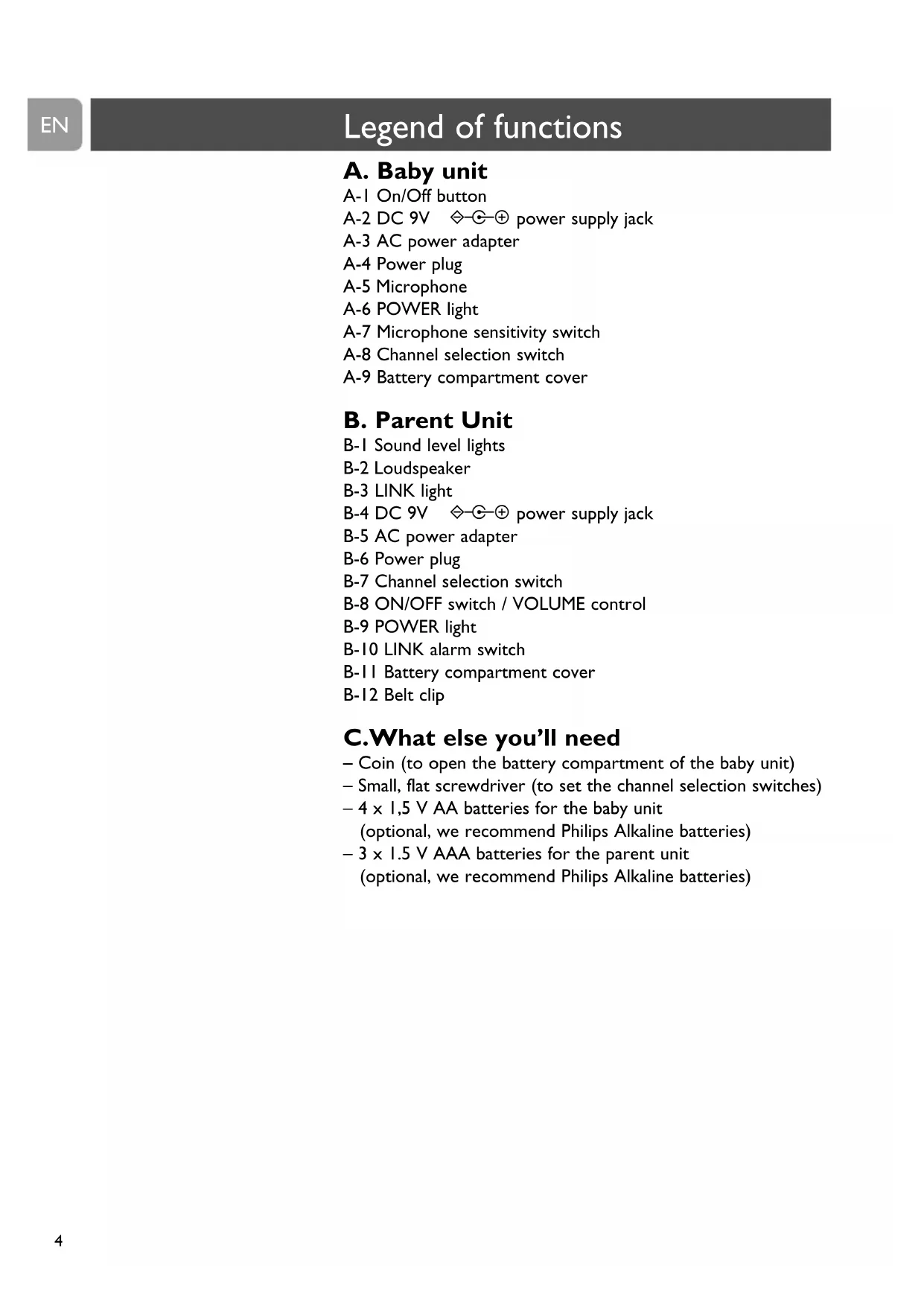
A-1 On/Off button A-2 DC 9V power supply jack A-3 AC power adapter A-4 Power plug A-5 Microphone A-6 POWER light A-7 Microphone sensitivity switch A-8 Channel selection switch A-9 Battery compartment cover
B. Parent Unit
B-1 Sound level lights B-2 Loudspeaker B-3 LINK light B-4 DC 9V power supply jack B-5 AC power adapter B-6 Power plug B-7 Channel selection switch B-8 ON/OFF switch / VOLUME control B-9 POWER light B-10 LINK alarm switch B-11 Battery compartment cover B-12 Belt clip
C. What else you'll need
- Coin (to open the battery compartment of the baby unit)
- Small, flat screwdriver (to set the channel selection switches)
- 4 x 1.5 V AA batteries for the baby unit (optional, we recommend Philips Alkaline batteries)
- 3 x 1.5 V AAA batteries for the parent unit (optional, we recommend Philips Alkaline batteries)
Contents
EN
3 Illustrations
4 Legend of functions
4 Baby unit 4 Parent unit 4 What else you need
5 Contents
6 Welcome
6 Safety information
7 Getting your baby monitor ready
7 Baby unit 7 Parent unit
8 Using your baby monitor
9 Other features
9 Avoiding interference 10 Adjusting microphone sensitivity 10 Monitoring baby silently Switching the LINK alarm on and off 11 Connecting / disconnecting the belt clip
12 Troubleshooting
14 Frequently asked questions
14 Technical specifications
15 Important information
15 Environmental information
15 Maintenance
15 Need help?
Philips is dedicated to producing caring, reliable products to give parents the reassurance they need. With this baby monitor you can hear your baby from wherever you are in and around your house. With sixteen different channel options you will experience minimal interference.
Philips Baby Care, taking care together
Safety information
Please read this user manual carefully before using your baby monitor and keep it for future reference. This baby monitor is intended as an aid. It is not a substitute for responsible and proper adult supervision and should not be used as such.
- Make sure the baby unit and adapter cable are always out of reach of the baby (at least 1 meter / 3 feet away).
- Never place the baby unit inside the baby's bed or playpen.
- Never cover the baby monitor (with a towel, blanket, etc.).
- Never use the baby monitor in moist places or close to water.
- Check if the voltage indicated on the type plate of the adapters (A-3, B-5) corresponds to the local power voltage before connecting to the AC power supply.
- Do not expose the baby monitor to extreme cold, heat or light (e.g. direct sunlight).
- To prevent electric shock, do not open the inside of the baby unit and parent unit (except for the battery compartment cover).
- The antennas on both units are fixed; do not try to extend them.
Getting your baby monitor ready
EN
Baby unit
The baby unit can be mains or battery operated.
When batteries are installed, you have an automatic back up in case of mains failure.
Mains operated use
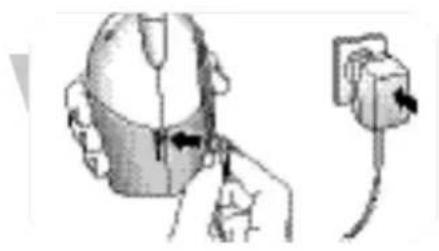
1 Connect the power adapter cord to the power supply jack (DC 9V ⇔ -A-2) of the baby unit. 2 Connect the AC power adapter (A-3) to a wall outlet. → The baby unit is now ready for mains operated use.
Battery operated use
1 Remove the battery compartment cover (A-9) of the baby unit, using a coin. 2 Insert four 1.5V AA batteries, noting the + and - configuration inside the battery compartment (batteries are not supplied, we recommend Philips Alkaline batteries). 3 Close the battery compartment cover (A-9), using a coin.
→ The baby unit is now ready for battery operated use.
Parent unit
The parent unit can be mains or battery operated.
When batteries are installed, you have an automatic backup in case of mains failure.
Mains operated use
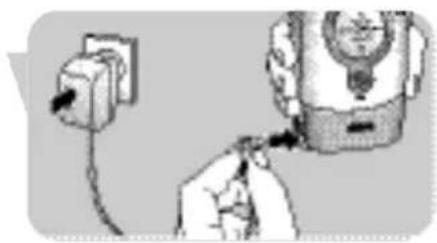
1 Connect the power adapter cord to the power supply jack (DC 9V ⇔ -B-4) of the parent unit. 2 Connect the AC power adapter (B-5) to a wall outlet.
→ The parent unit is now ready for mains operated use.


Getting your baby monitor ready
Battery operated use
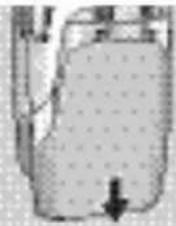
1 Remove the battery compartment cover (B-III) of the parent unit, by sliding down the cover.
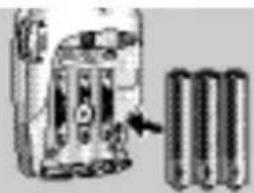
2 Insert three 1.5V AAA batteries, noting the + and - configuration inside the battery compartment (batteries are not supplied, we recommend Philips Alkaline batteries).
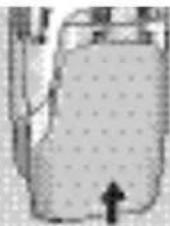
3 Slide the battery compartment cover (B-11) back in place until it clicks into position.
The parent unit is now ready for battery-operated use.
Using your baby monitor
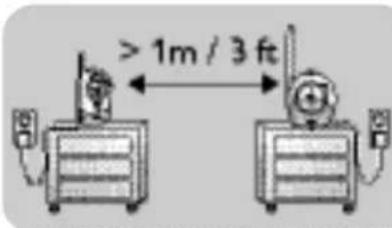
Position both units in the same room to test the connection. Make sure the baby unit is at least 1 meter / 3 feet away from the parent unit.
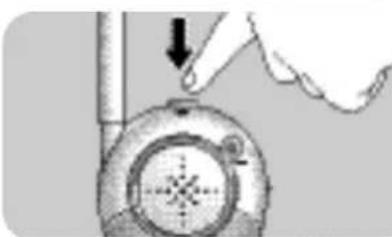
2 Press the ON/OFF button (A-I) to switch on the baby unit.
The POWER light (A-6) lights up green.

3 Switch on the parent unit using the ON/OFF switch (B-9) and adjust the volume to the level you prefer using the VOLUME control (B-9).
The POWER light (B-9) lights up green.
When connection has been established between the units, the LINK light (B-3) on the parent unit lights up green.
Using your baby monitor
4 Position the baby unit at least 1 meter / 3 feet away from your baby.
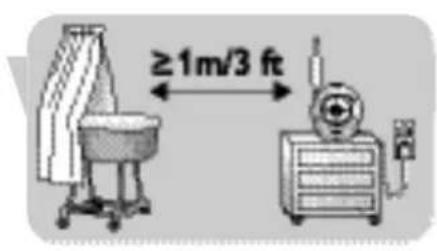
5 Position the parent unit at the desired place within the operating range of the baby unit but at least 1 meter / 3 feet away from the baby unit. For more information on the operating range see 'Technical specifications'.
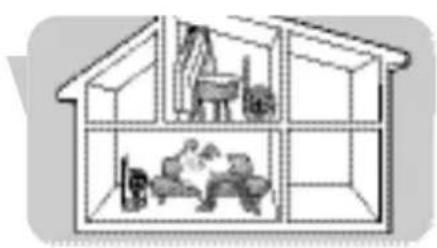
You can now monitor your baby!
Other features
Avoiding interference (channel selection)
Always make sure that the CHANNEL selection switches (A-8, B-7) inside the battery compartments (A-9, B-11) on both units are set to the same position! With the CHANNEL selection switches (A-8, B-7) you can select sixteen different channel positions. If you experience interference from other baby monitors, radio devices, etc., select a different channel.
Open the battery compartment covers (A-9, B-11) of both units.
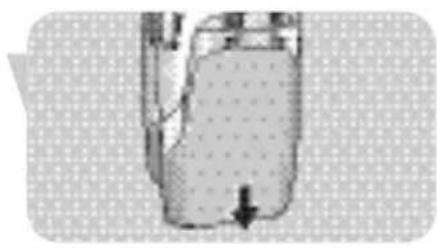
- Parent unit: slide down the cover.
- Baby unit: use a coin.
2 If you are operating the units on battery power, remove the batteries from both units.

Other features
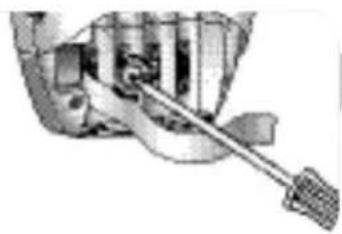
3 Use a small, flat screwdriver to rotate the inner circle of the channel selection switches (A-8, B-7) to the desired position. Make sure both units are set to the same channel.
If you don't experience any interference after testing the connection, close the battery compartment covers (A-9, B-11). If you do experience interference, try switching to another channel.
4 Close the battery compartments.
Adjusting microphone sensitivity
With the microphone sensitivity control (A-7) on the baby unit, you can set the sound coming from the baby unit to the desired level: low, mid, or high. When set to the maximum level, the baby unit monitors all sounds. If no sound is picked up, the baby monitor will not monitor since continuous transmission is prohibited by law. You can only change the microphone sensitivity if the connection between the baby unit and the parent unit is established (when the LINK light (B-3) on the parent unit lights continuously green).
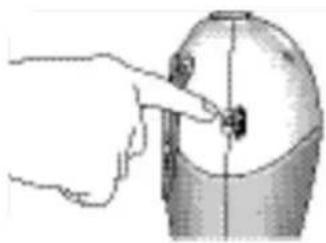
- Use the microphone sensitivity switch (A-7) to adjust the baby unit microphone sensitivity to the desired level. You can use your own voice as a sound reference.
The POWER light (A-6) on the baby unit lights up yellow when a sound is picked up.
Monitoring baby silently
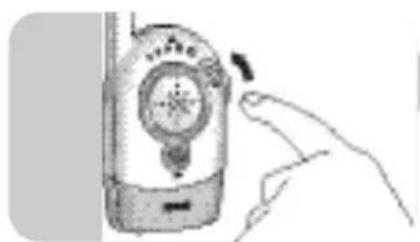
- Use the ON/OFF switch / VOLUME control (B-8) on the parent unit to set the volume to the lowest level. Do not switch off the parent unit completely!
The sound level lights (B-1) on the parent unit visually alert you to baby's sounds. The more sounds your baby makes, the more lights you will see.
When no sound is detected all sound level lights (B-1) will be off.
Switching the LINK alarm on and off
You can switch on the LINK alarm on the parent unit. The LINK alarm will beep when connection between the units is lost.
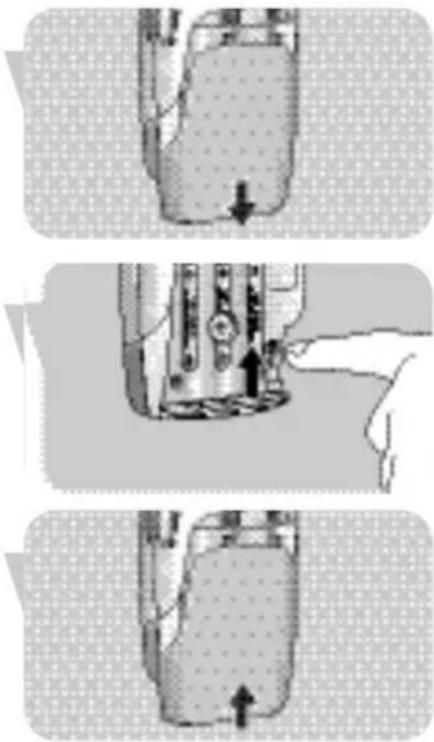
Open the parent unit's battery compartment (B-11) by sliding down the cover. 2 Set the switch (B-10) inside the compartment (B-11) to the ON position. 3 Slide the battery compartment cover (B-11) back in place until it clicks in position.
- To switch off the alarm, set the switch (B-10) to the OFF position.
Connecting / disconnecting the belt clip
If the parent unit is operating on batteries, you can carry it in and around your house, giving you freedom of movement while still monitoring your baby.
Connecting the belt clip
- Insert the little spindle on the rear of the belt clip into the recess on the rear of the parent unit. Turn the belt clip to the left until it clicks in position.

Disconnecting the belt clip
- Turn the belt clip to the right (TURN▶) and take it off.
Problem Possible cause Solution
No sound on parent unit. Volume off or too low. Turn VOLUME control (B-8) on parent unit downwards.
Units out of range. Move parent unit closer to baby unit.
No connection between units. Parent unit out of range of transmitted signal. Move parent unit closer to baby unit.
Units are set to different channels. Set channel selection switches (A-8, B-7) to the same position on both units.
Interference or poor reception. Mobile or cordless phone(s) too close to baby monitor. Move phone(s) away from baby monitor.
Interference from other baby monitors in the neighborhood. Switch both units to another channel using the channel selection switch (A-8, B-7).
Battery power running low. Replace batteries.
Transmitted signal is out of range; e.g. there are too many walls and/or ceilings between baby unit and parent unit. Move parent unit closer to baby unit.
Parent unit located too close to a window and picking up interfering signals from other appliances. Move parent unit away from window.
Problem Possible cause Solution
POWER light (A-6, B-9) does not light. Unit not switched on. Press On/Off button (A-1) or set On/Off switch (B-8) to ON.
AC power adapter (A-3, B-5) not connected to the power supply jack (A-2, B-4). Connect AC power adapter (A-3, B-5) to the DC 9V power supply jack (A-2, B-4).
AC power adapter (A-3, B-5) not connected to the power supply. Connect AC power adapter (A-3, B-5) to a wall outlet.
Batteries low. Replace batteries.
| POWER light (A-6, B-9) is blinking. | Batteries low. Replace batteries. | |
| High pitched noise. | Units too close to each other. | Move parent unit away from baby unit (at least 1 metre / 3 feet). |
| Volume set too high. | Turn ON/OFF switch / VOLUME control (B-8) upwards. | |
| Pick-up from another baby monitor. | Both systems are operating on the same frequency. | Switch channels (A-8, B-7). Make sure both units are set to the same position. |
| LINK light (B-3) flashing red / LINK alarm beeps. | Units are out of range. | Move units closer together. |
| Interference from another baby monitor. | Switch to a different channel (A-8, B-7). | |
| Interference from another FM source. | Remove other FM source. | |
| Question | Answer | |
| Parent unit reacts too slow/late on baby's cry. | Set microphone sensitivity on the baby unit to a higher level and/or move the baby unit closer to the baby (keep minimal distance of 1 meter / 3 feet). | |
| Parent unit reacts too quick on other ambient sounds. | Set microphone sensitivity on the baby unit to a lower level and/or move the baby unit closer to the baby (keep minimal distance of 1 meter / 3 feet). | |
| The link is lost every now and then, sound interruptions etc. | You are probably approaching the outer boundaries of the practical range. Try a different location or reduce the distance slightly. Please note that it takes about 30 seconds each time before a new link is established. |
Technical specifications
| Power supply | - AC power adapter 230V AC, 50 Hz (two included). Output voltage 9V DC, 200mAh. |
| Operating range | - Up to 200 meters / 600 feet in open air. Depending on the surroundings and other disturbing factors this range may be limited. |
| Dry materials Material Loss of thickness range | |
| Wood, plaster, plaster < 30cm / 12" 0-10% cardboard, glass (without metal or wires, no lead) | |
| Brick, plywood < 30cm / 12" 5-35% | |
| Reinforced concrete < 30cm / 12" 30-100% | |
| Metal grids, bars < 1cm / 0.4" 90-100% | |
| Metal, aluminium sheets < 1cm / 0.4" 100% | |
| For wet and moist materials reduction can be as up to 100%. | |
| Operating temperature | 0 °C - 40 °C |
| Transmission frequencies | 40.665 MHz, 40.680 MHz, 40.695 MHz |
Environmental information
Disposal of your old product
Your product is designed and manufactured with high quality materials and components, which can be recycled and reused.
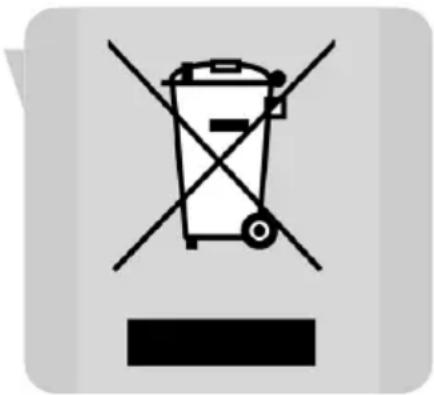
When this crossed-out wheeled bin symbol is attached to a product it means the product is covered by the European Directive 2002/96/EC.
Please inform yourself about the local separate collection system for electrical and electronic products.
Please act according to your local rules and do not dispose of your old products with your normal household waste.
The correct disposal of your old product will help prevent potential negative consequences for the environment and human health.
Maintenance
- Clean the baby monitor with a damp cloth
- Dispose of used batteries in an environmentally friendly manner
- Do not mix old and new batteries or different types of batteries.
- Remove batteries if the baby monitor is not to be used for long periods of time.
- If the batteries are left in the unit when it is powered from the mains, check them for leakage every six months.
Need help?
Online help: www.philips.com
For interactive help, downloads and frequently asked questions
Contact line:
If you have any questions about the SCD464, please contact our helpline for assistance! You can find the number in the separate Guarantee leaflet.
Before you call, please read this manual carefully.
You will be able to solve most of your problems.
You will be asked for:
A description of the problem and when it occurs The type number on the label of your product The date of purchase
A. Baby unit
Philips Baby Care, Taking care together
Technical specifications
40.665 MHz, 40.680 MHz, 40.695 MHz
You can connect the device to the SCD464 and control it with the remote control! You can find the number in the user manual.
We hope this will solve most of your problems.
You will need:
The description of the problem and the solution that was presented. The type number is indicated on the product label or the purchase date.
A. Baby unit
A-1 On/off button A-2 DC 9 V socket for power connection A-3 Adapter A-4 Power plug A-5 Microphone A-6 Power indicator A-7 Microphone sensitivity selector A-8 Channel selector A-9 Battery compartment cover
B. Parent unit
B-1 Sound level indicators B-2 Speaker B-3 Link indicator B-4 DC 9 V socket for power connection B-5 AC adapter B-6 Power plug B-7 Channel selector B-8 On/off button/volume control B-9 Power indicator B-10 Switch for link alarm B-11 Battery compartment cover B-12 Belt clip
Philips Baby Care, Taking care together
Safety information
40.665 MHz, 40.680 MHz, 40.695 MHz
Environmental information
40.665 MHz, 40.680 MHz, 40.695 MHz



- PARENT UNIT
- WHAT ELSE YOU'LL NEED
- CONTENTS
- ILLUSTRATIONS
- LEGEND OF FUNCTIONS
- WELCOME
- GETTING YOUR BABY MONITOR READY
- USING YOUR BABY MONITOR
- OTHER FEATURES
- TROUBLESHOOTING
- FREQUENTLY ASKED QUESTIONS
- TECHNICAL SPECIFICATIONS
- IMPORTANT INFORMATION
- NEED HELP
- PHILIPS BABY CARE, TAKING CARE TOGETHER
- SAFETY INFORMATION
- BABY UNIT
- MAINS OPERATED USE
- BATTERY OPERATED USE
- AVOIDING INTERFERENCE (CHANNEL SELECTION)
- ADJUSTING MICROPHONE SENSITIVITY
- MONITORING BABY SILENTLY
- SWITCHING THE LINK ALARM ON AND OFF
- CONNECTING / DISCONNECTING THE BELT CLIP
- CONNECTING THE BELT CLIP
- DISCONNECTING THE BELT CLIP
- PROBLEM POSSIBLE CAUSE SOLUTION
- ENVIRONMENTAL INFORMATION
- MAINTENANCE
- ONLINE HELP: WWW.PHILIPS.COM
- CONTACT LINE
Brand : PHILIPS
Model : SCD464
Category : Baby monitors