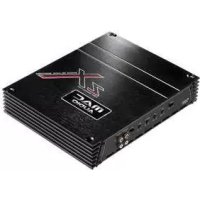
ZX 2000 - Receiver MAC AUDIO - Free user manual and instructions
Find the device manual for free ZX 2000 MAC AUDIO in PDF.



| Product type | 2-channel power amplifier |
| Brand | Mac Audio |
| Model | ZX 2000 |
| Category | Receiver / Amplifier |
| Max output power (stereo, 4 Ohm) | 2 x 220 W |
| Max output power (bridged, 4 Ohm) | 1 x 750 W |
| RMS power (stereo, 4 Ohm) | 2 x 100 W |
| RMS power (stereo, 2 Ohm) | 2 x 140 W |
| Speaker impedance (stereo) | 2 - 8 Ohm |
| Frequency response | 5 - 50 000 Hz (-3 dB) |
| Total harmonic distortion | < 0.05% (1 kHz) |
| Crosstalk attenuation | > 60 dB (1 kHz) |
| Input sensitivity LOW LEVEL | 400 mV - 5 V |
| Input impedance LOW LEVEL | 20 kOhm |
| Low-pass filter | 50-300 Hz, 12 dB/octave |
| High-pass filter | 40-400 Hz, 12 dB/octave |
| Bass Boost | 0...12 dB at 45 Hz |
| Power supply | +12 V (10-14.4 V), negative ground |
| Fuse | 2 x 20 A |
| Dimensions (W x H x D) | 252 x 55 x 290 mm |
| Weight | 3.0 kg |
Frequently Asked Questions - ZX 2000 MAC AUDIO
User questions about ZX 2000 MAC AUDIO
0 question about this device. Answer the ones you know or ask your own.
Ask a new question about this device
Download the instructions for your Receiver in PDF format for free! Find your manual ZX 2000 - MAC AUDIO and take your electronic device back in hand. On this page are published all the documents necessary for the use of your device. ZX 2000 by MAC AUDIO.
USER MANUAL ZX 2000 MAC AUDIO
At the end of the product's useful life, please dispose of it at appropriate co points provided in your country.
The ZX 2000 BLACK EDITION car hi-fi power amplifier will enable you to satisfy your high desound reproduction in your car. With its impressive deep-bass power reserves, low harmonic corneutral reproduction, the ZX 2000 BLACK EDITION takes car hi-fi to new heights. The amplifier characterized by low operating current, rapid switching capabilities and excellent temperature stability Experience and enjoy how this high-tech machine perfectly reproduces magnificent sound.
Please read all of the owner's manual before installing and using the amplifier.
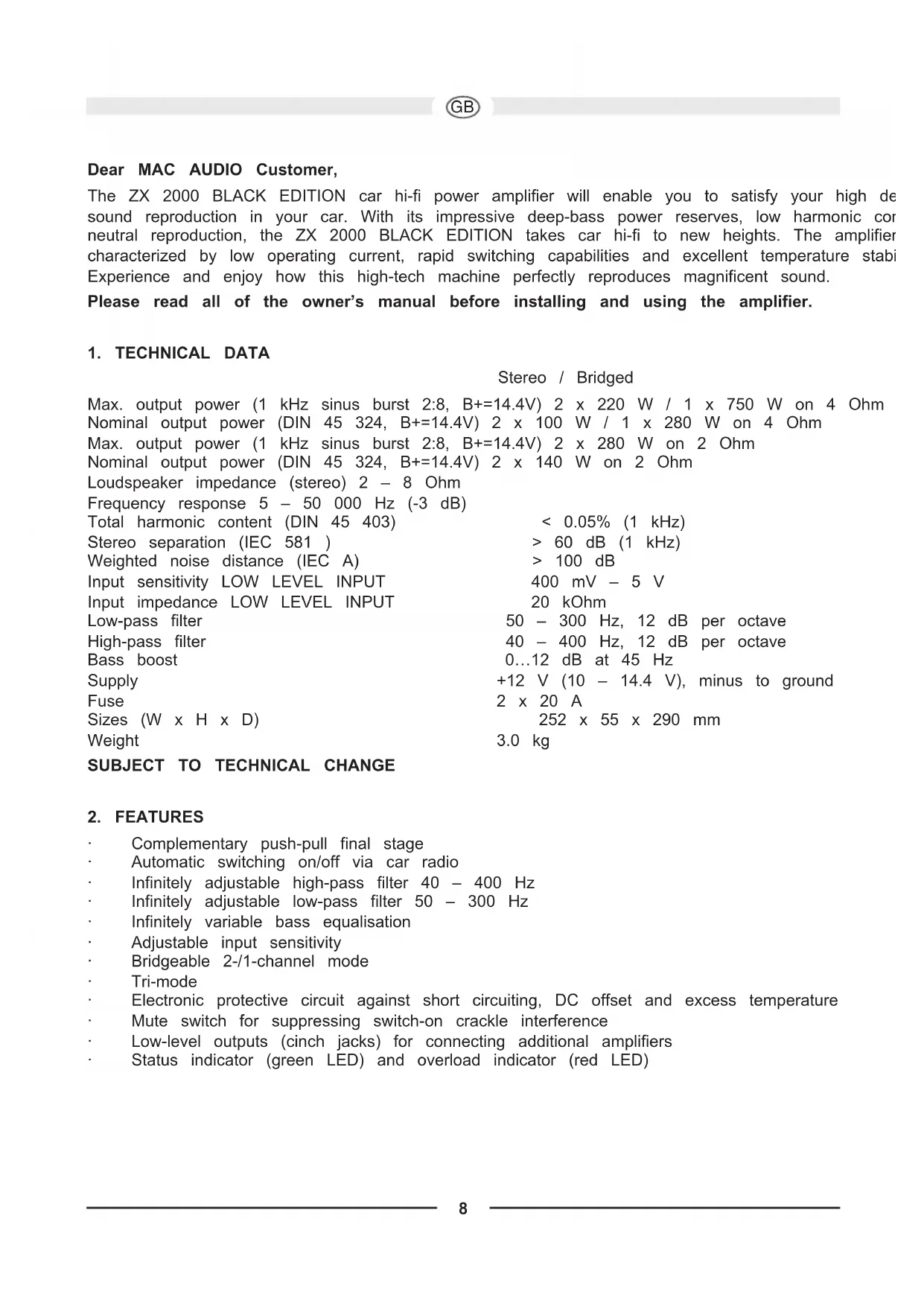
1. TECHNICAL DATA
Stereo / Bridged
Max. output power (1 kHz sinus burst 2:8, B + = 14.4V) 2 x 220 W / 1 x 750 W on 4 Ohm
Nominal output power (DIN 45 324, B + = 14.4V) 2 x 100 W / 1 x 280 W on 4 Ohm
Max. output power (1 kHz sinus burst 2:8, B + = 14.4V) 2 x 280 W on 2 Ohm
Nominal output power (DIN 45 324, B + = 14.4V) 2 x 140 W on 2 Ohm
Loudspeaker impedance (stereo) 2 - 8 Ohm
Frequency response 5 - 50 000 Hz (-3 dB)
Total harmonic content (DIN 45 403) < 0.05% (1 kHz)
Stereo separation (IEC 581 ) >60 dB (1 kHz)
Weighted noise distance (IEC A) >100 dB
Input sensitivity LOW LEVEL INPUT 400~mV- 5 V Input impedance LOW LEVEL INPUT 20~kOhm Low-pass filter 50 - 300~Hz, 12 dB per octave
High-pass filter 40 - 400~Hz, 12 dB per octave
Bass boost 0 12 dB at 45Hz Supply +12V(10 - 14.4V), minus to ground
Fuse 2× 20A Sizes (W x H x D) 252× 55× 290mm Weight 3.0kg
SUBJECT TO TECHNICAL CHANGE
2. FEATURES
- Complementary push-pull final stage
- Automatic switching on/off via car radio
- Infinitely adjustable high-pass filter 40 - 400 Hz
- Infinitely adjustable low-pass filter 50 - 300 Hz
- Infinitely variable bass equalisation
- Adjustable input sensitivity
- Bridgeable 2-/1-channel mode
- Tri-mode
- Electronic protective circuit against short circuiting, DC offset and excess temperature
- Mute switch for suppressing switch-on crackle interference
- Low-level outputs (cinch jacks) for connecting additional amplifiers
- Status indicator (green LED) and overload indicator (red LED)
3. IMPORTANT INSTALLATION INFORMATION
- This appliance may only be connected to a 12 volt system with negative ground.
- The heat radiated when the amplifier is used means that sufficient air circulation is required place of installation. It is very important that the cooler's cooler ribs do not contact any or any surfaces which could impair air circulation. The amplifier may not be installed in s confined spaces or spaces without air circulation (e.g. spare wheel recess or under the va carpeting). Installation in the boot is recommended.
- Install the amplifier in such a way that it is protected as far as possible against vibrations and dirt.
- Make sure that the input/output cables are sufficiently distant from the power supply cables a. otherwise interference may occur.
- Make sure that the fuse and operating elements are accessible after installation.
- The appliance's reliability and performance depend on the quality of installation. Preferably get expert to install the system, particularly if you want to install several loudspeakers or a c multi-way system.
4. CONNECTIONS
4.1 POWER SUPPLY AND AUTOMATIC SWITCHING ON
Important notice: Before commencing the installation, disconnect the plus terminals from car battery in order to prevent short circuits.
The power cabling usually installed in on-board car networks is not sufficient for a power amplifier demands. Make sure that the power lines to GND and to the +12V terminal have been sufficiently specified. A cable cross-section of at least 10mm^2 must be used to connect the battery to the terminals.
First connect the amplifier's GND terminal to the battery's minus pole. It is very important that connection is good. Dirt residues must be carefully removed from the battery's connection point. connection may cause malfunctions or interference noise or distortion.
The +12V amplifier connection must then be connected with a power cable possessing an internal fuse to the battery's plus pole. The fuse must be located close to the battery, the length of the battery's positive pole to the fuse must be less than 60 centimetres for safety reasons. Only if the fuse when all installation work, including the connection of the loudspeakers, has been completely
Now connect the car hi-fi receiver's remote control connection to the amplifier's REM control pad with a cross-section of 0.75mm^2 is sufficient for connecting the amplifier's REMOTE connection to control device.
4.2 AUDIO CABLES
When installing the audio cable between the cinch output of your car receiver and the cinch in amplifier inside your car, the audio and power supply cables should, wherever possible, not be along the same side of the vehicle. We recommend an isolated installation, e.g. routing the port through the cable duct on the left-hand side and the audio cable through the cable duct on the side or vice versa. This reduces interference due to crosstalk into the audio cables.
4.3 LOUDSPEAKER CONNECTIONS
-
In normal operating mode (i.e. one loudspeaker on each individual amplifier channel), the lower terminal resistance is 2 ohm per channel.
In bridging mode (two amplifier outputs combined) the lowest terminal resistance doubles to 4
The impedance in tri-mode may not fall below 2 ohm per channel. -
Never connect the loudspeakers' minus terminals to the vehicle chassis.
- Never connect the +12 V supply voltage to a loudspeaker output as this would destroy the final stage.
If the amplifier is operated with lower terminal resistances or incorrectly used as described both the amplifier and the loudspeakers may be damaged. The warranty becomes void in cases.
5. OPERATING ELEMENTS AND IN/OUTPUTS
5.1 SETTING THE INPUT SENSITIVITY
The input sensitivity may be adapted to any car radio or tape deck. Turn the volume control to its central position and then adjust the input-level control (5) to produce an average medium. This setting usually provides sufficient power reserves at optimum weighted noise voltage.
ATTENTION: only reproduce loud test noises briefly to prevent damaging the loudspeakers.
5.2 LOW-PASS FILTER WITH ADJUSTABLE CROSS-OVER FREQUENCY
If the amplifier is used as a subwoofer amplifier, set the switch (1) to "LPF". Set the desired frequency with the control (3). This makes the filter adaptable to the installed woofer's sound in. The filter's high edge steepness is responsible for the precision reduction of medium and high ranges.
5.3 HIGH-PASS FILTER WITH ADJUSTABLE CROSS-OVER FREQUENCY
If the amplifier is to be used as an amplifier for satellite loudspeakers (mid-range/tweeter loudsp) set switch (1) to "HPF". Set the desired cross-over frequency with the control (2). Only the fre above the set cross-over frequency will then be amplified. This effectively minimizes distortions by excessive membrane movement at low frequencies and small satellite loudspeakers without re the bass level.
5.4 BASS-BOOST
The bass-boost function (4) is used to increase or equalize the lower bass frequencies.
5.5 OUTPUTS FOR CONNECTING ADDITIONAL AMPLIFIERS
The input signal of the LINE INPUT connections L and R (7) is forwarded directly to the LINI and R jacks. The LINE OUT connections allow the use of additional amplifiers without requiring T-plugs and cables.
FIG. 1 POWER SUPPLY / REMOTE SWITCH-ON CONNECTION
(1) Terminal for +12V battery voltage
(2) REM terminal for remote switch-on
(3) GND terminal for the ground, to the battery's minus pole
(4) Battery
(5) Cable fuse
(6) To your car radio's automatic aerial connection
If your car is not equipped with an automatic aerial connection, connect this cable's plus the ignition lock. An on/off switch should be inserted in this case. Make sure that this switch is switched off if the amplifier is not used.
FIG. 2 STEREO MODE
Connect and set the amplifier as shown in Fig. 2 if it is to be controlled with two output channels use two loudspeakers. The high-pass filter must also be activated if the amplifier is also used for loudspeakers. See Chapter 5.3.
(1) To the car radio, left output
(2) To the car radio, right output
(3) Loudspeaker left
(4) Loudspeaker right
FIG. 3 BRIDGE MODE WITH STEREO CAR RADIO
If the amplifier has to generate more power to operate a subwoofer, connect and set it as sh 3. The use of the low-pass filter is described in Chapter 5.2.
(1) To the car radio, left output
(2) To the car radio, right output
(3) Subwoofer
FIG. 4 MONO MODE WITH ONE CAR RADIO WITH SUBWOOFER OUTPUT
(1) To the car radio, subwoofer output
(2) Subwoofer
FIG. 5 OPERATING ELEMENTS AND IN/OUTPUTS
(1) HPF (high-pass filter) / LPF (low-pass filter) / FULL option switch
(2) Cross-over frequency control for the high pass
(3) Cross-over frequency control for the low pass
(4) Bass-boost control
(5) Input level control
(6) Mono-stereo switch
(7) Low-level input
(8) Outputs for connecting additional amplifiers
Ecart signal / bruit (IEC A)
Dimensoes (L x A x P)
Peso
100 dB
400 mV a 5 V
20 kOhm
50 a 300 Hz, 12 dB por oitava
40 a 400 Hz, 12 dB por oitava
0...12 dB com 45 Hz
+12V (10...14,4V), negativo ligado à massa
2x20A
252 x 55 x 290 mm
3,0 kg
RESERVADOS OS DIREitos DE ALTERACOs TECNICAS
2. CHARACTERISTICAS ESPECIALIS
4.3 HÖGTALARANSLUTNINGAR
1. TEXHnueCKNE DAHHbIE
Ctepeo / uee3 nepemblyky
Makc. BixoHna Moochoctb (1 Kt Sinus Burst 2:8, B+=14,4B) 2 x 220 Bt / 1 x 750 Bt K
HomnHaJIbHna BixoHna Moochoctb (DIN 45 324, B+=14,4B) 2 x 100 Bt / 1 x 280 Bt K 4 C
Makc. BixoHna Moochoctb (1 Kt Sinus Burst 2:8, B+=14,4B) 2 x 280 Bt K 2 Om
HomnHaJIbHna BixoHna Moochoctb (DIN 45 324, B+=14,4B) 2 x 140 Bt K 2 Om
PoiHoe cOpOTnbIeHne rPOMKOrOBopnteTJe (cTepeOpexHM) 2 - 8 OM
UactOTnHa XapaKTePncTnka 5 - 50 000 Tc (-3 dB)
O6uN Ko3ΦΦuIeHT HeJIHeIhBy IckaKeHn (DIN 45 403) < 0,05% (1 KtU)
IepexoHoe 3atYxHnE (IEC 581 ) > 60 dB (1 KtU)
OTHOse HnHaI/Shm (IEC A) > 100 dB
UyBCTBnTEbHoctb Ha BxoDe LOW LEVEL INPUT 400 mB - 5 B
BxOHDoe PoiHoe cOpOTnbIeHne LOW LEVEL INPUT 20 kOM
ФиЛьТр HIXHnx YacToT 50 - 300 Tc, 12 d6 Ha OKTaBY
ФиЛьТр ВePxHnx YacToT 40 - 400 Tc, 12 d6 Ha OKTaBY
YcIIeHne Hn3Knx YacToT 0...12 d6 npn 45 Tc
Питанe +12B (10-14,4B), MInHyc Ha Macce
ПрEDoxpaHnTeIb 2 x 20 A
Pa3MepbI (Wx Bx F) 252 x 55 x 290 MM
Bec 3,0 kF
BO3MOXHbI TEXHNUeCKNE N3MEHEHn
2.OCOBEHHHOCTN
-Дононтельны ДыXTаКТьи ВixOДНо KackaI
ABTOMaTHueckoe BKNIOUeHne/BBIKIOUeHne Upe3 aBTOpaDNOpnEMHK
IpaBHO peryInpyeMbIe nIbtpI BepxHnx qactOT 40 do 400 T
IpaBHO perynpyemblc HnBtpbHxHnx qacto 50 do 300 T
Плавно рergyлneyмая Корpeкцянн3кх частOT
Perynpyemar yBCTBNTeNbHOCt Ha BXOJe
Bo3MOxHocTb nepembikahan, 2-/1-kaHaJIbHbI peKIM
TpmoI-peKIM (Tri-Mode)
3neKtpoHHa cxema 3aunTbI OT KopoTKoro 3ambikaHn, CMeueHn NOCTOARHO HapjxHn I neperpeBa
Hemay cxema nna noaBneHn Tpecka npn BkIouehn
BbIXOdbI c Hn3Km ypoBhem nepeKIOueHnra (Cinch-rHe3da) dnnnoKIOueHnra donoNHTeNbHbix ycInnteJIe
- INДикага рекима (3eJIeHbI CBeToIDnOД) И INДиКaTOp NepeRpy3Kn (kpacHbI CBeToIDnOД)
3. BAXHAR INHOPMauN IPED YCTAHOBKoI
3To yctpoiCTBO npedHa3HaueHo nckHouHTeIbHO dny noDKHouEHHa K 12-BoIbTHoN CnCTeme c OTPuCaTeIbHOJ MaccOJ.
BcBra3n C BbIeJIeHHeM TenJa npi OTdAye MOUHOCTH, Ha MeCTe IJN MoHTaXa DOJXHa 6bITb DoCTaToUHAnu CInPKyIaIcH N03dyxa. OueH BaxHo, YTObI OxJAAIOUe pe6pa TENNOOTBOJa H Kacalncb MetaIIuuecko IIIN dpyro NOBepxHOCTn, I3-3a Yero MOrna 6bl 6blb OrpaHneHa CInPKyIaIcH BO3dyxa. Henb3ry UcTaHabNtB yCNIteB B MaNbIX IIIN He BEHTUNpYeMbIX No. (Hanp., B yrIy6IeHnn DnA 3anachoro KOleca IIIN NOD KOBPOBbIM NOKpbITm EABTomO6nJIa). PekomeHdyetcpa3MeIeHne B 6baraxHke.
- YctaHabnBaIte yCnIteIb TaKIM o6pa3OM, Yo6bl OH 6bl XopoOo 3aunue H OT Bn6paun, O nblnn I rpa3n.
Cneinte 3a Tem, TTo6bI Ka6eB BXOa/BbIXoHa HaxoHnCn Ha DocTaTOUHOM pacCToHn OTo Ka6 3JIeKTPoNTaHnra, TaK KaK 3TO MoKeT npNBecTn K o6lyeHHo, Bbl3bBaHOmeMy NOMexn.
Cneinte 3a Tem, TTo6bI npedoxpAHntel n opraHbl ynpabJIeHnOcTabaINCb NocJe MOHTaKa DOCTyINHBIMN.
Pa6ota n HadexxHocTb yCTaHOBKn HaxoJNTcB B npraMo3aBNCIMOCtN OT kauecTba MOHTaJa. 5b bI npednoHTeJIbHo npuyuHb MoHTax CneuaNtCy, OcOBeHNo, ecIn peyb ndet o6 yCTaHOBn HeCKoJIbKIMn rPOMKOROBOpHTeJIaMn IIN O KOMIIeKCHO MHOROCTOPOHHe NCTeMe.
4. BXOДbl N BblXOДbl
4.1 3JIeKTPoPNTAHNE I ABtOMATnKA BKJIIOUcEHnIa
Baxhna ccbIka: PpeXde Yem HauaTb yCTaHOBky Bbl DOJXHbI OTcoEINHTb NOJoxHTbHbI 3axm aBTOMo6nJIbHorO aKKymyJrTopa, YTo6bl N36exKaTb KOpOTKnx 3aMbIKAHN.
O6bUHnA dIy aBtOMo6nIbHO 6OpTOBOcTe N Ka6eNbHa pa3BOkKa RaJIeTcN HeIOCTaTOOH nIa IOTpe6HocTe MoUHO yCInIteTg. CJeInte 3a TeM, YTo6bl pa3MepbI eJKeKTPoPpOBdKn K 3a3eMnIooJIe 1uHe (GND) n K +12B-3axmMy 6bln DoCTaTOHyIM. DJIa CoeINHeHna AKKymJaTOJ 3JIeKTPnueckIMM 3axmAmN yCInIteTg peKOMeHdyETc npImeHrTa Ka6eNb c nonepeuHbIM ceueHHe He Mehee 10 MM².
Chauana Bam Heo6xOIMO coeHNHTb 3axm 3a3emJIOuei xINhbl (GND) ycnHNTeJIc MmHycOB KIeMMo aKKymyIaTopa. OyeH BaxHO yCTaHOBnTb npOHyoe coeINHeHne. KJIeMma akKymJrTOpHO J6atapEn DoJXHa 6bITb TsaTeNbHO OUnSeHa OT 3arpy3HeHn. CBo6OHDoe coeINHeHne MoKeT Bbl3 cbo nn YUMOble nomexn n NCKaJKeHn 3Byka.
Tenepb 3axn m ycnnteHa +12B noDcoednHcTc 3neKtpokabeem c nHTerpnpoBaHHbIM npedoxpaHnteM K noLoXHTelbHO KnEMMe aKKymyIaTopa. IpeoxpaHnteB doJxeh HaxOHTc8 B6n3n akymyIaTopa, DnHa Ka6eN O T noLoXHTelbHOrO noHoc aKKymyIaTopa Do npedoxpaHnte DOJXHa coCTabTb B ceJnx 6e30nacchoCTm MeHee 60 cm. IpeoxpaHnteB doJxeh 6bItb yctAHC NnSb NocLe 3aBepseHnB CEx pa6OT No MOtAxy, BkInouy aNoDKlnOueHne rPOMKOrOBopTeJe.
Tenepb noDcoeHNHtKe Ka6JIb DnCTaHcHOnHHoro ynpabHeHna ABTomObunbHoro HiFi-npneMHnka K rHe ynpabHeHn REM ycInnteHa. IJRA coeHNHeHn MExdy BBOdom REMOTE ycInnteHa n ynpabNHOU yctpoiCTBOM doCTaToueH Ka6JIb C nonepuHbIM ceeyHem 0,75 MM2.
4.2 AYDNOKABENb
Ipn MOHTaxe aydnokabeJe Mexdy BbIXODom Cinch abTomobunbHoro padnOpnpemHnka n BXODom ( ycnnteB aBTOMOBune cneintb 3a Tem, YTO6bl aydnokabeN b TOKOIOBDOJUIN Ka6JIb NO BO3MOXHOCTN He npOKnaDbIBaNNCb Ha ToJ Xe CTOPOHe aBTOMOBnJ. LyuIm peSeHNEM AIBIaTcra OTDeJIbHbIMoHTaxk, T.e. npOKnaJa TOKONDBOJUero Ka6JIaB N JEBOn Ka6JIbHOJ WAXTe N npOK aydnokabeJe B npabOn Ka6JIbHOJ WAXTe HAI HAOBopoT. TaKIM o6pa3OM CHNXaETcR ONaCHOCtB NepeKpeCTHBIX NOMEX 3ByKOBOrO cnHaJa.
4.3 NOДКПIOUЧЕНЯ ГРOMΚΟΓΟΒΟΡΙΕΝΕ
B HopMaIbHOM pexHme pa6oTbi (t.e. no OndHomy rpomKorOBOpntHo Ha oDIN KaHAn yCnInTeJHa HAmMeHbUeep Harpy3OuHoe cOnpOTnBJIeHne paBHO 2 OM Ha oDIN KaHAn.
BpeKIme nepembIyKn (COBmecTHoe BkIIOHeHne IByx BbyXoOB yCNIInTeJIa) HaimMeHbWee Harpy3OuHoe cOnpoTnBJIeHne yDbanBaETcra 4 OM.
BpeKIMe TpIMoI NOHoe cOnpoTnBHe He Hxke 2 OMaOH KaHaJI.
·HnB Koem cIyuae He NpOcEINHryTe MInHycoBbI KJIeMMbl rPOMKOrOBOpHTeTKe K UACCn ABTOM
Hn B Koem clyuae He coeinnay Te HaprrxHne nTaan +12B C bblxOom rpoMkoorOBopnteJ. BeTe K pa3pyuene HbIXoDHorO kackada ycNJNTeJ.
Ecn ycnntelb 3KcnpnyatnpyeTcC 60nee Hn3kM cnpotnbHHeM nHn He npaBnBHO, KaK OncacoHo Bblse, To 3TO MOKeT npuBecTN K NOBpeJdeHIO Kac Camoro ycNITeJI, TAK IN rpomkoROBOpNTeJI. B 3tOM cnuyae rapaHTna nponaadaet.
Congratulations! You have made a wise selection in becoming the owner of a MAC AUDIO HiFi equipment. Due to high quality MAC AUDIO HiFi products have earned an excellent reputation through the western world. And this high quality standard enables us to grant a 2-years warranty for MAC AUDIO HiFi-electronic components.
The equipments are checked and tested continuously during the entire production process. In case you have problems with your MAC AUDIO HiFi equipment, kindly observe the following:
- The guarantee period commences with the purchase of the component and is applicable only to the original owner.
- During the guarantee period we will rectify any defects due to faulty material or workmanship by replacing or repairing the defective part at our discretion. Further claims, and in particular those for price reduction, cancellation of sale, compensation for damages or subsequent damages, are excluded. The guarantee period is not altered by the fact that we have carried out guarantee work.
- Unauthorized tampering with the equipment will invalidate this guarantee.
- Consult your authorized dealer first, if guarantee service is needed. Should it prove necessary to return the component to the factory, please insure that the component is packed in original factory packing in good condition - the quality control card has been filled out and enclosed with the component - your enclose your receipt as proof of purchase.
- Excluded from the guarantee are: - Illuminates - Shipping damages, either readily apparent or concealed (claims for such damages must be lodged immediately with forwarding agent, the railway express office or post office). - Scratches in cases, metal components, front panels, etc. (You must notify your dealer directly of such defects within three days of purchase.) - Defects caused by incorrect installation or connection, by operation errors (see operating instructions), by overloading or by external force. - Equipments which have been repaired incorrectly or modified or where the case has been opened by persons other than us. - Consequential damages to other equipments.
- Reimbursement of cools, without our prior consent, when repairing damages by third parties.
F
Toutes nos félicitations!
Name and address of the dealer/stamp
Käufer/Customer
Name/Name
Straße/Street
PLZ, Ort/City
Land/Country
Kaufdatum/buying date
No warranty without receipt!
MAC
AUDIO
Lise-Meitner-Str. 9 · D-50259 Pulheim · Germany
Tel. +49 (0) 2234 / 807 - 0 • Fax +49 (0) 2234 / 807 - 399
Internet: http://www.mac-audio.de



- TECHNICAL DATA
- SUBJECT TO TECHNICAL CHANGE
- FEATURES
- IMPORTANT INSTALLATION INFORMATION
- CONNECTIONS
- POWER SUPPLY AND AUTOMATIC SWITCHING ON
- AUDIO CABLES
- LOUDSPEAKER CONNECTIONS
- OPERATING ELEMENTS AND IN/OUTPUTS
- SETTING THE INPUT SENSITIVITY
- LOW-PASS FILTER WITH ADJUSTABLE CROSS-OVER FREQUENCY
- HIGH-PASS FILTER WITH ADJUSTABLE CROSS-OVER FREQUENCY
- BASS-BOOST
- OUTPUTS FOR CONNECTING ADDITIONAL AMPLIFIERS
- 1 POWER SUPPLY / REMOTE SWITCH-ON CONNECTION
- 2 STEREO MODE
- 3 BRIDGE MODE WITH STEREO CAR RADIO
- 4 MONO MODE WITH ONE CAR RADIO WITH SUBWOOFER OUTPUT
- 5 OPERATING ELEMENTS AND IN/OUTPUTS
- RESERVADOS OS DIREitos DE ALTERACOs TECNICAS
- CHARACTERISTICAS ESPECIALIS
- HÖGTALARANSLUTNINGAR
- TEXHnueCKNE DAHHbIE
- BO3MOXHbI TEXHNUeCKNE N3MEHEHn
- 2.OCOBEHHHOCTN
- BAXHAR INHOPMauN IPED YCTAHOBKoI
- BXOДbl N BblXOДbl
- 3JIeKTPoPNTAHNE I ABtOMATnKA BKJIIOUcEHnIa
- AYDNOKABENb
- NOДКПIOUЧЕНЯ ГРOMΚΟΓΟΒΟΡΙΕΝΕ
- Toutes nos félicitations!
- Käufer/Customer
Brand : MAC AUDIO
Model : ZX 2000
Category : Receiver