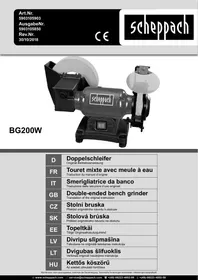
BG200W - Grinding wheel SCHEPPACH - Free user manual and instructions
Find the device manual for free BG200W SCHEPPACH in PDF.

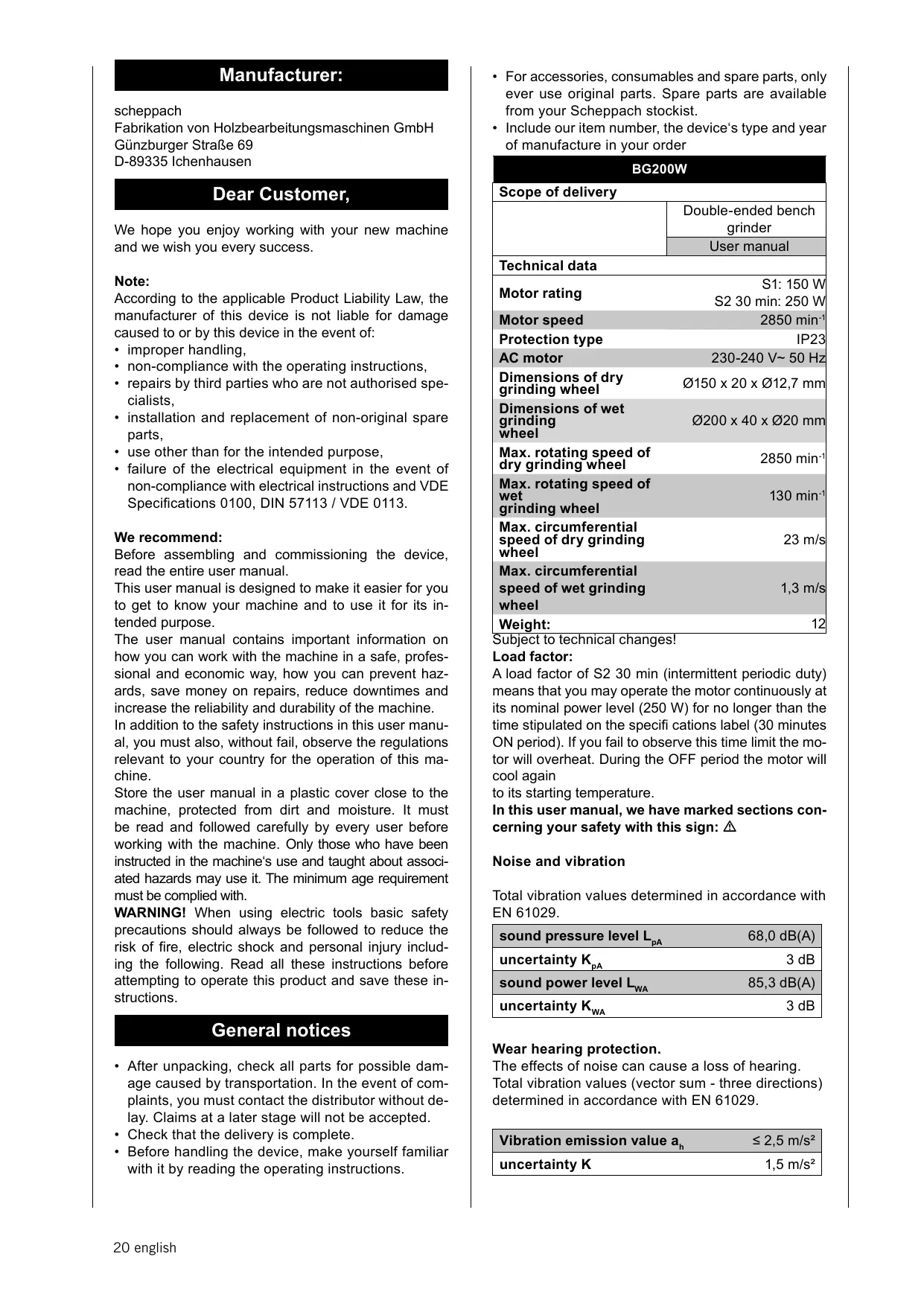


| Brand | Scheppach |
| Model | BG200W |
| Product type | Combined bench grinder (dry and wet) |
| Motor power S1 | 150 W |
| Motor power S2 30 min | 250 W |
| Power supply | 230-240 V~ 50 Hz |
| Motor rotation speed | 2850 min⁻¹ |
| Max. speed dry grinding wheel | 23 m/s |
| Max. speed wet grinding wheel | 1.3 m/s |
| Dimensions dry grinding wheel | Ø150 x 20 x Ø12.7 mm |
| Dimensions wet grinding wheel | Ø200 x 40 x Ø20 mm |
| Protection type | IP23 |
| Weight | 12 kg |
| Main functions | Dry grinding, wet sharpening, roughing and finishing of metals and plastics |
| Safety | Protective visor, spark guard, adjustable tool rest, automatic overload shut-off |
| Maintenance and cleaning | Keep ventilation openings clean, regularly check the cable and plug |
| Wear parts | Grinding wheels, carbon brushes, V-belts |
| Repairability | Repairs reserved for a qualified electrician, use only original parts |
| General information | Manual available in several languages, net weight 12 kg, max. admissible housing temperature 80°C |
Frequently Asked Questions - BG200W SCHEPPACH
User questions about BG200W SCHEPPACH
0 question about this device. Answer the ones you know or ask your own.
Ask a new question about this device
Download the instructions for your Grinding wheel in PDF format for free! Find your manual BG200W - SCHEPPACH and take your electronic device back in hand. On this page are published all the documents necessary for the use of your device. BG200W by SCHEPPACH.
USER MANUAL BG200W SCHEPPACH
We hope you enjoy working with your new machine and we wish you every success.
Note:
According to the applicable Product Liability Law, the manufacturer of this device is not liable for damage caused to or by this device in the event of:
- improper handling,
- non-compliance with the operating instructions,
- repairs by third parties who are not authorised speciaIstists,
- installation and replacement of non-original spare parts,
- use other than for the intended purpose,
- failure of the electrical equipment in the event of non-compliance with electrical instructions and VDE Specifications 0100, DIN 57113 / VDE 0113.
We recommend:
Before assembling and commissioning the device, read the entire user manual.
This user manual is designed to make it easier for you to get to know your machine and to use it for its intended purpose.
The user manual contains important information on how you can work with the machine in a safe, professional and economic way, how you can prevent hazards, save money on repairs, reduce downtimes and increase the reliability and durability of the machine.
In addition to the safety instructions in this user manual, you must also, without fail, observe the regulations relevant to your country for the operation of this machine.
Store the user manual in a plastic cover close to the machine, protected from dirt and moisture. It must be read and followed carefully by every user before working with the machine. Only those who have been instructed in the machine's use and taught about associated hazards may use it. The minimum age requirement must be complied with.
WARNING! When using electric tools basic safety precautions should always be followed to reduce the risk of fire, electric shock and personal injury including the following. Read all these instructions before attempting to operate this product and save these instructions.
General notices
- After unpacking, check all parts for possible damage caused by transportation. In the event of complaints, you must contact the distributor without delay. Claims at a later stage will not be accepted.
- Check that the delivery is complete.
-
Before handling the device, make yourself familiar with it by reading the operating instructions.
-
For accessories, consumables and spare parts, only ever use original parts. Spare parts are available from your Scheppach stockist.
- Include our item number, the device's type and year of manufacture in your order
BG200W
| Scope of delivery | |
| Double-ended bench grinder | |
| User manual | |
| Technical data | |
| Motor rating | S1: 150 W S2 30 min: 250 W |
| Motor speed | 2850 min-1 |
| Protection type | IP23 |
| AC motor | 230-240 V~ 50 Hz |
| Dimensions of dry grinding wheel | Ø150 x 20 x Ø12,7 mm |
| Dimensions of wet grinding wheel | Ø200 x 40 x Ø20 mm |
| Max. rotating speed of dry grinding wheel | 2850 min-1 |
| Max. rotating speed of wet grinding wheel | 130 min-1 |
| Max. circumferential speed of dry grinding wheel | 23 m/s |
| Max. circumferential speed of wet grinding wheel | 1,3 m/s |
| Weight: | 12 |
Subject to technical changes!
Load factor:
A load factor of S2 30 min (intermittent periodic duty) means that you may operate the motor continuously at its nominal power level (250 W) for no longer than the time stipulated on the specific cations label (30 minutes ON period). If you fail to observe this time limit the motor will overheat. During the OFF period the motor will cool again
to its starting temperature.
In this user manual, we have marked sections concerning your safety with this sign:
Noise and vibration
Total vibration values determined in accordance with EN 61029.
| sound pressure level LpA | 68,0 dB(A) |
| uncertainty KpA | 3 dB |
| sound power level LWA | 85,3 dB(A) |
| uncertainty KWA | 3 dB |
Wear hearing protection.
The effects of noise can cause a loss of hearing. Total vibration values (vector sum - three directions) determined in accordance with EN 61029.
| Vibration emission value ah | ≤ 2,5 m/s2 |
| uncertainty K | 1,5 m/s2 |
The specified vibration value was established in accordance with a standardized testing method. It may change according to how the electric equipment is used and may exceed the specified value in exceptional circumstances;
The specified vibration value can be used to compare the equipment with other electric power tools.
The specified vibration value can be used for initial assessment of a harmful effect.
Reduce noise generation and vibration to a minimum!
- Use only equipment that is in perfect condition.
- Maintain and clean the equipment regularly.
- Adopt your way of working to the equipment.
- Do not overload the equipment.
- Have the equipment checked if necessary.
- Switch off the equipment when not in use.
General safety instructions
for working with electrical devices
Safety notice: When working with power tools, you must always comply with basic safety measures in order to keep the risk of fire, electric shock and personal injuries to a minimum.
- Provide good lighting in the working area.
- Guard against electric shock. Avoid bodily contact with earthed parts (e.g. pipes, radiators, cookers and refrigerators).
- Keep other persons away. Do not allow other persons (particularly children) to touch the electric tool or the extension cable. Keep other persons away from your work area.
- Keep unused electric tools in a safe place. Unused electric tools should be kept in a dry, high or locked place.
- Do not overload your electric tool. It will work better and safer when used within its quoted capacity range.
- Use the right electric tool. Do not use any low powered machines for heavy-duty work. Never
- use the electric tool for purposes other than that for which it is designed. For example, do not use a hand-held circular saw to lop off branches or cut down trees.
- Rubber gloves and non-slip shoes are recommended when working outdoors.
- Also use a dust mask when working on dusty jobs.
- Follow the instructions for changing mounted tools.
- Check your extension cables regularly and replace them if damaged.
- Keep handles dry, clean and free from oil and grease.
- Always remove keys and wrenches after use. Before switching on the electric tool, make sure that all keys and wrenches have been removed from the tool.
- When using an extension cable outdoors. When working outdoors, use only extension cables that are approved for outdoor use.
- Be alert at all times. Concentrate on what you are doing. Use common sense when working. Never use the electric tool when you are distracted.
- Always check the machine, the power cable and the plug before use. Only ever use the machine if it is in perfect, undamaged condition.
Damaged parts are to be repaired or replaced immediately by a qualified electrician.
- Always pull the plug out of the power socket before carrying out any work on the machine, before changing the grinding tool and in periods of non-use.
- Always run the power cable away from the back of the machine to guard it from damage.
- Keep the machine in a safe place and out of the reach of children.
- It is prohibited to use the machine on asbestos materials.
- Please note the accident prevention regulations in force in your country.
- Use only original spare parts.
- Repairs are to be carried out by qualified electricians only.
- The level of noise at the workplace may exceed 85 dB(A). In this case you will need to introduce noise protection measures for the user. The noise produced by this electric tool is measured in accordance with IEC 59 CO 11, IEC 704, DIN 45635 Part 21, NFS 31-031 (84/537/EEC).
- Make sure of your footing. Avoid abnormal working positions.
- Keep electric tools out of the rain. Never use electric tools in wet or damp conditions, and never use them near inflammable liquids.
- Keep the power cable safe from damage. Oil, solvent and sharp edges can damage cables.
- Keep your workplace tidy.
- Make sure the power switch is off before inserting the plug in the socket.
- Wear suitable clothing. Never wear loose-fitting clothes or jewelry. Use a hair-net on long hair.
- For your own safety, use only the manufacturer's accessories and attachments.
- Always wear safety goggles, safety gloves and ear-protectors on grinding, brushing and cutting jobs.
- Check that the speed marked on the grinding wheel is the same as or higher than the grinder's rated speed.
- Make sure that the dimensions of the grinding wheel are suitable for the grinder.
- It is essential to store and handle grinding wheels in accordance with the manufacturer's instructions.
- Each time before using a grinding wheel, check it carefully. Never use a grinding wheel which is broken, cracked or damaged in any other way.
- Make sure that the grinding tools are mounted in accordance to the Manufacturers instructions.
- If backing layers are supplied with or stipulated for the grinding wheels, make sure they are used.
- Before beginning with your work, make sure that the grinding wheel is correctly mounted and secured. Allow the tool to run in a safe position for 5 minutes in idle mode. Stop the tool immediately if notable vibrations develop or if you discover any defects. In this case, examine the machine to find the cause of the trouble.
- Never use the grinder without the supplied hood guard.
- Never use a separate reducer sleeve or adapter to mount grinding wheels with too large a hole.
- Make sure that no danger results from any sparks produced during use, e.g. injury to persons or ignition of flammable substances.
Always wear safety goggles and ear-protectors. Use other personal safety items such as gloves, an apron and a helmet wherever necessary.
- Please note that the workpiece becomes hot during use.
Caution! Risk of burns!
Allow the workpiece to cool. Some materials become glowing hot when subjected to grinding. On lengthy jobs, interrupt your work and allow the workpiece to cool.
- Use no coolant or the like. The wet-and-dry grinder is a multi-function tool for the rough and precision grinding of metals, plastics and other materials using a selection of grinding wheels. The machine must only be used for its intended purpose!
- Even if the machine is used as intended, certain residual risk factors cannot be completely eliminated. The following hazards may arise in connection with the machine's construction and layout:
- Contact with the grinding wheel where it is not covered.
- Catapulting of parts from damaged grinding wheels.
- Catapulting of workpieces and parts of workpieces from the machine.
- Damage to hearing if ear-muffs are not used as necessary.
Special safety instructions
- Each time before you begin to work with the grinding machine, carry out an acoustic test on its grinding wheel (if a grinding wheel is in good condition it will produce a clear tone when tapped, e.g. with a plastic hammer). It is also important to perform this test when fitting new grinding wheels (risk of damage in transit). Always have the machine run in idle mode for a test period of at least 5 minutes. Leave the danger zone for this period.
- Use only grinding wheels which are marked with data specifying the manufacturer, type of bonding, dimensions and permissible rpm.
- Keep grinding wheels in a dry place where the temperature is as constant as possible.
- Use only the supplied clamping flanges to mount the grinding wheels.
- The clamping flanges used to mount the grinding wheels must be of identical size and format. Backing layers between the clamping flange and the grinding wheel must be made of elastic materials, e.g. rubber, soft board, etc.
- It is prohibited to enlarge the mounting hole in a grinding wheel by re-drilling.
- The workpiece supports and the adjustable upper guards must always be positioned as close as possible to the grinding wheel (max. gap 3 mm).
-
Never use a grinding wheel without a safety guard. Make sure that the following distances are not exceeded:
-
workpiece support / grinding wheel: max. 2 mm
-
safety guard / grinding wheel: max. 2 mm
-
The guard holder, workpiece support and transparent guard must all be fitted before you use the double grinder.
- Always pull out the power plug before changing a grinding wheel.
$$ \varnothing 1 5 0 = 2 3 \mathrm {m} / \mathrm {s} $$
$$ \varnothing 1 5 0 = 1, 3 \mathrm {m} / \mathrm {s} $$
- The maximum peripheral speed of the dry grinding wheel is:
- The maximum peripheral speed of the wet grinding wheel is:
- Maximum permissible motor housing temperature: 80^
- Fill the black water tank of the fine grinding wheel with water up to the shaft axle.
- Before starting work firmly screw the grinder to the workbench etc. using the 4 mounting holes in the base plate.
- Adjust the spark deflector periodically in order to compensate the wear of the wheel. Please note that the distance between the spark deflector and the wheel is to be kept as small as possible and should in no case exceed 2mm .
- The grinding wheel must be replaced at the latest when the spark deflector and the workpiece support can no longer be set a maximum distance of 2 mm from the grinding wheel.
- Use only grinding wheels that are recommended by the manufacturer which are marked with a peripheral speed that is equal or greater than the speed shown on the rating plate of the electric tool
- When the grinding wheels are blocked due to abnormal feed force or a jammed work piece during grinding, turn the machine off and disconnect it from power supply. Remove the work piece and ensure that both grinding wheels runs free. Turn the machine on and start new grinding operation with reduced feed force.
Warning! This electric tool generates an electromagnetic field during operation. This field can impair active or passive medical implants under certain conditions. In order to prevent the risk of serious or deadly injuries, we recommend that persons with medical implants consult with their physician and the manufacturer of the medical implant prior to operating the electric tool.
Installation
Operating elements of your double-ended bench grinder (Fig. 1)
1 Safety screen
2 Spark protection
3 Grinding wheel (grit size 60)
4 Tool rest
5 Wet grinder (grit size 80)
6 Grinding wheel guard
7 Hole for work bench attachment
8 Main switch (On/Off)
9 Container for cooling water
Assembly
Safety notice! Connect the device only after completing all assembly and adjustment work and reading and understanding the user manual and safety instructions.
Tool rests Fig 1./No. 4
Tighten the tool rest (4) on the grinding wheel guard (6) with a knurled-head screw.
The gap between the grinding wheel and the tool rest should be set to a maximum of 2mm .
Spark protection (Fig. 2)
Attach the spark protection with a cross-head screw and washer to the grinding wheel guard. The gap to the grinding wheel should be a maximum of 2 mm.
Safety screen (Fig. 3, Fig. 4)
Attach the safety screen to the clamping plate with 2 cross-head screws M4, washers and hex-nuts.
The bracket is inserted into the clamping plate and clamped down with the round-head screw M6 with washer and nut.
Screw the complete unit to the grinding wheel guard with U bracket, hex-nut M8 and washer.
The guard can be adjusted appropriately so that the user's eyes are protected during grinding.
Electric connection
The installed electric motor is connected and operational.
The connection complies with relevant VDE and DIN stipulations.
The customer's mains connection as well as the extension lead used must comply with these provisions. Installations, repairs and maintenance on the electrical installation may be carried out by an expert only.
Important notices
If there is a motor overload, it will turn off automatically. After a cool-down period (timing varies), the motor can be turned on again.
Operating instructions
You must observe the following points before commissioning the double-ended bench grinder:
- Activate the main switch. Wait until the grinding wheel has reached its maximum speed. Then you can start grinding.
- Hold the work piece firmly on the tool rest and move it slowly and steadily towards the grinding wheel.
- Grinding can lower the speed of the grinding wheel. Reduce the pressure a little until the wheel has returned to its full speed.
WARNING:
- Small work pieces should be held with pliers or a similar tool.
- Only ever grind on the face of the grinding wheel, never on the sides.
- As most materials get hot during grinding, you must be very careful with the work piece.
Working with the wet grinder
1 Put water into the water container.
2 Turn the machine on and leave it running until the grinding wheel is completely wet.
3 Grind the tool.
4 Empty the water container after grinding. The drain plug is located underneath the water container.
Note! If the grinding wheel has been in the water for a lengthy period, distortion can occur and the grinding wheel may no longer rotate smoothly.
Replacing the grinding wheel
WARNING: : In order to prevent injury by accidentally starting the double-ended bench grinder, the device must be turned off before replacing the grinding wheel (switch position „0“) and the power plug disconnected from the socket.
- Loosen the spark protection and safety screen and pull them out as much as possible but do not remove them.
- Loosen the tool rest and pull it out as much as possible.
- Remove the screws and pull off the end plate.
- Remove the outer flange and the old grinding wheel, then attach the new grinding wheel.
Note:
- Do not remove the cardboard discs attached to the sides of the new grinding wheel because they aid the secure grip of the flange against the grinding wheel.
-
Check the new grinding wheel for cracks or other visible damage and dispose of it if applicable.
-
Re-attach the flange and nut.
- Do not tighten the nut too much with a spanner because the grinding wheel may break.
- Attach the end plate again.
- Adjust the tool rest, spark protection and safety screen again according to the assembly instructions.
- Never sharpen or grind anything made of aluminum.
- Never sharpen or grind anything which cannot be held correctly because of the size.
Replacing the wet grinder wheel (Fg. 5)
1 Drain the water (A).
2 Loosen the 2 cross-head screws (B).
3 Loosen the hex-nut (C).
4 Push the guard up and remove it.
5 Loosen the hex-nut, remove the flange and grinding wheel (D), attach the new grinding wheel and secure it again. Re-attach the guard.
Service information
Please note that the following parts of this product are subject to normal or natural wear and that the following parts are therefore also required for use as consumables.
Wear parts*: grinding medium, carbon brushes, sharpening wheel, angle gauge, v-belt
- Not necessarily included in the scope of delivery!
Intended use
The machine complies with the relevant EC Machine Guideline.
- The manufacturer's stipulations concerning safety, work and maintenance as well as the measurements specified in Technical data, must be complied with.
-
The relevant accident prevention stipulations and other widely recognised safety rules must be observed.
-
The machine may only be used, maintained or repaired by expert personnel who are familiar with it and its dangers. Unauthorised changes to the machine negate the manufacturer's liability for damages resulting from this.
- The machine may only be used with the manufacturer's original accessories and original tools.
- Every use beyond that is deemed as not intended. The manufacturer is not liable for damage resulting from this; the risk lies exclusively with the user.
- Please note that our equipment has not been designed for use in commercial, trade or industrial applications. Our warranty will be voided if the equipment is used in commercial, trade or industrial businesses or for equivalent purposes.
Residual risks
The machine has been built according to the latest technology and recognised safety rules. However, there is still a chance of residual risks whilst working.
- Risk of injury to fingers and hands from the rotating grinding wheel during incorrect handling or placing of the work piece to be ground.
- Risk of injury from ejected work pieces during incorrect clamping or handling.
- Electrical hazards when unsuitable electric connections are used.
- Furthermore, despite all measures taken, residual risks can occur that are not obvious.
- Residual risks can be minimised by complying with the safety notices and the intended use as well as the operating instructions overall.
Transport
Unplug the machine!
Carry the equipment by the left and right grinding wheel cover.
When reassembling the equipment proceed as described
under section "Assembly", if necessary.
Disposal and recycling
The equipment is supplied in packaging to prevent it from being damaged in transit. The raw materials in this packaging can be reused or recycled. The equipment and its accessories are made of various types of material, such as metal and plastic. Defective components must be disposed of as special waste. Ask your dealer or your local council.
Old devices must not be disposed of with household waste!

This symbol indicates that this product must not be disposed of together with domestic waste in compliance with the Directive (2012/19/EU) pertaining to waste electrical and electronic
equipment (WEEE). This product must be disposed of at a designated collection point. This can occur, for example, by handing it in at an authorised collecting point for the recycling of waste electrical and electronic equipment.
Improper handling of waste equipment may have negative consequences for the environment and human health due to potentially hazardous substances that are often contained in electrical and electronic equipment. By properly disposing of this product, you are also contributing to the effective use of natural resources. You can obtain information on collection points for waste equipment from your municipal administration, public waste disposal authority, an authorised body for the disposal of waste electrical and electronic equipment or your waste disposal company.
Výrobce:
scheppach