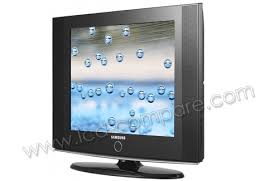
LE-20S81B - TV SAMSUNG - Free user manual and instructions
Find the device manual for free LE-20S81B SAMSUNG in PDF.



User questions about LE-20S81B SAMSUNG
0 question about this device. Answer the ones you know or ask your own.
Ask a new question about this device
Download the instructions for your TV in PDF format for free! Find your manual LE-20S81B - SAMSUNG and take your electronic device back in hand. On this page are published all the documents necessary for the use of your device. LE-20S81B by SAMSUNG.
USER MANUAL LE-20S81B SAMSUNG
Owner's Instructions
Before operating the unit, please read this manual thoroughly, and retain it for future reference.
ON-SCREEN MENUS
PC DISPLAY
TELETEXT
Register your product at www.samsung.com/global/register
Record your Model and Serial number here for future reference.
- Model
- Serial No.
Precautions When Displaying a Still Image
A still image may cause permanent damage to the TV screen.
Do not display a still image on the LCD panel for more than 2 hours as it can cause screen image retention.
This image retention is also known as "screen burn"
To avoid such image retention, reduce the degree of brightness and contrast of the screen when displaying a still image.
-
Watching the LCD TV in 4:3 format for a long period of time may leave traces of borders displayed on the left, right and center of the screen caused by the difference of light emission on the screen. Playing a DVD or a game console may cause a similar effect to the screen. Damages caused by the above effect are not covered by the Warranty.
-
Displaying still images from Video games and PC for longer than a certain period of time may produce partial after-images.
To prevent this effect, reduce the 'brightness' and 'contrast' when displaying still images.
Contents
CONNECTING AND PREPARED YOUR TV
List of Parts. 2
Installing the Stand 2
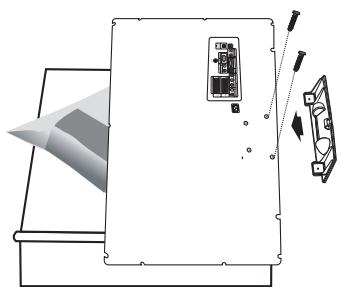
Installing the Wall Mount Kit 2
Viewing the Control Panel 3
Viewing the Connection Panel. 4
Viewing the Remote Control. 5
Installing Batteries in the Remote Control 6
Switching On and Off 6
Placing Your Television in Standby Mode.. 6
Plug & Play 6
SETTING THE CHANNELS
Storing Channels Automatically. 7
Storing Channels Manually. 8
Editing the Channels 9
Sorting the Stored Channels 9
Assigning Channels Names 10
Fine Tuning Channel Reception 10
SETTING THE PICTURE
Changing the Picture Standard 11
Adjusting the Custom Picture 11
Changing the Colour Tone 12
Adjusting the Colour Control 12
SETTING THE SOUND
Changing the Sound Standard 13
Adjusting the Volume Automatically. 13
Connecting headphones. 13
SETTING THE TIME
Setting and Displaying the Current Time 14
Setting the Sleep Timer 14
Switching the Television On and Off Automatically...15
SETTING THE OTHERS
Choosing Your Language 15
Setting the Blue Screen Mode. 16
Selecting the Source 16
Editing the Input Source Names. 16
USING THE TELEXT FEATURE
Teletext Decoder 17
Displaying the Teletext Information. 17
Selecting a Specific Teletext Page 18
Using Fastext to Select a Teletext Page 18
Storing Teletext Pages 18
SETTING THE PC
Setting up Your PC Software (Based on Windows XP). 19
Display Modes 19
Setting the PC 20
RECOMMENDATIONS FOR USE
Troubleshooting: Before Contacting Service Personnel. 21
Technical and Environmental Specifications 21
Symbol

Press

Important

Note

One-Touch Button
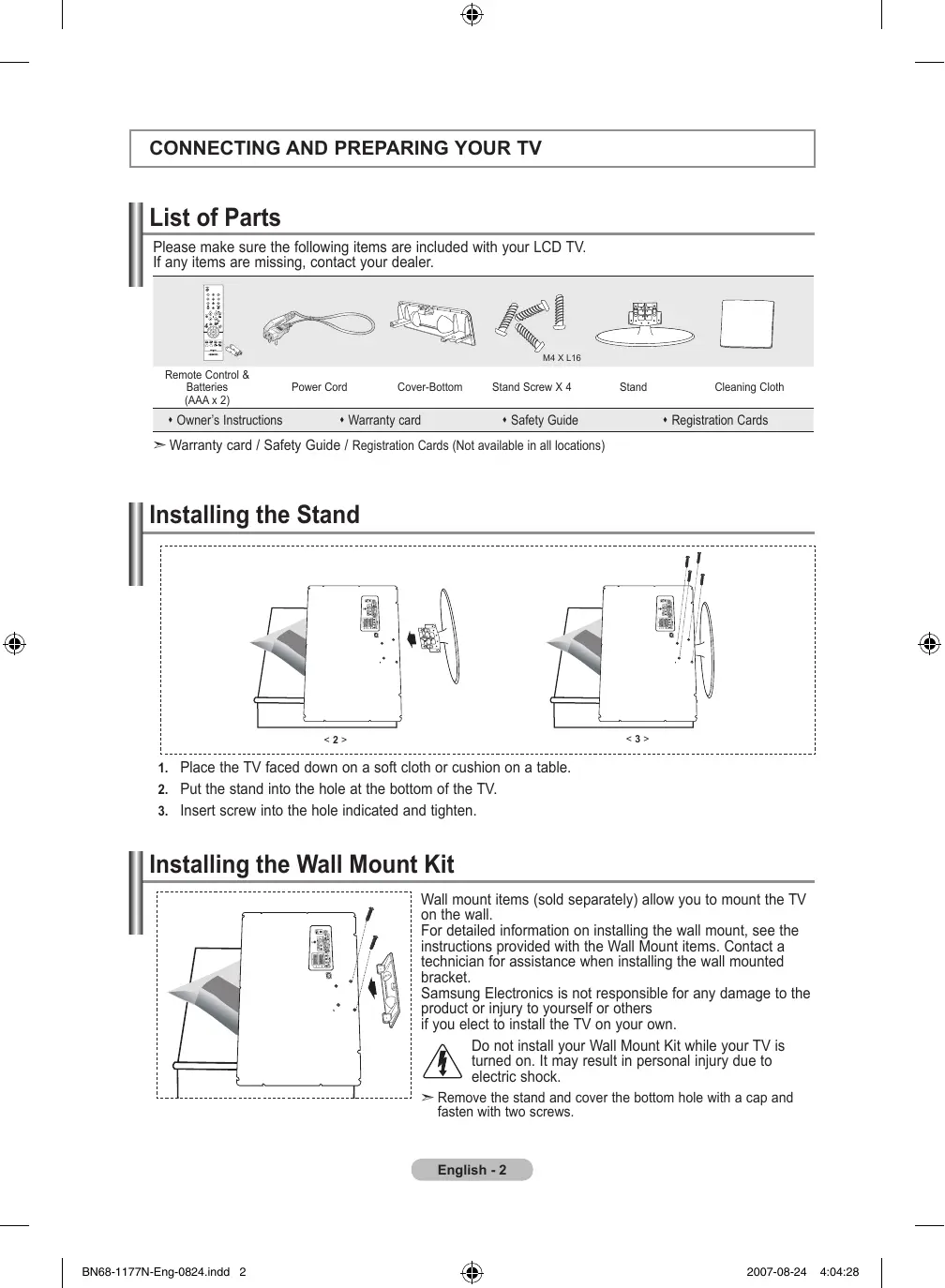
List of Parts
Please make sure the following items are included with your LCD TV. If any items are missing, contact your dealer.
| Remote Control & Batteries (AAA x 2) | Power Cord | Cover-Bottom | Stand Screw X 4 | Stand | Cleaning Cloth |
| • Owner's Instructions | • Warranty card | • Safety Guide | • Registration Cards | ||
Warranty card / Safety Guide / Registration Cards (Not available in all locations)
Installing the Stand
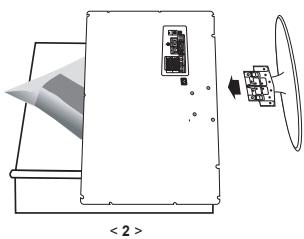
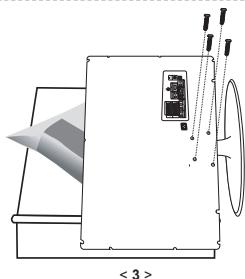
- Place the TV faced down on a soft cloth or cushion on a table.
- Put the stand into the hole at the bottom of the TV.
- Insert screw into the hole indicated and tighten.
Installing the Wall Mount Kit
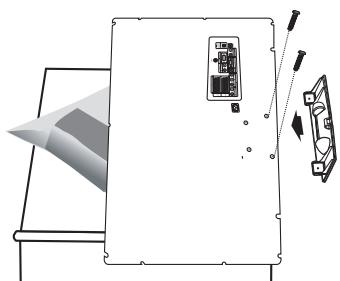
Wall mount items (sold separately) allow you to mount the TV on the wall.
For detailed information on installing the wall mount, see the instructions provided with the Wall Mount items. Contact a technician for assistance when installing the wall mounted bracket.
Samsung Electronics is not responsible for any damage to the product or injury to yourself or others if you elect to install the TV on your own.

Do not install your Wall Mount Kit while your TV is turned on. It may result in personal injury due to electric shock.
Remove the stand and cover the bottom hole with a cap and fasten with two screws.
The product colour and shape may vary depending on the model.
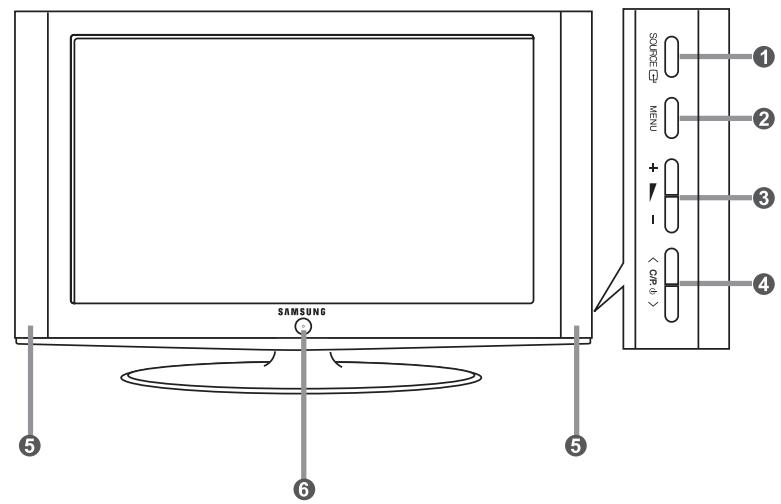
1 SOURCE
Toggles between all the available input sources (TV - Ext. - AV - S-Video - PC). In the on-screen menu, use this button as you use the ENTER button on the remote control.
2 MENU
Press to see an on-screen menu of your TV's features.
3 +▶
Press to decrease or increase the volume. In the on-screen menu, use the + - buttons as you use the and buttons on the remote control.
4
Press to change channels.
In the on-screen menu, use the C / P, buttons as you use the and buttons on the remote control.
(Without the Remote Control, you can turn on the TV by using the Channel buttons.)
5 Speakers
6 (Power)
Press to turn the TV on and off.
Power Indicator
Blinks and turns off when the power is on and lights up in stand-by mode.
Remote Control Sensor
Aim the remote control towards this spot on the TV.
The product colour and shape may vary depending on the model.
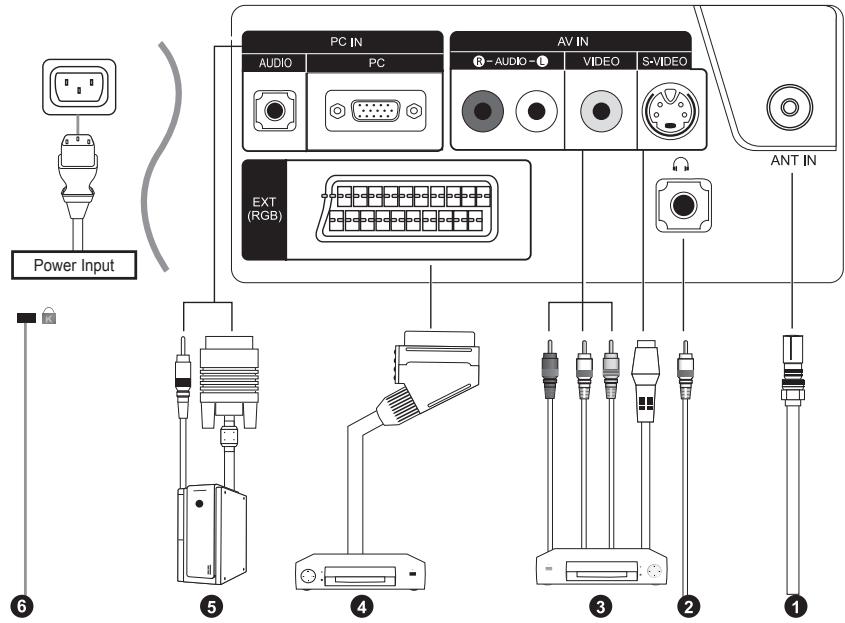
Whenever you connect an external device to your TV, make sure that power on the unit is turned off.
When connecting an external device, match the colour of the connection terminal to the cable.
1 Connecting an Aerial or Cable Television Network
To view television channels correctly, a signal must be received by the set from one of the following sources:
- An outdoor aerial / A cable television network / A satellite network
3 Connecting External A/V Devices
- Connect RCA (optional) or S-VIDEO cable (optional) to an appropriate external AV device such as VCR, DVD or Camcorder.
- Connect RCA audio cables (optional) to "R - AUDIO - L" on the rear of your set and the other ends to corresponding audio out connectors on the A/V device.
- Headphone may be connected to the headphone output (2) on the rear of your set. While the head phone is connected, the sound from the built-in speakers will be disabled.
4 Connecting Set-Top Box, VCR or DVD
- Connect the VCR or DVD SCART cable (optional) to the SCART connector of the VCR or DVD.
- If you wish to connect both the Set-Top Box and VCR (or DVD), you should connect the Set-Top Box to the VCR (or DVD) and connect the VCR (or DVD) to your set.
Connecting Computer
- Connect the D- Sub cable (optional) to "PC IN (PC)" on the rear of your set and the other end to the Video Card of your computer.
- Connect the stereo audio cable (optional) to "PC IN (AUDIO)" on the rear of your set and the other end to "Audio Out" of the sound card on your computer.
Kensington Lock
- The Kensington lock (optional) is a device used to physically fix the system when used in a public place.
- If you want to use a locking device, contact the dealer where you purchased the TV.
- The place of the Kensington Lock may be different depending on its model.
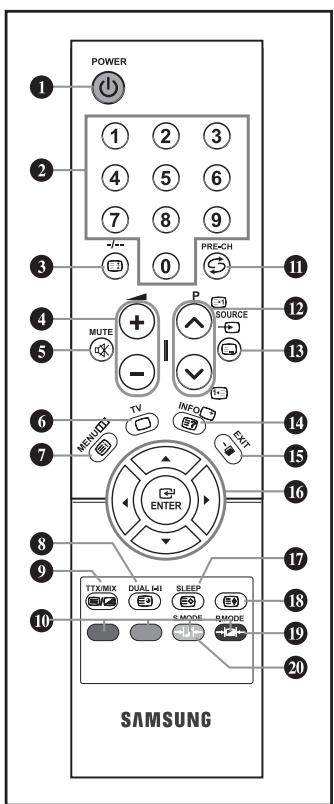
Television Standby button
Number buttons for direct channel access
One/Two-digit channel selection
: Volume increase : Volume decrease
5 Temporary sound switch-off
6 Selects the TV mode directly
1 Displays the main on-screen menu
Sound effect selection
1 Previous channel
10 P: Next channel P: Previous channel
Available source selection
Use to see information on the current broadcast
Exit the on-screen menu
16 Control the cursor in the menu
Automatic Power-off
Picture effect selection
20 Sound mode selection
The performance of the remote control may be affected by bright light.
For details, refer to further instructions.
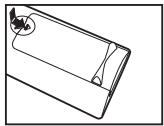
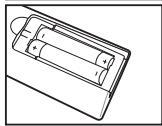
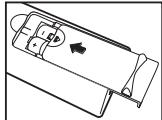
Installing Batteries in the Remote Control
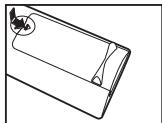
- Slide the cover out completely.
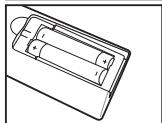
- Install two AAA size batteries.
Make sure to match the ^+ and - ends of the batteries with the diagram inside the compartment.
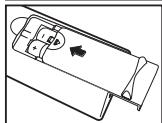
- Replace the cover.
Remove the batteries and store them in a cool, dry place if you won't be using the remote control for a long time. The remote control can be used up to about 23 feet from the TV. (Assuming typical TV usage, the batteries last for about one year.)
If the remote control doesn't work, check the following:
- Is the TV power on?
- Are the plus and minus ends of the batteries reversed?
- Are the batteries drained?
- Is there a power outage, or is the power cord unplugged?
- Is there a special fluorescent light or neon sign nearby?
Switching On and Off
The mains lead is attached to the rear of your set.
- Plug the mains lead into an appropriate socket.
The standby indicator lights up on the front of the set.
- Press the POWER button on the front of the set.
The programme that you were watching last is reselected automatically.
- Press the numeric button (0 9) or channel up/down ( / ) button on the remote control or
/ , button on the lower-right panel.
When you switch the set on for the very first time, you will be asked to choose language in which the menus are to be displayed. - To switch your set off, press the POWER button again.
Placing Your Television in Standby Mode
Your set can be placed in standby mode in order to reduce the power consumption. The standby mode can be useful when you wish to interrupt viewing temporarily (during a meal, for example).
- Press the POWER button on the remote control.
The screen is turned off and a standby indicator appears on the front of your set. - To switch your set back on, simply press the POWER , numeric buttons (0~9) or channel up/down ( / ) button again.
Do not leave your set in standby mode for long periods of time (when you are away on holiday, for example). It is best to unplug the set from the mains and aerial.
Plug & Play
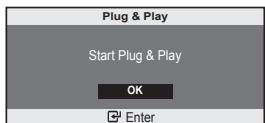
When the TV is initially powered on, several basic settings proceed automatically and subsequently. The following settings are available.
- Press the POWER button on the remote control.
The message "Start Plug & Play" is displayed with "OK" selected. Press the ENTER button. - Select the appropriate language by pressing the or button.
Press the ENTER button to confirm your choice. - The message "Check antenna input." is displayed with "OK" selected.
Press the ENTER button.
Please check that the antenna cable is connected correctly.
- Select the appropriate country by pressing the or button. Press the ENTER button to confirm your choice.
- The "Auto Store" menu is displayed with the "Start" selected. Press the ENTER button.
The channel search will start and end automatically. After all the available channels are stored, the "Clock Set" menu appears
Press the ENTER button at any time to interrupt the memorization process.
- Press the ENTER button.
Select the "Hour" or "Minute" by pressing the or button. Set the "Hour" or "Minute" by pressing the or button.
You can also set the hour and minute by pressing the number buttons on the remote control.
- Press the ENTER button to confirm your setting. The message "Enjoy your viewing." is displayed.
Language: Select your language.
Country: Select your country.
Auto Store: Automatically scans for and stores channels available in the local area.
Clock Set: Sets the current time for the TV clock.
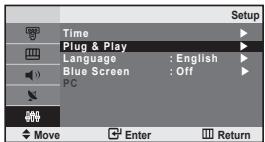
If you want to reset this feature...
- Press the MENU button to display the menu.
Press the or button to select "Setup", then press the ENTER + button.
- Press the or button to select "Plug & Play", then press the ENTER button.
- This message "Start Plug & Play" is displayed. (Refer to page 6)
SETTING THE CHANNELS
Storing Channels Automatically
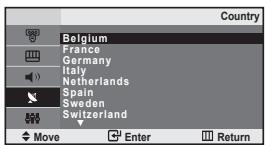
You can scan for the frequency ranges available to you (and availability depends on your country). Automatically allocated programme numbers may not correspond to actual or desired programme numbers. However, you can sort numbers manually and clear any channels you do not wish to watch.
- Press the MENU button to display the menu.
Press the or button to select "Channel", then press the ENTER button. - Press the ENTER button to select "Country".
- Select the appropriate country by pressing the or button. Press the ENTER button to confirm your choice.
- Press the or button to select "Auto Store", then press the ENTER button.
- Press the ENTER button to select "Start".
The TV will begin memorizing all of the available channels.
Press the ENTER button at any time to interrupt the memorization process and return to the "Channel" menu.
- After all the available channels are stored, the "Sort" menu appears. (Refer to page 9)
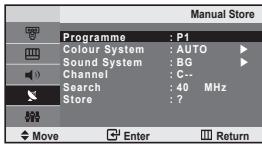
You can store up to 100 channels, including those received via cable networks. When storing channels manually, you can choose:
Whether or not to store each of the channels found.
The programme number of each stored channel which you wish to identify.
- Press the MENU button to display the menu.
Press the or button to select "Channel", then press the ENTER button. - Press the or button to select "Manual Store", then press the ENTER button.
- Press the ENTER button to select "Programme".
- To assign a programme number to a channel, find the correct number by pressing the or button and then press the ENTER button.
- Press the or button to select "Colour System", then press the ENTER button.
- Select the colour standard required by pressing the or button, then press the ENTER button.
- Press the or button to select "Sound System", then press the ENTER button.
- Select the sound standard required by pressing the or button, then press the ENTER button.
If there is an abnormal sound or no sound, re-select the sound system required.
- If you know the number of the channel to be stored, press the or button to select "Channel". Press the ENTER button. Select C (Air channel) or S (Cable channel) by pressing the or button. Press the button to select channel. Select the required number b pressing the or button and then press the ENTER button.
Channel mode: P (Programme mode)
C (Air channel mode)
S (Cable channel mode)
You can also set a channel number by pressing the number buttons on the remote control.
- If you do not know the channel numbers, press the or button to select "Search". Press the ENTER button.
Search by pressing the or button and then press the ENTER button.
- Press the or button to select "Store", then press the ENTER button.
Press the or button to select "OK", then press the ENTER button.
- Repeat steps 3 to 11 for each channel to be stored.
Programme: Selects a program number for the channel.
Colour System: Sets the colour supporting system.
Sound System: Sets the sound supporting system.
Channel: Selects a channel.
Search: Scans for the frequency value for the channel.
Store: Saves your settings.
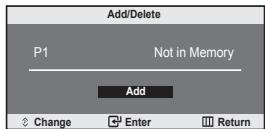
You can exclude the channels you chose from the channels you scanned. When you scan through the stored channels, those you have chosen to skip are not displayed. All channels that you do not specifically choose to skip are displayed during scanning.
- Use the number buttons to directly select the channel that will be added or deleted.
- Press the MENU button to display the menu. Press the or button to select "Channel", then press the ENTER 已 button.
- Press the or button to select "Add/Delete", then press the ENTER button.
- Repeatedly pressing the ENTER button will alternate between add channel and delete channel.
- Press the P^ or P^ buttons to switch to the appropriate channel, then repeat above.
- Press the EXIT button to exit.
You can view any channel (including an erased channel) by using the number buttons on the remote control.
Sorting the Stored Channels
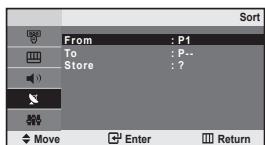
You can exchange the numbers of two channels, in order to:
Modify the numeric order in which the channels have been automatically stored.
Give easily remembered numbers to the channels that you watch most often.
- Press the MENU button to display the menu.
Press the or button to select "Channel", then press the ENTER button. - Press the or button to select "Sort", then press the ENTER button.
- Press the ENTER button to select "From". Press the or button until the channel number that you wish to change is displayed. Press the ENTER button.
- Press the or button to select "To", then press the ENTER button.
Press the or button until the new number by which you wish to identify the channel is displayed.
Press the ENTER button.
- Press the or button to select "Store", then press the ENTER button.
Press the or button to select "OK", then press the ENTER button.
The selected channel is exchanged with the one previously stored to the chosen number.
- Repeat steps 3 to 5 for another channel to be sorted.
- Press the EXIT button to exit.
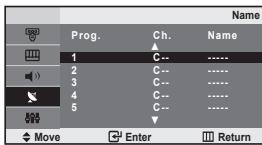
Channel names will be assigned automatically when channel information is broadcast. These names can be changed, allowing you to assign new names.
-
Press the MENU button to display the menu. Press the or button to select "Channel", then press the ENTER button.
-
Press the or button to select "Name", then press the ENTER button.
-
If necessary, select the channel to be assigned to a new name by pressing the or button. Press the ENTER button.
| To... | Then... |
| Select a letter, number or symbol | Press the ▲ or ▼ button |
| Move on the next letter | Press the ▶ button |
| Move back the previous letter | Press the ▲ button |
| Confirm the name | Press the ENTER □ button |
The characters available are: Letters of the alphabet (A~Z) Numbers (0~9) Special characters (-, space)
- Repeat steps 3 to 4 for each channel to be assigned to a new name.
- Press the EXIT button to exit.
Fine Tuning Channel Reception
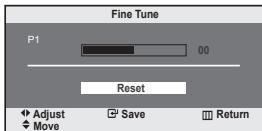
Use fine tuning to manually adjust a particular channel for optimal reception.
- Use the number buttons to directly select the channel that you want to fine tune.
- Press the MENU button to display the menu. Press the or button to select "Channel", then press the ENTER button.
- Press the or button to select "Fine Tune", then press the ENTER button.
- Press the or button to adjust the fine tuning. Press the ENTER button.
- Press the EXIT button to exit.
Fine tuned channels that have been saved are marked with an asterisk ** on the right-hand side of the channel number in the channel banner. And the channel number turns red.
To reset the fine-tuning, select "Reset" by pressing the or button and then press the ENTER button.
Changing the Picture Standard
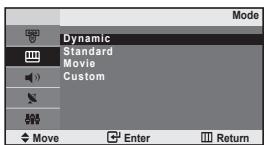
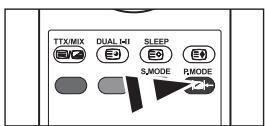

You can also press the P.MODE button on the remote control to select one of the picture settings.
You can select the type of picture which best corresponds to your viewing requirements.
- Press the MENU button to display the menu. Press the or button to select "Picture", then press the ENTER button.
- Press the ENTER button to select "Mode".
- Press the or button to select the desired picture effect. Press the ENTER button.
-
Press the EXIT button to exit.
-
Dynamic: Selects the picture for high-definition in a bright room.
- Standard: Selects the picture for optimum display in a normal environment.
- Movie: Selects the picture for comfortable display in a dark room.
- Custom: Select to view your favorite display settings. (Refer to "Adjusting the Custom Picture")
[PC mode]
- Entertain: High brightness. (For watching motion pictures such as a DVD or Video CD.)
- Internet: Medium brightness. (For working with a mixture of images such as text and graphics.)
- Text: Normal brightness. (For documentations or works involving heavy text.)
- Custom: Select to view your favorite display settings.
In the PC mode, "Entertain", "Internet", "Text", "Custom" appears.
Adjusting the Custom Picture
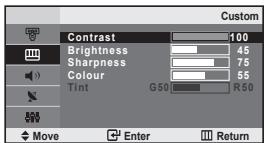
Your set has several settings which allow you to control picture quality.
- Press the MENU button to display the menu.
Press the or button to select "Picture", then press the ENTER + button.
- Press the or button to select "Custom", then press the ENTER button.
- Press the or button to select a particular item.
Press the ENTER button.
- Press the or button to decrease or increase the value of a particular item. Press the ENTER button.
-
Press the EXIT button to exit.
-
Contrast: Adjusts the lightness and darkness between objects and the background.
- Brightness: Adjusts the brightness of the whole screen.
- Sharpness: Adjusts the outline of objects to either sharpen them or make them more dull.
Colour: Adjusts the colours, making them lighter or darker. - Tint(NTSC only): Adjusts the colour of objects, making them more red or green for a more natural look.
If you make any changes to these settings, the picture mode is automatically switched to "Custom".
In the PC mode, only "Contrast" and "Brightness" can be adjusted.
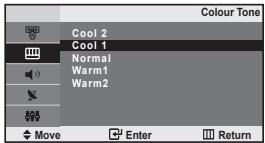
You can select the most comfortable colour tone to your eyes.
- Press the MENU button to display the menu.
Press the or button to select "Picture", then press the ENTER button. - Press the or button to select "Colour Tone", then press the ENTER 已 button.
- Press the or button to select the desired colour tone setting. Press the ENTER button.
- Press the EXIT button to exit.
Cool 2: Makes the colour temperature bluer than "Cool 1" menu.
Cool 1: Makes whites bluish.
Normal: Keeps whites white.
Warm1: Makes whites reddish.
Warm2: Makes the colour temperature redder than "Warm1" menu.
In the PC mode, "Cool", "Normal", "Warm", "Custom" appears.
Adjusting the Colour Control
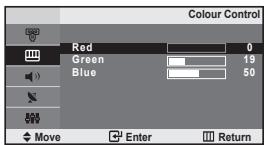
Adjust the individual R, G, B Colour Controls.
- Press the MENU button to display the menu.
Press the or button to select "Picture", then press the ENTER button. - Press the or button to select "Colour Control", then press the ENTER button.
- Press the or button to select a particular item. Press the ENTER button.
- Press the or button to decrease or increase the value of a particular item. Press the ENTER button.
- Press the EXIT button to exit.
Available in PC Mode Only.
Changing the Sound Standard

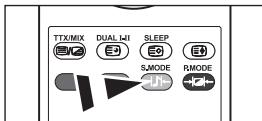
You can also select these options by simply pressing the S.MODE button on the remote control.
You can select the type of the special sound effect to be used when watching a given broadcast.
- Press the MENU button to display the menu.
Press the or button to select "Sound", then press the ENTER button.
- Press the ENTER button to select "Mode".
- Press the or button to select the desired sound effect.
Press the ENTER button.
-
Press the EXIT button to exit.
-
Standard: Selects the normal sound mode.
- Speech: Emphasizes voices over other sounds.
Adjusting the Volume Automatically
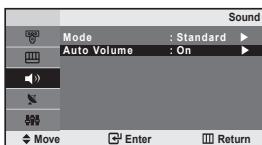
Each broadcasting station has its own signal conditions, and so it is not easy for you to adjust the volume every time the channel is changed.
This feature let you automatically adjust the volume of the desired channel by lowering the sound output when the modulation signal is high or by raising the sound output when the modulation signal is low.
- Press the MENU button to display the menu.
Press the or button to select "Sound", then press the ENTER button. - Press the or button to select "Auto Volume", then press the ENTER + button.
- Press the or button to select "On" or "Off". Press the ENTER l button.
- Press the EXIT button to exit.
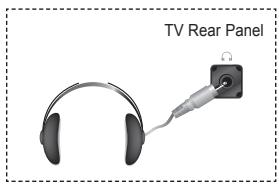
Connecting headphones
You can connect a set of headphones to your set if you wish to watch a TV programme without disturbing the other people in the room.
Prolonged use of headphones at a high volume may damage your hearing.
Setting and Displaying the Current Time
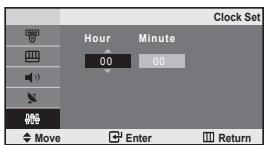
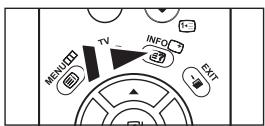
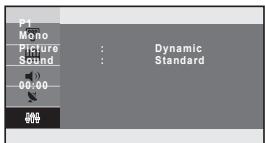
You can set the TV's clock so that the current time is displayed when you press the INFO button. You must also set the time if you wish to use the automatic On/Off timers.
- Press the MENU button to display the menu.
Press the or button to select "Setup", then press the ENTER l button.
-
Press the ENTER button to select "Time".
-
Press the ENTER button to select "Clock Set".
| To... | Press the... |
| Move to “Hour” or “Minute” | ▲ or ▲ button. |
| Set the “Hour” or “Minute” | ▲ or ▼ button. |
| Confirm the setting | ENTER button. |
- Press the EXIT button to exit.
If you disconnect the power cord, you have to set the clock again.
You can also set hour and minute by pressing the number buttons on the remote control.
Setting the Sleep Timer
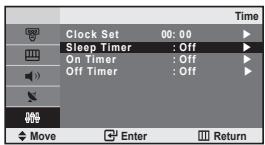
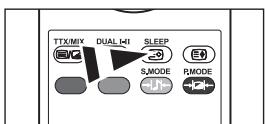

Press the SLEEP button on the remote control repeatedly until the appropriate time interval appears.
You can select a time period of between 30 and 180 minutes after which the television automatically switches to standby mode.
- Press the MENU button to display the menu.
Press the or button to select "Setup", then press the ENTER button. - Press the ENTER button to select "Time".
- Press the or button to select "Sleep Timer", then press the ENTER button.
- Press the or button repeatedly until the desired time appears (Off, 30, 60, 90, 120, 150, 180).
Press the ENTER button.The TV automatically switches to standby mode when the timer reaches 0.
- Press the EXIT button to exit.
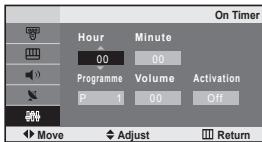
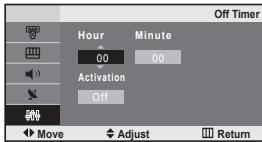
You can set the On/Off timers so that the set will:
Switch on automatically and tune to the channel of your choice at the time you select.
Switch off automatically at the time you select.
- Press the MENU button to display the menu.
Press the or button to elect "Setup", then press the ENTER button.
- Press the ENTER button to select "Time".
- Press the or button to select "On Timer", then press the ENTER button.
- Press the or button to adjust "Hour", then press the button to move to the next step.
Set other items using the same method as above.
When finished, press the ENTER 已 button to return.
- Press the or button to select "Off Timer", then press the
ENTER button. - Press the or button to adjust "Hour", then press the button to move to the next step.
Set other items using the same method as above.
When finished, press the ENTER button to return.
- Press the EXIT button to exit.
The first step is to set the television's clock.
(refer to "Setting and Displaying the Current Time" on page 14)
You can also set hour and minute by pressing the number buttons on the remote control.
The "Activation" setting must be set to "On" in order for the timers to work.
SETTING THE OTHERS
Choosing Your Language
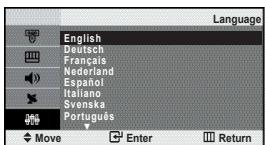
When you start using your set for the first time, you must select the language which will be used for displaying menus and indications.
- Press the MENU button to display the on-screen menu.
Press the or button to select "Setup", then press the
ENTER按钮。 - Press the or button to select "Language", then press the ENTER button.
- Select a particular language by pressing the or button repeatedly.
Press the ENTER button.
You can choose one of 12 languages. - Press the EXIT button to exit.
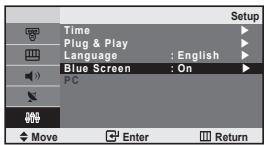
If no signal is being received or the signal is very weak, a blue screen automatically replaces the noisy picture background. If you wish to continue viewing the poor picture, you must set the "Blue Screen" mode to "Off".
- Press the MENU button to display the menu. Press the or button to select "Setup", then press the ENTER button.
- Press the or button to select "Blue Screen" then press the ENTER button.
- Press the or button to select "On" or "Off". Press the ENTER l button.
- Press the EXIT button to exit.
Selecting the Source
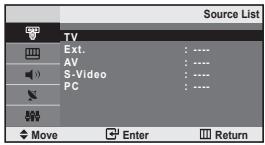
You can select among external sources connected to your TV's input jacks.
- Press the MENU button to display the menu. Press the ENTER button to select "Input".
- Press the ENTER button to select "Source List".
- Select the required device by pressing the or button. Press the ENTER button.
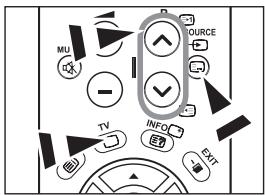
Press the SOURCE button on the remote control to toggel between all the available source. TV mode can be selected by pressing the TV or P/ / button on the remote control but you cannot select it by pressing the SOURCE button.
Editing the Input Source Names
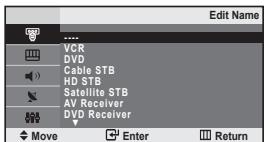
Name the device connected to the input jacks to make your input source selection easier.
- Press the MENU button to display the menu. Press the ENTER 已 button, to select "Input
- Press the or button to select "Edit Name", then press the ENTER button.
- Press the or button to input select input source that you wish to edit. Press the ENTER button.
- Press the or button to select the required device. Press the ENTER button.
- Press the EXIT button to exit.
Teletext Decoder
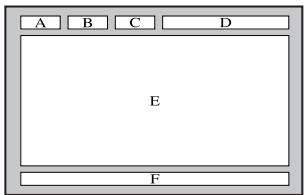
Most set channels carry " teletext ", pages of written information that provide information such as:
Television programme times.
News bulletins and Weather forecasts.
Sports results.
Subtitles for the hard of hearing.
The teletext pages are organized according to six categories:
| Part | Contents |
| A | Selected page number. |
| B | Broadcasting station identity. |
| C | Current page number or search status. |
| D | Date and time. |
| E | Text. |
| F | Status information. |
Displaying the Teletext Information
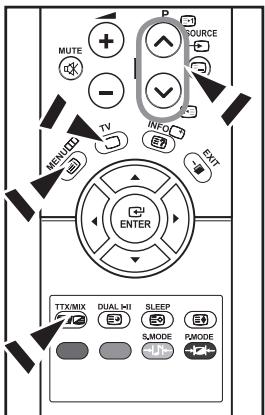
You can display teletext information at any time, but signal reception must be good. Otherwise:
Information may be missing.
Some pages may not be displayed.
To activate the teletext mode and display the contents page:
- Using the P^() or P^ (13) button, select the channel providing the teletext service.
- Press the TTX/MIX (☑/☑) button to activate the teletext mode.
The contents page is displayed. It can be redisplayed at any time by pressing the MENU (B) button.
- Press the TTX/MIX (☑/☑) button again.
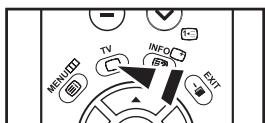
The actual broadcast will be displayed simultaneously with the teletext page on the screen. - Press the TV() button again to exit from the Text display.
If any broken character appears while Text is being viewed, make sure that the Text language is identical with the language in the "Setup" menu mode. If both languages are different, select the same language with the Text language on the "Setup" menu.
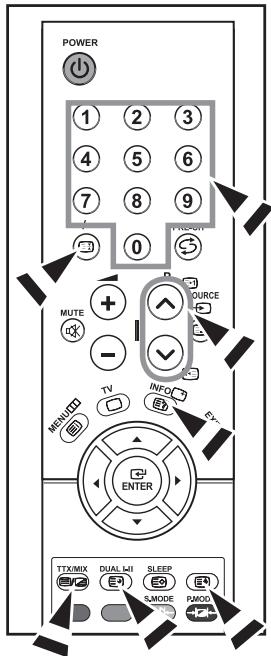
Press the number buttons on the remote control to enter the page number directly:
- Enter the three-digit page number listed in the contents by pressing the corresponding numeric buttons.
- If the selected page is linked with several secondary pages, the secondary pages are displayed in sequence. To freeze the display on a given page, press the (E3). Press the (E3) button again to resume.
- Using the various display options:
| To display... | Press the... |
| Both teletext information and the normal broadcast | TTX/MIX (≧/≧) |
| Hidden text (answers to quiz games, for example) | INFO (≧) |
| The normal screen | INFO (≧) |
| A secondary page, by entering its 4-digit number | DUAL I-II (≧) |
| The next page | P ≦ (≧) |
| The previous page | P ≦ (≧) |
| Double-size letters in the: | (≧) |
| • Upper half of the screen | • Once |
| • Lower half of the screen | • Twice |
| Normal screen | • Three times |
Using Fastext to Select a Teletext Page
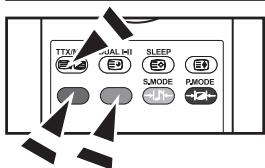
The various topics included in the teletext pages are colour-coded, and can be selected by pressing the coloured buttons on the remote control.
- Display the teletext contents page by pressing the TTX/MIX (3/2) button.
- Press the coloured button corresponding to the topic that you wish to select (The available topics are listed on the status information line).
- Press the Red button to display the previous page. Press the Green button to display the next page.
- Press the TV (□) button again to exit from the Text display.
Storing Teletext Pages
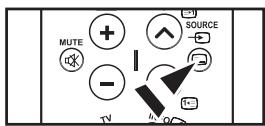
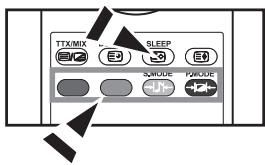
You can store up to four teletext pages to display them later at leisure.
- Select the LIST mode using the SOURCE (E) button.
The SOURCE (三) button is used to switch between the LIST and FLOF modes. - Press the coloured button corresponding to the page that will be replaced.
- Enter the new page number using the numeric buttons.
- Repeat steps 2 and 3 for each page to be stored, using a different coloured button each time.
- Press the SLEEP (E) button until the corresponding blocks blink.
Setting up Your PC Software (Based on Windows XP)
The Windows display-settings for a typical computer are shown below. The actual screens on your PC may be different depending upon your particular version of Windows and your particular video card. Even if your actual screens look different, the same, basic set-up information will apply in almost all cases. (If not, contact your computer manufacturer or Samsung Dealer.)
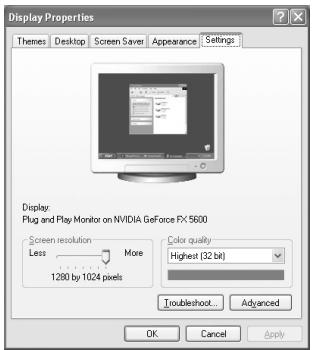
- First, click on "Control Panel" on the Windows start menu.
- When the control panel window appears, click on "Appearance and Themes" and a display dialog-box will appear.
- When the control panel window appears, click on "Display" and a display dialog-box will appear.
- Navigate to the "Settings" tab on the display dialog-box. The correct size setting (resolution):
Optimum: 640 X 480
If a vertical-frequency option exists on your display settings dialog box, the correct value is "60" or "60 Hz". Otherwise, just click "OK" and exit the dialog box.
Display Modes
Both screen position and size will vary depending on the type of PC monitor and its resolution. The resolutions in the table are recommended. (All resolutions between the supported limits are supported)
| Mode | Resolution | Horizontal Frequency (kHz) | Vertical Frequency (Hz) | Pixel Clock Frequency (MHz) | Sync Polarity (H/V) |
| VGA | 720X400 | 31.469 | 70.087 | 28.322 | - / + |
| 640X480 | 31.469 | 59.940 | 25.175 | - / - |
The interlace mode is not supported.
The set might operate abnormally if a non-standard video format is selected.
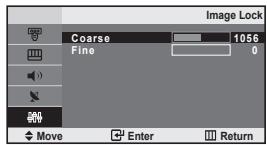
Coarse and Fine Tuning of the Image (Image Lock): The purpose of picture quality adjustment is to remove or reduce picture noise. If the noise is not removed by Fine-tuning alone, then adjust the frequency as best as possible (coarse) and Fine-tune again. After the noise has been reduced, re-adjust the picture so that it is aligned on the center of screen.
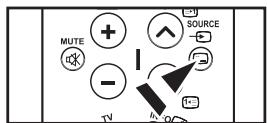
- Preset: Press the SOURCE button to select PC mode.
- Press the MENU button to display the menu. Press the or button to select "Setup", then press the ENTER button.
- Press the or button to select "PC", then press the ENTER button.
- Press the ENTER button to select "Image Lock".
- Press the or button to select "Coarse" or "Fine", then press the ENTER button.
- Press the or button to adjust the screen quality. Press the ENTER button.
- Press the EXIT button to exit.
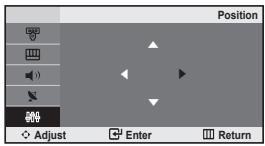
Changing the Image Position (Position): Adjust the PC's screen positioning if it does not fit the TV screen.
- Follow the "Coarse and Fine Tuning of the Image (Image Lock)" instructions number 1 to 3.
- Press the or button to select "Position", then press the ENTER button.
- Press the or button to adjusting the Vertical-Position. Press the or button to adjust the Horizontal-Position. Press the ENTER button.
- Press the EXIT button to exit.
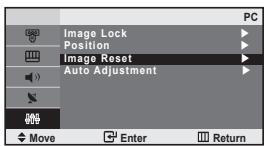
Initializing the Image Settings (Image Reset):
You can replace all image settings with the factory default values.
- Follow the "Coarse and Fine Tuning of the Image (Image Lock)" instructions number 1 to 3.
- Press the or button to select "Image Reset", then press the ENTER button.
- Press the EXIT button to exit.
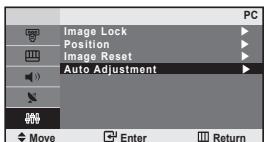
Adjusting the PC Screen Automatically (Auto Adjustment): Auto adjustment allows the PC screen of set to self-adjust to the incoming PC video signal. The values of fine, coarse and position are adjusted automatically.
- Follow the "Coarse and Fine Tuning of the Image (Image Lock)" instructions number 1 to 3.
- Press the or button to select "Auto Adjustment", then press the ENTER button.
- Press the EXIT button to exit.
Troubleshooting: Before Contacting Service Personnel
| No sound or picture | ·Check that the mains lead has been connected to a wall socket. ·Check that you have pressed the POWER按钮 on the front panel. ·Check the picture contrast and brightness settings. ·Check the volume. |
| Normal picture but no sound | ·Check the volume. ·Check whether the MUTE button has been pressed on the remote control. |
| No picture or black and white picture | ·Adjust the colour settings. ·Check that the broadcast system selected is correct. |
| Sound and picture interference | ·Try to identify the electrical appliance that is affecting the set and move it further away. ·Plug your set into a different mains socket. |
| Blurred or snowy picture, distorted sound | ·Check the direction, location and connections of your aerial. This interference is often due to the use of an indoor aerial. |
| Remote control malfunctions | ·Replace the remote control batteries. ·Clean the upper edge of the remote control (transmission window). ·Check the battery terminals. |
| "Check signal cable." message is displayed. | ·Check that the signal cable is firmly connected to the PC or video sources. ·Check that the PC or video sources are turned on. |
| On PC mode, "Not Supported Mode." message is displayed. | ·Check the maximum resolution and the frequency of the video adaptor. ·Compare these values with the data in the Display Modes. |
| Screen is black and power indicator light blinks steadily | ·On your computer check; Power, Signal Cable. ·The TV is using its power management system. |
The TFT LCD panel uses a panel consisting of sub pixels (921 600) which require sophisticated technology to produce. However, there may be few bright or dark pixels on the screen. These pixels will have no impact on the performance of the product.
Technical and Environmental Specifications
| Model Name | LE20S8 |
| Screen Size (Diagonal) | 20 inch |
| PC Resolution | 640 X 480 @ 60 Hz |
| Sound | |
| Output | 3W X 2 |
| Dimensions (WxDxH) | |
| Body | 574 mm X 70 mm X 428 mm |
| With stand | 574 mm X 196 mm X 468 mm |
| Weight | |
| With stand | 8 kg |
| Environmental Considerations | |
| Operating Temperature | 10 °C to 40 °C (50 °F to 104 °F) |
| Operating Humidity | 10 % to 80 %, non-condensing |
| Storage Temperature | -20 °C to 45 °C (-4 °F to 113 °F) |
| Storage Humidity | 5 % to 95 %, non-condensing |
Design and specifications are subject to change without prior notice.
This device is a Class B digital apparatus.
For the power supply and Power Consumption, refer to the label attached to the product.
Installation du support mural
Mode Canal: P (Mode Programme),
3 Connecting External A/V Devices
Colocar as pilhas no telecomando
Dostepne znaki, to: Litery alfabetu (A~Z)
Cyfry (0 9)
Precautions When Displaying a Still Image
A still image may cause permanent damage to the TV screen.
Do not display a still image on the LCD panel for more than 2 hours as it can cause screen image retention.
This image retention is also known as "screen burn"
To avoid such image retention, reduce the degree of brightness and contrast of the screen when displaying a still image.
- Watching the LCD TV in 4:3 format for a long period of time may leave traces of borders displayed on the left, right and center of the screen caused by the difference of light emission on the screen. Playing a DVD or a game console may cause a similar effect to the screen. Damages caused by the above effect are not covered by the Warranty.
- Displaying still images from Video games and PC for longer than a certain period of time may produce partial after-images.
To prevent this effect, reduce the 'brightness' and 'contrast' when displaying still images.
Kazalo
PRIKLJUCITEV IN PRIPRAVA TV
If you have any questions or comments relating to Samsung products, please contact the SAMSUNG customer care centre.