
HT 4500 - Wireless Microphone System AKG - Free user manual and instructions
Find the device manual for free HT 4500 AKG in PDF.


| Product type | Wireless handheld transmitter (microphone system) |
| Brand | AKG |
| Model | HT 4500 |
| Dimensions (L x Ø) | 239 x 39 mm |
| Net weight (without batteries) | 320 g |
| Power supply | 2 AA 1.5 V batteries or rechargeable BP 4000 battery pack (optional) |
| Battery life | 15 h with alkaline batteries, 12 h with BP 4000 battery pack |
| Carrier frequency ranges | 500-530, 570-600, 650-680, 680-710, 720-750, 760-790, 790-820, 835-862 MHz (depending on version) |
| Max. number of carriers | Up to 1200 |
| Modulation | FM |
| Audio bandwidth | 35 Hz – 20 kHz |
| Harmonic distortion (1 kHz) | < 0.3% at nominal excursion |
| Signal-to-noise ratio | typ. 118 dB(A) |
| RF power | 50 mW ERP |
| Max. input level | 140 dB SPL for nominal excursion |
| Power consumption | < 125 mA |
| Operating modes | LOCK (locked), ACTIVE (adjustable), SILENT (RF off) |
| Display | 5-line backlit LCD screen |
| LED indicator | Two-color: green (transmission), red (mute or low battery), off (SILENT mode) |
| Main functions | Interchangeable microphone heads (optional), frequency selection via presets or 25 kHz steps, manual or automatic gain adjustment, MUTE switch, charging contacts for battery pack |
| Maintenance and cleaning | Wipe with a soft cloth moistened with water. Do not use solvents. |
| Safety | Do not expose to sunlight, dust, moisture, or shocks. Observe regulations for recycling batteries and the device. |
| Optional accessories | BP 4000 battery pack, CU 4000 charger, microphone heads D 5 WL1, C 5 WL1, D 3700 WL1, D 3800 WL1, C 5900 WL1, C 535 WL1, SA 63 adapter |
Frequently Asked Questions - HT 4500 AKG
User questions about HT 4500 AKG
0 question about this device. Answer the ones you know or ask your own.
Ask a new question about this device
Download the instructions for your Wireless Microphone System in PDF format for free! Find your manual HT 4500 - AKG and take your electronic device back in hand. On this page are published all the documents necessary for the use of your device. HT 4500 by AKG.
USER MANUAL HT 4500 AKG
Please read the manual before using the equipment!
MODE D'EMPLOI p.38
1 Safety and Environment 21
1.1 Safety 21
1.2 Environment 21
FCC Statement. 21
2 Description 22
2.1 Introduction 22
2.2 Packing List 22
2.3 Optional Accessories 22
2.4 Description 22
2.4.1 Controls 22
2.4.2 Interchangeable Microphone Elements 24
3 Setting Up 25
3.1 Mounting the Microphone Element 25
3.2 Inserting Batteries 25
3.3 Operating Modes 25
3.4 Powering Up 26
3.4.1 Powering Up in SILENT Mode 26
3.4.2 Powering Up in LOCK Mode 26
3.5 Powering Down 27
3.6 Setting the Carrier Frequency 27
3.6.1 Preset Menu 27
3.6.2 Frequency Menu 29
3.7 Multichannel Systems 30
3.8 Setting Input Gain 30
3.8.1 Setting Gain Manually 30
3.8.2 Using Automatic Gain Mode 31
4 Operating Notes 32
4.1 Status Screens and Setup Menus 32
4.1.1 LOCK Mode 32
4.1.2 ACTIVE and SILENT Modes 32
4.2 Selecting Modes 32
4.3 Muting the Microphone 33
4.4 Replacing Batteries 33
4.5 Microphone Technique 33
4.5.1 Working Distance and Proximity Effect 33
4.5.2 Angle of Incidence 33
4.5.3 Feedback 33
4.5.4 Backing Vocals 33
4.6 Multichannel Systems 34
4.7 Battery Care 34
5 Cleaning 34
6 Error Messages 35
7 Specifications 37
1 Safety and Environment
1.1 Safety
-
Do not expose the equipment to direct sunlight, excessive dust, moisture, rain, mechanical vibrations, or shock.
-
Be sure to dispose of used batteries as required by local waste disposal rules. Never throw batteries into a fire (risk of explosion) or garbage bin.
- When scrapping the equipment, remove the batteries, separate the case, circuit boards, and cables, and dispose of all components in accordance with local waste disposal rules.
- The packaging of the equipment is recyclable. Dispose of the packaging in an appropriate container provided by the local waste collection/recycling entity and observe all local legislation relating to waste disposal and recycling.
1.2 Environment

FCC Statement
This equipment has been tested and found to comply with the limits for a Class B digital device, pursuant to Part 74 of the FCC Rules. These limits are designed to provide reasonable protection against harmful interference in a residential installation. This equipment generates, uses, and can radiate radio frequency energy and, if not installed and used in accordance with the instructions, may cause harmful interference to radio communications. However, there is no guarantee that interference will not occur in a particular installation. If this equipment does cause harmful interference to radio or television reception, which can be determined by turning the equipment off and on, the user is encouraged to try to correct the interference by one or more of the following measures:
Reorient or relocate the receiving antenna.
- Increase the separation between the equipment and the receiver.
- Connect the equipment into an outlet on a circuit different from that to which the receiver is connected.
- Consult the dealer or an experienced radio/TV technician for help.
Shielded cables and I/O cords must be used for this equipment to comply with the relevant FCC regulations.
Changes or modifications not expressly approved in writing by AKG Acoustics may void the user's authority to operate this equipment.
2.1 Introduction
Dear Customer:
Thank you for purchasing an AKG product. This Manual contains important instructions for setting up and operating your equipment. Please take a few minutes to read the instructions below carefully before operating the equipment. Please keep the Manual for future reference. Have fun and impress your audience!
2.2 Packing List
| 1 HT 4500 handheld transmitter | 2 AA size 1.5-V dry batteries | 1 SA 63 stand adapter |
2.3 Optional Accessories
-
Check that the package contains all the parts listed above. If anything is missing, please contact your AKG dealer.
-
For optional accessories, refer to the current AKG catalog or folder, or visit www.akg.com. Your dealer will be glad to help.
2.4 Description
The HT 4500 handheld transmitter and matching microphone elements (optional) provide the same acoustic performance as the equivalent hardwire microphone versions. The microphone elements available for the HT 4500 have been specifically designed for vocal use. The HT 4500 operates in one subband up to 30MHz wide within the 500MHz to 862MHz UHF carrier frequency band. Within the subband, you can either set the carrier frequency directly in 25-kHz increments or select one of the Channels of the Preset Frequency Groups of your transmitter.
The transmitter provides three operating modes:
In LOCK mode, the microphone output signal is transmitted to the receiver. All setup functions and controls except for the MUTE switch are electronically locked to prevent parameters from being readjusted unintentionally during a performance or lecture. The LCD screen displays the "LOCK" label.
ACTIVE mode allows you to adjust and save the carrier frequency and input gain.
In SILENT mode, power to the transmitter is on, but no RF signal is transmitted. We recommend using only this mode for setting the carrier frequency. This is the only way to make sure you won't "go on air" on a frequency that is not allocated or coordinated and risk "jamming" some other radio service or active radio mic.
The backlit LCD screen indicates all important parameters, the current battery capacity, and the remaining time before the battery will be dead.
The transmitter uses a dipole antenna integrated in the body and can be powered from two standard AA size dry batteries or the optional BP 4000 battery pack from AKG.
Important!

- Never use standard rechargeable batteries! These may damage the transmitter if the charging contacts are shorted and will provide no remaining battery life indication. AKG will accept no liability for any damage resulting from the use of standard rechargeable batteries.
2.4.1 Controls
Refer to fig. 1.
1 Status LED: This bicolor LED indicates the current operating status of the transmitter.
Green: The output signal of the microphone element is fed to the transmitter, which transmits the audio signal to the receiver.
Red: The Status LED is lit red
-
if the audio signal is muted while the RF section remains active. This prevents unwanted noise from becoming audible in the signal chain;
-
approximately 60 minutes before the batteries or BP 4000 battery pack will be dead; and
- while the transmitter recalls the carrier frequency from memory after you turned power to the transmitter on. Unless you muted the audio signal, the status LED will change to green as soon as the frequency has been recalled.
- while the display shows an error message.
Dark: The transmitter is in SILENT mode.
2 Display: The transmitter provides a five-line display:
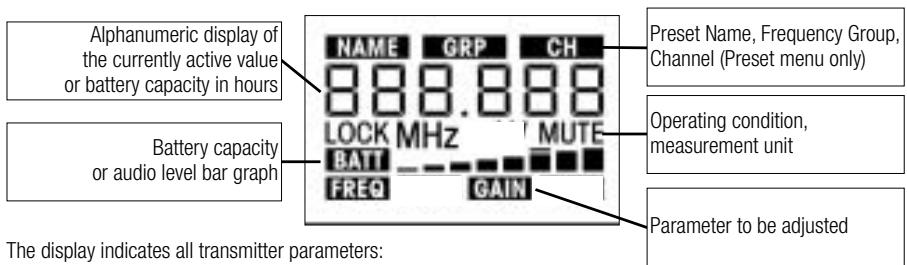
The display indicates all transmitter parameters:
- Carrier frequency in MHz or as a Channel of a Frequency Group
- Audio input level
- Battery status and remaining operating time
- Error messages
- Setup menus: Frequency, Preset, Gain
The backlighting of the display comes on every time you actuate the setup switch and will switch off after approximately 10 seconds.
3 ON/OFF button: A short push (approx. 0.6 seconds) will switch power to the transmitter ON and activate the display (2) and status LED (1). The transmitter will be ready to operate after approx. 7 seconds.
A long push (approx. 2 seconds) will switch power to the transmitter OFF.
The ON/OFF button is recessed for protection from unintentional actuation.
Refer to fig. 1.
4 MUTE switch: Sliding the MUTE switch toward the outside of the transmitter (arrow) will mute the audio signal. The status LED (1) will change to red. Since power and the RF section remain ON, no unwanted noise will become audible from the sound system when you mute the audio signal.
To switch the audio signal back on, slide the MUTE switch toward the inside of the transmitter (toward the ON/OFF switch). The status LED (1) will change to green.
The MUTE switch is active in all modes.
5 Charging contacts: The recessed charging contacts allow you to recharge the optional AKG BP 4000 battery pack on the optional CU 4000 charger without having to remove the battery pack from the transmitter.
6 Setup switch: Sets the various parameters of the transmitter. The setup switch has the following functions:
- LOCK mode:
Turn left or right briefly to scroll between Frequency, Preset (only if a Preset has been loaded), Gain, and Battery Capacity (shown in hours) screens.
Long push: toggles between LOCK and ACTIVE modes when the transmitter is ON. When power to the transmitter is OFF, a long push switches the transmitter ON and places it in SILENT mode.
ACTIVE and SILENT modes only:
Short push: calls up a parameter for adjustment or confirms a selected value.
2 Description
Turn left briefly to select a menu item or decrease a parameter value.
Turn right briefly to select a menu item or increase a parameter value.
Turn left or right and hold to scroll through available values.
7 Battery compartment cover: Screw-on tube covering the battery compartment.
8 Frequency sticker: Sticker attached to the transmitter shaft, indicating the available carrier frequency range and approval data.
9 Battery compartment accepting the two supplied 1.5 V AA size batteries or the optional BP 4000 battery pack.
2.4.2 Interchangeable Microphone Elements (optional)
Refer to fig. 2.
The interchangeable microphone elements (11) D 5 WL1, C 5 WL1, D 3700 WL1, D 3800 WL1, C 5900 WL1, and C 535 WL1 are acoustically and mechanically identical to the equivalent hardwire versions. They feature the same transducer capsules and mechanical construction.
Extremely high gain before feedback, optimum handling noise rejection, ultimate protection from damage, and an integrated wind and pop screen are only the most impressive features of these microphones.
For more details, refer to the respective AKG brochures or visit www.akg.com.
3 Setting Up
Important!
- Prior to setting up your WMS 4500, check that the transmitter and receiver are tuned to the same frequency, referring to section 3.6 and the receiver manual.
We recommend setting all channels to the same Preset and the same Group.
In the following sections, flashing characters are identified by angle symbols " > " and " < " . All values shown are examples of available settings.
| ● | Short push on the setup switch. |
| ● | Long push on the setup switch. |
| — | Turn the setup switch briefly to the left. |
| — | Turn the setup switch briefly to the right. |
| — | Turn the setup switch briefly to the left or right. |
-
Screw the microphone element CW onto the thread on the transmitter. All electrical connections will be made automatically.
-
Unscrew the battery compartment cover (1) CCW from the transmitter.
-
Push the locking button (2) toward the microphone element to unlock the securing clamp (3).
-
Make sure to hold down the securing clamp (3) as you unlock it. The securing clamp is spring-loaded and may cause injury if it is allowed to jump out of the battery compartment.
-
Insert the two supplied batteries into the battery compartment, aligning the batteries with the polarity symbols inside the battery compartment. If you insert the batteries the wrong way, the transmitter will not be powered.
- Press the securing clamp (3) down on the battery compartment to the point that the locking button (2) will engage and screw the battery compartment cover (1) back onto the transmitter CW.
- Alternatively to the supplied dry batteries, you may use the optional BP 4000 battery pack from AKG. The BP 4000 fits into the battery compartment in the correct orientation only, so you cannot insert it the wrong way.
-
Never use standard rechargeable batteries! These may damage the transmitter if the charging contacts are shorted and will provide no remaining battery life indication. AKG will accept no liability for any damage resulting from the use of standard rechargeable batteries.
-
LOCK mode: The transmitter transmits the microphone output signal to the receiver. All adjustment functions are electronically locked to prevent parameters from being readjusted unintentionally during a performance or lecture.
- ACTIVE mode: The transmitter transmits the microphone output signal to the receiver. All controls are active. You can check all transmitter parameters and set the carrier frequency (refer to section 3.6) and input gain (refer to section 3.8).
- SILENT mode: Power to the transmitter is ON, but no RF signal is transmitted. The
Note:
Symbols
3.1 Mounting
the Microphone Element
Refer to fig. 2.
3.2 Inserting Batteries
Refer to fig. 3.

Important!
Note:

Important!
3.3 Operating Modes
3 Setting Up
status LED remains dark. You can check all transmitter parameters and set the carrier frequency (refer to section 3.6) and input gain (refer to section 3.8).
Important!

We recommend setting the carrier frequency in SILENT mode only. This is the only way to make sure you won't "go on air" on a frequency that is not allocated or coordinated and risk "jamming" some other radio service or active radio mic.
3.4 Powering Up
Depending on the way you switch power to the transmitter ON, the transmitter will be in either LOCK mode or SILENT mode on powering up.
Important!

- If you are not sure what carrier frequency the transmitter is tuned to, switch the transmitter to SILENT mode (refer to section 3.4.1 below) and check that the current carrier frequency is legal and identical to the frequency selected on the receiver.
3.4.1 Powering Up in SILENT Mode
Refer to fig. 1.
- Push and hold the setup switch (6) until the backlighting of the display (2) comes on. The display (2) will first show the firmware version and then the currently selected carrier frequency in MHz. As the backlighting goes out, the display changes as follows:
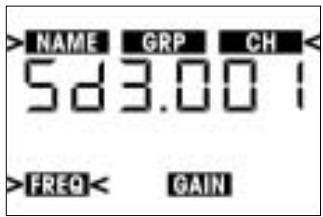
The transmitter is now in SILENT mode.
- If the carrier frequency is not an allocated or coordinated one and/or different from the receiver frequency, set the transmitter to a suitable, legal frequency referring to section 3.6.
3.4.2 Powering Up in LOCK Mode
Refer to fig. 1.
- Press the ON/OFF button (3) for approx. 0.6 seconds.
- As soon as the below screen appears on the display (2), the transmitter is in LOCK mode.
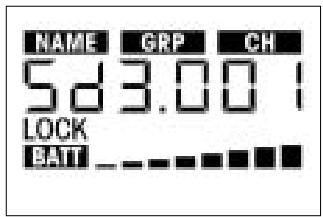
The "LOCK" label indicates that all controls except for the MUTE switch are electronically locked to prevent misadjustment.
Note:
-
If the microphone is muted, the "MUTE" label appears on the display and the status LED is lit red. If the microphone is active, "MUTE" will not appear and the status LED will be lit green.
-
Push and hold the ON/OFF button (3) until the message "oFF" appears on the display (2).
The display goes dark and power to the transmitter is OFF.
-
If you are not sure as to what carrier frequency the transmitter is tuned to, place the transmitter into SILENT mode following steps 1 and 2 below. In SILENT mode, you can check and adjust the carrier frequency and input gain without transmitting a radio signal.
-
If the transmitter is ON, switch it OFF.
- Push and hold the setup switch until the display backlighting comes on.
The display will first show the battery capacity in hours and as a bargraph and then the currently selected carrier frequency in MHz.
As the backlighting goes out, the display changes as follows:
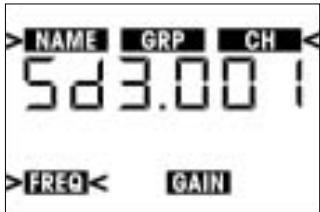
The transmitter is now in SILENT mode and the display shows the Preset menu.
- You can either select one of the Preset Channels from the Preset menu (section 3.6.1) or set the carrier frequency in 25-kHz increments in the Frequency menu (section 3.6.2). The spacing between Preset frequencies prevents any mutual interference.
A Preset comprises one or more Groups of carrier frequencies. Group numbers are shown under the "GRP" label. Carrier frequencies are also called "Channels" whose numbers are indicated below the "CH" label. The spacing between these frequencies is wide enough to prevent any mutual interference (intermodulation). Presets make it much easier to design a multichannel system. They save time because you do not need to calculate your own carrier frequencies and help you avoid intermodulation problems.
Each Preset has a one or two-character "NAME" relating to the country where the respective carrier frequencies are allocated (e.g., "SD" for countries with no regulations, "US" for the USA, or "UK" for Britain, etc.). The Preset names are sorted alphabetically.
When designing a multichannel system, make sure to use Channels within the same Group only. Using Channels of different Presets and/or Groups simultaneously may cause intermodulation.
-
Some Presets may be approved in more than one country. To check which Frequency Group(s) is (are) approved in your country, visit www.akgfrequency.at or contact your local regulation authority.
-
Push the setup switch briefly. The "NAME" label and the name of the currently active Preset will start flashing.
If no Preset has been stored in memory, the 2nd line of the display shows "-- -- --".
- To select the next Preset, turn the setup switch briefly to the right.
To select the previous Preset, turn the setup switch briefly to the left.
- Having selected the desired Preset, push the setup switch briefly. The "GRP" label and the number of the currently active Frequency Group will start flashing.
3.5 Powering Down (all modes)
Refer to fig. 1.
3.6 Setting the Carrier Frequency

3.6.1 Preset Menu
Note:
3 Setting Up
- To select the next higher Frequency Group number, turn the setup switch briefly to the right.
To select the next lower Frequency Group number, turn the setup switch briefly to the left. - Having selected the desired Frequency Group, push the setup switch briefly. "CH" and the number of the currently active Channel start flashing. Each Channel represents one factory-preset, intermodulation-free carrier frequency.
- To select the next higher Channel number, turn the setup switch briefly to the right. To select the next lower Channel number, turn the setup switch briefly to the left.
- Having finished your settings, push the setup switch briefly. This brings up the following screen:
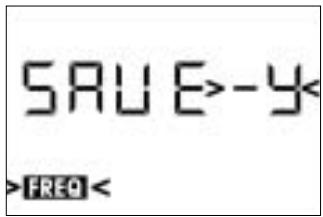
8a If you want to save the selected carrier frequency, push the setup switch briefly. The setting will be saved in memory and the display will change as follows:
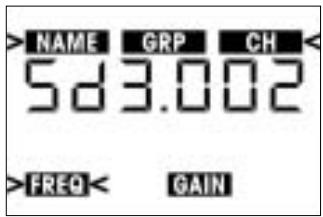
8b If you'd rather not save the selected frequency, briefly turn the setup switch to the left or right.
This brings up the following screen:
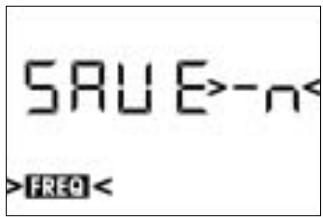
Refer to section 3.4.2.
-
Push the setup switch briefly. The transmitter will stay tuned to the original frequency.
-
To switch the transmitter into LOCK mode, switch the transmitter OFF and back ON in LOCK mode, referring to section 3.4.2.
-
To move from the Preset to the Frequency menu, turn the setup switch briefly to the left. Push the setup switch briefly. The display will change like this:
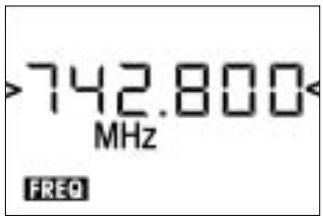
- To increase the frequency by 25kHz turn the setup switch briefly to the right. To decrease the frequency by 25kHz turn the setup switch briefly to the left.
- Having set the desired frequency, push the setup switch briefly. This brings up the following screen:
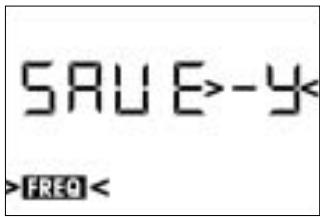
4a If you want to save the selected frequency, push the setup switch briefly. Your setting will be saved in memory and the display will change as follows:
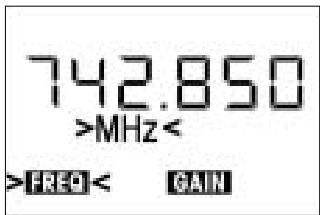
4b If you'd rather not save the selected frequency, briefly turn the setup switch to the left or right.
This brings up the following screen:
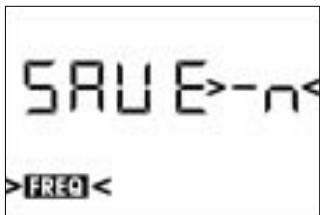
- Push the setup switch briefly. The transmitter will stay tuned to the original frequency.
3.7 Multichannel Systems
3 Setting Up
- Be sure to assign a separate carrier frequency to each wireless channel (transmitter and receiver).
- To find intermodulation-free carrier frequencies quickly and easily, we recommend selecting all required carrier frequencies from the same Frequency Group within the same Preset.
Note:
- If reception on the selected carrier frequency is poor, use automatic Frequency Selection on the receiver to find the next clean Channel within the selected Frequency Group. Should you find no clean Channel, use automatic Frequenc y Selection on the receiver to select a different Frequency Group within the same Preset and selecet a new frequency for each transmitter and receiver.
Important!

- Do not operate two or more wireless channels on the same frequency at the same time and location. This would cause unwanted noise due to radio interference.
3.8 Setting Input Gain
You can set the transmitter input gain either in SILENT mode or in ACTIVE mode. We recommend setting the input gain in ACTIVE mode because you can switch to LOCK mode directly, without having to power down first.
- To move from LOCK mode to ACTIVE mode, push and hold the setup switch for approx. two seconds.
The display will change as follows:
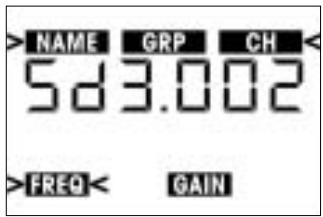
- Turn the setup switch briefly to the right once. The display will show the current input gain in dB and the "GAIN" label will be flashing.
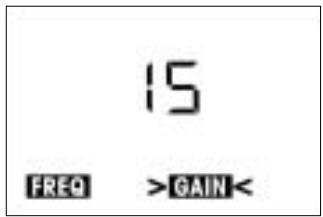
- Push the setup switch briefly. The currently selected input gain value in dB will be flashing on the display.
- Set the audio section input gain either manually (continue with section 3.8.1) or in automatic Gain mode (continue with section 3.8.2).
3.8.1 Setting Gain Manually
- To increase the gain value by 1 dB, turn the setup switch briefly to the right.
To decrease the gain value by 1 dB, turn the setup switch briefly to the left. The readout "00" will be followed by "Auto" (refer to section 3.8.2). - Push the setup switch briefly.
The display will change as follows:
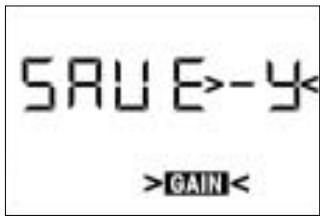
- If you want to save the new setting, push the setup switch briefly.
The display will show your new gain setting in dB and the "GAIN" label will be flashing. - If you'd rather not save your setting, turn the setup switch briefly to the left or right. The display will change to "SAVE-n".
-
Push the setup switch briefly. The display will revert to the original setting, with the "GAIN" label flashing.
-
To set input gain again, repeat steps 1 and 2 above.
-
To return to LOCK mode, push and hold the setup switch for approx. 1.5 seconds.
-
From the Gain menu, turn the setup switch to the left and hold until the display changes as follows:
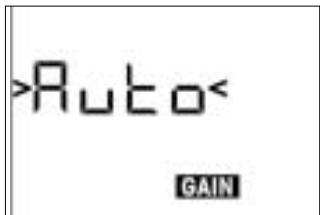
3.8.2 Using
Automatic Gain Mode
- Push the setup switch briefly.
The message " > tEST < " will start flashing on the display.
- Talk or sing into the microphone as loud as you can.
The transmitter will automatically set the optimum input gain.
The display indicates the audio level by short lines. The peak level is indicated by a heavier line that will remain fixed for approx. 2 seconds.
- Push the setup switch briefly.
The display will show "SAVE > - < "
To save the new setting, push the setup switch briefly.
The display will show your new gain setting in dB and the "GAIN" label will be flashing.
- If you'd rather not save your setting, turn the setup switch briefly to the left or right. The display will change to "SAVE > - n < ".
- Push the setup switch briefly. The display will revert to your original setting, with the "GAIN" label flashing.
-
To set input gain again, repeat steps 1 through 4 above.
-
To return to LOCK mode, push and hold the setup switch for approx. two seconds.

4.1 Status Screens and Setup Menus
4.1.1 LOCK Mode
4 Operating Notes
In LOCK mode, four status screens are available.
| 742.800 LOCK MHz MUTE 3000 | |
| 1 | Frequency screen: Carrier frequency in MHz, battery capacity bars. The "MUTE" label appears if the micro-phone is muted. |
| ←→ | NAME GRP CH 5d 3.0 0 LOCK EN1 |
| 2 | Preset screen (comes up only if at least one Preset has been saved): Carrier frequency as Channel number within a Frequency Group, battery capacity bars. If the microphone is ON, the "MUTE" label is off. |
| ←→ | 15 LOCK MUTE ENH GAIN |
| 3 | Gain screen: Input gain in dB. |
| ← | 15.0 h LOCK HUT |
| 4 | Battery screen: Battery capacity in hours and as bar graph. If the micro-phone is ON, the "MUTE" label is off. |
- To scroll through the status screens in the order shown above, turn the setup switch briefly to the right.
- To step through the above screens in reverse order, turn the setup switch briefly to the left.
4.1.2 ACTIVE and SILENT Modes
In ACTIVE and SILENT modes, the various setup menus described in sections 3.4 through 3.8 come up in the order shown below:
- Preset menu
Frequency menu - Gain menu
Battery screen
4.2 Selecting Modes
- To toggle between LOCK mode and ACTIVE mode, push and hold the setup switch for approx. two seconds.
In LOCK mode, the "LOCK" label will be shown on the display.
Note:
- The transmitter is on the air in ACTIVE mode, too. Remember, though, that settings may change if you inadvertently actuate the setup switch.
The transmitter will revert to LOCK mode after about 15 minutes.
4 Operating Notes
-
To toggle between LOCK or ACTIVE mode and SILENT mode:
-
Switch power to the transmitter OFF.
-
Hold down the ON/OFF switch for approx. 0.6 seconds to enter LOCK mode OR hold down the setup switch for approx. two seconds to enter SILENT mode.
-
To mute the microphone, slide the MUTE switch (4) toward the outside of the transmitter. The status LED (1) will change to red.
- To switch the microphone back ON, slide the MUTE switch (4) toward the inside of the transmitter. The status LED (1) will change to green.
In LOCK mode, the display constantly indicates the current battery capacity bargraph below the frequency readout.
- You can check the remaining battery capacity at any time by turning the setup switch briefly to the left or right one to three times (depending on the currently active screen). The battery capacity will be displayed in hours and as a bargraph.
- If the "BATT" label starts flashing, a dash appears instead of the bargraph, and the status LED changes to red, replace the batteries or charge the BP 4000 battery pack as soon as possible.
A handheld vocal microphone provides many ways of shaping the sound of your voice as it is heard over the sound system.
The following sections contain useful hints on how to use your HT 4500 handheld transmitter for best results.
Basically, your voice will sound the bigger and mellower, the closer you hold the microphone to your lips. Moving away from the microphone will produce a more reverberant, more distant sound as the microphone will pick more of the room's reverberation.
You can use this effect to make your voice sound aggressive, neutral, insinuating, etc. simply by changing your working distance.
Proximity effect is a more or less dramatic boost of low frequencies that occurs when you sing into the microphone from less than 2 inches. It gives more "body" to your voice and an intimate, bass-heavy sound.
- Sing to one side of the microphone or above and across the microphone's top. This provides a well-balanced, natural sound.
- If you sing directly into the microphone, it will not only pick up excessive breath noise but also overemphasize "sss", "sh", "tch", "p", and "t" sounds.
Feedback means that part of the sound projected by a speaker is picked up by a microphone, fed to the amplifier, and projected again by the speaker. Above a specific volume or system gain setting called the feedback threshold, the signal starts being regenerated indefinitely, making the sound system howl and the sound engineer desperately dive for the master fader to reduce the volume and stop the howling.
- To increase usable gain before feedback, place the main ("FOH") speakers in front of the microphones (along the front edge of the stage).
- If you use monitor speakers, be sure never to point any microphone directly at the monitors.
Feedback may also be triggered by resonances depending on the acoustics of the room or hall. With resonances at low frequencies, proximity effect may cause feedback. In this case, it is often enough to move away from the microphone a little to stop the feedback.
- Never let more than two persons share a microphone.
- Ask your backing vocalists never to sing more than 35 degrees off the microphone axis. The microphone is very insensitive to off-axis sounds. If the two vocalists were to sing into the microphone from a wider angle than 35 degrees, you may end up bringing up the fader of the microphone channel far enough to create a feedback problem.
4.3 Muting the Microphone Refer to fig. 1.
4.4 Replacing Batteries Refer to fig. 3.
4.5 Microphone Technique
4.5.1 Working Distance and Proximity Effect Refer to fig. 4.
4.5.2 Angle of Incidence Refer to fig. 4.
4.5.3 Feedback Refer to fig. 5.
4.5.4 Backing Vocals Refer to fig. 6.

4.6 Multichannel Systems
4 Operating Notes
- If reception on the selected carrier frequency is poor, use automatic Frequency Selection ("FREQ" -> "AUTO" -> "CHANNEL") on the receiver to find the nearest clean Channel within the selected Frequency Group.
- Should you find no clean Channel, use automatic Frequency Selection ("FREQ" -> "AUTO" -> "GROUP") on the receiver to select a different Frequency Group within the same Preset and selecet a new frequency for each transmitter and receiver.
4.7 Battery Care
- If you know you won't be using the transmitter for more than a week, remove the batteries or BP 4000 battery pack from the transmitter.
- Make it a habit to charge the BP 4000 battery pack fully every time you used the transmitter for at least one or two hours. This is a good way to prevent the battery pack from dying in the middle of the next gig.
- Always charge the BP 4000 battery pack fully before storing it outside the transmitter. This will maintain the battery pack's capacity at a higher level for a longer time.

5 Cleaning
To clean the transmitter surfaces, use a soft cloth moistened with water.
| Error Messages | Problem | Remedy |
| Err.>rF< | PLL error. (Receiver unable to lock on to selected frequency.) | 1. Press setup switch briefly and set different frequency. 2. If problem persists, contact your nearest AKG Service Center. |
| Err.>SYS< | Frequency settings cannot be changed. | 1. Switch power to transmitter OFF and back ON after about 10 seconds. 2. If problem persists, contact your nearest AKG Service Center. |
| Err.>USr< | Last setting cannot be loaded. | 1. Set frequency again. 2. If problem occurs frequently, contact your nearest AKG Service Center. |
| Err.>FrE< | Frequencies cannot be selected from Frequency screen. | 1. Continue with previous setting. 2. Press setup switch briefly and set frequency from Preset screen. 3. If problem occurs frequently, contact your nearest AKG Service Center. |
| Err.>PrE< (comes up on powering up or when trying to select a Preset and appears on receiver, too.) | All Presets defective; no Preset selec-table. | 1. Use frequency screen to set frequency section 3.6.2). 2. Contact your nearest AKG Service Center. |
| Err.>PrE< (comes up on powering up only and does not appear on receiver.) | One or more Presets defective. | 1. You can select Presets, but note that defective Presets will not be available. 2. Contact your nearest AKG Service Center. |
| Err.>rPt< | No remaining battery life data available. | 1. Check batteries: replace standard rechargeable batteries immediately with dry batteries or AKG BP 4000 battery pack. 2. Remove and reinsert BP 4000 battery pack. 3. If error persists, charge battery pack. 4. If error occurs with several different battery packs or types of dry batteries, contact your nearest AKG Service Center. |
| Err.>AF< | No signal at audio input. | 1. Check microphone element. 2. Mount microphone element. 3. Briefly push setup switch. 4. If error occurs frequently, contact your nearest AKG Service Center. |
| Rec.>Acc< | BP 4000 battery pack needs recovery. | • Run recovery cycle. Refer to User Manual of optional CU 4000 charger. |
| Error Message | Problem | Remedy |
| Err.>JoG< | Internal setup switch error. | 1. (Setup switch responds in spite of error message:) Switch power to transmitter off, wait for 10 seconds, and switch power back on. 2. (Setup switch fails to respond:) Remove and reinsert batteries/BP 4000 battery pack, and switch power to transmitter on. 3. If error persists, contact your nearest AKG Service Center. |
- The above error messages may appear on the display upon powering up or during operation:
- To delete an error message, push the setup switch.
- For more hints on troubleshooting, refer to the SR 4000 receiver manual.
| Carrier frequency ranges: | 500-530, 570-600, 650-680, 680-710, 720-750, 760-790, 790-820, 835-862 MHz |
| Carrier frequencies: | up to 1,200 |
| Modulation: | FM |
| Rated deviation: | ±20 kHz |
| Audio bandwidth: | 35 Hz to 20 kHz |
| T.H.D. at 1 kHz: | <0.3% at rated deviation |
| S/N Ratio (A-weighted) | 118 dB(A) typical |
| RF output: | 50 mW max. ERP |
| Current consumption: | <135 mA |
| Power requirement: | 2 AA size 1.5 V batteries or BP 4000 rechargeable battery pack |
| Battery life: | dry batteries: 15 hours, BP 4000: 12 hrs. |
| Size: | 70 x 90 x 25 mm (2.8 x 3.5 x 1.0 in.) |
| Net Weight: | 320 g (11.3 oz.) without batteries |
This product conforms to the standards listed in the Declaration of Conformity. To order a free copy of the Declaration of Conformity, visit http://www.akg.com or contact sales@akg.com.
Page
3.2 Colocar as pilhas
Veja fig. 3.

Important!
Nota:

Important!
4.4 Trocar as pilhas/ o accumulator
Veja fig. 3.
For other products and distributors worldwide visit www.akg.com


ROHS OK

A Harman International Company
Technische Änderungen vorbehalten. Specifications subject to change without notice. Ces caractéristiques sont susceptibles de modifications. Ci riserviamo il diritto di effettuare modifiche tecniche. Nos reservamos el correcho de introducir modificaciones Tecnicas. Especificações sujeitas a mudanças sem uso prévio.
Printed in China (P.R.C.)
02/08/9100 U 12740

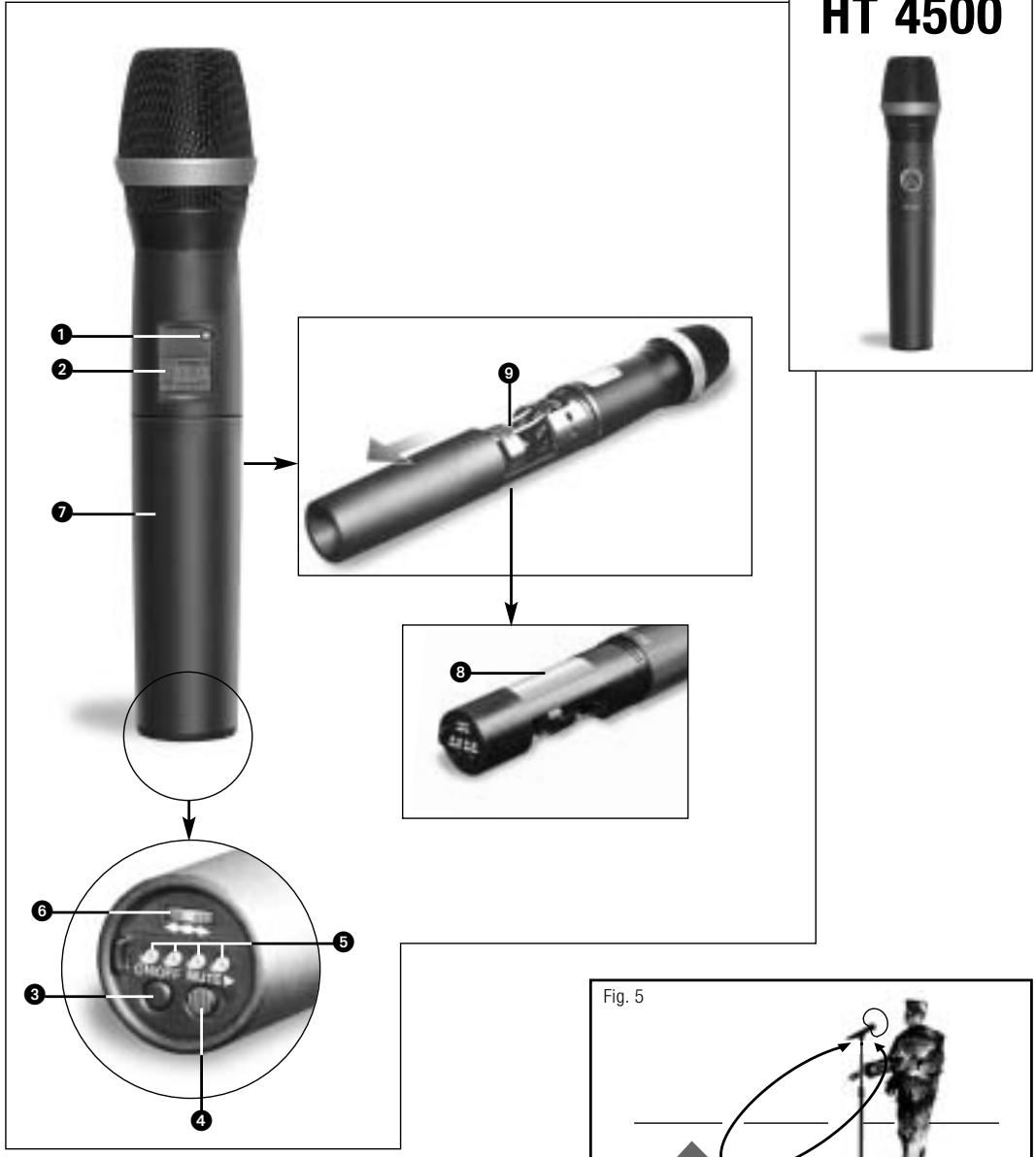
Fig. 1

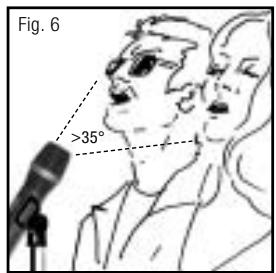
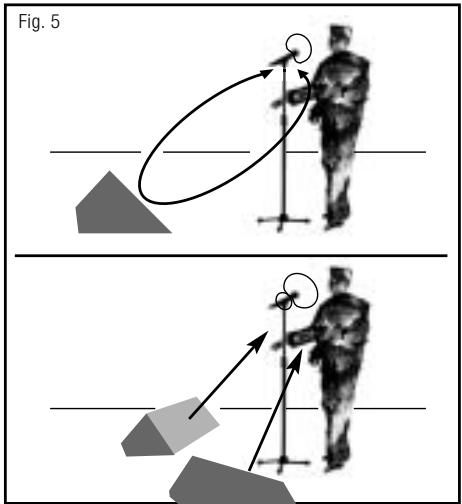
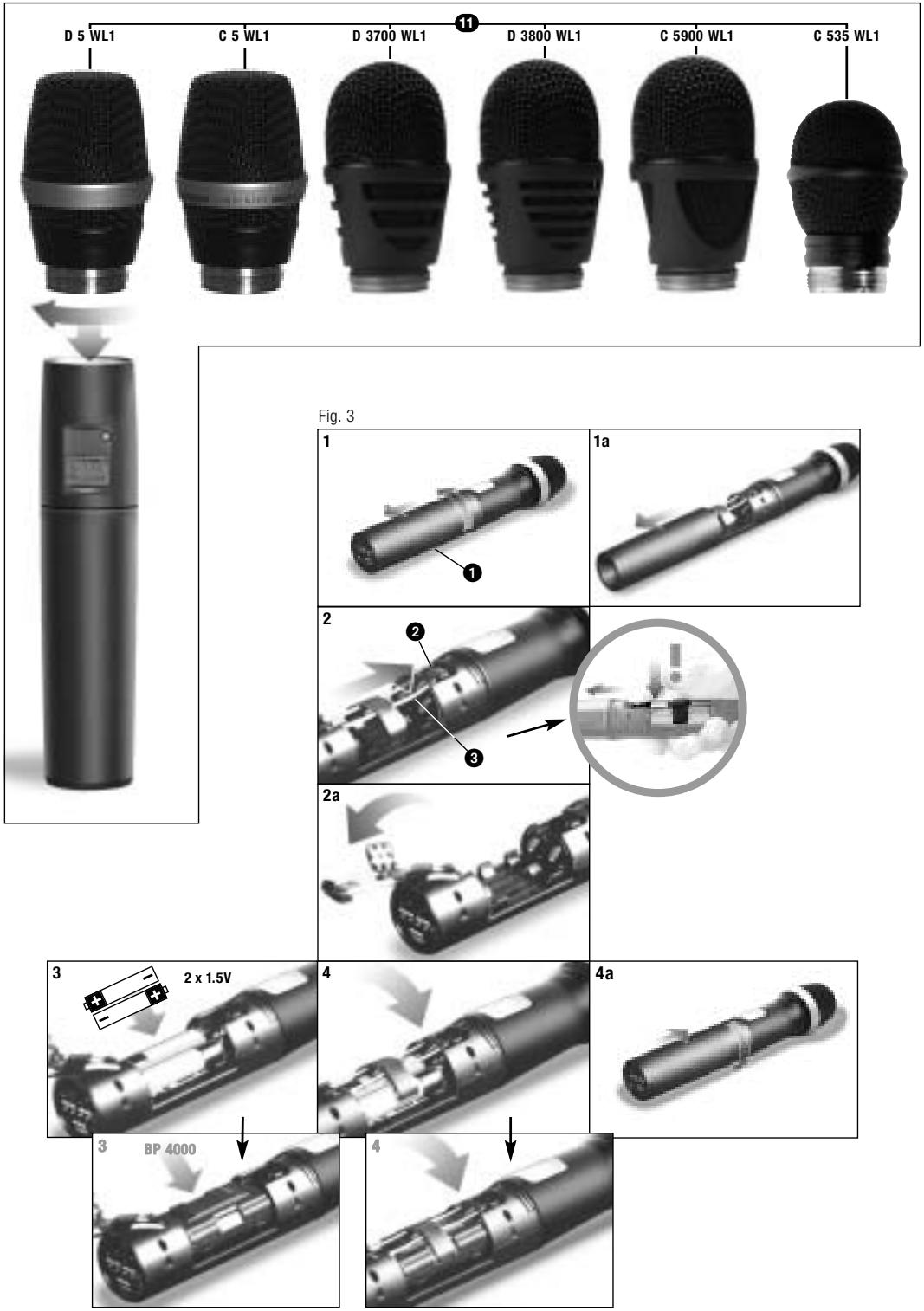
Fig. 2
- Safety and Environment 21
- FCC Statement. 21
- Description 22
- Setting Up 25
- Operating Notes 32
- Cleaning 34
- Error Messages 35
- Specifications 37
- Safety and Environment
- FCC Statement
- Introduction
- Packing List
- Optional Accessories
- Description
- Important!
- Controls
- Description
- Interchangeable Microphone Elements (optional)
- Setting Up
- Mounting
- the Microphone Element
- Inserting Batteries
- Powering Up
- Powering Up in SILENT Mode
- Powering Up in LOCK Mode
- Note:
- Preset Menu
- Multichannel Systems
- Setting Input Gain
- Setting Gain Manually
- Operating Notes
- ACTIVE and SILENT Modes
- Selecting Modes
- Multichannel Systems
- Battery Care
- Cleaning
- Colocar as pilhas
Brand : AKG
Model : HT 4500
Category : Wireless Microphone System