USER MANUAL UA-1EX EDIROL
Thank you, and congratulations on your choice of the UA-1EX USB Audio Interface.
Before using this unit, carefully read the sections entitled: "USING THE UNIT SAFELY" and "IMPORTANT NOTES" (p. 2; p. 4). These sections provide important information concerning the proper operation of the unit. Additionally, in order to feel assured that you have gained a good grasp of every feature provided by your new unit, Owner's manual should be read in its entirety. The manual should be saved and kept on hand as a convenient reference.
USING THE UNIT SAFELY
INSTRUCTIONS FOR THE PREVENTION OF FIRE, ELECTRIC SHOCK, OR INJURY TO PERSONS
About WARNING and CAUTION Notices
| WARNING | Used for instructions intended to alert the user to the risk of death or severe injury should the unit be used improperly. |
| CAUTION | Used for instructions intended to alert the user to the risk of injury or material damage should the unit be used improperly.* Material damage refers to damage or other adverse effects caused with respect to the home and all its furnishings, as well to domestic animals or pets. |
About the Symbols
| △ | The △symbol alerts the user to important instructions or warnings. The specific meaning of the symbol is determined by the design contained within the triangle. In the case of the symbol at left, it is used for general cautions, warnings, or alerts to danger. |
| ◎ | The ⊙symbol alerts the user to items that must never be carried out (are forbidden). The specific thing that must not be done is indicated by the design contained within the circle. In the case of the symbol at left, it means that the unit must never be disassembled. |
| ◎ | The ●symbol alerts the user to things that must be carried out. The specific thing that must be done is indicated by the design contained within the circle. In the case of the symbol at left, it means that the power-cord plug must be unplugged from the outlet. |
ALWAYS OBSERVE THE FOLLOWING
WARNING
- Before using this unit, make sure to read the instructions below, and the Owner's Manual.
- Do not open or perform any internal modifications on the unit.
- Do not attempt to repair the unit, or replace parts within it (except when this manual provides specific instructions directing you to do so). Refer all servicing to your retailer, the nearest Roland Service Center, or an authorized Roland distributor, as listed on the "Information" page.


WARNING
- Never use or store the unit in places that are:
- Subject to temperature extremes (e.g., direct sunlight in an enclosed vehicle, near a heating duct, on top of heat-generating equipment); or are
- Damp (e.g., baths, washrooms, on wet floors); or are
- Humid; or are
- Exposed to rain; or are
- Dusty; or are
- Subject to high levels of vibration.


WARNING
- Make sure you always have the unit placed so it is level and sure to remain stable. Never place it on stands that could wobble, or on inclined surfaces.

- This unit, either alone or in combination with an amplifier and headphones or speakers, may be capable of producing sound levels that could cause permanent hearing loss. Do not operate for a long period of time at a high volume level, or at a level that is uncomfortable. If you experience any hearing loss or ringing in the ears, you should immediately stop using the unit, and consult an audiologist.

- Do not allow any objects (e.g., flammable material, coins, pins); or liquids of any kind (water, soft drinks, etc.) to penetrate the unit.

- Immediately disconnect the USB cable, and request servicing by your retailer, the nearest Roland Service Center, or an authorized Roland distributor, as listed on the "Information" page when:

- If smoke or unusual odor occurs
- Objects have fallen into, or liquid has been spilled onto the unit; or
- The unit has been exposed to rain (or otherwise has become wet); or
- The unit does not appear to operate normally or exhibits a marked change in performance.

WARNING
- In households with small children, an adult should provide supervision until the child is capable of following all the rules essential for the safe operation of the unit.

- Protect the unit from strong impact. (Do not drop it!)

- DO NOT play a CD-ROM disc on a conventional audio CD player. The resulting sound may be of a level that could cause permanent hearing loss. Damage to speakers or other system components may result.


CAUTION
- Try to prevent cords and cables from becoming entangled. Also, all cords and cables should be placed so they are out of the reach of children.

- Never climb on top of, nor place heavy objects on the unit.

- Disconnect all cords coming from external devices before moving the unit.

In addition to the items listed under "USING THE UNIT SAFELY" on pages 2 and 3, please read and observe the following:
Placement
- Using the unit near power amplifiers (or other equipment containing large power transformers) may induce hum. To alleviate the problem, change the orientation of this unit; or move it farther away from the source of interference.
- This device may interfere with radio and television reception. Do not use this device in the vicinity of such receivers.
- Noise may be produced if wireless communications devices, such as cell phones, are operated in the vicinity of this unit. Such noise could occur when receiving or initiating a call, or while conversing. Should you experience such problems, you should relocate such wireless devices so they are at a greater distance from this unit, or switch them off.
- Do not expose the unit to direct sunlight, place it near devices that radiate heat, leave it inside an enclosed vehicle, or otherwise subject it to temperature extremes. Excessive heat can deform or discolor the unit.
- When moved from one location to another where the temperature and/or humidity is very different, water droplets (condensation) may form inside the unit. Damage or malfunction may result if you attempt to use the unit in this condition. Therefore, before using the unit, you must allow it to stand for several hours, until the condensation has completely evaporated.
Maintenance
- For everyday cleaning wipe the unit with a soft, dry cloth or one that has been slightly dampened with water. To remove stubborn dirt, use a cloth impregnated with a mild, non-abrasive detergent. Afterwards, be sure to wipe the unit thoroughly with a soft, dry cloth.
- Never use benzine, thinners, alcohol or solvents of any kind, to avoid the possibility of discoloration and/or deformation.
Additional Precautions
- Use a reasonable amount of care when using the unit's buttons, sliders, or other controls; and when using its jacks and connectors. Rough handling can lead to malfunctions.
- When connecting / disconnecting all cables, grasp the connector itself—never pull on the cable. This way you will avoid causing shorts, or damage to the cable's internal elements.
- To avoid disturbing your neighbors, try to keep the unit's volume at reasonable levels. You may prefer to use headphones, so you do not need to be concerned about those around you (especially when it is late at night).
-
When you need to transport the unit, package it in the case that it came in, if possible. Otherwise, you will need to use equivalent packaging materials.
-
Use a cable from Roland to make the connection. If using some other make of connection cable, please note the following precautions.
- Some connection cables contain resistors. Do not use cables that incorporate resistors for connecting to this unit. The use of such cables can cause the sound level to be extremely low, or impossible to hear. For information on cable specifications, contact the manufacturer of the cable.
Handling CD-ROMs
-
Avoid touching or scratching the shiny underside (encoded surface) of the disc. Damaged or dirty CD-ROM discs may not be read properly. Keep your discs clean using a commercially available CD cleaner.
-
Microsoft and Windows are registered trademarks of Microsoft Corporation.
- The screen shots in this document are used in compliance with the guidelines of the Microsoft Corporation.
- Windows® is known officially as: "Microsoft" Windows® operating system."
- Apple and Macintosh are registered trademarks of Apple Computer, Inc.
- Mac OS is a trademark of Apple Computer, Inc.
- All product names mentioned in this document are trademarks or registered trademarks of their respective owners.
Contents of the Package 9
Names of Things and What They Do 11
Getting Connected and Installing Drivers (Windows) 15
About the Driver Modes 15
Installing the Driver 16
Windows XP/2000 users 16
Windows Me/98 users 21
Driver Settings 22
About the input and output devices 22
Input/output device setting 23
Sequencer software settings 24
Checking that you hear sound 25
Getting Connected and Installing Drivers (Macintosh) 27
About the Driver Modes 27
Mac OS X Users 28
Installing the driver 28
Input/output device settings 29
Mac OS 9 Users. 30
Installing the UA-1EX driver. 30
Installing the ASIO driver 30
Checking that you hear sound 32
Basic use 34
Listening to Sound from Your Computer 34
Recording a Cassette Tape or LP into Your Computer 35
Recording Sound from Your Computer onto MD or DAT 37
Recording the Digital Output from a CD/MD/DAT into Your Computer 38
Recording a Mic. 39
Adjusting the Audio Latency 41
Decreasing the ASIO Buffer Size (Windows) 42
Using ASIO Direct Monitor (Windows/Mac OS 9) 43
Appendices 45
Installing the OS-Standard Driver 45
Windows XP/2000 users 45
Windows Me users 46
Windows 98 users 47
Input/output device setting. 49
Mac OS X users 53
Mac OS 9 users 54
Troubleshooting 55
UA-1EX Block Diagram 68
Main Specifications 69
Deutsch
The UA-1EX includes the following items. When you open the package, first make sure that all items are included. If any are missing, contact the dealer where you purchased the UA-1EX.
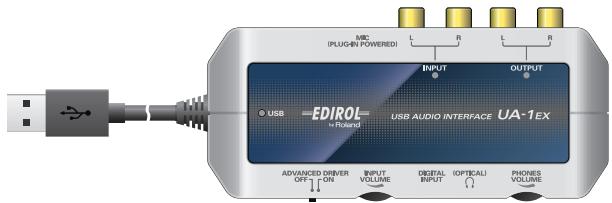
USB Audio Interface UA-1EX
CD-ROM
This contains drivers for using the UA-1EX in Advanced mode.
- Be careful not to touch or scratch the recorded surface (unprinted surface) of the disc. Doing so may render the disc unreadable. If the disc gets dirty, use a commercially available CD cleaner to clean it.
- Do not play back the CD-ROM in a conventional audio CD player. Doing so may produce high-volume sound that can damage your hearing and/or speakers.

Owner's Manual
This is the manual you are reading. Please keep it on hand for reference.
■ You'll need to provide the following items
An external amp, speakers, headphones, microphone, and MD or DAT recorder are not included. The external amp, speakers, or headphones you'll need in order to hear the sound that is output by the UA-1EX are not included. Also not included are a microphone or an MD or DAT recorder, which you'll need in order to input sound to the UA-1EX. You will need to provide these items separately.
Audio cables for line input/output and digital input/output cables are not included. The cables you will need to connect the UA-1EX to your audio equipment are not included. You will need to provide these separately.
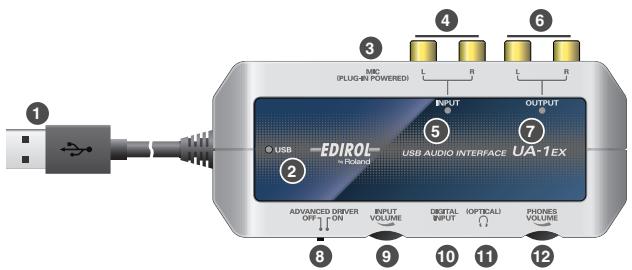
USB cable
Connect this to your computer so that audio signals can be transferred.
USB Indicator
After the UA-1EX is connected to your computer and your computer has recognized the UA-1EX, this indicator will light.
Connect a miniature condenser microphone that is designed for connection to a computer or other device that will supply power to the microphone. This jack provides a 3.3V power supply.
Use the Input volume to adjust the volume.
- You must use a monaural microphone that is designed for plug-in power.
Connect these when you want to input audio from an audio device or MIDI sound module.
Use the Input volume 9 to adjust the volume.
This will light when an audio signal is received from the mic input jack or the line input jacks.
Line output jacks
Connect these jacks to your audio system, such as amplified speakers or a stereo set.
- The volume of the audio output from these jackets cannot be adjusted on the UIA-1EX itself. Volume adjustments must be made on the audio device to which the UIA-1EX is connected.
Output indicator
This will light when an audio signal (sound) is being output from the line output jacks or the headphone jack.
ADVANCED (mode select) switch
This switches the driver mode. Normally, you should leave this ON.
| ON
(Advanced mode) | This mode uses a dedicated audio driver created specifically for the UA-1EX. Use this mode when you want to use your sequencer software or audio editing software to record, play, or edit audio with high quality and stable timing. |
| OFF
(Standard driver mode) | This mode uses the standard audio driver provided by the operating system. Use this mode when you want to use software that utilizes the functionality specific to your operating system. |
- If you change this setting, you must disconnect the UA-1EX from the computer and then reconnect it.
This adjusts the volume of the audio signal (sound) that is being input to the mic input jack ② and line input jacks ①.
Connect this when you want to input digital audio from an audio device such as a CD/MD/DAT.
Use an optical digital cable for connection.
Digital output connector (optical) / Headphone jack
The same jacks serves as both the headphone jack and digital output connector.
- You can connect an optical cable here, and output an audio signal in digital form to an MD recorder or other digital audio device.
- You can connect headphones here. Even if headphones are connected, sound will still be output from the Line output jacks
Optical
These are digital input/output jacks for connecting optical cables. Digital input/output jacks for connecting coaxial cables are labeled Coaxial.
Headphones volume
This adjusts the volume that is output from the Headphone jack ① .
- You can't adjust the volume that is output from the digital output connector and line output jacks.
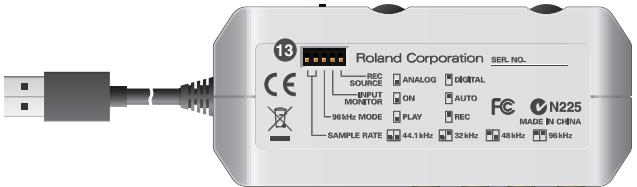
Setting select switches
These are miniature switches that you can slide up or down to make various settings.
- Sampling frequency select switch

SAMPLE RATE 44.1 kHz 32 kHz 48 kHz 96 kHz
This selects the sampling frequency for recording/playing audio data.
- If you've changed the sampling frequency, disconnect the UIA-1EX, and then reconnect it.
| 44.1kHz | Switch A set to the lower position
Switch B set to the lower position | Record/play at 44.1 kHz |
| 32kHz | Switch A set to the lower position
Switch B set to the upper position | Record/play at 32 kHz |
| 48kHz | Switch A set to the upper position
Switch B set to the lower position | Record/play at 48 kHz |
| 96kHz | Switch A set to the upper position
Switch B set to the upper position | Record or play at 96 kHz |
- 96 kHz play/record select switch

96 kHz MODE PLAYREC
If the sampling frequency is set to 96kHz , you can either record or play back (not both). Set this switch to choose either recording or playback.
- If you've changed setting, disconnect the UA-1EX, and then reconnect it.
| PLAY | Switch set to the lower position | Playback is selected. |
| REC | Switch set to the upper position | Recording is selected.
*You won't be able to play back sound from the computer. |

INPUT MONITOR

AUTO
This selects whether or not the audio signals that are input through the mic input jack ③ , digital input connector ⑩ , and Line input jacks ④ will be output to the headphone jack ⑩ and Line output jacks ⑥ .
| ON | Switch set to the lower position | The audio signal being received will be output to the Headphone jack and the Line output jacks. |
| AUTO(OFF) | Switch set to the upper position | Input monitoring will be switched on/off from your ASIO2.0 compatible sequencer software.(→“UsingASIO Direct Monitor (Windows/Mac OS 9)”(p.43))* The input signal will not be output if you're not usingthe ASIO driver. |
- If the recording source select switch is set to DIGITAL, input monitoring will always be ON regardless of the setting of this switch.
- Recording source select switch

REC SOURCE

DIGITAL
This selects the input signal that will be sent via USB to your computer as the recording source.
| ANALOG | Switch set to the lower position | The analog audio signal from the mic input jack or line input jacks will be sent to your computer. |
| DIGITAL | Switch set to the upper position | The sound from the digital input connector will be sent to the computer.
* If the DIGITAL position is selected, and no input signal is being sent to the digital input connector, the audio signal (sound) being output from the computer via USB will pass through the UA-1EX and then return to the computer. |
- If the recording source select switch is set to DIGITAL and a digital signal is being input to the Digital input connector, audio data from the computer cannot be played back.
About the Driver Modes
What is a driver?
A "driver" is software that transfers data between the UA-1EX and application software running on your computer, when your computer and the UA-1EX are connected. The driver sends data from your application to the UA-1EX, and from the UA-1EX to your application.
About the driver modes
The UA-1EX has two operating modes, Advanced mode and Standard driver mode, and a different driver is used by each mode.
| ON(Advanced mode) | This mode uses a dedicated audio driver created specifically for the UA-1EX. When this dedicated driver is used, you can record/play/edit audio with high quality and stable timing.Normally, you should use Advanced Mode.In Advanced mode, audio signals can be transferred between the UA-1EX and the computer at a resolution of 16/24 bits and sampling frequencies of 32/44.1/48/96 kHz.Choose Advanced mode if you are using sequencer software that supports 96 kHz or 24-bit audio, such as the Cakewalk series; or ASIO-compatible sequencer software that can record, play, and edit high-quality audio, such as Cubase VST or Logic.(→“Installing the Driver” (p. 16)). |
| OFF(Standard driver mode) | This mode uses the standard USB audio driver provided by Windows.You can use this mode without installing the dedicated driver.In Standard driver mode, audio signals are transferred between the UA-1EX and the computer at a resolution of 16 bits and sampling frequencies of 32/44.1/48 kHz.Choose this mode if you are using sequencer software that uses Window's own functionality, such as sequencer software that uses the CD-ROM drive of your computer to play CD audio, or that uses the software synthesizer included with Windows.(→“Installing the OS-Standard Driver” (p. 45)).* The driver included with Windows does not support ASIO.* Standard driver mode does not support 96 kHz or 24-bit. If you want to use 96 kHz or 24-bit audio, turn the ADVANCED (mode select) switch ON. |
Installing the Driver
The installation procedure will differ depending on your system.
Please proceed to one of the following sections, depending on the system you use.
- Windows XP/2000 users. (p. 16)
- Windows Me/98 users. (p. 21)
Steps to be performed on the UA-1EX itself are marked by a Operation of the UA-1EX symbol.
Windows XP/2000 users
- With the UA-1EX left unconnected, start up Windows.
Do not connect the UA-1EX to the computer until you reach Step 13 (p. 18).
Windows XP users
- Click the Windows start menu, and from the menu, select Control Panel.
- In "Pick a category," click "Performance and Maintenance."
- In "or pick a Control Panel icon," click the System icon. Depending on your setup, the System icon may appear directly in the Control Panel (Classic view). If so, double-click the System icon.
Windows 2000 users
- Click the Windows Start menu, and from the menu that appears, select Settings | Control Panel.
-
In Control Panel, double-click the System icon.
-
Click the Hardware tab, then click [Driver Signing].
The Driver Signing Options dialog box will open.
- In the Driver Signing Options dialog box, select "Ignore," then click [OK].
If the current setting is "Warn" or "Block," change this to "Ignore." Then, when you've finished installing the driver, change it back to the original setting.
- Click [OK] to close the System Properties dialog box.
- Exit all currently running software (applications).
Also close any currently open windows. If you are using virus checking or similar software, you must exit all of these programs as well.
- Prepare the CD-ROM.
Insert the CD-ROM into your computer's CD-ROM drive.
If the message "Windows can perform the same action each time you insert a disk or connect a device with this kind of file" appears, [Cancel].
- From the Windows start menu, choose Run...
The "Run..." dialog box will appear.
- In the Open field of the Run dialog box, type the following and click [OK].
D:\Driver\XP2k\setup.exe
-
The drive name is "D:" in the example shown here, but may be different on your system. Use the drive name for your CD-ROM drive.
-
The Driver Setup dialog box will appear.
Click [Next].
- To begin the installation, click [Next] once again. Installation will begin.
Windows XP users
If "Driver Signing Options" in step 4 is set to anything other than "Ignore," a dialog box with an "I" or "x" symbol will appear. If a [Continue Anyway] button is displayed, click [Continue Anyway] to proceed with the installation. If you are unable to continue, click [OK] and repeat the driver installation from step 1.
Windows 2000 users
If "Driver Signing Options" in step 4 is set to anything other than "Ignore," a dialog box indicating "Digital Signature Not Found" will appear. If a [Yes] button is displayed, click [Yes] to proceed with the installation. If you are unable to continue, click [OK] and repeat the driver installation from step 1.
The "Setup is now ready to install the drivers" dialog box will appear.
-
Operation of the UA-1EX Set the UA-1EX's ADVANCED (mode select) switch to ON.
-
The driver cannot be installed by means of the following procedure if the switch is set to OFF.
13. Operation of the UA-1EX Connect the UA-1EX to your computer.
A message of "Found New Hardware" will appear. Please wait.
- This unit is equipped with a protection circuit. A brief interval (a few seconds) after connecting the UIA-1EX is required before the unit will operate normally.
Windows XP users
- The Found New Hardware Wizard dialog box will appear.
If the message "Connect to Windows Update to search for software?" appears, choose "No" and then click [Next].
- Make sure that "EDIROL UA-1EX" is indicated. Then, choose "Install the software automatically (Recommended)" and click [Next].
If Driver Signing Options" in step 4 is set to anything other than "Ignore," a dialog box with an "I" symbol will appear. Click [Continue Anyway] to proceed with the installation.
Windows 2000 users
If "Driver Signing Options" in step 4 is set to anything other than "Ignore," a dialog box indicating "Digital Signature Not Found" will appear. Click [Yes] to proceed with the installation.
- The Completing the Found New Hardware Wizard dialog box will appear.
Click [Finish].
- In the Driver Setup dialog box, click [Close].
This completes driver installation.
If the Change System Settings dialog box appears, click [Yes]. Windows will restart automatically.
- If you changed the "Driver Signing Options" setting in step 4, restore the original settings after Windows has restarted.
Next, in order to ensure that audio processing occurs smoothly, you need to make settings so that Background Services is given priority.
( "Giving priority to Background Services" (p. 19))
Giving priority to Background Services
If you don't make this setting, you may experience problems such as clicks or pops in the sound. To ensure that audio data is handled smoothly, proceed as follows to make this setting.
Windows XP users
-
Open the System Properties dialog box.
-
From the Windows start menu, choose Control Panel.
- In "Pick a category," click "Performance and Maintenance."
-
In "or Pick a Control Panel icon," click the System icon. Depending on your setup, the System icon may appear directly in the Control Panel (Classic view). If so, double-click the System icon.
-
Click the Advanced tab.
- In the right side of the Performance area, click [Settings]. The Performance Options dialog box will open.
- Click the Advanced tab.
- In the Processor Scheduling area, choose "Background services," and click [OK].
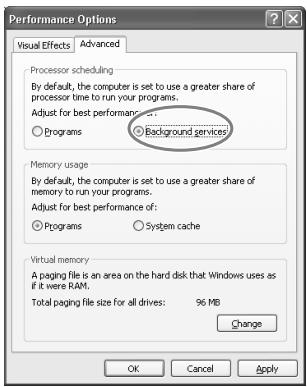
- In the System Properties dialog box, click [OK].
The System Properties dialog box will close.
Next, you'll make the driver settings. ( "Driver Settings" (p. 22))
Windows 2000 users
- Click the Windows Start menu, and from the menu that appears, select Settings | Control Panel.
- In Control Panel, double-click the System icon.
- Click the Advanced tab.
- Click [Performance Options].
The Performance Options dialog box will appear.
- Choose "Background services" and click [OK].
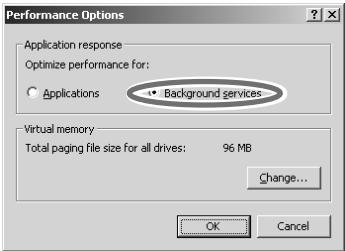
- Click [OK] to close the System Properties dialog box.
The System Properties dialog box will close.
Next, you'll make the driver settings. ( "Driver Settings" (p. 22))
Windows Me/98 users
- With the UA-1EX left unconnected, start up Windows.
Do not connect the UA-1EX to the computer until you reach Step 9.
- Exit all currently running software.
Also close any open windows. If you are using virus checking or similar software, be sure to exit it as well.
3.Prepare the CD-ROM.
Insert the CD-ROM into the CD-ROM drive of your computer.
- Click the Windows Start menu. From the menu that appears, select Run...
The "Run..." dialog box will appear.
- In the dialog box that appears, input the following into the "Open" field, and click [OK].
D:\Driver\Me98\setup.exe
-
The drive name is "D:" in the example shown here, but may be different on your system. Use the drive name for your CD-ROM drive.
-
The Driver Setup dialog box will appear. Click [Next].
- To begin the installation, click [Next] once again. Installation will begin.
The "Setup is now ready to install the drivers" dialog box will appear.
- Operation of the UA-1EX Set the UA-1EX's ADVANCED (mode select) switch to the ON position.
- The driver cannot be installed by means of the following procedure if the switch is set to OFF.
- Operation of the UA-1EX Connect the UA-1EX to your computer.
A message of "Found New Hardware" will appear. Please wait.
-
This unit is equipped with a protection circuit. A brief interval (a few seconds) after connecting the UA-1EX is required before the unit will operate normally.
-
In the Driver Setup dialog box, click [Close].
Next, you'll make the driver settings. ( "Driver Settings" (p. 22))
Driver Settings
In order to get the best performance from the software you are using, you must choose the correct device settings.
| Output device |
| EDIROL UA-1EXThis sends the audio signal from the computer to the UA-1EX. This is what you will normally use, for example when using the UA-1EX with an sequencer software such as Media Player. You will also use this when using an sequencer software such as SONAR in WDM driver mode, or when using a DirectX sound software. |
| Input device |
| EDIROL UA-1EXThis receives the audio signal that is sent from the UA-1EX itself to the computer. This is what you will normally use, for example when using the UA-1EX with an sequencer software such as Media Player. You will also use this when using an sequencer software such as SONAR in WDM driver mode. |
| ASIO device |
| EDIROL UA-1EXUse this if you are using the UA-1EX with an ASIO-compatible sequencer software such as Cubase. In the ASIO settings of your sequencer software, choose "EDIROL UA-1EX."* To prevent audio loop feedback or double monitoring, turn monitoring off in your sequencer software, or set your sequencer software to use ASIO Direct Monitor. |
Windows XP users
-
Open the Sound, Speech, and Audio Devices Properties dialog box.
-
From the Windows start menu, choose Control Panel.
- In "Pick a category," click Sound, Speech, and Audio Devices.
-
In "or Pick a Control Panel icon," click the Sounds and Audio Devices icon.
-
Click the Audio tab.
- For Sound playback and Sound recording, click the located at the right of [Default device], and select EDIROL UA-1EX.
- Click [OK] to complete the settings.
Windows 2000/Me users
-
Open the Sounds and Multimedia Properties dialog box
-
Click the Windows Start button, and from the menu that appears, select Settings | Control Panel.
-
In Control Panel, double-click the Sounds and Multimedia icon. If the Sound and Multimedia icon is not displayed, click "Show all control panel options" in the frame at the left.
-
Click the Audio tab.
- For Sound playback (or in Windows Me, Playback) and Sound Recording, click the located at the right of [Preferred device], and select EDIROL UA-1EX.
- Click [OK] to complete the settings.
Windows 98 users
- Open the Multimedia Properties dialog box.
- Click the Windows Start button, and from the menu that appears, select Settings | Control Panel.
- In Control Panel, double-click the Multimedia icon.
- Click the Audio tab.
- For Playing field and Recording, click the located at the right of [Preferred device], and select EDIROL UA-1EX.
- Click [OK] to complete the settings.
This completes the audio input/output settings.
Proceed to "Checking that you hear sound" (p. 25).
Sequencer software settings
Before you start up your sequencer software, connect the UA-1EX to your computer. If your sequencer software allows you to specify audio input/output settings, choose EDIROL UA-1EX. For details, refer to the owner's manual for your sequencer software.
Checking that you hear sound
Now let's play back the sample data to verify that the connections and the settings are correct. In order to hear the sample data, you will need approximately 30 MB of free space on the hard disk in which Windows is installed.
You can connect headphones and/or monitor speakers as shown in the diagram, and monitor the playback of your sequencer software.
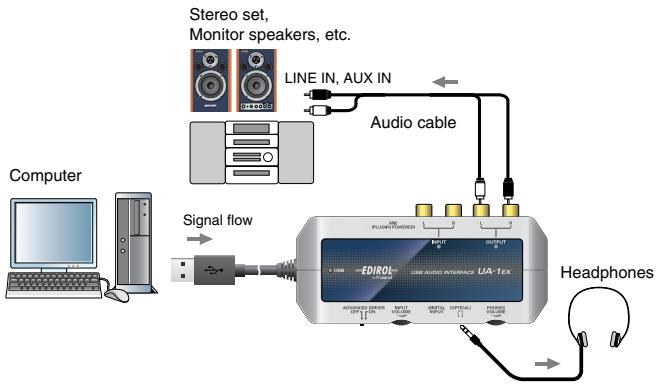

As soon as you connect the UA-1EX to your computer, sound will no longer be output from the speakers of your computer.
- Connect an external monitor system or headphones to the UA-1EX.
- If you want sound to be output from the speakers of your computer, disconnect the UA1EX from your computer.
Playing back the sample data
We will use standard Windows functionality to play back the sample data provided on the included CD-ROM.
-
Use of the song data supplied with this product for any purpose other than private, personal enjoyment without the permission of the copyright holder is prohibited by law. Additionally, this data must not be copied, nor used in a secondary copyrighted work without the permission of the copyright holder.
-
Insert the included CD-ROM into the CD-ROM drive of your computer.
- From the Sample folder of the CD-ROM, drag Alright(.wav) to your desktop, copying it.
-
Set the UA-1EX's Sampling frequency select switch to 44.1kHz.
-
If you've changed the sampling frequency, disconnect the UA-1EX, and then reconnect it.
-
Right-click the copied file Alright(.wav).
Windows XP/2000 users
- From the menu that appears, choose Play.
Windows Me/98 users
- From the menu that appears, choose Properties.
- Click the Preview tab, and then click the button.
Playback begins.
- If the UA-1EX is connected to your computer, sound will not be output from the speakers of your computer, but rather from headphones or speakers connected to the UA-1EX's headphone jack or line output jacks.
- If the record source select switch is set to DIGITAL and a digital signal is being received at the digital input connector, audio data from the computer cannot be played back. Please set the switch to ANALOG.
- If it did not play back correctly, refer to "Troubleshooting" (p. 55) to determine the reason. This section contains information on how to solve problems such as no sound, or failure to play back correctly.
Was the sample data played back?
If it was played back correctly, this means that the computer and the UA-1EX are connected correctly, and that the drivers have been installed correctly.
About the Driver Modes
What is a driver?
A "driver" is software that transfers data between the UA-1EX and application software running on your computer, when your computer and the UA-1EX are connected. The driver sends data from your application to the UA-1EX, and from the UA-1EX to your application.
About the driver modes
The UA-1EX has two operating modes, Advanced mode and Standard driver mode, and a different driver is used by each mode.
| ON(Advanced mode) | This mode uses a dedicated audio driver created specifically for the UA-1EX. When this dedicated driver is used, you can record/play/edit audio with high quality and stable timing. Normally, you should use Advanced Mode.In Advanced mode, audio signals can be transferred between the UA-1EX and the computer at a resolution of 16/24 bits and sampling frequencies of 44.1/48/96 kHz. Choose Advanced mode if you are using software that supports 24-bit or 96 kHz audio such as the Cubase VST or Logic; or ASIO-compatible software that can record, play, and edit high-quality audio, such as Cubase VST or Logic.Normally, you should use Advanced mode. (→“Installing the Driver” (p. 16)). |
| OFF(Standard driver mode) | This mode uses the standard USB audio driver provided by Macintosh.You can use this mode without installing the dedicated driver.In Standard driver mode, audio signals are transferred between the UA-1EX and the computer at a resolution of 16 bits and sampling frequencies of 32/44.1/48 kHz. Choose this mode if you are using software that uses Mac OS's own functionality, such as software that uses the CD-ROM drive of your computer to play CD audio, or that uses the software synthesizer included with Mac OS. (→“Installing the OS-Standard Driver” (p. 45)).* The driver included with Mac OS does not support ASIO.* Standard driver mode does not support 96 kHz or 24-bit. If you want to use 96 kHz or 24-bit audio, turn the ADVANCED (mode select) switch ON. |
The installation procedure will differ depending on your system.
Please proceed to one of the following sections, depending on the system you use.
Mac OS X users. (p. 28)
Mac OS 9 users (p.30)
Steps to be performed on the UA-1EX itself are marked by a Operation of the UA-1EX symbol.
Installing the driver
- If the "Authentication" dialog box appears during the installation, input the password and click "OK."
-
What you actually see on your computer screen may be different, depending on your computing environment and the operating system you're using.
-
With the UA-1EX disconnected, start up the Macintosh.
- Disconnect all USB cables except for a USB keyboard and USB mouse (if used).
- Exit all currently running software (applications).
If you are using virus checking or similar software, be sure to exit it as well.
3. Prepare the CD-ROM.
Insert the CD-ROM into the CD-ROM drive of your Macintosh.
-
In the Driver (Mac OS X) folder of the CD-ROM, double-click UA1EXUSBDriver pkg.
-
A message such as "This Installer package needs to..." may appear.
Click "Continue."
5. The display will indicate "Welcome to the EDIROL UA-1EX Driver Installer."
Click [Continue].
- The display will indicate "Select a Destination."
Click the drive in which the operating system is installed to select it, and then click [Continue].
- Select your startup disk as the drive.
- The display will indicate "Easy Install."
Click [Install] or [Upgrade].
- The display will indicate "Installing this software requires you to restart your computer when the installation is done."
Click [Continue Installation].
- The display will indicate "The software was successfully installed."
Click [Restart] to restart your computer.
This completes installation of the UA-1EX driver.
Next, make audio device settings. ( "Input/output device settings" (p. 29))
If you want to use the UA-1EX with the iTunes sequencer software included with your Macintosh, specify the input/output devices as follows.
The procedure for making device settings differs depending on the sequencer software you are using. For details, refer to the owner's manual for your software.
-
What you actually see on your computer screen may be different, depending on your computing environment and the operating system you're using.
-
Operation of the UA-1EX Set the UA-1EX's ADVANCED (mode select) switch to ON.
-
The driver cannot be installed by means of the following procedure if the switch is set to OFF.
-
Operation of the UA-1EX Connect the UA-1EX to your Macintosh.
-
This unit is equipped with a protection circuit. A brief interval (a few seconds) after connecting the UIA-1EX is required before the unit will operate normally.
-
Open "System Preferences" and click "Sound."
-
In the Sound Effects tab, set "Play alerts and sound effects through" to "EDIROL UA-1EX 44.1 kHz."
-
Although "44.1 kHz" is used for the purpose of explanation within this document, this changes depending on the actual setting of the Sampling frequency select switch on your UA-1EX.
-
In the Output tab, set "Choose a device for sound output" to "EDIROL UA-1EX 44.1 kHz."
- If you want sound to be output from the speakers of your Macintosh, disconnect the UA-1EX from your Macintosh.
- In the Input tab, set "Choose a device for sound input" to "EDIROL UA-1EX 44.1 kHz."
- When you have finished making settings, close the dialog box.
Before you use your sequencer software with the UA-1EX, please note the following
- Before you start up your sequencer software, connect the UA-1EX with your computer.
- Do not disconnect the UA-1EX while your sequencer software is running.
Close your sequencer software before you unplug the UA-1EX.
- The UA-1EX will not work in the Classic environment of Mac OS X. Use it when the Classic environment is not running.
- For details on how to make settings for your sequencer software, you should also refer to the owner's manual for your sequencer software.
This completes the audio input/output settings.
Proceed to "Checking that you hear sound" (p. 32).
Installing the UA-1EX driver
-
With the UA-1EX disconnected, start up the Macintosh.
-
Disconnect all USB cables except for a USB keyboard and USB mouse (if used).
-
Exit all currently running software (applications).
If you are using virus checking or similar software, be sure to exit it as well.
- Prepare the CD-ROM.
Insert the CD-ROM into the CD-ROM drive of your Macintosh.
- Double-click the UA-1EX Driver-E Installer icon (found in the Driver E (Mac OS 9) folder of the CD-ROM) to start up the installer.
-
Verify the Install Location, and click [Install].
-
The installation location will be shown differently depending on your system. Make sure that you have selected the startup disk for the system you are currently using.
-
If a message like the following is displayed, click [Continue].
The other currently running applications will exit, and installation will continue.

This installation requires your computer to restart after installing this software. Click Continue to automatically quit all other programs and run the program. Click Cancel to leave your disks untouched.
Cancel
Continue
- A dialog box will indicate Installation was successful.
Click [Restart] to restart your Macintosh.
Installing the ASIO driver
ASIO
This is an audio interface standard promoted by the Steinberg Corporation. When the UA-1EX is used with ASIO-compatible software, the synchronization precision will be improved, allowing a more sophisticated music production environment.
This section explains how to install the ASIO driver that allows the UA-1EX to be used by your sequencer software or audio editing software.
For details on installation and settings of the ASIO driver, be sure to also read the Driver E (Mac OS 9) - Readme_E.htm document on the CD-ROM.
- The UIA-1EX cannot play back audio data from the Macintosh's sound manager (such as audio CDs and alert sounds)
The ASIO driver of the UA-1EX supports the following audio input/output channels.
Audio input 24/16 bit 1 stereo ch. (2 monauralchs.)
Audio output 24/16 bit 1 stereo ch. (2 monauralchs.)
If your ASIO-compatible software supports ASIO 2.0 or recording/playback of 24 bit audio data, using the following drivers will provide a higher quality environment.
| ASIO-compatible software | Driver to use |
| ASIO2.0-compatible | 24 bit compatible |
| × | × | UA-1EX ASIO1.0 16bit |
| × | ○ | UA-1EX ASIO1.0 24bit |
| ○ | × | UA-1EX ASIO2.0 16bit |
| ○ | ○ | UA-1EX ASIO2.0 24bit |
Here we will explain how to install the ASIO 1.0 16 bit-compatible driver.
-
From the Driver E (Mac OS 9) - ASIO folder of the CD-ROM, copy [UA-1EX ASIO1.0 16bit] to the ASIO Drivers folder of the ASIO-compatible software you are using (e.g., Cubase VST, Logic, Digital Performer).
-
The Audio setting dialog box will be named differently depending on your software. For details refer to the manual of your software.
-
Operation of the UA-1EX Set the UA-1EX's ADVANCED (mode select) switch to ON.
-
The driver cannot be installed by means of the following procedure if the switch is set to OFF.
-
Operation of the UA-1EX Connect the UA-1EX to your Macintosh.
-
This unit is equipped with a protection circuit. A brief interval (a few seconds) after connecting the UIA-1EX is required before the unit will operate normally.
-
Start up your ASIO-compatible software.
-
Open the Audio setting dialog box of your ASIO-compatible software, and select [UA-1EX ASIO1.0 16bit] as the ASIO Device.
-
The Audio setting dialog box will be named differently depending on your software. For details refer to the manual of your software.
This completes the audio input/output settings.
Proceed to "Checking that you hear sound" (p. 32).
Checking that you hear sound
Now let's play back the sample data to verify that the connections and the settings are correct. In order to listen to the sample data, you'll need approximately 30 MB of free space on your system hard disk.
You can connect headphones and/or monitor speakers as shown in the diagram, and monitor the playback of your sequencer software.
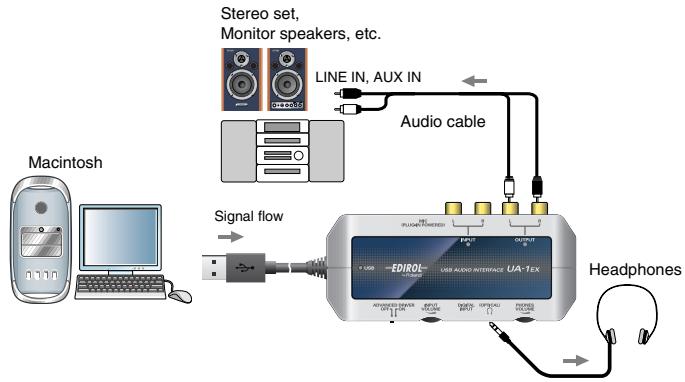

As soon as you connect the UA-1EX to your Macintosh, sound will no longer be output from the speakers of your Macintosh.
- Connect an external monitor system or headphones to the UA-1EX.
- If you want sound to be output from the speakers of your Macintosh, disconnect the UA-1EX from your Macintosh.
Playing back the sample data
We will use standard Macintosh functionality to play back the sample data provided on the included CD-ROM.
- Use of the song data supplied with this product for any purpose other than private, personal enjoyment without the permission of the copyright holder is prohibited by law. Additionally, this data must not be copied, nor used in a secondary copyrighted work without the permission of the copyright holder.
1.Prepare the CD-ROM.
Insert the CD-ROM into the CD-ROM drive of your Macintosh.
- From the Sample folder of the CD-ROM, drag Alright(.wav) to your desktop, copying it.
-
Set the UA-1EX's Sampling frequency select switch to 44.1kHz.
-
If you've changed the sampling frequency, disconnect the UA-1EX, and then reconnect it.
- Start up the QuickTime Player, which is included with Mac OS.
The QuickTime Player is normally located in QuickTime within the Applications folder of the hard disk.
- Open the Alright file you copied.
- Play back the sample data.
Click the play button. The sample data playback will be output from headphones or speakers connected to the UA-1EX's headphone jack or line output jackets.
- If the record source select switch is set to DIGITAL and a digital signal is being received at the digital input connector, audio data from the Macintosh cannot be played back. Please set the switch to ANALOG.
- If it did not play back correctly, refer to "Troubleshooting" (p. 55) to determine the reason. This section contains information on how to solve problems such as no sound, or failure to play back correctly.
Was the sample data played back?
If it was played back correctly, this means that the computer and the UA-1EX are connected correctly, and that the drivers have been installed correctly.
This chapter explains various ways in which you can connect and use the UA-1EX.
Listening to Sound from Your Computer
You can connect your headphones or monitor speakers as shown in the diagram, and listen to the audio playback from your sequencer software. You can also listen to the sound from a microphone or audio device that's connected to the UA-1EX.
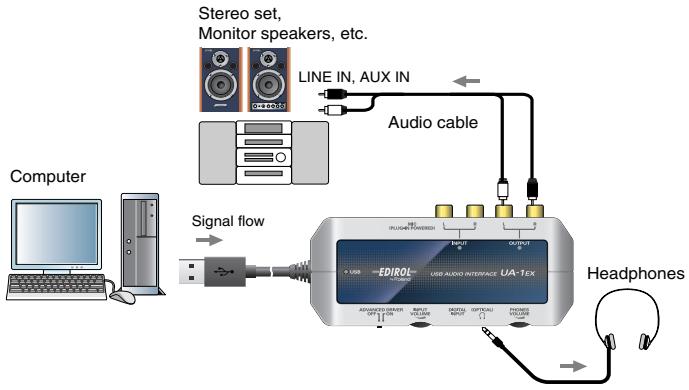

As soon as you connect the UA-1EX to your computer, sound will no longer be output from the speakers of your computer.
- Connect an external monitor system or headphones to the UA-1EX.
- If you want sound to be output from the speakers of your computer, disconnect the UA1EX from your computer.
Recording a Cassette Tape or LP into Your Computer
Here's how you can record the analog output of an audio device such as a cassette tape or LP (vinyl record) into your computer.
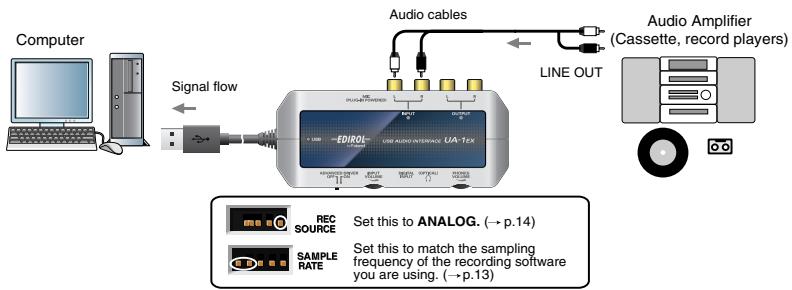
* If you are using a record player, use a player that has a built-in phono equalizer. If your record player does not have a phono equalizer, output the sound through a speaker system that has a phono equalizer.
Sampling frequency select switch
Set this to the sampling frequency that is selected in your recording sequencer software.
- After you change the position of the sampling frequency select switch, you will need to disconnect and reconnect the UA-1EX.
Recording source select switch
Set this to ANALOG.
- Turn down the volume of your connected monitor speakers (or similar equipment) before you change the setting of the recording source select switch.
Use this to adjust the input level.
■ Be careful of looped connections
Loop Connection
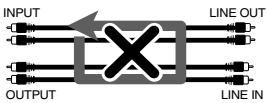
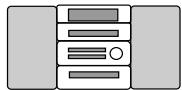
Stereo Set (cassette player)
If you connect the UA-1EX as shown in the above diagram with another device that passes the input audio back to the output (e.g., a MD/DAT in recording mode), the sound will loop between the UA-1EX and the other device, causing oscillation and producing an unexpected high volume. Be aware that such connections can cause malfunctions or damage your speakers.
Recording Sound from Your Computer onto MD or DAT
Here's how you can record audio data from your computer onto a digital device such as MD or DAT.
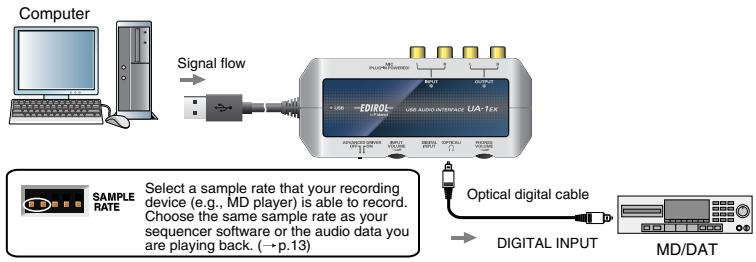
Sampling frequency select switch
Set this to match the sampling frequency of your digital recording device and the sampling frequency of your sequencer software or the audio data you are playing back.
- After you change the position of the sampling frequency select switch, you will need to disconnect and reconnect the UA-1EX.
Other notes
- Do not connect anything to input jacks you are not using.
- The UA-1EX does not support professional digital audio device formats.
- The UA-1EX cannot mix the input signals from the various input jacks with the input signal from the digital input connector and output them from the digital output connector.
Recording the Digital Output from a CD/MD/DAT into Your Computer
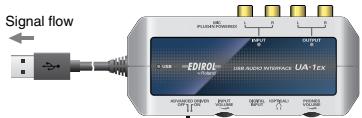

REC SOURCE
Set this to DIGITAL. ( p.14)

SAMPLE RATE
Set this to match the sampling frequency of your digital playback device. (→p.13)
Optical digital cable

DIGITAL OUTPUT
MD/DAT/CD player
Sampling frequency select switch
Set this to match the sampling frequency of your digital playback device and the sampling frequency of your sequencer software or the audio data you are playing back.
Normally, you will select 48kHz or 44.1kHz for DAT, and 44.1kHz for MD or CD. For details, refer to the owner's manual for your digital audio device and sequencer software.
- After you change the position of the sampling frequency select switch, you will need to disconnect and reconnect the UA-1EX.
Recording source select switch
Set this to DIGITAL.
- Turn down the volume of your connected monitor speakers (or similar equipment) before you change the setting of the recording source select switch.
Other notes
- The UA-1EX complies with SCMS. If the audio data that is input from the digital input connector contains copy-prohibit flags (as will be the case if you recorded an MD from a CD), the UA-1EX will not allow this data to be recorded on your computer. (The sound will be output from the line output jacks and headphone jack.)
Here's how you can sing along with audio data played back from your computer, and use your sequencer software to record just the sound of the mic.
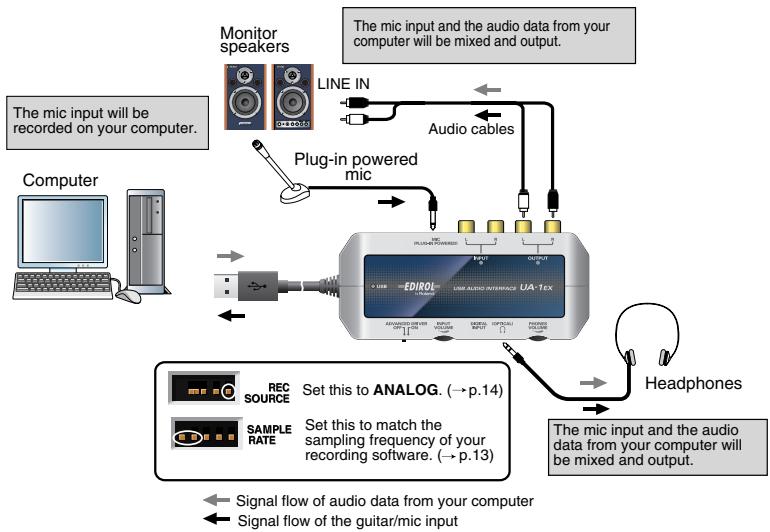
Sampling frequency select switch
Set this to the sampling frequency that is selected on your recording sequencer software.
- After you change the position of the sampling frequency select switch, you will need to disconnect and reconnect the UA-1EX.
Recording source select switch
Set this to ANALOG.
- Turn down the volume of your connected monitor speakers (or similar equipment) before you change the setting of the recording source select switch.
Use this to adjust the input level.
Other notes
-
Howling could be produced depending on the location of microphones relative to speakers. This can be remedied by:
-
The UA-1EX is compatible with plug-in powered mics (miniature condenser mics designed for connection to a computer's mic input or to the recording jack of an MD (Mini Disc) recorder). You must use a plug-in powered mic for connection to the mic input jack (plug-in powered mic). The circuit may be damaged if you connect a conventional stereo mini-type plug or an unsupported type of mic.
-
Changing the orientation of the microphone(s).
- Relocating microphone(s) at a greater distance from speakers.
- Lowering volume levels.
Adjusting the Audio Latency
When using the UA-1EX in Advanced mode, you can change the driver settings to adjust the latency of the audio. To adjust the latency, change the Buffer Size in the driver settings dialog box.
-
Latency is the time delay from when an sequencer software plays back audio data until the sound is actually heard from an audio device such as the UA-1EX.
-
As described in "Opening the dedicated driver settings dialog box" (p. 44), open the "Editrol UA-1EX Driver Settings" dialog box (or in Mac OS 9, "ASIO Control Panel").
- Adjust the buffer size.
The following settings will produce the shortest latency.
Windows users
Set "Audio Buffer Size" to the far left (Min).
Mac OS X users
Set "Audio Buffer Size" to the far left (Min).
Mac OS 9 users
Set "Buffer Size" to the far left (Min).
- Click [OK] (or in Mac OS X, [Apply]) to close the dialog box.
-
Restart the sequencer software that is using the UA-1EX.
-
If you are using a sequencer software that has a function for testing audio devices, get it to perform its tests.
- Play back audio data on your sequencer software.
If interruptions occur in the sound, repeat this procedure, and gradually increase the buffer size in step 2 until interruptions no longer occur.
- Depending on the sequencer software you are using, there may be a buffer size or latency adjustment function among the audio settings of the sequencer software as well. For details, refer to the operation manual for your sequencer software.
Decreasing the ASIO Buffer Size (Windows)
If you're using the UA-1EX from ASIO-compatible software, you'll be able to reduce the buffer size further. If clicks or pops occur, uncheck this check box.
-
"Adjusting the Audio Latency" (p. 41) must be performed with this check box unchecked.
-
As described in "Opening the dedicated driver settings dialog box" (p. 44), open the "Editol UA-1EX Driver Settings" dialog box.
- Check the "Use Smaller ASIO Buffer Size" check box.
- Click [OK] to close the "Edirol UA-1EX Driver Settings" dialog box.
Using ASIO Direct Monitor (Windows/Mac OS 9)
If you are using the UA-1EX from an ASIO2.0-compatible sequencer software in Advanced mode, the UA-1EX's direct monitor switch can be controlled automatically from the sequencer software.
- Set Input monitor switch to AUTO.
- As described in "Opening the dedicated driver settings dialog box" (p. 44), open the "Editrol UA-1EX Driver Settings" dialog box (or in Mac OS 9, "ASIO Control Panel").
- Make the following settings. Check the "Use ASIO Direct Monitor" check box.
-
Click [OK] to close the "Edirol UA-1EX Driver Settings" dialog box.
-
Depending on your sequencer software, there may also be an ASIO Direct Monitor setting among the audio settings of your sequencer software. For details, refer to the operation manual for your sequencer software.
- When using ASIO Direct Monitor, monitoring may switch on/off at unexpected times, depending on the sequence of software settings and on the recording procedure. If this occurs, uncheck the check box in step 3 to disable ASIO Direct Monitor.
■Opening the dedicated driver settings dialog box
Windows users
- Click the Windows Start menu, and from the menu that appears, select Settings | Control Panel.
Windows XP: Click the Windows start menu, and from the menu, select Control Panel.
-
In Control Panel, double-click the "EDIROL UA-1EX" icon. The "EDIROL UA-1EX Driver Settings" dialog box will appear.
-
In Windows XP, click "Switch to Classic View" to select Classic View on your computer. If you're not in Classic View, the EDIROL UIA-1EX icon won't be shown.
- In Windows Me, click "View all Control Panel options."
Mac OS X users
Open "System Preferences" and click the "UA-1EX" icon. "Editrol UA-1EX Driver Settings" dialog box will appear.
Mac OS 9 users
Open the ASIO Control Panel from the Audio Settings dialog box of your ASIO-compatible software.
- The name of the Audio Settings dialog box and the procedure for opening the ASIO Control Panel will differ depending on your software. For details, refer to the operation manual for your software.
Installing the OS-Standard Driver
Standard driver mode uses the standard USB audio driver provided with the operating system.
- Standard driver mode does not support 96 kHz or 24-bit. If you want to use 96 kHz or 24-bit audio, turn the ADVANCED (mode select) switch ON.
The installation procedure will differ depending on your system.
Please proceed to one of the following sections, depending on the system you use.
- Windows XP/2000 users. (p. 45)
- Windows Me users (p. 46)
- Windows 98 users. (p. 47)
Mac OS X users. (p. 53)
Mac OS 9 users (p.54)
Windows XP/2000 users
- With the UA-1EX disconnected, start up Windows.
- Disconnect all USB cables except for a USB keyboard and USB mouse (if used).
- Exit all currently running software (applications).
If you are using virus checking or similar software, be sure to exit it as well.
- Place the UA-1EX's ADVANCED (mode select) switch in the OFF position.
- Connect the UA-1EX to the computer.
The driver is automatically installed.
If you are using Windows XP, the installation has been completed when the message near the taskbar saying that "Found New Hardware" has disappeared.
- This unit is equipped with a protection circuit. A brief interval (a few seconds) after connecting the UIA-1EX is required before the unit will operate normally.
- When installation is complete, restart Windows.
Next, in order to ensure that audio processing occurs smoothly, you need to make settings so that Background Services is given priority.
( "Giving priority to Background Services" (p. 19))
Windows Me users
- With the UA-1EX disconnected, start up Windows.
- Disconnect all USB cables except for a USB keyboard and USB mouse (if used).
- Exit all currently running software (applications).
If you are using virus checking or similar software, be sure to exit it as well.
- Place the UA-1EX's ADVANCED (mode select) switch in the OFF position.
- Connect the UA-1EX to the computer.
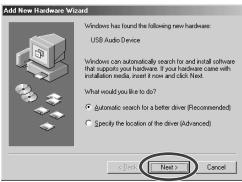
Windows will detect the UA-1EX, and the "Add New Hardware Wizard" dialog box will appear.
Make sure that Automatic search for a better driver (Recommended) is selected, and click [Next].
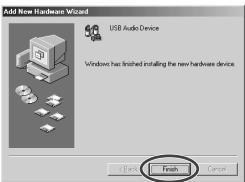
Click [Finish].
- Restart Windows.
Next, you will need to make audio input/output device settings.
( Input/output device setting (p. 49))
The driver necessary for using the UA-1EX with Windows 98 is provided on the Windows CD-ROM. Make sure that you have the Windows CD-ROM available.
- Some computers are sold with the contents of the Windows CD-ROM stored on the hard disk, and therefore will not come with a Windows CD-ROM. If this is the case for your computer, you'll be able to install the driver even without the Windows CD-ROM.
The USB composite device driver is installed first, then the USB audio device driver is installed. Use the following procedure to install the drivers.
- With the UA-1EX disconnected, start up Windows.
- Disconnect all USB cables except for a USB keyboard and USB mouse (if used).
- Exit all currently running software (applications).
If you are using virus checking or similar software, be sure to exit it as well.
- Place the UA-1EX's ADVANCED (mode select) switch in the OFF position.
-
Connect the UA-1EX to the computer.
-
This unit is equipped with a protection circuit. A brief interval (a few seconds) after connecting the UIA-1EX is required before the unit will operate normally.
-
USB composite device will be detected automatically, and the "Add New Hardware Wizard" dialog box will appear. Click [Next].
-
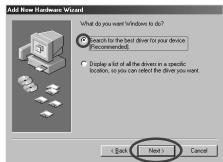
When "What do you want Windows to do?" appears, select "Search for the best driver for your device (Recommended)," and click [Next].
-
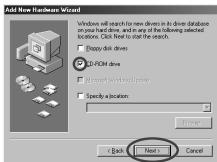
Check CD-ROM drive, and click [Next].
If the display indicates "Can't find an updated driver for this device," check "Updated driver," and click [Next].
8. Click [Next].
Depending on your system, the Driver location may differ from the illustration, but this is not a problem.
![EDIROL UA-1EX - Click [Next]. - 1](/content/2024/12/174386/images/15bc7748315a5879f89a27e918a02e81833986ada52f65a92a627b156d4dd4df.jpg)
9. File (driver) copying will begin.
If the Windows CD-ROM is not inserted in the CD-ROM drive, a "Insert Disk" dialog box may appear. In this case, insert the Windows CD-ROM into the CD-ROM drive and click [OK].
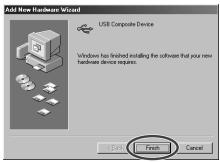
- When installation of the USB Composite Device driver is completed, a dialog box like the one shown here will appear. Click [Finish].
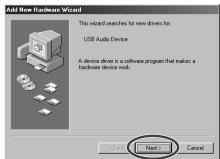
- Next, the USB audio device will be detected automatically, and the "Add New Hardware Wizard" dialog box will appear.
Click [Next], and proceed with the installation in the same way as in steps 6-9.
- When installation of the USB audio device driver is complete, a dialog box like the one shown here will appear. Click [Finish].
Installation of the USB composite device driver and USB audio device driver has been completed.
Restart Windows.
Next, you will need to make audio input/output device settings. ( Input/output device setting (p.49))
Windows XP users
-
Open the Sound, Speech, and Audio Devices Properties dialog box.
-
From the Windows start menu, choose Control Panel.
- In "Pick a category," click Sound, Speech, and Audio Devices.
-
In "or Pick a Control Panel icon," click the Sounds and Audio Devices icon.
-
Click the Audio tab.
- For Sound playback and Sound recording, click the located at the right of [Default device], and select UA-1EX.
- Click [OK] to complete the settings.
- Next, in order to ensure that audio processing occurs smoothly, you need to make settings so that Background Services is given priority.
( "Giving priority to Background Services" (p. 19))
Windows 2000/Me users
-
Open the Sounds and Multimedia Properties dialog box
-
Click the Windows Start button, and from the menu that appears, select Settings | Control Panel.
-
In Control Panel, double-click the Sounds and Multimedia icon. If the Sound and Multimedia icon is not displayed, click "Show all control panel options" in the frame at the left.
-
Click the AUDIO tab.
- For Sound Playback (or in Windows Me, Playback) and Sound Recording, click the located at the right of [Preferred device], and select USB Audio Device.
-
Click [OK] to complete the settings.
-
Windows 2000 users:
Next, in order to ensure that audio processing occurs smoothly, you need to make settings so that Background Services is given priority.
( "Giving priority to Background Services" (p. 19))
Windows 98 users
-
Open the Multimedia Properties dialog box.
-
Click the Windows Start button, and from the menu that appears, select Settings | Control Panel.
-
In Control Panel, double-click the Multimedia icon.
-
Click the Audio tab.
- For Playback field and Recording, click the located at the right of [Preferred device], and select USB Audio Device.
- Click [OK] to complete the settings.
This completes the audio input/output settings.
Proceed to "Checking that you hear sound" (p. 25).
Volume Control setting
If you have installed the Standard driver, the UA-1EX can use the Windows volume control to adjust the output volume.
1. Open the Volume Control.
Click the Windows Start menu, and select Programs (or in Windows XP, All programs) | Accessories | Entertainment | Volume Control.
- What you actually see on your computer screen may be different, depending on your computing environment and the operating system you're using.
- If the Volume Control is not installed on your computer, use the Control Panel icon Add or Remove Programs to install it. For details on installation, refer to the Windows manual or Help.
2. Raise or lower the slider to adjust the volume of the UA-1EX.
This will change the volume of the UA-1EX's digital output and analog output. Items that can be set
| WAVE | Controls the volume of sound output from "UA-1EX (or USB Audio Device)" audio output device. |
| SW Synth | Controls the volume of the software synthesizer built into Windows. |
| CD Player | Controls the volume of "audio CDs" on the internal CD-ROM drive of the computer. (*1) |
*1 If the CD playback volume does not change when you adjust this control, then change the WAVE volume.
- You will be able to use the UA-1EX at the best audio quality if you set the Volume Control volume to the maximum setting.
If Mute is checked or if the slider is lowered all the way, no sound will be output from the UA-1EX.
When playing audio CDs from the computer's internal CD-ROM drive, or using the UA-1EX to play game music
Windows XP/2000 users:
- Open the System Properties dialog box.
Select Start | Settings | Control Panel, and in the Control Panel, double-click the System icon.
(Windows XP- Click the Windows start menu, and from the menu that appears, select Control Panel.)
- Open the Device Manager.
Click the Hardware tab, and click the Device Manager.
- Open the CD-ROM drive's Properties.
In CD-ROM drive, double-click the CD-ROM drive that you are using.
- Click the Properties tab, and in Digital CD Playback, check the "Enable digital CD audio for this CD-ROM device" item.
Windows Me users:
- Open System Properties dialog box.
Select Start | Settings | Control Panel, and in Control Panel, double-click the System icon.
- Open the Device Manager.
Click the Device Manager tab.
- Open the CD-ROM drive's Properties.
Double-click the CD-ROM icon, and then double-click the CD-ROM drive that you are using.
- Click the Properties tab, and in Digital CD Playback, check the "Enable digital CD audio for this CD-ROM device" item.
Windows 98 users:
- Open the Multimedia Properties dialog box.
Select Start | Settings | Control Panel, and in Control Panel, double-click the Multimedia icon.
-
Click the Music CD tab, and check the "Enable digital CD audio for this CD-ROM device" item.
-
Depending on your system, playback may still not be possible. For details, please contact the manufacturer of your computer. If you are using a PC-card (PCMCIA) type CD-ROM drive, playing back WAVE data from a CD-ROM or playing an audio CD may cause interrupted sound, or possibly no sound at all.
Mac OS X users
- If the "Authentication" dialog box appears during the installation, input the password and click "OK."
-
What you actually see on your computer screen may be different, depending on your computing environment and the operating system you're using.
-
With the UA-1EX disconnected, start up the Macintosh.
- Disconnect all USB cables except for a USB keyboard and USB mouse (if used).
- Exit all currently running software (applications). If you are using virus checking or similar software, be sure to exit it as well.
- Place the UA-1EX's ADVANCED (mode select) switch in the OFF position.
- Connect the UA-1EX to your Macintosh.
- Open the System Preference dialog box and click Sound.
-
In the Sound Effects tab, click Play alerts and sound effects through and choose UA-1EX as the playback device for sound effects.
-
If you don't want the Macintosh's audio alerts to be heard via the UA-1EX, choose "Built-in audio controller" or a similar setting so that the internal speakers will be used.
-
Click the Output tab, and choose UA-1EX as the device that will output sound.
- If you want sound to be output from the speakers of your Macintosh, disconnect the UA-1EX from your Macintosh.
- If the Input tab is displayed, choose UA-1EX as the device for inputting sounds.
- The output volume of the UIA-1EX cannot be adjusted with the Mac OS sound dialog box. Make volume adjustments through other means, such as on the speaker system you are using.
Please check the following before you use your sequencer software.
- If your sequencer software allows you to make audio input/output settings, choose UA-1EX. For details, refer to the owner's manual of the sequencer software you are using.
- Connect the UA-1EX to your computer before you start up your sequencer software.
- Do not disconnect the UA-1EX while your sequencer software is running.
- Exit your sequencer software before you disconnect the UA-1EX.
- The UA-1EX will not operate in the Mac OS X Classic environment. You can not use it if the Classic environment is running.
Proceed to "Checking that you hear sound" (p. 32).
Mac OS 9 users
- With the UA-1EX disconnected, start up the Macintosh.
- Disconnect all USB cables except for a USB keyboard and USB mouse (if used).
- Exit all currently running software (applications).
If you are using virus checking or similar software, be sure to exit it as well.
- After starting up Mac OS, select Apple System Profiler from the Apple menu.
The "Apple System Profiler" dialog box will appear.
- Click the Devices and Volumes tab.
- Choose Update all information from the Commands menu.
- Set the UA-1EX's ADVANCE (mode select) switch to the OFF position.
- Connect the UA-1EX to your computer.
Wait for approximately five seconds.
UA-1EX uses a driver included with Mac OS.
- This unit is equipped with a protection circuit. A brief interval (a few seconds) after connecting the UA-1EX is required before the unit will operate normally.
While you are waiting, the screen display will not change, but the UA-1EX is being detected. Do not touch the mouse or keyboard.
- In order to check that detection has been completed, once again go to "Apple System Profiler," and select "Update all information" from the Commands menu.
In the USB area, three audio devices will be displayed.
If these are displayed correctly, driver installation has succeeded. In the File menu, click Quit to close "Apple System Profiler."
If they are not displayed correctly, disconnect the UA-1EX, wait for about ten seconds, and then repeat the procedure from step 2.
Proceed to "Checking that you hear sound" (p. 32).
If you experience problems, read this chapter first. It contains tips for solving most problems.
* For details on operating your Windows or Macintosh computer, refer to the owner's manual of the computer and operating system you are using.
Can't install the driver correctly
Install the driver once again as described in "Getting Connected and Installing Drivers (Windows)" (p. 15).
Does the Device Manager show "Other device," "Unknown device," or any device marked with "?" "1" or "x"? (Windows)
If driver installation did not end successfully, the installed driver may remain in an incomplete state. Install the UA-1EX driver once again as described in "Getting Connected and Installing Drivers (Windows)" (p. 15).
Is the UA-1EX connected correctly?
Make sure that UA-1EX is connected to the USB connector of your computer.
Could other USB devices be connected?
When installing, all USB devices other than the UA-1EX should be disconnected from your computer. If you have connected the UA-1EX to an external USB hard disk, please connect the UA-1EX directly to a USB connector on the computer itself.
Could other applications or resident software (such as a virus checking program) be running?
Installation may not occur correctly if other programs are running. Be sure to close all other programs before installing.
Are you attempting to install from a networked CD-ROM drive?
You cannot install from a networked CD-ROM drive.
Is the CD-ROM or the lens of your CD-ROM drive dirty?
If the CD-ROM or the lens of your CD-ROM drive are dirty, the installer may not work correctly. Use a commercially available CD cleaner or lens cleaner to clean the CD-ROM and/or lens.
Are the power conservation settings of your computer turned off?
If power conservation settings are turned on for your computer, disable these settings. (For details on how to disable them, refer to the owner's manual of your computer.)
Is there enough free space on your hard disk?
Delete unneeded files to increase the amount of free space.
After deleting the file(s), empty the recycling bin.
Is the UA-1EX's ADVANCED (mode select) switch set appropriately?
Set the UA-1EX's ADVANCED (mode select) switch to the appropriate position, then reinstall the driver.
Is the USB connector enabled on your computer?
Refer to the owner's manual for your computer, and verify that the USB connector of your computer is enabled. The driver cannot be installed unless the USB connector is enabled.
Does your computer or USB hub have a sufficient power supply?
If you are using bus power, the UA-1EX cannot be connected if insufficient power is being supplied to it. Check whether the following cases might apply.
- If you are using a notebook computer running on its battery, operation may be unstable with some computers. If this is the case, connect your computer to its AC adaptor.
- The power conservation mode of your computer may be limiting the power it supplies to the USB connector. Re-examine the settings of your computer.
- The UA-1EX cannot be used with some bus-powered hubs (hubs that do not have their own power supply). Use a self-powered hub (a hub that has its own power supply).
Does your computer meet the USB specification?
Operation may be unstable if you are using a computer that does not electrically meet the USB specification. If so, you may be able to solve the problem by connecting a USB hub that has its own power supply.
Can't install/uninstall the driver
Did you log onto Windows as a user with administrative privileges?
In order to install/uninstall/reinstall the UA-1EX driver in Windows, you must log onto Windows as a user with administrative privileges, such as Administrator.
Did you make the "Driver Signing Options" setting?
You must set "Driver Signing Options" in order to install/reinstall the driver. (p. 16)
Windows displays an "Installing Hardware," "Did not find digital signature" dialog box
Did you make the "Driver Signing Options" setting?
You must set "Driver Signing Options" in order to install/reinstall the driver. (p. 16)
You are asked for the driver file even though you installed the driver
Did you connect the UA-1EX to a different USB connector than the one you used when installing the driver?
If your computer or USB hub has two or more USB connectors, and you connect the UA-1EX to a USB connector to which you have not previously connected it, this dialog box may appear even though you have already installed the driver. (This is not a malfunction.)
Use the following procedure to install the driver.
- Connect the UA-1EX to your computer.
Windows XP users
- The Found New Hardware Wizard dialog box will appear. If the message "Connect to Windows Update to search for software?" appears, choose "No" and then click [Next].
- Make sure that "EDIROL UA-1EX" is indicated. Then, choose "Search for the best driver in these locations" and click [Next].
If "Driver Signing Options" in step 4 is set to anything other than "Ignore," a dialog box with an "!" or "x" symbol will appear. Click [Continue Anyway] to proceed with the installation. If you are unable to continue, click [OK] and repeat the driver installation. () "Installing the Driver" (p.16))
Windows 2000 users
If "Driver Signing Options" in step 4 is set to anything other than "Ignore," a dialog box indicating "Digital Signature Not Found" will appear. Click [Yes] to proceed with the installation. If you are unable to continue, click OK and repeat the driver installation.
( "Installing the Driver" (p. 16))
- The Completing the Found New Hardware Wizard dialog box will appear.
Click [Finish].
- If the Change System Settings dialog box appears, click [Yes]. Windows will restart automatically.
If you are unable to complete driver installation using the above method, repeat the driver installation. ( "Installing the Driver" (p. 16))
Can't record or play back audio No sound
Is the UA-1EX's Recording source select switch set to "ANALOG"?
If the recording source select switch is set to "DIGITAL," and an input signal is being received at the digital input connector, the audio signal being input to the digital input connector will be output. The audio data from the computer will not be output.
Are you attempting to use the CD player of your computer to play an audio CD?
If you wish to play an audio CD on the CD-ROM drive of your computer, refer to When playing audio CDs from the computer's internal CD-ROM drive, or using the UA-1EX to play game music (p. 52).
Are you running multiple applications?
If multiple applications are running simultaneously, an error message may appear. If this occurs, click [OK], and close the other applications. Even if an application window is closed, it is still running if it remains in the taskbar, so be sure to quit any unneeded applications shown in the taskbar.
Have you specified the audio data output destination for your playback sequencer software?
For some sequencer software such as Cool Edit Pro LE, you must set the audio data output destination as UA-1EX. For details on this setting, refer to the owner's manual for the sequencer software.
Have the drivers been installed correctly?
In order to playback audio data using the UA-1EX, the USB Audio Device driver must be installed. For details on installation and settings, refer to Getting Connected and Installing Drivers (Windows p. 15, Macintosh p. 27).
Are the faders of the Volume Control raised? (Windows)
Adjust the volume of each fader as described in Volume Control setting (p. 51).
Can't record from a digital connection
When capturing audio data from a CD or MD into your computer, is the recording source switch set to "DIGITAL"?
Is the recording source select switch set to "DIGITAL"?
Does the sampling frequency of your sequencer software match the sampling frequency of the digital audio device connected to the digital in connector?
Set the sampling frequency to the same setting.
If you change the UA-1EX's sampling frequency, you must disconnect the UA-1EX from your computer, and then re-connect the UA-1EX in order for the new setting to take effect.
Recording produces a silent file
Did you specify the correct audio data input source within the operating system?
Depending on the sequencer software you are using, you may need to specify the UA-1EX as the audio data input source for your computer. For details on this setting, refer to "Driver Settings" (p. 22), "Getting Connected and Installing Drivers (Macintosh)" (p. 27).
Data that contains the SCMS flag cannot be recorded digitally.
The UA-1EX supports SCMS, so that if SCMS-flagged data (such as data from an MD that was digitally copied from a commercial music CD) is input to the digital connector, the UA-1EX will not be able to record this on the computer.
The sound will be output from the line output jacks and the headphone jack.
You will become unable to record if you switch the sampling frequency (e.g., switch between digital broadcast mode A and mode B) of your digital device while it is still connected to the digital input connector.
If you switch the sampling frequency, reconnect the digital cable.
Can't play/record 24-bit audio data
Does your sequencer software support 24-bit audio data?
You will need to use sequencer software that supports 24-bit audio data.
Is your sequencer software set to record/play 24-bit audio data?
Set your sequencer software to 24-bit.
Noise or pops are heard when recording/playing on your computer
Noise is heard during audio playback Pops/ clicks occur during audio playback Noise is heard in the recorded sound
In Macintosh, check the Energy Saver settings.
In the Mac OS System Setup, set Energy Saver as follows.
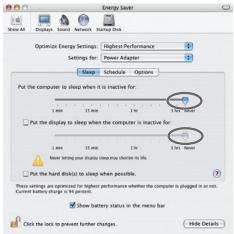
Click the Sleep tab.
Set "Put the computer to sleep when it is inactive for:" to Never.
Set "Put the display to sleep when the computer is inactive for:" to Never.
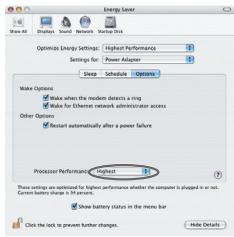
Click the Options tab.
If there is a Processor Performance setting, set it to Highest.
In Windows, did you make the setting described in "Giving priority to background services"?
In order to ensure that audio processing occurs smoothly, make the setting described in "Giving priority to background services." ( "Giving priority to Background Services" (p. 19))
In Windows, Power Management settings in the Control Panel may cause clicks or pops to occur in the audio playback.
The power management properties that appear when you double-click Power Management will differ depending on your computer system. The explanation that follows is for a typical situation, but you should refer to the owner's manual for your computer to verify these settings. Some computers may not have the following items.
- In the Windows Control Panel, double-click the System icon. The System Properties dialog box will appear.
- Click the Hardware tab.
- Click Device Manager to see the list of devices.
- From the list, choose Advanced Power Management Support, and click Properties. The Advanced Power Management Support Properties dialog box will appear.
- Click the Settings tab, and in Troubleshooting, check the "Don't Poll Power Supply Status" check box. Then click [OK].
- In the System Properties dialog box, click [OK].
- Restart Windows.
Could two or more audio devices be connected to your computer?
Try connecting only one UA-1EX to your computer. Check whether the noise disappears when only the UA-1EX is connected to the computer. Connecting numerous audio devices to a computer may produce noise in some situations. If this occurs, connect only the UA-1EX to your computer.
Are you using a USB device in addition to the UA-1EX?
Try switching off USB devices other than the UA-1EX.
If you have connected the UA-1EX to an external USB hard disk, please connect the UA-1EX directly to a USB connector on the computer itself.
Are numerous software programs running?
Playback may be interrupted if numerous software programs are running at the same time, or when you start up another software program. Close any unneeded software, and try again. If this does not solve the problem, try restarting your computer.
You may be able to solve the problem by adjusting the buffer size in the Driver Settings dialog box.
Adjust the buffer size as described in "Adjusting the Audio Latency" (p. 41).
If your sequencer software has an audio device test function, execute the test function.
- After changing the buffer size, you must restart any sequencer software that uses the UA-1EX.
Clicks or pops may occur in the sound if a LAN is operating.
Try disabling the LAN in the Device Manager. If this eliminates the clicks or pops, you may be able to solve the problem by updating your LAN driver or BIOS.
Try increasing the memory
You can increase the processing power of your computer by adding more memory. For details on how to install more memory, refer to the operation manual for your computer.
Is the UA-1EX connected to a USB hub?
Try connecting the UA-1EX directly to the USB connector of your computer itself.
Try making the following changes to the disk drive settings.
-
Some computers may not have the following settings.
-
In the Windows Control Panel, double-click System.
- Click the Device Manager tab.
- Double-click Disk Drives to see the list of devices.
-
From the list, select GENERIC IDE DISK TYPE??, and click Properties to access the GENERIC IDE DISK TYPE?? Properties dialog box.
-
In the ?? field of GENERIC IDE DISK TYPE??, there will be a number that differs depending on your computing environment.
- Click the Settings tab, place a check mark in the check box for the DMA option, and click [OK] to close the dialog box.
- Depending on your system, a dialog box for DMA settings may appear. Verify the contents of the dialog box, and click [OK] or [Cancel].
- In System Properties dialog box, click [OK] to close the dialog box.
- Restart your computer so that the above settings will take effect.
Please make the following settings before use.
- [Mac OS 9] In Chooser of the Apple menu, set AppleTalk to "Inactive."
(This setting is not changed as a result of turning off AppleTalk, as requested by OMS when sequencer software is started up. You must change the setting yourself using the "Chooser.")
- [Mac OS 9] In the "Memory" Control Panel, set Virtual Memory to "Off."
- Depending on the way in which you connect to the Internet, use the UA-1EX with the following settings.
If you connect to the Internet via a LAN cable
Use while the LAN cable is connected.
If you connect to the Internet via the internal modem port, or are not connected to the Internet
In the "TCP/IP" Control Panel, set "Connect via" to "PPP."
After you have made the settings, restart your Macintosh.
- Do not use software that accesses the network (such as a Web browser) at the same time that you are using sequencer software or audio editing software.
Playback/recording stops midway, and subsequent playback/ recording is not possible
While you were using the UA-1EX, could your computer have performed a task with a heavy processing load, such as accessing a CD-ROM drive or network?
If a heavy processing load occurs while the UA-1EX is being used, it may not work correctly. In this case, stop playback/recording, and then start playback/recording once again. If you are still unable to play/record correctly, close all sequencer software that had been using the UA-1EX, and re-connect the UA-1EX.
Digitally recorded sound has distortion, the wrong pitch, or contains noise
Is the sampling frequency setting in your sequencer software the same as the sampling frequency of the digital device connected to the digital input connector?
Set your software and the UA-1EX to the same sampling frequency.
If you change the UA-1EX's sampling frequency, you must disconnect the UA-1EX, and then reconnect in order for the new setting to take effect.
Noise or distortion occurs when playing back audio The sound is too weak
Has a mic been left connected?
If a mic is connected to the UA-1EX, disconnect the mic and turn the input sensitivity knob all the way toward the left (lowering the input level).
Have you connected the grounding terminal?
Connecting the chassis of your computer or the grounding terminal of your computer's AC power cord to an electrical ground may solve the problem. Also, make sure that a device that produces a strong magnetic field, such as a television or microwave oven, is not located nearby.
Could numerous audio devices be connected?
Noise may occur if numerous audio devices are connected. Do not connect audio devices you are not using.
Use the UA-1EX's input volume to reduce the input level.
Could you be using a connection cable with a built-in resistor?
Please use a connection cable that does not contain a built-in resistor (such as one from the Roland PCS series).
Try using the input volume to raise the input level.
Others
The volume changed when you resumed from Suspend or Hibernation status
When Windows 2000 resumes from Suspend or Hibernation, the output volume setting is changed due to a problem of Windows.
Using the Windows volume controls, adjust the USB audio (speaker) volume slider.
() "Volume Control setting" (p. 51))
Deleting the driver
If you were unable to install the driver according to the procedure given, the UA-1EX may not be recognized correctly by the computer. In this case, use the following procedure to delete the driver, and then follow the procedure in "Getting Connected and Installing Drivers" (Windows (p. 15), Macintosh (p. 27)) to install the driver once again.
Windows users
- With the UA-1EX disconnected, start up Windows.
Disconnect all USB cables except for a USB keyboard and USB mouse (if used).
-
If you are using Windows XP Professional/2000, you must log on using a user name with an administrative account type (e.g., Administrator).
-
Insert the CD-ROM into the CD-ROM drive of your computer.
- Click the Windows Start button. From the menu that appears, select "Run...
In the "Run..." dialog box, input the following into the "Open" field, and click [OK].
Windows XP/2000 users:
D:\Driver\XP2k\Uninstal.EXE
Windows Me/98 users:
D:\Driver\Me98\Uninstal.EXE
Macintosh users
Macintosh (Mac OS X) users
-
With the UA-1EX disconnected, start up Macintosh.
-
Disconnect all USB cables except for a USB keyboard and USB mouse (if used).
-
Exit all currently running software (applications).
If you are using virus checking or similar software, be sure to exit it as well.
3.Prepare the CD-ROM.
Insert the CD-ROM into the CD-ROM drive of your Macintosh.
- In the Driver (Mac OS X) folder of the CD-ROM, double-click "UA1EX_ Uninstaller."
The display will indicate "This instantalls EDIROL UA-1EX driver from this Macintosh." click [Uninstall].
The display will indicate "Are you sure to uninstall the driver?", click [OK].
-
The "Authentication" dialog box will appear, enter the password and click [OK].
-
The display will indicate "Uninstillation is completed," click [Restart]. Your Macintosh will then restart.
Macintosh (Mac OS 9) users
- With the UA-1EX disconnected, start up Windows.
- Disconnect all USB cables except for a USB keyboard and USB mouse (if used).
- Drag "USB UA-1EX Driver" from the Extensions folder into the Trash to delete it.
- Drag the ASIO driver that you installed in "Installing the ASIO driver" (p. 30) into thetrash to delete it.
- Restart the Macintosh.
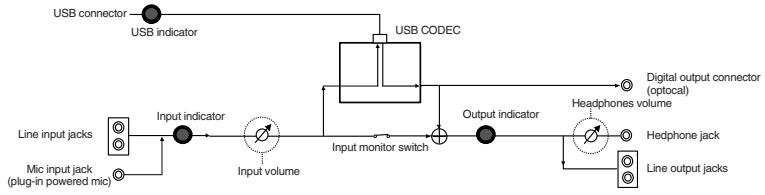
■ When the recording source select switch is set to ANALOG
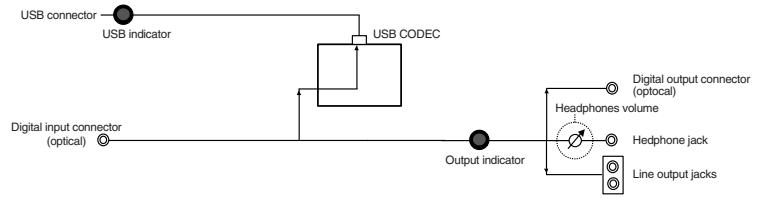
■ When the recording source select switch is set to DIGITAL
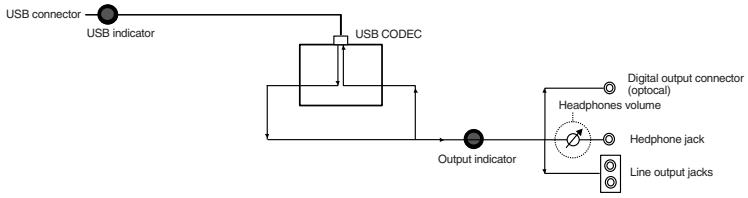
- When the recording source select switch is set to DIGITAL, and no input signal is being sent to the digital input connector
UA-1EX: USB Audio Interface
Number of Audio Record/Playback Channels
Record: 1 pair of stereo
Play: 1 pair of stereo
REC SOURCE switch = ANALOG:
Full duplex (except for 96kHz setting)
REC SOURCE switch = DIGITAL:
Recording only
Signal Processing
PC interface: 24 bits
(24-bit operation is available only when ADVANCE switch = ON)
AD/DA Conversion: 24 bits (linear)
- ADVANCE switch = OFF: 16 bits
Sampling Frequency
Digital output: 32/44.1/48/96 kHz
Digital input: 32/44.1/48/96 kHz
AD/DA Conversion: 32/44.1/48/96 kHz
- ADVANCE switch = OFF: 32/44.1/48 kHz
Line input jacks: -10 to +4 dBu
Mic input jack: -40 dBu
Nominal Output Level
Line output jacks: -10 dBu
Interface
USB
Digital input (Optical type)
Digital output (Optical type)
-
conforms to IEC60958 consumer format
-
The same jack serves as both the headphones jack and digital output connector.
-
0 dBu = 0.775 Vrms
-
In the interest of product improvement, the specifications, appearance, and/or contents of this unit are subject to change without prior notice.
Controllers
ADVANCED switch
INPUT VOLUME
PHONES VOLUME
SAMPLE RATE switch
96kHz MODE switch
INPUT MONITOR switch
REC SOURCE switch
- Connectors
USB Connector (B type)
Line Input jacks (L, R) (RCA phono type)
Line Output jacks (L, R) (RCA phono type)
Headphones jack (Stereo miniature phone type)
Digital Input connector (Optical type)
Digital Output connector (Optical type)
Mic Input jack (Plug-in powered miniature phone type)
- The same jack serves as both the headphones jack and digital output connector.
Power Supply
Supplied from the computer
Current Draw
200mA
- Dimensions
D:\Driver\XP2k\setup.exe
Das Dialogfeld "Setup is now ready to install the drivers" erscheint.
D:\Driver\XP2k\setup.exe
- Le message "The software was successfully installed" (installation terminée) s'affiche.
D:\Driver\XP2k\setup.exe
Fare cli scu [Installa] o [Upgrade].
- Verrà visualizzato il messaggio "Installing this software requires you to restart your computer when the installation is done."
Fare cli su [Continua installment].
- Verrà visualizzato il messaggio "The software was successfully installed".
Operation of the UA-1EX
Usarios de Windows XP/2000
D:\Driver\XP2k\setup.exe
Operation of the UA-1EX
- La pantalla indica "Installing this software requires you to restart your computer when the installation is done".
Haga cli en [Continue Installation].
- La pantalla indica "The software was successfully installed".
Roland Corporation U.S.
5100 S. Eastern Avenue
Los Angeles, CA 90040-2938, U.S.A.
TEL: (323) 890 3700
AFRICA
EGYPT
Al Fanny Trading Office
9, EBN Hagar A1 Askalany
Street,
ARD E1 Golf, Heliopolis,
Cairo 11341, EGYPT
TEL:20-2-417-1828
REUNION
Royal Cape Park, Unit 24
Londonderry Road, Ottery 7800
Cape Town, SOUTH AFRICA
TEL: (021) 799 4900
ASIA
CHINA
Roland Shanghai Electronics Co., Ltd.
5F.No.1500 Pingliang Road
Shanghai 200090, CHINA
TEL: (021) 5580-0800
Roland Shanghai Electronics Co., Ltd.
(BEIJING OFFICE)
10F. No.18 3 Section Anhuaxili
Chaoyang District Beijing
100011 CHINA
TEL: (010) 6426-5050
Roland Shanghai Electronics Co., Ltd.
(GUANGZHOU OFFICE)
2/F, No.30 Si You Nan Er Ji Yi Xiang, Wu Yang Xin Cheng
Guangzhou 510600, CHINA
TEL: (020) 8736-0428
HONG KONG
Parsons Music Ltd.
8th Floor, Railway Plaza, 39
Chatham Road South, T.S.T.
Kowloon, HONG KONG
TEL:23331863
INDIA
Rivera Digitec (India) Pvt. Ltd.
409, Nirman Kendra
Mahalaxmi Flats Compound
Off. Dr. Edwin Moses Road,
Mumbai-400011, INDIA
TEL: (022) 2493 9051
INDONESIA
PT Citra IntiRama
J1. Cideng Timur No. 15J-150
Jakarta Pusat
INDONESIA
TEL: (021) 6324170
KOREA
Cosmos Corporation
1461-9, Seocho-Dong,
Seocho Ku, Seoul, KOREA
TEL: (02) 3486-8855
MALAYSIA/
SINGAPORE
Roland Asia Pacific Sdn. Bhd.
45-1, Block C2, Jalan PJU 1/39, Datanat Prima, 47301 Petalingi
Java, Selangor, MALAYSIA
TEL: (03) 7805-3263
PHILIPPINES
G.A. Yupangco & Co. Inc.
339 Gil J. Puyat Avenue
Makati, Metro Manila 1200,
PHILIPPINES
TEL: (02) 899 9801
TAIWAN
ROLAND TAIWAN
ENTERPRISE CO., LTD.
Room 5, 9fl. No. 112 Chung
Shan N.Road Sec.2, Taipei,
TAIWAN, R.O.C.
TEL: (02) 2561 3339
THAILAND
Theera Music Co., Ltd.
330 Verng NakornKasem, Soi
2, Bangkok 10100, THAILAND
TEL: (02) 2248821
VIETNAM
SAIGON MUSIC
DISTRIBITOR
(TAN DINH MUSIC)
138 Tran Quang Khai Street
Dist. 1, Ho Chi Minh City
VIETNAM
TEL: (08) 848-4068
AUSTRALIA/
NEW ZEALAND
AUSTRALIA/
NEW ZEALAND
Roland Corporation
Australia Pty., Ltd.
38 Campbell Avenue
Dee Why West. NSW 2099
AUSTRALIA
For Australia
Tel: (02) 9982 8266
For New Zealand
Tel: (09) 3098 715
CENTRAL/LATIN
AMERICA
ARGENTINA
Instrumentos Musicales S.A.
Av.Santa Fe 2055
(1123) Buenos Aires
ARGENTINA
TEL: (011) 4508-2700
BARBADOS
A&B Music Supplies LTD
12 Webster Industrial Park
Wildey, St. Michael, Barbados
TEL: (246)430-1100
BRAZIL
Roland Brasil Ltda.
Rua San Jose, 780 Sala B
Parque Industrial San Jose
Cotia - Sao Paulo - SP, BRAZIL
TEL: (011) 4615 5666
CHILE
Comercial Fancy II S.A.
Rut.: 96.919.420-1
Nataniel Cox #739, 4th Floor
Santiago - Centro, CHILE
TEL: (02) 688-9540
COLOMBIA
Centro Musical Ltda.
Cra 43 B No 25 A 41 Bododega 9
Medellin, Colombia
TEL: (574)3812529
CURACAO
Zeelandia Music Center Inc.
Orionweg 30
Curacao, Netherland Antilles
TEL:(305)5926866
DOMINICAN
REPUBLIC
Instrumentos Fernando
Giraldez
155, New National Road
Patras 26442, GREECE
TEL:2610435400
HUNGARY
Roland East Europe Ltd.
Warehouse Area DEPO'Pf.83
H-2046 Torokbalint,
HUNGARY
TEL: (23) 511011
IRELAND
Roland Ireland
G2 Calmount Park, Calmount
Avenue, Dublin 12
Republic of IRELAND
TEL: (01) 4294444
ITALY
Roland Italy S. p. A.
Danvik Center 28, 2 tr.
S-131 30 Nacka SWEDEN
TEL: (0)8702 00 20
SWITZERLAND
Roland (Switzerland) AG
Atlantic Close, Swansea
Enterprise Park, SWANSEA
SA7 9FJ,
UNITED KINGDOM
TEL: (01792) 702701
MIDDLE EAST
BAHRAIN
Moon Stores
No.16, Bab Al Bahrain Avenue,
P.O.Box 247, Manama 304
State of BAHRAIN
TEL:17211005
CYPRUS
Radex Sound Equipment Ltd.
17, Diagorou Street, Nicosia,
CYPRUS
TEL: (022) 66-9426
IRAN
MOCO INC.
No.41 Nike St., Dr.Shariyati Ave.,
Roberoye Cerahe Mirdamad
Tehran, IRAN
TEL: (021) 285-4169
ISRAEL
Halilit P. Greenspoon & Sons
Ltd.
8 Retzif Ha'aliya Hashnya St.
Tel-Aviv-Yafo ISRAEL
TEL: (03) 6823666
JORDAN
Abdullah Salem Street,
Safat, KUWAIT
TEL: 243-6399
LEBANON
Chahine S.A.L.
Gerge Zeidan St., Chahine
Bldg., Achrafieh, P.O.Box: 16-
5857
Beirut,LEBANON
TEL: (01) 20-1441
OMAN
TALENTZ CENTRE L.L.C.
Malatan House No.1
Al Noor Street, Ruwi
SULTANATE OF OMAN
TEL:24783443
QATAR
Badie Studio & Stores
P.O.Box 62
Doha, QATAR
TEL: 423554
SAUDI ARABIA
aDawliah Universal
Electronics APL
Corniche Road, Aldossary
Bldg., 1st Floor, Alkhobar,
SAUDI ARABIA
P.O.Box 2154,Alkhobar 31952
SAUDI ARABIA
TEL: (03) 898 2081
SYRIA
Technical Light & Sound
Center
Rawda, Abdul Qader Jazairi St.
Bldg. No. 21, P.O.BOX 13520,
Damascus, SYRIA
TEL: (011) 223-5384
TURKEY
ZUHAL DIS TICARET A.S.
Galip Dede Cad. No.37
Beyoglu - Istanbul / TURKEY
TEL: (0212) 249 85 10
U.A.E.
Zak Electronics & Musical
Instruments Co. L.L.C.
Zabeel Road, Al Sherooq Bldg.
No.14, Grand Floor, Dubai,
U.A.E.
TEL: (04) 3360715
Numerics
96 kHz play/record select switch 13
A
ADVANCED (mode select) switch 12
Advanced mode 12, 15, 27
ANALOG 14
ASIO 30,42
ASIO Device 22,31
ASIO direct monitor 43
ASIO driver 30
ASIO2.0 14, 43
B
Background 19
Buffer Size 41-42
bus power 56
C
Cassette Tape 35
CD 38
Condenser Microphone 11,40
D
DAT 37-38
Default device 23,49
DIGITAL 14
Digital input connector 12
Digital output connector 12
Driver 12, 15, 27, 45
Driver Signing Options 16
H
Headphone jack 12
Headphones volume 12
1
Input Device 22
Input indicator 11
Input monitor switch 14
Input volume 12
L
latency 41
Line input jacks 11
Line output jacks 11
Loop 36
M
MD 37-38
Mic input jack 11
0
Optical 12
Other device 55
Output Device 22
Output indicator 12
P
Performance Options 19-20
plug-in powered mic 11,40
Preferred device 23,49-50
R
Recording source select switch 14,36,38,40
S
Sampling frequency select switch 13, 36-38, 40
SCMS 38
Setting select switches 13
Sound playback 23,49
Sound recording 23,49
Standard driver mode 12, 15, 27, 45
U
Unknown device 55
USB cable 11
USB Indicator 11
-For the USA
FEDERAL COMMUNICATIONS COMMISSION RADIO FREQUENCY INTERFERENCE STATEMENT
This equipment has been tested and found to comply with the limits for a Class B digital device, pursuant to Part 15 of the FCC Rules. These limits are designed to provide reasonable protection against harmful interference in a residential installation. This equipment generates, uses, and can radiate radio frequency energy and, if not installed and used in accordance with the instructions, may cause harmful interference to radio communications. However, there is no guarantee that interference will not occur in a particular installation. If this equipment does cause harmful interference to radio or television reception, which can be determined by turning the equipment off and on, the user is encouraged to try to correct the interference by one or more of the following measures:
Reorient or relocate the receiving antenna.
- Increase the separation between the equipment and receiver.
- Connect the equipment into an outlet on a circuit different from that to which the receiver is connected.
- Consult the dealer or an experienced radio/TV technician for help.
This device complies with Part 15 of the FCC Rules. Operation is subject to the following two conditions:
(1) This device may not cause harmful interference, and
(2) This device must accept any interference received, including interference that may cause undesired operation.
Unauthorized changes or modification to this system can void the users authority to operate this equipment.
This equipment requires shielded interface cables in order to meet FCC class B Limit.
For Canada
NOTICE
This Class B digital apparatus meets all requirements of the Canadian Interference-Caising Equipment Regulations.
AVIS
Model Name:UM-1EX
Type of Equipment: USB MIDI Interface
Responsible Party : Roland Corporation U.S.
Address: 5100 S. Eastern Avenue, Los Angeles, CA 90040-2938
Telephone:(323)8903700