
NDS Power Service PSB12-80 - Batteries DOMETIC - Free user manual and instructions
Find the device manual for free NDS Power Service PSB12-80 DOMETIC in PDF.


| Product type | Sealed lead-acid battery (AGM or GEL) |
| Brand | Dometic |
| Model | NDS Power Service PSB12-80 |
| Nominal voltage | 12 V |
| Capacity | 80 Ah |
| Dimensions (L x W x H) | 330 x 173 x 240 mm |
| Weight | Approximately 30 kg |
| Technology | AGM (Absorbent Glass Mat) or GEL |
| Power supply | Requires a suitable 12 V charger, recommended charging current 8-16 A |
| Main functions | Auxiliary power for caravans, motorhomes, boats, and solar systems |
| Applications | Leisure, solar energy, backup power |
| Terminal type | Standard conical terminals (A and B) |
| Maintenance | Maintenance-free (sealed, does not require water topping up) |
| Cleaning | Clean with a dry, lint-free cloth; avoid chemical products |
| Safety | Short-circuit protection; do not expose to flames or heat sources |
| Spare parts | No repairable parts; replace the entire battery at end of life |
| Repairability | Not repairable (sealed battery) |
| Warranty | Refer to the manual for warranty conditions |
| General information | Deep cycle battery for cyclic use; do not use as starter battery |
Frequently Asked Questions - NDS Power Service PSB12-80 DOMETIC
User questions about NDS Power Service PSB12-80 DOMETIC
0 question about this device. Answer the ones you know or ask your own.
Ask a new question about this device
Download the instructions for your Batteries in PDF format for free! Find your manual NDS Power Service PSB12-80 - DOMETIC and take your electronic device back in hand. On this page are published all the documents necessary for the use of your device. NDS Power Service PSB12-80 by DOMETIC.
USER MANUAL NDS Power Service PSB12-80 DOMETIC
PSB12-40, PSB12-80, PSB24-40, PSB24-60, PSB12/24-20, PSB12/24-40, PSB24/12-40, PSB24/12-80
EN Charger Short Operating Manual.... 3
© 2023 Dometic Group. The visual appearance of the contents of this manual is protected by copyright and design law. The underlying technical design and the products contained herein may be protected by design, patent or be patent pending. The trademarks mentioned in this manual belong to Dometic Sweden AB. All rights are reserved.
English
1 Important notes
Please read these instructions carefully and follow all instructions, guidelines, and warnings included in this product manual in order to ensure that you install, use, and maintain the product properly at all times. These instructions MUST stay with this product.
By using the product, you hereby confirm that you have read all instructions, guidelines, and warnings carefully and that you understand and agree to abide by the terms and conditions as set forth herein. You agree to use this product only for the intended purpose and application and in accordance with the instructions, guidelines, and warnings as set forth in this product manual as well as in accordance with all applicable laws and regulations. A failure to read and follow the instructions and warnings set forth herein may result in an injury to yourself and others, damage to your product or damage to other property in the vicinity. This product manual, including the instructions, guidelines, and warnings, and related documentation, may be subject to changes and updates. For up-to-date product information, please visit documents.dometic.com.
2 Explanation of symbols

DANGER!
Indicates a hazardous situation that, if not avoided, will result in death or serious injury.

WARNING!
Indicates a hazardous situation that, if not avoided, could result in death or serious injury.

CAUTION!
Indicates a hazardous situation that, if not avoided, could result in minor or moderate injury.

NOTICE!
Indicates a situation that, if not avoided, can result in property damage.
3 General safety instructions
Also observe the safety instructions and stipulations issued by the vehicle manufacturer and authorized workshops.

WARNING! Electrocution hazard
Failure to obey these warnings could result in death or serious injury.
- Installation and removal of the battery charger may only be carried out by qualified personnel.
- Do not operate the device if it is visibly damaged.
- If this device's power cable is damaged, the power cable must be replaced by the manufacturer, a service agent or a similarly qualified person in order to prevent safety hazards.
- This device may only be repaired by qualified personnel. Improper repairs can lead to considerable hazards.
- If you disassemble the device: Detach all connections. Ensure that no voltage is present on any of the inputs and outputs.
- Do not use the device in wet conditions or submerge in any liquid. Store in a dry place.
EN
- Only use accessories that are recommended by the manufacturer.
- Do not modify or adapt any of the components in any way.
- Disconnect the device from the power supply: Before each cleaning and maintenance After every use Before changing a fuse
Before carrying out electrical welding work or work on the electrical system

WARNING! Health hazard
Failure to obey these warnings could result in death or serious injury.
- This device can be used by children aged from 8 years and above and persons with reduced physical, sensory or mental capabilities or lack of experience and knowledge if they have been given supervision or instruction concerning use of the device in a safe way and understand the hazards involved.
- Electrical devices are not toys. Always keep and use the device out of the reach of very young children.
- Children must be supervised to ensure that they do not play with the device.
- Cleaning and user maintenance shall not be made by children without supervision.

NOTICE! Damage hazard
- Before start-up, check that the voltage specification on the data plate is the same as that of the power supply.
- Ensure that other objects cannot cause a short circuit at the contacts of the device.
- Ensure that the negative and positive poles never come into contact.
3.1 Installing the device safely

DANGER! Explosion hazard
Failure to obey these warnings will result in death or serious injury.
Never mount the device in areas where there is a risk of gas or dust explosion.

WARNING! Risk of injury
Failure to obey these warnings could result in death or serious injury.
- Ensure that the device is standing firmly. The device must be set up and fastened in such a way that it cannot tip over or fall down.
- When positioning the device, ensure that all cables are suitably secured to avoid any form of trip hazard.

NOTICE! Damage hazard
- Do not place the battery charger near heat sources (heaters, direct sunlight, gas ovens, etc.).
- Set up the device in a dry location where it is protected against splashing water.
3.2 Operating the device safely

DANGER! Electrocution hazard
Failure to obey these warnings will result in death or serious injury. Do not touch exposed cables with your bare hands.

WARNING! Explosion hazard
- Only use the device in closed, well-ventilated rooms.
- Do not operate the device under the following conditions: In salty, wet or damp environments In the vicinity of corrosive fumes In the vicinity of combustible materials In areas where there is a danger of explosions

WARNING! Electrocution hazard
- Before starting the device, ensure that the power supply line and the plug are dry and the plug is free from rust or dirt. • Always disconnect the power supply when working on the device.
- Observe that parts of the device may still conduct voltage even if the fuse has blown.
- Do not disconnect any cables when the device is still in use.

NOTICE! Damage hazard
- Ensure that the air inlets and outlets of the device are not covered.
- Ensure good ventilation.
- Never pull the plug out of the socket by the connection cable.
- The device shall not be exposed to rain.
3.3 Safety precautions when handling batteries

WARNING! Risk of injury
- Batteries contain aggressive and caustic acids. Avoid battery fluid coming into contact with your body. If your skin does come into contact with battery fluid, wash that part of your body thoroughly with water. If you sustain any injuries from acids, contact a doctor immediately.
- When working on batteries, do not wear any metal objects such as watches or rings. Lead acid batteries can cause short circuits which can cause serious injuries.
- Only use insulated tools.
- Do not place any metal parts on the battery.
- Wear goggles and protective clothing when working on batteries. Do not touch your eyes when working on batteries.
- Do not use defective batteries.

WARNING! Health hazard
Keep the battery out of the reach of children.

CAUTION! Electrocution hazard
- Keep the battery away from water.
- Avoid short circuits.
- Avoid clothing rubbing against the battery.
- Wear antistatic clothing when handling the battery.

CAUTION! Explosion hazard
- Do not place the battery in an area with flammable liquids or gases.
- Never attempt to charge a frozen or defective battery. Place the battery in a frost-free area and wait until the battery has acclimatised to the ambient temperature. Then start the charging process.
- Do not smoke, use an open flame, or cause sparking near the engine or a battery.
- Keep the battery away from heat sources.

NOTICE! Damage hazard
- Only use rechargeable batteries.
- Prevent any metal parts from falling on the battery. This can cause sparks or short-circuit the battery and other electrical parts.
- Ensure that the polarity is correct when connecting the battery.
- Follow the instructions of the battery manufacturer and those of the manufacturer of the system or vehicle in which the battery is used.
- If the battery has to be removed, first disconnect the ground connection. Disconnect all connections and all consumers from the battery before removing it.
- Only store fully charged batteries. Recharge stored batteries regularly.
- Do not carry the battery by its terminals.
Safety precautions when handling lithium batteries

CAUTION! Risk of injury
Only use batteries with integrated battery management system and cell balancing.

NOTICE! Damage hazard
- Only install the battery in environments with an ambient temperature of at least 0°C .
- Avoid deep discharge of the batteries.
Safety precautions when handling lead acid batteries

CAUTION! Health hazard
The water-acid liquid inside the battery can evaporate and cause an acidic odor. Use the battery only in a well-ventilated area.

NOTICE! Damage hazard
- The battery is not sealed. Do not turn the battery on its side or upside down. Place the battery on a horizontal surface.
- Check the acid level for open lead acid batteries regularly.
- Immediately recharge deeply discharged lead acid batteries to avoid sulfation.
4 Related documents

Find the installation and operating manual online on
http://qr.dometic.com/belsGZ.
5 Intended use
The battery charger is intended to monitor and charge house batteries in recreational vehicles by the alternator while driving.
The charger is intended to charge the following battery types:
- Lead acid batteries
- Lead gel batteries • Absorbed glass mat (AGM) batteries
- LiFePO4 batteries
The battery charger is not intended to charge other types of batteries (e.g. NiCd, NiMH, etc.).
The charger is suitable for:
• Installation in recreational vehicles • Stationary or mobile use - Indoor use
The charger is not suitable for:
- Mains operation
- Outdoor use
This product is only suitable for the intended purpose and application in accordance with these instructions.
This manual provides information that is necessary for proper installation and/or operation of the product. Poor installation and/or improper operating or maintenance will result in unsatisfactory performance and a possible failure.
The manufacturer accepts no liability for any injury or damage to the product resulting from:
- Incorrect assembly or connection, including excess voltage
- Incorrect maintenance or use of spare parts other than original spare parts provided by the manufacturer • Alterations to the product without express permission from the manufacturer
- Use for purposes other than those described in this manual
Dometic reserves the right to change product appearance and product specifications.
EN
6 Target Group

The mechanical and electrical installation and setup of the device must be performed by a qualified technician who has demonstrated skill and knowledge related to the construction and operation of automotive equipment and installations, and who is familiar with the applicable regulations of the country in which the equipment is to be installed and/or used, and has received safety training to identify and avoid the hazards involved.
7 Configuration

NOTICE! Damage hazard
Use a small screwdriver to carefully move the DIP switches to the required position.
1. Setting up the alternator type:
Table 1: Alternator configuration
| DIP switch position (gray) Function | |||
 | Standard alternator | activated 13.3 V | |
| deactivated 12.7 V | |||
 | Smart alternator | activated 11.7 V | |
| deactivated 11.25 V | |||
2. Setting the charging program:

NOTICE! Damage hazard
Only use batteries that are suitable for the specified charging voltage.
Table 2: Charging curve configuration
| DIP switch position (gray) | Function | ||||||
| Charging program | Max. voltage ( Uabs ) Float voltage ( Ufloat ) Max. desulfation voltage | ||||||
| 12 V~ | 24 V~ | 12 V~ | 24 V~ | 12 V~ | 24 V~ | ||
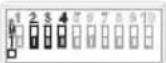 | Lead gel batteries | 14.2 V | 28.4 V | 13.5 V | 27 V | OFF | OFF |
EN
| DIP switch position (gray) | Function | ||||||
| Charging program | Max. voltage ( Uabs ) Float voltage ( Ufloat ) Max. desulfation voltage | ||||||
| 12 V | 24 V | 12 V | 24 V | 12 V | 24 V | ||
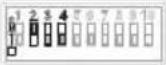 | Wet batteries | 14.4 V | 28.8 V | 13.8 V | 27.6 V | OFF | OFF |
 | AGM/1 batteries | 14.7 V | 29.4 V | 13.6 V | 27.2 V | OFF | OFF |
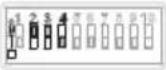 | AGM/2 batteries | 14.7 V | 29.4 V | 13.6 V | 27.2 V | 15.6 V | 31.2 V |
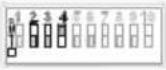 | LiFePO4/1 batteries | 14.5 V | 29 V | 13.8 V | 27.6 V | OFF | OFF |
 | LiFePO4/2 batteries | 14.5 V 29 V OFF OFF OFF OFF | |||||
 | LiFePO4/3 batteries | 14.2 V | 28.4 V | 13.6 V | 27.2 V | OFF | OFF |
 | LiFePO4/4 batteries | 14.2 V 28.4 V OFF OFF OFF OFF | |||||
EN
3. Setting the silent mode (optional):
Table 3: Silent mode configuration
| DIP switch position (gray) Function | |
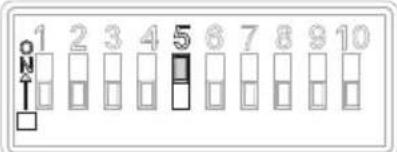 | Silent mode on |
 | Silent mode off |
4. Setting up the input current limit:
Table 4: Input current limit configuration
| DIP switch position (gray) | Function Model Max. input current Limited input cur- | rent | |
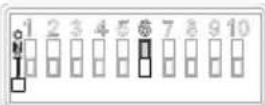 | Current limit on | PSB12-40 55 A 30 A | |
| PSB12-80 95 A 50 A | |||
| PSB24-40 55 A 40 A | |||
| PSB24-60 75 A 40 A | |||
| PSB12/24-20 60 A 30 A | |||
| PSB12/24-40 95 A 55 A | |||
| PSB24/12-40 40 A 20 A | |||
| PSB24/12-80 55 A 25 A | |||
 | Current limit off | ||
5. Setting up the output current limit:
Table 5: Output current limit configuration
| Model DIP switch position (gray) | |||
 |  |  | |
| PSB12-40 40 A 30 A 20 A | |||
Model DIP switch position (gray)
| PSB12-80 80 A 60 A 40 A | ||
| PSB24-40 40 A 30 A 20 A | ||
| PSB24-60 60 A 45 A 30 A | ||
| PSB12/24-20 20 A 15 A 10 A | ||
| PSB12/24-40 40 A 30 A 20 A | ||
| PSB24/12-40 40 A 30 A 20 A | ||
| PSB24/12-80 80 A 60 A 40 A |
8 Operation
Performing the system operation check
The state of charge (SoC) of the house battery must be at 75% of the capacity.
- Turn off the engine.
- Use a voltmeter to check the voltage of the house battery.
- Check if the DIP switch settings for the battery requirements and for the alternator type (traditional or smart) are correct.
- Turn the switch to position ON.
- Turn on the engine.
√ The LED lights up red or orange to indicate that the charging of the battery is in progress.
- Check the voltage of the house battery with the voltmeter and compare it to the previous measurement.
√ The voltage must be higher than before.
- After 2 min verify the maximum current data with a clamp meter.
√ This phase lasts a few seconds if the house battery is completely charged.
- Check the voltage of the starting battery at the battery poles with a voltmeter and compare it with the voltage between the charger's positive terminal and negative terminal.
√ The difference between the two connections may be max. 0.7 V. If the voltage difference is higher than 0.7 V, use a power cable with a larger cross-section for the connection to positive pole of starting battery (INPUT) or improve the ground connection (GND).
9 Disposal

Recycling packaging material: Place the packaging material in the appropriate recycling waste bins wherever possible.

Recycling products with non-replaceable batteries, rechargeable batteries or light sources:
- If the product contains any non-replaceable batteries, rechargeable batteries or light sources, you don't have to remove them before disposal.
- If you wish to finally dispose of the product, ask your local recycling center or specialist dealer for details about how to do this in accordance with the applicable disposal regulations.
- The product can be disposed free of charge.
1 Important notes
- Lead-acid batteries
- Gel batteries • AGM batteries
- LFP batteries
WARNING! Risk of injury
WARNING! Risk of injury
- ENGLISH
- IMPORTANT NOTES
- EXPLANATION OF SYMBOLS
- DANGER
- WARNING
- CAUTION
- NOTICE
- GENERAL SAFETY INSTRUCTIONS
- WARNING! ELECTROCUTION HAZARD
- EN
- WARNING! HEALTH HAZARD
- NOTICE! DAMAGE HAZARD
- INSTALLING THE DEVICE SAFELY
- DANGER! EXPLOSION HAZARD
- WARNING! RISK OF INJURY
- OPERATING THE DEVICE SAFELY
- DANGER! ELECTROCUTION HAZARD
- WARNING! EXPLOSION HAZARD
- SAFETY PRECAUTIONS WHEN HANDLING BATTERIES
- CAUTION! ELECTROCUTION HAZARD
- CAUTION! EXPLOSION HAZARD
- SAFETY PRECAUTIONS WHEN HANDLING LITHIUM BATTERIES
- CAUTION! RISK OF INJURY
- SAFETY PRECAUTIONS WHEN HANDLING LEAD ACID BATTERIES
- CAUTION! HEALTH HAZARD
- RELATED DOCUMENTS
- INTENDED USE
- TARGET GROUP
- CONFIGURATION
- SETTING UP THE ALTERNATOR TYPE
- SETTING THE CHARGING PROGRAM
- SETTING THE SILENT MODE (OPTIONAL)
- SETTING UP THE INPUT CURRENT LIMIT
- SETTING UP THE OUTPUT CURRENT LIMIT
- OPERATION
- PERFORMING THE SYSTEM OPERATION CHECK
- DISPOSAL
Brand : DOMETIC
Model : NDS Power Service PSB12-80
Category : Batteries