
GN900 - Pneumatic nailer MAKITA - Free user manual and instructions
Find the device manual for free GN900 MAKITA in PDF.



| Brand | MAKITA |
| Model | GN900 |
| Product Type | Cordless Gas Nailer |
| Rated Voltage | 7.2 V DC |
| Power Source | Rechargeable battery and fuel cell |
| Nail Length | 50 mm to 90 mm |
| Nail Shank Diameter | 2.9 mm to 3.3 mm |
| Magazine Capacity | 40 nails (1 strip) |
| Nail Angle | 34° |
| Nail Head Style | Clipped head |
| Dimensions (L x H x D) | 321 mm x 108 mm x 368 mm |
| Net Weight | 3.2 kg |
| Intended Use | Framing, joist and rafter fixing |
| Safety Mechanism | Contact trip and trigger (two actions required) |
| Sound Pressure Level | 89 dB(A) |
| Sound Power Level | 102 dB(A) |
| Acceleration Value | ≤ 2.5 m/s² (uncertainty 1.5 m/s²) |
| Integrated Safety Function | Anti-dry fire mechanism (empty lockout) |
| Status Indicator | LED indicator (green, red, orange) |
| Routine Maintenance | Air filter cleaning |
| Repairability | Makita authorized service center |
| Spare Parts | Use only genuine Makita parts |
| Maximum Storage Temperature | 50°C |
| Compliance | CE (EN792, EN60745, EN55014) |
Frequently Asked Questions - GN900 MAKITA
User questions about GN900 MAKITA
0 question about this device. Answer the ones you know or ask your own.
Ask a new question about this device
Download the instructions for your Pneumatic nailer in PDF format for free! Find your manual GN900 - MAKITA and take your electronic device back in hand. On this page are published all the documents necessary for the use of your device. GN900 by MAKITA.
USER MANUAL GN900 MAKITA
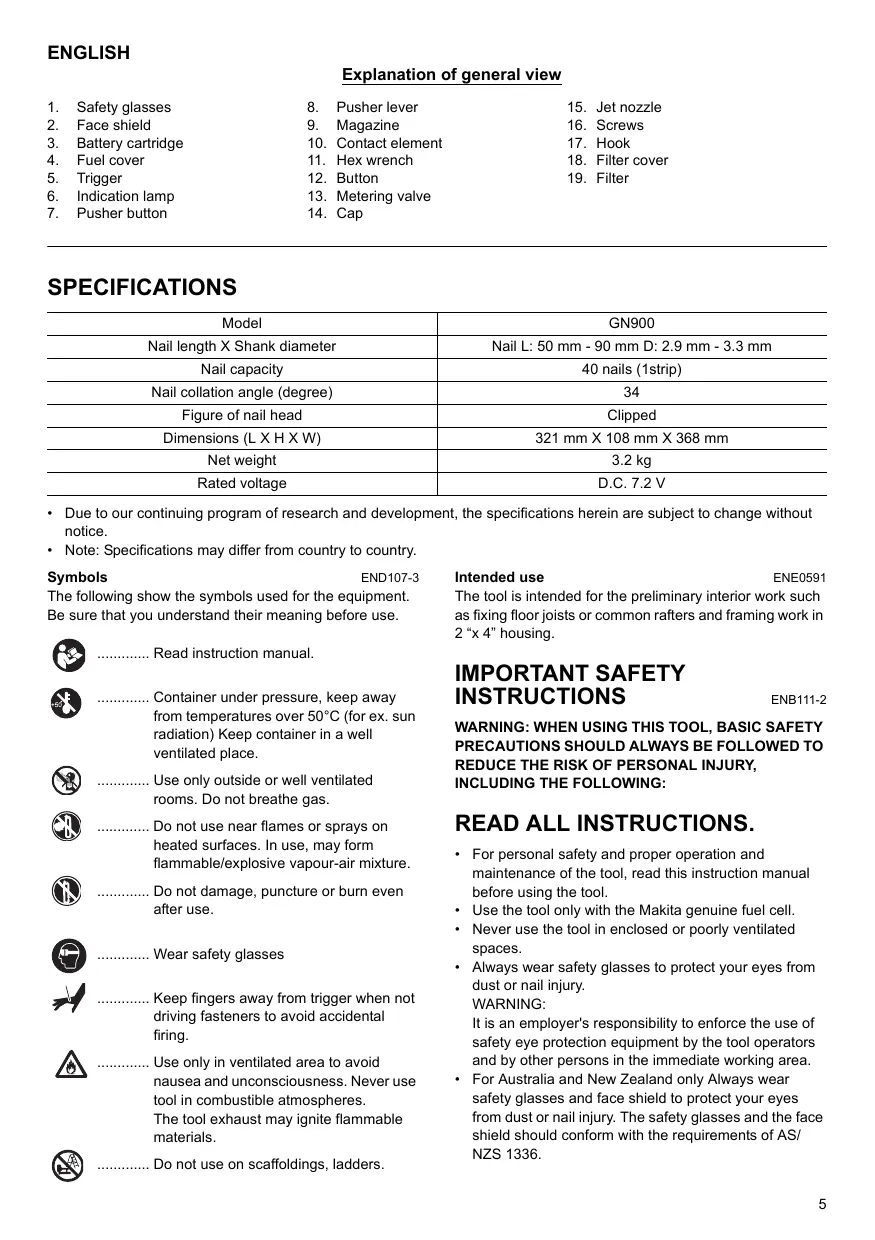
Explanation of general view
-
Safety glasses
-
Pusher lever
-
Jet nozzle
-
Face shield
-
Magazine
-
Screws
-
Battery cartridge
-
Contact element
-
Hook
-
Fuel cover
-
Hex wrench
-
Filter cover
-
Trigger
-
Button
-
Filter
-
Indication lamp
-
Metering valve
-
Pusher button
-
Cap
SPECIFICATIONS
| Model | GN900 |
| Nail length X Shank diameter | Nail L: 50 mm - 90 mm D: 2.9 mm - 3.3 mm |
| Nail capacity | 40 nails (1strip) |
| Nail collation angle (degree) | 34 |
| Figure of nail head | Clipped |
| Dimensions (L X H X W) | 321 mm X 108 mm X 368 mm |
| Net weight | 3.2 kg |
| Rated voltage | D.C. 7.2 V |
- Due to our continuing program of research and development, the specifications herein are subject to change without notice.
Note: Specifications may differ from country to country.
Symbols
END107-3
The following show the symbols used for the equipment.
Be sure that you understand their meaning before use.

Read instruction manual.

Container under pressure, keep away from temperatures over 50°C (for ex. sun radiation) Keep container in a well ventilated place.

Use only outside or well ventilated rooms. Do not breathe gas.

Do not use near flames or sprays on heated surfaces. In use, may form flammable/explosive vapour-air mixture.

Do not damage, puncture or burn even after use.

Wear safety glasses

Keep fingers away from trigger when not driving fasteners to avoid accidental firing.

Use only in ventilated area to avoid nausea and unconsciousness. Never use tool in combustible atmospheres. The tool exhaust may ignite flammable materials.

Do not use on scaffoldings, ladders.
Intended use
ENE0591
The tool is intended for the preliminary interior work such as fixing floor joists or common rafters and framing work in 2 "x 4" housing.
IMPORTANT SAFETY INSTRUCTIONS
ENB111-2
WARNING: WHEN USING THIS TOOL, BASIC SAFETY PRECAUTIONS SHOULD ALWAYS BE FOLLOWED TO REDUCE THE RISK OF PERSONAL INJURY, INCLUDING THE FOLLOWING:
READ ALL INSTRUCTIONS.
- For personal safety and proper operation and maintenance of the tool, read this instruction manual before using the tool.
- Use the tool only with the Makita genuine fuel cell.
- Never use the tool in enclosed or poorly ventilated spaces.
Always wear safety glasses to protect your eyes from dust or nail injury.
WARNING:
It is an employer's responsibility to enforce the use of safety eye protection equipment by the tool operators and by other persons in the immediate working area.
- For Australia and New Zealand only Always wear safety glasses and face shield to protect your eyes from dust or nail injury. The safety glasses and the face shield should conform with the requirements of AS/NZS 1336.
WARNING:
It is an employer's responsibility to enforce the use of safety eye protection equipment by the tool operators and by other persons in the immediate working area.
(Fig. 1)
- Wear hearing protection to protect your ears against exhaust noise and head protection. Also wear light but not loose clothing. Sleeves should be buttoned or rolled up. No necktie should be worn.
- Rushing the job or forcing the tool is dangerous. Handle the tool carefully. Do not operate when under the influence of alcohol, drugs or the like.
- General Tool Handling Guidelines:
(1) Always assume that the tool contains fasteners.
(2) Do not point the tool toward yourself or anyone whether it contains fasteners or not.
(3) Do not activate the tool unless the tool is placed firmly against the workpiece.
(4) Respect the tool as a working implement.
(5) No horseplay.
(6) Do not hold or carry the tool with a finger on the trigger.
(7) Do not load the tool with fasteners when any one of the operating controls is activated.
(8) Do not operate the tool with any power source other than that specified in the tool operating/ safety instructions.
- An improperly functioning tool must not be used.
- Sparks sometimes fly when the tool is used. Do not use the tool near volatile, flammable materials such as gasoline, thinner, paint, gas, adhesives, etc.; they will ignite and explode, causing serious injury.
- The area should be sufficiently illuminated to assure safe operations. The area should be clear and litter-free. Be especially careful to maintain good footing and balance.
- Only those involved in the work should be in the vicinity. Children especially must be kept away at all times.
- There may be local regulations concerning noise which must be complied with by keeping noise levels within prescribed limits. In certain cases, shutters should be used to contain noise.
- Do not play with the contact element: it prevents accidental discharge, so it must be kept on and not removed. Securing the trigger in the ON position is also very dangerous. Never attempt to fasten the trigger. Do not operate a tool if any portion of the tool operating controls is inoperable, disconnected, altered, or not working properly.
Always check the tool for its overall condition and loose screws before operation. Tighten as required. - Make sure all safety systems are in working order before operation. The tool must not operate if only the trigger is pulled or if only the contact arm is pressed against the wood. It must work only when both actions are performed. Test for possible faulty operation with nails unloaded and the pusher in fully pulled position.
- Check walls, ceilings, floors, roofing and the like carefully to avoid possible electrical shock, gas
leakage, explosions, etc. caused by striking live wires, conduits or gas pipes.
- Use only nails specified in this manual. The use of any other nails may cause malfunction of the tool.
-
Never use fastener driving tools marked with the symbol "Do not use on scaffoldings, ladders" for specific application for example:
-
when changing one driving location to another involves the use of scaffoldings, stairs, ladders, or ladder alike constructions, e.g. roof laths;
- closing boxes or crates;
-
fitting transportation safety systems e.g. on vehicles and wagons.
-
Do not permit those uninstructed to use the tool.
- Make sure no one is nearby before nailing. Never attempt to nail from both the inside and outside at the same time. Nails may rip through and/or fly off, presenting a grave danger.
- Watch your footing and maintain your balance with the tool. Make sure there is no one below when working in high locations to prevent danger if there is sudden jerking or catching.
- On rooftops and other high locations, nail as you move forward. It is easy to lose your footing if you nail while inching backward. When nailing against perpendicular surface, nail from the top to the bottom. You can perform nailing operations with less fatigue by doing so.
- A nail will be bent or the tool can become jammed if you mistakenly nail on top of another nail or strike a knot in the wood. The nail may be thrown and hit someone, or the tool itself can react dangerously. Place the nails with care.
- Do not point the ejection port at anyone in the vicinity. Keep hands and feet away from the ejection port area.
- Never carry the tool with your finger on the trigger or hand it to someone in this condition. Accidental firing can be extremely dangerous.
- Handle the tool carefully, as there is high pressure inside the tool that can be dangerous if a crack is caused by rough handling (dropping or striking). Do not attempt to carve or engrave on the tool.
- Stop nailing operations immediately if you notice something wrong or out of the ordinary with the tool.
Always remove the fuel cell, the battery cartridge and all of the nails:
(9) When unattended.
(10) Before performing any maintenance or repair.
(11) Before cleaning a jam.
(12) Before moving the tool to a new location.
- Perform cleaning and maintenance right after finishing the job. Keep the tool in tip-top condition. Lubricate moving parts to prevent rusting and minimize friction-related wear. Wipe off all dust from the parts.
- Do not modify tool without authorization from Makita.
- Ask Makita's Authorized service centers for periodical inspection of the tool.
-
To maintain product SAFETY and RELIABILITY, maintenance and repairs should be performed by Makita Authorized Service Centers, always using Makita replacement parts.
-
Do not attempt to keep the trigger contact element depressed with tape or wire. Death or serious injury may occur.
- Always check contact element as instructed in this manual. Nails may be driven accidentally if the safety mechanism is not working correctly.
SAVE THESE INSTRUCTIONS.
ENC007-2
IMPORTANT SAFETY INSTRUCTIONS
FOR BATTERY CARTRIDGE
- Before using battery cartridge, read all instructions and cautionary markings on (1) battery charger, (2) battery, and (3) product using battery.
- Do not disassemble battery cartridge.
- If operating time has become excessively shorter, stop operating immediately. It may result in a risk of overheating, possible burns and even an explosion.
- If electrolyte gets into your eyes, rinse them out with clear water and seek medical attention right away. It may result in loss of your eyesight.
- Do not short the battery cartridge:
(1) Do not touch the terminals with any conductive material.
(2) Avoid storing battery cartridge in a container with other metal objects such as nails, coins, etc.
(3) Do not expose battery cartridge to water or rain. A battery short can cause a large current flow, overheating, possible burns and even a breakdown.
- Do not store the tool and battery cartridge in locations where the temperature may reach or exceed 50°C (122°F).
- Do not incinerate the battery cartridge even if it is severely damaged or is completely worn out. The battery cartridge can explode in a fire.
- Be careful not to drop or strike battery.
SAVE THESE INSTRUCTIONS.
Tips for maintaining maximum battery life
- Charge the battery cartridge before completely discharged. Always stop tool operation and charge the battery cartridge when you notice less tool power.
- Never recharge a fully charged battery cartridge. Overcharging shortens the battery service life.
- Charge the battery cartridge with room temperature at 10°C - 40°C (50°F - 104°F) . Let a hot battery cartridge cool down before charging it.
Overview of the nailer (Fig. 2)
FUNCTIONAL DESCRIPTION
CAUTION:
- Always be sure to remove the fuel cell, the battery cartridge and nails before adjusting or checking function on the tool.
Installing or removing battery cartridge (Fig. 3)
- Always switch off the tool before insertion or removal of the battery cartridge.
- To remove the battery cartridge, withdraw it from the tool while pressing the button on the side of the cartridge as shown in the figure. (Fig. 4)
- To insert the battery cartridge, hold it so that the battery cartridge front shape fits to that of the battery installment opening and slip it into place. Always insert it all the way until it locks in place with a little click. If not, it may accidentally fall out of the tool, causing injury to you or someone around you.
- Do not use force when inserting the battery cartridge. If the cartridge does not slide in easily, it is not being inserted correctly.
Fuel cell
Attaching the metering valve to the fuel cell (Fig. 5) Detach the cap (in case the metering valve is provided with the cap). (Fig. 6)
Push in the front edge. (Fig. 7)
Push in the rear edge until it seats.
Inserting the fuel cell (Fig. 8)
Push up and pull the fuel cover to open. (Fig. 9) Insert the fuel cell directing the jet nozzle of the metering valve toward the adaptor. (Fig. 10)
Insert the jet nozzle into the small hole of the adapter properly. (Fig. 11)
Put the fuel cover over the metering valve and push it down to latch.
Adjusting the nailing depth
CAUTION:
- Remove the fuel cell, the battery cartridge and nails before adjusting the depth of nailing. (Fig. 12) With the hex wrench, loosen two screws and move the contact element. Retighten screws firmly.
Indication lamp
Color of the indication lamp means the followings.
Blinking green: Normal status
Blinking red: Need to recharge the battery cartridge Lighting-up-red: Recharge the battery cartridge. Nailing cannot be performed due to no remaining battery capacity.
Blinking orange after blinking green and red alternately: Fault detection is running. Remove and reinsert the battery cartridge to reset. If fault detection is running again, it is malfunction condition.
Hook (Fig. 13)
The hook is convenient for hanging the tool temporarily. The hook can be set in two positions according to where the tool will be hung.
To change the hook position, contract it at its foot by pushing in from both sides and shift to another position.
ASSEMBLY
CAUTION:
- Always remove the fuel cell and the battery cartridge.
Loading the nailer (Fig. 14)
Insert a strip of nails into the slit in the rear of the magazine. (Fig. 15)
Pull the Pusher Lever until the rear of the Magazine and return it to the end of the strip gently.
Removing nails (Fig. 16)
Pull the pusher lever and push the pusher button to release the nail supporter, and then return the pusher lever to the top pushing the pusher button.
Slide the nails toward the rear of the magazine and remove them out.
OPERATION
CAUTION:
- Make sure all safety systems are in working order before operation. (Fig. 17)
- To drive a nail, place the contact element against the workpiece.
The fan motor is activated, fuel gas is injected into combustion chamber and mixed with air by the fan. (Fig. 18) - Hold the contact element pressing firmly and pull the trigger.
Fuel gas is combusted and the nail is driven. - Further driving can be initiated only after both the contact element and the trigger are released
Anti dry fire mechanism
This is the mechanism that the tool prevents to be fired without nail.
Dry fire prevention automatically sets up when the rest of nails get to last 4-7 pieces.
Jammed nailer
CAUTION:
- Always be sure to remove the fuel cell and the battery cartridge before clearing a jam.
When the nailer becomes jammed, do as follows. - Remove the fuel cell, the battery cartridge and nails. (Fig. 19)
- Loosen the (2) magazine mounting screws with the hex wrench. (Fig. 20)
- Pull the handle/magazine away from the nose of the tool and clear jam.
- Realign the handle/magazine to the nose and tighten mounting screws.
- Reload a strip of nails.
WARNING:
- Make sure that the magazine mounting screws are tight and the magazine is tight to nose. Attempting to fire tool with a loose magazine will result in loss of nail control, damage to the tool or nail discharge toward operator.
MAINTENANCE
CAUTION:
- Always remove the fuel cell, the battery cartridge and nails before attempting to perform inspection or maintenance.
Cleaning the air filter (Fig. 21)
Press slightly up the fuel cover and pivot it open. And then remove the filter cover and simply lift out the filter. Tap the filter lightly to remove any dust. Soap and water restores the filter to an almost new condition.
Maintenance after daily work
At the end of daily work, conduct an end-of-workday routine.
These simple steps are based on maintaining the safety and performance of Makita Cordless Clipped Head Framing Nailer.
Before leaving the work site:
- Remove the battery cartridge and store in tool-carrying case. Always use the Cordless Clipped Head Framing Nailer case for transporting and storing the tool.
- Dispose of all empty fuel cells. Remember to dispose of these cells where they will not be found by children, crushed, punctured or burned.
When you get home:
(1) Place the battery cartridge in its charger if it needs charging as indicated by the red indication lamp near the handle.
(2) Wipe your Cordless Clip Head Framing Nailer with a clean, soft cloth.
(3) Check the filter and clean if it is dusty.
To maintain product SAFETY and RELIABILITY, repairs, any other maintenance or adjustment should be performed by Makita Authorized or Factory Service
Centers, always using Makita replacement parts.
ACCESSORIES
CAUTION:
- These accessories or attachments are recommended for use with your Makita tool specified in this manual. The use of any other accessories or attachments might present a risk of injury to persons. Only use accessory or attachment for its stated purpose.
If you need any assistance for more details regarding these accessories, ask your local Makita Service Center.
Nails
- Safety goggles
Fuel cell
- Cleaning kit
- Various type of Makita genuine batteries and chargers
For European countries only
Noise and Vibration
ENG045-2
The typical A-weighted noise levels are
sound pressure level: 89 dB (A)
sound power level: 102 dB (A).
Wear ear protection.
The typical weighted root mean square acceleration value is not more than 2.5m / s2
Uncertainty (K): 1.5m / s2
These values have been obtained according to EN792.
EC-DECLARATION OF CONFORMITY
Model; GN900
ENH023-1
We declare under our sole responsibility that this product is in compliance with the following standards of standardized documents;
EN792, EN60745 and EN55014 in accordance with
Council Directives, 98/37/EC, 2004/108/EC.
CE 2008
Tomoyasu Kato
Director
Responsible Manufacturer:
Makita Corporation
3-11-8, Sumiyoshi-cho, Anjo, Aichi, JAPAN
Authorized Representative in Europe:
Makita International Europe Ltd.
Michigan Drive, Tongwell, Milton Keynes, Bucks MK15
8JD, ENGLAND
Descriptif
Tomoyasu Kato
Director
Fabricant responsible:
Makita Corporation
3-11-8, Sumiyoshi-cho, Anjo, Aichi, JAPON
Representant agre en Europe:
Makita International Europe Ltd.
Michigan Drive, Tongwell, Milton Keynes, Bucks MK15 8JD, ANGLETERRE
Michigan Drive, Tongwell, Milton Keynes, Bucks MK15
8JD, ENGLAND
ITALIANO
3-11-8, Sumiyoshi-cho, Anjo, Aichi, GIAPPONE
Michigan Drive, Tongwell, Milton Keynes, Bucks MK15 8JD, INGHILTERRA
Michigan Drive, Tongwell, Milton Keynes, Bucks MK15
8JD, ENGELAND
Michigan Drive, Tongwell, Milton Keynes, Bucks MK15
8JD, REINO UNIDO
Descrição geral
Michigan Drive, Tongwell, Milton Keynes, Bucks MK15 8JD, INGLATERRA
Blinker orange after at have blinket henholdsvist
Michigan Drive, Tongwell, Milton Keynes, Bucks MK15
8JD, ENGLAND
Eviikn Iepiypaq
Ooynie ts Etnptpon9c, 98/37/EK, 2004/108/EK.
CE 2008
Tomoyasu Kato
Δ µ θ ντη
YtueuvoCs KataokEuaoTns:
Makita Corporation
3-11-8, Sumiyoshi-cho, Anjo, Aichi, JAPAN
Egouiofoiouevoa AvntipoawtoaTv Eupwn:
Makita International Europe Ltd.
Michigan Drive, Tongwell, Milton Keynes, Bucks MK15
8JD, AΓΓAIA
Makita Corporation
Anjo, Aichi, Japan
884862A999
- Explanation of general view
- Specifications
- Symbols
- Intended use
- Important safety instructions
- Read all instructions
- Warning
- (Fig. 1)
- Save these instructions
- For battery cartridge
- Tips for maintaining maximum battery life
- Overview of the nailer (fig. 2)
- Functional description
- Caution
- Installing or removing battery cartridge (fig. 3)
- Fuel cell
- Attaching the metering valve to the fuel cell (fig. 5) detach the cap (in case the metering valve is provided with the cap). (fig. 6)
- Adjusting the nailing depth
- Indication lamp
- Hook (fig. 13)
- Assembly
- Loading the nailer (fig. 14)
- Removing nails (fig. 16)
- Operation
- Anti dry fire mechanism
- Jammed nailer
- Maintenance
- Cleaning the air filter (fig. 21)
- Maintenance after daily work
- Before leaving the work site
- When you get home
- Accessories
- For european countries only
- Noise and vibration
- Wear ear protection
- Ec-declaration of conformity
- Model; GN900
- Makita corporation
- Makita international europe ltd
- Descriptif
- Fabricant responsible
- Italiano
- Descrição geral
- Eviikn iepiypaq
Brand : MAKITA
Model : GN900
Category : Pneumatic nailer