Khaki X-Wind - Wristwatch Hamilton - Free user manual and instructions
Find the device manual for free Khaki X-Wind Hamilton in PDF.


| Product type | Wristwatch |
| Brand | Hamilton |
| Model | Khaki X-Wind |
| Movement | Automatic (caliber H-30 or similar, 60h power reserve) |
| Main functions | Hours, minutes, small seconds, date, day, chronograph (60s, 30min, 12h), drift calculator (crosswind) |
| Case | Stainless steel, 45 mm diameter, 14 mm thickness |
| Bezel | Rotating outer bezel and two adjustable inner bezels |
| Crystal | Anti-reflective sapphire |
| Strap | Leather, 22 mm width, pin buckle |
| Water resistance | 10 bar (100 meters) according to ISO 22810 standard |
| Power supply | Automatic winding by wrist movement or manual (30 crown turns) |
| Dimensions (approx.) | 45 × 14 mm, weight ~100 g |
| Maintenance and cleaning | Rinse with fresh water after contact with seawater, dry. Avoid magnetic fields. Check water resistance every 2 years by a professional. |
| Leather strap precautions | Avoid water, humidity, sunlight, and fatty substances. |
| Repairability | Entrust exclusively to a Hamilton dealer or authorized professional. |
Frequently Asked Questions - Khaki X-Wind Hamilton
User questions about Khaki X-Wind Hamilton
0 question about this device. Answer the ones you know or ask your own.
Ask a new question about this device
Download the instructions for your Wristwatch in PDF format for free! Find your manual Khaki X-Wind - Hamilton and take your electronic device back in hand. On this page are published all the documents necessary for the use of your device. Khaki X-Wind by Hamilton.
USER MANUAL Khaki X-Wind Hamilton
Introduction Care and maintenance
Congratulations.
Hamilton is delighted that you have chosen a timepiece from its collection. You have acquired a small technological marvel that will serve you faithfully for many years. The most advanced technologies were used throughout its manufacture and it underwent stringent controls before it was released for sale.
Illustration keys
① Hour hand
② Minute hand
③ Small seconds hand
④ 60-second counter
⑤ 30-minute counter
⑥ 12-hour counter
⑦ Date / Day
⑧ Exterior rotating bezel
⑨ Upper interior rotating bezel
⑩ Lower interior rotating bezel
A Time/Date/Day setting crown
B Chronograph start/stop button
© Chronograph resetting button
D Crown for adjusting bezel ⑨
E Crown for adjusting bezel ⑩
Recommendations
- Like all micro-mechanical precision instruments, your Hamilton watch should be checked at least once every two years. Entrust your watch to an authorized Hamilton repair center or to any other professional watch service.
- To keep your watch water-resistant, make sure that its sealing features are tested at every check-up.
- Do not move the crown when you are in water.
- Rinse off your watch with fresh water after any immersion in seawater.
• Dry your watch whenever it gets wet. - Have your watch checked for water-resistance by an authorized Hamilton retailer or by any other professional watch service each time the case is opened.
Water-resistance
The water-resistance of your watch is indicated on the case back.
Water resistance and equivalent pressure used in Anglo-Saxon countries:
| Unit of measure Water resistance categories available | |||||
| atm (overpressure) 351020100 | |||||
| psi | 44 | 72,5 | 145 | 290 | 1450 |
| ft * | 100 | 165 | 330 | 660 | 3300 |
Water resistance and equivalent pressure used in countries using metric systems:
| Unit of measure Water resistance categories available | |||||
| bar | 3 5 10 20 | 100 | |||
| m* | 30 | 50 | 100 | 200 | 1000 |
* The values given in feet or meters of immersion in water are equivalent to the degree of overpressure applied during the tests according to the ISO 22810 standard.
Leather straps
Hamilton recommends that you follow the steps below in order to preserve the condition of your leather strap for as long as possible:
- Avoid contact with water and dampness to prevent discoloration and deformation.
- Avoid prolonged exposure to sunlight to prevent the color from fading.
- Do not forget that leather is permeable! Therefore avoid contact with greasy substances and cosmetic products.
- If you have a problem with your leather strap, please contact your nearest Hamilton retailer.
Magnetic fields
To prevent malfunctions of your watch avoid coming into contact with magnetic fields such as those of magnets, loudspeakers, cell phones, refrigerators, etc.
Operating instructions
Movement
Your watch is fitted with an automatic movement. The mechanism of the watch includes an oscillating rotor that winds the mainspring via the motion of your wrist. The power reserve is up to 60 hours.
If necessary, the movement may be rewound manually by turning the crown clockwise 30 times in position (I). With most of our models, the beauty of the inner working of the watch movement can be admired through the transparent case back.
The Hamilton Khaki Automatic X-Wind has three screw-down crowns and two push-buttons.
Important: to keep your watch water-resistant, always screw the crowns A, D, and E back to position (0) after all the settings.
Setting the time
- Unscrew setting crown A.
- Pull out the crown completely to position (III).
- Adjust the time by turning the crown in the desired direction.
- Push back the crown completely then screw it down again.
Setting the date / day
- Unscrew setting crown A.
- Pull out the crown to the intermediate position (II).
- Turn the crown anticlockwise until the desired date appears, or clockwise for the desired day. Do not perform this operation between 20:00 and 02:00 (8 p.m. and 2 a.m.).
- Push back the crown completely then screw it down again.
Chronograph functions
Simple or added timing
- Press button Ⓑ to start the chronograph.
- Press button Ⓑ again to stop the chronograph. The elapsed time or the first partial time is indicated by the hands of the counters ④, ⑤ and ⑥.
- Repeat these two steps for each additional timing. At the end of the last timing, the chronograph will indicate the cumulative time of all the partial timings added together.
- Push button Ⓐ to reset the counters to zero.
Operating instructions
Crosswind
The Khaki X-Wind integrates a drift – angle calculator, enabling pilots to accurately calculate and record the crosswinds they will encounter on their planned journey.
- Position the red arrow of the upper interior rotating bezel ⑨ at 12 o'clock by adjusting with crown D.
Adjust the lower interior rotating bezel ⑩ to 0irc by adjusting with crown E.


- Obtain wind speed and direction from control tower or weather chart.
Ex. Wind speed: 40 mph
Wind direction: 70irc
Indicate wind direction (70) in the window with the upper interior rotating bezel ⑨ by adjusting with crown D.

- Adjust the exterior rotating bezel ⑧ so that one tenth of the speed of the aircraft is indicated opposite the red arrow.
Ex. Aircraft speed:
180 mph – indicate 18.

- From the geographical bearing, calculate the magnetic bearing of the aircraft:
The variation (Var) depends on the current location, which can be determined from an aviation chart.
Ex. Geographical bearing: 30°
Variation (Var): 10°
Magnetic bearing: 30irc + 10irc = 40irc
Tn: True North | Mn: Magnetic North | Var: Variation

If the variation (Var) is to the West, it is added to the geographical bearing to obtain the magnetic bearing.
Ex. 30irc + 10irc = 40irc

If the variation (Var) is to the East, it is subtracted from the geographical bearing to obtain the magnetic bearing. Ex. 30irc-15irc=15irc
- Calculation of crosswind angle.
Ex. Wind direction: 70°
Magnetic bearing of aircraft: 40°
Crosswind angle: 70irc-40irc=30irc (headwind)

70irc - 40irc = 30irc (Headwind)

180irc - (330irc - 220irc) = 70irc (Tailwind)
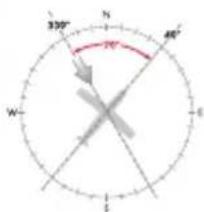
360irc - (330irc - 40irc) = 70irc (Headwind)
Operating instructions
6. Calculation of crosswind:
Using the graph (plastic card) determine the point of intersection of the wind speed (head/tailwind component) and the crosswind angle.
Going from the point of intersection, read the value of the crosswind component on the horizontal axis.
Ex. Headwind component: 40 mph
Crosswind angle: 30°
Crosswind component: 20 mph

radar
| Headwind Component HWC (mph) | Tailwind Component TWC (mph) | | ----------------------------- | ---------------------------- | | 20 | 30 |7. Calculate the angle of drift:
Locate the crosswind component (20) on the exterior rotating bezel ⑧ and read the value indicated on the interior bezel ⑨.
Ex. Angle of drift: approx. 6.5°

8. Calculation of corrected bearing:
If the wind is blowing from the right, add the angle of drift to the magnetic bearing.
If the wind is blowing from the left, subtract the angle of drift from the magnetic bearing.
Ex. Corrected bearing: 40irc + 6.5irc = 46.5irc
For memorization, use the crown Ⓔ to indicate the corrected bearing (t) on the lower interior rotating bezel ⑩.

180irc - (330irc - 220irc) = 70irc Vent arrière droite (Tailwind)

360irc - (330irc - 40irc) = 70irc Vent avant gauche (Headwind)
Mode d'emploi

70irc-40irc=30irc Gegen- wind (Headwind)

180irc - (330irc - 220irc)
7 0 ^ irc - 4 0 ^ irc = 3 0 ^ irc
(Tailwind)

3 6 0 ^ irc - (3 3 0 ^ irc - 4 0 ^ irc)
= 7 0 ^ irc vento di fronte
( Headwind )
70irc - 40irc = 30irc
Viento contrario (Headwind)

180irc - (330irc - 220irc)
= 70° Viento de cola
(Tailwind)
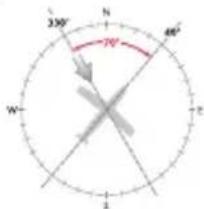
360irc - (330irc - 40irc) =
70° Viento contrario (Headwind)
70irc - 40irc = 30irc
vento de proa
(Headwind)

180irc - (330irc - 220irc)
= 70° vento de popa
(Tailwind)

360irc - (330irc - 40irc)
= 70° vento de proa
(Headwind)

360irc - (330irc - 40irc) = Kopwind (Headwind)
Vb. Kopwind (Headwind component): 40 mph
Vb. Drifthoek: circa 6.5°

Doğal Sapma (Var): 10°
Manyetik yön: 30irc + 10irc = 40irc
70irc-40irc=30irc Pruva rüzgarı (Headwind)

180irc - (330irc - 220irc) = 70irc Pruva rüzgari (Headwind)
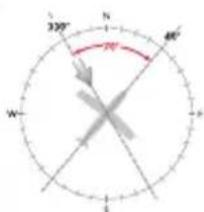
360irc - (330irc - 40irc) = 70irc Pruva rüzgari (Headwind)
180irc - (330irc - 220irc)
= 70° οὐριος ἀνεμος (Tailwind)

360irc - (330irc - 40irc) =
70irc - 40irc = 30irc
встречный ветер
(Headwind)
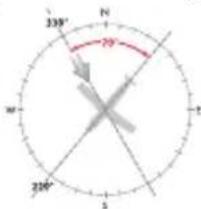
180irc - (330irc - 220irc) = 70irc попутный ветер (Tailwind)

360irc - (330irc - 40irc) = 70irc встречный ветер (Headwind)
70irc-40irc=30irc 向かい風 (Headwind)

180irc-(330irc-220irc)=70irc 追い風 (Tailwind)
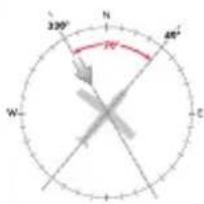
360irc-(330irc-40irc)=70irc 向かい風 (Headwind)
操作方法
6. クロスウィンドの計算
8. 修正針路の計算
70irc - 40irc = 30irc
역풍(Headwind)

180irc - (330irc - 220irc) =
70° 순풍 (Tailwind)

360irc - (330irc - 40irc) =
70°역풍 (Headwind)
작동 지침
6. 측풍 계산:

70irc - 40irc = 30irc
逆风 (Headwind)

180irc-(330irc-220irc)= 70irc 顺风 (Tailwind)

360irc - (330irc - 40irc) = 70irc 逆风(Headwind)
操作说明
6.侧风的计算

70irc - 40irc = 30irc
逆風 (Headwind)

180irc-(330irc-220irc)= 70irc 順風 (Tailwind)
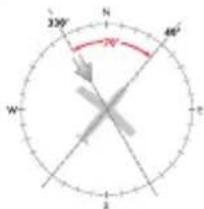
360irc - (330irc - 40irc) = 70irc 逆風(Headwind)
操作說明
6.側風的計算:

- Introduction Care and maintenance
- Congratulations.
- Illustration keys
- Recommendations
- Water-resistance
- Leather straps
- Magnetic fields
- Operating instructions
- Movement
- The Hamilton Khaki Automatic X-Wind has three screw-down crowns and two push-buttons.
- Setting the time
- Setting the date / day
- Chronograph functions
- Simple or added timing
- Crosswind
- Calculation of crosswind:
- Ex. Headwind component: 40 mph
- Calculate the angle of drift:
- Calculation of corrected bearing:
- Ex. Corrected bearing: 40irc + 6.5irc = 46.5irc
- Mode d'emploi
- 操作方法
- クロスウィンドの計算
- 修正針路の計算
- 작동 지침
- 측풍 계산:
- 操作说明
- 6.侧风的计算
- 操作說明
Brand : Hamilton
Model : Khaki X-Wind
Category : Wristwatch