
EWS1266 - Circular saw RYOBI - Free user manual and instructions
Find the device manual for free EWS1266 RYOBI in PDF.

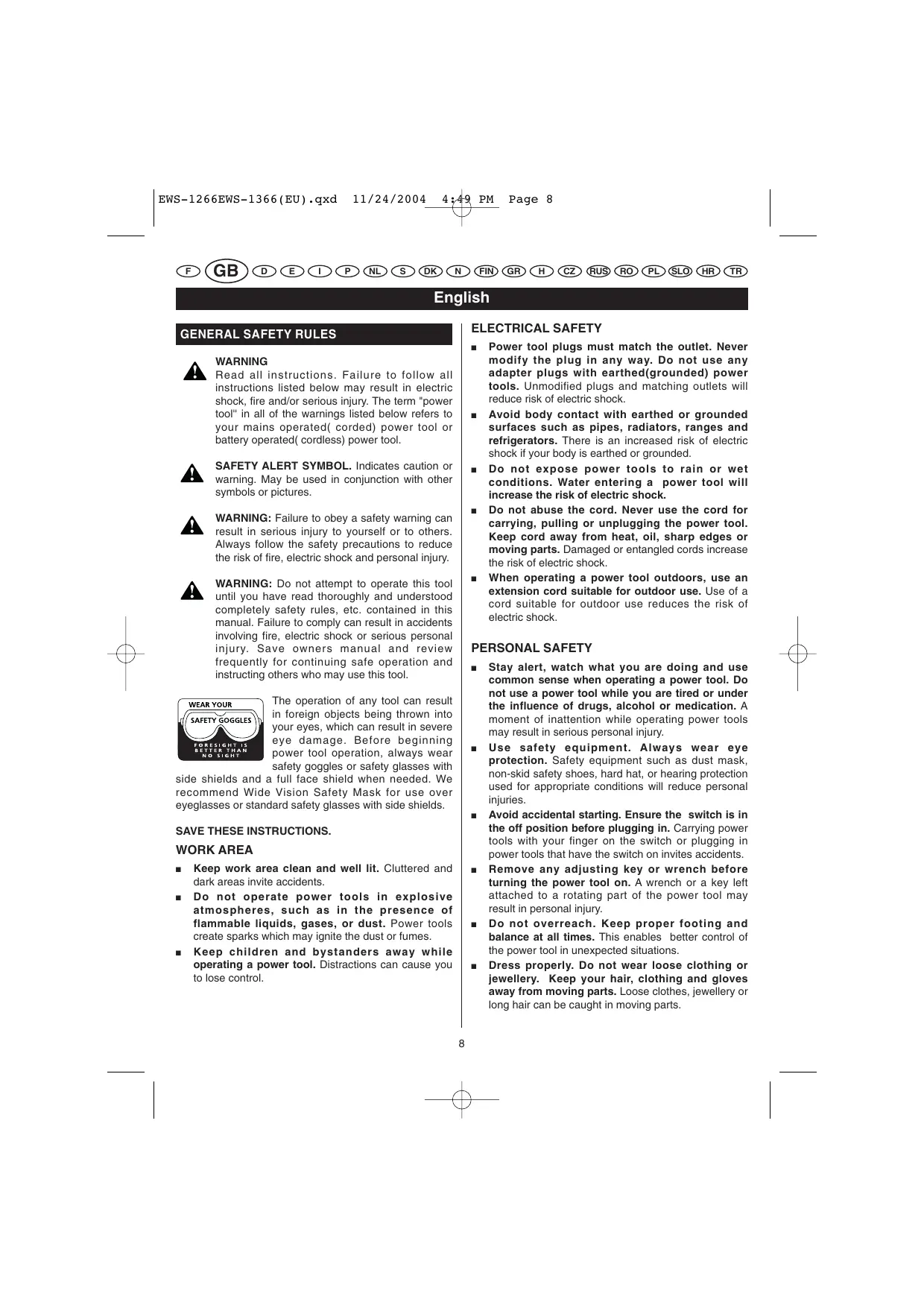


| Product type | Circular saw |
| Brand | RYOBI |
| Model | EWS1266 |
| Power supply | 230 V ~ 50 Hz |
| Input power | 1,250 W |
| No-load speed | 4,500 rpm |
| Blade diameter | 190 mm |
| Blade bore | 16 mm |
| Cutting capacity at 0° | 66 mm |
| Cutting capacity at 45° | 38 mm |
| Bevel range | 0 – 45° |
| Power cord length | 4 m |
| Adjustable cutting depth | Yes |
| Adjustable bevel | Yes |
| Lower blade guard | Yes, spring-loaded |
| Riving knife | Yes, adjustable |
| Safety switch | Yes |
| Power-on indicator | Yes |
| Included accessories | Blade, parallel guide, service wrench |
| Warranty | 24 months |
| Recommended maintenance | Annual lubrication and cleaning by a Ryobi authorized service center |
Frequently Asked Questions - EWS1266 RYOBI
User questions about EWS1266 RYOBI
0 question about this device. Answer the ones you know or ask your own.
Ask a new question about this device
Download the instructions for your Circular saw in PDF format for free! Find your manual EWS1266 - RYOBI and take your electronic device back in hand. On this page are published all the documents necessary for the use of your device. EWS1266 by RYOBI.
USER MANUAL EWS1266 RYOBI
CHARACTERISTIQUES PRODUIT
Read all instructions. Failure to follow all instructions listed below may result in electric shock, fire and/or serious injury. The term "power tool" in all of the warnings listed below refers to your mains operated (cored) power tool or battery operated (cordless) power tool.

SAFETY ALERT SYMBOL. Indicates caution or warning. May be used in conjunction with other symbols or pictures.

WARNING: Failure to obey a safety warning can result in serious injury to yourself or to others. Always follow the safety precautions to reduce the risk of fire, electric shock and personal injury.

WARNING: Do not attempt to operate this tool until you have read thoroughly and understood completely safety rules, etc. contained in this manual. Failure to comply can result in accidents involving fire, electric shock or serious personal injury. Save owners manual and review frequently for continuing safe operation and instructing others who may use this tool.

The operation of any tool can result in foreign objects being thrown into your eyes, which can result in severe eye damage. Before beginning power tool operation, always wear safety goggles or safety glasses with
side shields and a full face shield when needed. We recommend Wide Vision Safety Mask for use over eyeglasses or standard safety glasses with side shields.
SAVE THESE INSTRUCTIONS.
WORK AREA
- Keep work area clean and well lit. Cluttered and dark areas invite accidents.
- Do not operate power tools in explosive atmospheres, such as in the presence of flammable liquids, gases, or dust. Power tools create sparks which may ignite the dust or fumes.
- Keep children and bystanders away while operating a power tool. Distractions can cause you to lose control.
ELECTRICAL SAFETY
Power tool plugs must match the outlet. Never modify the plug in any way. Do not use any adapter plugs with earthed(grounded) power tools. Unmodified plugs and matching outlets will reduce risk of electric shock.
- Avoid body contact with earthed or grounded surfaces such as pipes, radiators, ranges and refrigerators. There is an increased risk of electric shock if your body is earthed or grounded.
- Do not expose power tools to rain or wet conditions. Water entering a power tool will increase the risk of electric shock.
- Do not abuse the cord. Never use the cord for carrying, pulling or unplugging the power tool. Keep cord away from heat, oil, sharp edges or moving parts. Damaged or entangled cords increase the risk of electric shock.
- When operating a power tool outdoors, use an extension cord suitable for outdoor use. Use of a cord suitable for outdoor use reduces the risk of electric shock.
PERSONAL SAFETY
- Stay alert, watch what you are doing and use common sense when operating a power tool. Do not use a power tool while you are tired or under the influence of drugs, alcohol or medication. A moment of inattention while operating power tools may result in serious personal injury.
Use safety equipment. Always wear eye protection. Safety equipment such as dust mask, non-skid safety shoes, hard hat, or hearing protection used for appropriate conditions will reduce personal injuries. - Avoid accidental starting. Ensure the switch is in the off position before plugging in. Carrying power tools with your finger on the switch or plugging in power tools that have the switch on invites accidents.
- Remove any adjusting key or wrench before turning the power tool on. A wrench or a key left attached to a rotating part of the power tool may result in personal injury.
- Do not overreach. Keep proper footing and balance at all times. This enables better control of the power tool in unexpected situations.
- Dress properly. Do not wear loose clothing or jewellery. Keep your hair, clothing and gloves away from moving parts. Loose clothes, jewellery or long hair can be caught in moving parts.
English
GENERAL SAFETY RULES
If devices are provided for the connection of dust extraction and collection facilities, ensure these are connected and properly used. Use of these devices can reduce dust related hazards.
POWER TOOL USE AND CARE
- Do not force the power tool. Use the correct power tool for your application. The correct power tool will do the job better and safer at the rate for which it was designed.
- Do not use the power tool if the switch does not turn it on and off. Any power tool that can not be controlled with the switch is dangerous and must be repaired.
- Disconnect the plug from the power source before making any adjustments, changing accessories, or storing power tools. Such preventive safety measures reduce the risk of starting the power tool accidentally.
Store idle power tools out of the reach of children and do not allow persons unfamiliar with the power tool or these instructions to operate the power tool. Power tools are dangerous in the hands of untrained users. - Maintain power tools. Check for misalignment or binding of moving parts, breakage of parts and any other condition that may affect the power tools operation. If damaged, have the power tool repaired before use. Many accidents are caused by poorly maintained power tools.
- Keep cutting tools sharp and clean. Properly maintained cutting tools with sharp cutting edges are less likely to bind and are easier to control.
Use the power tool, accessories and tool bits etc., in accordance with these instructions and in the manner intended for the particular type of power tool, taking into account the working conditions and the work to be performed. Use of the power tool for operations different from intended could result in a hazardous situation.
SERVICE
Have your power tool serviced by a qualified repair person using only identical replacement parts. This will ensure that the safety of the power tool is maintained.
- Check damaged parts. Before further use of the tool, a guard or other part that is damaged should be carefully checked to determine that it will operate properly and perform its intended function.
Check for alignment of moving parts, free running of moving parts, breakage of parts, mounting and any other part that is damaged should be properly repaired or replaced by an authorized service center unless otherwise indicated in this instruction manual. Have defective switches replaced by an authorized service facility. Do not use the tool if the switch does not turn it on and off.
PARTICULAR REQUIREMENTS FOR CIRCULAR SAWS
Not to use any abrasive wheels
Ensure that the riving knife is adjusted so that the distance between the riving knife and the rim of the blade is not more than 5mm and the rim of the blade does not extend more than 5mm beyond the lowest edge of the riving knife.
Safety instructions for all saws
DANGER:
- Keep hands away from cutting area and the blade.
- Keep your second hand on auxiliary handle, or motor housing. If both hands are holding the saw, they cannot be cut by the blade.
- Do not reach underneath the workpiece. The guard cannot protect you from the blade below the workpiece.
Adjust the cutting depth to the thickness of the workpiece. Less than a full tooth of the blade teeth should be visible below the workpiece. - Never hold piece being cut in your hands or across your leg. Secure the workpiece to a stable platform. It is important to support the work properly to minimize body exposure, blade binding, or loss of control.
- Hold power tool by insulated gripping surfaces when performing an operation where the cutting tool may contact hidden wiring or its own cord. Contact with a "live" wire will also make exposed metal parts of the power tool "live" and shock the operator.
- When ripping always use a rip fence or straight edge guide. This improves the accuracy of cut and reduces the chance of blade binding.
Always use blades with correct size and shape (diamond versus round) of arbour holes. Blades that do not match the mounting hardware of the saw will run eccentrically, causing loss of control.
English
PARTICULAR REQUIREMENTS FOR CIRCULAR SAWS
- Never use damaged or incorrect blade washers or bolt. The blade washers and bolt were specially designed for your saw, for optimum performance and safety of operation.
Further safety instructions for all saws
Causes and operator prevention of kickback:
■ kickback is a sudden reaction to a pinched, bound or misaligned saw blade, causing an uncontrolled saw to lift up and out of the workpiece toward the operator;
- when the blade is pinched or bound tightly by the kerf closing down, the blade stalls and the motor reaction drives the unit rapidly back toward the operator;
If the blade becomes twisted or misaligned in the cut, the teeth at the back edge of the blade can dig into the top surface of the wood causing the blade to climb out of the kerf and jump back toward the operator.
Kickback is the result of saw misuse and/or incorrect operating procedures or conditions and can be avoided by taking proper precautions as given below.
- Maintain a firm grip with both hands on the saw and position your arms to resist kickback forces. Position your body to either side of the blade, but not in line with the blade. Kickback could cause the saw to jump backwards, but kickback forces can be controlled by the operator, if proper precautions are taken.
- When blade is binding, or when interrupting a cut for any reason, release the trigger and hold the saw motionless in the material until the blade comes to a complete stop. Never attempt to remove the saw from the work or pull the saw backward while the blade is in motion or kickback may occur. Investigate and take corrective actions to eliminate the cause of blade binding.
- When restarting a saw in the workpiece, centre the saw blade in the kerf and check that saw teeth are not engaged into the material. If saw blade is binding, it may walk up or kickback from the workpiece as the saw is restarted.
Support large panels to minimise the risk of blade pinching and kickback. Large panels tend to sag under their own weight. Supports must be placed
under the panel on both sides, near the line of cut and near the edge of the panel.
- Do not use dull or damaged blades. Unsharpened or improperly set blades produce narrow kerf causing excessive friction, blade binding and kickback.
- Blade depth and bevel adjusting locking levers must be tight and secure before making cut. If blade adjustment shifts while cutting, it may cause binding and kickback.
Use extra caution when making a "plunge cut" into existing walls or other blind areas. The protruding blade may cut objects that can cause kickback.
Safety instructions for saws with lower guard
- Check lower guard for proper closing before each use. Do not operate the saw if lower guard does not move freely and close instantly. Never clamp or tie the lower guard into the open position. If saw is accidentally dropped, lower guard may be bent. Raise the lower guard with the retracting handle and make sure it moves freely and does not touch the blade or any other part, in all angles and depths of cut.
- Check the operation of the lower guard spring. If the guard and the spring are not operating properly, they must be serviced before use. Lower guard may operate sluggishly due to damaged parts, gummy deposits, or a build-up debris.
Lower guard should be retracted manually only for special cuts such as "plunge cuts" and "compound cuts." Raise lower guard by retracting handle and as soon as blade enters the material, the lower guard must be released. For all other sawing, the lower guard should operate automatically.
Always observe that the lower guard is covering the blade before placing saw down on bench or floor. An unprotected, coasting blade will cause the saw to walk backwards, cutting whatever is in its path. Be aware of the time it takes for the blade to stop after switch is released.
Additional safety instructions for all saws with riving knife
Use the appropriate riving knife for the blade being used. For the riving knife to work, it must be thicker than the body of the blade but thinner than the tooth set of the blade.
English
PARTICULAR REQUIREMENTS FOR CIRCULAR SAWS
- Adjust the riving knife as described in this instruction manual. Incorrect spacing, positioning and alignment can make the riving knife ineffective in preventing kickback.
Always use the riving knife except when plunge cutting. Riving knife must be replaced after plunge cutting. Riving knife causes interference during plunge cutting and can create kickback.
For the riving knife to work, it must be engaged in the workpiece. The riving knife is ineffective in preventing kickback during short cuts.
Do not operate the saw if riving knife is bent. Even a light interference can slow the closing rate of a guard.
DESCRIPTION
- Spindle lock button 14. Depth of cut
- Hex-head bolt 15.Depth scale
- Spanner 16. Bevel adjustment knob
- Outer blade washer 17. Bevel scale
- Lower guard 18.Trigger switch
- Lower guard lever 19. Safety button
- Upper guard 20. Line guide
- Blade 21.Depth adjustment lug
- Inner blade washer 22. Live Tool indicator
10.Dust nozzle 23.Laser guide button - Riving knife 24. Laser guide
12.Depth lock knob 25. LED button - Base plate 26. LED light
SPECIFICATIONS
Voltage 230V
Input 1,250 W 1,250W/1,350W
No load speed 4,500 min-1 4,500 min-1
Bore size 16 mm 16 mm
Blade size 190mm 190 mm
Cutting capacity at 0° 66 mm 66 mm
at 45° 38 mm 38 mm
Bevel scale 0 - 45° 0 - 45°
Cord length 4 m 3m/4 m
EWS-1366
110V/230V
1,250 W/1,350 W
4,500 min-1
16 mm
190 mm
66 mm
38 mm
0 - 45°
3m / 4m
INSTRUCTIONS FOR SAFE HANDLING
The maximum permissible system impedance:
Zmax for EWS-1266 is 0.245 Zref & Zmax for EWS-1366 is 0.252 Zref.
If in doubt, please verify with your local energy-utilitythat the AC outlets in your area do not exceed theabobe values.
STANDARD ACCESSORIES
Saw blade, Parallel fence, Spanner.
APPLICATION
Sawing wood.
NOISE BUILD-UP
Noise (sound pressure level) in the workplace can exceed 85 dB. In this case, sound insulation and hearing protection measures must be taken by the operator.
ASSEMBLY INSTRUCTIONS
BE SURE TO DISCONNECT THE TOOL FROM THE POWER SUPPLY BEFORE ATTACHING OR REMOivating THE SAW BLADE. BE SURE THAT THE TEETH OF THE SAW BLADE ARE POINTING UPWARD AT THE FRONT OF THE TOOL.
ATTACHING AND REMOVING
THE BLADE (FIGURES 2, 3, 4, AND 5)
ATTACHING THE BLADE
- Pressing the spindle lock button (1), turn the hexhead bolt (2) with the spanner (3) until the spindle locks. (Fig.2)
- Loosen the hex-head bolt by turning the spanner anticlockwise while pressing the spindle lock button. (Fig.2)
- Remove the hex-head bolt and the outer blade washer (4). (Fig. 2)
- Retract the lower guard (5) back with the lower guard lever (6) as far as possible under the upper guard (7). (Fig. 3)
- Then, attach the saw blade (8) against the inner blade washer (9) on the spindle. Then fit the outer blade washer and the hex-head bolt. (Fig. 3 and 4)
English
ATTACHING AND REMOVING THE BLADE (FIGURES 2, 3, 4, AND 5)
- Press the spindle lock button again, tighten the hexhead bolt by turning the spanner clockwise while pressing the spindle lock button. (Fig. 5)
- After tightening the hex-head bolt, release the spindle lock button.
REMOVING THE BLADE
- Pressing the spindle lock button, turn the hex-head bolt with the spanner until the spindle locks.
- Loosen the hex-head bolt by turning the spanner anticlockwise while pressing the spindle lock button.
- Remove the hex-head bolt and the outer blade washer.
- Retract the lower guard back as far as possible under the upper guard, then remove the saw blade.
ADJUSTING THE RIVING KNIFE (FIG. 6)

WARNING!
Do not use saw blades the disk of which is thicker, or the set of which is smaller, then the thickness of the riving knife.
- Ensure that the riving knife is adjusted so that (Fig. 6):
A. The distance between the riving knife (11) and the toothed rim of the saw blade is under 5mm .
B. The toothed rim does not extend more than 5mm beyond the lower edge of the riving knife.
- The riving knife should always be used except when making a plunging cut in the middle of a workpiece.
ADJUSTING THE DEPTH OF CUT (FIG. 7A, 7B, 8, 9)
- To adjust the depth of cut, loosen the depth adjustment knob (12). (Fig. 7A)
- Slide the base plate (13) to the desired depth using the depth adjustment lug (21) and retighten the knob securely. (Fig. 7B)
- The depth of cut (14) can be determined by the depth scale (15) or by measuring the distance by which the blade protrudes from the base plate. (Fig. 8 and 9)
ADJUSTING THE CUTTING ANGLE (FIG. 10A, 10B)
- The cutting angle may be set to any position between 0° and 45° . (Fig. 10A)
- Loosen the bevel adjustment knob (16) at the front of the tool and move the base plate to the desired angle using the bevel scale (17). (Fig.10B)
- Once the angle has been set, be sure to retighten the bevel adjustment knob firmly.
TRIGGER SWITCH (FIG. 11)
This tool is started and stopped by squeezing and releasing the trigger switch (18). To prevent the tool from being started accidentally, the trigger can only be operated if the safety button (19) is depressed first. The safety button can be depressed with the thumb leaving the other fingers free to squeeze the trigger switch. It is not necessary to maintain pressure on the safety button once the trigger switch has been depressed.
OPERATING INSTRUCTIONS (FIG. 12)

DANGER!
KEEP HANDS AWAY FROM THE CUTTING AREA WHEN OPERATING THE TOOL. KEEP THE CORD AWAY FROM THE CUTTING AREA AND POSITION IT SO THAT IT WILL NOT GET CAUGHT ON THE WORKPIECE DURING THE CUTTING OPERATION.
When cutting, use steady and even pressure (DO NOT FORCE) in order to obtain a uniform cut. Cut at a speed suited to the workpiece. (Cut slowly if the workpiece is hard.) Inspect the saw blade frequently and replace or sharpen it if dull, to avoid overloading the motor.
CUTTING POSITION (FIG. 13A, 13B)
When cutting a workpiece at 0° , use point "A" of the base plate line guide (20) and move the saw along the penciled line you have drawn. When cutting at 45° , use point "B". This line guide shows an approximate line of cut. Make a sample cut in scrap lumber to determine the actual line of cut.

CAUTION!
When ripping, the rip fence should only touch the workpiece slightly. Do not force.
English
USING THE LASER GUIDE (FOR EWS-1366 ONLY) (FIG. 14)

WARNING
Do not stare into the laser beam or turn the laser on when the tool is not in use. Failure to do so could result in possible serious personal injury. The laser unit comes from the factory already installed and aligned.
NOTE: Make a trial cut on a piece of scrap to ensure laser is aligned. Adjusting the laser may be necessary.
Mark the line to be cut on the workpiece.
Adjust the depth and angle of the cut as needed.
- Switch on the laser beam.
NOTE: Do not touch the blade to the workpiece until the saw has reached maximum speed.
Slowly push the saw forward into the workpiece.
NOTE: Keep the laser beam on the marked line on the workpiece for precision cutting.
Once the cut is complete, allow the saw to come to a complete stop before turning off the laser.
LED WORKLIGHTS (FOR EWS-1366 ONLY) (FIG. 15)
Your saw is equipped with 2 LED WORKLIGHTS (26). These worklight help illuminate the work piece in dimly lit areas and helps when following the cutting line.
ADJUSTING THE LASER GUIDE (FIG. 16)
Adjust the laser angle
Rotate the screw clockwise to turn the laser beam to right.
- Rotate the screw anti-clockwise to turn the laser beam to left.
Adjust the laser position
- Rotate the screw anti-clockwise to shift the beam to right.
Rotate the screw clockwise to shift the beam to left.
MAINTENANCE
After use, check the tool to make sure that it is in top condition.
We recommended that you take this tool to an Authorised Ryobi Service Centre for a thorough cleaning and lubrication at least once a year.
DO NOT MAKE ANY ADJUSTMENTS WHILE THE MOTOR IS RUNNING.
ALWAYS DISCONNECT THE POWER CORD FROM THE SOCKET BEFORE CHANGING REMOVABLE OR EXPENDABLE PARTS (BLADE, BIT, SANDPAPER, ETC.), LUBRICATING OR WORKING ON THE SAW.
KEEP HANDLES CLEAN AND FREE FROM OIL AND GREASE.

WARNING!
For greater safety and reliability, all repairs should be performed by an Authorised Ryobi Service Centre.
WARRANTY
All Ryobi products are guaranteed against manufacturing defects and defective parts for a period of twenty-four (24) months from the date stated on the original invoice drawn up by the retailer and given to the end user.
Deterioration caused by normal wear and tear, unauthorised or improper use or maintenance, or overload are excluded from this guarantee as are accessories such as battery packs, light bulbs, blades, fittings, bags, etc.
In the event of malfunction during the warranty period, please take the NON-DISMANTLED product, along with the proof of purchase, to your retailer or nearest Authorised Ryobi Service Centre.
This warranty in no way affects your legal rights concerning defective products.
LIVE TOOL INDICATOR
This tool features a live tool indicator (22) which illuminates as soon as the tool is connected to the supply. This warns the user that the tool is connected and will operate when the switch is pressed.
ENVIRONMENTAL PROTECTION

Do not dispose of in general household waste. Instead, dispose of in an environmentally friendly way. Contact your local recycling centre ou council for advise. Ryobi takes the care of the environment very seriously.
Deutsch
(FIGURES 2, 3, 4 Y 5)
INSTALAR LA HOJA
Whenever you want to use the language of this book, please use it in your work.
UTILIZACAO DA GUIA LASER (MODELO EWS-1366 UNICAMENTE) (FIG. 14)

ADVERTÉNCIA
STANDAARD ACCESSORIES
(AFB.7A, 7B, 8 EN 9)
- Zmax = 0,245 x Zref for model EWS-1266
- Zmax = 0,252 x Zref for model EWS-1366
INDSTILLING AF SAVEDYBDE
(FIG. 7A, B, 8, 9)
BRUK OG VEDLIKEHOLD AV VERKTØY MED LEDNING
INNSTILLING AV SPALTEKNIVEN (FIG. 6)

ADVARSEL!
Bruk参加会议的。
TUOTTEEN TEKNISET TIEDOT
PYOMIH TOY ΔI AIATIKOY MAXAIPIOY (x.6)

IPOEIAOIOIHSH!
Mn xpnaiouieite aaeic npioviu to owa tvw onoiw ivai nio nau h no oovtwon mikoTepn ano to naoc tou diaaataikou maaxiapiou.
SPOUSTUS NARADI (OBR. 11)
JIeKTPuECKA Be3OIIACHOCTb
BnIka HNCTpyMeHa DoJIKHa NoIOXoHHTb K pO3eTke. HKnOrJa He pa36HpAaTbe BNkY ceteBoro Ⅲhypa. HNKOrJa He noJIb3yIteCb aIaIaTePamn Ipn paOBe Tc 3a3eMJIeHHbIM HNCtpyMeHToM. ToI nOMoKet N36eKaTaB yIapOB TOKOM.
H36eraTe KOHTaTa C 3a3eMJIeHHbIMn IIpeIMTaMH H IIpeIMTaMH, IIOKIIIOUeHHbIMn HA Maccy (Tpy6aMH, 6aTapeMH, KXYoHHbIMn IIHTaMH, XOIOJINbHKaMH N T. J.) IIpn CoIpNKoCHOBeHHN C 3tHMn IIpeIMTaMH onaCHOCT ynapa TOKOM BO3pactaET.
He octabJIaIe HnctpyMeHT OIO JooKdEM IIN B CbIbIX MecTax. IIH nOIIaJAHn BOIb B 3JIeKtpNueckn HnctpyMeHT OAnchoCTb Yyapa TOKOM Bo3pactaert.
IIOJIePKeHbAHTe cTeBcOII HHyp B XopoIeM pa6ooyem coctoHHn. HIKoJIa He IepKHe INHCTpyMeH 3a cTeBcOII HHyp H He IepraHte 3a Hero, YTO6bI bHyHb Ero H3 pO3eTKn. IepKHe cTeBcOII HHyp IIOJaIbIe OT HcTOUYHKOB TEnla, OTrMaJIa,peJxuHIN PJeIMeTOB IIIOBbHXbIX DeTaJIe.IPi NIOBpeJXdEHOM cTeBcOM IIHype OAnachocbY yIapa TokOM Bo3paCTaET.
IhnapyKbIX pa6oTax I0JIb3yIteCb ToJIbKO cnHnHaJIbHM yIINHHTeJIMn IIA np HApYkBix pa6ot. 3TO IIOMOKeT H36eKaTb yIapOB TOKOM.
JIUHNAE3OIIACHOCTb
Ipn pa6oTe c 3eKtpueckHm HnctpyMeHTamn CJIeHtte 3a aekBAthocTbIO CBOHX JeCTBn H peHHe. He noJIyTeCb IHCTpyMeHTOM B yCTaIIeM COCTOHHN, B COcTOHHN aIKOJIoHBHO rHn HapKoTHueCKoTO OONHEHNA, a TAKKe NOI Bo3JeCTBHe M MeIHKaMeHTOB. IOMHnTe, TTO IOCTatoTOHO ceKHyIbI HeBHMMaHn, TTO6bI TAEJEIO NOPAHHTbcra.
I OJIb3yItec bAeKBAthbIMn 3aIHTbIMn cpeCTbAMH. BceTgda 3aIIuIuaTe rla3a.Bo n36EkaHne TjKeJIbIX TpaBM IIpi Heo6xoIIMocTH IOnJIb3yIteCb pecIIHpATOpOM, HECKOJIb3aIeH o6yBbIO, KaKoH n cpeCTBaAMn 3aIITbCI JyHa.
Pysckn
OBIIHE IIPABNJA TEXHUKI BE3OJIACHOCTH
H36eRaTe cIyuaHoro 3ayncKa HnCTpymeHa. IpeJxueBkJIIOuATb HnCTpyMeHT B pO3ETKy, npOBepbTe, YTO6bI bIKIOUaTeJIb CT0JI B NIOJOKeHHN BblKJI.Bo H36eKaHHe HeCuaCTbIX ClyuaeB He nepEHOChTE HnCTpyMeHT CIIaJIbEeM Ha Kypke H He BkJIIOuAte eRO B ceTb, KOJa BkIKIOUaTeJIb CTOTN B NIOJOKeHHN BKJI.
IpeR BkHIOueHHNtCPyMeHTaBbHtE Hrero BCE 3aTJKHe bKIOUH. 3aTJKHOH KIOUHa IOBbHXOJI DeTALIN HCTPcMyHTaMOKET Bb3BaTb TAKJEJIbTPABMbI.
Kpenko Depekntecb Ha Horax H He BbTnHbaTe pykn cIHHKOmJaIEKO. YcToOnHBoe pa6ooyee IIOJoxHe nIO3BOJIET LyuHHe KOHTPOJIHpOBaTB HNCTpyMeHT B Clyae HEOKNJaHHOCTN.
IIOJb3yItecb aKeBbAthoOeKdo. He HaJIeBaJIte IIHPOKyo OJeKJy H 6HxKyTePnHO. IepKHTe BOJIocbI, OeKJy H IepuATKn IOJaJIbOE IT OIOBnKhbIX DeTaJIe HNCTpyMeNTa. IIHPOKA OeKJa, 6HXyTePnH IIINHbIe BOIocbl MOrT IOnaCTB I IOJBNXHbIE DeTaJIH.
EcHn HnctpymeT OcHauen ChcTeMoY yJaJIeHHaONIOHOK,yCTAOHOBITE ee Ha HnctpymeHT NIOJb3yIITecb e np na6oTe. H36eaiTe IOnaIaHHaBbRpeDHOINbIIN BoprAraHbIbXaHHaN
HcIOJIb3OBAHNE IOBCJUYKINBAHNE 3JEKTPNUECKOFO HNCTPYMEHTA
He fopchpyte Hnctpyment. NcnoIb3yte Hnctpyment, noXdoJnni dKaoJoi nnHoo paobtoH. Hnctpyment 6ynt paobotatb npOn3BodJnHee H naDeekhee B pexjme, IJI KOTOPORO OH bbl papa6oTah.
He noIb3yItec 3JeKtpHueckn HnCtpyMeHtOM,ecJIb BkIOuateJIbe paObaTae.CeJIIN HnCTpyMeHT HeJIb38 BKNIOHTb JINBbIKIOHTb,3TO ONaCHO.ErHOeOOxIDMO 063aTeJIbHOOTpEMOHITnpOBatb.
- OTKJIIOUaIte HINCTPymeHTI cTeH npeH aHCTPOIKo, CMeHOI akCEccEyApOB HIN yKJIAKOH Ma xpaHeneH. 3To IOMOXETIbEXeKaTb CJUYAHIORO 3aIIYcKA HINCTPymeHTA.
XpaHHTe HnCTpyMeHTb B HeOCTyHOM IIN DeTeH MeCe. He DOBepaHTe HnCTpyMeHT pa6oYHM, He 3HaONHM erO HIn HE npOHtABHHM HactOJIeE pyKOBODCTBO. B pyKaX HeONIIbTHbIX pa6oYHX HnCTpyMeHTb IIpeJCTabJIHOT ONaCHOCTh.
3a60tJHBO yxaxhBaIte 3a HnctpymehTAMH. IpoBepaIte INHeHocTb NOBHHKbIX DeTaJIeI. IpoBepaIte CEIOCTHOCTB BcEx DeTaJIeI. IpoBepaIte C6Opky IHCTpyMeHTa HCe TEJIeMeHTb,OT KOTOpbIX 3aBHCT erO pa6Ota.Ipn IOJOMKe DeTaJIeI peMOHTpyIte Hx IpexKeJe WM pIOJOkKaTb HcIOJb3ObaTbc IHCTpyMeHTOM. MOrHne HeCyaactThIbe cUyau nPOnCXoJrT H3-3a HnnpABHbHorO yXoJa 3a IHCTpyMeHTAMH.
- Derjkhte HnchtpymentbI 3aTOeHHbIMn HnHCTbIMn. HcTbI H xOPOIIIO 3aTOeHHbI INJIbHI nHcK CHNJXaeT pHCK 3aKaTHaB I 3aROTOBKe H nO3BOJIaET JyUIIe KOHTPOIIHPoBaTB HnCHTpymENT.
CobIIOJaTe HactoJHnE npabHna TeXHHK6e30aHacHocTH B o6paUeHH C nHcTpymeHTOM,akceccayapmH, HacaKaHMn T.I.YuHTbIbaTeOCo6eHHocTHnHCTpymeHTa paOooYo MeCTa NipdeTOnH jaOToB.Bo NH6eKaHne OAnchbIX cHTyaHInNOJIb3yIteCb 3JIeKTPueckHM HnCTpymeHTOM ToJIbKO JITEx pAOT,ДЯ KOTOpbIX OH IpEHa3NaYeH.
PEMOHT
PemOHThIbe pa6oTbIOJIXhbl npOn3B0DHTbc8 KBAJIHΦHIIpOBAHHbTeHXNKOM C HcNO1b3OBaHHem MapoHbX 3aHacte. TorgaJIeKTPueckHM INCTpyMEHTOM MOXHO pa6oTaTb B NOJIHO 6eONACHOCTH.
I IpOBePJIe TeIIOCTHOCTB CExE DeTaleH HnCTpyMeHTA. IIpexJe Yem IpOIOJIkaTb IOJIb3OBAITcB HnCTpyMeHTOM, IpOBePJIte PaOooye COCTOHHne IOBpeJXeHNbIX DeTaleH ININ AkCECCyAPOB. IpOBePJIte IInHeHHOTb H paOooye COCTOHHne IOBHXbIX DeTaleH. IpOBePJIte CeIOCTOHTB CEx DeTaleH. IpOBePJIte c6Opky IHCTpyMeHTa H BCE 3JIeMeHTb, OT KOToBbX 3aBHCNT erO pa60Ta. IOpBpeJXeHNbIE DeTalN DOJIxHb 6bITb OTPoMOnTHPOBaHbI INI 3aMeHenbI B CEHTpe texHHueckORO 6cIJyKJBHbAHnry Obyi, eCII ToJIbKO b HactTOIe m pyKOBdCTbe He npYrHex HnCTpyKuHn. 3aMeHNe TcIOMaHbNtBE bIKJIOUaTeIN B CEHTpe texHHueckORO 6cIJyKJBHbAHnry Ryob. He nOL3yIteCb IHCTpyMeHTOM, eCII BkJIIOUaTeIN he p6oTaert.
OCOBbIE INPABHJATEXHNKBE30IACHOCTINJINCKOBbIXIIJI
HnKoIa He nCIOJIb3yIte a6pa3NBbIe nnckn.
IpoBepbTe, TTo6bI JeJIHTeJIbHbI H0X 6blI OTpeYJINPOBAH TaK, TTo6bI paCtOJHHe MeJxJy HmH 3y6bMn NcKa 6BJIO MeHbIe 5 MM, INTO6bI 3y6bI bIcTApaJI He 6oJee Yem Ha 5 MM 3a HxJHn KpaJI JeJIHTeJIbHOrO HOKA.
Pysckn
OCO6bIe IIPABUNIA TEXHNKU BE30NACHOCTH JIA INCKOBbIX INJI
Baxhblte npabHla texHHKn 6e3oNaChocTH IJIa BCEx TnIOB IIJI.
OIIACHOCTb:
-Держкге руки погальшое ор пььного днсka и зныpacплловск.Держкгесь онй рукоя за сховьуpyкогу,а pyrogo -3a BCnHOMorateJIbHyOин 3a KapTePmotopa.В tOMIoNoJekHe He noJaIyT B 3ohypacплловск ИИн Ha TpAeKTHOPINO pacnIIJa.
He 3aBOJInTe pyKN IIOI 3aTOrTOBky: B 3TOM MecTe KOkYx He 3aIIHIIaET IOJIOTHO.
PeryIyHpye rIy6bHy paacIIa b 3aBucnMoCTN OT ToIiHbI 3aTOrO8Kn. BOpeMa paicINIOBKn 3y6bJ DaNka He JOIJIKbI IIOIHOCTbIO BbIXoINTb CHN3Y aTOrO8Kn.
■ HNKOΓA He JepKHTe 3aROTOBky pykoH Nm MexKyHor. 3aKePJIHrTe ee Ha yCTOCHOBIO NEBOPEXHOCTn. BoH36eJHaHHe TpaBM, H3rH6a IINcKa HIOTEPH KOHTPOJ HAHnHCTpyMeHTOM HCKJIQUHTeJIbHO BaXHO IIpaBHJbHOΦHKUPOBaTb 3aROTOBky
- Pn paoote B NOBepxHocTJX, 3a KOTOpbIM MoKeT b6tB cnPraTana HJIeKTPoIPPOBOJka, H paOToax, Pn KOTOpbIX IIHyp IITaHHa MOKeT OKa3aTbCn Ha TpaeKTopHNHCtpyMeTHA, IepKHe HNCTpyMeHT OToJIbKOa 3a H3OIHPoBaHbIe H NecKoJIb3aIIHcuaTn. Pn cOnPiKocCHOBeHH C npOBaDM IOI NaHapRjExHem MeTaJIINHueckne Yactn HNCTpyMeHT MOryt T JIEKTPHOBAtCBn HIOBJeYUpTOKOM.
Ipn npapaJIeJIbHOH pacINIOBKe BceIgIIOJIb3yNTecb HnapabJIIOHeepaJIeJIbHOH pacINIOBKn IIN IpIMbIM 6pycKOM. 3TO IOBbICHT TOYHOCTb paCINIIa H npedOTbPAHTN INrH6 INIIbHORO INckA.
IIOJIb3yIteCb IINCKAMH,IOJIXOJIaIIHMn IO pa3Mepy HIOΦoPme Hape3Ke BaJIa.ДиCKN, He IOJIXOJIaIIHe BAJIy,HaKOTOpbI OHH yCTaHOBJIeHbI, 6yUyt BpaIIaTbCSHeIHPaBNJIbHO INpHBeYt K NOTEpe KOHTpOIaHdIHCTpyMeHTOM.
■ HnKOrIa He NOpIb3yITeCb DeΦeKTHbIMn HInHneIOXoJIaIIMMN BHTAMM IN IeYcAMN IIIBbHOrO IINCKa.IIeYKn I BNtBu IIINbHOrO IINcKa I3ROTOBJeHbCneIIaIbHO IJa DAHHo MOeJIH INIIbI, OHNOBecNEuHBaOT ONTImaIbHyO 6eONaCHOCt b INpOH3BOJITeJIbHOCTb IHCTpyMeHTa.
IIOHOIHHTeJIbHbIe IpaBH.Ia TEXHHKH 6e30NaCHOCTH IJI BCEX THNOB IIJI.
IIpHnHHbI OTCKOKOB Hx IIpeDyIpEJKdHeHne
OTCKOK BO3HNKaeT, KOrJa IIJIbHbI JINCK 3aXHMaeTcA,
IHeTcHJHHEPBOH CTOHT:IIJIa pe3Ko OTcKaKHBaetOT 3aOTOBKN B CTOPOH IOJIb3OBATeJI.
Korda IIbIbIbIaNcK 3acTepeBaet B IepeBe, MOTop npOIOJIgKaet p6oTatb H OToPacBIAeT IIH.Iy B HnPaPbJIeHHIN IpoTHBOJIOJIOxHOM HAnpaBJIeHHOBpaUeHHI duCKa, T.E. B CToPOHpy IOJIb3ObaTeYI.
EeHn HbHbN DnKrTcHn Hn HepBO CToHT,ero 3aHHe 3y6b MoYrBpe3aTbc BJepeBo Hpe3oKo OTpOcHt NHyOT 3aTOBOKN BCTOPOH NOb3OBateJI.
TaKM 06pa3OM, OTCKOK BO3HNkaET Bpe3yJbTaTe HeNpabHbIbHorO NcIOJIb3OBaHHu HnCTpyMeHTa HINHePABHbIbHX yCIOBn I npoQeYp pacIHIOBKn.OTcKoka MOKHO H36ExaTb, Co6JIHOdAHEKOToBpeIpaBHa.
- Deprkhte IIly o6eHMn pykamH, YTObI KOHTPOINHObaTbe E C Lyae OTCKOka. Bo BpeMa paOToBt cToITE cOky OITILbI, a He Ha e TpaekTOpHn. PPh OTCKOKe IIlyOTOpacbIAe TaHa3J, HO OTCKO KMOHKOHTPOINHObaTb, ECIIIOJI3OBATEJB ITOB K Hemy.
EcJIN INCK 3aCTPJI INI HeO6XODHMO INpePBATb PACHI IIO KaKoi-JIn60 INPIUHNHe,OTYNCTHTe KUPOK N OCTABTe HJy B 3aTOrTOBKE,IOKA INCK POIHOCTbUo HE OCTAHOBHTCJ. HIKORJa HE IIITaIITecb BbHYtB INJY I3 3aTOrOBKH JIN TAYHy ee HA3aI,IOKA INCK HE OCTAHOBHTCJ:3TO MOKeT INPBHEcTH KOTCKOy.EcJIN INJBHbN JINCK 3aKAt,HaJIITNE INPIuHiy 3aJHKMa IN pIMMTE HeO6XODHMble MebI, YTO6bI 3TO He IOBSTOPIOCb.
I IpejE qem 3aynckatb Hny H npoJolkahtpa60Ty BbyPOBHNrTe HINbHbHn JNCK NIO HNNH paCINHa H y6eHNTcB TOM, YTO eO 3y6bHa He KacaIoTc3 aTOrOBKn. EcIn Nnck 3aXat B 3aTOrOBKe, IIpH 3ayncke INbl MoKet I npoH3OHT OTCOK.
Bo 36eJHHe 3aJHMa IIHbHorO IIcKa H ONaHocThOTcKoA IIOJIepKJBAAITE IIINHHBe 3aTOrOBKn. IIINHHBe 3aTOrOBKn IPOrHbAOTcR IO CoCBtBEHHbIM BecOM.PacCTaJIaTe IOJCTABKN IO o6e CTOpOHbI 3aTOrOBKn pAnOM c JHNHeI paCnIIHa Y KpAr 3aTOrOBKn.
He noJIb3yItebc IOBpeJdeHbIMn HIN TyIbIMn IIIBbHMn DcKamn. IIOxo 3aTOueHHbe HIN HeIPAuBHbHO yCTaHOBJeHHBe INJBbHBe DNCKn CJIeJaOT OeyHB ToHKn pacHI. IPh nTOM dck 6yET 6OJIhe Tepetcbo a3arToBky, n PCH Kn HrNba n OTcKoka BO3paCTe.
IpeJIH hauaIOM pa6oTbI npOBePbTe 3aTJkKy BnHTOB perYInpOBrKn Iy6BnHbI N aKaHOA. Ecn peryIHpOBA KIOJooEHH IIINbHO IINCKa H3MeHHTc BO BpeMra pa6oTbI, INCK MOKeT 3aXaTbCn H bIB3BaTb OTCKOK.
ByIbTe Oc6o BHMaMeTbHb PnI Bp3aHHN BCTeHb IpyThe 3akpbTbIe IIIOCKOCTh. IHck MoKet HatoJIKHHTbCt Ha HeBUNHMbIe CHAPyHK INpeIMTeHb IHb3BaTbT OTCOK.
Pysckn
OCO6bIe IIPABUNa TEXHNKU BE30NACHOCTH JIA INCKOBbIX HJI
IpaBnJa texHnKn 6e3oHaacHoCTn IJIa 3aIHTHO KOKyxa
IpeJn haaJom pa60tBJ BcERJa IpoBepHte, YTO6bI HNHN 3aUHTbIK KOyX NIOHocTbO 3aKpbBaJI INbHbN ⅡNCK. HNKoRJa He pa6oTaIe IIIOJI,ecII INHKnH 3aUHTbIK KOyXe X OJNT CBO6OHO HIN He cpa7y 3aKpBbAeT IIbHbN ⅡNck.HNKoRJa He 6IoKpyIe HNKnH 3aUHTbIK KOyXb OTKpbTOM IOIOJEHH. EcII INIJa cIyauHaHO yIaJa, HNXHnn 3aUHTbIK KOyXu INbHoro DnCKa MOR NOrHyTbc. IIOHNMITE HNXHnn 3aUHTbIK KOyX 3aPyKu H IpoBepTe, YTO6bI OH xOJIJI cBO6OHO H He KacalcI INMbHO rDCKa H npYrHex DeTajE, He3aBnCHMo OT BbCTaBHeHORO yIJa H Iy6HbHb pacnIIa.
I IpoBepaIte 10ocTHO HcnpabHyo pa6Oty npjxHbI HxKHeRo 3aUHTHO Koxyxa IIbHorO IIcKa. EJIN 3aunTHbIKoKyxu ININpyKHa HeCNpABHbI, INpeJde Yem IPOIOJIkaTB IOJIb3OBAITcbc IIIIOJ CJaTe IH BpeMOHT INI Ha 3aMeHy. DIBXKeHHe HxKHeRo 3aIHTHORO Koxyxa IIbHorO INCKa HE JIoJIHO 3aMeJITbcN IOBpeKJDeHHbIMn DeTaJIaMn. HAJEtOM CMOLbI INI cKONHIIMMNc ONIKAMN.
3aunthbkoxydoJIkeyIpyabJIbTcBpyuHIOToJIbKO JIOOCbIX paINIOB, HApNMeP, npn Bpe3aHHN B 3arotOBky INI npn paCNIIOBKe IOI dBOIHbIM yIOM. IIOHNMHTe 3aunthbKOxy 3a pyuKy. KaK ToJIbKO IIhblbH NCK BOIIeB 3arotOBky -OTNyCTHe 3aunTHbKOxy. JIA BCEx IpyrHX BNIOB paCNIIOBKn 3aunTHbKOxy INIbHOFO INcka DOJKeH pa6OtaTB ABTOMaTHueCKN.
I IpeJxJe Yem CTaBHTb HnNy Ha BepCTak HnHa HnOJI BcERda npOBepaTe, YTO6bH NnKHN 3aUnTHbIK KOxuy XIOJHOCTbO 3aKpblBaJI HnJIbHbIK DnCK. Ecln HnJIbHbIK INCK IOJIOHcTbO He 3aKpblT, OH MoKeT IpoJOJIkaTb BpaIaTbcI NO HHePUNH nPa3pe3aTb IpeMeTbI, HaxoJIAuHecN aero TpaeKTOpHN. He 3a6bBAHTe, YTO HnJIbHbIK INck IpoJOJIkaeT HEKOTOpoe BpeMBAaTaTbcN IO HHePUNH NocIE OCTaHOBKn MOTopa.
IIpaBHJIaTexHHKn6e3oHacHOCTN IIAJeJIHTeJbHOrO HOKa
I OJIb3yIeTcB JeIHTeJIbHbIM HOXOM, NOJXoJIAHIM DaHHOMY IIbHOMY IuCKy. JeJIHTeJIbHbI HOK JIoJIKeH 6bITb TOIIe KOpNyca IIbHbOro IuCKa, HO ToHbIIE erO 3y6beb.
I OJIb3yIteCb IeJIHTeJIbHbIM HOXOM cOrlaCHO HcTpyKUHMA HAcTOHcero pyKOBoCTBa. EcJIeJIHTeJIbHbI HOK HeIIpaBUNbHO yCTaHOBJEHN He BByIOBHeN, OH He CMoKTe 3pFpEKTHBHO ppeJypKeJdTaB OTCKOKN.
Bcerda noIb3yTebcJeJIITeIbHbIM HOXOM,KpOme pEkhma Bpe3aHHN. DeJIeTIbHbHIOK MeoKet MeiHaTb Ipn Bpe3aHHN 3aIOTOBky H bblBaHT bOTcOKH. IocLe Bpe3aHHY cyaTahABJIHbAteJeJIeTIbHbHIOK HA mecTo.
IeJIHTeJIbHIOK cTOIT pAbaINbHO, KOJIgA KacaetcA 3aOTOBKn. IeJIHTeJIbHIOH KOHe npEynpEJaET oTCKo PI npO KotKnx pacnHax
HeIJIb3yHITcB IIIOJIO,ecJIN DeJIHTeJIbHbI HOK IOnHyt. EcJIn OH JAnKe cJIeRka 3aJeHET 3a HxKHN 3aIHTHBIO KOKYX INIIbHOrO DnCKa,KOKYX MOKe OTyCTHTbcJ.
ONHCAHNE
- KhoIIka 6JIOKINPOBKN BaJa
- BnHT IOJIOtha
- CepBnchbI KJIHOU
- BHeIHHaIIaIb6a IIOJIOTHa
- HxHn 3aunTHbKoKyx IOJIOtha
- Pbyar HnKHeRo 3aIHTHO Koxyxa IIOJIoTHa
- BepxHn3 3aunTHbIK KoxyIIOJIoTHa
- IIOJIOTHO
- BHyTreHnHa IIaIb6a IIOJIoTHa
- CoJIIO JIJI NJIIN
- Pa3JIeJIHTeJIbHbI HOK
- KhoIIka 6IOKHPOBKn Iy6HbI pe3KN
13.ПоJOшВа - TnybHa pe3Kn
- IIIkaJaI rLy6HbI pe3KN
- KhoIIka peYIINPOBKN HaKJIOna
- IIIkaJaHaKaJIOHa
- Kypok
- KhoIIka 6e30IaHocOCTN
- HanpaBIAIOHua pNcKa
- JIaIIka peryIINpOBKn rJy6HHb pe3KN
- INHINKATOP INTANNA
- BbIKIIOuATEJIbJa3epHOro MeTuNka
24.JIa3epHbIM MeTqHK - BbIKJIOuHaTeJIb CBeTOBOrO JaTUnKa
- CBETOBOДТУнК
OBIIHE XAPAKTEPHKIN
MaKcImaJIbHo IOIpyCTHMOE IOJIHOe COIIPOTHBJIeHHe cHCTeMBI
-ZMa c = 0,245× ZHOM IJIa MoJeJIN EWS-1266
-ZMaKc = 0,252× ZHOM IJIa MoJeJI EWS-1366
B Cnyue CoMHeHn IPOBEpbTe Co CBOHM NOCTaBIHkOM 3JIeKTPHcE7Ba, YTOb6blCpOHTHBJHeHne HcIOJIb3YeMbI PO3eTOK He I PBeBbIaIO BbIIe Yka3AHbI BeJIuHH.
CTAHДAPTHbIE AKCECCYAPBI
MbI COBETyEM CnABaTb HNCTPymENT He pEke pa3a B ToJ I BeHTp TexHHuecko O6cIyKHBaHrny Ryobi IJIe IIOHOn cMa3Kn YIChTKn.
OBCJYXHBAHHE
BO BPEMRA6BOTbI MOTOPA HE IPOU3BOJNTEHNKAKINX PEYJINPOBOK.
IIEPEJ CMEHOJ AKCECCYAPOB HIN H3AHINBAEMBX IETAJIEN (IOJLOTHA, HACAJNK, ABPA3INBH0N BYMATI N.T.)
A TAKKJE IIEPEI CMA3KOI HJIM MAHNIYJIUNHEIN HHCTPYMEHTOM BCEITDA OTKJIIOUAYTE CETEOBIIHYP.
YBEJNTECB, YTO PYUKN INHCTPYMEHTA YNCTbIE, YTO HA HNX HET MACJIA I KINPA.

IPEyIeXKeHHeNc!
Длббоьши Ббзогнги Идэхжстп СБ peMoHTHbIe pa6OtBJ IOJKNHbI pOnH3BOINHtBc B СИЧтЕ ТхMuHcKOrO O6CnKJBAHINr Ryobi.
TAPAHTIN
Hactoia npOdyKuHa RYOBI rapaHTnpoBaHa ot DekeTob npOIBBOdCTBa n DekeTob H3JeJn Ha 2 roJa co Iyro OOhnaJIbHO rOpMJeHHIO KOpYIKH, yKa3aHHOro HA opHInHaJe Ceta, BbINHcAHORo IpOdaBIOm NOKyInateJHo.
IIOBpeKdHnH, HIOJyueHbIe Bpe3yIbTaTe 06blHoro n3HocA, HeOpMaJIbHO rHIN 3aIpeJeHHoro HCIOJIb3OBaHHn HII OH 06cJyXHbAHnn, a TaKke Ieperpy3Ko-, He NOkPbIbAIOTc HactOaIeI rapaHTnei, TaKke KAK n AkceccCyapbl, TAKHe KaK 6aTapeN, JAMIOuKN, IQKII, NaTPOHbl, MeIKN II T.Ⅰ.
B cIyae IIOLOMKH HIN HeNCIIpaBHOCTN B rapaHTnHbI neHPOO TOnJIITNE IpoDyKUHNO HEPA30OBPAHHOc IOITBePKeJDeHNEM NOKyIKH BaIeMy IpoDABy HIN B 6JIHKaIHI OΦuHaJIbHbI IeHTp O6cIyXNBaHnI npOdyKIIIN Ryobi.
Hactoia rapaHTn He BIneT Ha BaIIIN 3aKOHbIe npaba,IO OTHIOEHNO K DeEkeKTHO IpOykuHH.
INHUNKATOP NITAHNIA
HnHKaTOP nHTaanHn(22),KOTOpbI 3arOpaetc,KOrTa HNCTpyMeHT BKNIOUeHN Cteb. 工 OTn HnHKatOP Yka3bIaet Ha TO, YTO HNCTpyMeHT BKNIOUeHN B cTe b N 3aIyCTNTcN IIpH HAKATTH NA BbIKNoTaeJIb.
3AHTA OKPYXAIIOIEN CPEIbI
He Bb6pa8bAaHte cbIpe. 3aunuauTe Oxykaohuyu cpey: copTnpyTe OTXoBnIH cdaBae HcnoB3OBAHH bie HnCTpyMeHTbI, AkcccccaybH ynaKOBKN B nepepa6OtKy. Ryobi oYeh 3a6OTJIHO OTHocITc K 3aunTe OKpykaHOIIe CpeBbI.
Romána
MÁSURI DE SIGURANTÀ GENERALE

AVERTISMENT
Citi toate instructiunile. Nerespectarea acestormasuri ar putea provoca accidente cum ar fi incendi, electrocutare si/sau ranir corporale grave. Termenul "masina electrica"utilizat in masurile de siguranta de mai jos se refera atat la masinile electrice care se connectezla prizacat si la masinile electrice fara fir.

SIMBOL DE ALERTÄ IN MATERIE DE SIGURANTÄ:
acentsymbolindicaotattentionarebau avertism.Elpoatefiasociatcualteimboluri sau pictograme.

INSTALOWANIE I SCIAGNIECIE TARCZY (RYSUNKI 2,3,415)
ZAINSTALOWANIE
GARANTIE - CONDITIONS
All Ryobi products are guaranteed against manufacturing defects and defective parts for a period of twenty four (24) months from the date stated on the original invoice drawn up by the retailer and given to the end user. Deterioration caused by normal wear and tear, unauthorised or improper use or maintenance, or overload are excluded from this guarantee as are accessories such as battery packs, light bulbs, blades, fittings, bags, etc. In the event of malfunction during the warranty period, please take the NON-DISMANTLED product, along with the proof of purchase, to your retailer or nearest Authorised Ryobi Service Centre.
This warranty in no way affects your legal rights concerning defective products.

DECLARATION OF CONFORMITY
We declare under our sole responsibility that this product is in conformity with the following standards or standardized documents.
EN60745-1, EN60745-2-5, EN55014, EN61000-3-2, EN61000-3-11, 98/37/EC, 89/336/EEC

Directive "masini" (98/37/CEE)
Directive "tensiune joasa" (73/23/CEE).si modificari (93/98/EEC)
Directive "compatilitate electromagnetica" (89/336/CEE si modificari)
Norme armonizate aplicabile: EN55014-1/A2:2002; EN55014
2/A1:2001; EN61000-3-2:2000; EN61000-3-3/A1:2001;
EN60745-2-4: 2003; EN60745-1: 2003 + A1: 2003; EN50366:2003.

DEKLARACJA ZGODNOSCI

- SAVE THESE INSTRUCTIONS
- WORK AREA
- ELECTRICAL SAFETY
- PERSONAL SAFETY
- ENGLISH
- GENERAL SAFETY RULES
- POWER TOOL USE AND CARE
- SERVICE
- PARTICULAR REQUIREMENTS FOR CIRCULAR SAWS
- SAFETY INSTRUCTIONS FOR ALL SAWS
- DANGER
- FURTHER SAFETY INSTRUCTIONS FOR ALL SAWS
- SAFETY INSTRUCTIONS FOR SAWS WITH LOWER GUARD
- ADDITIONAL SAFETY INSTRUCTIONS FOR ALL SAWS WITH RIVING KNIFE
- DESCRIPTION
- SPECIFICATIONS
- INSTRUCTIONS FOR SAFE HANDLING
- STANDARD ACCESSORIES
- APPLICATION
- NOISE BUILD-UP
- ASSEMBLY INSTRUCTIONS
- ATTACHING AND REMOVING
- ATTACHING THE BLADE
- ATTACHING AND REMOVING THE BLADE (FIGURES 2, 3, 4, AND 5)
- REMOVING THE BLADE
- ADJUSTING THE RIVING KNIFE (FIG. 6)
- WARNING
- ADJUSTING THE DEPTH OF CUT (FIG. 7A, 7B, 8, 9)
- ADJUSTING THE CUTTING ANGLE (FIG. 10A, 10B)
- TRIGGER SWITCH (FIG. 11)
- OPERATING INSTRUCTIONS (FIG. 12)
- CUTTING POSITION (FIG. 13A, 13B)
- CAUTION
- USING THE LASER GUIDE (FOR EWS-1366 ONLY) (FIG. 14)
- LED WORKLIGHTS (FOR EWS-1366 ONLY) (FIG. 15)
- ADJUSTING THE LASER GUIDE (FIG. 16)
- MAINTENANCE
- WARRANTY
- LIVE TOOL INDICATOR
- ENVIRONMENTAL PROTECTION
- DEUTSCH
- INSTALAR LA HOJA
- UTILIZACAO DA GUIA LASER (MODELO EWS-1366 UNICAMENTE) (FIG. 14)
- ADVERTÉNCIA
- STANDAARD ACCESSORIES
- (AFB.7A, 7B, 8 EN 9)
- INDSTILLING AF SAVEDYBDE
- (FIG. 7A, B, 8, 9)
- BRUK OG VEDLIKEHOLD AV VERKTØY MED LEDNING
- INNSTILLING AV SPALTEKNIVEN (FIG. 6)
- ADVARSEL
- TUOTTEEN TEKNISET TIEDOT
- PYOMIH TOY ΔI AIATIKOY MAXAIPIOY (X.6)
- IPOEIAOIOIHSH
- SPOUSTUS NARADI (OBR. 11)
- JIEKTPUECKA BE3OIIACHOCTB
- JIUHNAE3OIIACHOCTB
- PYSCKN
- OBIIHE IIPABNJA TEXHUKI BE3OJIACHOCTH
- HCIOJIB3OBAHNE IOBCJUYKINBAHNE 3JEKTPNUECKOFO HNCTPYMEHTA
- PEMOHT
- OCOBBIE INPABHJATEXHNKBE30IACHOCTINJINCKOBBIXIIJI
- OCO6BIE IIPABUNIA TEXHNKU BE30NACHOCTH JIA INCKOBBIX INJI
- OIIACHOCTB
- IIOHOIHHTEJIBHBIE IPABH.IA TEXHHKH 6E30NACHOCTH IJI BCEX THNOB IIJI
- IIPHNHHBI OTCKOKOB HX IIPEDYIPEJKDHEHNE
- OCO6BIE IIPABUNA TEXHNKU BE30NACHOCTH JIA INCKOBBIX HJI
- IPABNJA TEXHNKN 6E3OHAACHOCTN IJIA 3AIHTHO KOKYXA
- IIPABHJIATEXHHKN6E3OHACHOCTN IIAJEJIHTEJBHORO HOKA
- ONHCAHNE
- OBIIHE XAPAKTEPHKIN
- CTAHДAPTHBIE AKCECCYAPBI
- OBCJYXHBAHHE
- IPEYIEXKEHHENC
- TAPAHTIN
- INHUNKATOP NITAHNIA
- 3AHTA OKPYXAIIOIEN CPEIBI
- ROMÁNA
- MÁSURI DE SIGURANTÀ GENERALE
- AVERTISMENT
- SIMBOL DE ALERTÄ IN MATERIE DE SIGURANTÄ
- INSTALOWANIE I SCIAGNIECIE TARCZY (RYSUNKI 2,3,415)
- GARANTIE - CONDITIONS
- DECLARATION OF CONFORMITY
- DEKLARACJA ZGODNOSCI
Brand : RYOBI
Model : EWS1266
Category : Circular saw