
DSE 260 - Power tool AEG-ELECTROLUX - Free user manual and instructions
Find the device manual for free DSE 260 AEG-ELECTROLUX in PDF.



| Product type | Orbital action vibrating sander |
| Brand | AEG-ELECTROLUX |
| Model | DSE 260 |
| Supply voltage | 230 V ~, 50 Hz (single-phase) |
| Double insulation | Yes, according to DIN 57 740/VDE 0740 and CEE 20 |
| Interference suppression | Complies with EN 55014 |
| Electronic speed control | Yes, speed presetting via thumbwheel (1 to 6) |
| Variable speed | Yes, adjustable to material |
| Sanding pad | Velcro coating, mounting by turning and snapping |
| Abrasive attachment | Velcro sticker, holes for dust extraction |
| Dust extraction system | Connection for hose Ø 35 mm via supplied adapter |
| Switch | Slide switch with lock and Off button |
| Recommended use | Sanding wood, metal, plastic, paint, etc. |
| Maintenance | Clean cooling vents, use AEG accessories |
| Safety | Disconnect before any intervention |
| Spare parts | Customer service Atlas Copco or AEG |
| Accessories | Blade sanding pad, abrasive discs, dust extraction adapter |
Frequently Asked Questions - DSE 260 AEG-ELECTROLUX
User questions about DSE 260 AEG-ELECTROLUX
0 question about this device. Answer the ones you know or ask your own.
Ask a new question about this device
Download the instructions for your Power tool in PDF format for free! Find your manual DSE 260 - AEG-ELECTROLUX and take your electronic device back in hand. On this page are published all the documents necessary for the use of your device. DSE 260 by AEG-ELECTROLUX.
USER MANUAL DSE 260 AEG-ELECTROLUX
Please read and save these instruction
Gebrauchsanleitung
| Introduction | You demand the best and buy quality - quality provided by Atlas Copco. We have built for you a reliable and lasting tool. Working effectively and without endangering your health is only possible if this instruction for use is read carefully before first using the tool. We want to satisfy our customers and would like you to buy again AEG Electric Power Tools from Atlas Copco. | |||
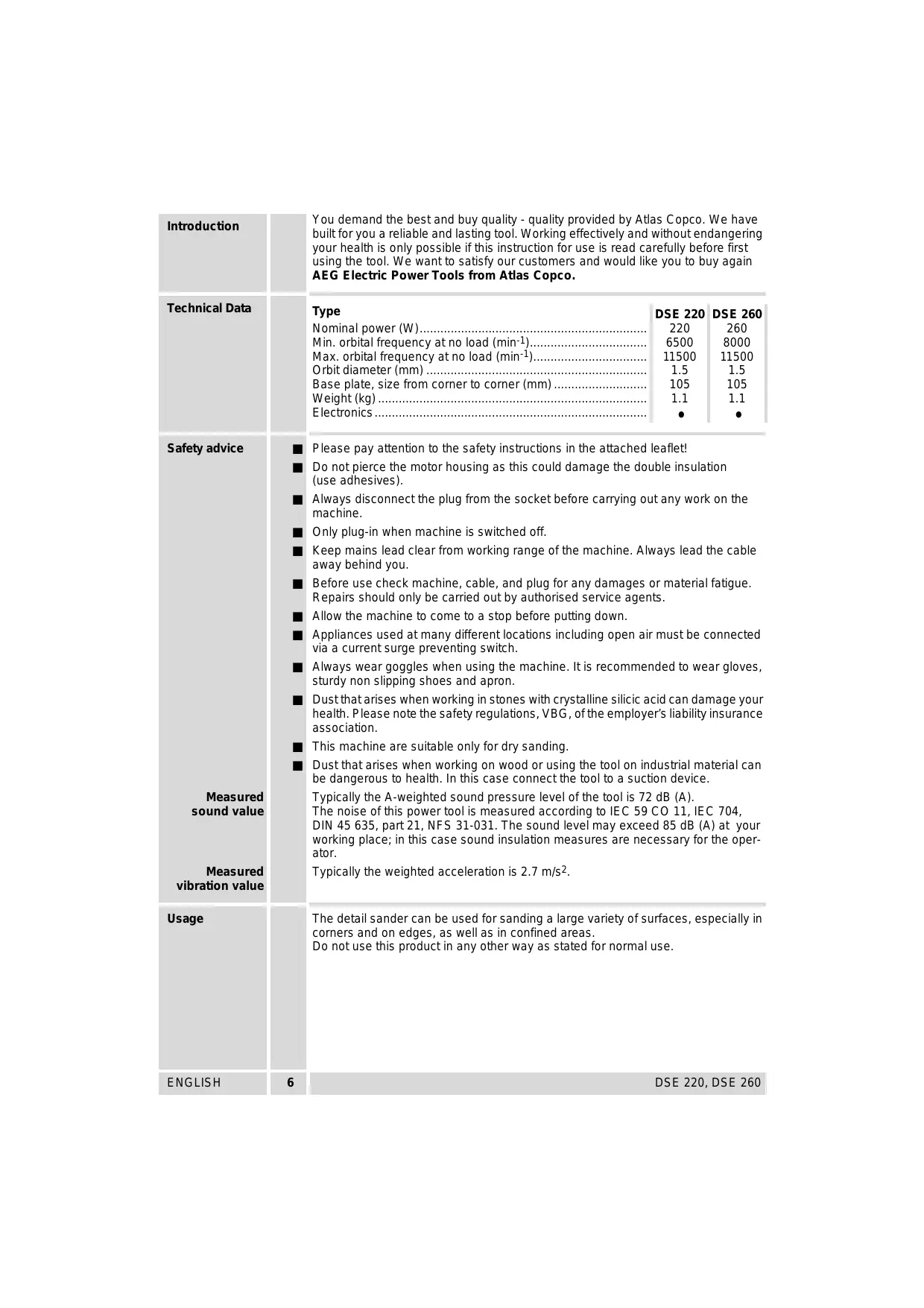
| Technical Data | Type | DSE 220 | DSE 260 | |
| Nominal power (W) | 220 | 260 | ||
| Min. orbital frequency at no load (min-1) | 6500 | 8000 | ||
| Max. orbital frequency at no load (min-1) | 11500 | 11500 | ||
| Orbit diameter (mm) | 1.5 | 1.5 | ||
| Base plate, size from corner to corner (mm) | 105 | 105 | ||
| Weight (kg) | 1.1 | 1.1 | ||
| Electronics | ● | ● | ||
| Safety advice | ■ | Please pay attention to the safety instructions in the attached leaflet! | ||
| ■ | Do not pierce the motor housing as this could damage the double insulation (use adhesives). | |||
| ■ | Always disconnect the plug from the socket before carrying out any work on the machine. | |||
| ■ | Only plug-in when machine is switched off. | |||
| ■ | Keep mains lead clear from working range of the machine. Always lead the cable away behind you. | |||
| ■ | Before use check machine, cable, and plug for any damages or material fatigue. Repairs should only be carried out by authorised service agents. | |||
| ■ | Allow the machine to come to a stop before putting down. | |||
| ■ | Appliances used at many different locations including open air must be connected via a current surge preventing switch. | |||
| ■ | Always wear goggles when using the machine. It is recommended to wear gloves, sturdy non slipping shoes and apron. | |||
| ■ | Dust that arises when working in stones with crystalline silicic acid can damage your health. Please note the safety regulations, VBG, of the employer's liability insurance association. | |||
| ■ | This machine are suitable only for dry sanding. | |||
| ■ | Dust that arises when working on wood or using the tool on industrial material can be dangerous to health. In this case connect the tool to a suction device. | |||
| Measured sound value | ■ | Typically the A-weighted sound pressure level of the tool is 72 dB (A). The noise of this power tool is measured according to IEC 59 CO 11, IEC 704, DIN 45 635, part 21, NFS 31-031. The sound level may exceed 85 dB (A) at your working place; in this case sound insulation measures are necessary for the operator. | ||
| Measured vibration value | ■ | Typically the weighted acceleration is 2.7 m/s2. | ||
| Usage | The detail sander can be used for sanding a large variety of surfaces, especially in corners and on edges, as well as in confined areas. Do not use this product in any other way as stated for normal use. | |||
| ENGLISH | 6 | DSE 220, DSE 260 | ||
Brief description
Infinitely variable electronic speed pre-selection for working a large variety of surfaces.
Modifications: Text, diagrams and data are correct at the time of printing. In the interest of continuous improvement of our products, technical specifications are subject to alteration without prior notice.
| Mains connection | Connect only to a single-phase AC current supply and only to the mains voltage specified on the rating plate. Connection to sockets without earth protection is possible as the appliance features protective insulation to DIN 57 740/ VDE 0740 and CEE 20. Radio suppression complies with the European standard EN 55014. When fitting the plug, make sure that the brown (live) wire of this appliance is connected to the plug terminal marked L or coloured red, and the blue (neutral) wire of this appliance is connected to the plug terminal marked N or coloured black. Under no circumstances must the wires of this appliance be connected to the earth terminal of the plug marked either E, with the earth symbol, or coloured green or green/yellow. | |
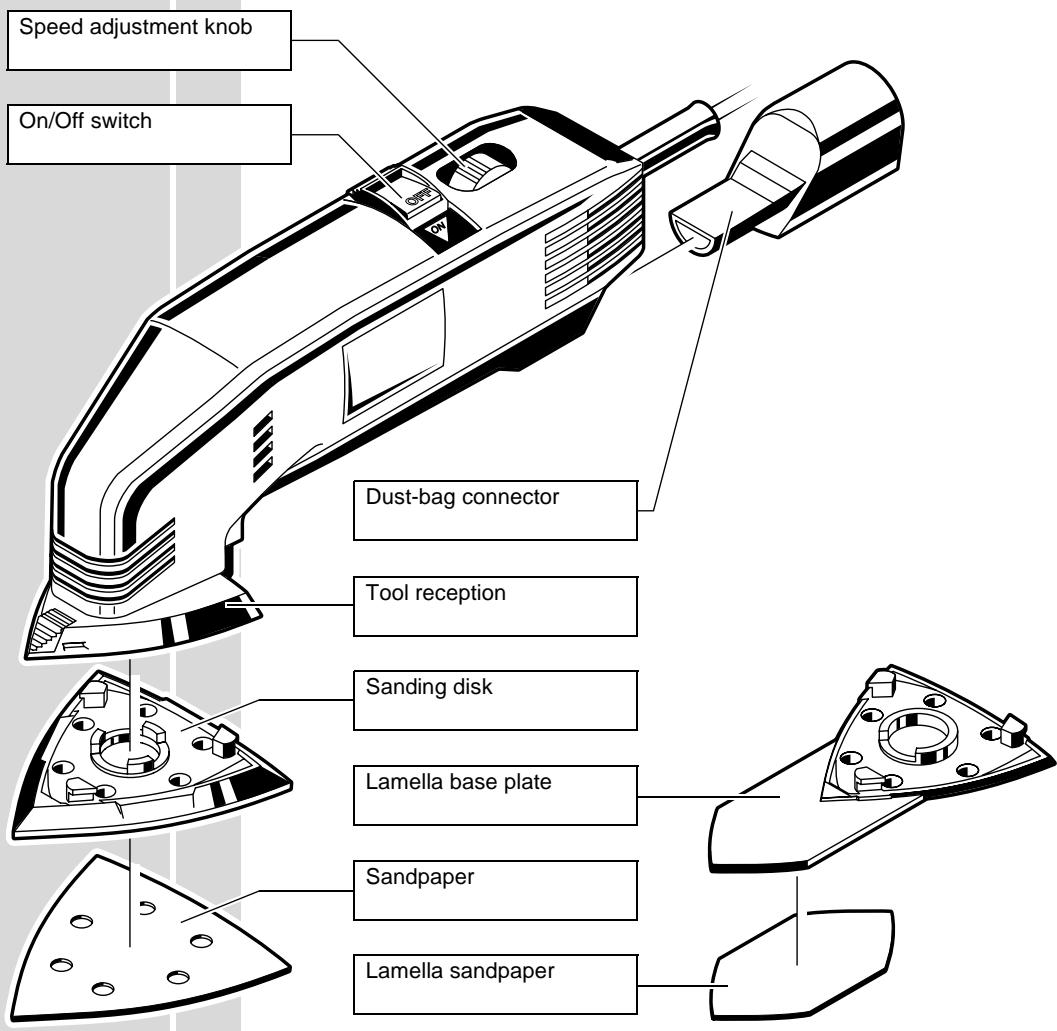
| Switching on and off | Switching on: Move the slide switch to the left in direction of arrow. The switch engages. Switching off: Depress "OFF" button of the slide switch. The switch moves automatically back to the 0-position. | |
| Electronics Speed selection | Due to the electronic the speed can be controlled by setting the wheel to suit the various materials. The speed is adjusted by means of the electronic thumb wheel. 1 = lowest r.p.m. 6 = largest r.p.m. | |
| Mounting the base plate/ lamella base plate | Always disconnect the plug from the socket before carrying out any work on the machine. Mount the base plate (turned approx. 15°) to the tool reception (as shown in illustration) and turn it in direction of arrow until it locks. | |
| ENGLISH | 6 | DSE 220, DSE 260 |
EC DECLARATION OF CONFORMITY
We declare under our sole responsibility that this product is in conformity with the following standards or standardization documents: EN 50 144, EN 55 014, EN 55 014-2, EN 60 555, HD 400 according to the provisions of the regulations 73/23/EEC, 89/336/EEC, 89/392/EEC.
DEUTSCH
Brand : AEG-ELECTROLUX
Model : DSE 260
Category : Power tool