
AF-S MICRO NIKKOR 60MM F-2.8G ED - Macro lens NIKON - Free user manual and instructions
Find the device manual for free AF-S MICRO NIKKOR 60MM F-2.8G ED NIKON in PDF.



| Product type | Macro lens |
| Brand | NIKON |
| Model | AF-S MICRO NIKKOR 60MM F/2.8G ED |
| Focal length | 60 mm |
| Maximum aperture | f/2.8 |
| Optical construction | 12 elements in 9 groups (1 ED glass, 2 aspherical lenses, nano crystal coating) |
| Field angle (FX) | 39°40' |
| Field angle (DX) | 26°30' |
| Minimum focusing distance | 0.185 m (1:1 reproduction ratio) |
| Filter diameter | 62 mm |
| Dimensions (diameter x length) | 73 mm x 89 mm |
| Weight | 425 g |
| Number of diaphragm blades | 9 (circular) |
| Aperture range | f/2.8 to f/32 |
| Focusing | Autofocus with SWM motor, M/A manual override |
| Mount | Nikon F bayonet mount |
| Included accessories | LC-62 front cap, LF-1 rear cap, HB-42 lens hood, CL-1018 case |
| Maintenance | Clean with blower and soft cloth slightly moistened with ethanol |
| Safety | Do not disassemble, avoid flammable gases, do not look at the sun through the lens |
Frequently Asked Questions - AF-S MICRO NIKKOR 60MM F-2.8G ED NIKON
User questions about AF-S MICRO NIKKOR 60MM F-2.8G ED NIKON
0 question about this device. Answer the ones you know or ask your own.
Ask a new question about this device
Download the instructions for your Macro lens in PDF format for free! Find your manual AF-S MICRO NIKKOR 60MM F-2.8G ED - NIKON and take your electronic device back in hand. On this page are published all the documents necessary for the use of your device. AF-S MICRO NIKKOR 60MM F-2.8G ED by NIKON.
USER MANUAL AF-S MICRO NIKKOR 60MM F-2.8G ED NIKON
AF-S Micro NIKKOR 60mm f/2.8G ED
Nano Crystal Coat
| 使用説明書 | (P.2-13) |
| User's Manual | (PP.14-25) |
| Benutzerhandbuch | (S.26-37) |
| Manuel d'utilisation | (P.38-49) |
| Manual del usuario | (PP.50-61) |
| Anvādarhandbok | (S.62-73) |
| PykoBočDtropoльzoВатěя | (CTP.74-85) |
| Gebruikshandleiding | (P.86-97) |
| Manuale d'uso | (PP.98-109) |
| 使用説明書 | (P.110-123) |
| 使用説明書 | (P.124-135) |
| 사용품명서 | (P.136-147) |
Touching the internal parts of the camera or lens could result in injury. Repairs should be performed only by qualified technicians. Should the camera or lens break open as the result of a fall or other accident, take the product to a Nikon-authorized service representative for inspection after unplugging the product and/or removing the battery.
Turn off immediately in the event of malfunction
Should you notice smoke or an unusual smell coming from the camera or lens, remove the battery immediately, taking care to avoid burns. Continued operation could result in injury. After removing or disconnecting the power source, take the equipment to a Nikon-authorized service representative for inspection.
Do not use the camera or lens in the presence of flammable gas. If the electronic equipment is operated in the presence of flammable gas, it could result in an explosion or a fire.
Do not look at the sun through the lens or viewfinder
Viewing the sun or other strong light sources through the lens or viewfinder could cause permanent visual impairment.
Keep out of reach of children
Particular care should be taken to prevent infants from putting the batteries or other small parts into their mouths.
Observe the following precautions when handling the camera and lens
- Keep the camera or lens unit dry. Failure to do so could result in a fire or electric shock.
- Do not handle or touch the unit with wet hands. Failure to do so could result in electric shock.
- In backlit shooting, keep the sun well out of the frame. The sunlight could focus into the lens body and cause a fire. When the sun gets close to the frame, it can also cause a fire.
- When the lens will not be used for a long time, attach both front and rear lens caps and store the lens away from direct sunlight. Failure to do so could result in a fire, as the lens might focus sunlight onto an object.
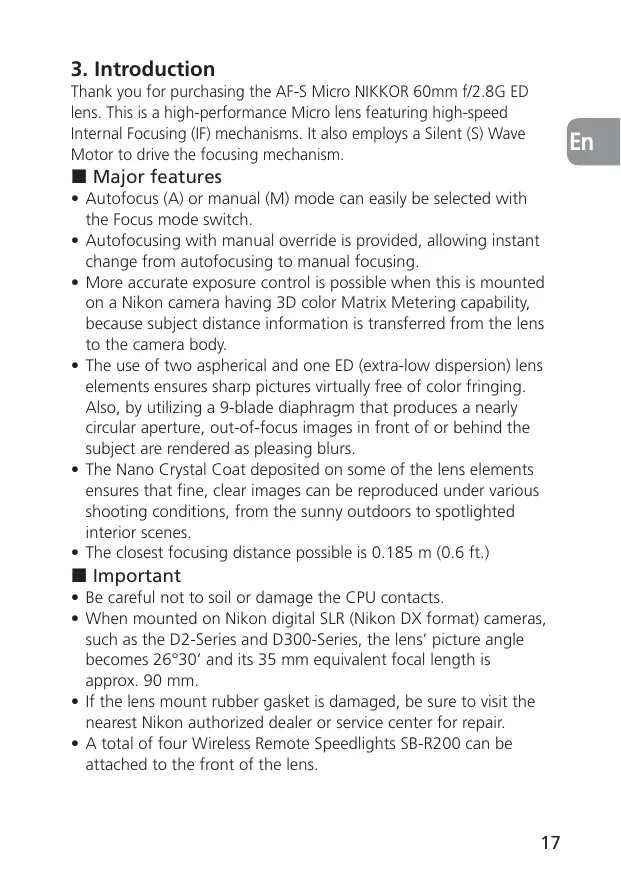
1. Nomenclature ( : Reference page
① Lens hood mounting index (p.21)
(2) Focus ring (p.18)
(3) Distance scale
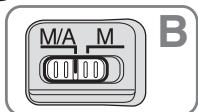
④ Focus mode switch (p.18)
(5) Mounting index
(6) Lens mount rubber gasket (p.17)
⑦ CPU contacts (p.17)
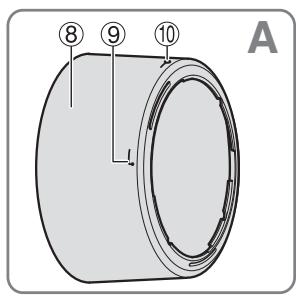
Lens hood (p.21)
Lens hood attachment index (p.21)
10 Lens hood setting index (p.21)
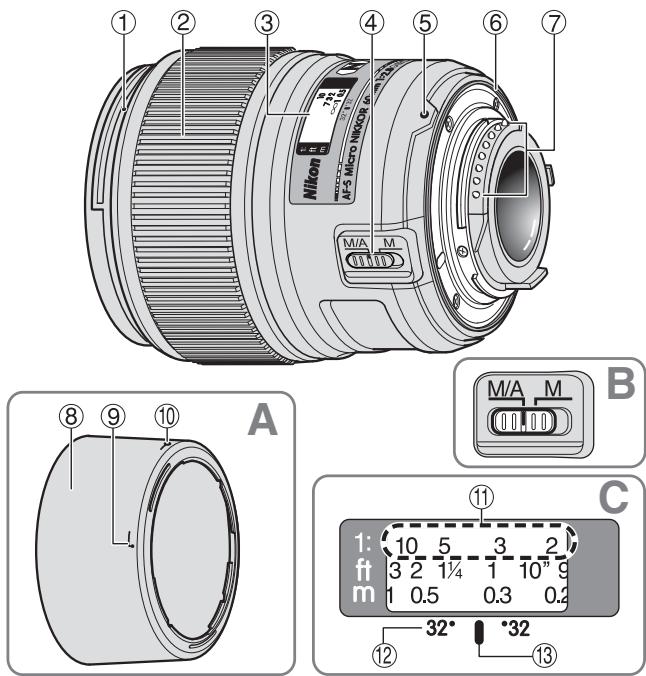
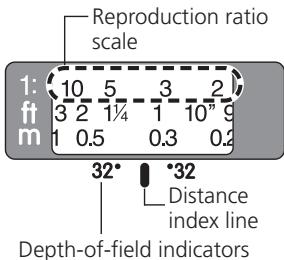
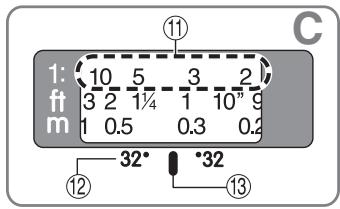
① Reproduction ratio scale (p.18)
(12) Depth-of-field indicators (p.18)
13 Distance index line (p.18)
2. Usable cameras and available functions
There may be some restrictions or limitation for available functions. Refer to your camera User's Manual for details.
| Cameras | Autofocus | Exposure mode | |||
| P*1 | S | A | M | ||
| Nikon digital SLR (Nikon FX/DX format) cameras | ✓ | ✓ | ✓ | ✓ | ✓ |
| F6, F5, F100, F80-Series/N80-Series*, F75-Series/N75-Series*, F65-Series/N65-Series* | ✓ | ✓ | ✓ | ✓ | ✓ |
| Pronea 600i/6i*, Pronea 5*2 | ✓ | ✓ | ✓ | ✓ | ✓ |
| F4-Series, F90X/N90s*, F90-Series/N90*, F70-Series/N70* | ✓ | ✓ | ✓ | — | — |
| F60-Series/N60*, F55-Series/N55-Series*, F50-Series/N50*, F-401x/N5005*, F-401s/N4004s*, F-401/N4004* | — | ✓ | ✓ | ✓ | ✓ |
| F-801s/N8008s*, F-801/N8008*, F-601M/N6000* | — | ✓ | ✓ | — | — |
| F3AF, F-601/N6006*, F-501/N2020**, Nikon MF cameras (except F-601M/N6000*) | — | — | — | — | — |
- Sold exclusively in the USA
Possible —: Impossible
** Sold exclusively in the USA and Canada
*1 P includes AUTO (General-Purpose Program) and Vari-Program System.
*2 Manual (M) is not available.
3. Introduction
Thank you for purchasing the AF-S Micro NIKKOR 60mm f/2.8G ED lens. This is a high-performance Micro lens featuring high-speed Internal Focusing (IF) mechanisms. It also employs a Silent (S) Wave Motor to drive the focusing mechanism.
Major features
- Autofocus (A) or manual (M) mode can easily be selected with the Focus mode switch.
- Autofocusing with manual override is provided, allowing instant change from autofocusing to manual focusing.
- More accurate exposure control is possible when this is mounted on a Nikon camera having 3D color Matrix Metering capability, because subject distance information is transferred from the lens to the camera body.
- The use of two aspherical and one ED (extra-low dispersion) lens elements ensures sharp pictures virtually free of color fringing. Also, by utilizing a 9-blade diaphragm that produces a nearly circular aperture, out-of-focus images in front of or behind the subject are rendered as pleasing blurs.
- The Nano Crystal Coat deposited on some of the lens elements ensures that fine, clear images can be reproduced under various shooting conditions, from the sunny outdoors to spotlighted interior scenes.
- The closest focusing distance possible is 0.185m (0.6 ft.)
Important
- Be careful not to soil or damage the CPU contacts.
- When mounted on Nikon digital SLR (Nikon DX format) cameras, such as the D2-Series and D300-Series, the lens' picture angle becomes 26^30' and its 35mm equivalent focal length is approx. 90mm .
- If the lens mount rubber gasket is damaged, be sure to visit the nearest Nikon authorized dealer or service center for repair.
- A total of four Wireless Remote Speedlights SB-R200 can be attached to the front of the lens.
4. Focusing
Set your camera's focus mode selector according to this chart.
| Cameras | Camera's focus mode | Lens' focus mode | |
| M/A | M | ||
| Nikon digital SLR (Nikon FX/DX format) cameras, F6, F5, F4-Series, F100, F90X/N90s*, F90-Series/N90*, F80-Series/N80-Series*, F75-Series/N75-Series*, F70-Series/N70*, F65-Series/N65-Series*, Pronea 600i/6i*, Pronea S | AF(C/S) | Autofocus with manual priority | Manual focus (Focus assist is available.) |
| MF | Manual focus (Focus assist is available.) | ||
| F55-Series/N55-Series*, F60-Series/N60*, F50-Series/N50*, F-801s/N8008s*, F-801/N8008*, F-601M/N6000*, F-401x/N5005*, F-401s/N4004s*, F-401/N4004* | AF(C/S)MF | Manual focus (Focus assist is available, except with the F-601M/N6000*. ) | |
- Sold exclusively in the USA
■ Autofocus with manual override (M/A mode)
1 Set the focus mode switch to "M/A".
2 You can manually override autofocus by operating the focus ring while lightly depressing the shutter release button or the AF start button on the camera.
- To cancel manual override, remove your finger from the shutter release button or the AF start button on the camera, and lightly depress the shutter release button to return to the autofocus mode.
5. Depth of field
The depth-of-field indicators are engraved beside the distance index line. At close distances, however, so little is in focus that it may be better to check the depth of field table (on page 152). If your camera has a depth-of-field preview button or lever, use it to check the depth of field in the viewfinder.
6. Focusing at a predetermined reproduction ratio
The reproduction ratio is the relation between the size of the image recorded on film and the actual subject size. If, for example, the image on the focusing screen is one-fifth the actual subject size, the reproduction ratio is 1:5.
To photograph at a predetermined reproduction ratio, use the following procedure:
1 Manually turn the focus ring until the desired reproduction ratio scale number is aligned with the distance index line.
2 Aim at the subject, then change your position, moving closer to or farther away from the subject, until the image in the viewfinder sharpens.
To obtain the appropriate reproduction ratio for each focused distance, see the table on page 152.
7. Notes on close-up photography and duplication work Camera shake
The AF-S Micro NIKKOR 60mm f/2.8G ED provides such exceptionally high image magnification that even the slightest movement during shooting can cause the image to blur. Be sure to mount the camera on a tripod and use a cable release or remote cord to release the shutter.
Close working distance
At the high reproduction ratios used in close-up shooting, the depth of field is very shallow. To ensure greater depth of field, stop down the lens, then carefully position the camera to ensure the most important surface of the subject is in the same zone of sharp focus.
- Use manual focus when using the close-up lens.
| Close-up attachment | Reproduction ratio | Subject field (cm/inch) | Focused distance (cm/inch) |
| No. 5T | 1/11.1–1.07 | 26.7 × 40.0 – 2.24 × 3.36 / 10.50 × 15.70 – 0.88 × 1.32 | 80.6 – 18.5 / 31.7 – 7.3 |
| No. 6T | 1/5.7 – 1.14 | 13.6 × 20.5 – 2.11 × 3.16 / 5.35 × 8.07 – 0.83 × 1.24 | 48.2 – 18.5 / 19.0 – 7.3 |
| No. 5T + 6T | 1/4.2 – 1.20 | 10.0 × 15.0 – 2.00 × 3.00 / 3.93 × 5.90 – 0.79 × 1.18 | 41.2 – 18.5 / 16.2 – 7.3 |
8. Exposure factor
The f-number of a lens indicates brightness of the image formed by the lens set at "infinity" shooting distance. The higher the reproduction ratio is, the more the brightness of the image will decrease. The actual brightness of the image is called the "effective f-number," and the exposure compensation value for the change of the effective f-number is called the "exposure factor."
9. Effective f-number variation (P. 148)
With this lens, the higher the reproduction ratio is, the more the brightness of the image on the film (image sensing device) will decrease and the effective f-number will increase (the amount of light that comes through the lens' aperture will decrease). This variation is automatically compensated for by the camera's exposure meter, so the user can determine exposure or operate TTL flash shooting without having to consider the exposure factor. The f-number displayed in the camera's LCD panel or viewfinder is the value automatically compensated.
10. Setting the aperture
Set the aperture on the camera body. When exposure (or shooting) mode is set at "A" (Aperture Priority auto) or "M" (manual), the camera will control to maintain the predetermined f-number (up to approx. 1.6 stops) as the effective f-number varies with shooting distance.
11. Using bayonet hood HB-42
Attaching the hood
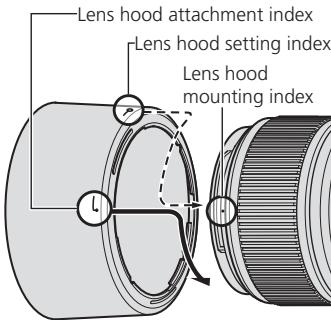
Align the lens hood attachment index ( ) on the hood (either one of the two indexes) with the lens hood mounting index on the lens, and turn the lens hood clockwise until it click stops to secure.
- Make sure that the lens hood mounting index aligns with the lens hood setting index (-) .
- If the lens hood is not correctly attached, vignetting can occur.
- To facilitate attachment or removal of the hood, hold it by its base (around the lens hood attachment index) rather than its outer edge.
- To store the lens hood, attach it in the reverse position.
Detaching the hood
While holding the base of the hood (near the lens hood attachment index) rather than its outer edge, turn it counterclockwise to detach.
12. Flash pictures using cameras with a built-in flash
To prevent vignetting, do not use a lens hood.
13. Recommended focusing screens
Various interchangeable focusing screens are available for certain Nikon SLR cameras to suit any picture-taking situation. The ones recommended for use with this lens are:
| Screen Camera | A | B | C | E | EC-B EC-E | F | G1 G3 G4 | G2 | J | K | L | M | P | U |
| F6 | ◎ | ◎ | — | ◎ | — | — | — | — | ◎ | — | ◎ | — | ||
| F5+DP-30 | ◎ | ◎ | ◎ | ◎ | — | ○ | ◎ | — | ◎ | — | ||||
| F5+DA-30 | ◎ | ◎ | ◎ | ◎ | — | ◎ | — | ◎ | — | |||||
| F4+DP-20 | — | ◎ | ◎ | — | ◎ | ◎ | ◎ | — | ◎ | |||||
| F4+DA-20 | — | ◎ | ◎ | — | ◎ | ◎ | — | ◎ |
:Excellent focusing
O:Acceptable focusing
Slight vignetting or moiré patterns appear in the viewfinder, but not on the film.
Not available.
Blank box means not applicable. Since type M screen can be used for both macrophotography at a magnification ratio of 1:1 or above and for photomicrography, it has different applications than other screens.
Important
- For F6 cameras, when using screens other than type B or E, "Other screen" must be selected in Custom Setting. Refer to camera's User's Manual for details.
- For F5 cameras, only EC-B, EC-E, B, E, J, A, L focusing screens are usable in Matrix Metering.
- When using the B and E focusing screens in cameras other than those listed above, refer to the columns for the B and E screens.
14. Lens care
- Clean the lens surfaces with a blower brush. To remove dirt and smudges, use a soft, clean cotton cloth or lens tissue moistened with ethanol (alcohol) or lens cleaner. Wipe in a circular motion from center to outer edge, taking care not to leave traces or touch other parts of the lens.
- Never use thinner or benzene to clean the lens as this might damage it, result in a fire, or cause health problems.
- To protect the front lens element, an NC filter is available. A lens hood also helps protect the front of the lens.
- When storing the lens in its lens case, attach both front and rear caps.
- When the lens will not be used for a long time, store it in a cool, dry place to prevent mold. Also store the lens away from direct sunlight or chemicals such as camphor or naphthalene.
- Do not get water on the lens or drop it in water as this will cause it to rust and malfunction.
- Reinforced plastic is used for certain parts of the lens. To avoid damage, never leave the lens in an excessively hot place.
15. Standard accessories
- 62mm snap-on front lens cap LC-62 - Rear lens cap LF-1
- Bayonet hood HB-42 - Flexible lens pouch CL-1018
16. Optional accessories
- 62mm screw-in filters
17. Incompatible accessories
- Teleconverters
- Auto Ring BR-4 and all models of Auto Extension Ring PK, K Ring and Bellows focusing attachment.
Other accessories may not be suitable for use with this lens. For details, carefully read your accessories instruction manual.
En
18. Specifications
Type of lens: G-type AF-S Micro NIKKOR lens with built-in CPU and Nikon bayonet mount
Focal length: 60 mm
Maximum f/2.8
aperture:
Lens construction: 12 elements in 9 groups (1 ED, 2 aspherical and some Nano Crystal Coat-deposited lens elements)
Picture angle: 39^40' with 35 mm (135) format Nikon film SLR cameras and Nikon FX format digital SLR cameras
26^30' with Nikon DX format digital SLR cameras
32^ with IX240 system cameras
Reproduction ratio 1:10 to 1:1 (life-size) scale:
Distance Output to camera body information
Focusing: Nikon Internal Focusing (IF) system (utilizing an internal Silent Wave Motor); manually via separate focus ring
Shooting distance Graduated in meters and feet from scale: 0.185 m (8 in.) to infinity ()
Closest focusing 0.185 m (0.6 ft) (life-size) distance:
No. of diaphragm 9 pcs. (rounded) blades:
Diaphragm: Fully automatic
Aperture range: f/2.8 to f/32
Exposure Via full-aperture method measurement:
Attachment size: 62mm (P = 0.75mm)
Dimensions:
Approx. 73 mm dia. x 89 mm extension from the camera's lens mount flange
Weight:
Approx. 425 g (15.0 oz)
Specifications and designs are subject to change without any notice or obligation on the part of the manufacturer.
ACHTUNG
| Verre Appareil | A | B | C | E | EC-B EC-E | F | G1 G3 G4 | G2 | J | K | L | M | P | U |
| F6 | ◎ | ◎ | — | ◎ | — | — | — | — | ◎ | — | ◎ | — | ||
| F5+DP-30 | ◎ | ◎ | ◎ | ◎ | — | ○ | ◎ | — | ◎ | — | ||||
| F5+DA-30 | ◎ | ◎ | ◎ | ◎ | — | ◎ | — | ◎ | — | |||||
| F4+DP-20 | — | ◎ | ◎ | — | ◎ | ◎ | ◎ | — | ◎ | |||||
| F4+DA-20 | — | ◎ | ◎ | — | ◎ | ◎ | — | ◎ |
| Pantalla Cámara | A | B | C | E | EC-B EC-E | F | G1 G3 G4 | G2 | J | K | L | M | P | U |
| F6 | ◎ | ◎ | — | ◎ | — | — | — | — | ◎ | — | ◎ | — | ||
| F5+DP-30 | ◎ | ◎ | ◎ | ◎ | — | ○ | ◎ | — | ◎ | — | ||||
| F5+DA-30 | ◎ | ◎ | ◎ | ◎ | — | ◎ | — | ◎ | — | |||||
| F4+DP-20 | — | ◎ | ◎ | — | ◎ | ◎ | ◎ | — | ◎ | |||||
| F4+DA-20 | — | ◎ | ◎ | — | ◎ | ◎ | — | ◎ |
@:Enfoque excellente
:Enfoque acceptable
Forvara utom rackhall for barn
| SkärnmKamera | A | B | C | E | EC-BEC-E | F | G1G3G4 | G2 | J | K | L | M | P | U |
| F6 | ◎ | ◎ | — | ◎ | — | — | — | — | ◎ | — | ◎ | — | ||
| F5+DP-30 | ◎ | ◎ | ◎ | ◎ | — | ○ | ◎ | — | ◎ | — | ||||
| F5+DA-30 | ◎ | ◎ | ◎ | ◎ | — | ◎ | — | ◎ | — | |||||
| F4+DP-20 | — | ◎ | ◎ | — | ◎ | ◎ | ◎ | — | ◎ | |||||
| F4+DA-20 | — | ◎ | ◎ | — | ◎ | ◎ | — | ◎ |
@:Utmärkt fokusering
O:Acceptabel fokusering
He pa36bpaTte yctpoCTBO
He nCnoIb3yIte foToHamepy nnN o6beKTHB npnHaJIuHn JERKOBocPImaMeHraUOxxCra3OB
He pa6oTaIe C 3JIeKToPONHbIM O6OpUyOBAHmE Pn HAnuHn B Bo3DyuXe IerKOBocNlAmEnHIOUxNCra3OB —3TO MOHeT npNBecTn K B3pBBy NIN NOkApY.
He cmotpnte Ha coIHnce uepe3 o6beKTHB nII IN BnOuCKaTeJIb
B3rIaH na coIhne nn IpyroJ npKn HcToUHKn CBeta Ope3 0beKeTbN BIn BIDOnckateB MoKeT Bbl3BaTb HeO6paTmOE yxuDweHne 3peHna.
XpaHnTe yctpoCTBO B HeOCTynHom dIa DeTeM cMeTe
PpIMnTe Ooc6bIe MepbI npeOocToPOHHOCTH BO I36eKaHHe NOpaDaHnB 6atapeN IN DpyrNX He6oJIbXIN PpeMeTOB B pOT DeTAM.
Bo Bpem 3Kcnnyataunn foToHamepbI nIn NObeHTNBa co6nOaIte cJeDyUoune MepbI npedocTopoHHoCTN
XpHAnHe FOtOKaMepy HIN O6bKeTHNb B CYXOM MeCTe. HeCoBIOJIeHNe 3TOrTO PTe6OBAHNI MOJE TPNIEBCTN K NOPAKHEKNIHO TEKHTPNeCHKIM TOKOM.
E He npiaacaiTecb K yctoRcTBy MOKpbimI pykami. Hec6ioJIeHne 3TOrTO Tpe6OBaHNI MOKET pNpAoeHHnIO JnAEHTPueChIM TOKOM.
PnI cBemKe C nOcBcTHoN C3aHn HE OJOnyCkAte NOnaAdHn COJNeuHbX LyeB H KaDP. CoJIeNHeB lyu MOrT yCfOHycPOBaTaB C B KOpNc o6BeKtINBa N CTaB pInuHNO nnHapa.Kpome TORO, pInuHNO NopKaMaMOT CTaB COJIeNHeB lyu, nonaadoaUne H KOpNc B HENOCpeDCTBEHNQ 6Sn3OCTN OT BINOckATeJIa.
EcIIIO6bEHTNBEHnIaHINpyETCAHcNOIb3ObAHTbHa nIPOTRAKeHHN DInTeIbHO BPEMeHH, INPcEOeIHNEIT3ADHIO HnepeDHIO KpBILHKN N OMECTHE o6bEHTNB HA XPAHENE B MEcTO, KOToPOe HE NOJBeHPeHHe BO3dEChTBNO PrrMbIX COJIHeHbX Iyuei. PnI Heo6bIOEHHN 3TOTO Tpe6OBaHHO BO3HNCTAE BPeORTHCTB OBo3HNHOBBENH NOJaPA, NOckOLbKy o6bEHTNB MOKET FOKycIpOBaHTC OJIeHHe Iyuei Ha OKpyKaHOxI ppeMetax.
1. KomnohehtbI (): cnpaBouhna CTpaHnca
① UcTaHOBOUHnA MeTka 6IeHdbI (CTp.81)
②ΦOκυκρούθουΗΟ Κόλβεο (CTp.78)
③ 卞ka npacctOraHHN
④ 蹁EπHIOUOaTeJIbpeJIMMOB φOKyCnPOBKn (CTp.78)
⑤ YctaHOBOUHARMeTKa
⑥ Pe3HHOBbIy yNLOTHHTeIb KpeJIeHnIy 06BeKtNbA (CTp.77)
⑦ Pa3bEmbl Ipoceccopa (Ctp. 77)
⑧ BneHda(ctp.81)
⑨ Meɪtka kpeɪnJIeHЯ 6JIeɪdʌbɪ (CTp. 81)
⑩ MeTkaФИКСаци 6JIeHДы (cTp.81)
① Macstab cBemkn (cTp.78)
⑫ INHINKaTOpbI rIy6HbI pe3KocTN (cTp.78)
⑬Уka3aTeIbpacCTOHaHnI(cTp.78)
2. COBmecTHMbIe FOToHaMepbI N DOCTyINHbIe FyHHcHn
NcnoIb3OBAHHe NOCTyINbIX yHKnI O6BeKTHBa MoKeT 6bITb C8BaHO C HeKOTOpbIMn ORpaHnueHnAIM.
IopnbHbIe CBeDeHnC M. BpyHOBoCTBO Nolb3OBaTeJI FOToKaMeBbl.
12. CbemHa Ha foToKaMepy co BCTpoEHHOB BCnblshKoH
Bo n36eJxHHe BnHbEtIupoBaHH He nCpOJIb3yIte 6JeHdy o6BeKTHBa.
13. PekomeHnyembIe fokucpoBOOHbIe 3KpaHbI
CmeHHbIe foKcHpOBOUHbIe 3KpaHbI, DocTyNHbIe IJIA
onpeJeJIeHHbIX 3epKaJIbHbIX fOToKaMep Nikon, NOMaHT
ocuIeCTBJIaTb CbeMHy pAANTUeCHN B JIO6bX cHTyaUaJnx. C 3TNM
ObBeKTINBOM peKoMeHdyeTcN cNOJIb3OBaTb cJeDyUOJIne
fokcHpOBOUHbIe 3KpaHbI.
| Фотонамера\Эндан | A | B | C | E | EC-B EC-E | F | G1 G3 G4 | G2 | J | K | L | M | P | U |
| F6 | ◎ | ◎ | - | ◎ | - | - | - | - | ◎ | - | ◎ | - | ||
| F5+DP-30 | ◎ | ◎ | ◎ | ◎ | - | ◎ | ◎ | - | ◎ | - | ||||
| F5+DA-30 | ◎ | ◎ | ◎ | ◎ | - | ◎ | - | ◎ | - | |||||
| F4+DP-20 | - | ◎ | ◎ | - | ◎ | ◎ | ◎ | - | ◎ | |||||
| F4+DA-20 | - | ◎ | ◎ | - | ◎ | ◎ | - | ◎ |
@:ИcklHounteIbHoeKaueCTBOΦOKycnupOBKIn
:PnneMmeoeKaecTBoΦokcnpOBKn He60JIbIooB VINHbETNPOBaHHe NIM Myap MOry T IMeTb MeCTO B BINOCKaTeJe,HO He Ha PIIeHKe.
一:HeoocTynHo
Iyctoe OJIe 03HauaET, YTO fOkyocnpoBOHyb 3KpaH NcNoJb3OBAbT HeJIb3r. TIOckOBKy kPAH TnA M MoKET NcNoJb3OBAbTCa Kd Ia MaKpocBEMKn PryBEnUeHN1:1 N BbIe, TaK i DIA MHKPOΦOTORFΦNPOBaHN, ERO pImMeHeHne OTLIuaeTcO TpIMMeHHeN dpyTNx 3KpaHOB.
BHHMaHne
| Matglazen Camera | A | B | C | E | EC-B EC-E | F | G1 G3 G4 | G2 | J | K | L | M | P | U |
| F6 | ◎ | ◎ | — | ◎ | — | — | — | — | ◎ | — | ◎ | — | ||
| F5+DP-30 | ◎ | ◎ | ◎ | ◎ | — | ○ | ◎ | — | ◎ | — | ||||
| F5+DA-30 | ◎ | ◎ | ◎ | ◎ | — | ◎ | — | ◎ | — | |||||
| F4+DP-20 | — | ◎ | ◎ | — | ◎ | ◎ | ◎ | — | ◎ | |||||
| F4+DA-20 | — | ◎ | ◎ | — | ◎ | ◎ | — | ◎ |
- 62mm inschroeffilters
17. Onverenigbare accessoires
- Teleconverters
- Auto Ring BR-4 en alle modellen van Auto Extension Ring PK, K Ring en Bellows scherpstellingsbevestiging.
| Schemo Fotocamera | A | B | C | E | EC-B EC-E | F | G1 G3 G4 | G2 | J | K | L | M | P | U |
| F6 | ◎ | ◎ | — | ◎ | — | — | — | — | ◎ | — | ◎ | — | ||
| F5+DP-30 | ◎ | ◎ | ◎ | ◎ | — | ○ | ◎ | — | ◎ | — | ||||
| F5+DA-30 | ◎ | ◎ | ◎ | ◎ | — | ◎ | — | ◎ | — | |||||
| F4+DP-20 | — | ◎ | ◎ | — | ◎ | ◎ | ◎ | — | ◎ | |||||
| F4+DA-20 | — | ◎ | ◎ | — | ◎ | ◎ | — | ◎ |
| 对焦屏 相机 | A | B | C | E | EC-B EC-E | F | G1 G3 G4 | G2 | J | K | L | M | P | U |
| F6 | ◎ | ◎ | — | ◎ | — | — | — | — | ◎ | — | ◎ | — | ||
| F5+DP-30 | ◎ | ◎ | ◎ | ◎ | — | ○ | ◎ | — | ◎ | — | ||||
| F5+DA-30 | ◎ | ◎ | ◎ | ◎ | — | ◎ | — | ◎ | — | |||||
| F4+DP-20 | — | ◎ | ◎ | — | ◎ | ◎ | ◎ | — | ◎ | |||||
| F4+DA-20 | — | ◎ | ◎ | — | ◎ | ◎ | — | ◎ |
⑤: 对焦效果良好
○:对焦效果一般
| 對焦屏 相機 | A | B | C | E | EC-B EC-E | F | G1 G3 G4 | G2 | J | K | L | M | P | U |
| F6 | ◎ | ◎ | - | ◎ | - | - | - | - | ◎ | - | ◎ | - | ||
| F5+DP-30 | ◎ | ◎ | ◎ | ◎ | - | ○ | ◎ | - | ◎ | - | ||||
| F5+DA-30 | ◎ | ◎ | ◎ | ◎ | - | ◎ | - | ◎ | - | |||||
| F4+DP-20 | - | ◎ | ◎ | - | ◎ | ◎ | ◎ | - | ◎ | |||||
| F4+DA-20 | - | ◎ | ◎ | - | ◎ | ◎ | - | ◎ |
@:最佳對焦
O: 可能對焦
| 카메라 | 오류 PDO克斯 | 生态系统 | |||
| P*1 | S | A | M | ||
| 내zens다지울 SLR(LI본 FX/DX foét) 가메라 | ✓ | ✓ | ✓ | ✓ | ✓ |
| F6, F5, F100, F80-사리지, F75-사리지, F65-사리지 | ✓ | ✓ | ✓ | ✓ | ✓ |
| profoundly 600i, Pronea S*2 | ✓ | ✓ | ✓ | ✓ | ✓ |
| F4-사리지, F90X, F90-사리지, F70-사리지 | ✓ | ✓ | ✓ | — | — |
| F60-사리지, F55-사리지, F50-사리지, F-401x, F-401s, F-401 | — | ✓ | ✓ | ✓ | ✓ |
| F-801s, F-801, F-601M | — | ✓ | ✓ | — | — |
| F3AF, F-601, F-50, 내zens다지 (F-601M 채와) | — | — | — | — | — |
| 스크리 가메라 | A | B | C | E | EC-B EC-E | F | G1 G3 G4 | G2 | J | K | L | M | P | U |
| F6 | ◎ | ◎ | — | ◎ | — | — | — | — | ◎ | — | ◎ | — | ||
| F5+DP-30 | ◎ | ◎ | ◎ | ◎ | — | ○ | ◎ | — | ◎ | — | ||||
| F5+DA-30 | ◎ | ◎ | ◎ | ◎ | — | ◎ | — | ◎ | — | |||||
| F4+DP-20 | — | ◎ | ◎ | — | ◎ | ◎ | ◎ | — | ◎ | |||||
| F4+DA-20 | — | ◎ | ◎ | — | ◎ | ◎ | — | ◎ |
@:
O: 速摺険広形
62mm(P = 0.75mm)
- 73 mm x 89 mm (Lézus 马oundtsurter的超大尺寸)
摇摇: 425g
新社是,自前公国就其人和代人用的成者云
Aperture range when shooting at the closest shooting distance*
Display on camera's LCD panel/viewfinder (f-number at "infinity")
Display on camera's LCD panel/viewfinder (f-number at closest shooting distance)
- The largest f-number (f/57) will vary according to the camera's exposure value increment. The chart accounts for 1/3 EV increment settings.
(ft.)
Depth of field
| Focused distance | Depth of field | Reproduction ratio | |||||||
| f/2.8* | f/4* | f/5.6* | f/8* | f/11* | f/16* | f/22* | f/32* | ||
| (7.29)in. | 7-5/16 in. | 7-5/16 in. | 7-5/16 in. | 7-5/16 in. | 7-5/16 in. | 7-5/16 in. | 7-4/16 in. | 7-4/16 in. | 1/1.0 |
| 7-5/16 in. | 7-5/16 in. | 7-5/16 in. | 7-5/16 in. | 7-5/16 in. | 7-5/16 in. | 7-5/16 in. | 7-5/16 in. | ||
| 8 in. | 8 in. - 8 in. | 8 in. - 8 in. | 8 in. - 8 in. | 8 in. - 8 in. | 8 in. - 8 in. | 7-15/16 in.8-1/16 in. | 7-15/16 in.8-1/16 in. | 7-15/16 in.8-1/16 in. | 1/1.36 |
| 9 in. | 9 in. - 9 in. | 9 in. - 9 in. | 9 in. - 9 in. | 8-15/16 in.9-1/16 in. | 8-15/16 in.9-1/16 in. | 8-15/16 in.9-1/16 in. | 8-14/16 in.9-2/16 in. | 8-14/16 in.9-3/16 in. | 1/1.82 |
| 10 in. | 10 in. - 10 in. | 10 in. - 10 in. | 9-15/16 in.10-1/16 in. | 9-15/16 in.10-1/16 in. | 9-15/16 in.10-1/16 in. | 9-14/16 in.10-2/16 in. | 9-13/16 in.10-3/16 in. | 9-12/16 in.10-4/16 in. | 1/2.27 |
| 1 | 1 ft. - 1 ft. | 1 ft. - 1 ft. | 11-14/16 in.1 ft. 2/16 in. | 11-14/16 in.1 ft. 2/16 in. | 11-14/16 in.1 ft. 2/16 in. | 11-12/16 in.1 ft. 4/16 in. | 11-10/16 in.1 ft. 6/16 in. | 11-8/16 in.1 ft. 8/16 in. | 1/3.14 |
| 1 1/4 | 1 ft. 2-14/16 in.1 ft. 3-2/16 in. | 1 ft. 2-14/16 in.1 ft. 3-2/16 in. | 1 ft. 2-14/16 in.1 ft. 3-2/16 in. | 1 ft. 2-12/16 in.1 ft. 3-4/16 in. | 1 ft. 2-10/16 in.1 ft. 3-6/16 in. | 1 ft. 2-8/16 in.1 ft. 3-8/16 in. | 1 ft. 2-6/16 in.1 ft. 3-12/16 in. | 1 ft. 2-3/16 in.1 ft. 4-1/16 in. | 1/4.43 |
| 2 | 1 ft. 11-12/16 in.2 ft. 6/16 in. | 1 ft. 11-10/16 in.2 ft. 8/16 in. | 1 ft. 11-6/16 in.2 ft. 10/16 in. | 1 ft. 11-3/16 in.2 ft. 13/16 in. | 1 ft. 10-15/16 in.2 ft. 1-3/16 in. | 1 ft. 10-7/16 in.2 ft. 1-15/16 in. | 1 ft. 9-15/16 in.2 ft. 2-10/16 in. | 1 ft. 9-2/16 in.2 ft. 4-3/16 in. | 1/8.27 |
| 3 | 2 ft. 11-3/16 in.3 ft. 13/16 in. | 2 ft. 10-15/16 in.3 ft. 1-3/16 in. | 2 ft. 10-7/16 in.3 ft. 1-11/16 in. | 2 ft. 9-13/16 in.3 ft. 2-8/16 in. | 2 ft. 9-2/16 in.3 ft. 3-10/16 in. | 2 ft. 8-1/16 in.3 ft. 5-6/16 in. | 2 ft. 6-13/16 in.3 ft. 8-1/16 in. | 2 ft. 5-1/16 in.4 ft. 1-7/16 in. | 1/13.35 |
| 7 | 6 ft. 3 in.7 ft. 11-10/16 in. | 6 ft. 2/16 in.8 ft. 5-4/16 in. | 5 ft. 8-4/16 in.9 ft. 2-8/16 in. | 5 ft. 3-6/16 in.10 ft. 8-6/16 in. | 4 ft. 10-1/16 in.13 ft. 5-10/16 in. | 4 ft. 3-6/16 in.24 ft. 3-4/16 in. | 3 ft. 9-4/16 in.∞ | 3 ft. 2-1/16 in.∞ | 1/33.65 |
| ∞ | 124 ft. 8-9/16 in.∞ | 89 ft. 9-11/16 in.∞ | 64 ft. 1-15/16 in.∞ | 44 ft. 11-2/16 in.∞ | 32 ft. 8-4/16 in.∞ | 22 ft. 5-14/16 in.∞ | 16 ft. 4-7/16 in.∞ | 11 ft. 3-4/16 in.∞ | 1/∞ |
- The f-number on the "Depth of field" chart is the value when the lens is set at "infinity".
- Due to the optical characteristics of this lens, as the lens is focused closer, the focal length decreases.
Nikon
No reproduction in any form of this manual, in whole or in part (except for brief quotation in critical articles or reviews), may be made without written authorization from NIKON CORPORATION.
NIKON CORPORATION
FUJI BLDG., 2-3, MARUNOUCHI 3-CHOME, CHIYODA-KU,
- AF-S Micro NIKKOR 60mm f/2.8G ED
- Turn off immediately in the event of malfunction
- Do not look at the sun through the lens or viewfinder
- Keep out of reach of children
- Observe the following precautions when handling the camera and lens
- Nomenclature ( : Reference page
- Usable cameras and available functions
- Introduction
- Major features
- Important
- Focusing
- ■ Autofocus with manual override (M/A mode)
- Depth of field
- Focusing at a predetermined reproduction ratio
- Notes on close-up photography and duplication work Camera shake
- Close working distance
- Exposure factor
- Effective f-number variation (P. 148)
- Setting the aperture
- Using bayonet hood HB-42
- Attaching the hood
- Detaching the hood
- Flash pictures using cameras with a built-in flash
- Recommended focusing screens
- Lens care
- Standard accessories
- Optional accessories
- Incompatible accessories
- En
- Specifications
- Dimensions:
- Weight:
- ACHTUNG
- Forvara utom rackhall for barn
- He pa36bpaTte yctpoCTBO
- He nCnoIb3yIte foToHamepy nnN o6beKTHB npnHaJIuHn JERKOBocPImaMeHraUOxxCra3OB
- He cmotpnte Ha coIHnce uepe3 o6beKTHB nII IN BnOuCKaTeJIb
- XpaHnTe yctpoCTBO B HeOCTynHom dIa DeTeM cMeTe
- Bo Bpem 3Kcnnyataunn foToHamepbI nIn NObeHTNBa co6nOaIte cJeDyUoune MepbI npedocTopoHHoCTN
- KomnohehtbI (): cnpaBouhna CTpaHnca
- COBmecTHMbIe FOToHaMepbI N DOCTyINHbIe FyHHcHn
- CbemHa Ha foToKaMepy co BCTpoEHHOB BCnblshKoH
- PekomeHnyembIe fokucpoBOOHbIe 3KpaHbI
- BHHMaHne
- Onverenigbare accessoires
- Nikon
- NIKON CORPORATION
Brand : NIKON
Model : AF-S MICRO NIKKOR 60MM F-2.8G ED
Category : Macro lens