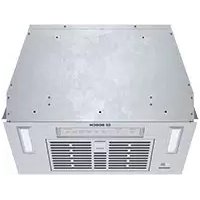
DWA 061450/01 - INSTALLATION INSTRUCTIONS - Basket BOSCH - Free user manual and instructions
Find the device manual for free DWA 061450/01 - INSTALLATION INSTRUCTIONS BOSCH in PDF.



| Brand | BOSCH |
| Model | DWA 061450/01 |
| Product type | Wall-mounted range hood |
| Available widths | 60 cm and 90 cm |
| Weight (60 cm – external extraction) | 10,3 kg |
| Weight (60 cm – recirculation) | 11,5 kg |
| Weight (90 cm – external extraction) | 13,2 kg |
| Weight (90 cm – recirculation) | 14,4 kg |
| Minimum safety distance (electric hob) | 60 cm |
| Minimum safety distance (gas or mixed hob) | 65 cm |
| Exhaust duct diameter | 120 mm (round) |
| Power cable length | 1,30 m |
| Power supply | 230 V ~ 50 Hz |
| Main functions | External extraction or recirculation with active carbon filter (optional) |
| Filters | Washable metal grease filters |
| Included accessories | Fixing bracket, screws, wall plugs, mounting template |
| Optional accessories | Recirculation mounting kit, active carbon filter |
| Installation type | Wall mounting, built-in |
| Material | Stainless steel (hood body) |
| Compliance | WEEE Directive 2002/96/EC |
Frequently Asked Questions - DWA 061450/01 - INSTALLATION INSTRUCTIONS BOSCH
User questions about DWA 061450/01 - INSTALLATION INSTRUCTIONS BOSCH
0 question about this device. Answer the ones you know or ask your own.
Ask a new question about this device
Download the instructions for your Basket in PDF format for free! Find your manual DWA 061450/01 - INSTALLATION INSTRUCTIONS - BOSCH and take your electronic device back in hand. On this page are published all the documents necessary for the use of your device. DWA 061450/01 - INSTALLATION INSTRUCTIONS by BOSCH.
USER MANUAL DWA 061450/01 - INSTALLATION INSTRUCTIONS BOSCH
Old appliances are not worthless rubbish.
Valuable raw materials can be reclaimed by recycling old appliances.
Before disposing of your old appliance, render it unusable.
This appliance is marked according to the European directive 2002/96/EC on Waste Electrical and Electronic Equipment (WEEE). By ensuring this product is disposed of correctly, you will help prevent potential negative consequences for the environment and human health, which could otherwise be caused by inappropriate waste handling of this product.
The symbol on the product, or on the
documents accompanying the product, indicates that this appliance may not be treated as household waste. Instead it should be taken to the appropriate collection point for the recycling of electrical and electronic equipment. Disposal must be carried out in accordance with local environmental regulations for waste disposal.
For more detailed information about treatment, recovery and recycling of this product, please contact your local council, your household waste disposal service or the shop where you purchased the product.
You received your new appliance in a protective shipping carton.
All packaging materials are environmentally friendly and recyclable.
Please contribute to a better environment by disposing of packaging materials in an environmentally-friendly manner.
Please ask your dealer or inquire at your local authority about current means of disposal.
The extractor hood can be used in exhaust air or circulating air mode.
Always mount the extractor hood over the centre of the hob.
The minimum distance between the supporting surface for the cooking vessels on the hob and the lowest part of the range hood must be not less than 60cm from electric cookers and 65cm from gas or mixed cookers. Fig.1
If the instructions for installation for the gas hob specify a greater distance, this must be adhered to.
Exhaust-air mode
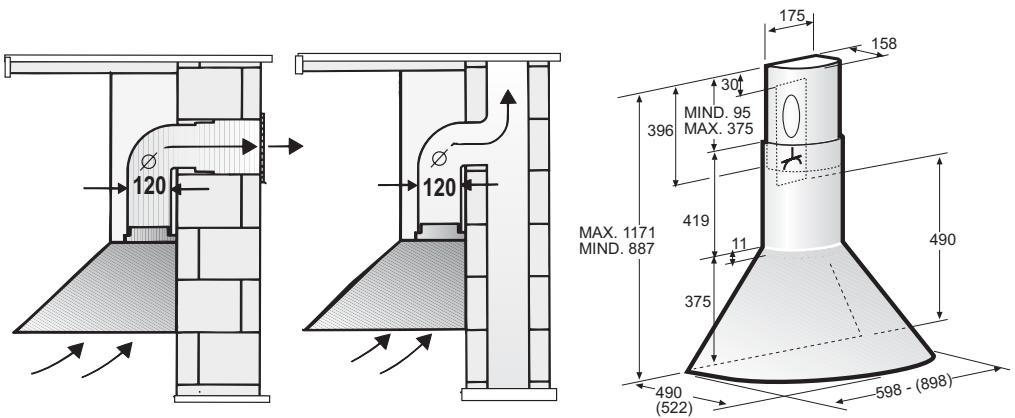
The exhaust air is discharged upwards through a ventilation shaft or directly through the outside wall into the open.
For operating in exhaust-air mode, a one-way flap should be mounted inside the wall ventilation box.
If no one-way flap was enclosed with the hood, it can be obtained from a specialist retailer.
Installing the one-way flap:
Snap the one-way flap into the air pipe.
The two lightly sprung flaps must be able to move upwards.
If the exhaust air is going to be discharged into the open, a telescopic wall box should be fitted into the outside wall.
For optimum extractor hood efficiency:
Short, smooth air exhaust pipe.
As few bends in the pipe as possible.
Diameter of pipe to be as large as possible and no tight bends in pipe. If long, rough exhaust-air pipes, many pipe bends or smaller pipe diameters are used, the air extraction rate will no longer be at an optimum level and there will be an increase in noise.
Round pipes:
We recommend Internal diameter: 120 mm
Flat ducts must have an internal cross section that equates to that of round pipes.
There should be no sharp bends. 120mm approx. 113~cm^2
If pipes have different diameters: Insert sealing strip.
For exhaust-air mode, ensure that there is an adequate supply of fresh air.
Connecting a 120 mm exhaust-air pipe:
- Mount the pipe directly onto the air outlet on the hood.
Prior to installation
Circulating-air mode
- With activated carbon filter if exhaust-air mode is not possible.
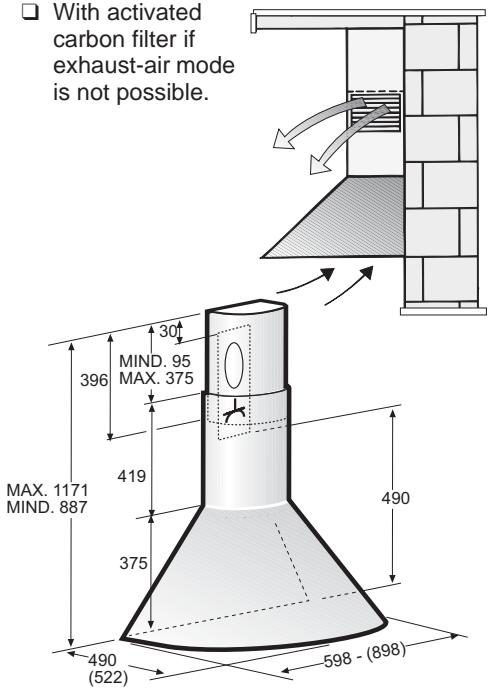
The complete installation set can be obtained from specialist outlets.
The corresponding accessory numbers can be found at the end of these operating instructions.
Preparing the wall
The wall must be flat and perpendicular.
- Ensure that the wall is capable of providing a firm hold for mounting screws and plugs.
Weight in kg:
| Exhaust-air mode | Circulating-air mode | |
| 60 cm | 10,3 | 11,5 |
| 90 cm | 13,2 | 14,4 |
We reserve the right to construction changes within the context of technical development.
Electrical connection
Risk of electric shock!
The appliance features an EU safety plug. To ensure protective earthing in a Danish socket, the appliance must be connected to a suitable plug adapter. This adapter (permitted up to max. 13 amps) is available from customer service (spare part no. 616581).
The mains power supply must correspond to the rating indicated on the plate situated inside the hood. If provided with a plug connect the hood to a socket in compliance with current regulations and positioned in an accessible area. If it not fitted with a plug (direct mains connection) or if the plug is not located in an accessible area apply a bipolar switch in accordance with standards which assures the complete disconnection of the mains under conditions relating to overcurrent category III, in accordance with installation instructions.
Warning! Before re-connecting the hood circuit to the mains supply and checking the efficient function, always check that the mains cable is correctly assembled.
Warning! Power cable replacement must be undertaken by the authorized service assistance centre or similar qualified person.
Connect the hood to a norm complying plug only. The plug should be located in an accessible zone.
The plug must be equipped with a protection circuit.
If after installation the plug can not be reached, a disconnecting device must be envisaged.

Electrical connection
Fixed installation:
The fixed installation can be carried out by a qualified and authorized person only. Envisage an omnipolar switch having a contact opening of at least 3mm, including an automatic circuit breaker.
The cable must be replaced by the manufacturer, the assistance centre or a qualified and authorized person only, in order to avoid any dangers.
Electrical data:
The technical data of the device are on the distinctive label inside the device behind the grease filters.
In case of repair, disconnect the electric supply from the cooker hood.
Length of the feeding cable: 1,30m.
The hood complies with the EMC directives.
Installation
This extractor hood is intended to be mounted onto the kitchen wall.
WARNING! Do not connect the appliance to the mains until the installation is fully complete.
Note: Take into account any special accessories that are going to be fitted.
- Remove the grease filter (refer to Operating Instructions).
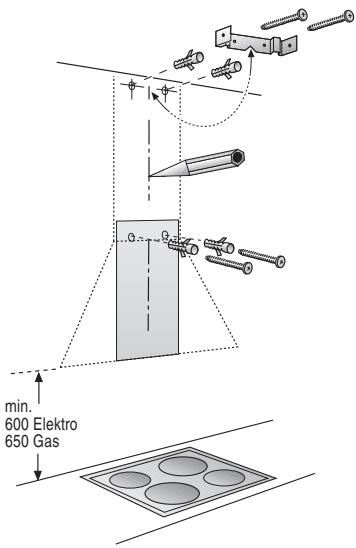
- Draw a line on the wall from the ceiling to the lower edge of the hood at the centre of the location where the hood is going to be mounted.
- Using the template, mark positions on the wall for the screws.
- Drill 2 holes (dia. 8mm ) for the extractor hood.
Drill 2 holes (dia. 8mm ) for the bracket for fixing the flue ducts - use the bracket as a template: this should be fit close to the ceiling so that index printed on the bracket matches with the line previously marked (see step 2).
Insert wall plugs flush with the wall.
- Screw on the bracket for fixing the flueducts.
- In order to help fix the hood onto the wall, screw in 2 screws until it protrudes by approx. 5mm
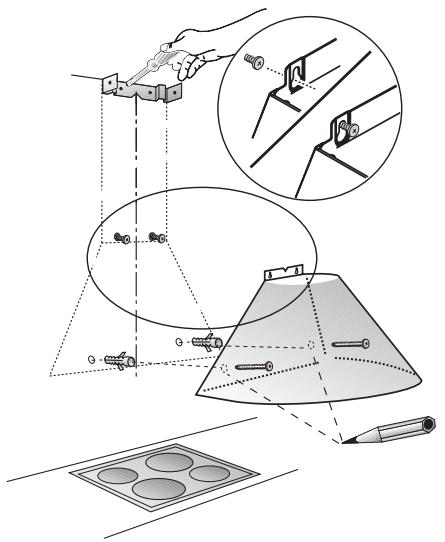
- Hook the extractor hood over the screws in the wall, align the extractor hood properly.
- Mark 2 lower fixing points.
Remove the hood and drill 2 holes (dia. 8 mm) on the marked points. Fit 2 wall plugs, Hang again the hood and fix the hood permanently with 2 screws.
- Connect up the air outlet pipe.
- Connect the hood to the electricity supply.
11. Stainless steel model:
Remove the protective film from the two flue ducts.
Avoid damage to the sensitive surface.
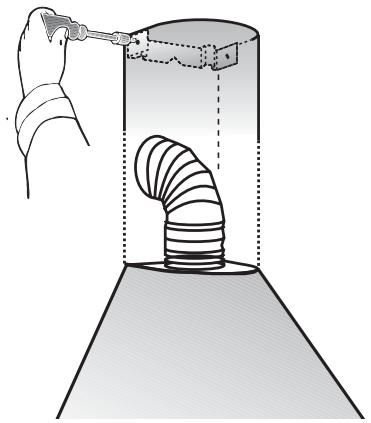
- Screw the upper flue duct to the sides of the fixing bracket with 2 short screws.
- Position the lower flue duct on the extractor hood, align the flue duct.
To prevent scratching the upper duct when pushing on the lower duct, cover the edge of the lower duct with the installation template or other protective material.
- Re-insert the grease filter (see operating instructions).
Remarques importantes
Circulating-air mode - complete installation set
Mode Air recyclé - Kit demontage
Recirculate kap complete installment set