
C525BEE - CD Player NAD - Free user manual and instructions
Find the device manual for free C525BEE NAD in PDF.



| Brand | NAD |
| Model | C525BEE |
| Product type | CD audio player |
| Dimensions (W x H x D) | 435 x 95 x 285 mm (approx.) |
| Weight | 5 kg (approx.) |
| Power supply | 220-240 V, 50/60 Hz |
| Power consumption | 15 W (max.) |
| Supported formats | CD audio, CD-R, CD-RW (16-bit 44.1 kHz PCM) |
| Audio outputs | Stereo line output (RCA), coaxial digital output (SPDIF) |
| Playback functions | Play, pause, stop, skip forward/back, search forward/back, repeat 1/all, random, program (20 tracks), track delete |
| Display | EFL display with track number, elapsed/remaining time, track list, mode indicators |
| Remote control | Infrared wireless, AAA batteries (2 x 1.5 V) |
| Maintenance and cleaning | Clean the tray with a damp cloth. Clean discs radially with a soft cloth and lukewarm water. Do not use solvents. |
| Safety | Class 1 laser, safe. Do not open the casing. |
| Spare parts and repairability | Contact an authorized NAD service center. No user-serviceable parts. |
| General information | Designed for horizontal use, away from vibrations. Do not expose to moisture. |
Frequently Asked Questions - C525BEE NAD
User questions about C525BEE NAD
0 question about this device. Answer the ones you know or ask your own.
Ask a new question about this device
Download the instructions for your CD Player in PDF format for free! Find your manual C525BEE - NAD and take your electronic device back in hand. On this page are published all the documents necessary for the use of your device. C525BEE by NAD.
USER MANUAL C525BEE NAD
Warning: To reduce the risk of fire or electric shock, do not expose this unit to rain or moisture.
The lightning flash with an arrowhead symbol within an equilateral triangle, is intended to alert the user to the presence of uninsulated "dangerous voltage" within the product's enclosure that may be of sufficient magnitude to constitute a risk of electric shock to persons.
The exclamation point within an equilateral triangle is intended to alert the user to the presence of important operating and maintenance (servicing) instructions in the literature accompanying the product.
Do not place this unit on an unstable cart, stand or tripod, bracket or table. The unit may fall, causing serious injury to a child or adult and serious damage to the unit. Use only with a cart, stand, tripod, bracket or table recommended by the manufacturer or sold with the unit. Any mounting of the device on a wall or ceiling should follow the manufacturer's instructions and should use a mounting accessory recommended by the manufacturer.
An appliance and cart combination should be moved with care. Quick stops, excessive force and uneven surfaces may cause the appliance and cart combination to overturn.
Read and follow all the safety and operating instructions before connecting or using this unit. Retain this notice and the owner's manual for future reference.
All warnings on the unit and in its operating instructions should be adhered to.
Do not use this unit near water; for example, near a bath tub, washbowl, kitchen sink, laundry tub, in a wet basement or near a swimming pool.
The unit should be installed so that its location or position does not interfere with its proper ventilation. For example, it should not be situated on a bed, sofa, rug or similar surface that may block the ventilation openings; or placed in a built-in installation, such as a bookcase or cabinet, that may impede the flow of air through its ventilation openings.
The unit should be situated from heat sources such as radiators, heat registers, stoves or other devices (including amplifiers) that produce heat.
The unit should be connected to a power supply outlet only of the voltage and frequency marked on its rear panel.
The power supply cord should be routed so that it is not likely to be walked on or pinched, especially near the plug, convenience receptacles, or where the cord exits from the unit.
Unplug the unit from the wall outlet before cleaning. Never use benzine, thinner or other solvents for cleaning. Use only a soft damp cloth.
The power supply cord of the unit should be unplugged from the wall outlet when it is to be unused for a long period of time.
Care should be taken so that objects do not fall, and liquids are not spilled into the enclosure through any openings.
This unit should be serviced by qualified service personnel when:
A. The power cord or the plug has been damaged; or
B. Objects have fallen, or liquid has been spilled into the unit; or
C. The unit has been exposed to rain or liquids of any kind; or
D. The unit does not appear to operate normally or exhibits a marked change in performance; or
E. The device has been dropped or the enclosure damaged.
DO NOT ATTEMPT SERVICING OF THIS UNIT YOURSELF. REFER SERVICING TO QUALIFIED SERVICE PERSONNEL
Upon completion of any servicing or repairs, request the service shop's assurance that only Factory Authorized Replacement Parts with the same characteristics as the original parts have been used, and that the routine safety checks have been performed to guarantee that the equipment is in safe operating condition. REPLACEMENT WITH UNAUTHORIZED PARTS MAY RESULT IN FIRE, ELECTRIC SHOCK OR OTHER HAZARDS.
ATTENTION
POUR ÉVITER LES CHOC ELECTRIQUES, INTRODUIRE LA LAME LA PLUS LARGE DE LA FICHE DANS LA BORNE CORRESPONDANTE DE LA PRISE ET POUSSER JUSQU'AU FOND.
CAUTION
TO PREVENT ELECTRIC SHOCK, MATCH WIDE BLADE OF PLUG TO WIDE SLOT FULLY INSERT.
If an indoor antenna is used (either built into the set or installed separately), never allow any part of the antenna to touch the metal parts of other electrical appliances such as a lamp, TV set etc.
CAUTION POWER LINES
Any outdoor antenna must be located away from all power lines.
OUTDOOR ANTENNA GROUNDING
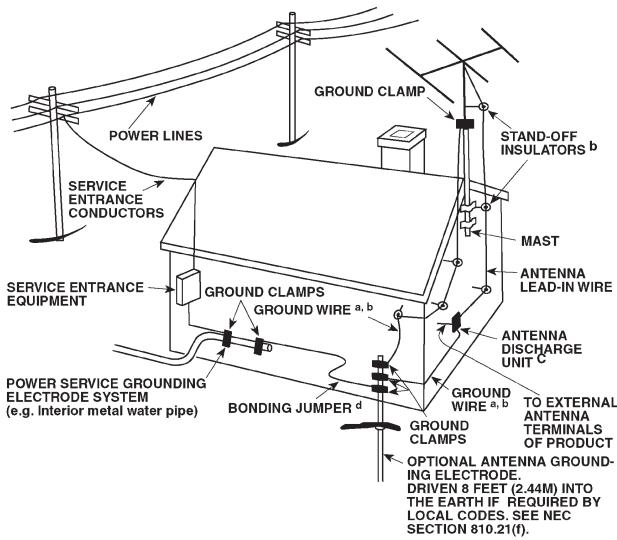
If an outside antenna is connected to your tuner or tuner-preamplifier, be sure the antenna system is grounded so as to provide some protection against voltage surges and built-up static charges. Article 810 of the National Electrical Code, ANSI/NFPA No. 70-1984, provides information with respect to proper grounding of the mast and supporting structure, grounding of the lead-in wire to an antenna discharge unit, size of grounding conductors, location of antenna discharge unit, connection to grounding electrodes and requirements for the grounding electrode.
a. Use No. 10 AWG (5.3mm2) copper, No. 8 AWG (8.4mm2) aluminium, No. 17 AWG (1.0mm2) copper-clad steel or bronze wire, or larger, as a ground wire.
b. Secure antenna lead-in and ground wires to house with stand-off insulators spaced from 4-6 feet (1.22 - 1.83 m) apart.
c. Mount antenna discharge unit as close as possible to where lead-in enters house.
d. Use jumper wire not smaller than No.6 AWG (13.3mm2) copper, or the equivalent, when a separate antenna-grounding electrode is used. see NEC Section 810-21 (j).
EXAMPLE OF ANTENNA GROUNDING AS PER NATIONAL ELECTRICAL CODE INSTRUCTIONS CONTAINED IN ARTICLE 810 - RADIO AND TELEVISION EQUIPMENT.
NOTE TO CATV SYSTEM INSTALLER: This reminder is provided to call the CATV system installer's attention to Article 820-40 of the National Electrical Code that provides guidelines for proper grounding and, in particular, specifies that the ground cable ground shall be connected to the grounding system of the building, as close to the point of cable entry as practical.
NOTES ON ENVIRONMENTAL PROTECTION
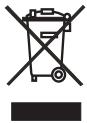
At the end of its useful life, this product must not be disposed of with regular household waste but must be returned to a collection point for the recycling of electrical and electronic equipment. The symbol on the product, user's manual and packaging, point this out.
The materials can be reused in accordance with their markings. Through re-use, recycling of raw materials, or other forms of recycling of old products, you are making an important contribution to the protection of our environment.
Your local administrative office can advise you of the responsible waste disposal point.
REAR PANEL CONNECTIONS
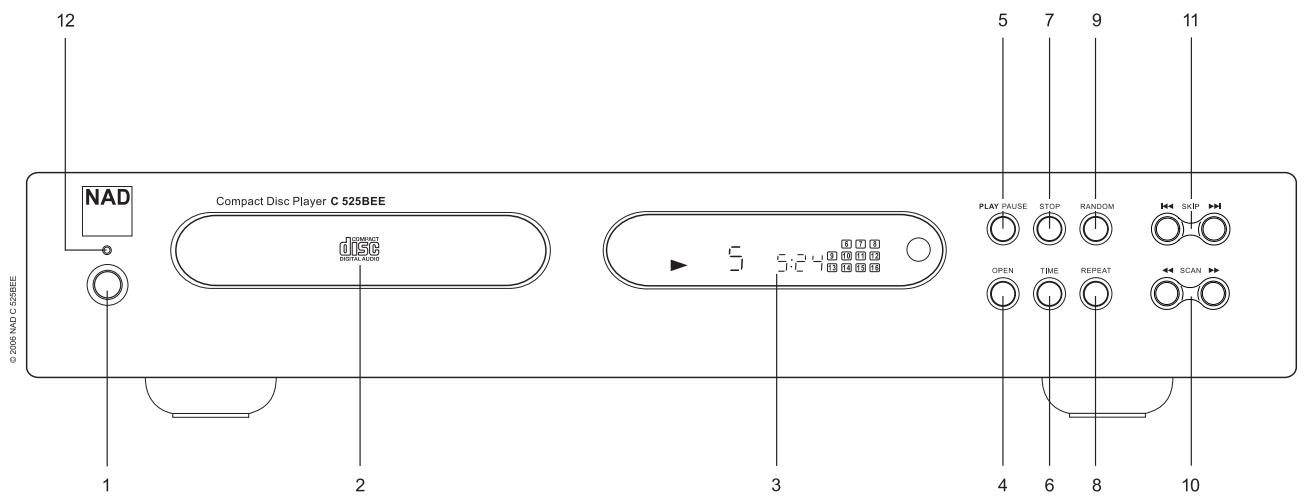
FRONT PANEL CONTROLS
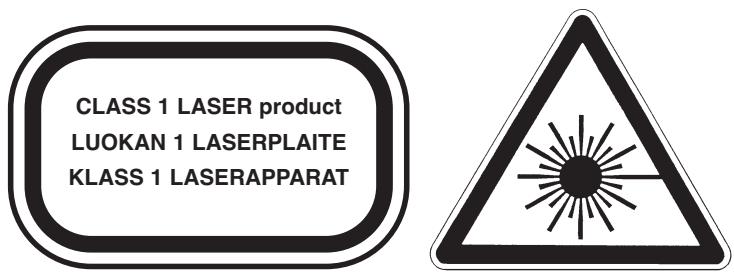
THIS DIGITAL APPARATUS DOES NOT EXCEED THE CLASS B LIMITS FOR RADIO NOISE EMISSIONS FROM DIGITAL APPARATUS AS SET OUT IN THE RADIO INTERFERENCE REGULATIONS OF THE CANADIAN DEPARTMENT OF COMMUNICATIONS.
LE PRESENT APPAREIL NUMVERIQUE N'EMET PAS DE BRUITS RADIOELECTRIQUES DEPASSANT LES LIMITES APPLICABLES AUX APPAREILS NUMERIQUES DE LA CLASSE B PRESCRITES DANS LE REGLEMENT SUR LE BROUILLAGE RADIO ELECTRIQUE EDICTE PAR LE MINISTERE DES COMMUNICATIONS DU CANADA.
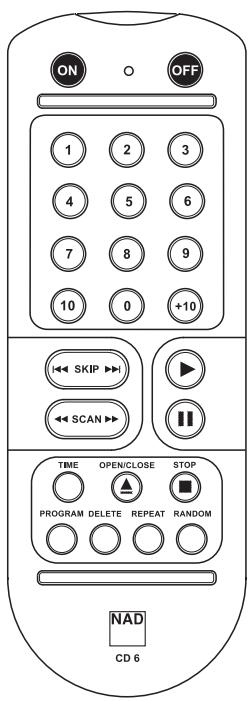
REMOTE CONTROL
QUICK START
1 Connect a twin RCA-to-RCA lead from the L (left) and R (right) Line Output jacks to the corresponding CD inputs on your amplifier.
2 Plug in the AC power cord.
3 Press the POWER button to turn on the player.
4 Press OPEN to open the disc drawer.
5 Place a CD, label side up, in the tray's circular recess. Be certain that the disc is centred within the recess.
6 Press PLAY/PAUSE. The drawer closes automatically, and the disc begins to play.
7 At any time you may press SKIP to select different tracks on the disc.
8 Press PLAY/PAUSE if you want to stop play temporarily while keeping the pickup at its current position on the disc. Press PLAY/PAUSE again when you want to resume playback. Press STOP if you want to end play and reset the pickup to the beginning of the disc.
NOTE ON INSTALLATION
Install the NAD C 525BEE Compact Disc player on a level, vibration-free surface. (Severe vibration, or operation in a tilted position, may cause the player to mis-track.) The player may be stacked with other stereo components, as long as there is adequate ventilation around it. If the player is placed in close proximity to a radio tuner (AM or FM), a VCR, or a television set, the operation of its digital circuits may produce static that would interfere with reception of weak broadcast signals. If this occurs, move the CD player away from other devices or switch it off when viewing or listening to broadcasts.
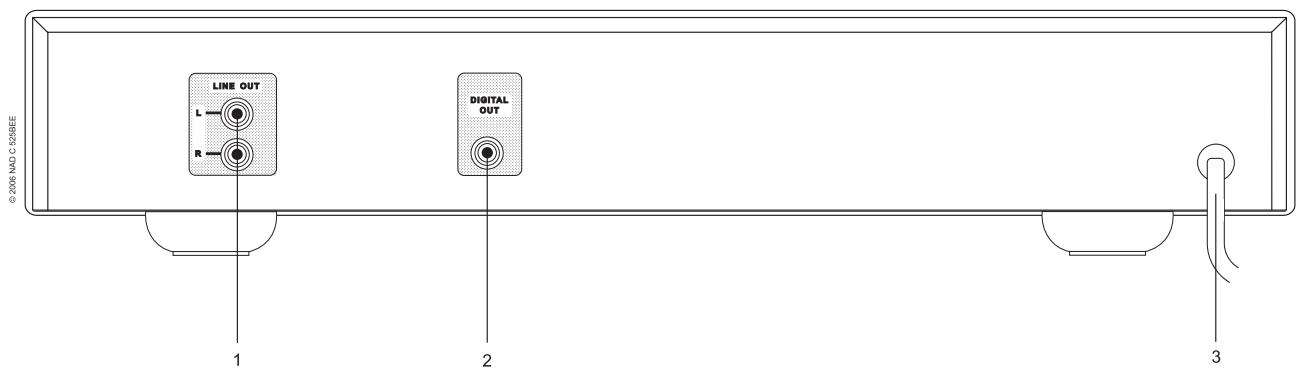
REAR PANEL CONNECTIONS
1. LINE OUTPUT
Connect a cable from these jacks to your amplifier. Plug one end of a twin RCA-to-RCA lead into the L (upper) and R (lower) output jacks. Connect the other end of the cable to your stereo amplifier's CD input, or to any other "line-level" input jacks (such as the AUXiliary inputs). Do NOT connect this cable to the amplifier's PHONO input jacks. The RCA sockets on your NAD C 525BEE are colour coded for convenience. Red and White are Right and Left audio respectively, and yellow for Digital Out. Ensure that leads and sockets are not damaged in any way and all sockets are firmly pushed home.
2. DIGITAL OUTPUT
The digital playback signal is available at this output jack. The serial data output is taken after the error correction but before the digital-to-analogue conversion and filtering. The output is transformer-isolated from the built-in D-to-A circuits. It may be connected to any digital signal processor that conforms to the Sony/Philips (SPDIF) standard.
To use the digital output, connect a cable from this jack to the "CD Digital" or equivalent input on a digital processor or recorder. For best results, the cable should be a 75 ohm coaxial cable of the type used for video signals, with an RCA phono plug at each end. (To distinguish them from similar phono-plug cables used for analogue audio signals, video and digital signal cables often are colour-coded with yellow plugs.)
3. AC LINE CORD
Connect this power cord to an AC mains wall outlet or to an AC convenience outlet at the rear of your amplifier.
FRONT PANEL CONTROLS
1. POWER ON/OFF
Press this button to switch on the power to the disc player. Press again and release to switch the power off. The display will light up to indicate the unit is switched on and ready for use.
2. DISC DRAWER
To play a disc, press the OPEN button to open the disc drawer. Place the CD within the large circular recess in the drawer, with its transparent playing surface facing down. The label must face UP. CD-3 discs (3-inch CD "singles") can be played without the aid of an adapter. Place the disc in the drawer, centered in the smaller circular recess, with its label facing UP.
NOTE: This player was not designed to accommodate a “damping disc” placed on a CD, nor two CDs stacked together. It plays audio CDs and CD-RW, but not discs identified as CD-V, DVD, CD-I, CD-ROM, or PHOTO CD. Refer also to chapter “A note on CD-R and CD-RW audio discs”
3. DISPLAY
The display provides information about playback status and about the optical pickup's location on the disc. The displayed track/time information is obtained by reading inaudible "sub-codes" in the disc.
TRACK NUMBER Each disc is segmented into numbered tracks when the recording is made; typically each numbered track will correspond to a different song, symphonic movement, etc. These track numbers are identified on the CD package and are encoded in the disc by its manufacturer. In some CDs, at the manufacturer's option, tracks may be sub-divided into sections identified by Index numbers. This player does not display Index numbers.
TIME Normally this display shows the time elapsed since the beginning of the current track. Using the TIME button you can switch the display to show the remaining number of tracks and playing time to the end of the disc. When you load a different disc and use the OPEN button (No. 4) to close the disc drawer, the display shows the number of tracks and the total playing time of all the tracks on the disc.
REMAIN REMAIN lights up in the lower-left corner of the display if you have pressed the TIME button to show the remaining number of tracks and time of the disc.
REPEAT 1 "REPEAT" and "1" light up respectively in the centre and upper-left corner during repeat-play of a single track. "REPEAT" and "ALL" light up during repeat-play of the entire program or disc
RANDOM When the C 525BEE's random mode has been selected, "RANDOM" will be shown in the Display Panel.
CALENDAR DISPLAY TRACK LISTING Displays a list of tracks available on the disc. As each track is played its number is blanked out on the Track Listing, giving a simple indication of how much of the disc has been played and how much remains. The number for the current track being played blinks. The display shows up to 16 numbered tracks.
MEMORY During Program Play or programming for Program Play, MEMORY will light up.
STATUS A right-pointing arrowhead ▶, located near the left edge of the time display, lights up during PLAY. Two vertical bars || indicate that the player is in PAUSE. In STOP mode the display reverts to showing the total number of tracks and playing time of the disc.
no dISC When no disc is present or when you load a disc that cannot be read (because it is dirty or is upside-down) "no dISC" lights up in the display.
REMOTE RECEIVER An infrared sensor, located at the right-hand portion of the display window, receives commands from the remote control. There must be a clear line-of-sight path from the remote control to this window; if that path is obstructed, the remote control may not work.
4. OPEN
Press this button to open the disc drawer, and press it again to close the drawer. If this button is pressed while a disc is being played, playback will stop, the pickup will reset to the beginning of the disc and the drawer will open. Opening the drawer will also delete the players memory for Program Play. When the disc drawer is open, the drawer-closing mechanism can also be activated by pressing PLAY or by gently pushing the drawer inward.
NOTE: The disc drawer is opened and closed by an internal motor. Do not close the drawer by hand with the power off.
When the drawer closes, the player scans the disc's TOC (Table Of Contents) and displays the total number of tracks and playing time on the disc. If you press PLAY to close the drawer this information is skipped, and play commences immediately at Track 1.
5. PLAY/PAUSE
This dual-function button alternates between starting and stopping playback. Press to start play or to resume play after Pause. During play, press this button to stop playback temporarily, keeping the optical pickup at its current position on the disc. The PLAY mode is identified by a right-pointing arrowhead in the display. The PAUSE mode is identified by two vertical bars . To resume playback at the exact point where it stopped, press PLAY/PAUSE again. If you don't want to resume play at the same point, you may use the SKIP and SCAN controls to cue the pickup to a different starting point before pressing PLAY again.
6. TIME
The TIME button alternates between displaying the elapsed or remaining tracks and time of the disc or program being played. In the default setting, the display will indicate the current track number and time elapsed since the beginning of the track. Press the button once to display the total number of remaining tracks and time of the disc or program being played. Press again to revert to the default, elapsed time display.
7. STOP
Press the STOP button once to stop playback, and re-sets the pickup to the beginning of the disc. The display reverts to showing the number of tracks and total playing time on the disc. If the CD player was programmed to play a selection of tracks, the program will be retained in the player's memory. Pressing STOP a second time will also delete the program. Pressing STOP twice will also disengage Repeat and Random play if these were engaged.
8. REPEAT
This button engages the Repeat Play mode, an endless-repeat cycle. Press the Repeat button once to select the REPEAT 1 mode, in which only the current track is repeated over and over again. Pressing the Repeat button once again selects the REPEAT ALL mode, in which the entire disc is played from beginning to end, over and over again. Press the Repeat button a third time to cancel the repeat cycle and return to normal operation.
The Repeat Play mode can be used in combination with Program and Random Play modes. When the C 525BEE is in Repeat Play mode "REPEAT 1" or "ALL" will be shown in the Display Panel. Repeat Play mode can also be disengaged by pressing the STOP button twice. On the first press of the STOP button, playback will stop, the second press will disengage Repeat Play mode.
9. RANDOM
Engaging the Random Play mode will play all the tracks once on the CD in a random order. From Stop, press first the RANDOM and then the PLAY/PAUSE button to engage Random Play mode. During normal playback the Random Play mode can also be engaged by pressing the RANDOM button. The current track will stop playing and the first randomly selected track will commence.
The Random Play mode can be used in combination with the Repeat Play All mode but not with Program Play mode. When the C 525BEE is in Random mode "RANDOM" will be shown in the Display Panel. Press the RANDOM button again to cancel Random Play mode and return to normal Play mode. Random Play mode can also be disengaged by pressing the STOP button twice. On the first press of the STOP button, playback will stop, the second press will disengage Random Play mode.
10. SCAN ◀◀ ▶▶
The SCAN ◀ button causes the optical pickup to scan backward through the recording at high speed. This button works only while the player is in PLAY or PAUSE. After a STOP command, or after loading a new disc, you must press PLAY before the scan circuit will work. If Scan is initiated while the player is in PAUSE the scan is silent; if initiated during PLAY the music will be heard in fragmentary form at reduced volume as the player scans through it. For the first approximately 50 seconds of a track, scanning will be at around 3 times the speed, after which scanning speed increases to around 15 times faster than normal playing speed.
Use this “audible scan” to cue the player precisely to the spot where you want to resume play. If you scan back to the beginning of the disc while playing Track 1, the player automatically reverts to normal playback.
The SCAN ▶▶ button causes the optical pickup to scan rapidly forward through the music. The behaviour of this function is similar to SCAN ◀◀. If you scan forward to the end of the disc while playing the final track, the scan will stop and the Time display will show the table of contents. (There is no “wrap-around” mode.)
11. SKIP |←→
During playback, press the SKIP ◄◀◀ button once to skip back to the beginning of the current track. Press SKIP ◄◀◀ twice in rapid succession to skip back to the previous track or previous programmed track in Program Play mode, once to reach the beginning of the current track and again to jump to the previous track. When pressing continuously, the player will skip to previous tracks repeatedly, concluding at the beginning of the disc (Track 1) or the first track programmed in Program Play mode.
During playback, press the SKIP ▶▶▶ once to skip to the beginning of the next track on the disc or next programmed track in Program Play mode. Thus, to sample each song, press PLAY and then tap SKIP after you've heard a few seconds of each track. From Stop, press the SKIP ▶▶▶ button until you've reached the track from where you want to start playback. Press Play to start playback.
12. STAND-BY INDICATOR
The stand-by indicator turns on in green when the unit is switched on, and changes to amber when switched to stand-by mode.
REMOTE CONTROL
A wireless remote control is provided with your compact disc player, enabling you to operate play-back functions from the comfort of your chair or from virtually anywhere in the room. For reliable operation there should be a clear line-of-sight path from the remote control to the front of the CD player. If the player does not respond to remote commands, it may be that this line-of-sight path is obstructed by clothing, paper, or furnishings.
Most of the buttons on the remote control handset have the same effect as the corresponding buttons on the front panel of the disc player. In addition the handset is equipped with some extra buttons and functions, such as the numeric keypad and Program functions.
POWER ON
Press the Green button to swith on the power to the disc player from stand-by mode. The LED will change from amber to green, and the display will illuminate.
POWER OFF
Press this red button to switch to stand-by mode from power on mode. The LED will change from green to amber and the display will go dark.
NUMERIC KEYPAD
Using the direct-entry numeric keypad (1 to 10; +10) causes the player to jump directly to the beginning of a numbered track and commence play. Thus to play Track 5, simply press 5. To play Track 20, press: +10, 10. To play Track 36, press: +10, +10, +10, 6.
PROGRAM
The C 525BEE CD player allows for programmed playback of up to 20 tracks in any desired order. To engage Program Play with your desired track sequence in the memory:
1 Press PROGRAM. The "MEMORY" indicator will light up. The display indicates "Pr p:01", meaning that the player is awaiting the first Program entry.
2 Use the SKIP or the Direct-Entry Numeric keypad buttons to select the first track in your planned sequence. The selected track number will blink in the display.
3 Press PROGRAM to store the selected track number in memory. The display will revert to show Program-Entry mode and advance to "Pr p:02", showing that the player is ready for your second entry.
4 Repeat Steps 2 and 3 to select and store other track numbers in memory, up to a maximum of 20 entries. The display will show "FULL" when 20 tracks have been entered.
5 If you want to review or edit your program entries, press PROGRAM repeatedly to cycle the display through them. When the highest program number is displayed, you can enter additional tracks in the memory by repeating Steps 2 and 3.
6 To play the stored program, press PLAY. "MEMORY" will appear in the display, indicating that a stored program is being played. During Program Play the SKIP buttons will access only the tracks in the program list. So if you want to play only a portion of a stored program, initiate play and press SKIP ▶▶▶I to jump over the programmed tracks that you don't want to hear.
7 To terminate program play, press STOP. However the stored track list remains in memory; if you want to play the program again, simply press PLAY again. If you want to edit the program, press PROGRAM repeatedly to review the list and change. To add tracks, press the PROGRAM button until the highest program number is displayed.
8 To clear the program memory, press STOP, OPEN/CLOSE to open the drawer, or switch off the POWER.
The following example presents a step-by-step illustration of how to program and start Program Play to play tracks 5, 23, 9, 16, and 1.
While the CD player is stopped:
| Press on remote control | Display shows | |
| PROGRAM | Pr | p:01 |
| 5 | 5 | p:01 |
| PROGRAM | Pr | p:02 |
| +10, +10, 3 | 23 | p:02 |
| PROGRAM | Pr | p:03 |
| 9 | 9 | p:03 |
| PROGRAM | Pr | p:04 |
| +10, 6 | 16 | p:04 |
| PROGRAM | Pr | p:05 |
| 1 | 1 | p:05 |
| PROGRAM | Pr | p:06 |
| PLAY | ||
DELETE
The C 525BEE CD Player allows the user to delete unwanted tracks in any desired order in either the Program Mode or the Stop Mode. To Delete tracks, use the sequence of commands below.
In Program Mode:
1 Press DELETE. The display indicates "dE d:01"; the player is now ready for first Delete entry. "dE" will change to first memory track after 1 second.
2 Use the ◀◀◀ SKIP & SKIP ▶▶▶I buttons to select the first track you would like to delete. The track number will flash.
3 Press DELETE again to store the selected track number in memory. The selected track number will be deleted in the display. The display will advance to next location. This showing that the player is ready for your second entry but cannot delete track above track 25.
4 Repeat Steps 2 and 3 to select the delete the track numbers in memory, up to a maximum of 20 entries.
5 To play the stored program, just press PLAY. During playing, the SKIP buttons will access only the tracks still listed. The deleted songs are not listed.
6 To clear the memory, press STOP twice, OPEN/CLOSE to open the drawer, or switch off the power.
In Stop Mode:
1 Press DELETE. The display indicates "dE d:01" with total track time. The player is ready for the first Delete entry.
2 Use the Direct-Entry Numeric keypad buttons to select the first track you would like to delete. The selected track number will be deleted in the calendar display and the updated total playing time is shown on display.
3 Repeat Steps 2 to select the track numbers you would like to delete, up to a maximum of 25 entries but cannot delete track above track 25.
4 To play the remaining tracks, just press PLAY. During playing, the SKIP buttons will access only the tracks still listed. The deleted songs are not listed.
5 To clear the memory, press STOP, OPEN/CLOSE to open the drawer, or switch off the power.
The Calender display will indicate remaining track listing. After completing playback, the C 525BEE will automatically stop, and the display will again shown all the tracks contained on the inserted CD.
NOTE: In the Program-entry mode, the SKIP ◄◀◀ and ▶▶◀I buttons have a "wrap-around" function: if you SKIP Back ◄◀◀ repeatedly from Track 01, the number counts down from the final track on the disc. This provides a convenient way to select high-numbered tracks.
INSTALLING AND REPLACING BATTERIES
The remote control requires two 1.5-volt AAA-size (i.e. UM-4 or IEC RO3) cells. Alkaline cells are recommended, to obtain maximum operating life. To open the battery compartment, place your fingertip in the recess on the rear of the remote control, push against the flexible edge of the battery cover and lift the cover upwards. Install fresh cells, orienting them as shown on the diagram within the compartment.
The coil springs should contact the (-) end of each cell. Push the battery compartment cover back and press gently until it latches. In some cases, corrosion or fingerprint oil on the battery contacts may cause poor operation. Remove both cells, rub the metal contacts at both ends of each cell with a clean cloth or a pencil eraser, and re-install the cells, being careful to orient them correctly.
CD-R & CD-RW AUDIO DISCS
The C 525BEE can play back CD-R & CD-RW audio discs that have been recorded on a computer or CD-recorder. The quality of CD-R audio discs varies widely which may affect playability.
Some factors that affect playability:
- The quality of the disc itself. Generally speaking, CD-R & CD-RW blanks from well-renowned companies give better results than unbranded ones.
- The quality of CD-recorder or computer CD re/writer. Some recorders and writers produce better results than others.
- The CD-R & CD-RW was created with high-speed writing. In general, the quality of a CD-R & CD-RW is better when produced at a lower speed against a higher speed on the same recorder or re/writer.
DISC PLAYABILITY
This CD Player is designed to play musical program material only, on CD, CD-R, and CD-RW discs recorded in the 16 bit 44.1 kHz PCM Compact Disc format. It is not designed to play any other disc format, or discs with data or pictures.
WARNING: Attempting to play discs with non-musical programs may result in damage to your playback system.
MAINTENANCE
At periodic intervals, open the disc drawer and wipe with a damp cloth to remove any loose dust.
HANDLING COMPACT DISCS
Handle Compact Discs with care. The playback of a disc will not be impaired by small dust particles, a few light fingerprints, or slight scratches. But large scratches, or a thick layer of oily fingerprints, can prevent the player from tracking the disc. (Incidentally, although the tracking optical pickup "plays" the disc through its clear side, the actual data surface is embedded directly beneath the label, protected only by a very thin coating of lacquer. So a scratch that cuts through the label may damage the disc more than a similar scratch on the transparent "playing" surface. Thus you should treat both surfaces of the disc with care.) Severe scratches or fingerprints may cause the player to mis-track (skipping ahead, or repeating the same passage). Less severe damage may produce very brief bursts of high-frequency noise. The tracking and error-correction circuits of this NAD CD player are unusually sophisticated, providing secure tracking of flawed discs that are unplayable on some other players. Nevertheless, the discs should not be abused or handled carelessly. For best results, grasp the disc only by its edges.
CLEANING DISCS
Soiled discs may be cleaned by wiping with a soft cloth, either dry or moistened, with water. Do NOT use conventional LP record-cleaning products (cleaning solutions, sprays, treated cloths, or anti-static preparations), nor any kind of chemical solvent (alcohol, benzene, etc). A severely soiled disc may be washed in a warm-water spray, possibly with a small amount of a mild kitchen detergent added, and then wiped dry with a clean, soft towel.
When cleaning the disc, use only RADIAL strokes (from centre to edge). Never use a circular wiping motion like that used for cleaning ordinary LP records, because in wiping the disc there is a risk of scratching it. A radial scratch will do the least harm because it affects only a small portion of each circular data track, which can be fully compensated by the player's error-correction circuits. But a circular scratch that follows a data track may damage such a long continuous segment of data that it cannot be corrected.
ABOUT THE OPTICAL PICKUP
The Compact Disc player uses a solid-state semi-conductor diode laser, mounted on a tracking servo-mechanism, to play the disc. The laser illuminates the track of microscopic pits representing the digital data bits, while photo-diodes detect the reflected illumination from the disc and convert it into an electronic signal which is then decoded to recover the musical waveform in each stereo channel.
You cannot see the laser operating, because it operates at wavelength of 7800 Angstroms, which is in the infrared and thus invisible to the human eye.
The Compact Disc player is completely safe for children to use. The laser operates at very low power and is concealed within the player mechanism. Even when the player is disassembled, the laser remains sealed within an optical system that causes its light to focus only 1 millimeter from the lens and then diverge rapidly, reducing its intensity to negligible levels.
| TROUBLESHOOTING | ||
| SYMPTOM | POSSIBLE CAUSE | SOLUTION |
| No Power when the POWER button is set to ON | Poor or no power plug connection at the AC outlet | Insert the power plug firmly into the AC outlet. |
| Disc play does not start | The disc is loaded upside downThe disc is too dirty | Reload the disc with the label side UPClean the disc |
| No sound | Incorrect audio cable connectionsIncorrect amplifier/receiver operation | Connect the CD player to the amplifier/receiver correctlyMake sure that the input selector on your amplifier or receiver is set to CD |
| Sound skips | The CD player is subject to vibration or physical shock from external sources | Change the installation location |
| Remote control does not work | Batteries in Remote Control handset have expiredObject obscuring remote sensor on the player | Replace batteriesRemove any objects directly in front of the player |
| A “humming” sound can be heard | Loose cable connections | Check the cable connections, particularly the phono connecting cables |
MISE EN MARCHE RAPIDE
10. RECHERCHE [SCAN] ◀◀ ▶▶
8. REPEAT (HERHALEN)
2. DIGITAL OUTPUT [SALIDA DIGITAL]
1. "POWER ON/OFF" (ACCESO/SPENTO)
2. DIGITAL OUTPUT (SAÍDA DIGITAL)
www.NADelectronics.com
©2006 NAD ELECTRONICS INTERNATIONAL A DIVISION OF LENBROOK INDUSTRIES LIMITED
- DO NOT ATTEMPT SERVICING OF THIS UNIT YOURSELF. REFER SERVICING TO QUALIFIED SERVICE PERSONNEL
- ATTENTION
- CAUTION
- CAUTION POWER LINES
- OUTDOOR ANTENNA GROUNDING
- NOTES ON ENVIRONMENTAL PROTECTION
- QUICK START
- NOTE ON INSTALLATION
- REAR PANEL CONNECTIONS
- LINE OUTPUT
- DIGITAL OUTPUT
- AC LINE CORD
- FRONT PANEL CONTROLS
- POWER ON/OFF
- DISC DRAWER
- DISPLAY
- OPEN
- PLAY/PAUSE
- TIME
- STOP
- REPEAT
- RANDOM
- SCAN ◀◀ ▶▶
- SKIP |←→
- STAND-BY INDICATOR
- REMOTE CONTROL
- POWER ON
- POWER OFF
- NUMERIC KEYPAD
- PROGRAM
- DELETE
- INSTALLING AND REPLACING BATTERIES
- CD-R & CD-RW AUDIO DISCS
- DISC PLAYABILITY
- MAINTENANCE
- HANDLING COMPACT DISCS
- CLEANING DISCS
- ABOUT THE OPTICAL PICKUP
- MISE EN MARCHE RAPIDE
- RECHERCHE [SCAN] ◀◀ ▶▶
- REPEAT (HERHALEN)
- DIGITAL OUTPUT [SALIDA DIGITAL]
- "POWER ON/OFF" (ACCESO/SPENTO)
- DIGITAL OUTPUT (SAÍDA DIGITAL)
- ©2006 NAD ELECTRONICS INTERNATIONAL A DIVISION OF LENBROOK INDUSTRIES LIMITED
Brand : NAD
Model : C525BEE
Category : CD Player