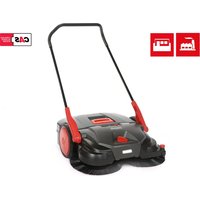
DuroSweep 77 Pro 18V - Sweeper Starmix - Free user manual and instructions
Find the device manual for free DuroSweep 77 Pro 18V Starmix in PDF.


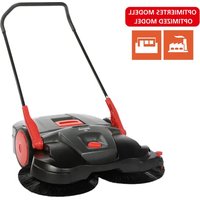
| Product type | Sweeper |
| Brand | Starmix |
| Model | DuroSweep 77 Pro 18V |
| Sweeping width | 770 mm |
| Sweeping capacity | 3 600 m²/h |
| Waste container capacity | 40 L |
| Weight (without battery) | 16 kg |
| Power supply | Lithium-ion battery 18 V (not included) |
| Approximate runtime | 120 min (with 5.2 Ah battery) |
| Sound pressure level | 64 dB(A) |
| Sound power level | 80 dB(A) |
| Operating temperature range | -10 °C to 40 °C |
| Brush height adjustment | 6 levels (1-6) |
| Selectable rotation speeds | 4 positions (1 slow to 4 fast) |
| Manual operation | Yes (without electrical power) |
| Overload protection | Yes (with LED indicator) |
| LED display | Charge indicator and warnings |
| Dust filter | 2 washable synthetic foam filters |
| Recommended cleaning | Damp cloth, no high-pressure cleaner |
| Safety | Emergency stop, protection against accidental start |
| Intended use | Commercial (hotels, schools, factories) |
| Delivery contents | Device, retractable roll bar, handle fittings, manual (battery not included) |
| Warranty | Legal warranty of the country of purchase |
| Manufacturer | Electrostar GmbH, Germany |
Frequently Asked Questions - DuroSweep 77 Pro 18V Starmix
User questions about DuroSweep 77 Pro 18V Starmix
0 question about this device. Answer the ones you know or ask your own.
Ask a new question about this device
Download the instructions for your Sweeper in PDF format for free! Find your manual DuroSweep 77 Pro 18V - Starmix and take your electronic device back in hand. On this page are published all the documents necessary for the use of your device. DuroSweep 77 Pro 18V by Starmix.
USER MANUAL DuroSweep 77 Pro 18V Starmix
5.2 Transportsymbole 9
5.2 Transportsymbole
Gefahrengut
natural_image
Diagram of a car interior showing steering wheel, dashboard, and seatbelt (no text or symbols)natural_image
Technical line drawing of a mechanical device with no visible text or symbolsnatural_image
Recycling symbol composed of three chasing arrows forming a triangle (no text or labels)Carsten Gresser
Head of Assurance
starmix
DuroSweep 77 Pro / DuroSweep 77 Pro 18V
Table of contents
- General 3
1.1 Address....3
1.2 Conventions....3
1.3 Symbols and labels....3
1.4 Limitation of Liability 3
1.5 Warranty....3
1.6 Copyright 4
1.7 Target group....4 - Safety......4
2.1 Intended use 4
2.2 Inappropriate use .... 4
2.3 Responsibility of the user ....5
2.4 General safety instructions....5
2.5 General safety instructions for the battery....5
2.6 Hazard notices on the device....7
2.7 Personal Safety Equipment....7 - Technical data....7
- Construction and Function 8
4.1 DuroSweep 77 Pro 18V 9
4.2 DuroSweep 77 Pro....9 - Transportation 9
5.1 Delivery 9
5.2 Transport icons 9
5.3 Delivery scope....9
5.4 Handling packaging materials 9
5.5 Storage of the sweeping machine 9
5.6 Carrying the device....10
5.7 Transporting the device in a vehicle 10 - Commissioning ....11
6.1 Fitting the handle fittings .... 11
6.2 Install sliding bracket....11
6.3 Installing the battery 12
6.4 Charging battery....12 - Operation 12
7.1 Before starting work 12
7.2 Height adjustment of the plate brooms....13
7.3 Setting the hold-down device 13
7.4 Battery operation and LED display....14
7.5 Overload protection 14
7.6 Manual operation....15
7.7 Empty sweeping container....15 - Troubleshooting 16
8.1 Fault table part 1....17
8.2 Fault table part 2....18
8.3 Troubleshooting procedure....19
DuroSweep 77 Pro / DuroSweep 77 Pro 18V
starmix
- Maintenance and cleaning.... 19
9.1 Maintenance schedule....20
9.2 Cleaning the dust filters 21
9.3 Remove blockage....21
9.4 Align bristles....21
9.5 Clean the device....21 - Decommissioning and storage 22
10.1 Disassembling the sliding bracket 22
10.2 Removing the battery....22
10.3 Storage/Safekeeping....23
10.4 Disposal 23
10.5 Service/transport....23 - REACH....24
- EU Declaration of Conformity 24
1. General
These operating instructions are a part of the sweeping machine DuroSweep 77 Pro (year of manufacture: from 2022), sweeping machine DuroSweep 77 Pro 18V (year of manufacture: from 2022) and valid exclusively for the named devices.
These operating instructions provides important information for the safe and efficient use of the machine.
A requirement for safe operation of the machine is the adherence to all of the safety and operation instructions provided.
- Read the operating instructions carefully before using the device.
- Read the safety instructions!
- Keep the operating instructions safe and accessible during the service life of the device.
• Pass the operating instructions onto any subsequent owner or user of the device.
1.1 Address
Electrostar GmbH
Hans-Zinser-Str. 1-3
73061 Ebersbach/Fils
Germany
Tel.: +49 (0)7163 9988-100
Fax: +49 (0)7163 9988-155
info@starmix.de
www.starmix.de
1.2 Conventions
To be able to work optimally with the operating instructions, please note the following explanations of the typographical conventions.
Bulleted list
- Texts shown like this are bullet points.
Work sequence
- Step 1 of the work sequence
- Step 2 of the work sequence
- Step 3 of the work sequence
The sequence of the work steps must be observed.
Tip
» Tips and instructions (not machine damage) are shown like this.
1.3 Symbols and labels
All warnings and safety instructions must be complied with! Always take care during operation in order to avoid accidents, personal injury and damage to property.
Safety instructions

SIGNAL WORD
Type and source of hazard
Possible consequences
• Measures for avoiding danger
Risk level
| Risk level Probability | Consequences in the event of noncompliance |
| of occurrence |

DANGER

WARNING
Direct Death, serious injury
Possible Death, serious injury

CAUTION
Possible
Slight injury
NOTE Possible material damage
1.4 Limitation of Liability
Electrostar GmbH does not accept any liability for damage and consequential damage caused by the following points:
- Failure to observe the operating instructions
- Use of nonapproved replacement parts / wrong spare parts / spare parts that do not correspond to the manufacturer's specification
- Unauthorized changes, additions to and modifications to the device
1.5 Warranty
The respective legal regulations of the country in which the device was purchased apply. Please contact your dealer or the nearest authorised customer service centre with proof of purchase.
1.6 Copyright
The operating instructions are copyright protected for Electrostar GmbH.
The operating instructions include instructions and drawings or drawing sections of a technical nature, which may not be reproduced in their entirety or in part, distributed or used for competition purposes or otherwise communicated.
Electrostar GmbH reserves all rights for the provision of permission for use for publication or distribution of copies or information from these operating instructions to third parties.
In case of infringement the manufacture is entitled to make a claim for damages. Further claims are reserved.
1.7 Target group
These operating instructions are intended for the use of this sweeping machine.
2. Safety
To avoid incorrect functioning, damage and health impairments, please observe the following instructions!
2.1 Intended use
The sweeping machines DuroSweep 77 pro and DuroSweep 77 pro 18 V are intended exclusively for the removal of road pollution such as foliage, grass, split, sand and similar impurities on flat and hard surfaces.
The device is suitable for commercial use, e.g. in hotels, schools, hospitals, factories, and offices.
2.2 Inappropriate use
Any uses other than those described in Section "Intended use" are not considered to comply with the intended purpose. The operator of the device alone is liable for any resulting damage.
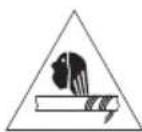
The sweeping machine may not be used for sweeping hazardous, flammable or glowing substances (cigarettes and matches) metal cuttings, liquids, explosive or hazardous dusts (ex), acids or solvents.
The sweeping machine must also not be used for sweeping water, concrete, mortar, cement and plaster dust, straw, hey and horse hairs.
The sweeping machine should also not be used for damp sweepings such as snow, manure, cow dung and sludge like e.g faeces.
The sweeping machine may not be used in areas where there is a risk of explosion or as a means of transport.
2.3 Responsibility of the user
A user is any individual or legal entity, who uses the sweeping machine or has it used by third parties and is responsible during its use for the safety of the user or third parties.
- Supervise children who are in the working environment, to ensure that they do not play with it.
- Minors may not work with the device. Young people over the age of 16 years who are being trained under supervision are excluded.
- Persons, whose reaction times are influenced by, e.g. drugs, alcohol or medications, may not carry out any work with the device.
- Persons who are not allowed to do strenuous work due to their health status may not work with the sweeping machine.
- Replace any signs on the sweeping machine that have become illegible.
2.4 General safety instructions
- Keep the packaging material out of reach of children. There is a risk of suffocation.
- Do not wear long hair, ties, loose clothing or jewellery including rings.
- When handling the sweeping machine, please note that there is a risk of injury from loose clothing or parts of the body being pulled into the machine.
2.5 General safety instructions for the battery

DANGER
Danger to life due to electric shock.
If the charger is handled incorrectly there is a danger of a life-endangering electric shock.
• Never use a defective or damaged charger
• Never open or dismantle the charger
- Check the charger connection lead regularly for damage. Disconnect the plug immediately if the connection lead is damaged

DANGER
Risk of death from explosion!
The charger and the sweeping machine can cause sparks, which may ignite dust or fumes. Sparks may be caused when switching the machine on and off
- The charger and the sweeping machine must never be used in an environment in which there is a danger of explosion, for example in areas where there are intl ammable liquids of fumes, gases or dust.

WARNING
Risk of injury or accident when handling the battery
If the battery is handled incorrectly, it may cause a number of different hazards. The following points must be noted
- Follow the instructions supplied with the battery and battery charger.
- Ensure that the battery is not exposed to direct sunlight, heat, open fire or electric sparks.
- Do not smoke in the immediate vicinity of the battery
- Never expose the battery to microwaves or high pressure
- Do not charge the battery at temperatures below 0°C.
- Never throw the battery into a fi re
- Never charge or use a defective, damaged or deformed battery
- Never open, damage or drop the battery
- Keep battery out of reach of children.

WARNING
Particles escaping from the battery may cause a risk of injury or accidents.
Escaping battery particles may cause irritation to skin, burns and chemical burns.
- In case of accidental contact, wash the affected body parts thoroughly with water and soap.
- If the particles enters the eyes, do not rut and rinse the eyes with plenty of water for at least 15 minutes. Then seek medical assistance
- Be careful to handle the battery with care
NOTE
If the battery and the charger are handled incorrectly or inappropriately, they may cause damage to material or devices. The following points must be noted:
- Operate the sweeping machine only with the battery specified by the manufacturer as pe Chapter "3. Technical data"
- Use only the charger the manufacturer recommends for the specified battery
- Only connect the charger to the mains frequency and mains voltage indicated on the nameplate.
- Do not remove the plug from the socket by pulling the connection lead; always remove by pulling the plug itself
- Damaged connecting leads must be disconnected by a qualified electrician
- The charger must only used in closed and dry spaces. Protect the charger from rain and moisture
- Only use the charger and battery in the temperature range values specified in Chapter "3. Technical data"
- Never connect the charger contacts to metal objects such as nails, coins or jewellery as this can cause a short-circuit. The charger may be damaged by a short-circuit
- Do not use metal containers to transport the battery
- Protect the battery from rain and moisture
- When the battery is stored for 2 or more months, it must be removed from the sweeping machine in order to prevent the battery from deep discharging. Information regarding the storage and disconnection of the battery can be found in Section "10.2 Removing the battery" of these operating instructions.
- If the battery is to be stored for 6 months or more the battery must first be fully charged in order to retain the performance of the battery. Information on charging the battery can be found in Section "6.4 Charging battery" of these operating instructions
2.6 Hazard notices on the device
The following pictograms are affi xed to the sweeping machine or to the nameplate:

CAUTION
When working on the machine, the safety instructions described in the operating instructions must be observed.

Operating instructions
Read the operating instructions carefully before using the device.
Risk of clothing or body parts being caught and jammed in the machine
During operation, troubleshooting and maintenance and cleaning, there is a risk of getting caught and of injury from rotating parts. The safety instructions described in the operating instructions must be observed in these cases.
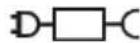
Charger and battery
To charge the battery, use only the charger approved by the manufacturer.
2.7 Personal Safety Equipment
Personal safety equipment must be worn when working to minimise health hazards. For that reason:
- Before starting all work put on each item of specified protective equipment properly and wear it during work.

Sturdy footwear
Wear sturdy footwear with well-gripping, non-slip soles.

Protective gloves
Wear protective gloves.

Dust protection mask
Wear a dust protection mask.
3. Technicaldata
Basic information on the sweeping machine DuroSweep
77 pro / 77 pro 18 V
| Technical data 77 pro 77 pro 18 V | ||
| Sweeping width in millimetres [mm] | 770 770 | |
| Sweeping capacity in square metres per hour [m2/h] | 3,000 3,600 | |
| Gross capacity of the sweeping container in litres [l] | 40 40 | |
| Weight kilogrammes [kg] 15 | 16 (without battery) | |
| Operating time at full battery power* approx. min (Li-power battery 18 V 5.2 Ah) | / 120 | |
| Maximum operating temperature | -10 °C to 40 °C | |
| Noise and vibration information (measured according to EN 60335-2-72) | measured according to EN 60745-2-6 | |
| 77 pro 77 pro 18 V** | ||
| Sound pressure level Lp (EN 60335-2-72)* | / | 64 dB (A) |
| Sound power level Lw (EN 60335-2-72)* | / | 80 dB (A) |
| Uncertainty for given sound level (2006/42/EG) | / | 2.5 dB (A) |
*Calculated at the highest notational rotation speed in an ambient temperature of 20
a C / depending on floor surface.
**Measured for the device with Li-power battery 18 V 5.2 Ah
Technical data / Construction DuroSweep 77 Pro / and Function DuroSweep 77 Pro 18V
starmix
EN
| Vibration information(measured according toEN 60335-2-72) | 77 pro 77 pro 18 V |
| Left handle, ah | / < 2.5 m/s2 |
| Right handle, ah | |
| Uncertainty (K)(RL 2006/42/EG) | / 2.0 m/s2 |
| Battery 77 pro 18 V | |
| Voltage [V] 18 | |
| Power and weight depend on the battery used. For further information, please refer to the manufacturer documentation of the battery. | |
| Maximum temperature range | |
| Operation from -10 | °C to 40 °C |
| Charging* from 5 | °C to +40 °C |
| Storage from -10 | °C to 40 °C |
*Also observe the information in the charger manufacturer's instructions.
- Construction and Function
| Item no. | Component |
| 1 | Sliding bracket |
| 2 | Sweeping container |
| 3 | Container handle |
| 4 | Plate brooms height adjustment |
| 5 | Carrying handle |
| 6 | Plate brooms |
| 7 | Lateral guide roller |
| 8 | Hold-down device |
| 9 | Impeller |
| 10 | Handle fitting |
| 11 | Bonnet |
| 12 | Flaps |
| 13 | Speed selector switch |
| 14 | LED display |
| 15 | On/Off button |
| 16 | Fine dirt sweeping roller |
| 17 | Sweeping plate |
| 18 | Sweeper lip |
| 19 | Helical gear |
| 20 | Connection |
| 21 | Toothed sleeve |
| 22 | Dust filter |
| 23 | Nameplate |
| 24 | Battery |
| 25 | Battery support |
| 26 | Lock |
4.1 DuroSweep 77 Pro 18V
Before switching on the device, the desired rotation speed of the plate brooms is set using the speed selector switch (13). The device is then put into battery mode by pressing the on/off button (15). The display (14) shows the residual capacity of the battery. The rotation speed of the plate brooms can then be readjusted with the speed selector switch (13) (0 -> speed 0).
For sweeping, the device is moved forward by pushing, via the sliding bracket (1). This causes both plate brooms (6) to convey the sweepings in the direction of the sweeping container (2) with the aid of the sweeper lip (18).
The fi ne dirt sweeping roller (16) conveys the rest of the sweepings into the sweeping container (2). Power is supplied by the inserted battery (24), which must be sufficiently charged for optimal performance of the device.
» Information on charging the battery can be found in Section "6.4 Charging battery" of these operating instructions.
During battery operation the current operating status of the sweeping machine is shown on the LED display (14).
» Information on battery operation and the LED display can be found in Section “7.4 Battery operation and LED display” of these operating instructions.
When the battery charge is low, the machine may also be operated temporarily without electric power.
» Information on manual operation can be found in Section “7.6 Manual operation” of these operating instructions.
4.2 DuroSweep 77 Pro
The device is moved forward by pushing, via the sliding bracket (1). This causes both plate brooms (6) to convey the sweepings in the direction of the sweeping container (2) with the aid of the sweeper lip (18).
The fi ne dirt sweeping roller (14) conveys the rest of the sweepings into the sweeping container (2).
5. Transportation
5.1 Delivery
NOTE
Visible damage on the outer packing must be immediately confirmed on delivery by the parcel service driver. If transport damage is only noticed during unpacking, the parcel service must be notified in writing within 24 hours after delivery so that it can be liable for the damage.
5.2 Transport icons
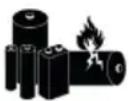
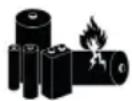
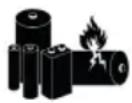
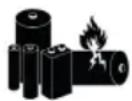
Hazardous materials
Cargo containing lithium ion batteries / rechargeable batteries (UN 3481).
5.3 Delivery scope
- Device
- Sliding bracket
- Two handle fittings (pre-mounted)
- Operating instructions
» The lithium-ion battery (18V) is not included in the delivery scope.
5.4 Handling packaging materials
• Always dispose of packing in an environmentally responsible manner.
- Observe the local and regional legal provisions in force.
5.5 Storage of the sweeping machine
NOTE
Damage to the sweeping machine can be caused by improper storage of the device, e.g. in a damp environment or with an insufficient charged battery. Information regarding the storage and safekeeping of the machine can be found in Chapter "10. Decommissioning and storage".
» In order to save storage space, the sliding bracket can be detached from the device. Information on the removal of the sliding bracket can be found in Section “10.1 Disassembling the sliding bracket” of these operating instructions.
5.6 Carrying the device

CAUTION
Risk of injury through tipping over of the sliding bracket.
Tipping over of the sliding bracket may lead tc slight injuries, such as jamming of the fi nger o haematomas in users or other persons
- When carrying the device, hold it so that the sliding bracket cannot tip over
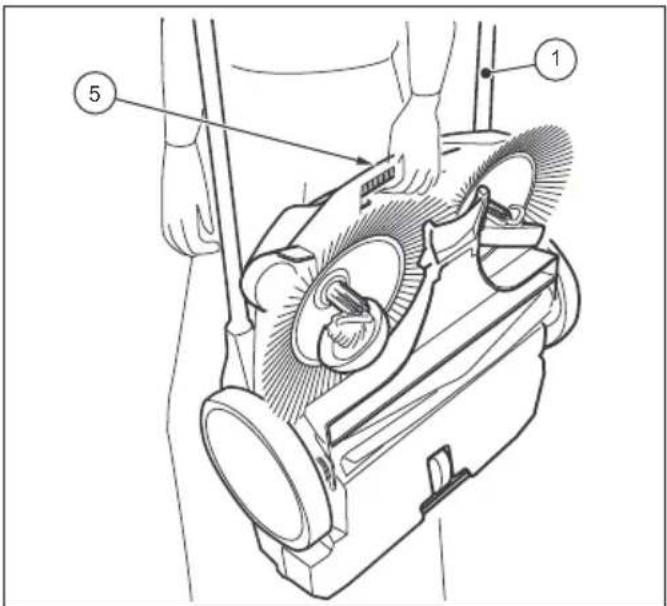
Fig. 1: Carrying the device
- Swivel the sliding bracket (1) fl at towards the front.
- Grasp the device on the carrying handle (5).
- Carry the device in such a manner that the plate brooms face away from the body.
5.7 Transporting the device in a vehicle

CAUTION
Risk of injury through improper transport of the sweeping machine.
Wandering, skidding or tipping of the device can result in injury to the driver or other persons.
- Secure the device with a lashing strap to prevent it from slipping and moving around
- Place the device in a suitable location in the vehicle.
- Secure the device with a lashing strap.
» In order to save space when transporting the device in a vehicle, the sliding bracket (1) can be removed from the device. Information on the removal of the sliding bracket can be found in Section "10.1 Disassembling the sliding bracket" of these operating instructions.
NOTE
- Improper transport can result in damage to the sweeping machine.
- In order to protect the battery, do not leave the machine in a hot vehicle
- Ensure that the device is not switched or by accident during transport. Remove the battery, if necessary. Information on the removal of the battery can be found in Section "10.2 Removing the battery" of these operating instructions.
6. Commissioning
6.1 Fitting the handle fi ttings
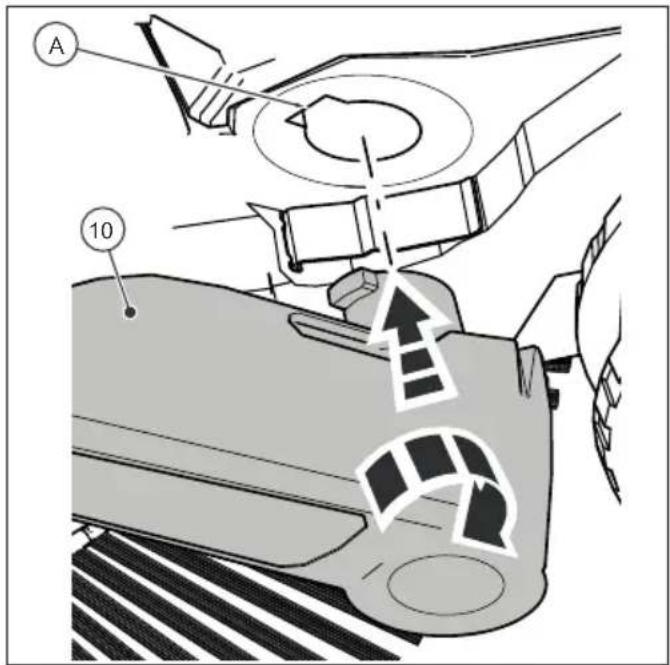
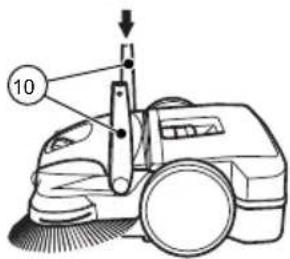
Fig. 2: Fitting the handle fi ttings
Two handle fi ttings (10) and the sliding bracket (1) are included as individual parts in the delivery.
- Position the handle fittings (10) as shown in Figure 2.
- In this position, insert the handle fittings (10) into the intended receptacle (A) of the sweeping machine up to the stop.
- Twist the handle fittings opposite to the insertion position so that they cannot be pulled out again.
6.2 Install sliding bracket

CAUTION
Risk of injury through tipping over of the sliding bracket.
Tipping over of the sliding bracket may lead to slight injuries, such as jamming of the finger or haematomas in users or other persons.
- When carrying the device, hold it so that the sliding bracket cannot tip over
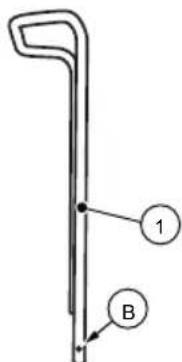
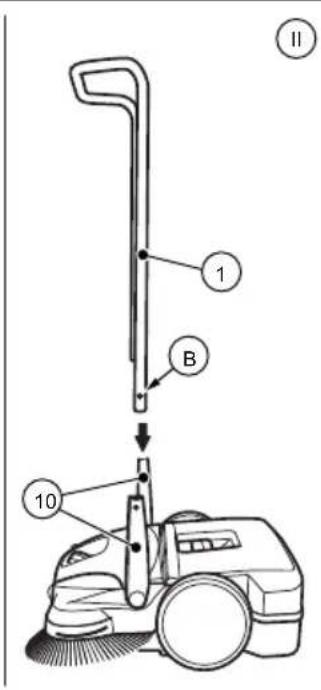
The sliding bracket (1) can be adjusted to the height of the user at two levels (I) and (II).
» (I): Lower level
» (II): Upper level
1
||
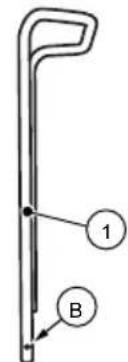
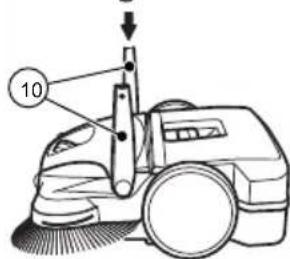
Fig. 3: Sliding bracket assembly
- Turn the handle fittings (10) into the vertical position.
-
Press the locking springs (B) inwards on both sides of the sliding bracket.
-
Push the sliding bracket (1) into both handle fi ttings (10) simultaneously.
» To do so, the sliding bracket must be pulled apart about 10 cm before being inserted in the handle fi ttings. - Push the sliding bracket (1) into the handle fi ttings (10) until the locking springs lock in.
6.3 Installing the battery
» The lithium-ion battery is not included in the delivery scope. To prevent a self-discharge of the battery, the battery should be removed if not in use for a longer period of time.
- Pull the two fl aps (12) on the front underside of the cover (11) a short distance forwards.
- Swivel the hood (11) upwards.
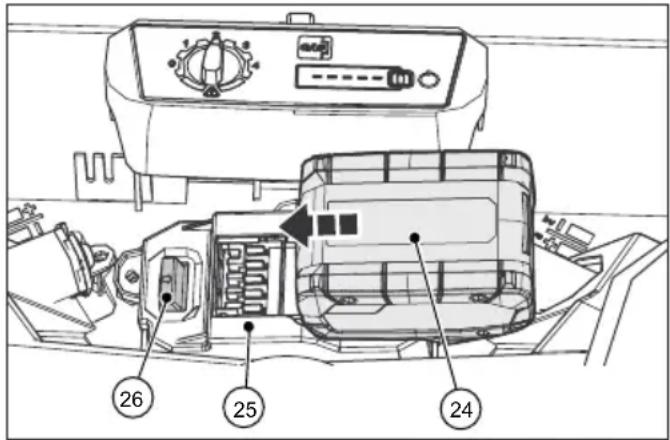
Fig. 4: Installing the battery
- Push the battery (24) onto the battery support (25) as far as it will go.
» You will hear a “click” sound when the battery locks into the lock (26). - Close the cover (11) and lock it over the flaps (12).
6.4 Chargingbattery
» It is recommended to charge the battery (24) fully before being operated for the first time.
» Refer to the battery manufacturer documentation for all information on charging the battery.
» Information on battery operation and the LED display can be found in Section “7.4 Battery operation and LED display” of these operating instructions.
7. Operation

WARNING
Risk of cutting due to broken glass, metal or other sharp edged materials.
When emptying the sweeping container, cutting injuries may occur due to broken glass, metal or other sharp edged materials.
- Wear the prescribed personal protective equipment.

CAUTION
Health impairments caused by dust resulting from sweeping.
The inhalation of dusts can endanger the health
- Wear the prescribed personal protective equipment.
7.1 Before starting work
- Check the device to make sure that it is functioning before starting work.
- Check the sliding bracket (1) for fi rm seat in the handle fi ttings (10).
- Check the sweeping container (2) for fi rm seat and good condition.
- Check the plate brooms (6) and the fi ne dirt sweeping roller (16) for branches, rolled up threads and cords, materials with long strands and the like. Remove these if necessary.
- Check the plate brooms (6) and the fi ne dirt sweeping roller (16) for jammed items or contamination.
- Check the handles for contamination and clean if necessary.
- Check whether the on/off switch (15) can be switched on at any time.
- Check whether that the battery level is sufficient for the work to be carried out.
7.2 Height adjustment of the plate brooms
NOTE
Height adjustment should be done in set-up state (see Fig. 11). This relieves the load on the inclined wheels and ensures easy adjustment
The height of the plate brooms is adjusted with a dial in the middle of the front part. The height adjustment sets the plate brooms to the surface to be swept. The levels are based on empirical values and must therefore be considered as the levels are based on empirical values and must therefore be regarded as reference values. As a result, during sweeping, adaptations of the levels may need to be made depending on the surface.
• Level 1-2: for all level, hard surfaces
(e.g. asphalt, concrete, slabs...)
• Level 3-4: for damp leaves, sand, and uneven surfaces (e.g. washed concrete slabs)
- Level 5-6: for heavy contamination and severely uneven surfaces
NOTE
Do not press the plate brooms too firmly on the ground. Excessive surface pressure leads to increased wear and shortens the battery life. Excessive surface pressure also increases pushing resistance and can have a negative effect on the cleaning result
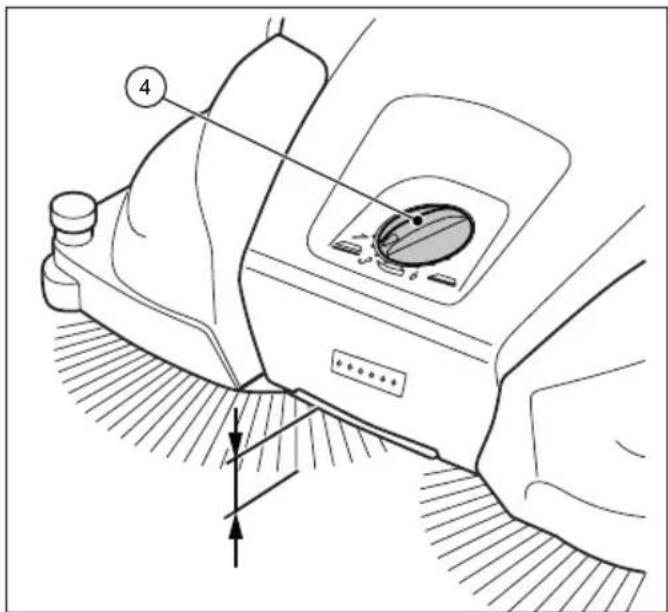
Fig. 5: Height adjustment of the plate brooms
- Set the required level:
- Turn the dial (4) to the left to lower the level.
- Turn the dial (4) to the right to increase the level.
7.3 Setting the hold-down device
The hold-down device is used to position the right plate broom on the edge regions to be swept, for example on walls or curbs. The hold-down device always assumes the correct position due to its spring action.
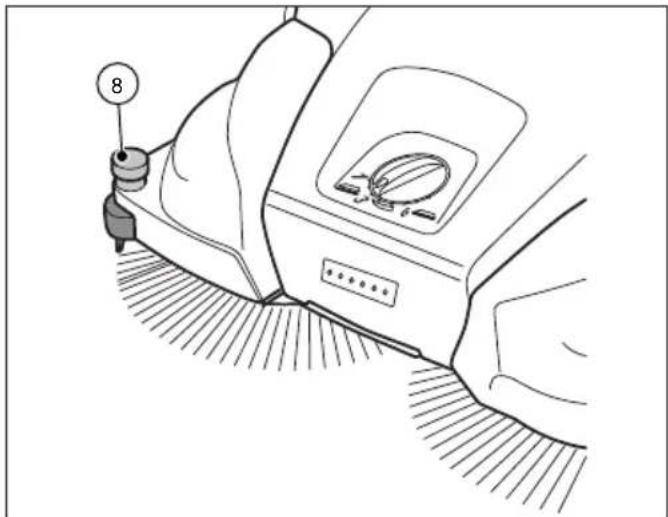
natural_image
Diagram of a car interior showing steering wheel, dashboard, and seatbelt (no text or symbols)Fig. 6: Hold-down device setting
7.4 Battery operation and LED display
The LED display (14) communicates the current operating state of the battery-operated sweeping machine.
- Place the sweeping machine on the surface to be swept.
- Use the selector switch (13) to choose the speed for the electrically driven plate brooms.
The setting is possible from position 1 (slow) for very light sweepings (e.g. polystyrene balls) to position 4 (fast) for heavy sweepings (e.g. wet leaves).
- Switch on the sweeping machine by pressing the on/off switch (15).
The plate brooms and the fi ne dirt sweeping roller begin to rotate with the selected speed. The green LED of the LED display (14) will fl ash during battery operation provided there is sufficient charge.
- Operate the device via the sliding bracket (1) using both hands.
- Push the device forward at normal walking speed.
- Switch off the sweeping machine by pressing the on/off switch (15).
- Empty the sweeping container (2) as needed. See Section "7.7 Empty sweeping container" of these operating instructions.
» Empty the sweeping container at regular intervals to achieve a satisfactory sweeping result.
NOTE
- If the plate brooms are rotating more slowly or if the last green LED on the LED display (14) fl ashes during operation, this means that the battery charge is low. Switch off the machine and charge the battery
-
When the battery charge is too low, the machine will be switched off automatically by the electronic system installed. The green LED of the LED display (14) will flash hereby Switch off the machine and charge the battery. The guarantee is void if the battery is allowed to deep discharge.
-
Clean the sweeping machine and dust filter after operation. See Section "9.5 Clean the device" of these operating instructions.
-
Fully charge the battery again as needed. See Section "6.4 Charging battery" of these operating instructions.
7.5 Overloadprotection
In order to avoid damage from overload, the motors are fitted with overload protection. If the electronics of the sweeping machine switch themselves off after a short time, this means that the motors are being overloaded. Block the fine dirt sweeping roller and the plate brooms. In this case, the warning triangle in the battery display lights up.
- Switch the electronics of the sweeping machine off and then on again with the on/off switch (15) after the overload protection has been triggered. This unblocks the machine.
If the fi ne dirt sweeping roller and the plate brooms continues to be blocked, check both for ease of movement and remove any blockages, such as stones, rolls of thread and similar items.
- Switch off the electronics of the sweeping machine by pressing the on/off switch (15).

CAUTION
Risk of injury from unintentional starting of the sweeping machine.
When working on the sweeping machine, there is a draw-in hazard due to accidental start-up of the device.
-
Ensure that the device is not switched on by accident when the block is being dealt with. Set the speed selector switch to position "0". Remove the battery. Information on the connection of the battery can be found in Section "10.2 Removing the battery" of these operating instructions.
-
Locate and remove the blockage. See Section "9.3 Remove blockage" of these operating instructions.
- Switch on the sweeping machine again by pressing the on/off switch (15).
- Check whether the device is working again as usual. If the warning light stays red, contact our customer service.
7.6 Manualoperation
When the battery is low, the sweeping machine can be used temporarily without a power supply. The sweeping mechanism is activated by pushing the machine forward.
- Operate the device via the sliding bracket (1) using both hands.
- Push the device forward at walking speed.
- Empty the sweeping container (2) as needed. See Section "7.7 Empty sweeping container" of these operating instructions.
- Fully charge the battery (24) again as needed. See Section "6.4 Charging battery" of these operating instructions.
» Only use manual operation temporarily. Results are better under battery operation and use a very small amount of power.
7.7 Empty sweeping container

WARNING
Risk of cutting due to broken glass, metal or other sharp edged materials.
When emptying the sweeping container, cutting injuries may occur due to broken glass, metal or other sharp edged materials
- Wear the prescribed personal protective equipment.

CAUTION
Draw-in hazard on the rotating roller
When emptying the sweepings container there is a draw-in hazard from the rotating sweeping roller.
- Wear the prescribed personal protective equipment.

CAUTION
Health risk from swept up dust.
There is a risk to health from dust collected when the sweeping container is emptied.
- Wear the prescribed personal protective equipment.
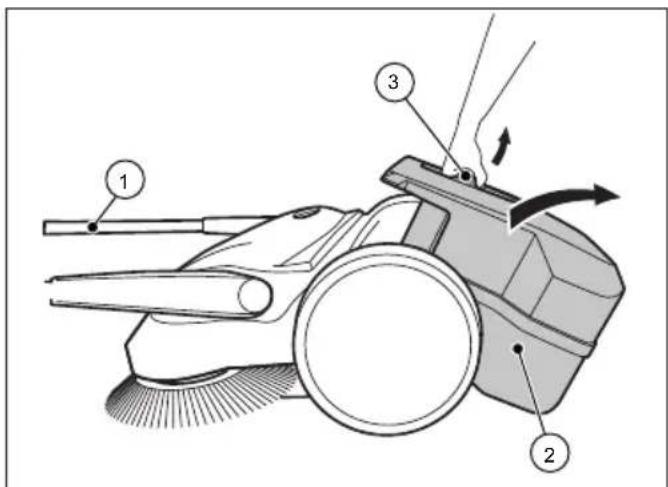
Fig. 7: Empty the sweeping container
• Empty the sweeping container (2) after each use.
• Empty the sweeping container (2) at regular intervals to achieve a proper sweeping result.
1. Bring the sliding bracket (1) to the forward position or into the latching position (sliding bracket vertical).
2. Pull the sweeping container (2) upwards by the container handle (2).
3. Empty the sweeping container (2) completely.
» Make sure that the enclosure sides are free of dirt.
4. Insert the empty sweeping container (2) on the device.
5. Press the container handle (3) back into the starting position.
» The sweeping container (2) must audibly lock into position.
6. Bring the sliding bracket (1) back into the operating position.
8. Troubleshooting

WARNING
Risk of cutting due to broken glass, metal or other sharp edged materials.
When emptying the sweeping container, cutting injuries may occur due to broken glass, metal or other sharp edged materials
- Wear the prescribed personal protective equipment.

CAUTION
Health impairments caused by dust resulting from sweeping.
The inhalation of dusts can endanger the health
- Wear the prescribed personal protective equipment.

CAUTION
Risk of injury through tipping over of the sliding bracket.
Tipping over of the sliding bracket may lead to slight injuries, such as jamming of the finger o haematomas in users or other persons
- When carrying the device, hold it so that the sliding bracket cannot tip over

CAUTION
Risk of injury from unintentional starting of the sweeping machine.
When working on the sweeping machine, there is a draw-in hazard due to accidental start-up of the device.
- Ensure that the device is not switched on by accident while the fault is being dealt with. Set the speed selector switch to position "0". Remove the battery. Information on the connection of the battery can be found in Section "10.2 Removing the battery" of these operating instructions.
Malfunctions may occur even if the prescribed maintenance work and checks of the device before use are complied with. Possible malfunctions are listed in the tables 1 and 2 below with specification of the cause and remedy.
8.1 Fault table part 1
| Fault Cause Remedy | ||
| Device is running with difficulty or roughly | Device is contaminated | For cleaning the sweeping machine, see Section “9.5 Clean the device”. |
| Broom blocked | For removing blockages, see Section “9.3 Remove blockage”. | |
| Contaminated broom drives | For cleaning broom drives, see Section “9.5 Clean the device”. | |
| Height adjustment set too low | For height adjustment, see Section “7.2 Height adjustment of the plate brooms”. | |
| Plate broom surface pressure too high | ||
| Battery charge too low. The last LED of the LED display flashes “green”. | For charging the battery, see Section “6.4 Charging battery”. | |
| Plate brooms do not rotate | Contact Service | |
| Fine dirt sweeping roller does not rotate | ||
| The device is switched off | Plate broom surface pressure too high | For height adjustment, see Section “7.2 Height adjustment of the plate brooms”. |
| Broom blocked, warning triangle in battery display lights up | For cleaning the sweeping machine, see Section “9.5 Clean the device”. | |
| Overload protection active | For removing blockages, see Section “7.5 Overload protection”. | |
| Battery charge too low. The last LED of the LED display on the sweeping machine flashes “green”. Device switched off electronically | For charging the battery, see Section “6.4 Charging battery”. | |
| Device can no longer be switched on | Disconnected battery | For checking the battery fit, see Section “6.3 Installing the battery”. |
| Battery empty | For charging the battery, see Section “6.4 Charging battery”. | |
| Bristles are bent Improper storage | For aligning the bristles, see Section “9.4 Align bristles”. |
8.2 Fault table part 2
| Fault Cause Remedy | ||
| Sweeping result is insufficient | Sweeper lip is missing, loose or worn Replace sweeper lip | |
| Plate broom surface pressure too high | For height adjustment, see Section “7.2 Height adjustment of the plate brooms”. | |
| Heavy wear and tear of plate brooms | Exchange plate brooms | |
| Sweeping container is full | For emptying the sweeping container, see Section “7.7 Empty sweeping container”. | |
| Inappropriate use of sweeping machine according to the information in Section “2.2 Inappropriate use”. | Use suitable cleaning device or cleaning agent. | |
| Lateral ejection of sweepings. Cleaning the sweeping plate (17). | ||
8.3 Troubleshooting procedure

CAUTION
Risk of injury from unintentional starting of the sweeping machine.
After troubleshooting the sweeping machine, there is a draw-in hazard due to accidental start-up of the device
- Before installing the battery, make sure that the device is switched off
- Switch off the device by pressing the on/off switch (15).
- If necessary, remove the battery (24) from the device. For information on removing the battery, see Section "10.2 Removing the battery".
- Correct the fault as described in the fault table.
- Reinsert the battery (24) into the device. For information on removing the battery, see Section "6.3 Installing the battery".
- Switch on the sweeping machine by pressing the on/off switch (15). Check whether the device is working again as usual.
9. Maintenance and cleaning

WARNING
Risk of cutting due to broken glass, metal or other sharp edged materials.
When emptying the sweeping container, cutting injuries may occur due to broken glass, metal or other sharp edged materials.
- Wear the prescribed personal protective equipment.

CAUTION
Health impairments caused by dust resulting from sweeping.
The inhalation of dusts can endanger the health
- Wear the prescribed personal protective equipment.

CAUTION
Risk of injury through tipping over of the sliding bracket.
Tipping over of the sliding bracket may lead to slight injuries, such as jamming of the finger or haematomas in users or other persons.
- When carrying the device, hold it so that the sliding bracket cannot tip over

CAUTION
Hazard due to cleaning materials!
The agents can contain harmful ingredients and can thereby cause irritation of the respiratory tract and the skin.
- Observe the manufacturer's safety data sheet.
- Avoid spillage and the formation of fog.
• Do not eat, drink or smoke while working. - Avoid contact with skin and eyes.

CAUTION
Risk of injury from unintentional starting of the sweeping machine.
During maintenance and cleaning of the sweeping machine there is a draw-in hazard due to accidental start-up of the device.
- The device must be switched off during all works.
- Never erform any work on the machine while the engine is running.
- Ensure that the device is not switched on by accident while maintenance and cleaning work is being carried out. To do this, remove the battery from the device. See Section "10.2 Removing the battery" of these operating instructions.
NOTE
Improper maintenance can lead to damage or a shortening of the service life of the sweeping machine
NOTE
Users of this device may carry out maintenance and care work only as described in these instructions for use. Only specialist dealers may carry out further repairs.
Use only original Electrostar spare parts for repairs. Otherwise there may be a risk of accidents or damage to the device
In the following sections the maintenance and cleaning work required for optimal and fault-free operation is described.
The conduct of the specified work depends in some cases on time and/or load. For the maintenance interval information shown both in deadlines and operating hours (oh), the one that occurs first applies.
In case of questions on the maintenance work and intervals contact the manufacturer.
9.1 Maintenance schedule
| Maintenance interval | Maintenance work |
| Before starting work | Check the device to make sure that it is functioning before starting work. If necessary, contact the Service. |
| Check the sliding bracket for fi rm seat in the handle fi ttings. | |
| Check the sweeping container to make sure it is fi rmly seated and in good condition. | |
| Check the plate brooms and the fi ne dirt sweeping roller for rolled up threads and cords. Remove them, if necessary. | |
| Check the plate brooms and the fi ne dirt sweeping roller for jammed items or contamination. | |
| Check the handles for contamination and clean them, if necessary. | |
| Check that the height is adjusted correctly. | |
| Check the sweeping pressure setting. Adapt the sweeping pressure to the surface to be swept, if necessary. | |
| Check wether the device can be switched on. | |
| Check the charge on the battery is suffi cient for the sweeping work planned. Charge the battery, if necessary. | |
| After fi nishing work | Empty the sweeping container. |
| Clean the device. | |
| Clean the dust fi lter. | |
| Charge the battery. | |
| 8 Bh Clean the broom drives. | |
9.2 Cleaning the dust fi Iters
- Remove the sweeping container (2) from the sweeping machine. See Section "7.7 Empty sweeping container" of these operating instructions.
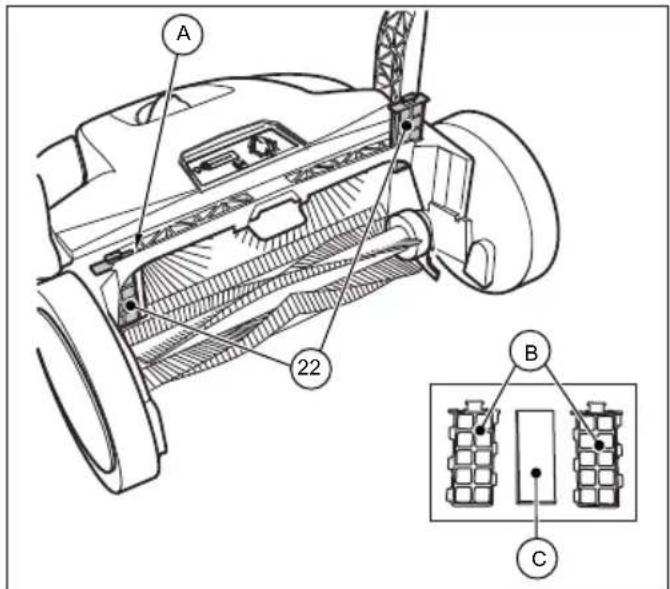
Fig. 8: Dust fi Iter removal
- Pull both dust filters (22) up from the guides (A).
- Open the plastic housing (B) of the dust filters and remove the foam insert (C).
- Pound out the foam insert (C) and clean it with water.
- Insert the dry foam insert back into the plastic housing.
- Slide the dust fi Iters (22) back into the guides.
- Insert the sweeping container (2) into the sweeping machine.
9.3 Removeblockage
- Remove wound-up material (e.g. cords, threads, long-threaded fi bres.) from the brooms and axles.
- Remove jammed material (e.g. stones, twigs, leaves etc.).
9.4 Alignbristles

WARNING
Fire hazard due to improper handling of a fan or the use of an unsuitable fan!
When aligning the bristles, there is a risk of fire if they are heated to too high temperatures.
- Do not use open flames or furnace to heat the bristles!
- Do not use a hot air blower. If the air is too hot, the bristles may melt
Bent bristles can be straightened out again with heating by means of a warm air fan (e.g. hairdryer).
- Point the switched-on hot air fan towards the bent bristles.
» If the heating is sufficient, the bristles will straighten out again by themselves.
9.5 Clean the device
- Do not use a degreasing agent.
- Do not use any aggressive cleaning agents.
- Do not clean the device with a high-pressure cleaner or under running water. The device may neither be immersed in water nor cleaned with water.
- Protect the bearings against moisture.
-
Do not clean the plate brooms and the fi ne dirt sweeping roll with compressed air.
» The strong air jet can damage the bristles. -
Clean the plate brooms, the fi ne dirt sweeping roll and the drives with a wet cloth.
-
Clean all plastic parts with a damp cloth.
» Keep the battery clean as a dirty battery can lead to battery leakage via the terminals over time.
- Clean the dust fi Iters (see Section "9.2 Cleaning the dust fi Iters" of these operating instructions)
10. Decommissioning and storage
10.1 Disassembling the sliding bracket

CAUTION
Risk of injury through tipping over of the sliding bracket.
Tipping over of the sliding bracket may lead to slight injuries, such as jamming of the finger o haematomas in users or other persons
- When carrying the device, hold it so that the sliding bracket cannot tip over
» In order to save storage space, the sliding bracket (1) can be detached from the device.
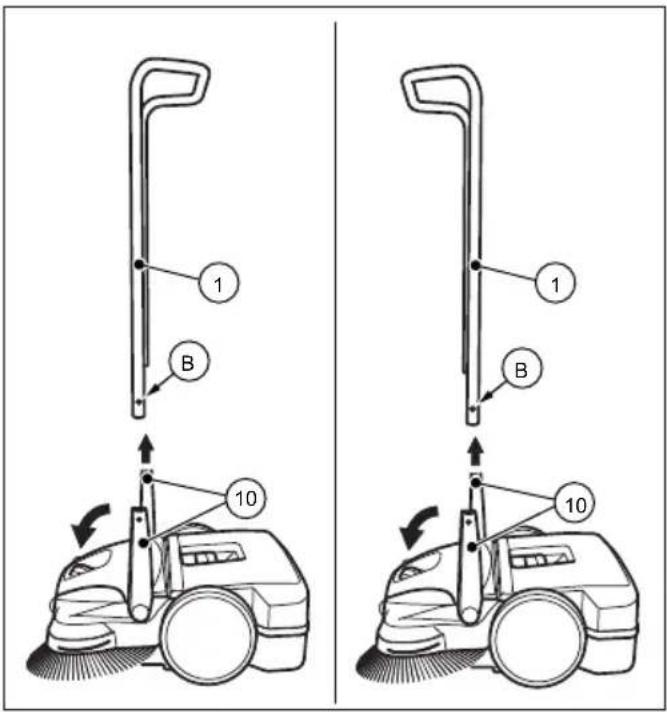
Fig. 9: Sliding bracket assembly
- Bring the sliding bracket (1) into the vertical position.
- Press the locking springs (B) inwards on both sides of the sliding bracket (1).
- Pull the sliding bracket (1) out of both handle fittings (10) simultaneously.
- Turn the handle fittings (10) so that they are close to the housing.
10.2 Removing the battery
In addition, if necessary, the battery should be removed during fault correction and removal of blockages. This serves as protection from accidental starting of sweeping machine.
» Keep the battery clean as a dirty battery can lead to battery leakage via the terminals over time.
- Pull the two fl aps (12) on the front underside of the cover (11) a short distance forwards.
- Swivel the hood (11) upwards.
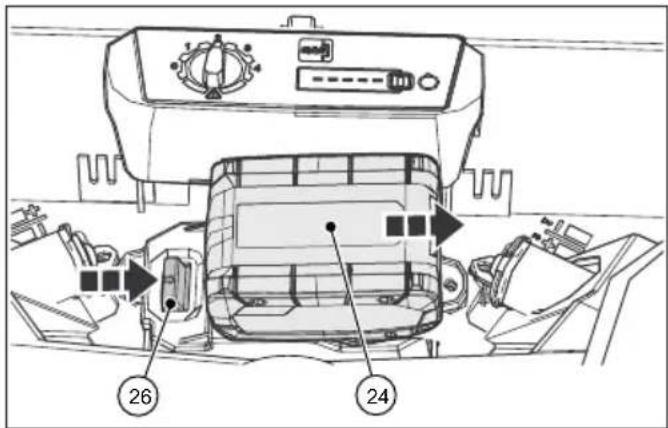
Fig. 10: Removing the battery
- Push the lock (26) in the direction of the battery (24).
- Pull the battery (24) off the battery support (25) in the indicated direction.
- Close the cover (11) and lock it over the fl aps (12).
10.3 Storage/Safekeeping
NOTE
Improper storage, e.g. storage of the device in a humid environment, can lead to damage to the sweeping machine.
» Note the information contained in Section "10.2 Removing the battery" of these operating instructions.
- Store the device only in cleaned condition and with an emptied sweeping container (2).
» Information on emptying the sweeping container (2) can be found in Section "7.7 Empty sweeping container" and those on cleaning in Section "9.5 Clean the device" of these operating instructions.
natural_image
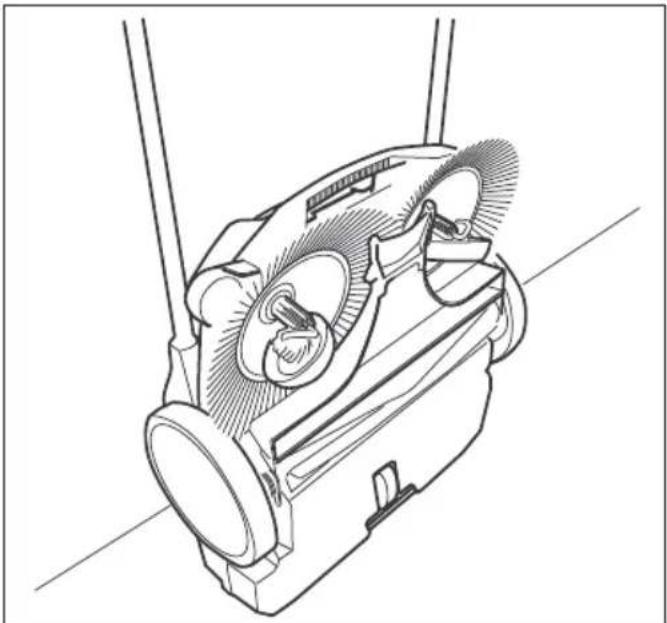
Technical line drawing of a mechanical device with no visible text or symbolsFig. 11: Storage position
- Place the device in such a way that the bristles cannot be kinked or bent.
- Secure the device including sliding brackets against tipping over, slipping and thus against damage.
- Do not store the device outdoors or in damp environments.
10.4 Disposal
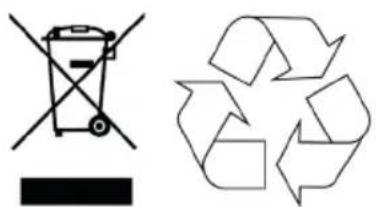
- Dispose of the sweeping machine, the charger and the battery in an environmentally friendly manner in accordance with the applicable regional regulations.
- Dispose of the device and the battery separately.
- Do not dispose of the device in household waste.
10.5 Service/transport
The shipping of Li-Ion batteries is subject to dangerous goods legislation (UN3480 and UN3481) and special regulations apply. Clarify the currently valid regulations in your country.
In case of service, these must not be sent together with the device. Also, do not send individual batteries either; these stay at your premises.
Contact the sales outlet where you purchased the device or the service workshop responsible for your country in advance and clarify the details of handling the service case directly.
11. REACH
REACH is the European Chemical Directive for the Registration, Evaluation, Authorisation and Restriction of Chemical substances.
EN
Information regarding compliance with REACH directive (EU) no. 1907/2006 can be found on www.haaga-gmbh.de
12. EU Declaration of Conformity EU Declaration of Conformity in accordance with Machinery Directive 2006/42/EC Annex II 1A
Manufacturer:
Electrostar GmbH
Hans-Zinser-Str. 1-3
73061 Ebersbach/Fils
Germany
Authorised for the preparation of technical documents:
Electrostar GmbH
Hans-Zinser-Str. 1-3
73061 Ebersbach/Fils
Germany
Product:
Battery-powered sweeping machine
DuroSweep 77 Pro 18V
We hereby declare that the above-mentioned product complies with the provisions of Machinery Directive 2006/42/EU. The above-mentioned product complies with the demands of the relevant directives:
• EMC Directive 2014/30/EU
• RoHS Directive 2011/65/EU
The following harmonised standards were applied:
• EN ISO 12100:2010, Safety of machinery, general principles for design, risk assessment and risk reduction
- EN 60335-1:2012/A15:2021, Household and similar electrical appliances – Safety – Part 1: General requirements
- EN 60335-2-72:2012, Safety of electric devices for use at home and similar purposes – Part 2-72: Particular requirements for floor treatment machines, with or without traction drive, for commercial use
- EN IEC 55014-1:2021, Electromagnetic compatibility – Requirements for household appliances, electric tools and similar apparatus – Part 1: Interference emission (CISPR 14-1:2020)
- EN IEC 55014-2:2021, Electromagnetic compatibility – Requirements for household appliances, electric tools and similar apparatus – Part 2: Immunity – Product family standard (IEC/CISPR 14-2:2020)
- EN 62233:2008-04, Measurement methods for electromagnetic fields of household appliances and similar apparatus with regard to human exposure.
- EN IEC 63000:2018, Technical documentation for the assessment of electrical and electronic products with respect to the restriction of hazardous substances.
Ebersbach, 09/06/2023
Carsten Gresser
Head of Assurance
starmix
DuroSweep 77 Pro / DuroSweep 77 Pro 18V
Table des matières
natural_image
Diagram of a car interior showing steering wheel, dashboard, and seat area with no text or symbols10.3 Stockage / conservation
INDICATION
natural_image
Technical line drawing of a mechanical device with no visible text or symbols10.5 Service/Transport
Carsten Gresser
Head of Assurance
starmix
DuroSweep 77 Pro / DuroSweep 77 Pro 18V
Índice de contenido
natural_image
Diagram of a car interior showing steering wheel, dashboard, and seatbelt (no text or symbols)Fig. 6: Ajuste del pisador
natural_image
Technical line drawing of a mechanical device with no visible text or symbolsnatural_image
Two symbols: a crossed-out trash bin and a recycling symbol (no text or labels)Fig. 4: Montar a bateria
natural_image
Diagram of a car interior showing dashboard and seat area with no visible text or symbolsFig. 6: Ajuste do fi xador
Fig. 7: Esvaziar o recipiente de material varrido
9.4 Alinhar as cerdas

AVISO
Fig. 10: Retirar a bateria
natural_image
Technical line drawing of a mechanical device with no visible text or symbolsnatural_image
Two symbols: a crossed-out trash bin and a recycling cycle, both without any text or labels.natural_image
Diagram of a car interior showing steering wheel, dashboard, and seatbelt (no text or symbols)natural_image
Technical line drawing of a mechanical device with no visible text or symbolsHead of Assurance
starmix
DuroSweep 77 Pro / DuroSweep 77 Pro 18 V
Inhoudsopgave
5.2 Transportsymbolen
Afb. 4: Accu monteren
natural_image
Diagram of a car interior showing dashboard and seat area with no visible text or symbolsAfb. 9: Duwbeugelmontage
natural_image
Technical line drawing of a mechanical device with no visible text or symbols10.5 Service/transport
5.2 Transportsymboler
Farligt gods
Abb. 1: Bær enheden
natural_image
Diagram of a car interior showing steering wheel, dashboard, and seatbelt (no text or symbols)Abb. 6: Nedholder indstilling
Abb. 7: Aff aldsbeholderen tømme
Abb. 10: Akku'en tages ud
natural_image
Technical line drawing of a mechanical device with no visible text or symbolsAbb. 11: Opbevaringsposition
10.5 Service/transport
5.2 Transportsymboler
Farligt gods
natural_image
Diagram of a car interior showing steering wheel, dashboard, and seat area with no visible text or symbolsnatural_image
Technical line drawing of a mechanical device with gears and shafts (no text or symbols)Försäkringschef
starmix
DuroSweep 77 Pro / DuroSweep 77 Pro 18V
Innholdsfortegnelse
5.2 Transportsymboler
Farlig gods
Varene som skal transporteres inneholder litium-ion-batterier/oppladbare batterier (UN 3481).
5.3 Leveransens omfang
Abb. 4: Sett inn batteri
natural_image
Diagram of a car interior showing steering wheel, dashboard, and seatbelt (no text or symbols)Abb. 10: Ta ut batteri
natural_image
Technical line drawing of a mechanical device with no visible text or symbols10.5 Service/transport
natural_image
Diagram of a car interior showing seatbelt, dashboard, and steering wheel (no text or symbols)natural_image
Technical line drawing of a mechanical device with no visible text or symbols10.5 Huolto/kuljetus
Varmennuspäällikkö
starmix
DuroSweep 77 Pro / DuroSweep 77 Pro 18V
İçindekiler
natural_image
Diagram of a car interior showing seatbelt, dashboard, and steering wheel (no text or symbols)natural_image
Technical line drawing of a mechanical device with gears and shafts (no text or symbols)10.5 Servis/Taşıma
Carsten Gresser
Güvence Müdürü
starmix
DuroSweep 77 Pro / DuroSweep 77 Pro 18V
Spis treści
natural_image
Diagram of a car interior showing seatbelt, dashboard, and steering wheel (no text or symbols)natural_image
Technical line drawing of a mechanical device with no visible text or symbols10.5 Serwis/transport
Carsten Gresser
Head of Assurance
starmix
DuroSweep 77 Pro / DuroSweep 77 Pro 18V
Obsah
Obr. 4: Instalace baterie
natural_image
Diagram of a car interior showing seatbelt, dashboard, and steering wheel (no text or symbols)Obr. 10: Vyjmutí baterie
natural_image
Technical line drawing of a mechanical device with no visible text or symbolsObr. 11: Skladovací poloha
natural_image
Recycling symbol composed of three chasing arrows forming a triangle (no text or labels)natural_image
Diagram of a car interior showing a seatbelt, dashboard, and fan (no text or symbols)natural_image
Technical line drawing of a mechanical device with no visible text or symbolsnatural_image
Two symbols: a left-pointing trash can with no crossed lines and a right-angled recycling symbol (no text or labels)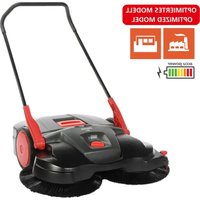
- Transportsymbole
- Gefahrengut
- starmix
- DuroSweep 77 Pro / DuroSweep 77 Pro 18V
- Table of contents
- General
- Address
- Conventions
- Bulleted list
- Work sequence
- Tip
- Symbols and labels
- Safety instructions
- SIGNAL WORD
- Type and source of hazard
- Risk level
- DANGER
- WARNING
- CAUTION
- Limitation of Liability
- Warranty
- Copyright
- Target group
- Safety
- Intended use
- Inappropriate use
- Responsibility of the user
- General safety instructions
- General safety instructions for the battery
- Danger to life due to electric shock.
- Risk of death from explosion!
- Risk of injury or accident when handling the battery
- Particles escaping from the battery may cause a risk of injury or accidents.
- NOTE
- Hazard notices on the device
- Operating instructions
- Risk of clothing or body parts being caught and jammed in the machine
- Charger and battery
- Personal Safety Equipment
- Sturdy footwear
- Protective gloves
- Dust protection mask
- Technicaldata
- Basic information on the sweeping machine DuroSweep
- Technical data / Construction DuroSweep 77 Pro / and Function DuroSweep 77 Pro 18V
- DuroSweep 77 Pro 18V
- DuroSweep 77 Pro
- Transportation
- Delivery
- Transport icons
- Hazardous materials
- Delivery scope
- Handling packaging materials
- Storage of the sweeping machine
- Carrying the device
- Risk of injury through tipping over of the sliding bracket.
- Transporting the device in a vehicle
- Risk of injury through improper transport of the sweeping machine.
- Commissioning
- Fitting the handle fi ttings
- Install sliding bracket
- Installing the battery
- Chargingbattery
- Operation
- Before starting work
- Height adjustment of the plate brooms
- Setting the hold-down device
- Battery operation and LED display
- Overloadprotection
- Risk of injury from unintentional starting of the sweeping machine.
- Manualoperation
- Empty sweeping container
- Risk of cutting due to broken glass, metal or other sharp edged materials.
- Draw-in hazard on the rotating roller
- Health risk from swept up dust.
- Troubleshooting
- Troubleshooting procedure
- Maintenance and cleaning
- Cleaning the dust fi Iters
- Removeblockage
- Alignbristles
- Fire hazard due to improper handling of a fan or the use of an unsuitable fan!
- Clean the device
- Decommissioning and storage
- Disassembling the sliding bracket
- Removing the battery
- Storage/Safekeeping
- Disposal
- Service/transport
- REACH
- EU Declaration of Conformity EU Declaration of Conformity in accordance with Machinery Directive 2006/42/EC Annex II 1A
- Manufacturer:
- Authorised for the preparation of technical documents:
- Product:
- The following harmonised standards were applied:
- Table des matières
- Stockage / conservation
- INDICATION
- Índice de contenido
- Alinhar as cerdas
- AVISO
- DuroSweep 77 Pro / DuroSweep 77 Pro 18 V
- Inhoudsopgave
- Transportsymbolen
- Afb. 4: Accu monteren
- Transportsymboler
- Farligt gods
- Abb. 1: Bær enheden
- Abb. 7: Aff aldsbeholderen tømme
- Abb. 11: Opbevaringsposition
- Innholdsfortegnelse
- Farlig gods
- Leveransens omfang
- Huolto/kuljetus
- İçindekiler
- Servis/Taşıma
- Spis treści
- Serwis/transport
- Obsah
- Obr. 11: Skladovací poloha
Brand : Starmix
Model : DuroSweep 77 Pro 18V
Category : Sweeper