801018 - Yogurt maker Browin - Free user manual and instructions
Find the device manual for free 801018 Browin in PDF.


User questions about 801018 Browin
0 question about this device. Answer the ones you know or ask your own.
Ask a new question about this device
Download the instructions for your Yogurt maker in PDF format for free! Find your manual 801018 - Browin and take your electronic device back in hand. On this page are published all the documents necessary for the use of your device. 801018 by Browin.
USER MANUAL 801018 Browin
YOGHURT MAKER WITH THERMOSTAT
USER MANUAL FOR YOGHURT MAKER WITH THERMOSTAT
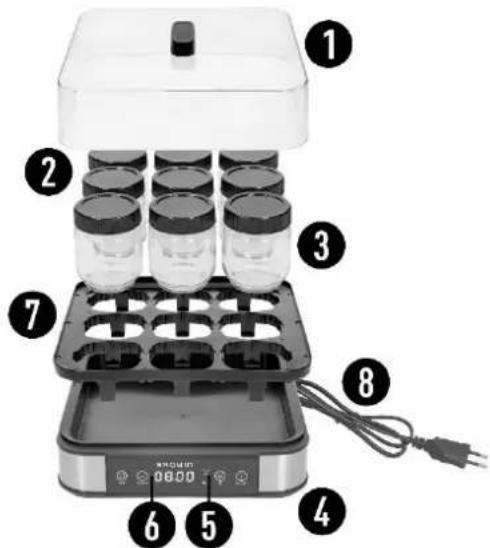
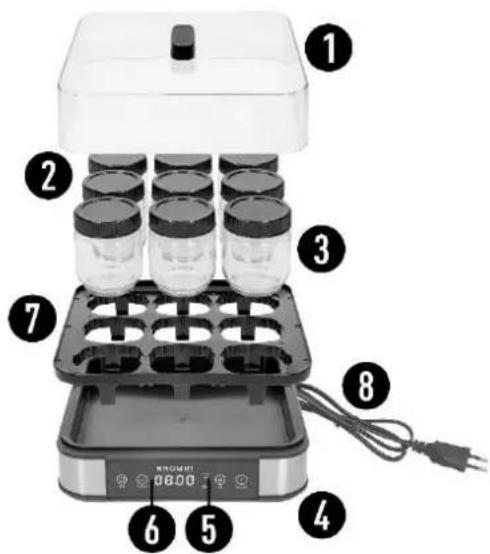
Contents of the set:
- Yoghurt maker body
- Transparent cover
Stabilising insert
9 twist-off jars with capacity of 180ml
122 cm long power cable -
User manual
-
Cover
- Plastic twist-off lid (9 pcs)
- Glass twist-off jar (9 pcs)
- Casing
- Indicator light
- LED display
- Insert for stabilising jars
- Power supply cable
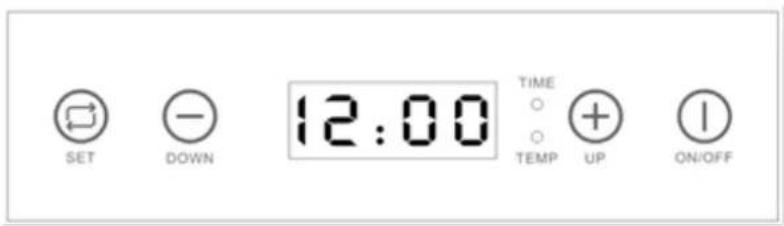
Control panel:
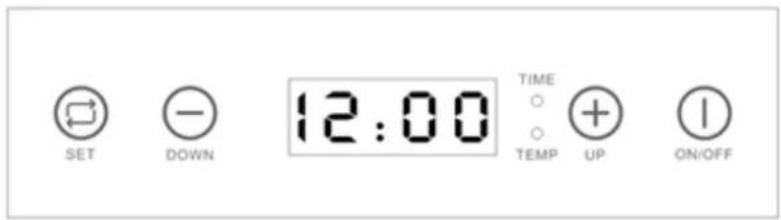
- "SET" button for changing the settings
- “+” (UP) and “-” (DOWN) adjustment buttons
- LED display: display from 0-99 h, 0-59 min, temp 25-65°C
- "ON/OFF" power switch
- "TIME, TEMP" (time, temperature) display of the currently controlled parameter
Please read this manual carefully before using the device - and keep it for future reference. Familiarising yourself thoroughly with the recommendations below will enable using the device properly and enjoy its faultless functioning for a long time.
PRIOR TO FIRST USE
- Check the contents of the packaging and make sure you have all the kit parts and that none of them are damaged.
-
Remove protective films from the device.
-
Wash glass jars and lids thoroughly - in warm water with dishwashing liquid, then rinse and dry. The jars and lids are dishwasher safe.
- Wipe the inside of the yoghurt maker and the cover with a damp cloth and leave to dry.
HOW TO USE
- Connect the device to a mains socket.
- Press the "ON/OFF" button to turn the device on. The display will automatically show a default setting of "10:00", indicating the default 10 hours of operation of the device.
- Press the "SET" button to select temperature or time settings. Each time the 'SET' button is pressed, the next parameter is set. On the right-hand side of the display, the lamp indicating the parameter currently being set ("TEMP" for temperature or "TIME" for time) will light up and a flashing digit will indicate the value currently set.
- Use the "+" (UP) and "-" (DOWN) buttons in both parameters to set the desired value - number of hours, minutes and temperature.
- To confirm the selected parameters and start the process, press the "ON/OFF" button again. When the process starts, the display will stop flashing and the unit will start to heat up and count down.
- Once the set time has elapsed, the unit switches off automatically.
PLEASE NOTE: If you do not proceed to the next setting or do not confirm the selected parameters within 5 seconds, the unit will automatically switch off. When the "ON/OFF" button is pressed again, the device will save the previously set parameters, unless it has been disconnected from the power socket.
Yoghurt preparation
Yoghurt is an excellent natural source of healthy ingredients. It is made from milk fermented by yoghurt bacteria. These bacteria multiply in the warm milk until, after some time, they turn it into yoghurt. This process significantly enriches the milk with high-quality proteins. Homemade yoghurt also contains micronutrients and friendly bacterial microflora. It has no unnecessary additives that are usually employed in store-bought flavoured yoghurts (thickeners, artificial colours, flavours, sugar). By making your own yoghurt, you can enrich your home menu with healthy and attractive snacks that will taste great both on their own and with the addition of fruit or nuts. A portion of such yoghurt is ideal for a meal for work or school.
To make a tasty homemade yoghurt you need:
1250 mL milk,
- 0.125 g freeze-dried yoghurt bacterial cultures.
Please note: this yoghurt maker allows 9 portions of yoghurt to be prepared at one time (1 portion = 1 jar = 180 ml). The total volume of the jars is 1620 mL. The recommended usable volume of the yoghurt maker is 1250 ml.
Preparation process:
- Carefully wash the jars along with the lids with warm water and dishwashing liquid. Scald the jars after washing and then dry them together with the lids.
- Measure out the amount of milk needed. If you are using fresh unpasteurised milk, pasteurise it beforehand. To this end, pour the milk into a pot and heat it to 65^ , stirring all the time. Maintain this temperature for 30 minutes, then quickly cool the milk down to 40 - 45^ . If you are using low-pasteurised milk, heat it in a pot to 40 - 45^ .
- Dissolve the bacteria separately in a small amount of milk or water (about 20~mL ), and once they are completely dissolved, pour the water/milk with bacteria into the prepared warm milk. Avoid the formation of lumps.
- After inoculating the milk with yoghurt bacteria, stir it for 3-5 minutes. After this time, pour the milk into the jars you prepared earlier, up to about 14 of their height, and then close them with lids.
- Place the jars inside the yoghurt maker and put the cover on the machine.
- On the control panel, set the time and temperature in line with the recommendations on the package of yoghurt cultures used. Typical fermentation time is about 8-12 hours, for temperatures in the range of 42 - 44^ . After 8 hours, check whether you are happy with the texture and flavour of the yoghurt. If not, leave it in the yoghurt maker, increasing the time until you are satisfied with the texture and flavour.
- The yoghurt so prepared is suitable for direct consumption. To extend the shelf life of the portions you prepare,
store the yoghurt in the fridge.
Please note: The fermentation time will be influenced by the ambient temperature and the temperature of the raw materials. Heating the obtained yoghurt for too long can lead to spoilage.
Ideas for yoghurt delicacies
Good additions to homemade yoghurt include fresh fruit, cocoa, vanilla, coconut flakes, jams, and fruit pulps. Yoghurt served dry, for example as tzatziki, will also be an interesting idea. All you need to do is add chopped or grated cucumber, garlic, a little olive oil, salt and chopped dill and mint. Homemade yoghurt can also form a great base for other dishes and drinks: smoothies, lassi, cold soups, oatmeal, sauces or cakes. There are no limits to your creativity, but it is important to remember that any flavourings should only be added to the finished yoghurt - otherwise they can adversely affect the process. If you intend to add the prepared yoghurt to hot dishes, be aware that it may curdle. To avoid this, mix the yoghurt with a small amount of hot sauce or soup and only then combine it with the rest.
Additional tips:
The maturation time affects the consistency and flavour of the yoghurt. The longer it is, the drier the yoghurt and the more intense the flavour.
After 8 hours you will get a very mild yoghurt and after 10 hours a more acidic natural yoghurt.
- The finished yoghurt should be stored in the refrigerator and eaten within 3-5 days after preparation.
Homemade yoghurt is generally softer and not as thick as store-bought products.
- When preparing yoghurt, a small amount of water may separate on the surface, which is a natural occurrence. This water should be poured off or mixed in.
- You can use the prepared yoghurt as a starter for your next batch of yoghurt instead of using freeze-dried yoghurt cultures. However, the more often you repeat this process, the thinner the yoghurt may become or the production process may require longer preparation time. If the yoghurt becomes too runny or the length of the production process becomes unacceptable, start from scratch using a new purchased yoghurt or starter bacteria.
If you use less milk or add 3-4 teaspoons of powdered milk, the yoghurt will be slightly thicker.
- The yoghurt will become thicker if you leave it in the fridge for a day before eating.
- Low-pasteurised milk does not need to be boiled before preparing the yoghurt.
- Yoghurt can also be made in a vegan version, using soy milk. In this case, you can also use the yoghurt cultures we offer or use soy milk yoghurt as a starter culture.
Potential problems and how to solve them:
After 8 hours the yoghurt is still too runny
- Extend the process to a maximum of 14 hours, monitoring the consistency of the yoghurt regularly until you have a product of satisfactory thickness.
After 14 hours the yoghurt is still too runny
- The milk may have been too hot when it was being mixed with the yoghurt cultures. Make sure that the temperature of the milk does not exceed 44^ when adding the cultures.
- The cultures used may have been inactive or inappropriate. Make sure you are using the right cultures of the right quality and that their expiry date has not passed.
- The milk may not have been suitable - the preservatives in it or its improper pasteurisation may have inhibited or prevented the development of yoghurt cultures.
Yoghurt is too grainy
- The yoghurt cultures and milk were not mixed properly. The cultures should always be mixed thoroughly with warm milk.
Red spots can be seen on the surface of the yoghurt
- This can be a sign that mould spores have previously entered the milk. The yoghurt is not fit for consumption and should be discarded. Wash the yoghurt jars and their lids very thoroughly before next use. Pour boiling
water over the jars. Mould spores can linger in the air for a long time, contaminating the milk and making it unsuitable for making yoghurt, so keep your equipment as clean as possible and do not leave the milk container open before adding cultures.
Cleaning and storage
Proper and regular maintenance will extend the life of the product. Make sure that it is stored in good condition and used properly.
- It is recommended that gentle cleaning agents and delicate accessories are used, which will protect the body of the devices and its plastic parts against scratches.
- The jars should be thoroughly washed and scalded before each use. Wash jar lids using warm water with a detergent. Wipe the container with the housing and panel with a damp cloth and dry it. Do not immerse in water!
After each use, the device should be cleaned with a damp kitchen cloth and allowed to dry.
Kit components must remain clean at all times as they come into contact with food. - Store the yoghurt maker in a dry place, out of the reach of children, and protect it from dust and dirt.
SAFETY PRINCIPLES
- When operating the yoghurt maker, take precautions related to the safety of using electrical equipment.
- It is prohibited to remove or insert the plug with wet hands.
It is recommended that the device be placed in the kitchen, in a place sheltered from excessive sunlight, to ensure comfort of use and safe operation.
Children should only have access to the yoghurt maker under adult supervision.
The device should be secured so that pets do not have access to it.
While the device is in operating mode, do not move it. - Do not repair or modify the device on your own.
- Never leave the operating device unattended.
- Make sure that the rated voltage of the device matches that of the mains you are using.
- It is prohibited to use this device near flammable objects.
- Do not use the device on an unstable surface, in a damp place or near another heat source.

Failure to follow these recommendations can be hazardous to health and it can also interfere with the operation of the equipment and lead to its failure.
Technical data:
Rated voltage: 230V 50Hz
Rated power: 40 W
Capacity: 9 twist-off jars with a total capacity of 1.62L (180 mL each)
Protection class: II
| Device dimensions | |
| Width | 25 cm |
| Length | 26.5 cm |
| Height | 14 cm |
| Length of the power cable | 122 cm |


WASTE MANAGEMENT
Waste electrical and electronic equipment must not be discarded into a waste bin. Selection and correct disposal of waste of this type contributes to protection of the natural environment. The user is liable for delivering the waste equipment to a specialised collection point, where it will be accepted without charging any fee. Information on such collection point can be obtained from local authorities or at the point of purchase.
Please note!
Every household uses electrical and electronic equipment and, therefore, is a potential producer of waste that is hazardous to people and the environment due to presence of hazardous substances, mixtures, and constituents in the equipment. On the other hand, waste equipment constitutes valuable material from which raw materials such as copper, tin, glass, iron, etc. can be recovered.
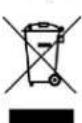
The symbol of a crossed-out rubbish bin placed on equipment, packaging, or accompanying documents means that the product must not be disposed of together with other waste. Such a marking means at the same time that the equipment was placed on the market after 13th of August 2005.
The user is obligated to provide waste equipment to the designated waste collection point for appropriate processing. You can find information on the available system for collecting waste electrical equipment at a given
store's enquiry point and at the city hall/municipal office. Proper handling of waste equipment prevents negative consequences for the natural environment and human health!

INHCTPYKUJNIO NcNoJIb3OBAHNUI IOIpyTHNuC I CTEPMOCTATOM
3nemehbHa6opa:
Kopnyc noIpyrTHnUbI
- PpO3paHNa KpbIka
Ct6nH3npyIOuaBCTABKa
96aHOeK twist-off EMKOCTbIO 180 M
- Hpy nHTaHnA nnHO 122 cm
HCTpyKUINIO NICN0JIb3OBAHNIHO
- Kpbioka
2.Пл actikobaria Kpbilka twist off (9 wt.) - CTeKJIHHa 6aHa Ka TnTa twist off (9 Wt.)
- Kopnyc
5.CnHaJIbHaJaMaNoUka - CBeToIOHbI nCnne
- BctabKa, cta6nH3npyUoJaa 6aHKn
8.CunOBKa6eNb
PanaB ynpaBneHn:
- KhoIIka n3MeHHeHH NaCTpoEK «SET»
- KhoHKn peRyIInpoBKN «+» (UP) n «-» (DOWN).
- CBeToOnIOHbI DnCnJIeN: OTo6paXeHne 0-99 YacOB, 0-59 MnHyT, TEmpePaTypa 25-65°C.
4.KhONka nHTaHnA «ON/OFF» (BKNHOueHne/BBKIOueHne) - ИndикаторTekушero HabtpoehHoro napametpa «TIME, TEMP» (Врем/Тemпература)
Ioxayncta, BHNMaTeNbHO npOHTne daHHyIO HnCTpyKunIO nepei nCnoNb3OBaHem ycTpoiCTBa n COxpaHnte ee dna daJIbHeJwero nCNoB3OBaHn. IopDp6Hoe O3HaKOMJeHne C HnHexyKa3aHHbIMn peKOMeHdaunrMn
No3BOJNT npaBnIbHO 3KcNJIyATnpoBaTb yCTpOcTBo n noLyuTaB ydoBOJIbCTBne oT erO 6e3aBapHOn pa60TbI B TeueHne doJrTO RbpeMeH.
NEPED NEPBbIM UcNoJIb3OBAHHEM
- Поверьтесаджимое упakobи и убдntecb, чу у bac ectb BCE части habopa и Нюда частей habopa He noвржdeha.
- CHIMMTE c yctpOcTBa 3aunTHyU nJIeHky.
- CTeKJIaHHbIe 6aHKn I KpbIuKn TuaTeNbHO BbIMoHTe -B TeNIOB OBe C XUdkOcTbIO DJIa MblbI NOcybl, 3aTeM ONIOCHNTe N BbICyWntE. BaHKn I KpbIuKn MOXHO MbITb B NOCyDOMoeHOr MaUNHe.
- IpoTpnte BHyTpEHHIO YacTb NOrypTHNcbl N KpbIuKy BlaXHOb TpAnKoN NaTe BbICOXHyTb.
CNOCOB 3KCNJYATAUIN
- BkIIOUHTe yCTpOncTBO B 3JIeKTpnuEckyUo pO3eTKy.
- Haxmte KhoNky «ON/OFF», yTo6bI BKNIOHTb yCTpoiCTBO. Ha ducnnee abTomatueckn noBntcnaHacTPOka no yMOnuHaHIO «10:00», yKa3bIBaIOUa, yTO BpeMa pa6oTbI yCTpoiCTBa no yMOnuHaHIOcoCTabJIeT 10 YAcOB.
- HaxmTe KhoNky «SET», YTo6bI BbIbpaTb HAcTroKn TemnepaTypb IINBpeMeHn. Ipn KaXdOm Haxattn KhoNkn «SET» Bbl MoKeTe NpeeIn K CLeDyUoIm HAcTroKnam npaMeTpOB. B npaBoi Yactn Dncnpe 3arOpntcraHdkaTOp, yka3bBaOuUsn TeKyuUsn ycTaHOBneHbN npaMeTp («TEMP» ДЯ TemnepaTypb IIN «TIME» dJa BpeMeHn), a MiraOuJau ZnΦpa 6ydet yka3bBaTb TeKyuuee yCTaHOBNeHHoe 3NaYeHne.
- KhoIkaMn «+» (UP) n «-» (DOWN) yctaHOBNTe HxHoe 3naueHne o6oNx npaMeTpob - KOJIueCTBa YacOB, MInHyT n TempepaTypbl.
- Дя подеверждени вьбраньх napametpoBи залуcka npocecca nobTropHo haKMITE KhoNky «ON/OFF». Korda npoeecc NaHcHeTc, dinCnnei nepeCTaHET MraTb u yctpoiCTBO hauHET HarpeBaTBcN OTCHTbIBaTb Bpemr.
- IIO nCTeHn 3aDaHHoro BpeMeH yCTpOInCTBO aBtOMaTnueeCKn BBkIIOuHaETcra.
BHIMAHNE: EcnB He nepeJeTe K cIeDyUoSei HAcTpoKe IIN He NOdTBePdnte Bbl6paHHbI npaMeTpbl B TeueHne 5 cekHy, yCTpOcTBO ABtOMaTHueCKn BblKIOuHTc. NocNe NOBTOphoro HaxKatN KONKn «ON/OFF» yCTpOcTBO 3aONMHt paHee yCTaHOBJEHbI npaMeTpbl, ecnero He OTKnIOUaHn OT po3ETKn.
PnroTOBJIeHne Norypta
Iorypt - npebocxodhbi HaTpaJIbHbI NCTOCHNk CEHHbIX DnA 3DOpOBBy INHrpEJaHENTOB. OH n3rotobneH n3 MoNoka,CKBaWeHHoro IyoryptOBbIMN 6aKTEpmaMn. 3TN 6aKTEpnn pa3MHoXaOTcB T eTTOM MOLOke n Chepe3 HeKOTOpoe BpemnIpeBpaauot erO B Iyorypt. 3TO Tnpcecc 3HaUHTbHO 6boraaaet MOnOKO BBICOKOKaueCTBeHHbIMn 6eKAMn. DomaHm Iyorypt TAKKe CODepKNT MInKPOaemeHtBI n OJNE3HyO 6aKTEpnaJIbHbYIO MInKPOΦLopy. OH He CoDEPKNT HEnyXbIX Doabok, KOTOpBie 6bUHO nCNOJIb3yOTcB NOKyINbIX apOMATn3PObaHHbIX Iyoryptax (3aryCTntJI, NCKycCTBeHHbIE KpacnteJI, apOMATn3aTopBI, caxap). PpiROTOBIV IyoryptBI CaMOCToTeJIbHO, Bbl CMOKeTe O60rATNTB CBOE DomaShee MeHIO NOE3HbIMN II pINBNeKaTeJIbHbIMN 3aKycKaIMn, KOToPbe 6byT IMeTB npeKpaChBn BKYC KaK CamnNo Ce6e, TAK n CdoabBHeHem fpyKTOB nII cyxoΦpyKTOB. Iopzra TAKORO IyoryptA - OTNIuHnA ydeI dJe npeKycCa Ha paBoTe nII B uKoJe.
YTo6bI npriroTOBnTB BKychbI DOMaunHn NOrypT, Bam noHaDo6ntc:
1250 MЛ MOJIOKA,
0,125 r IInoФиИзИрОваньх ИorypTOБьх KynbTyp 6aKTePn.
BHHMaHHe: 3Ta IyypTHnca nO3BOJnEe T OHOBpeMeHHo rTOBnTb 9 npuN yOpyta (1 npuN = 1 6aHaKa = 180 m). O6uN o6bem 6aHoueK 1620 m. PekomeHdyembl noJe3hbl o6bem IyypTHnCb - 1250 mI.
PpoecpnpiroTOBHeHnA:
- TuaTeJIbHO BbIMoIe 6aHKn I KpbIuKn TEINoB BOIO C XNIDKOCTbIO DnA MbITbI NOcydI. NocJe MblTbI BbIMOnTe camn 6aHKn, a 3aTEM BbICyUIne INX BmecTe C KpbIuKamn.
- OTmepbTe Heo6xoDnMoE KOJHecTBO MOJOKa. Ecnn Bbl NcNoB3yeTe CBExee HEnaCTepu3OBaHHoe MOJOKO, CHaHaIe erO nactepn3yem.ДЯ 3tOrO nepeJeIe erO B KAcTpIOH u HarpeIte Do 65^ ,NocToaHHO NomeuBaJ. IodepKuBaIe 3Ty TemnepaTypy B TeueHne 30 MInHT, 3aTeM 6bICTpo OxJaNTe MOJOKO Do 40-45°C. Ecnn Bbl NcNoB3yeTe Hn3KoNaCTepu3OBaHHoe MOJOKO, HarpeIte erO B KAcTpIOe Do TemnepaTypb 40-45°C.
3.БakTePn paCTbOpHTe OTdEJIbHO B He6OJbWOM KOINueCTBe MOIoka NII IN BOIy (okono 20 M),a KOrDa OHI pONHOCTbIO paCTbOPaTcR, BblneTe BCE B IOnrTOBHeHoe TEnnoe MoIOKo.He IOnyckaiTe o6pa3OBaHn rpydk.
4. Iocne nonadaHnB MoIOKo IorpyTObI bakTePn nepMeunBaHTe B TeueHne 3-5 MNHyT. IIO nCTeueHN 3TORO BpeMeHn pa3JeTe MOlOkO B 3apaHee noDrTOBJIeHHbIe 6aHKn pnpMeHPO do 12 INx BBICOTbl, a 3aTeM 3AkpoNTe INX.
5. IomeCTnTe 6aHouKb BHyTpB bIyypTnUcbI n 3aKpoTbe yctPoIcTBO KpbIkwOi.
6. YctaHOBtE Bpemn n Tempeatpy Ha naHeIy npabIeHna - B COOTBeTCTBn C peKOMeHaIaIIMn Ha ypaKOBKe IcNoIb3yeMbIX KylbTyp NOrypTOBbIX 6aKTePm. Ba3OBoE Bpemn FepMeHTaun CoCTaBnReT npimepHo 8-12 caoB npn Tempeatype 42 - 44^ .Yepe3 8 caoB npoBepbTe, HpaBntcJn Bam KOHCnCTeHua n BKyc NOrypTa. Ecnn HeT, octabBe erO B NOrypTHnue, yBelenuBaB pEmn, noka He nOnyuHte JKeJaemyo KOHCnCTeHnIO n BKyc.
7. Пи���ньлгий Тадим образим Ногур РOTВ К уnotpe6JIeHIO.Чтобп npoДNTb cpoK xpaHENЯ
при���ньньх поц尼,ханITE НогурТВ XOLOДЛБИКЕ.
BnHmAHne:Ha Bpem qepMeHTaun 6yUyT BnIaTb TempeTa pOkyKaIOe Cpebl N TeMepaTpa cbipra. CnIshKOMdoJIroe HarpeBaHne nOnyuEHHO rOpyTa moKeT npNBecTN K erO nopue.
IeBkycbIX 6JIIOH n3 NOrypTa
XopoWIMn Do6abKamn K DomaShemy Iyrgpy TaBnaHTc BcExne fpykbl, KaKaO, BaHInb, KOKOCOBa CTpyKka, DxKembl n FpyKTOBA MRAOTb. Eeze Onda opunHaJIbHnA nde — Iyrgpt, KOTOpbl nOdaIOT B NIKaHTHom BnDE, HAnpImep, B BVide ZaUNKn. BCE, yTo Bam HyKHO, 3To Do6abNTb Hape3aHHbI INI TepTb ORypeU, YecHOK, HEMHOrO OINBKOBOrO MaCNa, CoNb, Hape3aHHbIe YKpON i MAty. DomaHnn Iyorgpt TAKKe MoKet CtaTB npeKpaChOH OCHOBd Pnynx 6NIOu HAnITKB: CMy3N, NaCCN, XoNoDhBX CyNOB, OBcAHKn, COycOB INIPOXhBX. Het npedeLa BaWemy TBOpueCTBy, HO NOMHnte, IIO6ble apOMaTHzATOpbl Do6abNlTe TOJbKO B rOTOBbl Iyorgpt - INaue 3TO MOKET HeraTINBHO OTPa3ntbcra Ha npoccece ero co3dAnHry. Ecnn Bbl pNaHnpyeTe Do6abNlTe rOTOBbl Iyorgpt B ropYne 6NIOda, NomHnte, yTo OH MoKet CBepHyTbcR. UTo6bl 3toro N36ExKaTb, CMeaaine Iyorgpt C He6oNBshm KOINueCTBOM OCTporo CoYca INI cyNa, a 3aTem CMeaaine C OCTaIBHbIM.
DOnoJIHnTeIbHbIe yka3aHaHa:
Bpem Co3peBaHn BInaTe Ha KOHCnCTeHcNIO n Bkyc NOrypTa. Yem DoIbwe Bpem, Tem cyue NOrypT n TEM INHTeHCnBHee erO Bkyc.
- Upe3 8 yacob Bbl noJyHte OeHb Mrgkn IorypT, a Upe3 10 yacob -6oJee Kncbl HaTypaIbHbI NOrypT.
- IOTOBH NOrypT CneJeYt yNontpe6bNb B TeueHne 3-5 dHei nocIe npnroTOBneHn I xpaHnTB B XoJIoNDJIbNHKe.
- DomauHHn HpyrT, KaK npabHNo, 6OJIe HeXHbI N He TaKo IyCToN, KaK MaRa3HHbI.
- Pn npiroTOBHeHn Iorgypta Ha NOBepxHOCTn MOKeT OTDeJIHTbCRA He6oNbIooe KOINueCTBO BOdbI, TTo RnAeTcR eCTeCTBeHHbIM RAJIeHNEM. 3Ty BDOy CNeDyET BblNTb NIN BCE nepemeWAtb.
BbMOKTe NcNoJIb3OBAtB npIROTOBHeHbI yOryPT B KaueCTBe 3aKBaCKn IJyDpyoN napTIN OryptOB BMeCTO NcNoJIb3OBAHn JIOOHN3nPOBaHHbIX KjNbTyp NOrypTOBbIX 6aKTePn. Ondako Yem 60JIbWe Bbl NOBTopReTe 3OT IpOeCC, TeM XnKe MoKET CTAb YOryPT INn IpoCeCC PniroTOBHeHn MOxET 3aHrTB 60JIbWe BpeMeH. EcIn NOrypCTaHOBNTCn CNIuKOM XnIDKIM INn IpoDOJXHTeBHOCTb npON3BOdCTBEHHORo IpoCecca CTaHOBNTcA HePiNeMJeMo, NaHHTe 3aHOBO, NcNoJIb3yra HOBbI, KynneHHbI NOrypT INn 3aKBacoHbIE 6aKTePn.
- Ecni Bbl NcnoB3yeTe MeHbSe MoNoka Hn DoabAaIe 3-4 YaHbIe loxKu cyXoro MoNoka, IorypT noNyUHTca HEMHOrO rUe.
- Iypt cTaHr yue, ecn nepeynoTpeBHeHem ocTabntb erHa cyTKN B XOJIOJIbHKe.
- Hn3kONaCTepu3OBaHHoe MOLOKOp nepe npiroTOBJIeHneM horypTa He HxKHO KINrAITb.
- IyryrTaKKe MoXHO npnroTOBHT B BERaHcKOM BapnaHte, nCNoJIb3yra CoeBOe MONOKo. B 3tOM cIyuae Bbl TaKKe MoXTe NcNoJb3OBAbT IyryptOBbIe 6aKTePnAhbHbIe KylbTypbl, ppeJaRaemble HaWei KOMNaHnei, INN INcNoJIb3OBAbTB KaueCTBe 3aKBaCKn IyryPT N3 COeBOrO MONoka.
Bo3MoXHbIe HEnCnpaBHOCTn Ix peSeHne:
Cnyc78 yacob norypt BCE eue cnilnkom kndkn.
- PpOaHnTe npoecc MaKcHymmdo 14 yacOB, peryIpaHno npoBepra KOHCnCTeHcHIO IyOrypTa, noka He noJyHTe
npOdykT yOoBnTeBOpnteIbHOI rCyToTBI.
Cnyctra 14 yacob myorypr BCE eue cnilskom kndkn.
Bo3MOxHO, MoIIO KO 6bIIO CINuKOM TROPaHIM npn CMeUINBaHIN C IyOrypTOBbIMN KynbTypaMn. PpN Do6abJeHN KynbTyp y6eHNTecb, YTO TEMpepaTpa MoIOKa He npeBbIwaet 44^
- IcnoIb3yemble KylbTypbl Mornn 6bItb HeaKTHBbIMN INH HeNOxOJaUMM. Y6eITecb, YTO Bbl NcNoIb3yeTe HxKhbie KylbTypbl COOTBeTCTByIOUeRO KaueCTBa IN YTO cPOK INX rOdHOCTNe He nCTek.
- Monoko Morno 6bItb HenpurodHbIM - codepaueceB HEM KOHcepBaHTbI nn He npabnBnaerero nactepn3aunr MoRn 3aTopMo3ntb nnnpedotBpatNTb pa3BNTne Iyortobix KyIbTyp.
IOnpyT CnUHKOM KOMKOBaTbIi
- IorytpThIe KjIbTypbI IN MOnOko 6blIn nepMeUaHbI HnnpabNtBHO. KyIbTypbI Bcerda CneNyET TuaTeNbHO nepMeuBaTb C TeNlbIM MONOKOM.
Ha nobepxhoctn noypTa noBnncb KpaChbIe nTHa
3To MoKet 6bITb npn3HakOM TOrO, yTO B MOLOKO paHee nonaHc nOpbl nIceHN. Norypt HnnpurodeH Kynotpe6JIeHNIO, n erO cneJyET BbIbpcNTb. Npeed cneJyUoIm nCNOJb3ObaHNem TuaTeNbHO BbIMOnTe 6aHKn I KpbIuKN i3-NoD hOrypTa. 3aneTbe 6aHKn KInrAkom. Cnpbl nIaceHN MOryt DoJIroe BpEm aocBaTbcB B Bo3dyXe, 3arpa3HbTB MONOKO n DeNaTb erO He npriroDhbIM dnn npriROTOBHeH NOrpyta, no3Tomy y6eDiNtEcB, YTO BaWe yCTPOiCTBO MaKcMaJIbHO YnCToe, n He ocTabJIeTbe MOLOKO OTKpbITbIM nepeed do6abHeHMe KylbTyp.
OuNTka XpaHHeHne
PpabnlbHoe n peryIapHoe Texo6cnyKuBaHne npOaNT cpoK noIb3OBaHna n3deJeHMe. CneIte 3a TeM, yTo6bl OHO coepXaNcB X opoWe m COCToAHn n IcNoIb3OBaNoc bpAunbHo.
- PekomeHnyetcnaCNOJb3ObaTb MRAKNE YNCTaUne CpeCTBa N DEJIKAthBie Akceccyapbl, YTO6bl 3aunTntb Kopnyc yCTpoiCTBa n INaCTIKOBbIe 3NeMeHTbl OT capanHH.
- Pered Kaqdbm nCnoIb3ObaHnem 6aHKn CneJyET TuaTeJIbHO Mblb N cTePNJIN3OBaTb. KpbIuKn 6aHOK BbIMOnTe TeNIOB BOoC MoUcIM CpeCDtBOM. PpOTpuTE KOHTeHep C Kopnycom N naHeJIbIO BlaXHO TpAknOu BBICUYNTe, He norpykaite BBOy!
- Iocne KaKdoRo NcnoJb3OBAHn yCTpOInCTBO CJeDyET IpOTnPaTb BnaXHOu KxOHHO TpAknIO u OCTaBnTb COXHyTb.
- KomnoHeTbI Ha6opa DoJIxHbI BceIa OCTaBaTbcra YIcTBIMN, NockoJIbky OHN KOHTaKTpyOT C NiUeBbIMn npOdyKTamN.
- IyryptHnCy CneDyET XpaHnTB B CyXOM, HeOCTynHom DJIa DeTee MeCe, 3aunuEHHOM OT nbJIn n rpr3n.
ПРавиJA TEXHиКБE3ОнACHOCTN
- Pprn nCnoNb3OBaHm nIogypTHnUcI b cIeNyET co6HOnaTb MepbI npEoCTOpOxHocTn, CBraHHbIe C 6e3OnacHbIM nCnoNb3OBaHmem 3neKtpoPn6opob.
3anpeuaeTcBbHIMaTbIINBCTaBnTbBnIKyMOKpbIMpyKaMn. - PekomeHnyetcpa3MeaTaB yCtpoNCTBO Ha KyxHe, B MceTe, 3aunuHHom OT Ype3MepHOrO cJHeuHOrO CBeTa, o6ecneuBaIOUeM KOMΦoPT NcONb3OBaHn I 6e3OnaChy OKcnnyatauio.
-ДETNdoJXHbIMeTbDOCTynKIHyrpyTHnCeTOJbKO NOI pINCMOTPOM B3pOcJIbIX. - UcTpoCTBO DoJXHO 6bITb 3aKpeJIHeO TaK, YTO6bI DomauHne JINBOTHbIE He IMeJI K Hemy DOCTyna.
- Ioka yctpoiCTBO haoDiTcB pa6oohem pexime, He nepemeuaTe erO.
BbI He Imeete npaba peMOHTnipoBaT bIIM MOINΦNtIpOBAt yCTPOIcTBO CAMOCTOReJIbHO.
He octabnTe pa6oTaOuee yCtpoiCTBO 6e npncMoTpa. - Y6eIITecb, yTO HOMHaJIbHOe HAnpJxHHe yCTpoIcTBa COOTBeTCTByET HAnpJxHIO CeTI, KOtOpYIO Bbl IcNoJIb3yeTe.
3anpeaetcnaonb3oBaTdaHHoe yctpoCTBO B6n3n JnerkoBocJIameHIOxxCnpeMetOB.
He nCnoJIb3yIe n3dIeHn He HecTa6uNbHOJ NOBepxHocTn, BO BnaXHOM MeCTe nn pRdom C npYrIMN nCTOCHKAMn Tennla.

HecobIIOHeHne BbIeUyKa3aHHbIX peKOMeHdaCm MOKeT 6bITb ONaChbIM dIg 3DOpOBb; 3TO TAKKe MoKeT NOMeTaB pa6oTe yCTpoiCTBa n npNBecTN K erO BbIXOy N3 CTPOJ.
TexHueckne xapaKTepeNtMkn:
HomHaJIbHoe HapXeHne: 230B~50Tu
HOMHaJIbHa RA MoUHOCTb: 40 BT
BMECTIMOCTs:
96aHOeK twist off o6uei eMkoctb1o 1,6-2 n (no 180 m kaxdai)
Knacc 3aunTbI: II