
RO 125 FEQ-Plus - Sander FESTOOL - Free user manual and instructions
Find the device manual for free RO 125 FEQ-Plus FESTOOL in PDF.


| Brand | Festool |
| Model | RO 125 FEQ-Plus |
| Product Type | Rotary-orbit sander |
| Power Consumption | 500 W |
| Rotational Speed (Orbital) | 3000 - 6000 rpm |
| Rotational Speed (Rotary-Orbital) | 300 - 600 rpm |
| Sanding Stroke | 3.6 mm |
| Sanding Pad Diameter | 125 mm (FastFix) |
| Weight | 1.9 kg |
| Power Supply | 120 V / 60 Hz (North America), voltage as per rating plate |
| Movement Type | Orbital (fine sanding) or rotary-orbital (Rotex) |
| Speed Setting | Progressive adjustment wheel |
| Soft Start | Yes, electronic |
| Constant Speed Control | Yes, electronic |
| Thermal Fuse | Yes, power reduction in case of overheating |
| Pad Brake | Yes, replaceable rubber sleeve |
| Pad Change | Tool-free, FastFix system |
| Abrasive Attachment | Self-adhesive (StickFix) |
| Dust Extraction Connection | Diameter 27 mm, compatible with Festool vacuum |
| Edge Guard | Removable (Protector) |
| Sound Pressure Level | LPA = 82 dB(A) |
| Sound Power Level | LWA = 90 dB(A) |
| Vibration Emission (Fine Sanding) | ah = 6.0 m/s² |
| Vibration Emission (Rough Sanding) | ah = 3.5 m/s² |
| Vibration Emission (Polishing) | ah = 6.0 m/s² |
Frequently Asked Questions - RO 125 FEQ-Plus FESTOOL
User questions about RO 125 FEQ-Plus FESTOOL
0 question about this device. Answer the ones you know or ask your own.
Ask a new question about this device
Download the instructions for your Sander in PDF format for free! Find your manual RO 125 FEQ-Plus - FESTOOL and take your electronic device back in hand. On this page are published all the documents necessary for the use of your device. RO 125 FEQ-Plus by FESTOOL.
USER MANUAL RO 125 FEQ-Plus FESTOOL
natural_image
Festool industrial power tool with black body and white base, no visible text or symbols on the tool itself.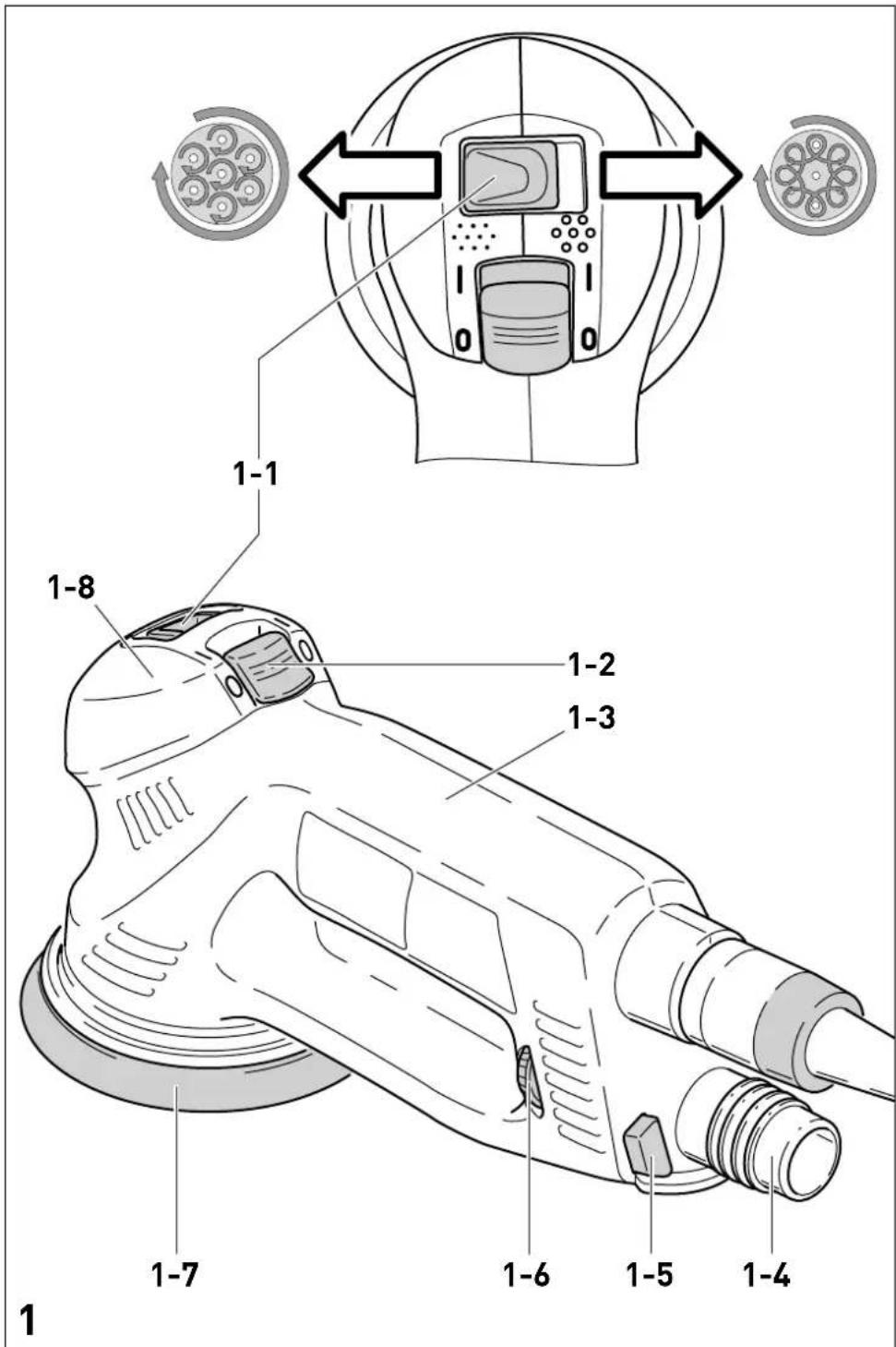
en: EU Declaration of Conformity. We declare under sole responsibility that this product complies with all the relevant requirements in the following EU Directives, and following standards or normative documents were applied:
We as the manufacturer declare under our sole responsibility that the product(s) fulfill(s) all the relevant provisions of the following UK Regulations and are manufactured in accordance with the following designated standards:
S.I. 2008/1597 Supply of Machinery [Safety] Regulations 2008
S.I. 2016/1091 Electromagnetic Compatibility Regulations 2016
S.I. 2021/422 Restriction of the Use of Certain Hazardous Substances in Electrical and Electronic Equipment Regulations 2012
BS EN 62841-1:2015 + AC:2015 + A11:2022,
BS EN 62841-2-4:2014 + AC:2015,
BS EN 55014-1:2017 + A11:2020,
BS 55014-2:1997 + A1:2001 + A2:2008 + AC:1997,
BS EN 61000-3-2:2014,
BS EN 61000-3-3:2013,
BS EN IEC 63000:2018
Head of Research & Development Products

Tim Weber
Head of Product Compliance
Inhaltsverzeichnis
1 Symbols....13
2 Safety warnings....13
3 Intended use....14
4 Technical data.... 14
5 Parts of the machine....14
6 Commissioning....15
7 Settings....15
8 Working with the electric power tool......16
9 Service and maintenance....17
10 Accessories.... 18
11 Environment....18
12 General information....18
1 Symbols

Warning of general danger

Warning of electric shock

Read the operating manual and safety warnings.

Wear ear protection.

Wear a dust mask.

Wear protective goggles.

Connecting the mains power cable

Disconnecting the mains power cable

Pull out the mains plug

Safety class II

UKCA marking: Confirms the conformity of the product with UK regulations.

CE conformity marking

Do not dispose of it with domestic waste.

Tip or advice

Tool contains a chip which stores data. See section 12.1
2 Safety warnings
2.1 General power tool safety warnings

WARNING! Read all safety warnings, instructions, illustrations and specifications provided with this power tool. Failure to follow all instructions listed below may result in electric shock, fire and/or serious injury.
Save all warnings and instructions for future reference.
- Only for AS/NZS: The tool shall always be supplied via residual current device with a rated residual current of 30 mA or less.
2.2 Machine-specific safety notices
- Harmful/poisonous dust may be produced when working (e.g. paint products containing lead and some types of wood). Contact with or inhalation of this dust may pose a risk for the operating personnel or persons in the vicinity. Comply with the safety regulations that apply in your country. Connect the power tool to a suitable dust extractor.


Wear suitable personal protective equipment: Ear protection and safety glasses.
- Use suitable breathing protection to protect your health. In enclosed spaces, ensure that there is sufficient ventilation and connect a mobile dust extractor.
- If potentially explosive or self-igniting dust is produced during sanding, the machining instructions issued by the material manufacturer must always be followed.
- Prevent liquid polish from seeping into the machine. The penetration of liquid polish into the power tool increases the risk of electric shock.
- If the power tool is dropped or falls, check for damage to the machine and sanding pad. Remove the sanding pad for closer inspection. Have the damaged parts repaired before use. Broken sanding pads and damaged machines can cause injuries and machine instability.
- Clean using materials soaked in oils, e.g. abrasive pad or polishing felt with water, and spread them out to dry. Materials soaked in oil may ignite spontaneously.
2.3 Mixed dust containing metal and sanding of damp surfaces

With mixed dust containing metal (such as resulting from paint sanding in the auto-ve field) and when sanding damp surfaces, following measures must be observed for ons of safety:
- Install an upstream residual-current circuit breaker (RCD, PRCD).
- Connect the machine to a suitable dust extractor.
- Regularly vacuum the motor housing of the machine to remove dust deposits.

protective goggles.
2.4 Emission levels
The levels determined in accordance with EN 62841 are typically:
Sound pressure level L
$$ _ {P A} = 8 2 \mathrm{dB(A)} $$
Sound power level L
$$ _ {\mathrm{WA}} = 9 0 \mathrm{dB(A)} $$
Uncertainty K = 3 dB


CAUTION
Noise emissions created while working with the power tool may damage your hearing.
▶ Always use ear protection.
Vibration emission level a_h (vector sum for three directions) and uncertainty K measured in accordance with EN 62841:
$$ \mathbf {a} _ {\mathrm{h}} \left[ \mathrm{m} / \mathrm{s} ^ {2} \right] \mathrm{K} \left[ \mathrm{m} / \mathrm{s} \quad^ {2} \right] $$
Fine sanding 6.0 1.5
Coarse sanding 3.5 1.5
Polishing 6.0 1.5

CAUTION
The emission values may deviate from the specified values. This is dependent on how the tool is used and the type of workpiece being machined.
▶ Assess the actual load during the entire operating cycle.
▶ Depending on the actual load, suitable protective measures must be defined in order to protect the operator.
3 Intended use
The sanders are designed for sanding wood, plastic, composite, paint/varnish, filler and similar materials as directed. With mixed dust containing metal (such as dust resulting from paint sanding in the automotive industry) and when sanding damp surfaces, special safety instructions must be followed. The sanders are not intended to be suitable for grinding bare metal. Material containing asbestos cannot be processed.

The user is liable for improper or non-in-tended use.
4 Technical data
Geared eccentric sander RO 125 FEQ
| Power 500 W | |
| Eccentric motion speed 3000–6000 rpm | |
| ROTEX rotary motion speed | 300–600 rpm |
| Sanding stroke | 3.6 mm |
| FastFix sanding pad | Dia. 125 mm |
| Weight | 1.9 kg |
5 Parts of the machine
[1-1] Selector switch
[1-2] On/off switch
[1-3] Motor housing
[1-4] Extractor connector
[1-5] Spindle stop
[1-6] Speed control
[1-7] Sanding pad
[1-8] Gear head
The specified illustrations appear at the beginning of the Operating Instructions.
6 Commissioning

WARNING
Unauthorised voltage or frequency.
Risk of accidents
▶ The mains voltage and the frequency of the power source must correspond to the specifications on the name plate.
▶ In North America, only Festool machines with the voltage specifications 120 V / 60 Hz may be used.

CAUTION
Heating of the plug it connection if the bayonet fitting is not completely locked.
Risk of burns
▶ Before switching on the power tool, make sure that the bayonet fitting at the mains cable is closed fully and locked.
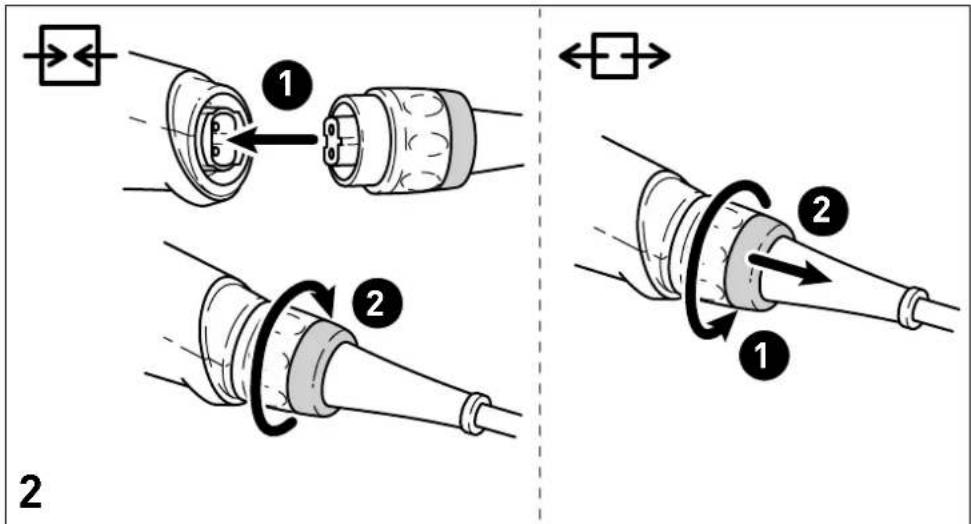
For connecting and detaching the mains power cable, see figure [2].
6.1 Switching on/off
The switch [1-2] serves as an on/off switch (I = ON, 0 = OFF).
① The on/off switch can only be actuated if the selector switch [1-1] is locked in place.
In case of a power failure or if the mains connector is removed, move the on/off switch immediately to the Off position. This prevents uncontrolled restarting.
7 Settings

WARNING
Risk of injury, electric shock
▶ Always disconnect the mains plug from the socket before performing any work on the machine.
7.1 Electronics
The power tool features full-wave electronics with the following properties:
Smooth start-up
The electronically controlled smooth start-up function ensures that the power tool starts up smoothly. The limited starting current ensures that even standard household fuses are not triggered.
Speed control
You can use the adjusting wheel [1-5] to continuously adjust the speed within the speed range (see Section 4). This enables the sanding speed to be optimally adjusted to suit the material you are working on.
Constant speed
The preselected motor speed is kept constant through electronic control. This means that, if the machine is used as intended (reasonable contact pressure), a constant sanding speed is achieved.
Temperature cut-out
The power supply is restricted and the speed reduced if the motor exceeds a certain temperature. The power tool continues operating at reduced power to allow the ventilator to cool the motor quickly. The power tool starts up again automatically once the motor has cooled sufficiently.
7.2 Setting the sanding motion
Two different sanding motions can be set using the selector switch [1-1] .
The switchover can only be performed when the sanding pad is stationary, as the selector switch is locked during operation.
Fine sanding - eccentric motion

This position is selected for sanding with low output for a scratch-free surface (fine sanding).
Coarse sanding, polishing - ROTEX rotary motion
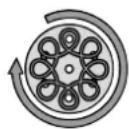
The Rotex rotary motion is a combination of rotary and eccentric motions. This position is selected for sanding with high output (coarse
sanding) and polishing.
7.3 Changing the sanding/polishing pad
Choice of sanding pads
The power tool can be fitted with three sanding pads of different hardnesses depending on the surface to be sanded.
Hard: Coarse sanding on surfaces, sanding at edges.
Soft: Universal use for coarse and fine sanding for flat and curved surfaces.
Supersoft: Fine sanding on formed parts, curves, radii. Do not use on edges!
Assembly
The FastFix system enables toolless sanding pad replacement:
- Move the selector switch [1-1] to the right to ROTEX rotary motion.
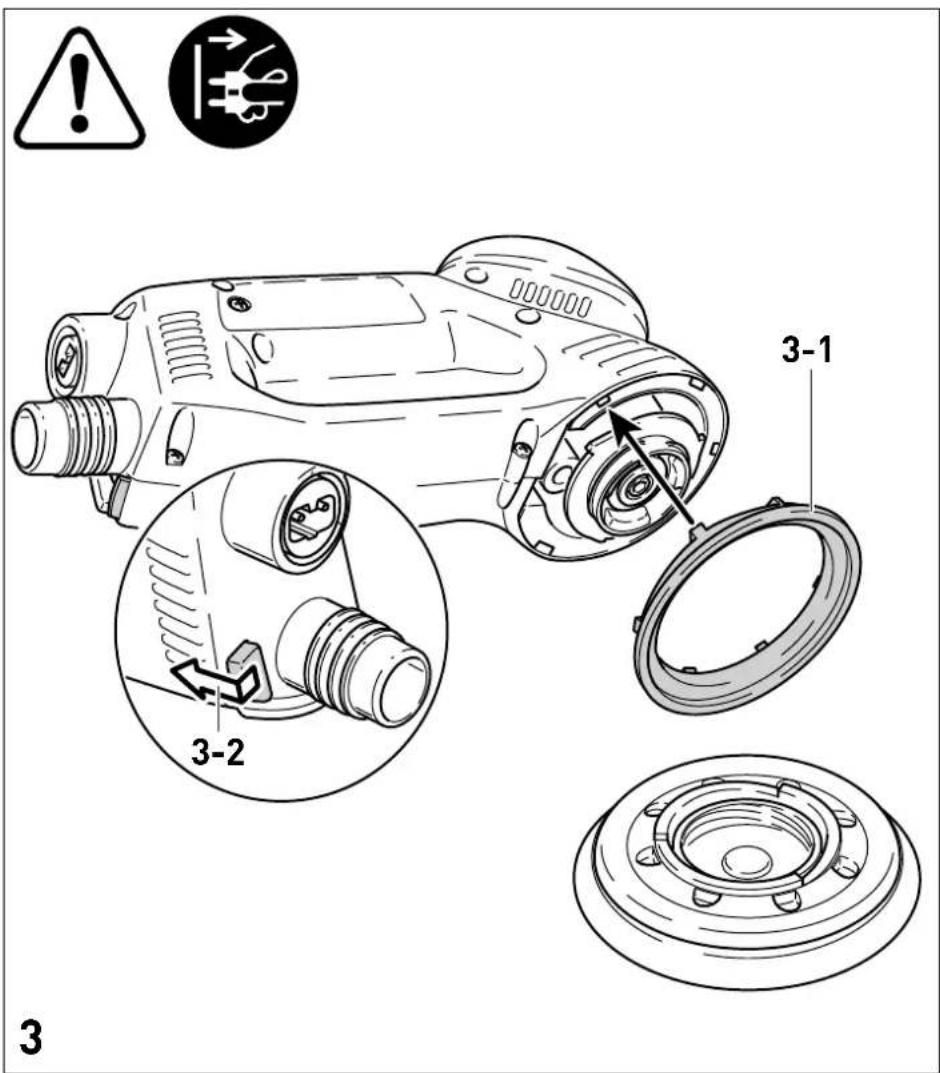
CAUTION! Only use the spindle stop when the drive spindle is stationary. Do not switch on the motor when the spindle stop is pressed. - Press and hold the spindle stop [1-5] and unscrew the sanding pad [1-7] from the spindle (right-hand thread).
- Press and hold the spindle stop [1-5] and screw on the new sanding pad [1-7] (the rubber sleeve [3-1] must be correctly fitted).
7.4 Attaching sanding accessories
The suitable StickFix sandpaper and StickFix sanding cloth can be attached quickly and simply to the StickFix sanding pad.
▶ Press the self-adhesive sanding accessory onto the sanding pad [1-7].
7.5 Attaching polishing accessories
To avoid damage, PoliStick polishing accessories (sponges, felts, sheepskin) may only be used on the special polishing pad, which is fitted on the machine instead of a sanding pad. Like the StickFix sanding accessories, the PoliStick polishing accessory is simply pressed onto the polishing pad and removed again after use.

In the case of a weakening adhesive effect of the StickFix surface, the backing accessories, in particular those which are not touching the workpiece, may come from the backing pad and cause injuries.
Replace the backing pad.
7.6 Dust extraction

WARNING
Hazardous dust
Damage to the respiratory passage
▶ Always work with an extractor.
▶ Comply with national regulations.
▶ Wear a dust mask.
A Festool mobile dust extractor with an extraction hose diameter of 27 mm should be connected at the extractor connector [1-4].
Recommendation: Use an antistatic extractor hose. This helps reduce the electric charge.
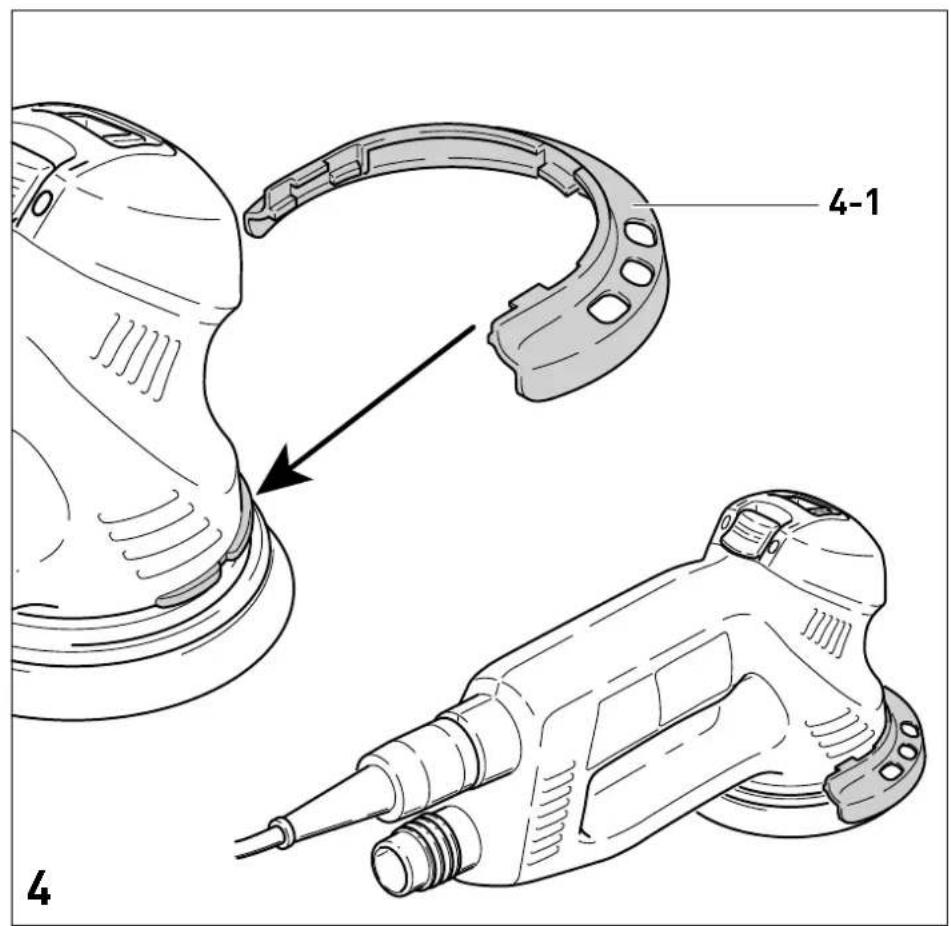
7.7 Edge protector [4]
The edge protector [4-1] stops the outer edge of the sanding pad from coming into contact with a surface (e.g. when sanding along a wall or a window), preventing machine kickback.
Assembly
Slide the edge protector onto the machine until it clicks into place (see figure [4]).
8 Working with the electric power tool

WARNING
Risk of injury
▶ Always secure the workpiece in such a manner that it cannot move while being machined.
Observe the following information:
- Do not overload the machine by pressing with excessive force! The best sanding results are achieved with moderate application pressure. The sanding performance and quality are mainly dependent on the selection of the correct abrasive.
- Hold the machine with two hands – one on the motor housing [1-3] and one on the gear head [1-8] – to ensure safe guidance.
- Before operation, ensure that the sanding pad is securely fastened to the power tool.
- The pad foam becomes brittle due to ageing. Before working, check the pad foam for wear.
- Only operate the power tool when there are no persons in the vicinity.
i Tables A and B show the recommended settings for different sanding and polishing jobs.
8.1 Table A - Sanding
| Coarse sanding Fine sanding | ||
 | Clear coat, filler, priming material | x 5 - 6 Soft x 1 - 3 Ultra-soft |
 | Clear coat, paint x 4 - 6 Hard x 3 - 6 Hard | |
 | Wood, veneered surface | x 5 - 6 Hard x 3 - 6 Soft |
 | Plastic x x 2 - 6 Soft x 1 - 4 Soft | |
 | Steel, copper, aluminium | x 6 Soft x 3 - 6 Soft |
8.2 Table B - Polishing
[XTX]  | Polishing | Sealing | Polishing to a high-gloss finish | |
 |  | 6 | 3 | 4 - 6 |
 |  | PadCoarse/fine | FeltSoft | Sheepskin |
 | [head] | Polishing paste Hard wax | - | |
 |  | 6 | 3 | 6 |
 |  | FeltHard | FeltSoft | Sheepskin |
| [head] | Polishing paste Hard wax | - | ||
9 Service and maintenance


WARNING
Risk of injury, electric shock
▶ Always pull the mains plug from the socket before performing any servicing and maintenance work.
- All maintenance and repair work which requires the motor housing to be opened should always be carried out by an authorised service workshop.
Customer service and repairs must only be carried out by the manufacturer or service workshops. You must only use original Festool spare parts.
Further information: www.festool.co.uk/service
To ensure constant air circulation, always keep the cooling air openings in the motor housing clean and free of blockages.
The tool is equipped with special self-disconnecting carbon brushes. If they wear out, the power supply is disconnected automatically and the tool stops.
9.1 Sanding pad brake
The rubber sleeve [3-1] prevents uncontrolled turning of the sanding pad in the event of eccentric motion (fine sanding). As the collar wears out over the course of time, it must be replaced with a new one if the braking effect is decreasing.
10 Accessories
Only use original Festool sanding and polishing pads. Low-quality sanding and polishing pads may cause serious machine imbalance that decreases the quality of the working results and increases machine wear.
You can find the PO numbers for accessories and tools under www.festool.co.uk.
11 Environment

Do not dispose of the device in the household waste! Recycle devices, accessories and packaging. Observe applicable national regulations.
In accordance with the European Directive on waste electrical and electronic equipment and implementation in national law, used electrical devices must be collected separately and handed in for environmentally friendly recycling.
Information on the collection points can be viewed at www.festool.com/environment.
Information on critical materials:
www.festool.co.uk/reach
12 General information
12.1 Information on data privacy
The power tool contains a chip which automatically stores machine and operating data. The data saved cannot be traced back directly to an individual.
The data can be read in a contactless manner using special devices and shall only be used by Festool for fault diagnosis, repair and warranty processing and for quality improvement or enhancement of the power tool. The data shall not be used in any other way without the express consent of the customer.
Imported into the UK by
Festool UK Ltd
1 Anglo Saxon Way
Bury St Edmunds
IP30 9XH
Great Britain
Sommaire
natural_image
Sequence of seven circular mechanical components with internal gear-like structures, no text or symbols present
Hout, fineer x 5 - 6 hard x 3 - 6 zacht


- Tim Weber
- Inhaltsverzeichnis
- Symbols
- Safety warnings
- General power tool safety warnings
- Machine-specific safety notices
- Mixed dust containing metal and sanding of damp surfaces
- Emission levels
- CAUTION
- Noise emissions created while working with the power tool may damage your hearing.
- The emission values may deviate from the specified values. This is dependent on how the tool is used and the type of workpiece being machined.
- Intended use
- Technical data
- Parts of the machine
- Commissioning
- WARNING
- Unauthorised voltage or frequency.
- Risk of accidents
- Heating of the plug it connection if the bayonet fitting is not completely locked.
- Risk of burns
- Switching on/off
- Settings
- Risk of injury, electric shock
- Electronics
- Smooth start-up
- Speed control
- Constant speed
- Temperature cut-out
- Setting the sanding motion
- Fine sanding - eccentric motion
- Coarse sanding, polishing - ROTEX rotary motion
- Changing the sanding/polishing pad
- Choice of sanding pads
- Assembly
- Attaching sanding accessories
- Attaching polishing accessories
- Dust extraction
- Hazardous dust
- Damage to the respiratory passage
- Edge protector [4]
- Working with the electric power tool
- Risk of injury
- Observe the following information:
- Service and maintenance
- Sanding pad brake
- Accessories
- Environment
- General information
- Information on data privacy
- Imported into the UK by
- Sommaire
Brand : FESTOOL
Model : RO 125 FEQ-Plus
Category : Sander