
CN65 - Screwdriver Vevor - Free user manual and instructions
Find the device manual for free CN65 Vevor in PDF.
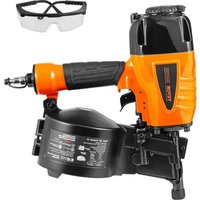


| Product Type | Pneumatic Coil Nailer |
| Brand | Vevor |
| Model | CN65 |
| Power Source | Compressed Air |
| Working Pressure | 70 - 110 PSI (4.8 - 7.5 bar) |
| Maximum Pressure | 120 PSI (8.3 bar) |
| Sound Pressure Level (LpA) | 84 dB(A) |
| Sound Power Level (LwA) | 97 dB(A) |
| Vibration | 4.6 cm/s² |
| Magazine Capacity | 250 nails |
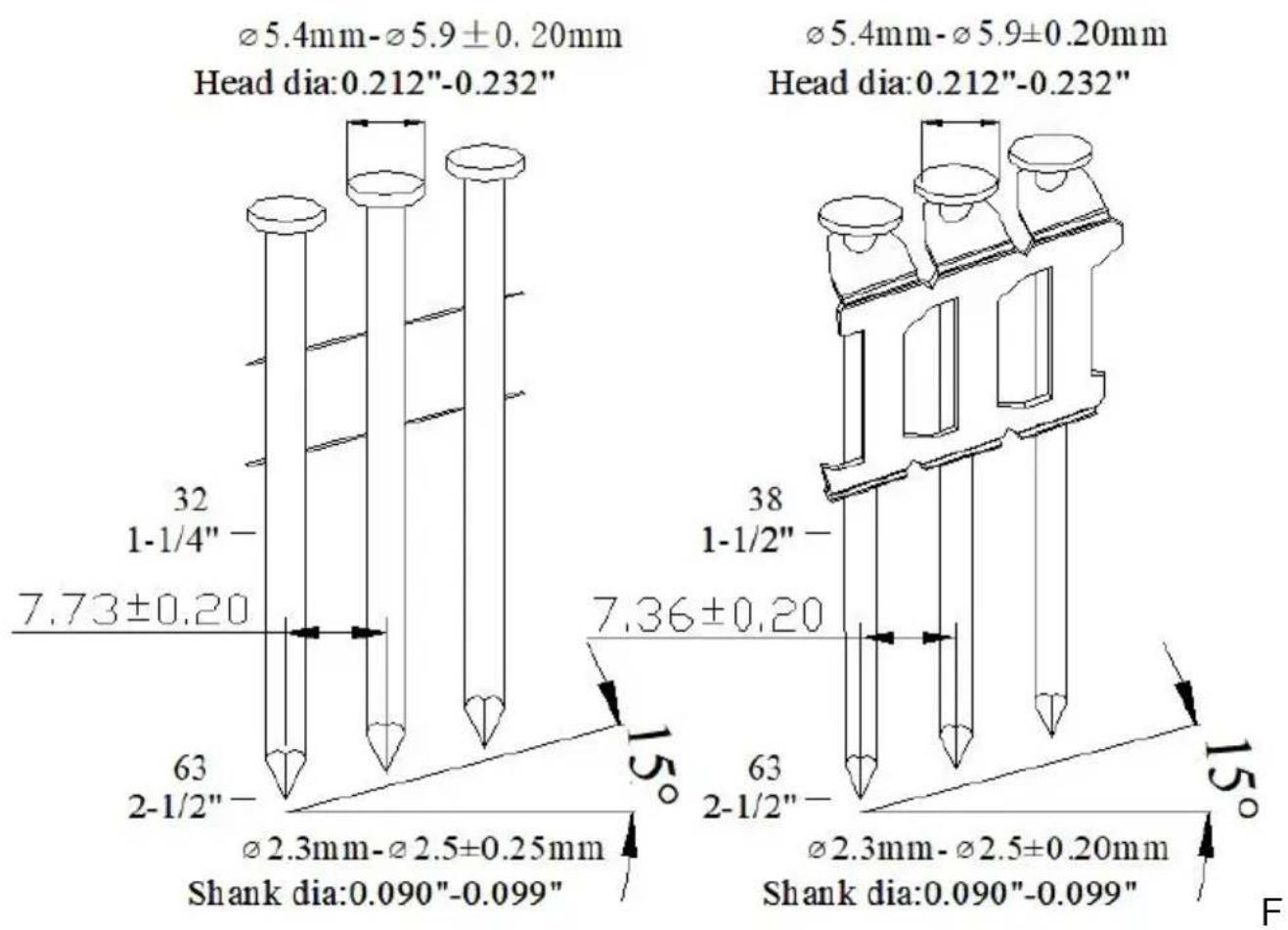
| Nail Length | 1 1/4" to 2 1/2" (31.75 mm to 63.5 mm) |
| Magazine Angle | 15 degrees |
| Body Material | Magnesium |
| Weight | Approximately 2.8 kg |
| Trigger System | Single Sequential and Contact (Selectable) |
| Adjustable Exhaust | Yes, tool-free rotatable |
| Adjustable Drive Depth | Yes, tool-free |
| Air Fitting | Quick coupler (US, European, Japanese types) |
| Lubrication | Pneumatic tool oil (2-6 drops per day) |
| Applications | Roofing underlayment, wall sheathing, framing, decking, furring strips |
Frequently Asked Questions - CN65 Vevor
User questions about CN65 Vevor
0 question about this device. Answer the ones you know or ask your own.
Ask a new question about this device
Download the instructions for your Screwdriver in PDF format for free! Find your manual CN65 - Vevor and take your electronic device back in hand. On this page are published all the documents necessary for the use of your device. CN65 by Vevor.
USER MANUAL CN65 Vevor
Technical Support and E-Warranty Certificate www. vvor. com/support
COIL NAILER
MODEL:CN65
We continue to be committed to provide you tools with competitive price. "Save Half", "Half Price" or any other similar expressions used by us only represent the estimate of savings you might benefit from buying certain tools with us compared to top brands and does not necessarily mean to cover all categories of tools offered. We are kindly reminded to verify carefully when you are placing an order with us actually saving half in comparison with the top major brands.
MODEL:CN65
NEED HELP? CONTACT US!
Have product questions? Need technical support? Please feel fr contact us:
Technical Support and E-Warranty Certificate www. vevor. com/support
This is the original instruction, please read all manual instruction carefully before operating. VEVOR reserves a clear interpretation user manual. The appearance of the product shall be subject to product you received. Please forgive us that we won't inform you if there are any technology or software updates on our product
| Warning-To reduce the risk of injury, user must read instruct manual carefully. | |
| Always wear ANSI approved safety goggles when working wi and equipment. Wear eye protection. Wear ear protection. Wear dust masks Wear protective gloves. | |
Technical Data
| MODEL | CN65 | Noise according to EN12549:1999 and EN ISO 4871 | |
| QUICK COUPLEF | USA TYPE EUROPE TYPE JAPAN TYPE | A-weighted sound pressure level | LpA=84dB (A) |
| Working pressure | 70- 110PSI (4.8-7.5bar) | Sound power level | LwA=97dB (A) |
| Max. pressure | 120PSI (8.3bar) | Vibration | 4.6cm/s2 |
1.1 Fastener
capacity: 250pcs
Fastener size:
1.2 Description/Features
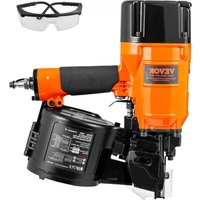
CN65 Coil nailer: Strong and light weight magnesium body, Drive standard 15 degree wire-collated and plastic nails from 1- 1/4" to 2- 1/2" long, both single and bump firing are available, steel contact safety with dual carbide inserts for wear, delivers the power to consistently drive nails in the toughest application. Sets nails properly every time with a tool free depth of drive with detents, p high-performance motor with adjustable tool free exhaust diffuser, big loading capacity magazine will fasten a full bundle of shingles, without reloading.
Application: Roof Decking Underlayment, Wall sheathing, Framing, Recreational
decks, Furring strips
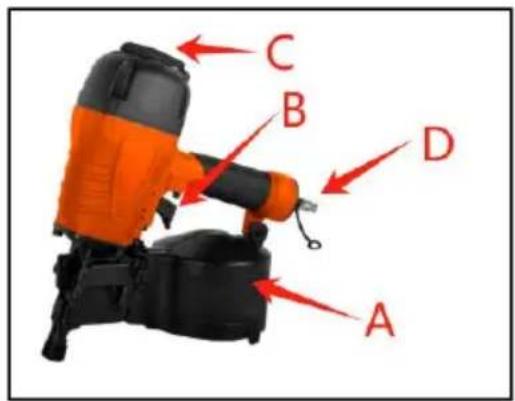
1.4 locations of Parts (see Figure)
A-Magazine
B-Trigger
C-Exhaust Vent
D- Air Quick Coupler
Special references
2.1 Instructions
The following standard is applicable to fastener driving tools; EN792- 13: 2000 2008"Hand-held non-electric power tools-safety requirements - Part 13: Fastene driving tools".
This standard requires that
-
only those fasteners which are specified in the operating instructions (see TECHNICAL DATA) shall be used in fastener driving tools. The fastener driving tool and the fasteners specified in the operating instructions are to be consid as one unit safety system;
-
quick action couplings shall be used for connection to the compressed air and the non-sealable nipple must be fitted at the tool in such a way that n compressed air remains in the tool after disconnection;
-
oxygen or combustible gases shall not be used as an energy source for compressed air operated fastener driving tools;
-
fastener driving tools shall only be connected to an air-supply where the maximum allowable pressure of the tool cannot be exceeded by more than 1 the case of higher pressure ,a pressure reducing valve which includes a downstream safety valve shall be built into the compressed air supply;
-
only spare parts specified by the manufacturer or his authorized representative shall be used in the repair of fastener driving tools;
-
repairs shall be carried out only by the manufacturers authorized agents or other experts, having due regard to the information given in the operating instructions.
-
stands for mounting the fastener driving tools to a support, for example to table, shall be designed and
constructed by the stand manufacturer in such a way that the fastener driving can be safely fixed for the intended use, thus for example avoiding damage, distortion, displacement.
Special fields of application for the fastener driving tool may require the observance of additional provisions and regulations.
-
only the main energy and lubricants listed in the operating instructions may be used:
-
fastener driving tools marked with an inverted equilateral triangle standing on point may only be used with an effective safety yoke;
-
for the maintenance of fastener driving tools, only spare parts specified by manufacturer or his authorized representative shall be used;
-
repairs shall be carried out only by agents authorized by the manufacturer other specialists, having due regard to the information given in the operating instructions;
-
NOTE: Specialists are those who, as a result by professional training or experience, have sufficient expertise in the field of fastener driving tools and sufficient familiarity with relevant governmental industrial protection provisions, accident prevention regulations, directives and generally recognized technical regulations (e.g. CEN-and CENELEC-standards), to be able to assess the safe working condition of fastener driving tools.
2.2 Noise emission
The characteristic noise values for the fastener driving tool have been determined in accordance with EN12549:1999 and EN ISO4871"Acoustics-Noise test code"fastener driving tools-Engineering method"(see Technical Data).
These values are tool-related characteristic values and do not represent the n development at the point of use. Noise development at the point of use will example depend on the working environment, the work piece, the work piece support and the number of driving operations, etc.
Depending in the conditions at the workplace and the form of the workplace, individual noise attenuation measures may need to be carried out, such as p work pieces on sound-damping supports, preventing work piece vibration by means of clamping or covering, adjusting to the minimum air pressure require the operation involved, etc, It is necessary to wear hearing protection equipme
2.3 Information on mechanical impact (vibration)
The characteristic vibration values for the fastener driving tool have been determined in accordance with ISO 8662-11:1999 and EN 12096 - Measurer of vibration in hand-held power tools - Part 11:Fastener driving tools (see Technical Data).
This value is a tool-related characteristic value and does not represent the
influence to the hand-arm-system when using the tool. An influence to the hand-arm-system when using the tool will for example depend on the gripping force, the contact pressure force, the working direction, the adjustment of enesupply, the workplace, the work piece support.
2.4 Safety of the fastener driving tool
- Check prior to each operation that the safety and triggering mechanism is functioning properly and that all nuts and bolts are right.
- Do not carry out any alterations to the fastener driving tool without the manufactures authorization.
- Do not disassemble or make inoperative any parts of the fastener driving test such as the safety yoke.
- Do not perform any" emergency repairs" without proper tools and equipment
- The fastener driving tool should be serviced properly and at regular interval accordance with the Manufacturer's instructions.
- Avoid weakening or damaging the too, for example by:
punching or engraving; modification not authorized by the manufacturer guiding against templates made of hard material such as steel; use the equipment as hammer; applying excessive force of any kind
2.5 Safety at work
Never point any operational fastener driving tool at you at any other person or animals.
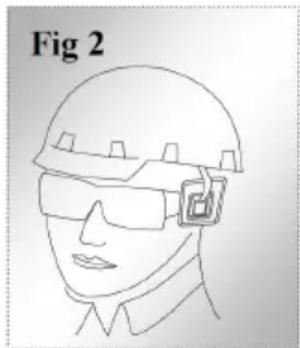
Hold the fastener driving tool during the work operation such a way that no injuries can be caused to the he body in the event of possible recoil consequent upon disruption in the energy supply or hard areas within the workplace. (see fig 2)
Never actuate the fastener driving tool into free space will avoid any hazard caused by free flying fasteners excessive strain of the tool.
The tool shall be disconnected from the compressed system for the purpose of transportation, especially w
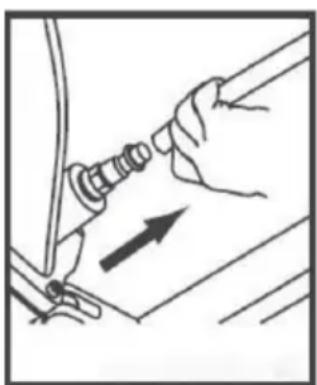
ladders are used or where an unusual physical posture is adopted whilst mo (see Fig 3).
Carry the fastener driving tool at the workplace using only the handle, and r with the trigger actuated.
Take conditions at the workplace into account. Fasteners can penetrate thin w/ pieces or slip off corners and edges of workplaces, and thus put people at For personal safety, use protective equipment such ad hearing and eye prote (see fig 2)
IMPORTANT: DO NOT direct the adjustable vent hole to the operator or other person or animals during the use.
2.6 Triggering devices
Fastener driving tools are operated by actuating the trigger using finger press In addition, fastener driving tool is fitted with a safety yoke which enables the driving operation to be carried out only after the muzzle of the tool is press against a work piece, These tool are marked with an inverted triangle( ) ber the serial number and are not permitted for use without an effective safety y
2.7 Actuating systems
Depending on their purpose, fastener driving tool is fitted with actuating system single sequential actuation and contact actuation.
You could switch to one nail figure to choose single sequential actuation, and switch to two nail figure to choose contact actuation.
-
Single sequential actuation: An actuating system in which the trigger and the safety yoke have to be activated so the only one single driving operation is actuated via the trigger after the muzzle of the tool has been applied to the location. Thereafter further driving operations can only be performed after the trigger has been returned to the non driving position whilst the safety yoke is depressed.
-
Contact actuation (restricted version): An actuating system in which the trigger and the safety yoke have to be actuated for each driving operation, with the of actuation not being specified. For repeated driving operations, it is sufficient either the trigger remains activated and the safety yoke is activated thereafter vice versa.
Fastener driving tools equipped with contact actuation must be marked with the symbol" Do not use on scaffoldings, ladders' (see Fig.4) and shall not be us specific application for example:
- when changing one driving location to another involves the use of scaffolding stairs, ladders, or ladder alike constructions, e.g. roof laths;
- closing boxes or crates;
- fitting transportation safety systems e.g. on vehicles and wagons.

Fig. 4: Symbol" Do not use on scaffoldings, ladders
3 Compressed air system
Proper functioning of the fastedriving tool requires filtered, dand lubricated compressed airadequate quantities.
| WARNING |
| Never free-fire the tool at high pressure. |
If the air pressure in the line system exceeds the maximum allowable of the fastener driving tool, a pressure reducing
valve followed by a downstream safety valve shall additionally be fitted in the supply line to the tool.
NOTE: When compressed air is generated by compressors, the natural moisture in the air condenses and collects as condensed water in pressure vessels and pipelines. This condensate must be removed by water separators.
These water separators must be checked on a daily basis and if necessary drained, since corrosion can otherwise develop in the compressed air system in the fastener driving tool. Which serves to accelerate wear.
The compressor plant shall be adequately dimensioned in terms of pressure output and performance (volumetric flow) for the consumption which is to be expected. Line sections which are too small in relation to the length of the (pipes and hoses), as well as overloading the compressor, will result in press drops.
Permanently laid compressed air pipelines should have an internal diameter of least 19mm and a corresponding large diameter where relatively long pipeline multiple users are involved.
Compressed air pipelines should be laid so as to form a gradient (highest p the direction to the compressor). Easily accessible water separators should be installed at the lowest points.
Junctions for users should be joined to the pipelines from above,
Connecting points for fastener driving tools should be fitted with a compresseservicing unit (filter/water separator/oiler) directly at the junction point.
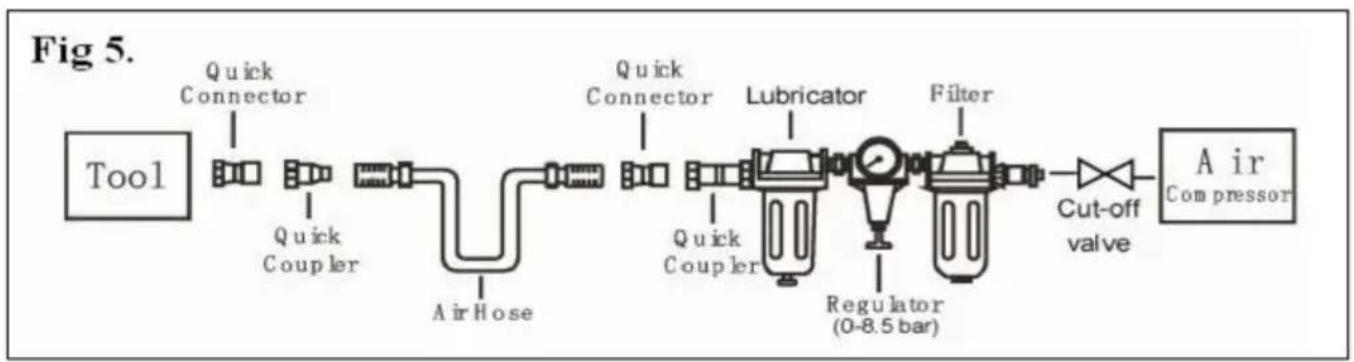
Oilers must be checked on a daily basis and if necessary topped up with the recommended grade of oil (see TECHNICAL DATA). Where hose lengths of 0.10m are used., the oil supply for the fastener driving tool cannot be guaranteed. We therefore recommend that 2to 5drops (depending on the loading of the fastener driving tool) of the recommended oil (see TECHNICAL DATA) should be added via the air inlet of the tool, or an oiler attached directly to the faster tool. (see fig 5)
4 Preparing the tool for use
4.1 Preparing a tool for first time operation
Please Read and observe these Operating Instruction before using the tool. B safety measures should always be strictly followed to protect against damage
the equipment and personal injury to the user or other people working in the vicinity of operation.
4.2 Connection to the compressed air system
Ensure that the pressure supplied by the compressed air system does not e) the maximum allowable pressure of the fastener driving tool. Set the air pres initially to the lower value of the recommended allowable pressure (see TECHNICAL DATA).
Empty the magazine to prevent a fastener from being ejected at the next sta work in the event that internal parts of the fastener driving tool are not in t starting position following maintenance and repair work or transportation.
Connect the fastener driving tool to the compressed air supply using suitable pressure hose equipped with quick-action connectors.
Check for proper functioning by applying the muzzle of the fastener driving to a piece of wood or wooden material and actuating the trigger once or twice.
4.3 Filling the magazine
Only those fasteners specified under TECHNICAL DATA (see 1.1) may be used. When filling the magazine, hold the tool so that the muzzle is not pointing to the operator or any other person or animals.
4.4 Handling the tool
Pay attention to 2-Special Reference-of these operating instructions.
Having checked that the fastener driving tool is functioning correctly, apply the tool to a work piece and actuate the trigger.
Check whether the fastener has been driven into the work piece in accordance with the requirements.
-
if the fastener is protruding, increase the air pressure in increments of 0.5 checking the result after each new adjustment;
-
if the fastener is driven into an excessive depth reduce the air pressure I increments of 0.5 bar until the result is satisfactory.
You should endeavor in any event to work with the lowest possible air press. This will give you three significant advantages;
-
Energy will be saved,
-
Less noise will be produced,
3.A reduction in fastener driving tool wear will be achieved.
Avoid triggering the fastener driving tool if the magazine is empty.
Any defective or improperly functioning fastener driving tool must immediately be disconnected from the compressed air supply and passed to a specialist for inspection.
In the event of longer breaks in work or at the end of the working shift, did the tool from the compressed air supply and it is recommended to empty the magazine.
The compressed air connectors of the fastener driving tool and the hoses sh be protected against contamination, the ingress of coarse dust chips, sand et result in leaks and damage to the fastener driving tool and the couplings.
5. Maintenance
Disconnect the tool from the compressor before adjusting, clearing jams, servicing & maintenance, relocating and during non operation.
Regular lubrication, if your tool without using the in-liner automatic oilier, place 6 drops of pneumatic tool oil into the air inlet before each work day or after of continuous use depending in the characteristic of work piece or type of fasteners.
Air-operated tools must be inspected periodically, and worn or broken parts may be replaced to keep the tool operating safely and efficiently. Check and chan- worn or damaged O-ring, Seals, etc. Tighten all the screws and caps to avo personal injury. This should be done by an expert.
Make regular inspection for free movement of trigger, spring and safety mechanism to assure safe system is complete and functional: no loose and missing parts, no building or stocking parts.
Keep magazine and nose of tool clean and free of any dirt lint or abrasive. When temperatures are below freezing, tools should be kept warm by any convenient, safe method.
6 Troubleshooting (See Table 1)
| SYMPTOM | PROBLEM | SOLUTIONS |
| Air leak near top of tool or in trigger area | 1. O-ring in trigger valve is damaged. 2. Trigger valve head are damage. 3. Trigger valve stem, seal O-ring are damaged. | 1. Check and replace O-ring 2. Check and replace. 3. Check and replace trigger valve stem, seal or O-ring |
| Air leak near bottom of tool. | 1. Loose screws. 2. Worn or damaged O-ring or bumper. | 1. Tighten screws. 2. Check and replace O-ring or bumper. |
| Air leak between body and cylinder cap. | 1. Loose screws. 2. Worn or damaged O-ring or seals. | 1. Tighten screw. 2. Check and replace O-ring or bumper. |
| Blade driving fastener too deep. | 1. Worn bumper. 2. Air pressure is too high | 1. Replace bumper. 2. Adjust the air pressure. |
| Tool does not operate well: cannot drive fastener or operate sluggishly. | 1. Inadequate air supply. 2. Inadequate lubrication. 3. Worn or damaged O-ring or seals. 4. Exhaust port in cylinder head is blocked. | 1. Verify adequate air supply 2. Place 2 or 6 drops of air inlet. 3. Check and replace O-rings or seal. 4. Replace damaged internal parts. |
| Tool skips fasteners. | 1. Worn bumper or damagspring. 2. Dirt in front plate. 3. Dirt or damage prevents fasteners from moving freely in magazine. 4. Worn or dry O-ring on piston or lack of Lubrication 5. Cylinder covers seal leaking. | 1. Replace bumper or push spring. 2. Clean drive channel on plate. 3. Magazine needs to be cleaned. 4. O-ring needs to be replaced And lubricate. 5. Replace Sealing washer. |
| Tool jams. | 1. Incorrect or damaged fasteners. 2. Damaged or worn driver guide. 3. Magazine or nose screw loose. 4. Magazine is dirty. | 1. Change and use correct fastener. 2. Check and replace the driver. 3. Tighten the magazine. 4. Clean the magazine. |
VEVOR
TOUGH TOOLS, HALF PRICE
Technical Support and E-Warranty Certificate
www. vvor. com/support
VEVOR®
TOUGH TOOLS, HALF PRICE
Assistance technique et certificat de garantie electronique www. vvor. com/support
CLOUEUR À BOBINE
MODELE:CN65
Never free-fire the tool at high pressure.
HULP NODIG? NEEM CONTACT MET ONS OP!
- COIL NAILER
- MODEL:CN
- NEED HELP? CONTACT US
- TECHNICAL DATA
- FASTENER
- DESCRIPTION/FEATURES
- LOCATIONS OF PARTS (SEE FIGURE)
- SPECIAL REFERENCES
- INSTRUCTIONS
- NOISE EMISSION
- INFORMATION ON MECHANICAL IMPACT (VIBRATION)
- SAFETY OF THE FASTENER DRIVING TOOL
- SAFETY AT WORK
- TRIGGERING DEVICES
- ACTUATING SYSTEMS
- COMPRESSED AIR SYSTEM
- PREPARING THE TOOL FOR USE
- PREPARING A TOOL FOR FIRST TIME OPERATION
- CONNECTION TO THE COMPRESSED AIR SYSTEM
- FILLING THE MAGAZINE
- HANDLING THE TOOL
- MAINTENANCE
- VEVOR
- VEVOR®
- TOUGH TOOLS, HALF PRICE
- CLOUEUR À BOBINE
- HULP NODIG? NEEM CONTACT MET ONS OP
Brand : Vevor
Model : CN65
Category : Screwdriver