
Avent SCF537 - Breast pump PHILIPS - Free user manual and instructions
Find the device manual for free Avent SCF537 PHILIPS in PDF.


| Product type | Double electric hands-free breast pump |
| Brand | Philips |
| Model | Avent SCF537 |
| Motor unit dimensions | 145 mm x 95 mm x 45 mm |
| Net weight | 355 g (double pump) |
| Power supply | Rechargeable lithium-ion battery 3.6 V, 2600 mAh, 9.4 Wh; USB input 5 V DC, 1.8 A |
| Battery life | Approximately 5 x 15-minute (double) or 30-minute (single) sessions per full charge |
| Charging time | Up to 1.5 hours |
| Suction levels | Stimulation mode: 8 levels (-70 to -225 mbar); Expression mode: 16 levels (-70 to -360 mbar) |
| Cycles per minute | Stimulation: 105-120 cycles/min; Expression: 53-85 cycles/min |
| Automatic shut-off | After 30 minutes of inactivity or 15 minutes on pause |
| Operating modes | Stimulation and expression, automatic switch after 90 seconds |
| Included parts | Motor unit, removable clip, carrying strap, USB cable, tube connector, pouch, user manual |
| Materials | Motor unit: MABS, ABS, silicone, TPE; Clip: ABS; Strap: polyester, polypropylene, ABS |
| Operating temperature | 5 °C to 40 °C |
| Operating humidity | 15% to 90% non-condensing |
| Operating pressure | 700 to 1060 hPa (altitude < 3000 m) |
| Protection rating | IP22 |
| Compatibility | Only with Philips Avent SCF481/11, SCF439/01 collection bottles or SCF335/12, SCF337/01/11, SCF338/11 kits |
| Maintenance | Wipe the motor unit and cable with a damp cloth and mild detergent |
| Safety | Automatic shut-off, electromagnetic field protection, battery with integrated protections |
| Warranty | 2 years (Philips international) |
| Lifespan | 500 hours |
Frequently Asked Questions - Avent SCF537 PHILIPS
User questions about Avent SCF537 PHILIPS
0 question about this device. Answer the ones you know or ask your own.
Ask a new question about this device
Download the instructions for your Breast pump in PDF format for free! Find your manual Avent SCF537 - PHILIPS and take your electronic device back in hand. On this page are published all the documents necessary for the use of your device. Avent SCF537 by PHILIPS.
USER MANUAL Avent SCF537 PHILIPS
Double Electric Motor Unit
User manual for mother 7
Introduction 7
General description 7
Intended use and indications for use 8
Important safety information 8
Before first use - instruction for mother 10
Cleaning and disinfecting 11
Using the breast pump 11
After use 16
Compatibility 17
Ordering accessories and spare parts 17
Support 17
Troubleshooting 17
Undesirable side effects 19
Storage 20
Electromagnetic fields (EMF) 20
Technical specifications 20
Explanation of symbols 24
User manual for rental agent 28
Introduction 28
General description 28
Important safety information 28
Preparing for rental use 29
Step 1: Register and track 29
Step 2: Instructions for motor unit return 29
Step 3: Quality checklist 30
Step 4: Factory reset 31
Step 5: Cleaning before renting 32
Step 6: Prepare for the next rental use 32
Recycling 32
Removal of built-in rechargeable battery 32
User manual for mother
Introduction
Thank you for choosing to rent this Philips Avent breast pump.
Unleash your freedom with the Philips Avent Hands-free Electric Breast Pump. The pump that brings the best of both worlds; unique soft comfort combined with an effective* hospital-strength pump. The unique SkinSense silicone breast shields softly shape around your breast, using your body's natural warmth for a comfortable fit. The ultra-light collection cups are fully transparent for easy nipple placement and milk flow visibility.
Did you know that breast pumps can play a crucial support role in your breastfeeding experience? Breast pumps can enhance milk volume and with a stash of expressed milk in the fridge, partners and caregivers can actively participate in caring for the little one, affording you precious moments of self-care or a smooth return to work. If you are breastfeeding, it is advisable (unless recommended otherwise by your healthcare professional) to wait until your milk supply and breastfeeding schedule are established (normally at least 2 to 4 weeks after giving birth) before you start expressing.
- 'Effective' is related to the technical performance of the product.
General description
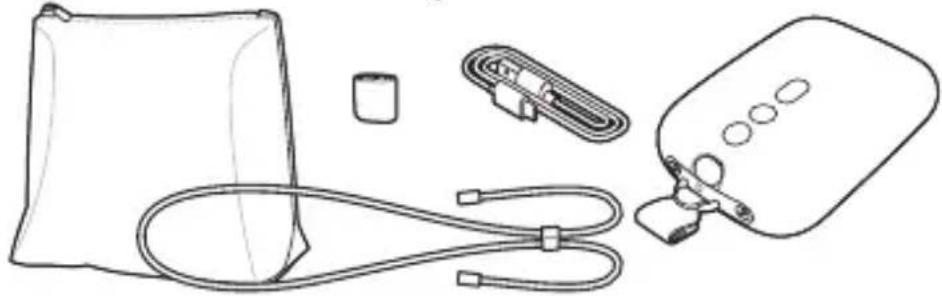
① Note: The numbers mentioned below refer to the numbers in the figure on the front foldout page of this user manual.
Rental items (Fig. 1) - motor unit (1 pcs) and parts (to be returned)
1 USB power inlet
2 On/off button with pause function
3 Mode selection button
4 'Level down' button
5 'Level up' button
6 LED display
7 Tubing ports for double breast pump
8 Clip (detachable) (1 pcs)
9 Loop
10 Carrying cord (1 pcs)
11 Tube coupler (1 pcs)
12 USB cable (1 pcs)
Additional items (to be returned)
These additional items are not shown in the figure:
- User manual
- Pouch
Intended use and indications for use
The Philips Avent hands-free double electric breast pump is intended to express and collect milk from the breast of a lactating woman, and indicated to alleviate the symptoms of engorgement. The motor unit is intended for multiple users. The collection cups are intended for a single user.
Important safety information
Only use the product for its intended purpose. Read this important information carefully before you use the product and its batteries and accessories, and save it for future reference. Misuse can lead to hazards or serious injuries.
This user manual can also be found online at: www.philips.com/support.
Please also read the separate user manual for your Philips Avent hands-free collection cups before you start using the breast pump.
This product is operated by the lactating woman herself.
You can use this breast pump in an everyday environment.

Contraindication
- Never use the breast pump while you are pregnant, as pumping can induce labor.

Warning
Warnings to avoid choking, strangulation and injury:
-
Never use the breast pump while driving to avoid accidents due to reduced attention.
-
Children and pets should be supervised to ensure that they do not play with the motor unit, packaging materials or accessories.
-
Make sure that you use the silicone tube(s), carrying cord, and USB cable carefully to avoid strangulation.
-
This breast pump is not intended for use by persons (including children) with reduced physical, sensory or mental capabilities, or lack of experience and knowledge. Such persons can only use this breast pump if they are supervised by or have received proper instruction concerning use of the appliance by a person responsible for their safety.
Warning to prevent transmitting infectious diseases:
- If you are a mother who is infected with Hepatitis B, Hepatitis C or Human Immunodeficiency Virus (HIV), expressing breast milk will not reduce or remove the risk of transmitting the virus to your baby through your breast milk.
Warnings to avoid electric shock:
- If a power adapter (not included) is used for charging, only use a certified double-insulated USB power adapter. Check if the symbol for double insulation is on the adapter: Use a power source (an adapter or a power bank) with a USB port, of 5 V direct current/1.8 A or 9 W for your breast pump.
- When using a USB power adapter (not included) to charge or operate the breast pump: inspect the adapter for signs of damage before charging. Do not use if the adapter is damaged, or outer casing becomes loose or is separating. Separation of the casing can result in electric shock.
- Inspect the breast pump for signs of damage before each use or if it has been dropped. Do not use the breast pump if it is damaged or does not work properly, or if it has been submerged in water.
- Always ensure that it is easy to disconnect the device from the mains in case of malfunction. The external power supply is considered the disconnection device.
Warnings to avoid contamination and to ensure hygiene:
- Multiple-user breast pumps are designed in such a way that the breast milk can never touch the parts of the product that can be shared. The only part of a multiple-user breast pump that can be shared safely is the motor unit.
Warning to avoid cross-contamination:
- Clean the motor unit before renting out the device to the next user.
Warnings to avoid breast and nipple problems including pain:
- Only use accessories and parts recommended by Philips Avent.
- No modification of the breast pump is allowed. If you do so, your warranty becomes invalid.
- There are no user serviceable parts inside the motor unit of the breast pump.
- Never use the breast pump while you are sleepy or drowsy to avoid lack of attention during use.
- If the vacuum is uncomfortable or causes pain, switch off the motor unit and remove the collection cups from your breast.
- Contact your healthcare professional or breastfeeding specialist if you express no or insufficient milk or if your breast is painful, hot, swollen, or red.
Warnings to prevent damage and malfunction of the breast pump:
-
Portable radio frequency (RF) communications equipment (including mobile phones and peripherals such as antenna cables and external antennas) should not be used closer than 30~cm (12 in) to any part of the breast pump, including external power supply. This could have a negative effect on the performance of the breast pump.
-
Use of this equipment adjacent to or stacked with other equipment should be avoided because it could result in improper operation.
Warning to avoid increased electromagnetic emissions or decreased electromagnetic immunity of this device, resulting in improper operation:
- Use of accessories, transducers and cables other than those specified or provided by the manufacturer of this equipment could result in increased electromagnetic emissions or decreased electromagnetic immunity of this equipment and result in improper operation.
Battery safety instructions
Only use the product for its intended purpose. Read this important information carefully before you use the product and its batteries and accessories, and save it for future reference. Misuse can lead to hazards or serious injuries.
Accessories supplied may vary for different products.
- Charge, use and store the product at the temperature ranges indicated in the technical specifications chapter in this user manual.
- Keep product and batteries away from fire and do not expose them to direct sunlight or high temperatures.
- If the product becomes abnormally hot or smelly, changes color or if charging takes longer than usual, stop using and charging the product and contact Philips.
- Do not place products and their batteries in microwave ovens or on induction cookers.
- Do not open, modify, pierce, damage or dismantle the product or battery to prevent batteries from heating up or releasing toxic or hazardous substances. Do not short-circuit, overcharge or reverse charge batteries.
- Be aware of the risk of terminals of the battery-operated appliance on battery being short-circuited by metal objects.
Caution
Cautions to prevent damage to and malfunctioning of the breast pump:
- Prevent the USB power adapter (not included), USB cable, and motor unit from coming into contact with water.
- Keep all parts away from heated surfaces to avoid overheating and deformation of these parts.
Before first use - instruction for mother
Please refer to the user manual of your Philips Avent hands-free collection cups for the instructions on how to clean and disinfect them.
Fully charge the device before you use it for the first time or after a long period of non-use.
Cleaning and disinfecting
- Clean the pouch, carrying cord, tube coupler, USB cable, and motor unit (including the clip) when needed. Wipe with a clean, damp cloth with water and mild detergent.
Using the breast pump
Note: The figure numbers mentioned below refer to the numbers of the figures on the back foldout pages of this user manual.
Charging the breast pump
Fully charge the battery before you use the breast pump for the first time and when the battery is low. Fully charging the battery takes up to 1.5 hours. Use a power source (an adapter or a power bank) with a USB port, of 5V direct current/1.8 A or 9W for your breast pump. Using a power source with lower specifications might result in slow charging or being unable to pump while connected to a wall socket.
1 Switch off the device (Fig. 2).
2 Insert the small plug of the USB cable into the motor unit and insert the other end of the USB cable into a USB power source, e.g. adapter or laptop.
3 The battery lights light up one by one and then all go out: the battery is charging (Fig. 3).
4 All 3 lights are steady on: the battery is fully charged (Fig. 4).
5 Remove the USB cable from the USB power source and pull the small plug out of the motor unit.
Battery indicator light description
The battery indicator lights show the battery capacity.
- Three lights are steady on: the battery is fully charged for approximately 5 pumping sessions.
- Two lights are steady on: the battery is charged sufficiently for 2-3 sessions.
- One light flashes slowly: the battery is charged sufficiently for maximum 1 session. Charging is needed soon.
- First light flashes quickly: the battery is very low, the device will stop operating soon. Charging is needed.
One session is 15 minutes of pumping (double breast pump) or 30 minutes of pumping (single breast pump).
Assembling the breast pump
1 Please refer to the user manual of your Philips Avent hands-free collection cups for the first assembly steps, for example how to assemble the collection cups and connect the tube(s) to them.
2 Connect the silicone tube(s) to the motor unit (Fig. 5).
3 When the breast pump is charged, you can use it cordless. You can also use the breast pump connected to a power source. The battery will not charge while pumping.
Wearing the motor unit
The motor unit can be worn in multiple ways:
1 Use the provided clip to attach it to your clothes. The clip is pre-attached to the motor unit. Slide the clip over your clothes to fasten it tightly (Fig. 6).
2 Use the provided carrying cord to wear it across your body (Fig. 7). Attach the carrying cord to the clip. Make sure that the carrying cord and the silicone tubes do not get entangled. You can adjust the length of the carrying cord.
Motor unit part description
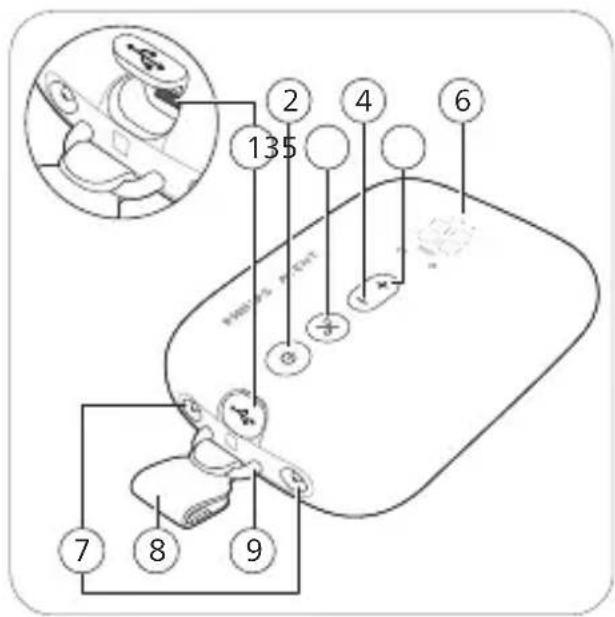
1 USB power inlet
2 On/off button with pause function
3 Mode selection button
4 'Level down' button
5 'Level up' button
6 LED display
7 Tubing ports for double breast pump
8 Belt clip (detachable)
9 Loop
LED display description
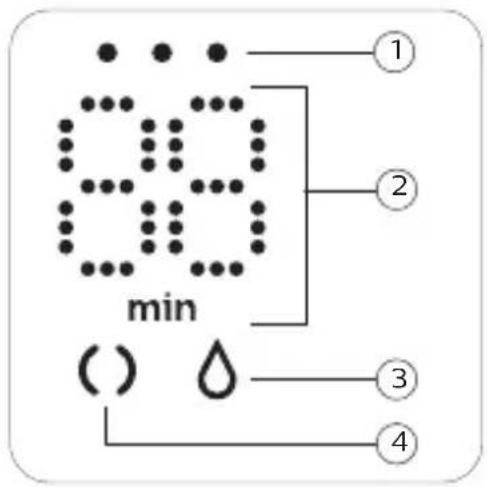
1 Battery indicator lights
2 Timer (minutes) and vacuum level indication
3 Expression icon
4 Stimulation icon
Explanation of modes
The breast pump has two modes. Below you can find an explanation of these modes.
| Mode icons | Mode Explanation | No. of suction | levels |
| Stimulation mode | Mode to stimulate the breast to start up the milk flow. | 8 suction levels | |
| Expression mode | Mode for efficient milk removal after milk has started flowing. After 90 sec. of stimulation, the device automatically switches to the expression mode. | 16 suction levels |
| The number on the display shows the running time in minutes. | ||
| When you change the suction level, the display shows the selected suction level for a few seconds and then shows the running time again. |
If you do not use the buttons for 8 seconds, the LED display dims and then switches off. Pressing any button will re-activate the LED display by showing the running time.
Pumping instructions
Warning: Always switch off the breast pump before you remove the collection cup from your breast, in order to release the vacuum.
Warning: Do not continue pumping for more than five minutes at a time if you do not succeed in expressing any milk. This can lead to pain and damage to your milk ducts. Try to express at another time during the day.
Warning: If the process becomes very uncomfortable or painful, stop using the breast pump and consult your healthcare professional.
Caution: The vacuum level generated by the device is sensitive to the ambient atmospheric pressure. At higher altitudes, the generated vacuum is less intense.
1 Wash your hands thoroughly with soap and water. Clean your breast and nipple prior to placing the collection cup.
2 Place the assembled collection cup into your bra, on your breast, with the pouring spout (opening) positioned at the top (Fig. 8).
3 Make sure that the nipple is in the center of the breast shield.
4 Press and hold the on/off button until the device switches on (Fig. 2). The indicator lights go on to indicate that the device is in stimulation mode.
5 You can look through the top of the transparent cup to check whether the collection cup is positioned properly, and whether the nipple is moving. Your nipple should be in the center of the breast shield and should move in and out of the funnel (Fig. 8).
6 The breast pump starts in the stimulation mode and slowly increases its vacuum to the last used stimulation suction level (or level 5 when used for the first time) (Fig. 9).
7 The display shows the running time (Fig. 10).
8 Use the 'level up' and 'level down' buttons to change the suction level to your preference (Fig. 11).
9 After 90 seconds, the breast pump smoothly switches to expression mode and slowly increases its vacuum to the last used expression suction level (or level 11 when used for the first time) (Fig. 12).
10 If your milk starts flowing earlier, or if you do not have a milk flow after 90 seconds (and want to switch back to the stimulation mode), you can switch modes with the mode selection button (Fig. 13).
11 Briefly press the on/off button if you want to pause. To continue, briefly press the on/off button again.
12 Press and hold the on/off button to switch off (Fig. 2).
Note: You can use the double breast pump as a single breast pump by disconnecting the silicone tube from one collection cup. For your convenience, you can attach the silicone tube to the tube coupler (Fig. 14).
Note: The collection cups can be worn in your regular nursing bra. If you experience discomfort or pain, try switching to a more stretchy bra.
Using the breast pump when you have symptoms of engorgement
Breast engorgement is the swelling of the breasts, often caused by increased milk production. It occurs when the breasts become overly full and swollen, leading to discomfort. Symptoms may include hard, tight, or warm breasts, difficulty with milk ejection reflex, and redness, tenderness, or pain. To reduce the risk of overstimulation and engorgement, follow these instructions:
- Gently massage the breasts before and during pumping to encourage milk flow.
- Use the lowest effective suction level and avoid prolonged pumping sessions. High suction levels or extended sessions may cause discomfort or potential breast tissue damage.
- Pump only the amount that your baby needs.
If you experience symptoms of engorgement, consider the following measures: - Pumping gently for a short duration can help relieve discomfort. Pump just enough to relieve the discomfort as excessive pumping may worsen engorgement.
- If discomfort persists or if you experience redness, warmth, fever, or flu-like symptoms, consult a healthcare professional.
Warning: Overstimulation of the breasts through high suction levels or prolonged pumping may lead to discomfort or potential breast tissue damage.
Warning: Excessive or prolonged pumping may increase breast swelling, tenderness, or worsen engorgement. If you experience these symptoms, stop pumping and consult a healthcare professional.
After use
Warning: Refrigerate or freeze expressed breast milk immediately or keep it at a temperature of 16 - 29^ C for a maximum of 4 hours before you feed your baby.
1 After completing the pumping session, lift the collection cup out of your bra. Place the collection cup on a clean and flat surface (Fig. 15). Be careful not to spill any milk from the pouring spout.
2 To store the breast milk: pour the expressed breast milk from the collection cup into a separate milk storage container (e.g., a bottle or a breast milk storage bag) (Fig. 16). Do not store expressed breast milk in the collection cup.
3 Disassemble, clean and disinfect all parts that have been in contact with the breast and breast milk (see 'Cleaning and disinfecting').
Storing breast milk
Below you find guidelines for storing breast milk:
Storage location Temperature Max. storage
duration
Room 16-29 °C 4 hours
Refrigerator 4^ 4 days
Freezer < -4^ 6 months
Warning: Never refreeze thawed breast milk to avoid a decrease in milk quality.
Warning: Never add fresh breast milk to frozen breast milk to avoid a decrease in milk quality and unintended thawing of the frozen milk.
Compatibility
The Philips Avent hands-free motor unit (SCF537/11) can only be used in combination with the Philips Avent hands-free collection cups (SCF481/11, SCF439/01) or the Philips Avent breast pump kits (SCF335/12, SCF337/01, SCF337/11, SCF338/11). Do not combine it with other Philips Avent models or different brands.
Ordering accessories and spare parts
To order accessories or spare parts, visit www.philips.com/support or go to your Philips dealer. You can also contact the Philips Consumer Care Center in your country.
Support
For all product support, power consumption details and the EU Declaration of Conformity, please visit www.philips.com/support.
Troubleshooting
This chapter summarizes the most common problems you could encounter with the breast pump. If you are unable to solve the problem with the information below, visit www.philips.com/support for a list of frequently asked questions or contact the Consumer Care Center in your country.
| Problem Solution | |
| I experience pain when I use the breast pump. | - Check if you use the most suitable breast shield size and, if necessary, the insert size.- Choose a suction level that is comfortable for you (see 'Pumping instructions').- Check if the membrane is not damaged (does not have small cracks, holes etc.).- Make sure that your nipple is placed in the center of the opening of the breast shield.- If the pain persists, stop using the breast pump and consult your healthcare professional. |
| I do not feel any suction/the suction level is too low. | - Check if the valve is not damaged, the opening in its pointed part closes fully, and that the valve is assembled correctly. - Check if the membrane is not damaged (does not have small cracks, holes etc.). - Make sure that all the parts are clean and assembled correctly (see 'Assembling the breast pump'). - Check if you use the most suitable breast shield size and, if necessary, the insert size. - Make sure that the collection cup is positioned correctly on the breast to allow a seal between the breast shield and your breast. - If possible, try a higher suction level. - Before pumping, try warming your breast with a warm towel and massaging it to stimulate the areola so the breast is completely unblocked. |
| The breast pump is not charging. | - Make sure that you use a power source (an adapter or a power bank) with a USB port, of 5 V direct current/1.8 A or 9 W for your breast pump. - The breast pump is too cold or too hot for charging. Let the breast pump acclimate to room temperature for 30 minutes. |
| The breast pump does not switch on (indicator lights do not go on). | Make sure that the battery is charged (see 'Charging the breast pump') or connect the breast pump to a power source. Use a power source (an adapter or a power bank) with a USB port, of 5 V direct current/1.8 A or 9 W for your breast pump. |
| The suction of the breast pump is too strong. | - Before pumping, try warming your breast with a warm towel and massaging it to stimulate the areola so the breast is completely unblocked. - If possible, try a lower suction level. When you express for the first time, start with the default suction level (level 5 in stimulation mode, level 11 in expression mode) and increase/decrease the level when needed. During different expression sessions, different levels may feel most comfortable for you. - Make sure that you only use the breast pump parts provided with this breast pump. - Check if the membrane is not damaged (does not have small cracks, holes etc.). |
Undesirable side effects
Any serious incident that has occurred in relation to this device should be reported to Philips via www.philips.com/support and to the competent authority of the Member State in which the user and/or patient is established. When using the breast pump, the below undesirable side effects may occur. If you experience any of these symptoms, contact a healthcare professional or breastfeeding specialist.
| Undesirable side effect | Description |
| Pain Pain felt on the | breast or nipple, or felt as a response to the suction being above a comfortable level. |
| Sore nipples Persistent | pain in the nipples at the beginning of the pumping session, or that lasts throughout the entire pumping session, or pain between sessions. |
| Engorgement Swelling of the breast. The breast may feel hard, lumpy and tender. May include erythema (redness) of the breast area and fever. Usually occurs during the first days of lactation. | |
| Erythema (redness) | Redness of the skin of the breast. |
| Bruise, thrombus A | reddish-purple discoloration that does not fade when pressed. When a bruise fades, it may become green and brown. |
| Nipple trauma | - Fissures or cracked nipples. - Skin tissue peeling off the nipple. Normally occurs in combination with cracked nipples and/or blisters. - Nipple tear. - Blister. Looks like small bubbles on the surface of the skin. - Bleeding. Cracked or torn nipples can lead to bleeding of the affected area. |
| Clogged mammary ducts | A red, tender lump on the breast. May include erythema (redness) of the breast area. Can lead to mastitis (breast inflammation) and fever if left untreated. |
| Rash or allergic reaction | Redness or irritation of the skin of the breast, it can be itchy, scaly, painful or blistered. |
Storage
- Keep the breast pump out of direct sunlight as prolonged exposure may cause discoloration. Store the breast pump and its accessories in a safe, clean and dry place.
- If the device has been stored in a hot or cold environment, place it in an environment with a temperature of 20^ for 30 minutes to let it reach a temperature within the usage conditions (5 °C to 40 °C) before you use it.
- To preserve the battery life, fully charge the battery before storing your breast pump for an extended period of time.
Electromagnetic fields (EMF)
This Philips device complies with all applicable standards and regulations regarding exposure to electromagnetic fields.
Technical specifications
| Vacuum level Stimulation | -70 to -225 mbar (-53 to -169 mmHg) Expression: -70 to -360 mbar (-53 to -270 mmHg) Intermittent vacuum |
| Cycle speed Stimulation | 105-120 cycles/min, depending on vacuum level Expression: 53-85 cycles/min, depending on vacuum level |
| Motor unit rated input | 5 V direct current / 1.8 A |
| Battery Lithium-ion rechargeable battery: 3.6 V, 2600 mAh, 9.4 Wh (internal) | |
| Automatic power-off | After 30 minutes (after the last user interaction), after 15 minutes (in the pause mode) |
| Power port USB-C | |
| Operating conditions | Temperature: 5 °C to 40 °C Relative humidity: 15 to 90 % (non-condensing) |
| Storage and transportation conditions | Temperature: -20 °C to 45 °C Relative humidity: up to 90 % (non-condensing) |
| Operating and storage pressure | 700-1060 hPa (<3000 m/9842 ft. altitude) |
| Net weight 355 g (double breast pump) | |
| External dimensions | Motor unit: 145 mm x 95 mm x 45 mm (length x width x height) |
| Device classification | Applicable classifications Degree of protection against electric shock: - Collection cup: type BF applied part The motor unit and external power supply (not provided) are a medical electrical system. |
| Materials Motor unit | MABS, ABS, silicone, TPE. Clip, tube coupler: ABS. Carrying cord: polyester, polypropylene, ABS. |
| Service life 500 hours | |
| Mode of operation | Continuous operation |
| Ingress protection IP | 22 |
Electromagnetic compatibility - compliance information
This device has been tested and found to comply with IEC 60601-1-2:2020 for electromagnetic compatibility (EMC) as Class B according to CISPR 11:2015 +A1:2016 +A2:2019. Tests levels are listed in the accompanying tables.
Emissions Compliance Electromagnetic environment - guidance
| RF emissions CISPR 11 | Group 1 The device does not use RF energy for its intended function. Therefore, its RF emissions are very low and are not likely to cause any interference in nearby electronic equipment. |
Emissions Compliance Electromagnetic environment - guidance
| RF emissions CISPR 11 | Class B | The device is suitable for use in locations in residential environments and in establishments directly connected to a low voltage power supply network which supplies buildings used for domestic purposes. |
| Harmonic emissions IEC 61000-3-2 | Complies Class A Category | |
| Voltage fluctuations / flicker emissions IEC 61000-3-3 | Complies |
Guidance and manufacturer's declaration - electromagnetic immunity
The Philips Avent hands-free double electric motor unit is intended for use in the electromagnetic environment specified below. The customer or the user of the motor unit should assure that it is used in such an environment. The essential performance functions are the accuracy of the vacuum pressure and the backflow protection to withstand milk leakage into the motor unit. The Philips Avent hands-free double electric motor unit was tested for immunity to electromagnetic disturbances and passed using the criteria of no change in modes, vacuum accuracy (± 20%) , backflow protection and operation of the motor unit.
| Immunity test Immunity test level | Electromagnetic environment - guidance | |
| Electrostatic discharge (ESD) IEC 61000-4-2 | ±8 kV contact ±15 kV air | Floors can be a source of static electricity. When the air is very dry (<20 % RH) the user is advised to prefer to use the device in a room with concrete or wooden floor (instead of using it in a room with a synthetic floor). |
| Radiated RF EM fields IEC 61000-4-3 | 10 V/m 80 MHz – 2.7 GHz 80 % AM at 1 kHz | |
| Proximity fields from RF wireless communications equipment IEC 61000-4-3 | 385 (27), 450 (28), 710 (9), 745 (9), 780 (9), 810 (28), 870 (28), 930 (28), 1720 (28), 1845 (28), 1970 (28), 2450 (28), 5240 (9), 5500 (9), 5785 (9) MHz (V/m) | The device is immune against any RF wireless communication device such as smart phone, Wi-Fi or Bluetooth device at a distance of 30 cm (12 in) or more. Avoid a closer distance as this may result in improper operation. |
| RATED power frequency magnetic fields IEC 61000-4-8 | 30 A/m 50 Hz or 60 Hz | |
| Electrical fast transient/ burst IEC 61000-4-4 | ±2 kV 100 kHz repetition frequency | Mains power quality expected of a typical commercial or residential environment. |
| Surges IEC 61000-4-5 | ±1 kV Line-to-line ±2 kV Line-to-ground | Mains power quality expected of a typical commercial or residential environment. |
| Conducted disturbances induced by RF fields IEC 61000-4-6 | 3 Vrms, before modulation is applied 0.15 MHz – 80 MHz 6 Vrms, before modulation is applied, in ISM and amateur radio bands between 0.15 MHz and 80 MHz 80 % AM at 1 kHz | |
| Immunity test Immunity test level | Electromagnetic environment – guidance | |
| Voltage dips, short interruptions and voltage variations on power supply input lines IEC 61000-4-11 | 0 % UT; 0.5 cycle at 0°, 45°, 90°, 135°, 180°, 225°, 270° and 315° | Mains power quality expected of a typical commercial or residential environment. At power interruptions the breast pump will automatically switch-over to battery mode without interruption of the function. |
| 0 % UT; 1 cycle and 70 % UT; 25/30 cycles single phase at 0° | ||
| 0 % UT; 250/300 cycle | ||
| Radiated field in close proximity IEC 61000-4-39 | 30.00 kHz, CW mod., 8.0 A/m 134.20 kHz, PM mod., 65.0 A/m 13.56 MHz, PM mod., 7.5 A/m | |
Note: UT is the AC mains voltage prior to application of the test level. If in the unlikely event the Philips Avent hands-free double electric motor unit is locked inoperative in a function by disturbances from other devices beyond the levels stated in the table above, the device will shut-off completely and restart. In that case make sure the distance to the other device causing this disturbance is enlarged.
Explanation of symbols
The warning signs and symbols are essential to ensure that you use this product safely and correctly and to protect you and others from injury.
| Symbol | Explanation |
| Indicates to follow the instructions for use. | |
| Indicates important information such as warnings and cautions. | |
| i | Indicates usage tips, additional information or a note. |
| Indicates the manufacturer. | |
| Indicates the manufacturing date. | |
| €0344 | Indicates the compliance with the general safety and performance requirements of Regulation (EU) 2017/745 of the European Parliament and of the Council of 5 April 2017 on medical devices. |
| REF | Indicates manufacturer's catalog number of the breast pump. |
| LOT | Indicates the batch number of the medical device. |
| Indicates the Global Trade Identification Number and the Lot Code of the breast pump. | |
| MD | This symbol indicates that the device is a medical device. |
| Indicates that the part of the appliance that comes into physical contact with the user (also known as the applied part) is of type BF (Body Floating) according to IEC 60601-1. The applied part is the collection cup. | |
| IP22 | Indicates the protection against ingress of solid foreign objects greater than 12.5 mm and against harmful effects due to the ingress of dripping water when tilted at 15 degrees. |
| = | Indicates 'direct current'. |
| Indicates USB. | |
| Indicates the storage and transportation temperature limits to which the medical device can be safely exposed: -4 °F to 113 °F/-20 °C to 45 °C. | |
| Indicates the relative humidity upper limits to which the device can be safely exposed: up to 90 %. | |
| Indicates the operating pressure range: 700 to 1060 hPa. | |
| Indicates that the breast pump must be kept dry. | |
| Indicates that the breast pump must be kept out of direct sunlight. | |
| Indicates 2-year Philips worldwide guarantee. | |
| Forest Stewardship Council. | |
| Indicates that the material used in the product is safe for food contact. | |
| Identifies the UDI carrier, including the AIDC and human readable information. | |
| Indicates that the material used for the packaging is corrugated cardboard/fiberboard. | |
| 21PAP | Indicates that the material used for the packaging is non-corrugated cardboard/fiberboard. |
| 4LDPE | Indicates that the material used for the plastic bag is low density polyethylene. |
User manual for rental agent
Introduction
Thank you for choosing to rent out this Philips Avent hands-free double electric breast pump to your customers. These instructions describe how you can prepare the breast pump for rental use. For all warnings and general specifications of the pump, please refer to section 'User manual for mother' or refer to your Philips sales agent.
Note: The Philips Avent hands-free motor unit (SCF537/11) can only be used in combination with the Philips Avent hands-free collection cups (SCF481/11, SCF439/01) or the Philips Avent breast pump kits (SCF335/12, SCF337/01, SCF337/11, SCF338/11). Do not combine it with other Philips Avent models or different brands.
General description
Note: The numbers mentioned below refer to the numbers in the figure on the front foldout page of this user manual.
Rental items (Fig. 1) - motor unit (1 pcs) and parts (to be returned)
1 USB power inlet
2 On/off button with pause function
3 Mode selection button
4 'Level down' button
5 'Level up' button
6 LED display
7 Tubing ports for double breast pump
8 Clip (detachable) (1 pcs)
9 Loop
10 Carrying cord (1 pcs)
11 Tube coupler (1 pcs)
12 USB cable (1 pcs)
Additional items (to be returned)
These additional items are not shown in the figure:
- User manual
- Pouch
Important safety information
Read the important safety information (see 'User manual for mother') before you perform the quality checklist with the breast pump.
Preparing for rental use
Follow the 6 steps below to successfully prepare the Philips Avent hands-free double electric motor unit for rental use.
Step 1: Register and track
Before renting out the motor unit for the first time, please visit www.philips.com/welcome to register the product.
Step 2: Instructions for motor unit return
Note: Before unpacking returned items and before performing the checks on returned items, put on personal protective equipment (disposable gloves).
2A Clean the motor unit (the buttons and overall surface). You can do this by using alcohol wipes (isopropanol).
2B Clean the USB cable. You can do this by using alcohol wipes (isopropanol).
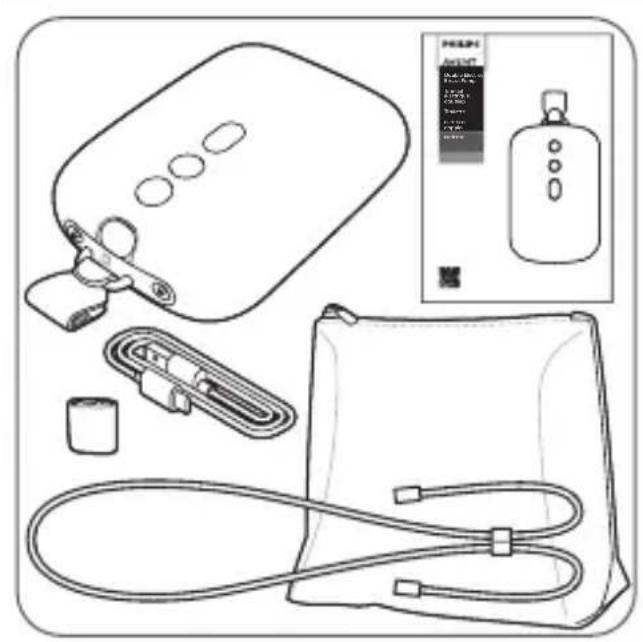
2C Check if the customer returned only:
- Motor unit with the detachable clip
- Carrying cord
- USB cable
- Tube coupler
- Pouch
- User manual of the Philips Avent hands-free motor unit SCF537/11
2D It is important to check whether the customer has not accidentally also returned other items, including the collection cups which are for personal use only. Please return all other items to the customer or dispose of all other items in case they are returned to you.
Keep Return to the customer or throw
away
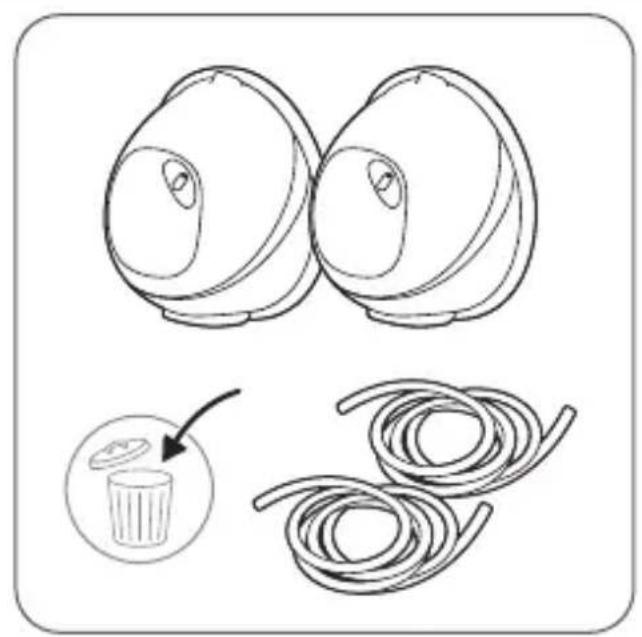
Step 3: Quality checklist
Follow steps 3A to 3I to inspect the returned items for any damage or malfunction. In case of damage or malfunction, please contact your Philips sales agent.
3A - Check whether the returned items include a motor unit.
- Also check whether the USB cable has been returned.
3B Check whether any damage or malfunction is visible from the outside.
3C Gently shake the motor unit to listen for any loose parts inside.
3D - Insert the small plug of the USB cable into the motor unit and insert the other end of the USB cable into a USB power source, e.g. adapter or laptop.
- The battery indicator lights go on.
- Press and hold the on/off button until the device switches on.
3E Check whether the full LED display (6 in Fig. 1) lights up.
3F Listen whether the device starts pumping.
3G Listen to the sound of the pumping; it should be a rhythmic pumping sound.
3H Check whether the two outlets draw in air. In order to check the performance of the pump, you should have a spare collection cup to be able to assemble the complete pump.
How to check the performance of the pump:
- Assemble all parts of the hands-free collection cup. Please refer to the user manual of the Philips Avent hands-free collection cups for the assembly steps.
- Press and hold the on/off button (2 in Fig. A) until the device switches on and press the 'Level up' button (5 in Fig. A) several times.
- Check if the membrane in the collection cup (please refer to the user manual of the Philips Avent hands-free collection cups) moves gradually up and all the way back down during each pumping cycle.
If the membrane does not move according to the description above, please contact your Philips sales agent.
31 - Check the pouch to make sure it is not damaged.
- Check the user manual for completeness.
- If the pouch and/or the user manual is damaged, please replace.
Step 4: Factory reset
Reset the motor unit to factory settings as follows:
4A. Make sure that the small plug of the USB cable is inserted into the motor unit and the other end of the USB cable into a USB power source, e.g. adapter or laptop.
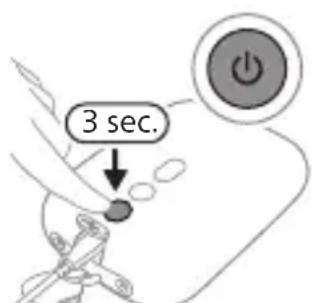
4B. Press and hold the on/off button to switch off.
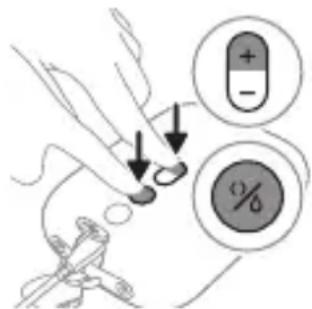
4C.
Simultaneously press the mode selection button (see 3 in Fig.1) and the 'Level up' button (see 5 in Fig.1).
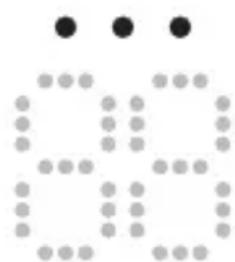
4D. Wait until the LED display lights up (6 in Fig. A).
Step 5: Cleaning before renting
| 5A Motor unit USB cable | It is important to repeat cleaning of the motor unit (the buttons and overall surface) and the USB cable before the motor unit is rented out to the next customer. This can be done by using alcohol wipes (isopropanol). |
| 5B Pouch Clean | the pouch by wiping it with a clean, damp cloth with water and mild detergent. |
| Warning: Do not use alcohol wipes (isopropanol) to clean the pouch. | |
| 5C User manual | Do not clean the user manual. If the user manual is dirty or damaged, please replace it. |
Step 6: Prepare for the next rental use
Make sure that the following 5 items are included in an assembled package of the motor unit for the next customer:
- Motor unit with the detachable clip
- USB cable
- Tube coupler
- Pouch
- User manual of the Philips Avent hands-free motor unit SCF537/11
Note: Hands-free collection cups SCF481/11 - a separate package for each new customer - already includes a separate user manual for the Philips Avent hands-free collection cups.
Recycling
- This symbol means that electrical products and batteries shall not be disposed of with normal household waste (Fig. 23).
- Follow your country's rules for the separate collection of electrical products and batteries.
- Correct disposal helps prevent negative consequences for the environment and human health.
Removal of built-in rechargeable battery
The built-in rechargeable battery must only be removed by a qualified professional when the appliance is discarded. Before removing the battery, make sure that the appliance is disconnected from the wall socket and that the battery is completely empty.
Take any necessary safety precautions when you handle tools to open the appliance and when you dispose of the rechargeable battery.
When you handle batteries, make sure that your hands, the product and the batteries are dry.
To avoid accidental short-circuiting of batteries after removal, do not let battery terminals come into contact with metal objects (e.g. coins, hairpins, rings). Do not wrap batteries in aluminum foil. Tape battery terminals or put batteries in a plastic bag before you discard them.
- If batteries are damaged or leaking, avoid contact with the skin or eyes. If this occurs, immediately rinse well with water and seek medical care.
1 Remove the rubber feet from the bottom of the motor unit (Fig. 17).
2 Remove the screw with a torx screwdriver (Fig. 18).
3 Open the motor unit by pressing at the sides of the device (Fig. 19).
4 Disconnect the connectors from the printed circuit board (Fig. 20).
5 Remove the frame from the motor unit (Fig. 21).
6 Cut or fold the edges of the plastic battery frame. Remove the battery from the plastic battery frame (Fig. 22).
① Note: Dispose of the rechargeable battery at a separate local collection point. Other parts can be disposed at a specific place for disposal of electric equipment.
Inhalt
Note: Los vasos recolectores manos libres SCF481/11 (un paquete分开ado para cadareshareshareshareshareshareshareshareshareshareshareshareshareshareshareshareshareshareshareshareshareshareshareshareshareshareshareshareshareshareshareshareshareshareshareshareshareshareshareshareshareshareshareshareshareshareshareshareshareshareshareshahashashashashashashashashashashashashashashashashashashashashashashashashashashashashashashashashashashashashashashashashashashashashashashashashashashashashashashashashashashashashashashashashashashashashashashashashashashashashashashashashashashashashashashashashashashashashashashashashasheshaheshaheshaheshaheshaheshaheshaheshaheshaheshaheshaheshaheshaheshaheshaheshaheshaheshaheshaheshaheshaheshaheshaheshaheshaheshaheshaheshaheshaheshaheshaheshaheshaheshaheshaheshaheshaheshaheshaheshaheshaheshaheshaheshaheshaheshaheshaheshaheshahshaheshaheshaheshahshaheshahshaheshahshahshahshahshahshahshahshahshahshahshahshahshahshahshahshahshahshahshahshahshahshahshahshahshahshahshahshahshahshahshahshahshahshahshahshahshahshahshahshahshahshahshahshahshahshahshahshahshahshahshahs
Reciclaje
- User manual for mother 7
- User manual for rental agent 28
- User manual for mother
- Introduction
- General description
- Rental items (Fig. 1) - motor unit (1 pcs) and parts (to be returned)
- Additional items (to be returned)
- Intended use and indications for use
- Important safety information
- Contraindication
- Warning
- Warnings to avoid electric shock:
- Warnings to avoid contamination and to ensure hygiene:
- Warning to avoid cross-contamination:
- Warnings to avoid breast and nipple problems including pain:
- Warnings to prevent damage and malfunction of the breast pump:
- Warning to avoid increased electromagnetic emissions or decreased electromagnetic immunity of this device, resulting in improper operation:
- Battery safety instructions
- Caution
- Cautions to prevent damage to and malfunctioning of the breast pump:
- Before first use - instruction for mother
- Cleaning and disinfecting
- Using the breast pump
- Charging the breast pump
- Battery indicator light description
- Assembling the breast pump
- Wearing the motor unit
- Motor unit part description
- LED display description
- Explanation of modes
- Pumping instructions
- Using the breast pump when you have symptoms of engorgement
- After use
- Storing breast milk
- Compatibility
- Ordering accessories and spare parts
- Support
- Troubleshooting
- Undesirable side effects
- Storage
- Electromagnetic fields (EMF)
- Technical specifications
- Electromagnetic compatibility - compliance information
- Emissions Compliance Electromagnetic environment - guidance
- Guidance and manufacturer's declaration - electromagnetic immunity
- Explanation of symbols
- User manual for rental agent
- Preparing for rental use
- Step 1: Register and track
- Step 2: Instructions for motor unit return
- Keep Return to the customer or throw
- Step 3: Quality checklist
- How to check the performance of the pump:
- Step 4: Factory reset
- Step 5: Cleaning before renting
- Step 6: Prepare for the next rental use
- Recycling
- Removal of built-in rechargeable battery
- Inhalt
- Reciclaje
Brand : PHILIPS
Model : Avent SCF537
Category : Breast pump