PTROW90 - Construction machine MSW - Free user manual and instructions
Find the device manual for free PTROW90 MSW in PDF.


User questions about PTROW90 MSW
0 question about this device. Answer the ones you know or ask your own.
Ask a new question about this device
Download the instructions for your Construction machine in PDF format for free! Find your manual PTROW90 - MSW and take your electronic device back in hand. On this page are published all the documents necessary for the use of your device. PTROW90 by MSW.
USER MANUAL PTROW90 MSW
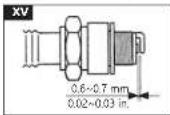
0.6\~0.7 mm 0.02\~0.03 in.
Ölwechsel im Motor:
Engine speed (rpm) 4,370
Troweling diameter 91 with blades [cm]
Troweling diameter 96 with pan (cm)
Number of trowel blades 4
Size of trowel blades 35x15 [cm]
Booster cable length 1.22 [m]
Fuel type ≥92% Acoustic power 100.90 level L _max
Vibration Right 6.76 emission hand value a, Loft hand 5.05
Dimensions [mm] 1,910x1,000x1,080
Weight |kg| 85
- GENERAL DESCRIPTION
The user manual is designed to assist in the safe and trouble free use of the device. The product is designed and manufactured in accordance with strict technical guidelines, using state-of-the-art technologies and components. Additionally, it is produced in compliance with the most stringent quality standards.
DO NOT USE THE DEVICE UNLESS YOU HAVE THOROUGHLY READ AND UNDERSTOOD THIS USER MANUAL.
To increase the product life of the device and to ensure trouble-free operation, use it in accordance with this user manual and regularly perform maintenance tasks. The technical data and specifications in this user manual are up to date. The manufacturer reserves the right to make changes associated with quality improvement. The device is designed to reduce noise emission risks to a minimum, taking into account technological progress and noise reduction opportunities.
LEGEND
The product satisfies the relevant safety standards.
EN
Read instructions before use.
The product must be recycled.
WARNING or CAUTIONI or REMEMBER! Applicable to the given situation (general warning sign).
Use ear protection. Exposure to loud noise may result in hearing loss.
Wear protective goggles.
Wear protective gloves.
Wear head protection.
Wear foot protection.
ATTENTION! Loud noise warning!
CAUTION! Moving parts may cause serious injuries.
ATTENTION! Hot surface, risk of burns!
LEASE NOTE! Drawings in this manual are for ustration purposes only and in some details, it may ffer from the actual product.
The original operation manual is in German. Other language versions are translations from German.
- USAGE SAFETY
ATTENTION! Read all safety warnings and all instructions. Failure to follow the warnings and instructions may result in serious injury or even death.
The terms "device" or "product" are used in the warnings and instructions to refer to
2.1. ENGINE OPERATION SAFETY
a) Do not smoke near the device. The device contains flammable substances.
b) W The engine gets very hot during operation. Do not touch the hot engine because it may cause burns.
c) Add oil till the full marking before start using the device. If the oil level is low, engine will not start or it might shut down.
d) Oil leaking from the machine should be reported to the appropriate services or comply with legal requirements applicable in the area of use.
c) Danger! Danger to health and the risk of explosion of the internal combustion engine
f) Poisonous carbon monoxide is present in the engine exhaust. Remaining in a carbon monoxide environment may lead to losing consciousness or even death. Do not run the engine in a closed space. g) Protect the engine from heat, sparks and flame. Do not smoke in the vicinity of the chipper!
h) Petrol is flammable and explosive. Before refuelling the engine should be turned off and cooled down.
i) Warning! Risk of engine damage due to wrong fuel. j) Make sure that all users have read, understood and follow the manual.
k) Misuse or careless use of the device may cause serious injuries.
Before each cleaning, regulation, accessory change, or if the device is not in use, turn the engine off and completely cool the device.
m) Do not touch moving parts or accessories unless the engine is turned off and left to cool.
n) Stay away from moving and rotating parts as they may cause injury.
b) Do not use the machine if all protective covers are not installed.
p) Do not increase the engine speed above 3500 rpm without more a load. Any increase may result in injury or damage to the device.
q) Do not touch the silencer or other hot elements when the engine is hot it may cause serious burns.
r) Make sure that petrol is stored only in certified containers (e.g. canister).
s) Do not refuel near sparks, flames or lit cigarettes. t) Stop the engine before refuelling. Never refuel while the engine is running or is still hot. Otherwise, spilled or evaporated fuel may catch fire from engine sparks or silencer heat.
u) Do not overfill fuel tank and avoid spilling petrol while refuelling. Spilled petrol or petrol fumes may catch fire. If petrol has been spilled, make sure that the area is dry before starting the engine.
v) After refuelling, make sure that the fuel tank cap is properly screwed on.
w) Do not operate the engine or refuel petrol in enclosed areas without appropriate ventilation.
x) Avoid operating the machine in enclosed spaces, tunnels or other poorly ventilated plates as the exhaust fumes contain lethal/harmful fumes and gases. If operating the machine in such conditions is unavoidable, provide adequate exhaust extraction.
y) To transport: Stop the engine. Close and secure the fuel tank cap. Switch the fuel valve to the "OFF-O" position. Drain the fuel tank before long distance transportation or on bumpy roads.
z) Keep flammable materials (petrol, matches, straw, etc.) away from the exhaust.
2.2 SAFETY IN THE WORKPLACE
a) Make sure the workplace is clean and well lit. A messy or poorly lit workplace may lead to accidents. Try to think ahead, observe what is going on and use common sense when working with the device.
b) Do not use the device in a potentially explosive environment, for example in the presence of flammable liquids, gases or dust. The device generates sparks which may ignite dust or fumes.
c) If you discover damage or irregular operation, immediately switch the device off and report it to a supervisor without delay.
d) If there are any doubts as to the correct operation of the device, contact the manufacturer's support service.
c) Only the manufacturer's service point may repair the device. Do not attempt any repairs independently!
f) In case of fire, use a powder or carbon dioxide (CO _2 ) fire extinguisher (one intended for use on live electrical devices) to put it out.
g) Children or unauthorised persons are forbidden to enter a work station. (A distraction may result in loss of control over the device).
h) Regularly inspect the condition of the safety labels. If the labels are illegible, they must be replaced.
i) Please keep this manual available for future reference. If this device is passed on to a third party, the manual must be passed on with it.
j) Keep packaging elements and small assembly parts in a place not available to children.
k) Keep the device away from children and animals. l) If this device is used together with another
equipment, the remaining instructions for use shall also be followed.
REMEMBER! When using the device, protect children and other bystanders.
2.3. PERSONAL SAFETY
a) Do not use the device when tired, ill or under the influence of alcohol, narcotics or medication which can significantly impair the ability to operate the device.
b) The machine may be operated by physically fit persons who are able to handle the machine, are properly trained, who have reviewed this operating manual and have received training in occupational health and safety.
c) The machine is not designed to be handled by persons (including children) with limited mental and sensory functions or persons lacking relevant experience and/or knowledge unless they are supervised by a person responsible for their safety or they have received instruction on how to operate the machine.
d) When working with the device, use common sense and stay alert. Temporary loss of concentration while using the device may lead to serious injuries.
c) Use personal protective equipment as required for working with the device, specified in section 1 (Legend). The use of correct and approved personal protective equipment reduces the risk of injury.
f) Do not overestimate your abilities. When using the device, keep your balance and remain stable at all times. This will ensure better control over the device in unexpected situations.
g) Do not wear loose clothing or jewellery. Keep hair, clothes and gloves away from moving parts. Loose clothing, jewellery or long hair may get caught in moving parts.
h) Remove all adjusting tools or spanners before turning the device on. A tool or spanner left in the revolving part of the device may cause injury.
i) Use eye, ear and respiratory protection.
j) The device is not a toy. Children must be supervised
to ensure that they do not play with the device.
2.4.SAFE DEVICE USE
a) Do not overload the device. Use the appropriate tools for the given task. A correctly-selected device will perform the task for which it was designed better and in a safer manner.
b) Do not use the device if the ON/OFF switch does not function properly (does not switch the device on and off). Devices which cannot be switched on and off using the ON/OFF switch are hazardous, should not be operated and must be repaired.
c) When not in use, store in a safe place, away from children and people not familiar with the device who have not read the user manual. The device may pose a hazard in the hands of inexperienced users.
d) Keep the device in perfect technical condition. Before each use check for general damage and especially check for cracked parts or elements and for any other conditions which may impact the safe operation of the device. If damage is discovered, hand over the device for repair before use.
e) Keep the device out of the reach of children. f) Device repair or maintenance should be carried out by qualified persons, only using original spare parts. This will ensure safe use.
g) To ensure the operational integrity of the device, do not remove factory-fitted guards and do not loosen any screws.
h) When transporting and handling the device between the warehouse and the destination, observe the occupational health and safety principles for manual transport operations which apply in the country where the device will be used.
i) Do not leave this appliance unattended while it is in use.
j) Clean the device regularly to prevent stubborn grime from accumulating.
k) The specified vibrations emission was measured using standard measurement methods. Vibrations emissions may change if the device is used in different surroundings.
I) The device is not a toy. Cleaning and maintenance may not be carried out by children without supervision by an adult person.
m) It is forbidden to interfere with the structure of the device in order to change its parameters or construction.
n) Keep the device away from sources of fire and heat. o) During operation, the device generates vibrations and requires repetitive activities that may be harmful to user's hands and shoulders.
p) The user and the machine should be in a stable position on level ground. Make sure that the machine does not tip over, slip or fall during operation or when left unattended.
q) Before using the device near excavation, make sure that excavation walls are stable and will not collapse under vibration.
r) Do not stand on the device, whether it is currently in use or not.
s) Slipping, tripping or falling are the main causes of serious injury or death. Be careful of uneven or slippery working surfaces as well as unprotected holes and excavations.
t) Always wear appropriate clothing when working with this device. Protective clothing includes (but is not limited to) boots, a long-sleeved shirt, long pants, gloves, hearing protection and safety glasses.
u) Use proper techniques to lift heavy components. Do not lift the machine by the guard basket of the trowel assembly.
v) The throttle lever must be in the idle position when the engine is being started.
w) Before starting the engine, make sure that the working area is clean and all dangerous objects are removed from it (e.g. protruding rod or wood). Do not use the device in places where it seems dangerous to work with it.
x) Before using the device, always test the safety devices including the engine stopping mechanisms.
y) Never place feet on or inside the shields when starting the engine.
z) The users must ensure that bystanders and/or nearby objects are kept at a safe distance from the machine. Untrained persons can not operate the machine.
aa) Do not use the machine in a dangerous environment. bb) Secure all the machine components that are normally lifted for servicing (e.g. blade grip).
cc) Do not lubricate or service the machine when it is running.
dd) All parts must be correctly installed.
ee) When disposing of hazardous waste (e.g. engine oil, fuel, filters) follow the procedures for hazardous waste disposal.
ff) Make sure that there are no live electric cables, gas, water or telecommunication lines which could be damaged by vibrations in the area to be troweled / smoothed.
gg) Caution: the space around the machine may be dangerous, please protect unauthorized persons.
ATTENTION! Despite the safe design of the device and its protective features, and despite the use of additional elements protecting the operator, there is still a slight risk of accident or injury when using the device. Stay alert and use common sense when using the device.
- USE GUIDELINES
The machine is designed for processing concrete slabs by troweling / smoothing out by means of blades or a pan. The machine is equipped with a combustion engine. This device is not intended for indoor use.
The user is liable for any damage resulting from unintended use of the device.
3.1. PREPARING FOR USE
ASSEMBLING THE DEVICE
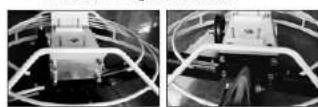
- Undo the 4 screws on the gear housing, connect the handle tube and tighten the screws.
Unscrew the adjustment cable bolt from the
fastening pin, put the pin through the yoke, put the cable bolt in and secure with the nuts.
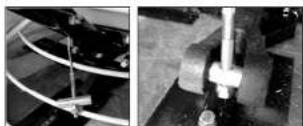
Insert the lifting tube in the handle tube clamp.
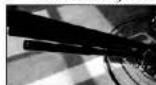
- Undo the fastening screw from the grip handle, attach the handle to the grip tube and tighten the fastening screw.
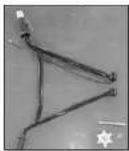
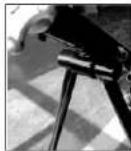
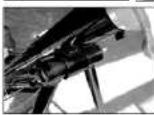
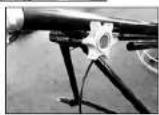
- Connect the cable connector in the correct position on the engine, then insert the engine oil sensor cable (1) and the engine stop switch cable (2) into the connector.
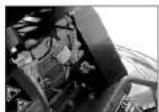
- Guide the throttle cable through the tube on the grip and secure the throttle lever in the proper place on the grip. Remove the air filter from the engine, attach the throttle cable to positions 1 and 2 and refit the air filter.
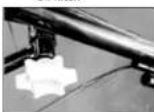

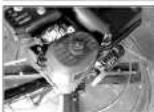
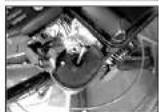
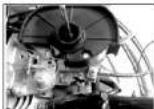
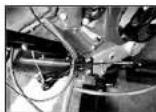
- Attach the engine switch cable and throttle cable in the correct place (1) with a plastic band..
Before starting operation
- Make sure that all impurities, blockages, unnecessary nuts and caps, etc. have been removed from the device. Particular attention should be paid to surfaces that have contact with the vibrating plate and area adjacent to the engine air intake, carburettor and air filter.
- Check if all bolts and screws are installed and adequately tightened. Loose bolts and screws may damage the device.
- Check if the V-belt is properly tightened.
- Check an engine oil level (A- maximum, B- minimum). If the level is low, top it up through the hole for the oil dipstick(C) (Fig. 1).
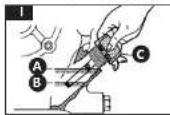
Use proper engine oil according to instructions in the table below.
| Temperature Oil type | |
| +120°F ~40°F (49°C~4.5°C)(Spring, summer, autumn) | SAE 30 |
| +40°F ~+15°F (4.5°C~9.5°C)(Winter) | SAE 20 |
Below +15°F (-9.5°C) SAE 10W-30
- Use only petrol (92% and above). When filling the fuel tank, make sure that the fuel filter is installed. - The device can be used with either the blades or the pan installed on the trowel assembly: » Trowel blades
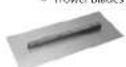
• Replacing the trowel blades
If not all of the blades are replaced, the device may go into unexpected vibrations during operation and start wobbling or bouncing. It is recommended to replace all the blades at the same time. To replace the blades, place the machine on a flat and level surface. Adjust the pitch of the blades so they are positioned as flat as possible. Record the position / setting of the blades. Undo the screws on the blade arm, remove the blade. Then remove any impurities (e.g. residual concrete) from the arm and install the new blade. Mind the direction of rotation. Tighten the screws again. Repeat this for each blade.
- Trowel blades are essential parts of the machine. They should be replaced when they do not smooth the concrete in a satisfactory way.
» Trowel pan
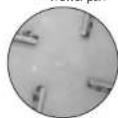
- The round plate mounted on the trowel assembly makes it possible to smooth out wet concrete. The plate design allows easy movement from wet area to dry area.
3.2. DEVICE USE
Starting the engine.
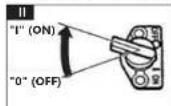
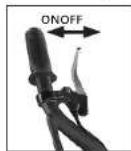
1. Turn ON/OFF switch clockwise to the "T" (ON) position (Fig. 1)
2. Open the fuel valve (move to the right to the "OPEN-I" position (Fig. III))
3. Move the speed control lever from 1/3 to 1/2 of the high speed position distance (Fig. IV).
4. Close the suction lever (push to the far left).
CAUTION: If the engine is warm or the ambient temperature is high, open the suction lever halfway or leave it entirely open. If the engine is cold and the ambient temperature is low, close the suction lever completely (Fig. V).
5. Slowly pull the starter cable handle until you feel resistance. This is the "compression" point. Return the handle to its original position, then quickly pull again. Do not pull it fully. After starting the engine and still holding the handle, let the starter cable slowly return to its original position. (Fig. VI)
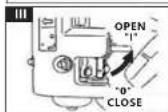
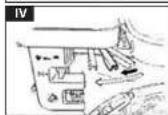
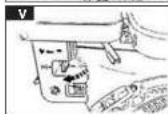
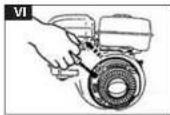
Operation of the clutch lever:
- The towel assembly of the machine stops rotating after the clutch lever is released. The clutch operation should be tested every time the machine is started. NOTE: The machine should not be left unused for a longer time with the engine running at high speed. This will wear or damage the belt. Set the engine rotation at idle speed when the clutch (manual lever) is in the off position.
Blade pitch knob
- The knob controlling the inclination of the trowel assembly is a large star-shaped knob at the end of the main tube of the handle.
- The pitch can be controlled by turning the knob. Turning clockwise increases the pitch of the trowel assembly while turning counter-clockwise decreases it.
Operating the speed lever.
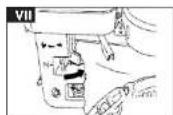
- As the engine heats up, gradually move the suction lever to the far right - open position (Fig. VII).
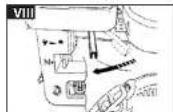
- Vigorously move the speed control lever to the right. from the LOW position (turde) to the HIGH position (rabbit). As soon as the motor speed reaches approx. 2300-2600 rpm, the centrifugal coupling is engaged. (Fig. VIII, IX)
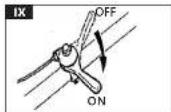
Turning the device off:
-
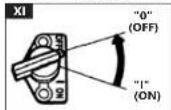
EMERGENCY SHUTDOWN - turn ON/OFF switch to "OFF" position (Fig. XI).
-
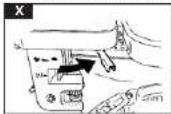
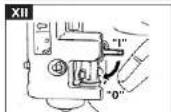
REGULAR SHUTDOWN - move the speed control lever to the low speed position (turtle) (Fig. X) for 3-5 minutes. When the engine is cold, turn the ON/OFF switch to the "OFF" position (Fig. XI) and close the valve to shut off the fuel - "0" position (Fig. XII).
Using the machine
- Check the oil level in the engine and transmission.
-
Before the engine start-up procedure, check if there is fuel in the tank.
-
Set the throttle in the idle position. NOTE: Never start the engine with the throttle above the idle speed position.
-
Begin the engine starting procedure. NOTE: Systemically check the On / Off engine switch. If the engine switch is working properly, the engine should stop
-
After starting the engine, allow it to warm up for a few minutes while idling.
-
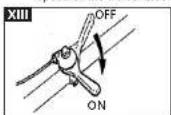
The user should position themselves in a stable position behind the grip handle. Hold the handle firmly, then increase the engine speed (towards the ON position - Fig. XIII) until you reach the desired speed of the trowel assembly.
-
To manoeuvre the machine, gently raise or press its main handle. Raising the handle up moves the machine to the left, pressing the handle down moves the machine to the right.
-
The best method of finishing a concrete slab is to slowly walk backwards with the machine, guiding it from side to side.
NOTE: Look behind you to avoid dangers when backing up.
Arrangement of struts
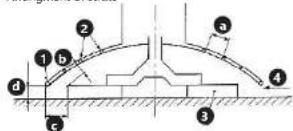
1. Outermost strut
2 Struts
-
Blades
-
Test force
a) 90 max
b) x > 0
c) y > 0
d) 60 max
Horizontal distance from the pole to the outermost strut
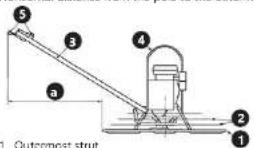
1. Outermost strut
-
Struts
-
Handlebar
-
Lifting device
-
Controls
a) 900 min.
3.3. CLEANING AND MAINTENANCE
a) Before any service, repair or maintaining work is done on the machine, disconnect the spark plug leads, turn off the engine and make sure it has cooled down.
b) After cleaning the device, all parts should be dried completely before using it again.
c) Store the unit in a dry, cool place, free from moisture and direct exposure to sunlight.
d) Do not spray the device with a water jet or submerge it in water.
c) Do not allow water to get inside the device through vents in the housing of the device.
f) Clean the vents with a brush and compressed air. g) The device must be regularly inspected to check its technical efficiency and spot any damage.
h) Use a soft, damp cloth for cleaning. i) To minimise wear and tear on the equipment, change oil regularly.
j) Check the tension and wear of the V belt regularly. Adjust or change it whenever necessary.
k) Check, clean and/or change the engine air filter regularly, especially when working in dusty environments.
1) Check, clean and/or change the spark plug regularly. m) Check that all mounting elements are properly installed because the machine is exposed to vibrations.
n) When storing the machine for a longer period of time after operation:
• carefully remove fuel from the fuel line, tank and carburettor.
• after removing the spark plug, pour a few drops of an engine oil into the cylinder. Manually turn the engine a few times to make sure that the inside of the cylinder has been covered with the oil.
o) Clean the outside of the device with a damp cloth. Store the covered unit in a dry place.
p) Never allow concrete to harden on the trowel machine. Immediately after use, wash the concrete off the blades/pan with water.
NOTE: Do not spray water on the engine. Where it is difficult to wash off hardened concrete, use a brush or a duster. To prevent rusting and enable easier cleaning in the future, coat the blades and blade arms with diesel fuel after cleaning.
q) When working with the machine, pay special attention to the kickback phenomenon, which is a sudden reaction of the machine to the rotating disc being blocked. The consequence of locking the rotating tool is the jerk of the machine in the direction opposite to the disc rotation. The kickback is a consequence of improper use of the machine.
r) Maintenance check schedule:
| Daily (or every 8-10 hrs.) | Check the fluid level in the engine and transmission. |
| Weekly (or every 50-60 hrs.) | Lubricate the blade arms, thrust collar and clutch. |
| Replace the blades if necessary. | |
| Check, and if necessary clean or replace, the engine air filter. | |
| Monthly (or every 100-200 hrs.) | Remove, clean, re-install and lubricate the blade arms, thrust collar and clutch. |
| Adjust the blade arms. | |
| Annually (or every 200-2500 hrs.) | Check and replace if necessary; arm bushings, thrust collar bushings, shaft gaskets and the belt. |
| Check the control cable for wear. |
Air filter:
- Check and clean the air filter. (Fig. XIV). Dirty parts of the air filter can cause difficulty in starting, loss of power, engine malfunction and considerably shorten the life of the engine. Keep the air filter clean.
• Urethane foam filter (D):
Remove the urethane foam and wash it in kerosene. Then saturate it with a mixture of 3 parts kerosene and 1 part engine oil. Wring the foam to remove the mixture. Put the foam back into the air filter.
• Double-structured urethane foam filter (E):
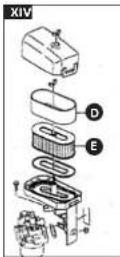
Remove the urethane foam and wash it in kerosene. Then saturate it with a mixture of 3 parts kerosene and 1 part engine oil. Shake off excess oil.
- Remove the spark plug, clean and adjust the spark plug gap to 0.6-0.7 mm (0.02-0.03 inches). If necessary, replace the spark plug. (Fig. XV)
Changing engine oil:
- When changing the oil, drain the old oil from the engine through the unscrewed oil plug, re-install the plug and pour in the new oil. (Fig. XVI) NOTE: When the engine is new, the first oil change should be made after 20 hours of operation. Top up to the proper level before restarting.
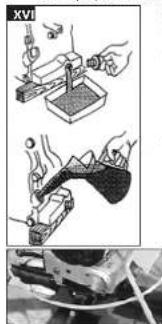
Changing oil in the gearbox - Check the oil level in the gearbox daily. - When checking the oil level in the gearbox, be careful when unscrowing and removing the plugs (there are 2). - To change the oil, remove the bottom plug, located approximately halfway up the gearbox.
Checking belt tension
- The first belt wear indication is the reduced blade speed despite the engine working at full speed. Check the belts regularly for damage or excessive wear. - Excessively worn out belts should be replaced. Check the condition of the machine especially when: - Machine blades wear out unevenly (eg one blade is completely worn out while others look new). - The machine has a perceptible rolling motion. - The guard basket sways up and down.
DANE TECHNICZNE
NAMEPLATE TRANSLATIONS

| 1234 | ● | ● | ● | |
| DE Produktname Modell Gewicht Produktionsjahr | ||||
| EN Product Name Model Weight Production year | ||||
| PL Nazwa produktu Model Wega Rok produkcji | ||||
| CZ | Název výrobku | Model Hmotnost Rok výroby | ||
| FR | Nom du produit | Modelle | Poids | Année de production |
| IT | Nome del prodotto | Modello | Peso | Anno di produzione |
| ES | Nombre del producto | Modelo | Peso | Año de producción |
| 56 | ●7 | ●8 | ● | |
| DE | Ordnungsnummer | Maximale Leistung | Maximale Motordrehzahl | Hersteller |
| EN | Serial No. | Max. Power | Max. Engine speed | Manufacturer |
| PL | Numer serii | Maksymalna moc | Maksymalna prędkość obrotowa silnika | Producent |
| CZ | Sériové číslo | Maximalní výkon | Maximalní otáčky motoru | Výrobce |
| FR | Numero de serie | Puissance maximale | Vitcsse maximale du moteur | Fabricant |
| IT | Numero di serie | Massima potenza | Velocità massima del motore | Produktore |
| ES | Número de serie | Potencia motriz | Velocidad máxima del motor | Fabricante |
WARNING STICKER TRANSLATIONS
WARNING
Before use, please read the menu and all warrings Exhaust fume coming out of the motor contain harmful /ethal fumes and gazes. Do not operate in enclosed areas without appropriate ventilation.
In rat tank when running. Do not overfill fuel tank. After refueling, make sure that the fuel tank cap is properly screwed on.
To rat use near flammable materials. To rat operate when it rains or snows or close to water, danger of electric shock.
| DE | Bitte lesen Sie vor der Verwendung das Handbuch und alle Wamhinweise. Aus dem Motor austretende Abgase enthalten schädliche/todliche Dämpfe und Gase. Betreiben Sie das Gerät nicht in geschlossenen Rahmen ohne ausreichende Belüftung. Füllen Sie den Tank nicht auf, wenn das Gerät läuft. Überfüllen Sie den Kraftstofftank nicht. Achten Sie noch dem Tanken darauf, dass der Tankdecker richtig zugeschraubt ist. Nicht in der Nähe von brenmbaren Materialien verwenden. Nicht bei Regen, Schnee oder in der Nähe von Wasser betreiben. Gefahr eines Stromschlags. |
| EN | Before use, please read the manual and all warnings. Zahaud fume coming out of the motor contain harmful/lethal fumes and gases. Do not operate in enclosed areas without appropriate ventilation. Do not tank when running. Do not overfill fuel tank. After refuelling, make sure that the fuel tank cap is properly screwed on. Do not use near flammable materials. Do not operate when it rains or snows or close to water. Danger of electric shock. |
| PL | Przed uzyciem należy przeczytał instrukcje i zapozmać się z wszystkimi ostrzeżeniem. Spaliny wydobywające się z silnika zawieraja szkodliwo/ śmicriconicne dmyi y gazy. Nie użytkować urządzenia w zamkniętoj przestrzeni bez odpowiedniej wentylacji. Nigdy nie użypełnić benżyny, gdy silnik pracuje. Nie przepełnića zbmiorka paliwa. Po zatankowanu upewnić się, ze korek zubiorka paliwa jest odpowiednio przykręção. Nie używać uralządzenia w strefie występowania materiałów łatwopalnych. Nie należy używać uralządzenia w podczas opadów deszczu lub śniegu oraz w przypadku bliskiego występowania zbmiroków wody. Rzykyo porazenia prądem! |
| CZ | Před použitim si płočeće návoć a vlochna varování. Vyfučové plyny z motoru obshují skodlivé / smrtić výpary a plyny. Zażizení proto nepouživejte u vyzafeném prostoru bez dostatechno větrání. Nikdy nedopłifije palivo za chodu motoru. Palivovou nádrž neprofiňuje. Po doplnční paliva se ujištěte, że je uzávěr palivovó nádrž správné za zalroubovan. Zażizení nepouživejte v blízkost hořavých materiálů. Zażizení nepouživejte za došte, sněżeni nebo v blízkost vodnich nádrži. Nebezpeći úrazu elektryckym proudemi! |
| FR | Lisez attentivement le manuel et toutes les consignes de sécurité avant l'utilisation. Le moteur produit des vapeurs et des gaz nocifs, voire mortols. N'utilisez pas l'appareil dans les pièces fermées sans ventilation adéquate. Ne remplissez pas le réservoir pendant le fonctionnement. Ne remplissez pas le réservoir de carburant de façon excessive. Una fois le plein terminé, assurez-vous que le couverde est visse adéquatement. N'utilisez pas l'appareil à proximité de matériaux inflammables. N'utilisez pas la machine par temps pluvieux, nigeux ou près de l'eau. Risque d'électrocution. |
| IT | Prima dell'utilizzo loggore attentamente il manuale d'istruzioni o tutti avvisi di sicurezza i gas di scarico emessi dal motoe contengono vapori e fumi dannos/mortali. Non azionare il dispositivo in ambienti chiusi senza una ventilazione adeguata. Non riempire il serbatoio quando il dispositivo é in funzione. Non riempirlo eccessivamente. Fare attenzione che il serbatoio sia avvitato correttamente. Non utilizzare in prossimità di materiali inflammabili. Non utilizzare il dispositivo sotto neve, pioggia o vicino all'acqua. Sussiste il pericolo di una scossa elettrica. |
| ES | Antes de utilizar, por favor lea el manual y todas las advertencias. Los gases de escape procedentes del motor contienen humos y gases daílinos/letales. No lo ponga en funcionamiento en zonas cerradas que carezcan de una ventilación apropiada. No llene el depósito de combustible cuando estó en funcionamiento. No llene el depósito por encima del limite. Después de reposter, aseguresse de que la taps del depósito de combustible esté correctamente enroscada. No lo ponga en funcionamiento cerca de materiales inflamiables. No lo ponga en funcionamiento cuando liueva o nieve, ni cerca del agua. Pelligro de descarga eléctrica. |
For the disposal of the device please consider and act according to the national and local rules and regulations.
CONTACT
expondo Polska sp. z o.o. sp. k.