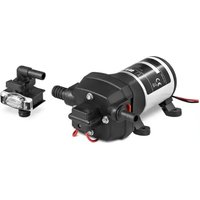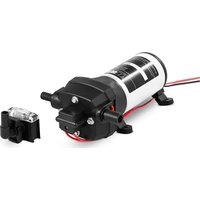
M-WPP-17LPM - Water pump MSW - Free user manual and instructions
Find the device manual for free M-WPP-17LPM MSW in PDF.


| Product type | Water pressure pump |
| Brand | MSW |
| Model | M-WPP-17LPM |
| Supply voltage | 12 V DC |
| Current intensity | 6 A |
| Max. operating pressure | 2.8 bar |
| Max. flow rate | 17 L/min |
| Max. water temperature | 60 °C |
| Outlet diameter | 17 mm |
| Dimensions (L × W × H) | 420 × 170 × 14 mm |
| Weight | 2.38 kg |
| Recommended use | Motorhomes, yachts, irrigation, solar systems |
| Power supply | 12 V DC battery, dedicated circuit |
| Main functions | Integrated pressure switch, automatic shut-off when tank is empty |
| Safety | Mandatory fuse, overload protection, do not use in explosive areas |
| Maintenance and cleaning | Clean regularly with a soft, damp cloth; winterization necessary |
| Housing material | Plastic (plastic fittings recommended) |
| Mounting | All positions; vertically, pump head facing down |
| Inlet/outlet connection | Reinforced hose, inner Ø min. 10 mm (3/8") |
Frequently Asked Questions - M-WPP-17LPM MSW
User questions about M-WPP-17LPM MSW
0 question about this device. Answer the ones you know or ask your own.
Ask a new question about this device
Download the instructions for your Water pump in PDF format for free! Find your manual M-WPP-17LPM - MSW and take your electronic device back in hand. On this page are published all the documents necessary for the use of your device. M-WPP-17LPM by MSW.
USER MANUAL M-WPP-17LPM MSW
This manual is intended to assist you in safe and reliable use. The product is designed and manufactured strictly according to technical specifications using the latest technology and components, and maintaining the highest quality standards.
READ THE MANUAL CAREFULLY AND UNDERSTAND IT BEFORE USE.
To ensure long and reliable operation of the product, operate and maintain it correctly and strictly in compliance with this manual. The technical data and specifications in this manual are up-to-date. The manufacturer reserves the right to modifications for the purpose of quality improvement. Considering the technological progress and the feasibility of noise reduction, the product is designed and built so that risks resulting from noise emissions are minimised as far as possible.
Explanation of symbols
| CE | The product meets the requirements of relevant safety standards. |
| Read the manual before use. | |
| Recyclable product. | |
| CAUTION! or WARNING! or REMEMBER! indicates a specific instruction (general warning sign). | |
| CAUTION! Risk of electric shock! |
The original version of the manual is in German language. Other language versions are translations from German.
2. Operating safety
CAUTION! Read all safety warnings and all instructions. Failure to follow the warnings and instructions may result in electric shock, fire and/or serious injury or death.
The term "machine" or "product" in the warnings and instructions refers to the
2.1. Electrical safety
a) Do not use the power cord in any unintended way. Never use it to carry the appliance. Keep the power cord away from sources of heat, oil, sharp edges or moving parts. Damaged or tangled cords increase the risk of electric shock.
b) Make sure that the supply voltage is 12 V DC (direct current). Higher voltage will cause the pump to fail.
2.2. Workplace safety
a) Keep the workplace tidy and well lit. Disorder or poor lighting can lead to accidents. Be careful, watch what you are doing and use common sense when working with the appliance.
b) Do not use the appliance in areas of explosion hazard, for example in the presence of flammable liquids, gases or dust. The appliance generates sparks which can ignite dust or vapours.
c) If in doubt as to whether the appliance is working, contact the manufacturer's technical service.
d) Repairs to the appliance may only be carried out by the manufacturer's service. Do not attempt to repair the product on your own!
e) In the event of ignition or a fire, use dry powder or CO2 extinguishers only to suppress the fire of the appliance if live with electrical voltage.
f) No children or unauthorised individuals shall be allowed at the workplace. (Lack of attention may result in loss of control over the appliance).
Connect and disconnect the water pressure line isolated upstream.
h) Do not aim the water pressure line outlet towards any people or animals. Pressurised water can cause serious injuries.
i) Check the condition of the safety warning stickers regularly. Replace them if they are illegible.
j) Keep this manual for future reference. If the product is to be handed over to a third party, hand it over with this user manual.
k) Keep packaging components and small installation parts out of the reach of children.
I) Keep the appliance away from children and animals.
m) When operating this appliance together with other appliances, follow each of their user manuals.
Remember! Keep children and other bystanders safe while operating this product.
2.3. Personal safety
a) Do not operate the product if you are tired, ill or under the influence of alcohol, drugs or medication which might significantly impair your ability to operate the product.
b) The product is not intended to be used by individuals (including children) with reduced mental, sensory or intellectual capacity or lack of experience and/or knowledge, unless they are supervised by an individual responsible for their safety or have been given instructions by the responsible individual on how to operate the product.
c) The appliance may only be operated by individuals who are physically fit, capable of handling the appliance and who have been adequately trained, have read this manual and have received training in health and safety.
d) The appliance is not a toy. Children must be supervised to ensure that they do not play with it.
2.4. Safe use of the product
a) Do not overload the product. Use tools that are suitable for the application. A correctly selected product ensures better and safer performance of the work it is intended for.
b) Unplug the appliance from the mains before adjustment, cleaning or maintenance. This safety precaution reduces the risk of accidental operation.
c) Keep unused appliances out of the reach of children and anyone unfamiliar with the appliance or this manual. Appliances are dangerous in the hands of inexperienced users.
d) Keep the product in good working order. Before each use, check for generally evident damage and damage to any of the moving parts (inspect for cracks in parts and components or any other condition that may affect the safe operation of the product). If damaged, have the product repaired before use.
e) Keep the product out of the reach of children.
f) The product shall be repaired and maintained by qualified personnel using original spare parts only. This will ensure safe operation of the product.
g) To ensure the designed operational integrity of the product, do not remove the factory-installed covers or loosen any bolts.
h) Clean the appliance regularly to prevent permanent deposits of dirt.
i) Always make sure that the nozzle is properly installed in the appliance and the hose is properly attached and free of damage before use.
j) The appliance is not a toy. Cleaning and maintenance shall not be performed by children without adult supervision.
k) Do not start the appliance when it is empty.
I) Never attempt to tamper with the product to change its parameters or structure.
m) Keep the appliance away from sources of fire and heat.
n) Do not overload the product.
o) It is recommended to use a flexible hose for potable water or a PEX tube instead of a rigid pipe to connect to the pump.
p) Do not use metal couplings for the connections. Use plastic couplings whenever possible.
q) Only a qualified technician may adjust the bypass.
r) Routinely maintain and clean the pump. Failure to ensure hygienic treatment and maintenance is one of the reasons for low discharge capacity of the pump.
s) Remember to properly winterise the pump in storage, which means proper preservation of the product against low temperature.
t) The pump can be installed in any orientation. If installed in vertical orientation, the pump head must be at the bottom to avoid ingress of water into the motor in the event of a failure.
u) The suction hose must be reinforced with a minimum I.D. of 3/8'' (10 mm). The discharge hose I.D. shall be 3/8'' (10 mm).
v) Do not apply an inlet pressure above 30 psi (2.07 bar) at the suction side. Avoid any inlet overpressure.
w) Avoid all kinks and couplings which would restrict the water flow too much.
x) Connect the filter on the inlet/suction side.
y) Use band clips to attach both ends of the hose and avoid air leaks into the water line.
z) If a water stop valve is installed in the riser, its opening pressure shall not exceed 2 psi.
aa) If using a piping sealant or a sealing tape for water piping, do not tighten the connections sealed with these products too much or the products can be sucked into the pump.
bb) Connect the water pump to a separate power line from the power source. Connect the red (positive) lead to the positive (+) terminal post of the battery. Connect the black (negative) lead to the negative (-) terminal post of the battery.
cc) Do not connect other electrical loads to the pump's power line.
dd) Install a service switch in an accessible location for easy operation of the pump's electrical power source. Always stop the pump if it is not going to be used for a long time or when the tank is empty.
ee) Always install a fuse with a suitable rating. If there is a short circuit, an unsuitable rating of the fuse increases the risk of pump failure and may potentially result in injury and/or a risk of fire.
CAUTION! Although the appliance has been designed to be safe and has been provided with adequate safeguards, and despite the use of additional safety measures, there is still a low, residual risk of accident or injury during its operation. Caution and common sense are advised when using the product.
3. Rules of use
This appliance is intended for pumping water. The product is intended for water systems aboard motor homes and yachts, as well as for irrigation, solar-heated water systems, and other pressurized water systems.
The product is intended for private home use only!
The user is responsible for any damage caused by non-intended use.
3.1. Appliance overview
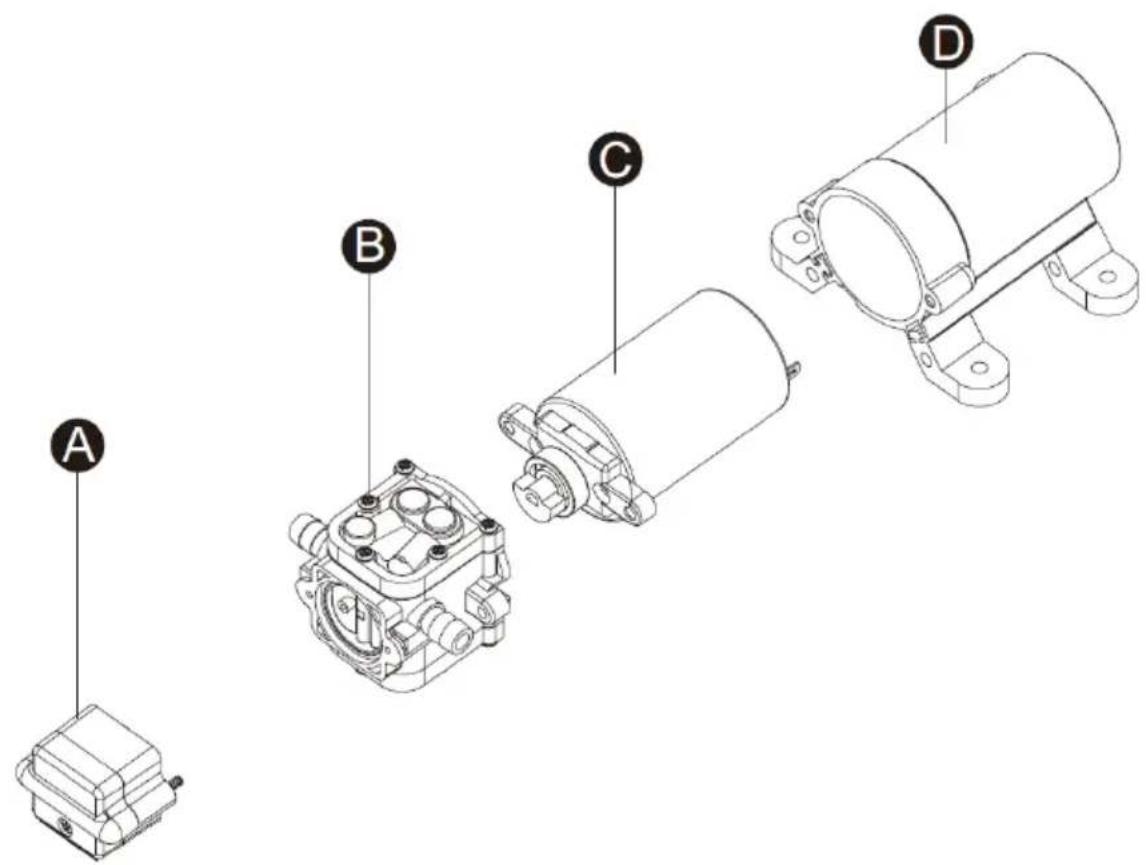
A. Pressure switch
B. Pump head assembly
C. Motor assembly
D. Rear casing assembly
3.2. Operating the appliance
a) It is recommended to use a flexible hose for potable water or a PEX tube instead of a rigid pipe to connect to the pump.
b) Do not use metal couplings for the connections. Use plastic couplings whenever possible.
c) Only a qualified technician may adjust the bypass.
d) The pump can be installed in any orientation. If installed in vertical orientation, the pump head must be at the bottom to avoid ingress of water into the motor in the event of a failure.
e) The suction hose must be reinforced with a minimum I.D. of 3/8'' (10 mm). The discharge hose I.D. shall be 3/8'' (10 mm).
f) Plumb the system using high-pressure rated (up to 2 × pump power rating), braid-reinforced, flexible piping to minimise vibration and noise.
g) Do not apply an inlet pressure above 30 psi (2.07 bar) at the suction side. Avoid any inlet overpressure whenever possible.
h) Avoid all kinks and couplings which would restrict the water flow too much.
i) Connect the filter on the inlet/suction side.
j) Secure all connections against leaks.
k) Use band clips to attach both ends of the hose and avoid air leaks into the water line.
If a water stop valve is installed in the riser, its opening pressure shall not exceed 2 psi.
m) If using a piping sealant or a sealing tape for water piping, do not tighten the connections sealed with these products too much or the products can be sucked into the pump.
n) Connect the water pump to a separate power line from the power source. Connect the red (positive) lead to the positive (+) terminal post of the battery. Connect the black (negative) lead to the negative (-) terminal post of the battery.
o) Do not connect other electrical loads to the pump's power line.
p) Install a service switch in an accessible location for easy operation of the pump's electrical power source. Always stop the pump if it is not going to be used for a long time or when the tank is empty.
q) Always install a fuse with a suitable rating. If there is a short circuit, an unsuitable rating of the fuse increases the risk of pump failure and may potentially result in injury and/or a risk of fire.
C
| The pump starts and stops repeatedly. | Kinked water lines. | Inspect the water lines for kinks. |
| Hydraulic lines and/or couplings have the bores too small. | Make sure that the hydraulic lines and couplings have a sufficient size. | |
| Dirty water taps and filters. | Clean the water taps and filters. | |
| Air leak into the water line. | Inspect the sealing of the couplings to pinpoint air leaks. | |
| The motor is running but there is no flow through the pump. | The suction line or the discharge line is clogged. | Inspect the lines for clogs. |
| Air leak in the suction line. | Inspect the suction line. | |
| The pump diaphragm is broken. | Contact the manufacturer's service. | |
| The starting current is insufficient for the motor to break away and run. | Check the power supply. | |
| The valves have dirt inside. | Clean the valves. | |
| The pump casing is cracked. | Contact the manufacturer's service. | |
| The motor does not turn on. | The power wiring is out of specification or the connections are loose. | Verify the power wiring. |
| The pump's power supply has no voltage. | Check the power supply. | |
| Blown fuse. | Replace the fuse. | |
| The pressure switch has failed. | Contact the manufacturer's service. | |
| The motor has failed. | ||
| The pump does not stop when all valves are closed. | The pump diaphragm is broken. | |
| The discharge line is leaking. | ||
| The pressure switch has failed. | ||
| Insufficient supply voltage. | Verify the voltage. | |
| The valves in the pump head are clogged. | Clean the valves. | |
| Low flow and pressure. | Air leak on the suction side. | Inspect the sealing of the couplings to pinpoint air leaks. |
| Dirt accumulated inside of the pump or in the hydraulic system. | Clean the hydraulic system. | |
| The pump bearing is worn (this can be evident by loud noise). | Contact the manufacturer's service. | |
| The pump diaphragm is broken. | ||
| The motor has failed. | ||
| Abnormal running noise. | The installation substrate is flexible. | If it is, it can be the source of the noise. |
| Loose heads/bolts. | Inspect for loose heads/bolts. | |
| The pump is plumbed to a rigid pipe. | If it is so, the pipe carries noise easier. |
Dane techniczne
| Opis parametru | Wartosć parametu | |||||
| Nazwa produktu | POMPA CIŚNIENIOWA DO WODY | |||||
| Model | MSW-M-WPP-4.3LPM | MSW-M-WPP-17LPM | MSW-M-WPP-10.6LPM | MSW-M-WPP-11.3LPM | MSW-M-WPP-12.5LPM | MSW-M-WPP-10LPM |
| Napiȩcie zasilania[V] | 12 | 12 | 12 | 12 | 12 | 12 |
| Nateżeni e prȩdu [A] | 2 | 6 | 4,5 | 6,74 | 8,5 | 4,43 |
| Maksym alne ciȩnienie robocze [bar] | 2,4 | 2,8 | 3,1 | 3,1 | 2,4 | 1,2 |
| Maksym alny przyteptyw [l/min] | 4,3 | 17 | 10,6 | 11,3 | 12,5 | 10 |
| Maksym alna tempera tura wody [℃] | 60 | 60 | 60 | 60 | 60 | 60 |
| Średnica wylotu [mm] | 10 | 17 | 21 (1/2'') | 21 (1/2'') | 19 | 19 |
| Wymiary (Szerokość / Głowokość / Wysokość)c) [mm] | 170x100 x70 | 420x170 x14 | 210x19,5 x16 | 200x270x 100 | 200x210x 100 | 200x210x 100 |
| Ciezar [kg] | 0.6 | 2,38 | 1,82 | 1,82 | 1,74 | 1,74 |
1. Ogólny opis
Product Name:Water Pressure Pump
Model: MSW-M-WPP-4.3LPM
Flow Rate: 1.2 GPM / 4.3 LPM
Voltage: 12 V,2.0 A
Pressure: 35 PSI / 2.4 bar
Production Year:
Serial No.:
C E
expondo.com
For the disposal of the device please consider and act according to the national and local rules and regulations.
CONTACT
expondo Polska sp. z o.o. sp. k.