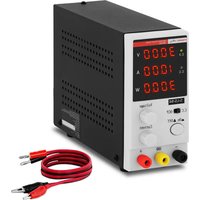
S-LS-94 - Measuring equipment Stamos - Free user manual and instructions
Find the device manual for free S-LS-94 Stamos in PDF.


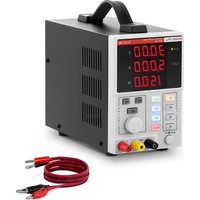
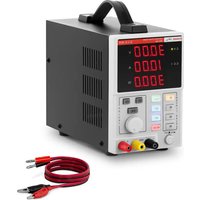
| Product type | Laboratory power supply |
| Brand | Stamos |
| Model | S-LS-94 |
| Supply voltage | 230 V~ / 50 Hz |
| Rated power | 300 W |
| DC voltage range | 0-30 V |
| Current range | 0-10 A |
| CV stabilization coefficient (operation) | ≤ 0.3 % + 10 mV |
| CC stabilization coefficient (operation) | ≤ 0.3 % + 10 mA |
| CV ripple | ≤ 0.3 % mV r.m.s. |
| CC ripple | ≤ 0.3 % mA r.m.s. |
| Resolution | ± 0.3 % FS ± 1 digit |
| Protections | OCP (overcurrent protection), OTP (overtemperature), OPP (overpower) |
| Ambient temperature (operation) | -10 to 40 °C / Humidity < 80 % |
| Ambient temperature (storage) | -20 to 80 °C / Humidity < 70 % |
| IP protection rating | IP20 |
| Dimensions (L x W x H) | 220 x 70 x 150 mm |
| Weight | 1.2 kg |
| Main functions | Continuous voltage and current adjustment, digital display, CV/CC modes, OCP protection, audible alarm |
| Maintenance and cleaning | Disconnect before cleaning; use a dry, non-abrasive cloth; do not immerse |
| Safety | Symbols: CE, mandatory reading of manual, recycling, indoor use only |
| Recycling | Do not dispose of with household waste; take to a collection point for electrical appliances |
Frequently Asked Questions - S-LS-94 Stamos
User questions about S-LS-94 Stamos
0 question about this device. Answer the ones you know or ask your own.
Ask a new question about this device
Download the instructions for your Measuring equipment in PDF format for free! Find your manual S-LS-94 - Stamos and take your electronic device back in hand. On this page are published all the documents necessary for the use of your device. S-LS-94 by Stamos.
USER MANUAL S-LS-94 Stamos
| Parameter description | Parameter value | ||
| Name of the product | LABORATORY POWER SUPPLY | ||
| Model | S-LS-90 | S-LS-91 | S-LS-92 |
| Supply voltage [V~] / Frequency [Hz] | 230/50 | ||
| Rated power [W] | 300 | 200 | 300 |
| Voltage regulation range DC [V] | 0-100 0-100 0-60 | ||
| Current regulation range [A] | 0-3 0-2 0-5 | ||
| Operation stabilisation coefficient | CV≤0.3%+10 mVCC≤0.3%+10 mA | ||
| Operation stabilisation coefficient under load (FS - full range) | CV≤0.5%FSCC≤0.3%FS | ||
| Ripples | CV≤0.3% mV r.m.s.CC≤0.3% mA r.m.s. | ||
| Resolution | ±0.5%FS ± 1digital | ±0.5%FS ± 1digital | ±0.3%FS ± 1digital |
| Safeguards | OCP, OTP, OPP | ||
| Ambient temperature [°C] / Relative humidity [%] during operation | -10÷40 / < 80 | ||
| Ambient temperature [°C] / Relative humidity [%] during storage | -20÷80 / < 70 | ||
| IP Code | IP20 | ||
| Dimensions [Width x Depth x Height; mm] | 220x70x150 | ||
| Weight [kg] | 1.2 | ||
| Description description | Parameter value | ||
| Name of the product | LABORATORY POWER SUPPLY | ||
| Model | S-LS-93 | S-LS-94 | S-LS-95 |
| Supply voltage [V~] / Frequency [Hz] | 230/50 | ||
| Rated power [W] | 180 | 300 | 150 |
| Voltage regulation rangeDC [V] | 0-60 0-30 0-30 | ||
| Current regulation range[A] | 0-3 0-10 0-5 | ||
| Operation stabilisationcoefficient | CV≤0.3%+10 mVCC≤0.3%+10 mA | ||
| Operation stabilisationcoefficient under load (FS –full range) | CV≤0.5%FSCC≤0.3%FS | ||
| Ripples | CV≤0.3% mV r.m.s.CC≤0.3% mA r.m.s. | ||
| Resolution | ±0.3%FS ± 1digital | ||
| Safeguards | OCP, OTP, OPP | ||
| Ambient temperature [°C]/ Relative humidity [%]during operation | -10÷40 / < 80 | ||
| Ambient temperature [°C]/ Relative humidity [%]during storage | -20÷80 / < 70 | ||
| IP Code | IP20 | ||
| Dimensions [Width x Depthx Height; mm] | 220x70x150 | ||
| Weight [kg] 1.2 | |||
1. General description
These instructions are intended to assist you in safe and reliable use. The product is designed and manufactured strictly according to technical specifications using the latest technology and components and maintaining the highest quality standards.
READ THE INSTRUCTIONS CAREFULLY AND UNDERSTAND THEM BEFORE USE.
To ensure long and reliable operation of the device, care should be taken to operate and maintain the device correctly in accordance with the instructions. The technical data and specifications contained in these instructions are up-to-date. The manufacturer reserves the right to make changes for the purpose of quality improvement. Taking technological progress and the possibility to reduce noise into
account, the device is designed and built so that risks resulting from noise emissions are reduced to the lowest possible level.
Explanation of symbols
 | The product meets the requirements of relevant safety standards. |
 | Read the instructions before use. |
 | Recyclable product. |
 | CAUTION! or WARNING! or REMEMBER! describing a given situation (general warning sign). |
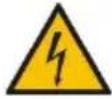 | CAUTION! Risk of electric shock! |
 | For indoor use only. |
CAUTION! The illustrations in this manual are for illustrative purposes only and may differ in some details from the actual product appearance.
The original version of the instructions is the German version. Other language versions are translations from German.
2. Safe use
The term "device" or "product" in the warnings and instructions refers to the
2.1. Electrical safety
a) The device plug must fit into the socket. Do not modify the plug in any way. Original plugs and matching sockets reduce the risk of electric shock.
b) Avoid touching earthed items such as tubes, radiators, heaters and refrigerators. There is an increased risk of electric shock if your body is earthed and touches the device exposed to direct rain, wet floor and humid environment. If water penetrates into the device, there is an increased risk of damage to the device and electric shock.
c) Do not touch the device with wet or damp hands.
d) Do not use the cable in a wrong way. Never use it to carry the device or to pull the plug out of the socket. Keep the cable away from heat sources, oil, sharp edges or moving parts. Damaged or tangled cables increase the risk of electric shock.
e) If you cannot avoid using the device in a wet environment, use a residual current device (RCD). Using an RCD reduces the risk of electric shock.
f) Do not use the device if the power cable is damaged or shows clear signs of wear. A damaged power cable should be replaced by a qualified electrician or the manufacturer's service.
g) To avoid electric shock, do not immerse the cable, plug or device itself in water or other liquid. Do not use the device on wet surfaces.
h) CAUTION - DANGER TO LIFE! When cleaning or using the device, never immerse it in water or other liquids.
i) Do not use the device in high humidity rooms or in a direct vicinity to a water tanks!
2.2. Safety in the work area
a) Keep the work area tidy and well lit. Disorder or poor lighting can lead to accidents. Be careful, watch what you are doing and use common sense when working with the device.
b) Do not use the device in an area with a risk of explosion, for example in the presence of flammable liquids, gases or dust.
c) In the event of damage or malfunction of the device, it must be switched off immediately and the incident must be reported to an authorised person.
d) If in doubt as to whether the device is working properly, contact the manufacturer's service.
e) Repairs to the device may only be carried out by the manufacturer's service. Do not carry out repairs yourself!
f) In the event of fire or fire, use only powder or snow (CO2) extinguishers to extinguish fire in the device where there is voltage.
g) No children or unauthorised persons are allowed in the work area. (Lack of attention may result in loss of control over the device).
h) Check the condition of the safety stickers regularly. Replace them if they are illegible.
i) Keep these instructions for future reference. If the device is to be passed on to third parties, the instructions for use must be handed over together with the device.
j) Keep packaging parts and small assembly parts out of the reach of children.
k) Keep the device away from children and animals
I) When using this device together with other devices, the other instructions for use must also be followed.

Remember! Keep children and other bystanders safe while operating the device.
2.3. Personal safety
a) Do not operate the device if you are tired, ill or under the influence of alcohol, drugs or medication which might impair your ability to operate the device.
b) The device is not intended to be used by persons (including children) with reduced mental, sensory or intellectual functions or lack of experience and/or knowledge, unless they are supervised by a person responsible for their safety or have been given instructions by them on how to operate the device.
c) The device may only be operated by persons who are physically fit, capable of handling the device and who have been adequately trained, who have read these instructions and have received training in health and safety.
d) Be careful and use common sense when operating the device. A short moment of distraction during operation may lead to serious personal injury.
e) The device is not a toy. Children should be supervised to ensure that they do not play with the device.
2.4. Safe use of the device
a) Do not overload the device. Use tools that are suitable for the given application. A correctly selected device ensures better and safer performance of work.
b) Do not use the device if the ON/OFF switch does not function properly (does not switch on and off). Devices that cannot be controlled by the switch are dangerous, must not be operated and must be repaired.
c) The device must be disconnected from the power supply before adjustment, cleaning and maintenance. This preventive measure reduces the risk of accidental activation.
d) Keep unused devices out of the reach of children and anyone not familiar with the device or these instructions. Devices are dangerous in the hands of inexperienced users.
e) Keep the device in good working order. Before each use, check for general damage or damage to moving parts (cracks in parts and components or any other condition that may affect the safe operation of the device). If damaged, have the device repaired before use.
f) Repair and maintenance of the device should be carried out by qualified persons using only original spare parts. This will ensure a safe use of the device.
g) To ensure the designed operational integrity of the device, do not remove factory-installed covers or loosen any screws.
h) Do not move, shift or rotate the device during operation.
i) Do not leave the switched on device unattended.
j) Clean the device regularly to prevent the permanent accumulation of dirt.
k) The device is not a toy. Cleaning and maintenance must not be performed by children without adult supervision.
1) It is forbidden to tamper with the device in order to change its parameters or construction.
m) Keep the device away from sources of fire and heat.
n) Do not cover the vents of the device!
o) It is forbidden to use the power supply unit under full load for a long period of time, it may damage the device.
p) The output voltage of the power supply should not exceed the input voltage of the powered device. Excessive voltage may damage the powered device.
q) Before changing the power supply unit operation mode, disconnect the connected cables of the external load first.
r) If the device is running with an inductive load such as magnetic coils, DC motors, stepper motors, etc., make sure to change the voltage / current slowly. NEVER switch on or off the power supply with inductive load connected.
s) Do not turn on or off the power supply unit while it is connected to a load.
t) Do not short-circuit the cables connected to the voltage.
u) Please make sure that the input voltage matches the setting of the input voltage selector, otherwise it will cause the power supply unit to malfunction or even damage it.

CAUTION! Although the device has been designed to be safe and has been equipped with adequate safeguards, and despite the use of additional safety measures, there is still a small risk of accident or injury when operating the device. Caution and common sense are advised when using the device.
3. Rules of use
The device is designed to supply external receivers with direct current of a specified voltage and intensity.
The user is responsible for any damage caused by improper use.
3.1. Description of the device
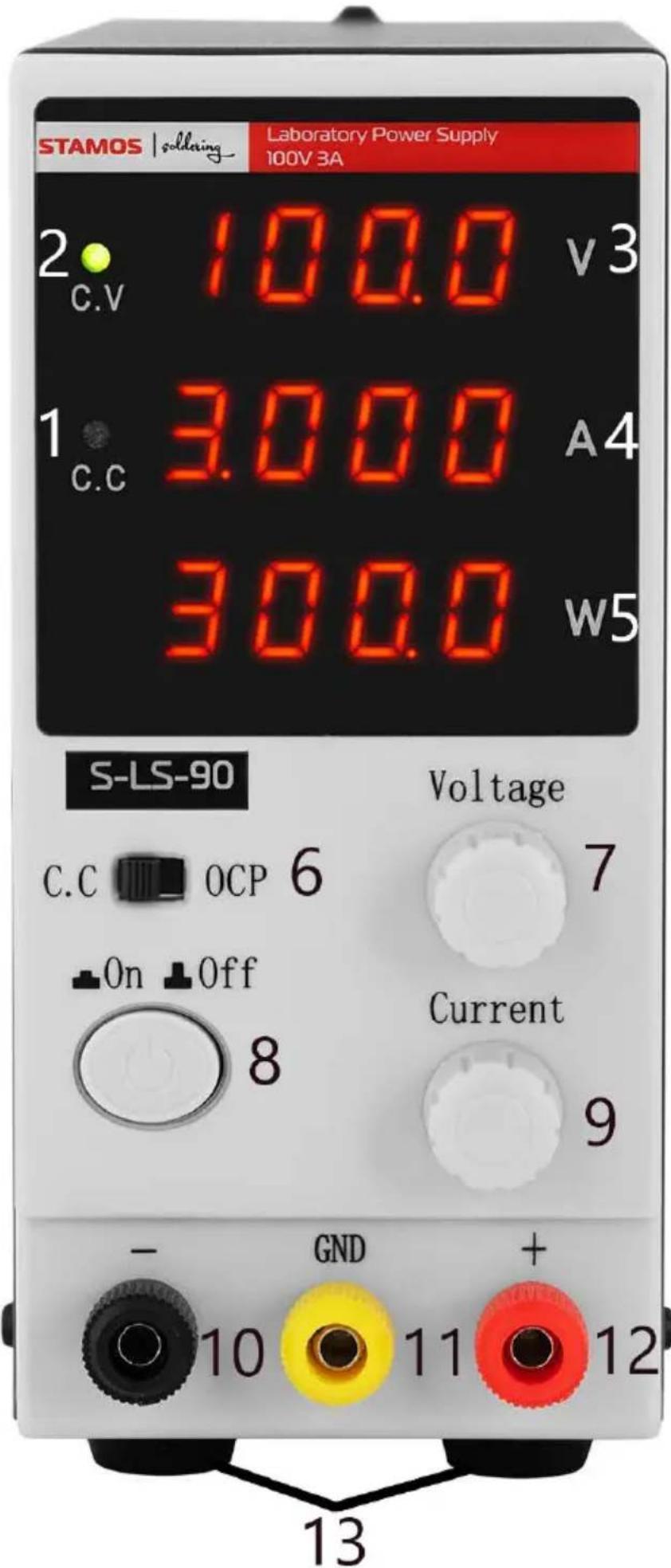
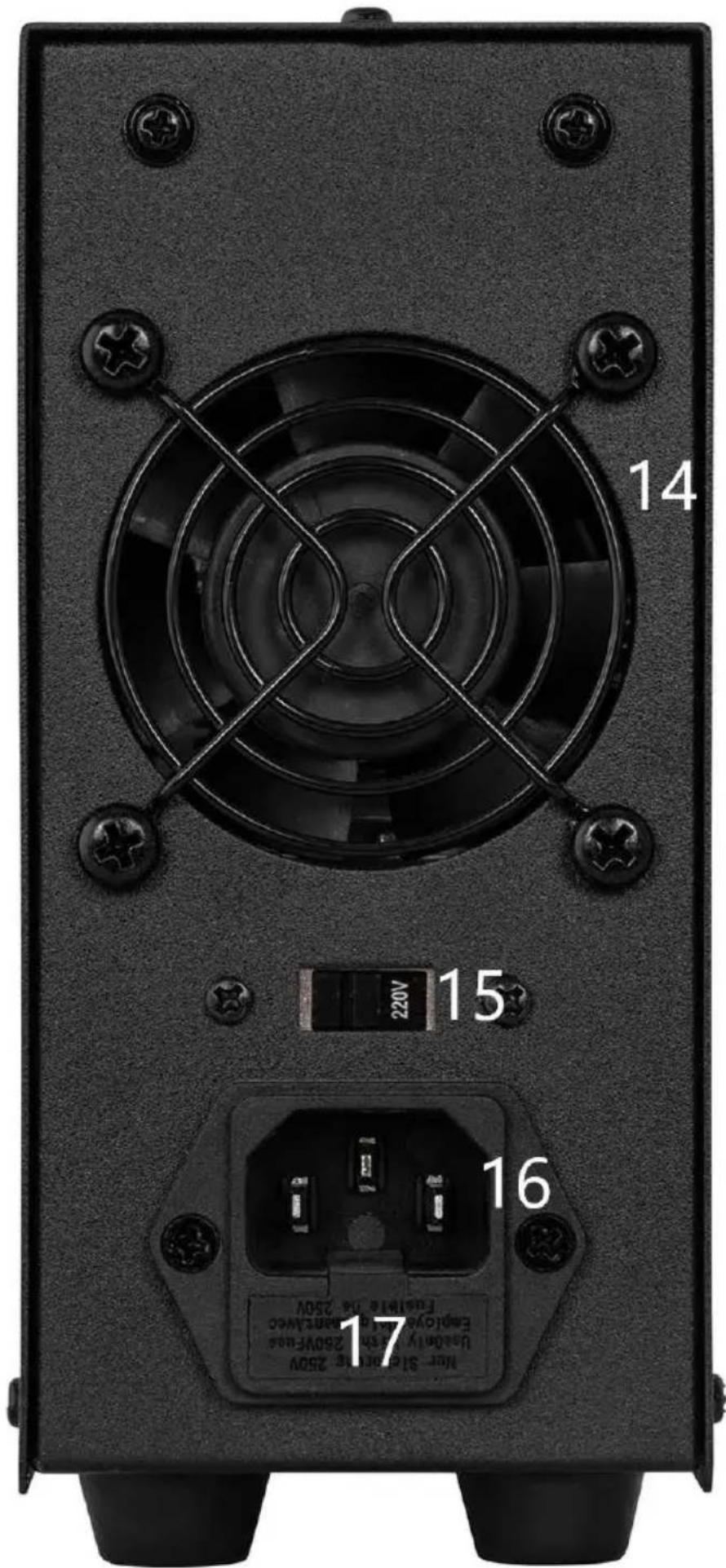
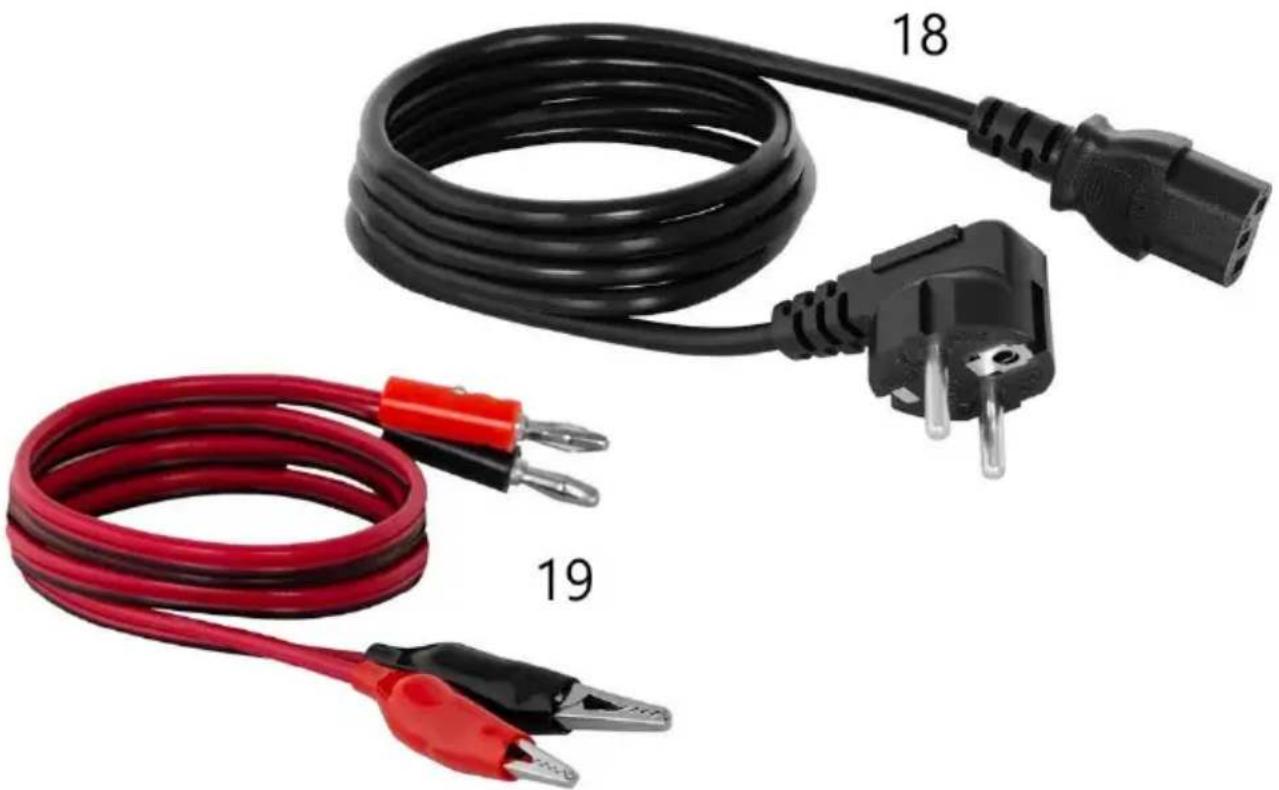
-
Indicator – indicates operation in the current stabilisation mode on the output
-
Indicator – indicates operation in the voltage stabilisation mode on the output
-
Voltage value display
-
Current value display
-
Output power value display
-
Switch: output current stabilisation mode/overload protection activation
-
Voltage value regulation knob
-
On/Off button
-
Current value regulation knob
-
Output terminal with negative polarity
-
Output terminal – grounding
-
Output terminal with positive polarity
-
Support legs
-
Exhaust fan
-
Switch of the input voltage value 110/230V
-
Power supply socket
-
Fuse socket
-
Power supply cable
-
Connection wires
3.2. Preparation for work
LOCATION OF THE DEVICE
The ambient temperature should not exceed 40° C and the relative humidity should not exceed 85%. Position the device in a way that allows for good air circulation. Maintain a minimum distance of 10 cm from any wall. Keep the device away from any hot surfaces. Always operate the device on a level, stable, clean, fireproof and dry surface and out of the reach of children and persons with reduced mental, sensory and intellectual abilities. Position the device in such a way that the power supply plug can be reached at any time. Make sure that the device's power supply corresponds to the data on the rating plate!
3.3. Working with the device
To obtain the most stable settings within the tolerance of the PSU device, turn it on 30 minutes before starting work.
- Plug the power supply cable connector (18) into the socket (16) on the back of the device.
- Switch the device on by pressing the On/Off button (8).
- Set the output parameters depending on the selected operating mode
a) Voltage regulation mode
- Turn the current regulation knob (9) clockwise to the maximum, then use the knob (7) to set the preferred voltage value.
- Connect the external load to the clamps (10) and (12).
- In this operating mode the device will output a constant, set voltage value, while the current value will change with respect to the connected load. The C.V diode (2) should be on.
b) Current regulation mode
- Set the switch (6) to "CC" position.
- Turn the current regulation knob (9) clockwise until the CV indicator lights up, then use the voltage regulation knob (7) to set the voltage value to 5-8V.
- Turn the current regulation knob (9) counter-clockwise to the minimum. Then connect the output terminals (10) and (12) with the wires. Use the knob (9) to change the current value. After adjusting the current value, turn the voltage regulation knob (7) counter-clockwise to the minimum, then remove the wires connecting the output terminals.
- Connect the load to the output terminals. Turn the voltage regulation knob (7) clockwise until the C.C indicator (1) turns on.
- In this mode, the current assumes a constant, set value. On the other hand, the voltage changes depending on the load.
4. Overload protection
- Set the switch (6) to "CC" position. - Following instructions in item 3 connect the terminals (10) and (12) with wires to regulate the current value. The set value will be the threshold value of protection activation. Remove wires from terminals.
- Set the switch (6) to “OCP” position. The protection will be activated. - Set the desired voltage on the output with knob (7). Connect the loads to output terminals (10) and (12). If the load has a short circuit or other abnormal behaviour, the output current will increase. If the set value is exceeded, the protection will cut the power supply to the outputs and an audible alarm will be activated.
- In order to reset the protection after its activation, disconnect the load, then set the switch (6) to "CC" position, and then again to "OCP". NOTE: When the OCP protection is active, the device cannot operate in the mode of stabilising the output current.
- After use, switch the device off using the On/Off button (8), disconnect the external load and disconnect the device plug from the power source.
3.4. Cleaning and maintenance
a) Before cleaning and when the device is not in use, pull the power supply plug.
b) Use only non-corrosive agents for cleaning the surface.
c) After each cleaning, all components should be well dried before the device s used again.
d) Store the device in a dry and cool place protected from moisture and direct sunlight.
e) Do not spray the device with a stream of water and do not immerse it in water.
f) Ensure that no water enters through the ventilation openings in the housing.
g) Clean the ventilation openings with a brush and compressed air.
h) Regularly inspect the device for technical failure and damage.
i) In order to ensure fire protection, replace the fuse only to the specified type and class.
Fuse replacement
CAUTION! A fuse should be replaced by a specialist technician.
- Disconnect the device from the power supply.
- Disconnect the power supply cable and remove the fuse socket.
- Replace the fuse with a new one with the same parameters.
- Assemble the fuse socket.
CAUTION! To avoid damaging the fuse socket, do not use excessive force in removing and installing the fuse socket.
DISPOSAL OF USED DEVICES
At the end of its service life, this product must not be disposed of with normal household waste, but should be taken to a collection point for the recycling of electrical and electronic devices. This is shown by the symbol placed on the product, operating manual or the packaging. The materials used in the device can be reused according to their intended use. By reusing materials or conducting other forms of using used devices, you make a significant contribution to the protection of our environment.
Local administration will provide you with information about the appropriate point for disposal of used devices.
Dane techniczne
For the disposal of the device please consider and act according to the national and local rules and regulations.
CONTACT
expondo Polska sp. z o.o. sp. k.
- GENERAL DESCRIPTION
- READ THE INSTRUCTIONS CAREFULLY AND UNDERSTAND THEM BEFORE USE
- SAFE USE
- ELECTRICAL SAFETY
- SAFETY IN THE WORK AREA
- PERSONAL SAFETY
- SAFE USE OF THE DEVICE
- RULES OF USE
- DESCRIPTION OF THE DEVICE
- PREPARATION FOR WORK
- LOCATION OF THE DEVICE
- WORKING WITH THE DEVICE
- OVERLOAD PROTECTION
- CLEANING AND MAINTENANCE
- FUSE REPLACEMENT
- DISPOSAL OF USED DEVICES
- DANE TECHNICZNE
- CONTACT
Brand : Stamos
Model : S-LS-94
Category : Measuring equipment