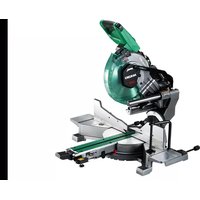
C3610DRA - Saw HiKOKI - Free user manual and instructions
Find the device manual for free C3610DRA HiKOKI in PDF.


| Brand | HiKOKI |
| Model | C3610DRA |
| Product Type | Cordless Radial Miter Saw |
| Power Source | 36V lithium-ion battery (BSL36B18) or ET36A 120V AC adapter |
| Blade Diameter | 10 inches (255 mm) |
| No-Load Speed | 4,000 rpm |
| Max Cutting Capacity (Height) | With anchor plate: 89 mm; without plate: 64 mm |
| Max Cutting Capacity (Width) at 0° | With plate: 292 mm; without plate: 318 mm |
| Miter Range | 0° – 55° left, 0° – 60° right |
| Bevel Range | 0° – 48° left, 0° – 48° right |
| Net Weight | 20.6 kg (with BSL36B18 battery) |
| Compatible Battery | BSL36B18 (Multivolt) |
| Charger | UC18YSL3 (120 V, 60 Hz, charging time approx. 52 min) |
| Electric Brake | Yes |
| Laser Marker | Yes, Class 1M, <0.39 mW, 630-660 nm |
| Lower Guard | Yes, with secondary guards (A) and (B) |
| Recommended Use | Wood and aluminum frames |
| Maintenance and Cleaning | Clean regularly with compressed air, lubricate moving parts with machine oil, replace worn blade |
| Safety | Wear safety glasses, hearing protection, do not use without guards, disconnect before maintenance |
| Spare Parts and Repairability | Use only genuine metabo HPT parts, repairs by authorized service center |
Frequently Asked Questions - C3610DRA HiKOKI
User questions about C3610DRA HiKOKI
0 question about this device. Answer the ones you know or ask your own.
Ask a new question about this device
Download the instructions for your Saw in PDF format for free! Find your manual C3610DRA - HiKOKI and take your electronic device back in hand. On this page are published all the documents necessary for the use of your device. C3610DRA by HiKOKI.
USER MANUAL C3610DRA HiKOKI
(Laser Marker Equipment)
Cordless Slide Compound Miter Saw
natural_image
Technical line drawing of a mechanical assembly with no visible text or symbolsSAFETY INSTRUCTIONS AND INSTRUCTION MANUAL

WARNING
IMPROPER OR UNSAFE use of this power tool can result in death or serious bodily injury!
This manual contains important information about product safety. Please read and understand this manual before operating the power tool. Please keep this manual available for other users and owners before they use the power tool. This manual should be stored in safe place.
INSTRUCTIONS DE SECURITE ET MODE D'EMPLOI

AVERTISSEMENT
IMPORTANT SAFETY INFORMATION
Read and understand all of the safety precautions, warnings and operating instructions in the Instruction Manual before operating or maintaining this power tool.
Most accidents that result from power tool operation and maintenance are caused by the failure to observe basic safety rules or precautions. An accident can often be avoided by recognizing a potentially hazardous situation before it occurs, and by observing appropriate safety procedures.
Basic safety precautions are outlined in the "SAFETY" section of this Instruction Manual and in the sections which contain the operation and maintenance instructions.
Hazards that must be avoided to prevent bodily injury or machine damage are identified by WARNINGS on the power tool and in this Instruction Manual.
NEVER use this power tool in a manner that has not been specifically recommended by metabo HPT.
MEANINGS OF SIGNAL WORDS
WARNING indicates a potentially hazardous situations which, if ignored, could result in death or serious injury.
CAUTION indicates a potentially hazardous situations which, if not avoided, may result in minor or moderate injury, or may cause machine damage.
NOTE emphasizes essential information.
MEANINGS OF SYMBOLS
| SymbolsThe following show symbols used for the machine. Be sure that you understand their meaning before use. | |||
 | ⚠ WARNINGTo reduce the risk of injury, user must read instruction manual. | ⚠ WARNINGAlways wear eye protection. | |
 | ⚠ CAUTIONDo not stare at operating lamp. | ⚠ WARNINGAlways wear hearing protection. | |
SAFETY
GENERAL POWER TOOL SAFETY WARNINGS

WARNING
Read all safety warnings, instructions, illustrations and specifications provided with this power tool.
Failure to follow all instructions listed below may result in electric shock, fire and/or serious injury.
Save all warnings and instructions for future reference.
The term “power tool” in the warnings refers to your mains-operated (corded) power tool or battery-operated (cordless) power tool.
1) Work area safety
a) Keep work area clean and well lit.
Cluttered or dark areas invite accidents.
b) Do not operate power tools in explosive atmospheres, such as in the presence of fl ammable liquids, gases or dust.
Power tools create sparks which may ignite the dust or fumes.
c) Keep children and bystanders away while operating a power tool.
Distractions can cause you to lose control.
2) Electrical safety
a) Power tool plugs must match the outlet.
Never modify the plug in any way.
Do not use any adapter plugs with earthed (grounded) power tools.
Unmodified plugs and matching outlets will reduce risk of electric shock.
b) Avoid body contact with earthed or grounded surfaces, such as pipes, radiators, ranges and refrigerators.
There is an increased risk of electric shock if your body is earthed or grounded.
c) Do not expose power tools to rain or wet conditions.
Water entering a power tool will increase the risk of electric shock.
d) Do not abuse the cord. Never use the cord for carrying, pulling or unplugging the power tool.
Keep cord away from heat, oil, sharp edges or moving parts.
Damaged or entangled cords increase the risk of electric shock.
e) When operating a power tool outdoors, use an extension cord suitable for outdoor use.
Use of a cord suitable for outdoor use reduces the risk of electric shock.
f) If operating a power tool in a damp location is unavoidable, use a residual current device (RCD) protected supply.
Use of an RCD reduces the risk of electric shock.
3) Personal safety
a) Stay alert, watch what you are doing and use common sense when operating a power tool. Do not use a power tool while you are tired or under the influence of drugs, alcohol or medication.
A moment of inattention while operating power tools may result in serious personal injury.
b) Use personal protective equipment. Always wear eye protection.
Protective equipment such as dust mask, non-skid safety shoes, hard hat, or hearing protection used for appropriate conditions will reduce personal injuries.
c) Prevent unintentional starting. Ensure the switch is in the off -position before connecting to power source and/or battery pack, picking up or carrying the tool.
Carrying power tools with your finger on the switch or energising power tools that have the switch on invites accidents.
d) Remove any adjusting key or wrench before turning the power tool on.
A wrench or a key left attached to a rotating part of the power tool may result in personal injury.
e) Do not overreach. Keep proper footing and balance at all times.
This enables better control of the power tool in unexpected situations.
f) Dress properly. Do not wear loose clothing or jewellery. Keep your hair, clothing and gloves away from moving parts.
Loose clothes, jewellery or long hair can be caught in moving parts.
g) If devices are provided for the connection of dust extraction and collection facilities, ensure these are connected and properly used.
Use of dust collection can reduce dust-related hazards.
h) Do not let familiarity gained from frequent use of tools allow you to become complacent and ignore tool safety principles.
A careless action can cause severe injury within a fraction of a second.
4) Power tool use and care
a) Do not force the power tool. Use the correct power tool for your application.
The correct power tool will do the job better and safer at the rate for which it was designed.
b) Do not use the power tool if the switch does not turn it on and off.
Any power tool that cannot be controlled with the switch is dangerous and must be repaired.
c) Disconnect the plug from the power source and/or remove the battery pack, if detachable, from the power tool before making any adjustments, changing accessories, or storing power tools.
Such preventive safety measures reduce the risk of starting the power tool accidentally.
d) Store idle power tools out of the reach of children and do not allow persons unfamiliar with the power tool or these instructions to operate the power tool.
Power tools are dangerous in the hands of untrained users.
e) Maintain power tools and accessories. Check for misalignment or binding of moving parts, breakage of parts and any other condition that may affect the power tool's operation. If damaged, have the power tool repaired before use.
Many accidents are caused by poorly maintained power tools.
f) Keep cutting tools sharp and clean.
Properly maintained cutting tools with sharp cutting edges are less likely to bind and are easier to control.
g) Use the power tool, accessories and tool bits etc. in accordance with these instructions, taking into account the working conditions and the work to be performed.
Use of the power tool for operations different from those intended could result in a hazardous situation.
h) Keep handles and grasping surfaces dry, clean and free from oil and grease.
Slippery handles and grasping surfaces do not allow for safe handling and control of the tool in unexpected situations.
5) Battery tool use and care
a) Recharge only with the charger specified by the manufacturer.
A charger that is suitable for one type of battery pack may create a risk of fire when used another battery pack.
b) Use power tools only with specifically designated battery packs.
Use of any other battery packs may create a risk of injury and fire.
c) When battery pack is not in use, keep it away from other metal objects, like paper clips, coins, keys, nails, screws or other small metal objects, that can make a connection from one terminal to another.
Shorting the battery terminals together may cause burns or a fire.
d) Under abusive conditions, liquid may be ejected from the battery; avoid contact. If contact accidentally occurs, fl ush with water. If liquid contacts eyes, additionally seek medical help.
Liquid ejected from the battery may cause irritation or burns.
e) Do not use a battery pack or tool that is damaged or modified.
Damaged or modified batteries may exhibit unpredictable behaviour resulting in fire, explosion or risk of injury.
f) Do not expose a battery pack or tool to fire or excessive temperature.
Exposure to fire or temperature above 265^ F ( 130^ C) may cause explosion.
g) Follow all charging instructions and do not charge the battery pack or tool outside the temperature range specified in the instructions.
Charging improperly or at temperatures outside the specified range may damage the battery and increase the risk of fire.
6) Service
a) Have your power tool serviced by a qualified repair person using only identical replacement parts.
This will ensure that the safety of the power tool is maintained.
b) Never service damaged battery packs.
Service of battery packs should only be performed by the manufacturer or authorized service providers.
PRECAUTION
Keep children and infirm persons away.
When not in use, tools should be stored out of reach of children and infirm persons.
SAFETY INSTRUCTIONS FOR MITER SAW with
a) Miter saws are intended to cut wood or wood-like products, they cannot be used with abrasive cut-off wheels for cutting ferrous material such as bars, rods, studs, etc.
Abrasive dust causes moving parts such as the lower guard to jam. Sparks from abrasive cutting will burn the lower guard, the kerf insert and other plastic parts.
b) Use clamps to support the workpiece whenever possible. If supporting the workpiece by hand, you must always keep your hand at le mm from either side of the saw blade. Do not use this saw to cut pieces that are too small to be securely clamped or held by hand.
If your hand is placed too close to the saw blade, there is an increased risk of injury from blade contact.
c) The workpiece must be stationary and clamped or held against both the fence and the table. Do not feed the workpiece into the blade or cut "freehand" in any way.
Unrestrained or moving workpieces could be thrown at high speeds, causing injury.
d) Push the saw through the workpiece. Do not pull the saw through the workpiece. To make a cut, raise the saw head and pull it out over the workpiece without cutting, start the motor, press the saw head down and push the saw through the workpiece.
Cutting on the pull stroke is likely to cause the saw blade to climb on top of the workpiece and violently throw the blade assembly towards the operator.
e) Never cross your hand over the intended line of cutting either in front or behind the saw blade.
Supporting the workpiece “cross handed” i.e. holding the workpiece to the right of the saw blade with your left hand or vice versa is very dangerous.
f) Do not reach behind the fence with either hand closer than 100 mm from either side of the saw blade, to remove wood scraps, or for any other reason while the blade is spinning.
The proximity of the spinning saw blade to your hand may not be obvious and you may be seriously injured.
g) Inspect your workpiece before cutting. If the workpiece is bowed or warped, clamp it with the outside bowed face toward the fence. Always make certain that there is no gap between the workpiece, fence and table along the line of the cut.
Bent or warped workpieces can twist or shift and may cause binding on tile spinning saw blade while cutting. There should be no nails or foreign objects in the workpiece.
h) Do not use the saw until the table is clear of all tools, wood scraps, etc., except for the workpiece.
Small debris or loose pieces of wood or other objects that contact the revolving blade can be thrown with high speed.
i) Cut only one workpiece at a time.
Stacked multiple workpieces cannot be adequately clamped or braced and may bind on the blade or shift during cutting.
j) Ensure the miter saw is mounted or placed on a level, fi rm work surface before use.
A level and firm work surface reduces the risk of the miter saw becoming unstable.
k) Plan your work. Every time you change the bevel or miter angle setting, make sure the adjustable fence is set correctly to support the workpiece and will not interfere with the blade or the guarding system.
Without turning the tool "ON" and with no workpiece on the table, move the saw blade through a complete simulated cut to assure there will be no interference or danger of cutting the fence.
I) Provide adequate support such as table extensions, saw horses, etc. for a workpiece that is wider or longer than the table top.
Workpieces longer or wider than the miter saw table can tip if not securely supported. If the cut-off piece or workpiece tips, it can lift the lower guard or be thrown by the spinning blade.
m) Do not use another person as a substitute for a table extension or as additional support.
Unstable support for the workpiece can cause the blade to bind or the workpiece to shift during the cutting operation pulling you and the helper into the spinning blade.
n) The cut-off piece must not be jammed or pressed by any means against the spinning saw blade. If confined, i.e. using length stops, the cut-off piece could get wedged against the blade and thrown violently.
o) Always use a clamp or a fixture designed to properly support round material such as rods or tubing.
Rods have a tendency to roll while being cut, causing the blade to "bite" and pull the work with your hand into the blade.
p) Let the blade reach full speed before contacting the workpiece.
This will reduce the risk of the workpiece being thrown.
q) If the workpiece or blade becomes jammed, turn the miter saw off. Wait for all moving parts to stop and disconnect the plug from the power source and/or remove the battery pack. Then work to free the jammed material.
Continued sawing with a jammed workpiece could cause lass of control or damage to the miter saw.
r) After finishing the cut, release the switch, hold the saw head down and wait for the blade to stop before removing the cut-off piece.
Reaching with your hand near the coasting blade is dangerous.
s) Hold the handle firmly when making an incomplete cut or when releasing the switch before the saw head is completely in the down position.
The braking action of the saw may cause the saw head to be suddenly pulled downward, causing a risk of injury.
SPECIFIC SAFETY RULES FOR USE OF THIS POWER TOOL AND SYMBOLS
WARNING
The following specific operating instructions must be observed when using this POWER TOOL in order to avoid injury:
DO's
ALWAYS OBSERVE THE FOLLOWING RULES TO ASSURE SAFE USE OF THIS TOOL:
-
Review this Manual and familiarize yourself with the safety rules and operating instructions for this POWER TOOL before attempting to use it.
-
Remove all packing materials attached or connected to the tool before attempting to operate it.
-
Always confirm that the POWER TOOL is clean before using it.
-
Always wear snug-fitting clothing, non-skid footwear (preferably with steel toes) and eye protection when operating the POWER TOOL.
-
Always handle the POWER TOOL carefully. If the POWER TOOL falls or strikes against a hard object, it might become deformed or cracked or sustain other damage.
-
Always cease operating the saw at once, if you notice any abnormality whatsoever.
-
Always confirm that all components are mounted properly and securely before using the tool.
- When replacing the saw blade, always confirm that the rpm rating of the new blade is correct for use on this tool.
- Always shut off the power and wait for the saw blade to completely stop rotating before doing any maintenance or adjustments.
- During slide cutting, always push the saw blade away from the operator.
- Always clamp or otherwise secure the workpiece to the fence; otherwise the workpiece might be thrust form the table and cause bodily harm.
- During miter or bevel cutting, always wait for the rotation of the blade to stop completely before the saw blade.
- Always make a trial run first before attempting any new use of the saw.
- Always handle the saw blade with care when dismounting and mounting it.
- Always confirm that the workpiece is free of nails or other foreign objects before beginning a cut.
- Always keep your hands out of the path of the saw blade.
- Always confirm that the lower guard is in the proper place before using the saw.
- Always confirm that the lower guard does not obstruct the sliding motion of the saw before attempting slide cutting.
- Inspect the tool power cords periodically.
- Always confirm that the proper lengths and types of extension cords are being utilized, if necessary, before starting the tool.
- Always confirm that the motor air vents are fully open before using the tool.
- Always wait until the motor has reached full speed before starting a cut.
- Always keep the handles dry, clean and free of oil and grease. Hold the tool firmly when in use.
- Always use outboard stands to provide support for long workpieces that overhang the table of the slide compound miter saw.
- Always operate the tool after ensuring the workpiece is fixed properly with a vise assembly.
- The operating instructions provided with the tool shall direct the user to secure the tool to supporting structure if, during normal operation, there is a tendency for the tool to tip over, slide, or walk on the supporting surface.
-
Ensure before each cut that the machine is stable. Use only saw blades whose maximum permitted speed is higher than the no-load speed of the power tool.
-
If the saw blade should become jammed, switch the machine off and hold the workpiece until the saw blade comes to a complete stop. To prevent kickback, the workpiece may not be moved until after the machine has come to a complete stop. Correct the cause for the jamming of the saw blade before restarting the machine.
DON'Ts
NEVER VIOLATE THE FOLLOWING RULES TO ASSURE SAFE USE OF THIS TOOL:
- Never operate the POWER TOOL unless you fully understand the operating instructions contained in this Manual.
life2ngNever leave the POWER TOOL unattended without first unplugging the power cord.
-
Never operate the POWER TOOL when you are tired, after you have taken any medications, or have consumed any alcoholic beverages.
-
Never use the POWER TOOL for applications not specified in the instruction manual.
-
Never operate the tool while wearing loose clothing, a necktie or jewelry, or while your hair is uncovered, to protect against getting caught in the moving machinery.
-
Never reach around the saw blade.
-
Never touch any moving parts, including the blade, while the saw is in use.
-
Never remove any safety devices or blade guards; use of the tool without them would be hazardous.
-
Never lock the lower guard; always confirm that it slides smoothly before using the tool.
-
Never damage the power cord of the tool.
-
Never attempt to move a plugged-in POWER TOOL while your finger is on the starting switch.
-
Never use the POWER TOOL if the starting switch does not turn on and off properly.
-
Never use the POWER TOOL if the plastic housing or the handle is cracked or deformed.
-
Never use the POWER TOOL near flammable liquids or gases because sparking can cause an explosion.
-
Never clean plastic components with solvents because the plastic may dissolve.
-
Never operate the saw unless all the blade guards are in place.
-
Never raise the saw blade from the workpiece until it has first come to a complete stop.
-
When slide cutting, never pull the handle toward the operator, since this could cause the saw blade to kick up from the workpiece. Always push the handle away from the operator in a single, smooth motion.
-
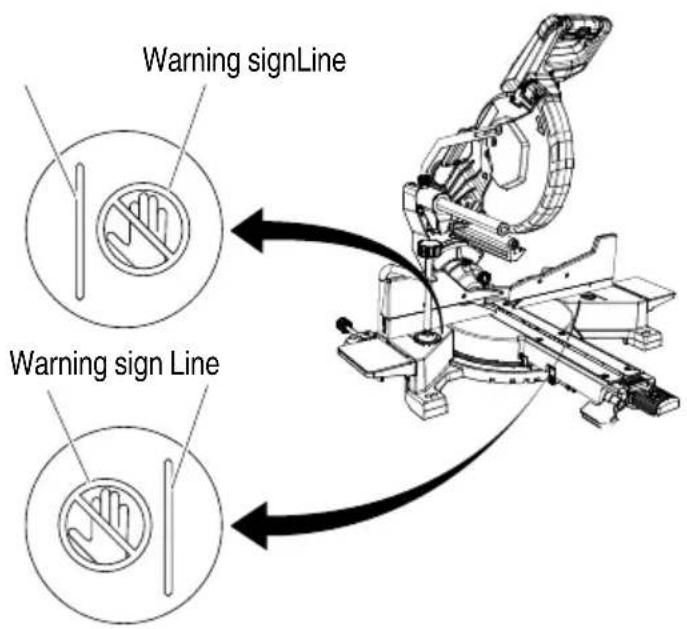
Never place your limbs inside of the line next to warning sign " 🔍" while the tool is being operated. This may cause hazardous conditions.
-
Never use abrasive type blades on this saw.
-
Never expose to rain or use in damp locations.
- Never cut ferrous metals or masonry.
- Do not replace the laser with a different type.
- Do not stand in a line with the saw blade In front of the machine. Always stand aside of the saw blade. This protects your body against possible kickback. Keep hands, fingers and arms away from the rotating saw blade.
- Do not cross your arms when operating the tool arm.
- Definitions for symbols used on this tool.
V ......volts
A ......amperes
Hz ......hertz
W ......watts
or DC .....direct current
\~ or AC ......alternating current
no ......no load speed
---/min ....revolutions or reciprocation per minute min ....minutes

WARNING
- Always wear eye protection when using the slide compound miter saw.
- Always keep hands out of the path of the saw blade.
- Never operate the saw without the guards in place.
- Never perform any freehand operation with the slide compound miter saw.
- Never reach around the saw blade.
- Always turn off tool and wait for saw blade to stop before moving workpiece or changing settings.
- Always disconnect the battery before changing blade or servicing.
- Saw blade diameter is 10" (255 mm).
- No load speed is 4,000/min.
- To reduce the risk of injury, return carriage to the full rear position after each crosscut operation.
REPLACEMENT PARTS
When servicing use only identical replacement parts. Repairs should be conducted only by a metabo HPT authorized service center.
IMPORTANT SAFETY INSTRUCTIONS FOR CHARGER OR ADAPTER
The term "charger or adapter" in the safety instructions refers to your battery charger or AC/DC adapter.

WARNING
Death or serious bodily injury could result from improper or unsafe use of charger or adapter. To avoid these risks, follow these basic safety instructions:
READ ALL INSTRUCTIONS
- This manual contains important safety and operating instructions for battery charger Model UC18YSL3 or AC/DC adapter Model ET36A.
- Before using charger or adapter, read all instructions and cautionary markings on (1) charger or adapter, (2) battery, and (3) product using battery.
- When charging the battery with a battery charger, reduce the risk of injury by charging metabo HPT rechargeable battery multi volt type series and BSL18 series. Other type of batteries may burst causing personal injury and damage.
- Use of an attachment not recommended or sold by the charger or adapter manufacturer may result in a risk of fire, electric shock, or injury to persons.
- To reduce risk of damage to electric plug and cord, pull by plug when disconnecting charger or adapter.
- Make sure cord is located so that it will not be stepped on, tripped over, or otherwise subjected to damage or stress.
- An extension cord should not be used unless absolutely necessary. Use of improper extension cord could result in a risk of fire and electric shock.
If extension cord must be used make sure:
a. That blades of extension cord are the same number, size, and shape as those of plug on charger or adapter:
b. That extension cord is properly wired and in good electrical condition; and
c. That wire size is large enough for rating of charger or adapter as specified in Table 1.
Table 1
RECOMMENDED MINIMUM AWG SIZE FOR
EXTENSION CORDS FOR CHARGER OR ADAPTER
| AC Input Rating Amperes* AWG Size of Cord | ||
| Equal to or greater than | but less than | Length of Cord, Feet (Meter)25 (7.5) 50 (15) 100 (30) 150 (45) |
| 0 2 18 18 18 16 | ||
| 2 3 18 18 16 14 | ||
| 3 4 18 18 16 14 | ||
* If the input rating of a charger or adapter is given in watts rather than in amperes, the corresponding ampere rating is to be determined by dividing the wattage rating by the voltage rating-for example:
$$ \frac {1 , 2 5 0 \mathrm{W}}{1 2 5 \mathrm{V}} = 1 0 \mathrm{A} $$
- Do not operate charger or adapter with damaged cord or plug-replace them immediately.
- Do not operate charger or adapter if it has received a sharp blow, been dropped, or otherwise damaged in any way; take it to a qualified serviceman.
- Do not disassemble charger or adapter; take it to a qualified serviceman when service or repair is required. Incorrect reassembly may result in a risk of electric shock or fire.
- To reduce risk of electric shock, unplug charger or adapter from receptacle before attempting any maintenance or cleaning. Removing the battery will not reduce this risk.
- This AC/DC adapter is for use only with specific tools, including C3610DRA. The adapter might be suitable for use with other metabo HPT battery operated tools. It is necessary to confirm suitability by referencing the instruction manual of the specific tool or by consulting our web site https://www.metabo-hpt.com/. Failure to confirm suitability before using the adapter with specific tools could result in fire hazard.
IMPORTANT SAFETY INSTRUCTIONS FOR USE OF THE BATTERY AND CHARGER OR ADAPTER
You must charge the battery before you can use the power tool. Before using the model UC18YSL3 battery charger, be sure to read all instructions and cautionary statements on it, the battery and in this manual.

CAUTION
USE ONLY metabo HPT BATTERY TYPE BSL36B18. OTHER TYPES OF BATTERIES MAY BURST AND CAUSE INJURY!
Follow these instructions to avoid the risk of injury:

WARNING
Improper use of the battery or battery charger can lead to serious injury. To avoid these injuries:
- NEVER disassemble the battery or AC/DC adapter.
- NEVER incinerate the battery or AC/DC adapter, even if it is damaged or is completely worn out. The battery can explode in a fire.
- NEVER short-circuit the battery or AC/DC adapter.
- NEVER insert any objects into the charger or adapter's air vents. Electric shock or damage to the charger or adapter may result.
- NEVER use outdoors. Keep the battery or AC/DC adapter away from direct sunlight and use only where there is low humidity and good ventilation.
- NEVER charge when the temperature is below 14°F (-10°C) or above 104°F (40°C). (UC18YSL3) NEVER use when the temperature is below 32°F (0°C) or above 104°F (40°C). (ET36A, BSL36B18)
- NEVER connect two charger or adapter together.
- NEVER insert foreign objects into the hole for the battery or the charger or adapter.
- NEVER use a booster transformer.
- NEVER use DC power.
- NEVER store the battery or charger or adapter in places where the temperature may reach or exceed 104^ F ( 40^ C) such as inside metal box or car.
- NEVER expose the battery or charger or adapter to rain or wet conditions.
- ALWAYS operate charger or adapter on standard household electrical power (120 volts). Using the charger or adapter on any other voltage may overheat and damage the charger.
- ALWAYS wait at least 15 minutes between charges to avoid overheating the charger. (UC18YSL3)
- ALWAYS disconnect the power cord from its receptacle when the charger or adapter is not in use.
[The information below applies only to ET36A] -
Do not use the product if the tool or the AC/DC adapter terminals (AC/DC adapter mount) are deformed. Installing the AC/DC adapter could cause a short circuit that could result in smoke emission or ignition.
-
Keep the tool's terminals (AC/DC adapter mount) free of swarf and dust.
○ Prior to use, make sure that swarf and dust have not collected in the area of the terminals.
During use, try to avoid swarf or dust on the tool from falling on the AC/DC adapter.
When suspending operation or after use, do not leave the tool in an area where it may be exposed to falling swarf or dust.
Doing so could cause a short circuit that could result in smoke emission or ignition.
-
The product is intended for Use in Pollution Degree 2 or PD2 environments. Operate only in areas of non-conductive pollution. A temporary conductivity caused by condensation is normally expected.
-
This is a precision machine so do not drop or expose to impact.
-
Do not use this product near a pacemaker or other similar implanted device, which may be affected by a magnetic fi eld produced by this product.
-
The adapter, power supply box and the inside of the DC cord generates a boosted high voltage of 380 V so please be careful of the following.
○ Do not disassemble the product.
○ Do not drop or expose to impact.
In the event the product is damaged from strong impact, do not use the product.
○ Do not use the product in areas exposed to rain, snow, iron powder or wet condition.
○ Do not touch the product with wet hands.
○ Do not pull the cord with excessive force.
○ Use the product in a well-ordered work environment.
CAUTION
- When the mesh of the vent is plugged by objects such as wood shavings, try to keep the objects out when you clear the mesh.
(If not properly maintained, the temperature protective feature could shut the product off)
-
When the temperature protective feature frequently cuts the power off, do not overload the machine with continued work, but let the machine rest for a little before continuing operation.
-
The machine does get hot. However, this does not indicate an abnormality.
Keep the electricity running and operate the internal fan to cool the machine before carrying it elsewhere. When carrying the product, the case may be hot so please be careful.
-
During use, do not pull the cord to move the Box. Doing so may result in damage.
-
Do not use more that a single cord reel of 30 meters. Doing so may result in damage.
-
During use, if the machine stops running after the Box's LED lamp blinks, confi rm the power supply environment.
-
Do not drag the cord when using or carrying the machine.
Doing so may tear the cord insulation or break the cord which could result in electric shock.
- Do not stretch the cord out any more than required.
When using tools such as gardening clippers or circular saws, always make sure of the power cord's position to avoid cutting the cord during operation.
- To use the AC/DC adapter after it shuts down due to high temperature, disconnect the box's power plug, wait for the LED lamp to go out and then reconnect the box's power plug.
If the machine cuts off even after sufficiently cooling it off with the built-in fan, discontinue use as there may be a problem with the machine.
-
Do not use this product near a radio. Doing so could cause noise from the radio, making it difficult to listen to a broadcast.
-
This is a power source for multi volt products. Do not use with 18 V products or chargers. Doing so could result in damage.
-
Overload behavior may differ when compared with BSL36B18 battery use.
With the battery where the LED should blink on the main unit, the LED on the AC/DC adapter may blink instead.
PRECAUTIONS FOR AC/DC ADAPTER
The adapter equips with the protection function to stop the output. In the cases of 1 to 2 described below, when using this product, even if you are pulling the switch, the motor may stop. This is not the trouble but the result of protection function.
-
If the tool is overloaded, output may stop. In this case, release the switch of tool and eliminate causes of overloading.
-
If the adapter is overheated under overload work, output may stop. In situations like this, discontinue use of the adapter and detach it from the tool. Allow the adapter to cool in a location such as a shaded area with good air circulation.
CAUTION ON LITHIUM-ION BATTERY
To extend the lifetime, the lithium-ion battery equips with the protection function to stop the output.
In the cases of 1 to 3 described below, when using this product, even if you are pulling the switch, the motor may stop. This is not the trouble but the result of protection function.
- When the battery power remaining runs out, the motor stops.
In such case, charge it up immediately.
-
If the tool is overloaded, the motor may stop. In this case, release the switch of tool and eliminate causes of overloading. After that, you can use it again.
-
If the battery is overheated under overload work, the battery power may stop.
In this case, stop using the battery and let the battery cool. After that, you can use it again.
Furthermore, please heed the following warning and caution.
WARNING
In order to prevent any battery leakage, heat generation, smoke emission, explosion and ignition beforehand, please be sure to heed the following precautions.
- Make sure that swarf and dust do not collect on the battery.
During work make sure that swarf and dust do not fall on the battery.
○ Make sure that any swarf and dust falling on the power tool during work do not collect on the battery.
○ Do not store an unused battery in a location exposed to swarf and dust.
Before storing a battery, remove any swarf and dust that may adhere to it and do not store it together with metal parts (screws, nails, etc.). - Do not pierce battery with a sharp object such as a nail, strike with a hammer, step on, throw or subject the battery to severe physical shock.
- Do not use an apparently damaged or deformed battery.
- Do not use the battery in reverse polarity.
- Do not connect directly to an electrical outlets or car cigarette lighter sockets.
- Do not use the battery for a purpose other than those specified.
- If the battery charging fails to complete even when a specified recharging time has elapsed, immediately stop further recharging.
- Do not put or subject the battery to high temperatures or high pressure such as into a microwave oven, dryer, or high pressure container.
- Keep away from fire immediately when leakage or foul odor are detected.
- Do not use in a location where strong static electricity generates.
-
If there is battery leakage, foul odor, heat generated, discolored or deformed, or in any way appears abnormal during use, recharging or storage, immediately remove it from the equipment or battery charger, and stop use.
-
Do not immerse the battery or allow any fluids to flow inside. Conductive liquid ingress, such as water, can cause damage resulting in fire or explosion. Store your battery in a cool, dry place, away from combustible and flammable items. Corrosive gas atmospheres must be avoided.
CAUTION
- If liquid leaking from the battery gets into your eyes, do not rub your eyes and wash them well with fresh clean water such as tap water and contact a doctor immediately.
If left untreated, the liquid may cause eye-problems.
- If liquid leaks onto your skin or clothes, wash well with clean water such as tap water immediately. There is a possibility that this can cause skin irritation.
- If you find rust, foul odor, overheating, discolor, deformation, and/or other irregularities when using the battery for the first time, do not use and return it to your supplier or vendor.
WARNING
If an electrically conductive foreign object enters the terminals of the lithium ion battery, a short-circuit may occur resulting in the risk of fire. Please observe the following matters when storing the battery.
○ Do not place electrically conductive cuttings, nails, steel wire, copper wire or other wire in the storage case.
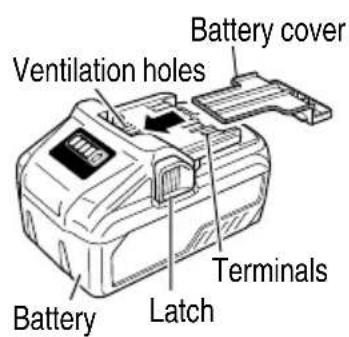
○ Either install the battery in the power tool or store by securely pressing into the battery cover until the ventilation holes are concealed to prevent short-circuits (See Fig. 4).
REGARDING LITHIUM-ION BATTERY TRANSPORTATION
When transporting a lithium-ion battery, please observe the following precautions.
WARNING
Notify the transporting company that a package contains a lithium-ion battery, inform the company of its power output and follow the instructions of the transportation company when arranging transport.
● Lithium-ion batteries that exceed a power output of 100 Wh are considered to be in the freight classification of Dangerous Goods and will require special application procedures.
- For transportation abroad, you must comply with international law and the rules and regulations of the destination country.
- If the BSL36B18 is installed in the power tool, the power output will exceed 100 Wh and the unit will be classified as Dangerous Goods for freight classification.
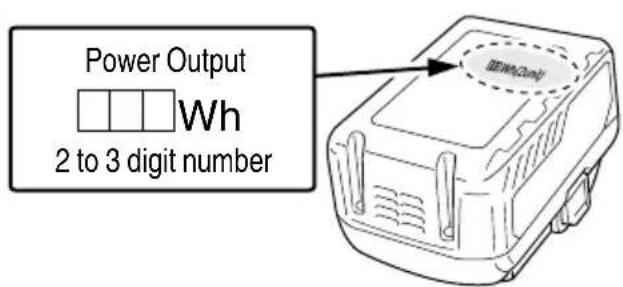
text_image
Power Output Wh 2 to 3 digit numberFig. 1
USB DEVICE CONNECTION PRECAUTIONS
When an unexpected problem occurs, the data in a USB device connected to this product may be corrupted or lost. Always make sure to back up any data contain USB device prior to use with this product.
Please be aware that our company accepts absolutely no responsibility for any data stored in a USB device that is corrupted or lost, nor for any damage that may occur to a connected device.
WARNING
Prior to use, check the connecting USB cable for any defect or damage.
Using a defective or damaged USB cable can cause smoke emission or ignition.
When the product is not being used, cover the USB port with the rubber cover.
Buildup of dust etc. in the USB port can cause smoke emission or ignition.
NOTE
There may be an occasional pause during USB recharging.
When a USB device is not being charged, remove the USB device from the charger.
Failure to do so may not only reduce the battery life of a USB device, but may also result in unexpected accidents.
- It may not be possible to charge some USB devices, depending on the type of device.
SAVE THESE INSTRUCTIONS AND
MAKE THEM AVAILABLE TO OTHER USERS AND OWNERS OF THIS TOOL!
The information contained in this Instruction Manual is designed to assist you in the safe operation and maintenance of the power tool. Some illustrations in this Instruction Manual may show details or attachments that differ from those on your own power tool.
NAME OF PARTS
- Cordless Slide Compound Miter Saw(C3610DRA)
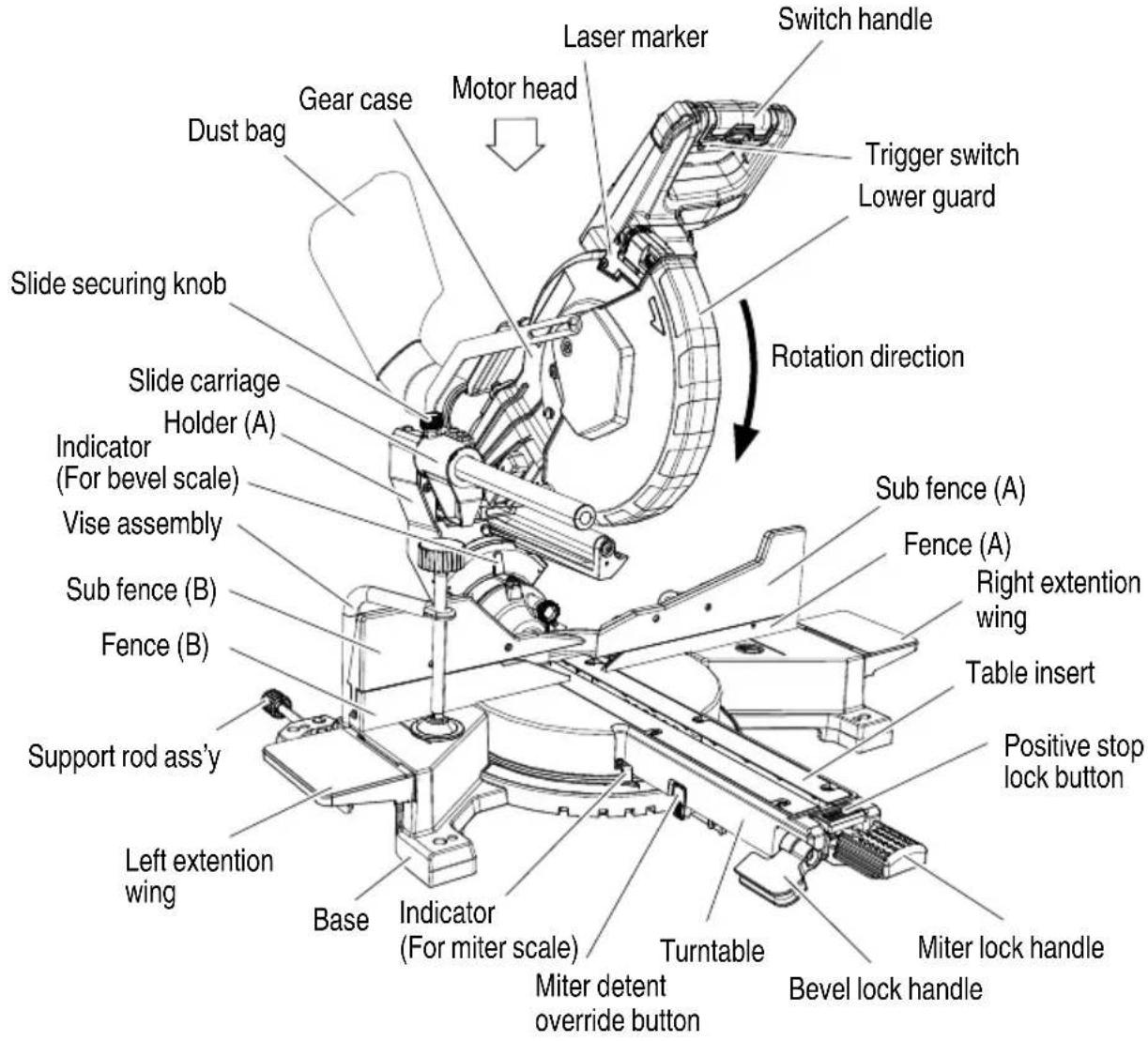
text_image
Gear case Dust bag Slide securing knob Slide carriage Holder (A) Indicator (For bevel scale) Vise assembly Sub fence (B) Fence (B) Support rod ass'y Left extension wing Base Indicator (For miter scale) Motor head Laser marker Motor handle Switch handle Trigger switch Lower guard Rotation direction Sub fence (A) Fence (A) Right extension wing Table insert Positive stop lock button Turntable Miter lock handle Bevel lock handle Miter detent override buttonFig. 2
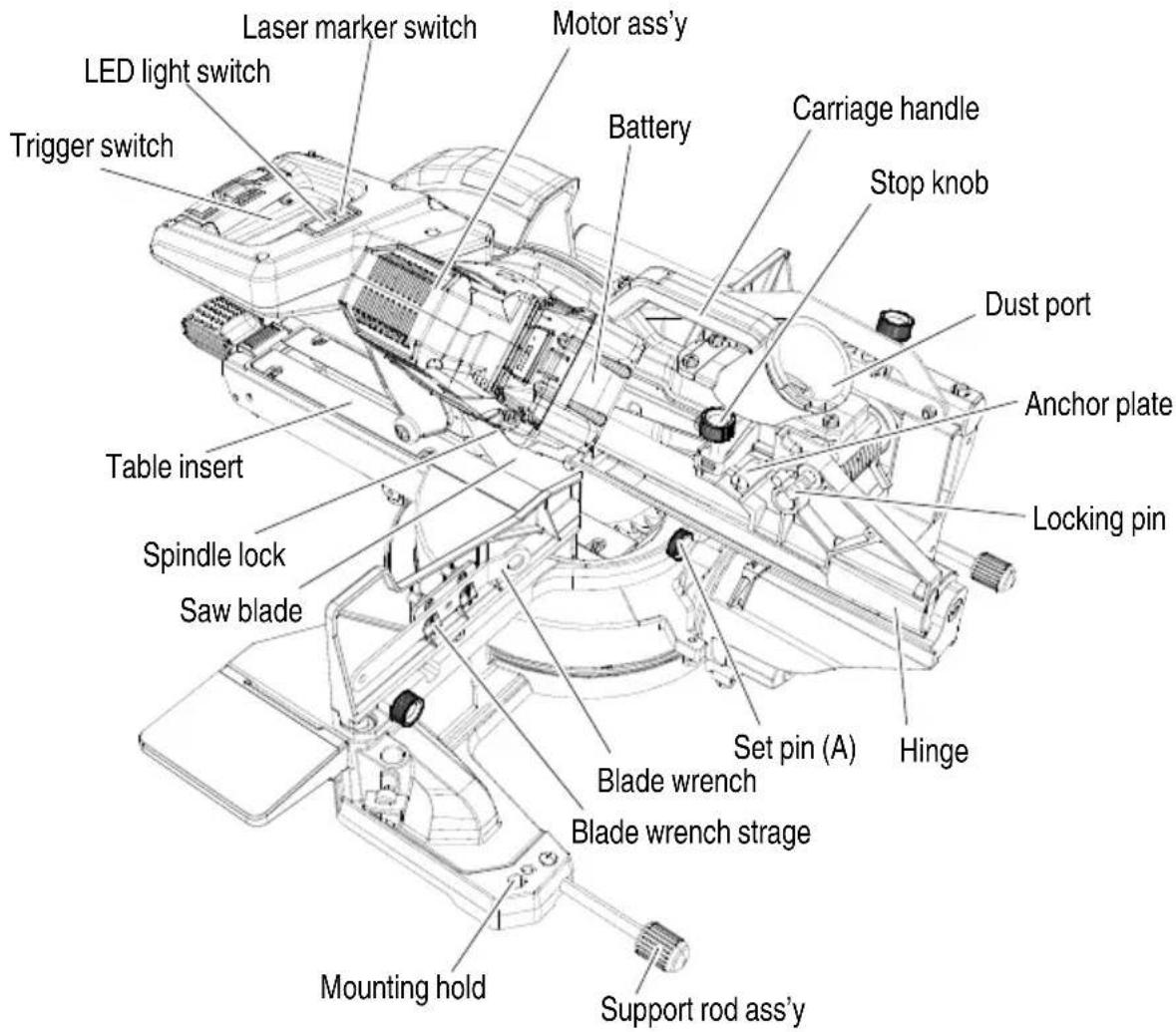
text_image
Laser marker switch LED light switch Trigger switch Motor ass'y Battery Carriage handle Stop knob Dust port Anchor plate Table insert Spindle lock Saw blade Set pin (A) Hinge Blade wrench Blade wrench strage Mounting hold Support rod ass'yFig. 3
- Battery 3. Battery Charger
text_image
Battery cover Ventilation holes Terminals Battery Latch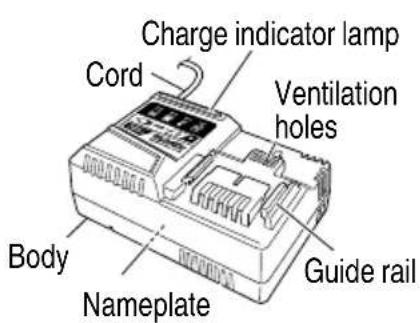
text_image
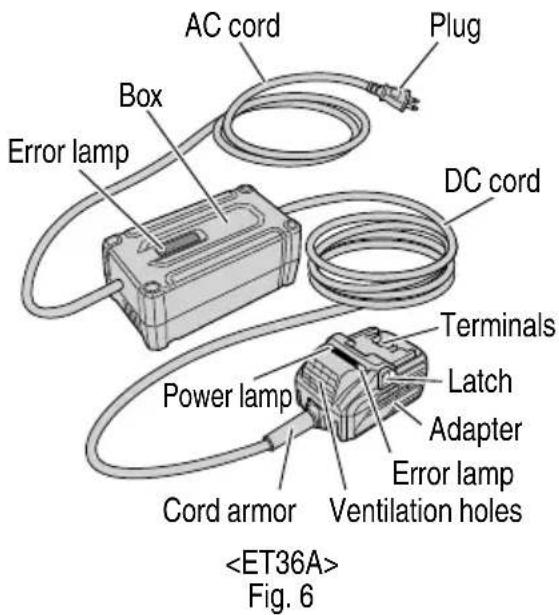
Charge indicator lamp Cord Ventilation holes Guide rail Body Nameplate- AC/DC Adapter
text_image
AC cord Plug Box Error lamp DC cord Power lamp Terminals Latch Adapter Error lamp Cord armor Ventilation holesSPECIFICATIONS
1. Cordless Slide Compound Miter Saw
* Existing batteries (BSL3660/3626/3620, BSL18xx and BSL14xx series, etc.) cannot be used with this tool.
| Item Model C 361 | 0DRA | ||||
| Motor DC brushless motor | |||||
| Laser Marker | Maximum output <0.39 mW CLASS 1M Laser Product | ||||
| Wave length 630 – 660 nm | |||||
| Laser medium Laser Diode | |||||
| Applicable saw blade | Outside Dia. 10" (255 mm)Hole Dia. 5/8" (15.9 mm) | ||||
| No load speed 4,000/min | |||||
| Max.sawing dimension | Miter | Head Turntable Max. sawing dimension | |||
| 0 | 0 | (With anchor plate)Max. HeightMax. Width(Without anchor plate)Max. HeightMax. Width | 3-1/2" (89 mm)11-1/2" (292 mm)2-1/2" (64 mm)12-1/2" (318 mm) | ||
| 0 | Left 45° or Right 45° | (With anchor plate)Max. HeightMax. Width(Without anchor plate)Max. HeightMax. Width | 3-1/2" (89 mm)8" (204 mm)2-1/2" (64 mm)8-3/4" (222 mm) | ||
| 0 Left 55° | (With anchor plate)Max. HeightMax. Width(Without anchor plate)Max. HeightMax. Width | 3-1/2" (89 mm)6-7/8" (176 mm)2-1/2" (64 mm)7-1/4" (182 mm) | |||
| 0 | Right 60° | (With anchor plate)Max. HeightMax. Width(Without anchor plate)Max. HeightMax. Width | 3-1/2" (89 mm)5-3/4" (146 mm)2-1/2" (64 mm)6-1/4" (158 mm) | ||
| Bevel | Left 45° 0 | (With anchor plate)Max. HeightMax. Width(Without anchor plate)Max. HeightMax. Width | 1-3/4" (45 mm)11-1/2" (292 mm)1-5/8" (41 mm)12-1/2" (318 mm) | ||
| Right 45° | 0 | (With anchor plate)Max. HeightMax. Width(Without anchor plate)Max. HeightMax. Width | 1" (25 mm)11-1/2" (292 mm)3/4" (19 mm)12-1/2" (318 mm) | ||
| Max. sawing dimension | Compound | Left 45° | Left 45° or Right 45° | (With anchor plate) Max. Height Max. Width (Without anchor plate) Max. Height Max. Width | 1-3/4" (45 mm) 8" (204 mm) 1-5/8" (41 mm) 8-3/4" (222 mm) |
| Right 45° | Left 45° or Right 45° | (With anchor plate) Max. Height Max. Width (Without anchor plate) Max. Height Max. Width | 1" (25 mm) 8" (204 mm) 3/4" (19 mm) 8-3/4" (222 mm) | ||
| Miter sawing range Left 0° – 55° Right 0° – 60° | |||||
| Bevel sawing range Left 0° – 48° Right 0° – 48° | |||||
| Compound sawing range | Left (Bevel) 0° – 45°, Left (Miter) 0° – 45° | ||||
| Right (Bevel) 0° – 45°, Right (Miter) 0° – 45° | |||||
| Power supply | Type* Li-ion battery Model BSL36B18 | ||||
| Voltage 36V | |||||
| Net weight 45.5 lbs. (20.6 kg) (BSL36B18 attached) | |||||
- Battery Charger
| Model UC18YSL3 | |
| Input power source Single phase: AC 120 V 60 Hz | |
| Charging time(At a temperature of 68°F (20°C)) | BSL36B18 : Approx. 52 min |
| Charging voltage DC 14.4 – 18 V | |
| Charging current DC 8.0 A | |
| Weight 1.3 lbs. (0.6 kg) | |
NOTE: The charging time may vary according to temperature and power source voltage.
- AC/DC Adapter
| Model | ET36A |
| Input power source Single phase: AC 120 V 60 Hz | |
| Output voltage | 36V |
| Operating temperature range | 14°F (-10°C) -104°F (40°C) |
| Weight | Adapter : 1.8 lbs. (0.8 kg)Box : 2.6 lbs. (1.2 kg) |
APPLICATIONS
Wood and aluminum sash.
Make the following preparations before operating the power tool:
- Remove all packing materials attached or connected to the tool before attempting to operate it.
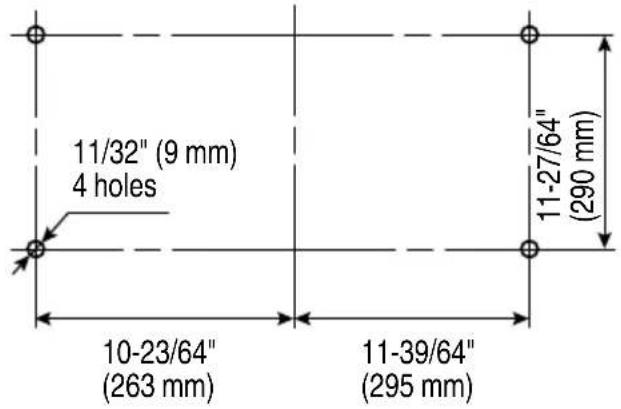
- Installation
text_image
11/32" (9 mm) 4 holes 10-23/64" (263 mm) 11-39/64" (295 mm) 11-27/64" (290 mm)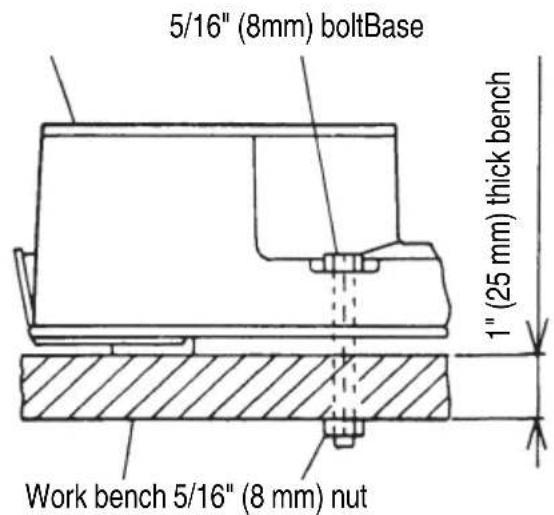
text_image
5/16" (8mm) boltBase 1" (25 mm) thick bench Work bench 5/16" (8 mm) nutFig. 7
Attach the power tool to a level, horizontal work bench in accordance with Fig. 7.
Select 5/16" (8 mm) diameter bolts suitable in length for the thickness of the work bench.
Bolt length should be at least 1-9/16" (40 mm) plus the thickness of the work bench.
For example, use 2-9/16" (65 mm) or larger bolts for a 1" (25 mm) thick work bench.
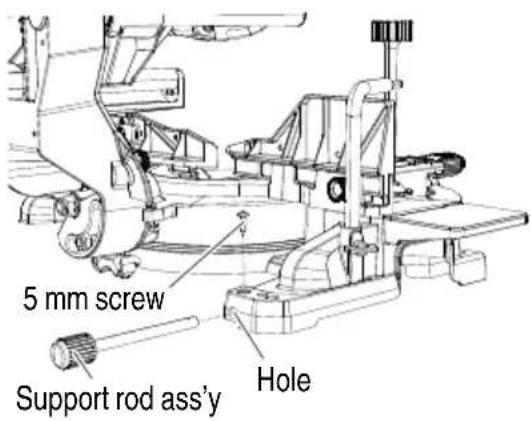
The support rod ass'y attached to the rear of the base helps stabilize the power tool.
Installing the support rod ass'y
Insert one support rod ass'y into the hole located at the rear of the base and push it in as far as it will go.
Thread the 5 mm screw into the hole next to the mounting hold.
Firmly tighten the 5 mm screw with a screwdriver.
Repeat the above steps for installing the other support rod ass'y.
text_image
5 mm screw Support rod ass'y HoleFig. 8
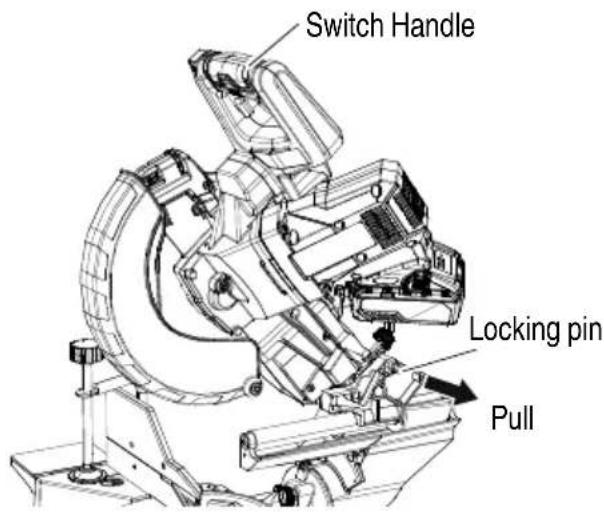
- Releasing the locking pin
When the power tool is prepared for shipping, its main parts are secured by a locking pin.
Press the handle slightly down and pull out the locking pin to disengag the cutting head.
text_image
Switch Handle Locking pin PullFig. 9
NOTE
Lowering the handle slightly will enable you to disengage the locking pin more easily and safely. The lock position of the locking pin is for carrying and storage only.
- Installing the dust bag and vise
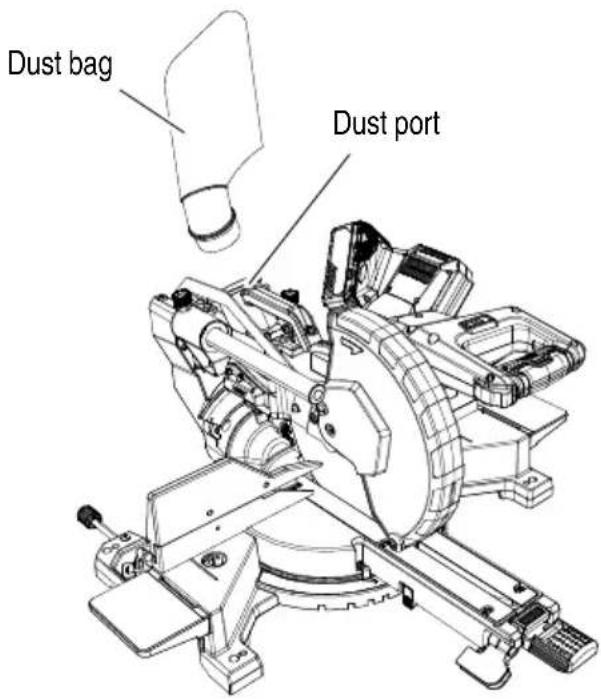
Install the dust bag onto the dust port on the miter saw. Fit the connecting tube of dust bag and the dust port together.
To empty the dust bag, pull out the dust bag assembly from dust port. Open zipper on underside of bag and empty into waste container. Check frequently and empty the dust bag before it gets full.
text_image
Dust bag Dust portFig. 10
NOTE
The dust bag should be angled toward the right side of the saw for best results. This will also avoid any interference during the saw operation.
CAUTION
Empty the dust bag frequently to prevent the duct and the lower guard from becoming clogged. Sawdust will accumulate more quickly than normal during bevel cutting.
WARNING
Do not use this saw to cut and/or sand metals. the hot chips or sparks may ignite saw dust from the bag material.
(Attach the vise assembly as shown in Fig. 2, Fig. 3 and Fig. 31.)
REMOVAL AND INSTRUCTION METHOD OF BATTERY OR AC/DC ADAPTER
○ How to install the battery or AC/DC adapter.
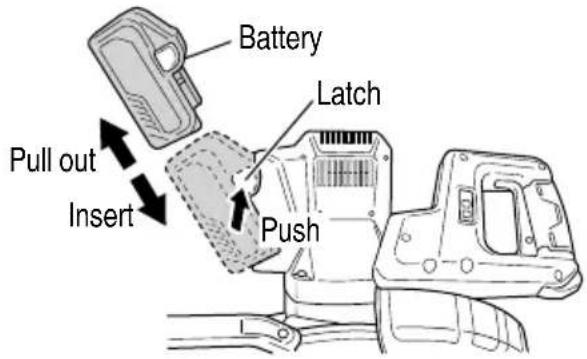
Align the battery or AC/DC adapter with the groove in tool handle and slip it into place.
Always insert it all the way until it locks in place with a little click, If not, it may accidentally fall out of the tool, causing injury to you or someone around you (Fig. 11).
○ How to remove the battery or AC/DC adapter.
Withdraw battery or AC/DC adapter from the tool handle while pressing the latch (2 pcs) of the battery or AC/DC adapter (Fig. 11).
text_image
Battery Latch Pull out Insert PushFig. 11
CHARGING METHOD
NOTE
Before plugging into the receptacle, make sure the following points.
○ The power source voltage is stated on the nameplate.
○ The cord is not damaged.
WARNING
Do not charge at voltage higher than indicated on the nameplate.
If charged at voltage higher than indicated on the nameplate, the charger will burn out.
- Connect the charger's power cord to a receptacle. When the power cord is connected, the charge indicator lamp will blink in red. (At 1-second intervals)
WARNING
Do not use the electrical cord if damaged. Have it repaired immediately.
2. Insert the battery to the battery charger.
Firmly Insert the battery into the battery charger as shown in Fig. 12.

text_image
Battery Charge indicator lamp Guide railFig. 12
3. Charging
When inserting a battery in the charger, the charge indicator lamp will blink in blue.
When the battery becomes fully recharged, the charge indicator lamp will light up in green.(See Table 2)
(1) Charge indicator lamp indication
The indications of the charge indicator lamp will be as shown in Table 2, according to the condition of the battery charger or the battery.
Table 2
| Indications of the charge indicator lamp | ||||
| Charge indicator lamp (RED / BLUE / GREEN / PURPLE) | Before charging | Blinks (RED) | Lights for 0.5 seconds. Does not light for 0.5 seconds. (off for 0.5 seconds) | Plugged into power source |
| While charging | Blinks (BLUE) | Lights for 0.5 seconds. Does not light for 1 second. (off for 1 second) | Battery capacity at less than 50% | |
| Blinks (BLUE) | Lights for 1 second. Does not light for 0.5 seconds. (off for 0.5 seconds) | Battery capacity at less than 80% | ||
| Lights (BLUE) | Lights continuously | Battery capacity at more than 80% | ||
| Charging complete | Lights (GREEN) | Lights continuously(Continuous buzzer sound: about 6 seconds) | ||
| Overheat standby | Blinks (RED) | Lights for 0.3 seconds. Does not light for 0.3 seconds. (off for 0.3 seconds) | Battery overheated. Unable to charge. (Charging will commence when battery cools) | |
| Charging impossible | Flickers (PURPLE) | Lights for 0.1 seconds. Does not light for 0.1 seconds. (off for 0.1 seconds) (Intermittent buzzer sound: about 2 seconds) | Malfunction in the battery or the charger | |
(2) Regarding the temperature of the rechargeable battery.
The temperatures for rechargeable batteries are as shown in the Table 3, and batteries that have become hot should be cooled for a while before being recharged.
Table 3
| Rechargeable batteries | Temperatures at which the battery can be recharged |
| BSL36B18 | 32^ - 122^ (0^ - 50^) |
(3) Regarding recharging time (At 68°F (20°C))
Table 4 Charging time
| Battery\Charger | UC18YSL3 |
| BSL36B18 Approx. | 52 min. |
NOTE
The recharging time may vary according to the ambient temperature.
- Disconnect battery charger from the receptacle.
CAUTION
Do not pull the plug out of the receptacle by pulling on the cord.
Make sure to grasp the plug when removing from receptacle to avoid damaging cord.
- Remove the battery from the battery charger.
Supporting the battery charger with hand, pull out the battery from the battery charger.
NOTE
Be sure to pull out the battery from the battery charger after use, and then keep it.
Regarding electric discharge in case of new batteries, etc.
As the internal chemical substance of new batteries and batteries that have not been used for an extended period is not activated, the electric discharge might be low when using them the first and second time. This is a temporary phenomenon, and normal time required for recharging will be restored by recharging the batteries 2 – 3 times.
How to make the batteries perform longer
(1) Recharge the batteries before they become completely exhausted.
When you feel that the power of the tool becomes weaker, stop using the tool and recharge its battery. If you continue to use the tool and exhaust the electric current, the battery may be damaged and its life will become shorter.
(2) Avoid recharging at high temperatures.
A rechargeable battery will be hot immediately after use. If such a battery is recharged immediately after use, its internal chemical substance will deteriorate, and the battery life will be shortened. Leave the battery and recharge it after it has cooled for a while.
CAUTION
- When the battery charger has been continuously used, the battery charger will be heated, thus constituting the cause of the failures. Once the charging has been completed, give 15 minutes rest until the next charging.
- If the battery is charged while it is heated because it has been left for a long time in a location subject to direct sunlight or because the battery has just been used, the charge indicator lamp of the charger lights for 0.3 seconds, does not light for 0.3 seconds (off for 0.3 seconds). In such a case, first let the battery cool, then start charging.
- When the charge indicator lamp flickers (at 0.2-second intervals), check for and take out any foreign objects in the charger's battery installation hole. If there are no foreign objects, it is probable that the battery or charger is malfunctioning. Take it to your authorized Service Center.
HOW TO RECHARGE USB DEVICE
WARNING
- Prior to use, check the connecting USB cable for any defect or damage.
Using a defective or damaged USB cable can cause smoke emission or ignition.
- When the product is not being used, cover the USB port with the rubber cover.
Buildup of dust etc. in the USB port can cause smoke emission or ignition.
NOTE
☐ The time required for charging will be longer when a USB device and battery are being simultaneously charged.
- There may be an occasional pause during USB recharging.
When a USB device is not being charged, turn the USB power switch OFF and remove the USB device from the charger.
Failure to do so may not only reduce the battery life of a USB device, but may also result in unexpected accidents.
(1) Select a charging method
Depending on the charge method selected, either the battery is inserted into the charger or the power cord is plugged into an outlet.
○ Charging a USB device by battery (Fig. 13-a)
○ Charging a USB device from a electrical outlet (Fig. 13-b)
○ Charging a USB device and battery from a electrical outlet (Fig. 13-c)
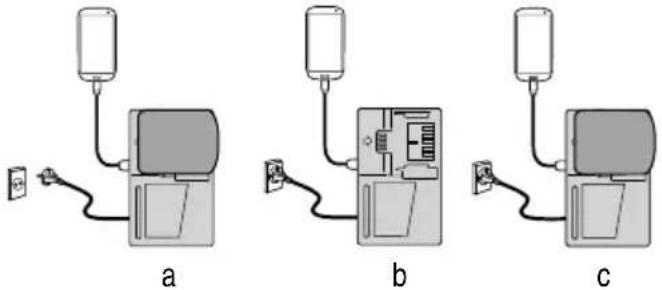
Fig. 13
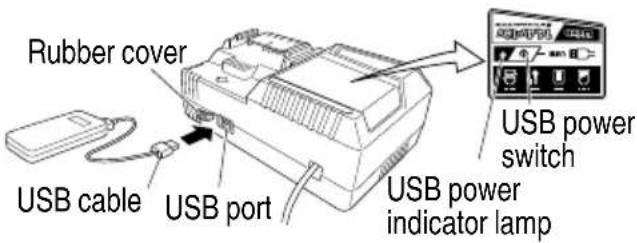
(2) Turn the USB power switch ON (Fig. 14) When you turn the USB power switch ON, the USB power indicator lamp will light up.
text_image
Rubber cover USB cable USB port USB power indicator lamp USB power switchFig. 14
(3) Connect the USB cable. (Fig. 14) Pull back the rubber cover and firmly plug in a commercially available USB cable (appropriate to the device being charged) into the USB port.
When the power cord is not plugged into an outlet and the battery runs out of power, power output will stop and the USB power indicator lamp will shut off.
When the USB power indicator lamp goes out, change the battery or plug the power cord into an electrical outlet.
(4) When charging is completed ○ The USB power indicator lamp will not go out when a USB device has been completely charged.
To verify charge status, check the USB device.
Turn the USB power switch OFF and unplug the power cord from the electrical outlet. (Fig. 14)
○ Remove the battery from the charger and place the rubber cover over the USB port.
BEFORE USING
Power tool
WARNING
Check steps 1 through 6 before you have installed the power supply (battery) to the tool.
- Make sure the trigger switch is turned OFF.
WARNING
If the battery is inserted while the power switch is in the ON position, the power tool will start operating immediately, inviting serious accident.
-
Check the saw blade for visible defects. Confirm that the saw blade is free of cracks or other visible damage.
-
Confirm that the saw blade is attached securely to the power tool.
Using the supplied 13 mm wrench, tighten the 8 mm bolt on the saw blade spindle to secure the saw blade. For details, see Fig. 50-a, Fig. 50-b, Fig. 50-c and Fig. 50-d in the section on "SAW BLADE MOUNTING AND DISMOUNTING".
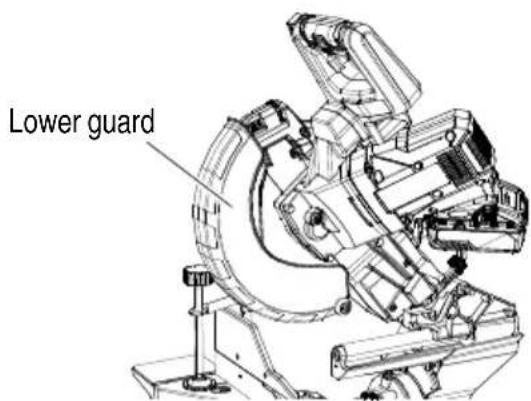
- Check the lower guard for proper operation.
Lower guard is designed to protect the operator from coming into contact with the saw blade during operation of the tool.
Always check that the lower guard moves smoothly and covers the saw blade properly.
text_image
Lower guardFig. 15
WARNING
NEVER OPERATE THE POWER TOOL if the lower guard does not function smoothly.
- Confi rm the position of the spindle lock before using the tool.
After installing the saw blade, confirm that the spindle lock has been returned to the released position before using the power tool (see Fig. 3).
- Eye protection
Always wear eye protection with side shields that meets the requirements of ANSI Standard Z87.1. Ordinary eyeglasses do not provide adequate protection because they do not contain impact resistant safety glass.
WARNING
Operating the tool without wearing proper eye protection may result in serious injury.
AFTER INSTALLING THE POWER SUPPLY (BATTERY) TO THE TOOL, CHECK THE OPERATION OF THE TOOL AS FOLLOWS:
7. Elec tric brake
This tool is equipped with an electric brake which will typically stop the blade within 5 seconds after the trigger switch is released.
Occasionally, there will be a delay in the brake engaging which will result in a longer blade stopping time. On rare occasions, the brake may not engage at all and the saw blade will coast to a stop.
If the brake fails to engage frequently, depress and release the trigger switch to turn the tool on and off 4 or 5 times. If the brake still does not engage, have the tool serviced at a metabo HPT authorized service center.
Always confirm that the saw blade has completely stopped before raising it from the workpiece.
The brake is not a substitute for a properly functioning lower guard. Check the function of the lower guard before each use. Serious personal injury may occur if the lower guard does not move smoothly and cover the blade properly.
WARNING
Please be aware of the reaction of the Motor Head (Fig.2) when the brake is activated. Braking causes the Motor Head to jerk downward and the user should be prepared for this reaction, especially when the trigger switch is released before the blade is completely down. Failure to be familiar with, and prepared for, the operational characteristics of the tool may cause serious injury.
8. Trial Run
After confirming that no one is standing behind, the power tool start and confirm that no operating abnormalities exist before attempting a cutting operation.
9. Inspect the rotating stability of the saw blade.
For precise cutting, rotate the saw blade and check for deflection to confirm that the blade is not noticeably unstable; otherwise vibrations might occur and cause an accident.
AC/DC adapter
- Check the work area to make sure that it is clear of debris and clutter.
Clear the area of unnecessary personnel. Ensure that lighting and ventilation are adequate. - To prevent electric shock, connect to a power source equipped with a ground fault circuit breaker.
- Prior to use, make sure that the DC cord insulation is not torn or that the case is not cracked.
Do not use the product if there is a break in the DC cord, the insulation is torn, or the case is damaged. - Before starting operation, make sure that the vicinity of the box's vent is free from any wood shavings or iron powder.
Also, do not use in locations where iron powder is abundant, or in areas where there is rain, snow or other water sources that could wet the product. - Make sure there are no solid metal material or liquid in the adapter box. Failure to do so may result in damage.
- Be careful not to step on the box. Also, make sure the box is placed in a location where it won't be stepped on. Do not place in a location where the box could be immersed in water when it rains.
BEFORE CUTTING
- Positioning the table insert
text_image
4 mm machine screw Saw blade Table insert[Right angle cutting]
Fig. 16-a

text_image
4 mm machine screw Saw blade Table insert[Left bevel angle cutting]
Fig. 16-b
text_image
Saw blade Table insert 4 mm machine screw[Right bevel angle cutting] Fig. 16-c
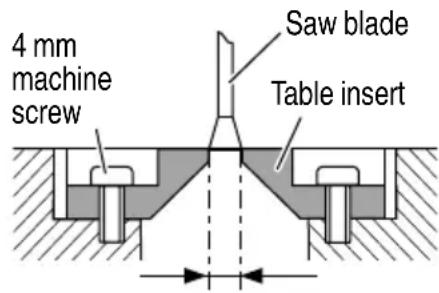
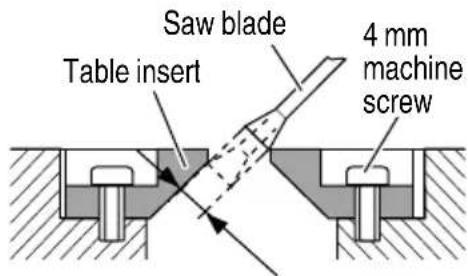
Table inserts are installed on the turntable. When shipping the tool from the factory, the table inserts are so fixed that the saw blade does not contact them. The burr of the bottom surface of the workpiece is remarkably reduced, if the table insert is fixed so that the gap between the side surface of the table insert and the saw blade will be minimum. Before using the tool, eliminate this gap in accordance with the following procedure.
(1) Right angle cutting
Loosen the three 4 mm machine screws, then secure the left side table insert and temporarily tighten the 4 mm machine screws of both ends. Then fix a workpiece (about 7-7/8" (200 mm) wide) with the vise assembly and cut it off. After aligning the cutting surface with the edge of the table insert, securely tighten the 4 mm machine screws of both ends. Remove the workpiece and securely tighten the 4 mm center machine screw. Adjust the right hand table insert in the same way.
(2) Left and right bevel angle cutting
Adjust the table insert in the manner shown in Fig. 16-b and Fig. 16-c following the same procedure for right angle cutting.
CAUTION
After adjusting the table insert for right angle cutting, the table insert will be cut to some extent if it is used for bevel angle cutting.
When bevel cutting operation is required, adjust the table insert for bevel angle cutting.
- Use of sub fence (A)
WARNING
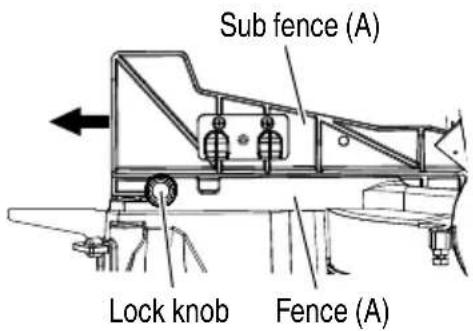
The sub fence (A) must be extended when making any right angle bevel cut. Failure to extend the sub fence (A) will not allow enough space for the blade to pass through which could result in serious injury. At extreme miter or bevel angles the saw blade may also contact the fence.
text_image
Sub fence (A) Lock knob Fence (A)Fig. 17
This power tool is equipped with a sub fence (A). In the case of direct angle cutting and left bevel angle cutting, use the sub fence (A). Then, you can realize stable cutting of the material with a wide back face. When right angle cutting, loosen the lock knob, then slide the sub fence (A) outward, as shown in Fig. 17. When you slide sub fence (A) outward, if enough space cannot be secured or the sub fence (A) comes into contact with other parts of the tool including the motor, fully remove sub fence (A) from fence (A). Also, make sure to remove the lock knob from fence (A).
NOTE
When transporting the saw, always secure the sub fence (A) in the collapsed position and lock it.
- Use of sub fence (B)
WARNING
The sub fence (B) must be extended when making any left angle bevel cut. Failure to extend the sub fence (B) will not allow enough space for the blade to pass through which could result in serious injury. At extreme miter or bevel angles the saw blade may also contact the fence.
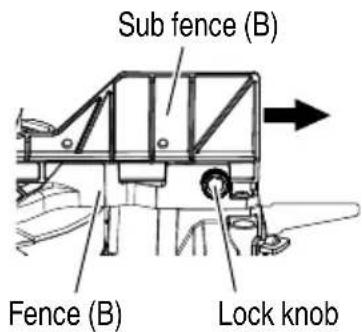
text_image
Sub fence (B) Fence (B) Lock knobFig. 18
This power tool is equipped with a sub fence (B). In the case of direct angle cutting and right bevel angle cutting, use the sub fence (B). Then, you can realize stable cutting of the material with a wide back face. When left angle cutting, loosen the lock knob, then slide the sub fence (B) outward, as shown in Fig. 18. When you slide sub fence (B) outward, if enough space cannot be secured or the sub fence (B) comes into contact with other parts of the tool including the lower guard, fully remove sub fence (B) from fence (B).
NOTE
When transporting the saw, always secure the sub fence (B) in the collapsed position and lock it.
- Securing the workpiece

WARNING
Always clamp or vise to secure the workpiece to the fence; otherwise the workpiece might be thrust from the table and cause bodily harm.
- Slide carriage system

WARNING
To reduce the risk of injury, return slide carriage to the full rear position after operation.
Slide securing knob
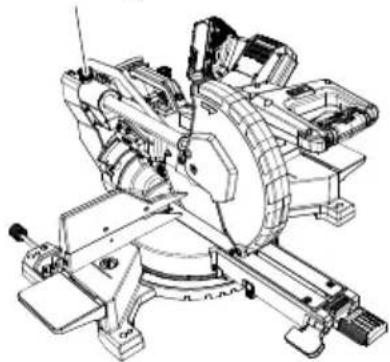
natural_image
Technical line drawing of a mechanical cutting machine (no text or symbols visible)Fig. 19
For chop cutting operations on small workpieces, slide the cutting head assembly completely toward the rear of the unit and tighten the slide securing knob.
To cut wide boards up to 305 mm, the slide securing knob must be loosened to allow the cutting head slide freely.
- Quick-cam locking lever operation
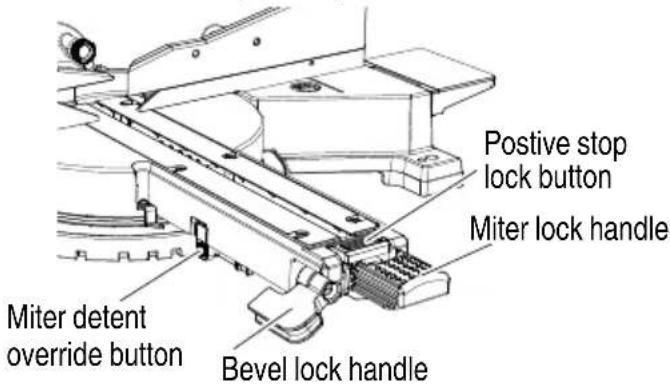
text_image
Miter detent override button Bevel lock handle Postive stop lock button Miter lock handleFig. 20
If miter angles required are NOT one of the nine positive stops, the miter table can be locked at any angle between these positive stops by using the positive stop lock button and miter lock handle.
Unlock the miter table by lifting up the miter lock handle, grasp the miter lock handle and pressing down on the positive stop lock button to table to the desired angle, then release the positive stop lock button. Press down on the miter lock handle to lock the table in position.
- Miter detent override button (Fig. 20)
The miter detent override button allows for the table to be micro adjusted, disengaging the positive detent stops feature. When a required miter angle is close to a positive detent stop, this override prevents the wedge on the miter arm from slipping into that detent slot on the base.
(1) Unlock the miter table by lifting up the miter lock handle.
(2) Press down on the positive stop locking button and press the miter detent override button in, then release the positive stop locking button while pressing the miter detent override in. The detent override is now engaged.
(3) Turn the table to the desired angle, secure the table at the desired angle by pressing the miter lock handle.
(4) To disengage the miter detent override button, press down again on the positive stop locking button.
- 90° (0°) Bevel adjustment

WARNING
To ensure accurate cuts, alignment should be checked and adjustments made prior to use.
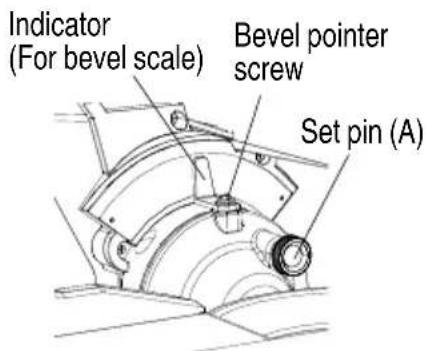
(1) Loosen bevel lock handle by lifting it up and tilting the cutting arm while pushing in the set pin (A) against the 0° bevel stop, please refer Fig. 21-a and 21-b. Tighten the bevel lock handle.
(2) Place a combination square on the miter table with the ruler against the table and the heel of the square against the saw blade as show in Fig. 21-a.
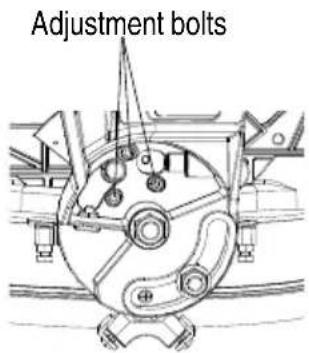
(3) If the blade is not 0^ to the miter table, loosen the three adjustment bolts at the rear of the unit with a 4 mm hex spanner, please refer Fig. 21-c. Unlock the bevel lock handle and adjust the cutting arm to zero degrees to the table. After alignment is achieved, tighten the three adjustment bolts and press down on the bevel lock handle to secure the cutting head.
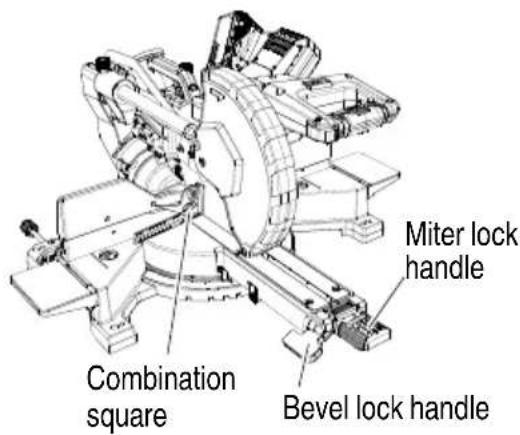
text_image
Miter lock handle Combination square Bevel lock handleFig. 21-a
text_image
Indicator (For bevel scale) Bevel pointer screw Set pin (A)Fig. 21-b
text_image
Adjustment boltsFig. 21-c
- 90° Indicator (For bevel scale) adjustment (Fig. 21-b)
(1) When the blade is exactly 90^ ( 0^ ) to the table, loosen the bevel pointer screw using a #2 Phillips screwdriver.
(2) Adjust Indicator to the "0" mark on the bevel scale and retighten the screw.
- 45° Left bevel adjustment
text_image
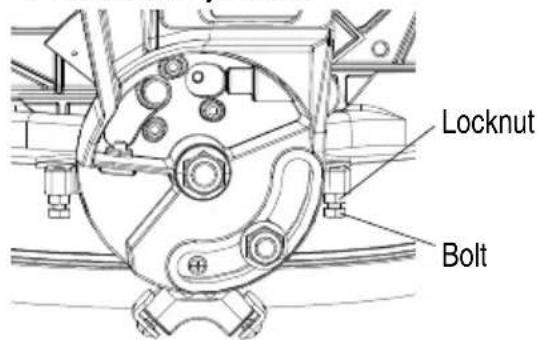
Locknut BoltFig. 22
(1) Fully extend the sub fence (B) completely to the left, and then pull the set pin (A) towards the front of the machine.
NOTE
When retracting the set pin (A), it may be necessary to shift the miter saw upper arm assembly to the left/right to release the holding pressure.
(2) Loosen the bevel lock handle and tilt the gear case completely to the left.
(3) Using a combination square, check to see if the blade is 45^ to the table.
(4) To adjust, tilt the gear case to 0^ , loosen the locknut, and turn the bolt in or out to increase or decrease the angle as shown in Fig. 22.
(5) Tilt the gear case back to the left, and recheck alignment.
(6) Repeat steps until the blade is 45^ to the table. Once alignment is achieved, tighten locknut and bevel lock handle when alignment is achieved.
- 45° Right bevel adjustment
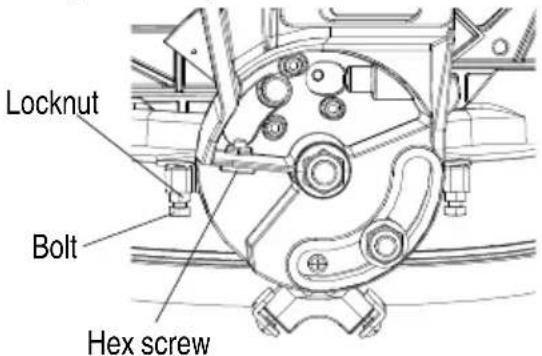
text_image
Locknut Bolt Hex screwFig. 23
(1) Set the miter angle to 0^ . Fully extend the sub fence (A) completely to the right, and then pull the set pin (A) towards the front of the machine.
NOTE
When retracting the set pin (A), it may be necessary to shift the mitre saw upper arm assembly to the left/right to release the holding pressure.
(2) Loosen the bevel lock handle and tilt the gear case completely to the right.
(3) Using a combination square, check to see if the blade is 45^ to the table.
(4) To adjust, tilt the gear case to 0^ , loosen the locknut, and turn the bolt in or out to increase or decrease the angle as shown in Fig. 23.
(5) Tilt the cutting arm back to the right, and recheck alignment.
(6) Repeat steps until the blade is 45^ to the table. Once alignment is achieved, tighten locknut and bevel lock handle when alignment is achieved.
- 33.9° Left and right bevel adjustment
(1) Set the mitre angle to 0^ . Fully extend both sub fences (A, B).
(2) Loosen the bevel lock handle, and tilt gear case to the 33.9° right bevel positive stop by pushing on the set pin (A) towards the rear of the machine.
(3) Using a combination square, check to see if the blade is 33.9^ to the table.
(4) To adjust, turn the hex screw in or out with a 3 mm spanner until the blade is 33.9^ to the table.
(5) Repeat the above steps and turn the hex screw for the 33.9° left bevel adjustment.
- Miter angle adjustment
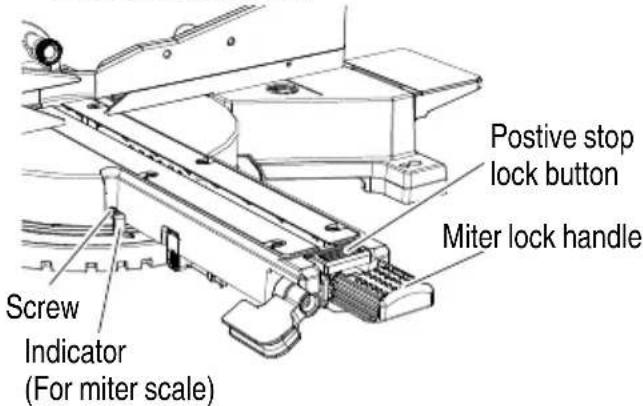
The slide compound miter saw scale can be easily read, showing miter angles from 0^ to 48^ to the left and right. The miter saw table has nine of the most common angle settings with positive stops at 0^ , 15^ , 22.5^ , 31.6^ , and 45^ . These positive stops position the blade at the desired angle quickly and accurately. Follow the process below for quickest and most accurate adjustments.
text_image
Screw Indicator (For miter scale) Postive stop lock button Miter lock handleFig. 24
Adjusting miter angles:
(1) Lift up on the miter lock handle to unlock the table.
(2) Move the table while pressing down on the positive stop lock button to align the pointer to the desired degree measurement.
(3) Lock the table into position by pressing down on the miter lock handle.
Indicator (For miter scale) adjustment:
(1) Move the table to the 0° positive stop.
(2) Loosen the screw that holds the Indicator (For miter scale) with a Phillips screwdriver.
(3) Adjust the pointer to the 0^ mark and retighten the screw.
14. Adjusting cutting depth
The maximum depth travel of the cutting head was set at the factory.
text_image
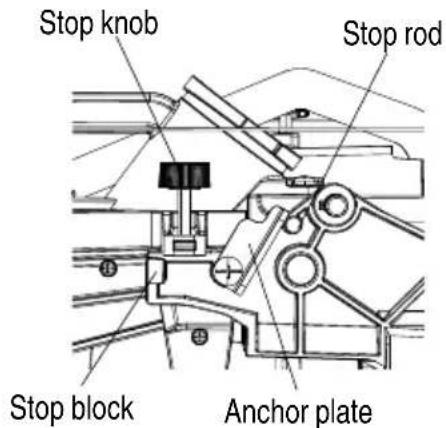
Stop knob Stop rod Stop block Anchor plateFig. 25-a
(1) Setting the maximum width travel of the cutting head, follow the below steps: (Fig. 25-a)
Turn the stop knob counterclockwise until the stop knob is not protruding out of the stop block while moving the cutting head upward.
Rotate the anchor plate clockwise to touch the stop rod.
Recheck the blade depth by moving the cutting head front to back through the full motion of a typical cut along the control arm.
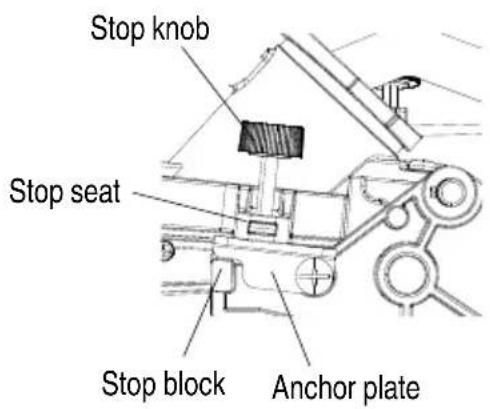
(2) Setting the maximum height travel of the cutting head, follow the below steps: (Fig. 25-b)
Turn the stop knob counterclockwise until the stop knob is not protruding out of the stop block while moving the cutting head upward.
Rotate the anchor plate counterclockwise to touch the stop seat.
Make sure the stop block touches the anchor plate completely.
text_image
Stop knob Stop seat Stop block Anchor plateFig. 25-b
- Setting the cutting depth (Fig. 25-b)
The depth of cut can be preset for even and repetitive shallow cuts.
(1) Adjust the cutting head down until the teeth of the blade are at the desired depth.
(2) While holding the upper arm in that position, turn the stop knob until it touches the anchor plate.
(3) Recheck the blade depth by moving the cutting head front to back through the full motion of a typical cut along the control arm.
NOTE
If the anchor plate becomes loose, it can interfere with raising and lowering the cutting head. The anchor plate must be tightened in horizontal position as shown in Fig. 25-b.
- The laser guide

WARNING
- For your own safety, never insert the battery to tool until all the adjustment steps are complete and you have read and understood the safety and operational instructions.
- Your tool is equipped with a laser guide using a Class 1M laser guide. The laser guide allows you to preview the saw blade path on the workpiece to be cut before starting the miter saw. The saw must be connected to the power source and the laser on/off switch must be turned laser line to show.
(1) Avoid direct eye contact

WARNING
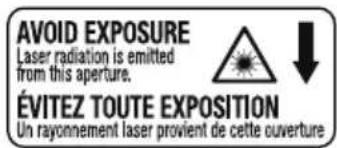
* AVOID EXPOSURE Laser radiation is emitted from this aperture.
text_image
AVOID EXPOSURE Laser radiation is emitted from this aperture. ÉVITEZ TOUTE EXPOSITION Un rayonnement laser provient de cette ouverture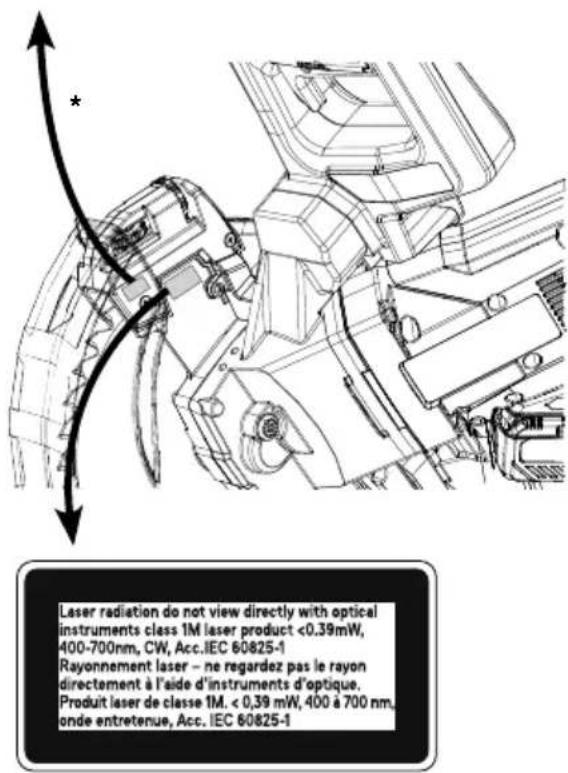
● Use of controls or adjustments or performance of procedures may result in hazardous radiation exposure.
● The use of optical instruments with this product will increase eye hazard.

WARNING
on f do the attempt to repair or disassemble the laser. If unqualifi ed persons attempt to repair this laser product, serious injury may result. Any repair required on this laser product should be performed by a qualified service dealer.
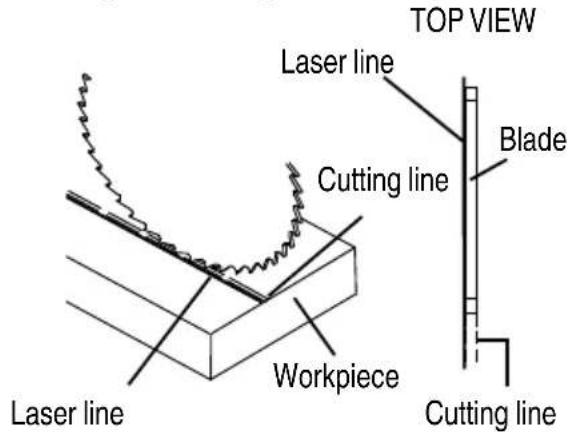
(2) Checking laser line alignment
text_image
TOP VIEW Laser line Blade Cutting line Laser line Workpiece Cutting lineFig. 27
(a) Set the saw to a 0° miter and 0° bevel setting.
(b) Use a combination square to mark a 90^ angled running across the top and down the front of a board. This line will serve as the pattern line to adjust the laser. Place the board on the saw table.
(c) Carefully lower the saw head down to align the saw blade with the pattern line. Position the saw blade to the left, side of the "pattern line" depending on your preference for the laser line location. Lock the board in place with the hold-down clamp.
(d) With the saw plugged in, turn on the laser guide. Your saw has been preset with the laser line to the left side of the blade.
WARNING
When making laser line adjustments, keep fingers away from the ON/OFF trigger switch to prevent accidental starting and possible serious injury.
(e) Slide the cutting head forward enough so that the laser line is visible on the front of the board.
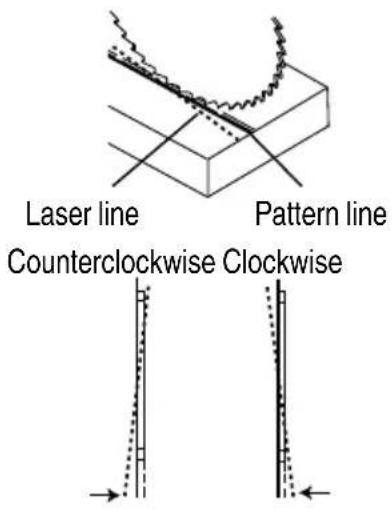
(f) Looking at the front of the board, if the laser line is not parallel to the "pattern line" please follow the instructions listed below under "Front line" paragraph.
(g) Looking at the top of the board, if the laser line is not parallel to the "pattern line" please follow the instructions listed below under "Top line" paragraph.
NOTE
If the laser line is not visible on the front of a board, lower the cutting head until the laser line is visible.
(3) Adjusting the position of the laser line
Front line
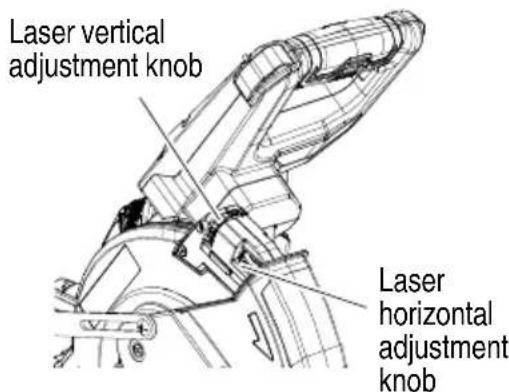
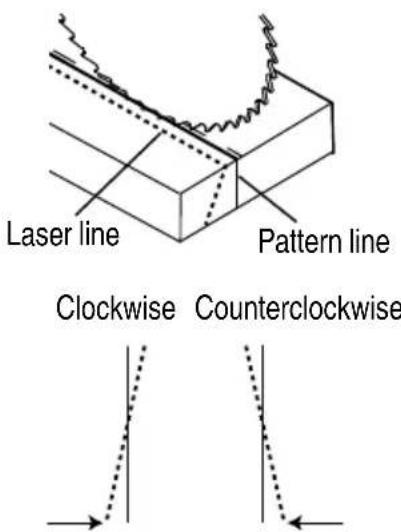
If the laser line is angled from pattern line of front side, turn the laser vertical adjustment knob to align the laser line parallel with pattern line. (Fig. 28- b)
Top line
If the laser line is angled from pattern line of top side, turn the laser horizontal adjustment knob to align the laser line parallel with pattern line. (Fig. 28- c)
NOTE
When adjusting the front line and top line, turning the adjustment knob too much will result in the laser reflecting off of the saw blade to produce two laser lines.
○ After performing the above adjustments, visually check that both the front and top laser lines are parallel with pattern line.
text_image
Laser vertical adjustment knob Laser horizontal adjustment knobFig. 28-a
text_image
Laser line Pattern line Clockwise CounterclockwiseFig. 28-b
text_image
Laser line Pattern line Counterclockwise ClockwiseFig. 28-c
PRACTICAL APPLICATIONS

WARNING
● To avoid personal injury, never remove or place a workpiece on the table while the tool is being operated.
● Never place your limbs inside of the line next to warning sign while the tool is being operated. This may cause hazardous conditions (see Fig. 29).
NOTE
Prior to operating the switch, make sure to check the stability of the tool by setting the angle and turn to conduct a trial cutting run without using a workpiece.
text_image
Warning signLine Warning sign LineFig. 29
1. Switch operation
text_image
ON/OFF Trigger switch LED light switch Laser switch Lock-off button HoleFig. 30
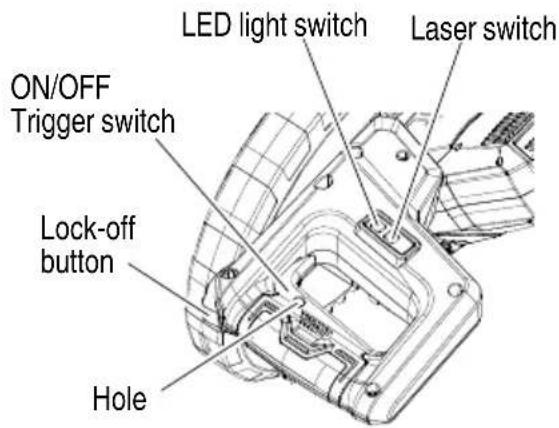
(1) Turning the saw on
This miter saw is equipped with an ON/OFF trigger switch (2). With the lock-off button pressed, squeeze the trigger switch to turn the miter saw ON. Release the trigger switch to turn the saw OFF.
(2) Turning the laser guide / LED light on
Press the laser switch to turn it ON, and press again to turn it OFF.
Press the the LED light switch to turn it ON, and press again to turn it OFF.

WARNING
Make the ON/OFF switch childproof. Insert a padlock, or chain with padlock, through the hole in the trigger and lock the tool's switch, preventing children and other unqualifi ed users from turning the machine on.
2. Using the Vise Assembly (Standard accessory)
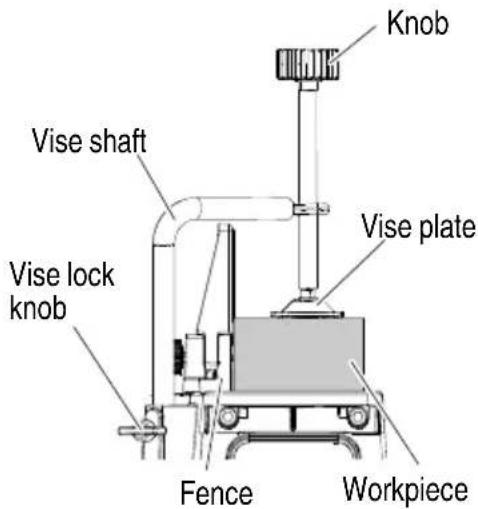
text_image
Knob Vise shaft Vise lock knob Vise plate Fence WorkpieceFig. 31
(1) The vise assembly can be mounted on the base.
(2) Turn the upper knob and securely fix the workpiece in position (Fig. 31).
NOTE
When using the vise, make sure that the tool is free of any excessive contact when the unit is swung or slid.
WARNING
Always firmly clamp or vise to secure workpiece to the fence; otherwise the workpiece might be thrust from the table and cause bodily harm.
3. Cutting Operation
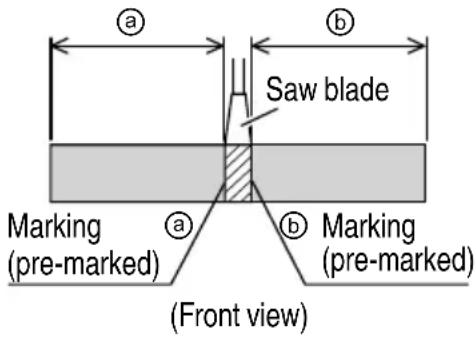
text_image
Saw blade Marking (pre-marked) (a) (b) Marking (pre-marked) (Front view)
text_image
Adjusting line a bFig. 32
(1) As shown in Fig. 32 the width of the saw blade is the width of the cut. Therefore, slide the workpiece to the right (viewed from the operator's position) when length ⓑ is desired, or to the left when length is desired.
If a laser marker is used, align the laser line with the left side of the saw blade, and then align the ink line with the laser line.
(2) Once the saw blade reaches maximum speed, push the handle down carefully until the saw blade approaches the workpiece.
(3) Once the saw blade contacts the workpiece, push the handle down gradually to cut into the workpiece.
(4) After cutting the workpiece to the desired depth, turn the power tool OFF and let the saw blade stop completely before raising the handle from the workpiece to return it to the full retract position.
CAUTION
Increased pressure on the handle will not increase the cutting speed.
On the contrary, too much pressure may result in overload of the motor and/or decreased cutting efficiency.
WARNING
- Confir rm that the trigger switch is turned OFF and the power plug has been removed from the receptacle whenever the tool is not in use.
● Always turn the power off and let the saw blade stop completely before raising the handle from the workpiece.
If the handle is raised while the saw blade is still rotating, the cut-off piece may become jammed against the saw blade causing fragments to scatter about dangerously.
- Every time one cutting or deep-cutting operation is finished, turn the trigger switch off, and check that the saw blade has stopped. Then raise the handle, and return it to the full retract position.
- Be absolutely sure to remove the cut material from the top of the turntable, and then proceed to the next step.
- Continued cutting operation can result in overload of the motor. Touch the motor and if it's hot, stop your cutting operation at once and rest for 10 minutes or so, and then restart your cutting operation.
4. Cutting wide workpieces (Slide cutting)
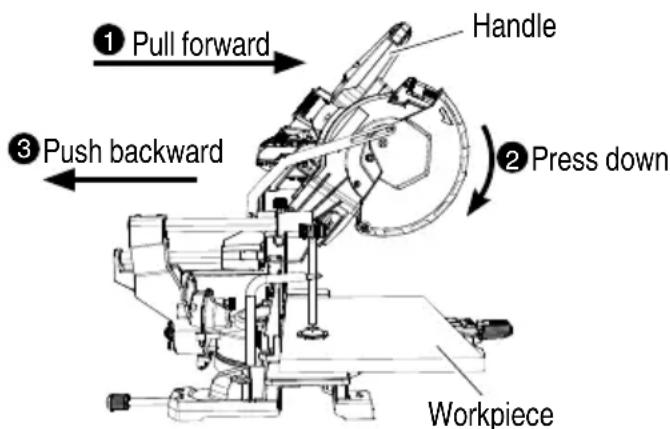
text_image
① Pull forward Handle ② Press down ③ Push backward WorkpieceFig. 33
(1) Workpieces up to 3-1/2" (89 mm) high and 11-1/2" (292 mm) wide:
Loosen the slide securing knob (see Fig. 2), grip the handle and slide the saw blade forward.
Then press down on the handle and slide the saw blade backward to cut the workpiece as indicated in Fig. 33. This facilitates cutting of workpieces of up to 3-1/2" (89 mm) in height and 11-1/2" (292 mm) in width.
(2) Workpieces up to 2-1/2" (64 mm) high and 12-1/2" (318 mm) wide:
Workpieces of up to 2-1/2" (64 mm) in height and up to 12-1/2" (318 mm) in width can be cut in the same manner as described in paragraph 4-(1) above on page 30.
CAUTION
- If the handle is pressed down with excessive or lateral force, the saw blade may vibrate during the cutting operation and cause unwanted cutting marks on the workpiece, thus reducing the quality of the cut.
Accordingly, press the handle down gently and carefully.
● In slide cutting, gently push the (rearwards) in a single, smooth operation.
Stopping the handle movement during the cut will cause unwanted cutting marks on the workpiece.
WARNING
● For slide cutting, follow the procedures indicated above in Fig. 33.
Forward slide cutting (toward the operator) is very dangerous because the saw blade could kick upward from the workpiece. Therefore, always slide the handle away from the operator.
● Always return the carriage to the full rear position after each crosscut operation in order to reduce the risk of injury.
● Never put your hand on the side handle during the cutting operation because the saw blade comes close to the miter lock handle when the motor head is lowered.
5. Bevel cutting procedures
WARNING
The sub fences must be extended when making any bevel cut. Failure to extend the sub fences will not allow enough space for the blade to pass through which could result in serious injury. At extreme miter or bevel angles the saw blade may also contact the fence.
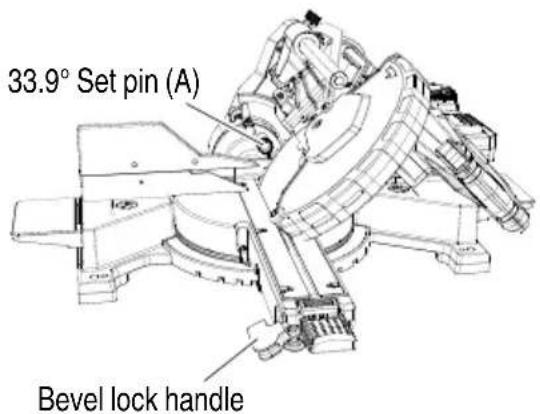
text_image
33.9° Set pin (A) Bevel lock handleFig. 34
(1) When a bevel cut is required, loosen the bevel lock handle.
(2) Tilt the cutting head to the desired angle while pulling the set pin (A), as shown on the bevel scale.
(3) The blade can be positioned at any angle, from a 90° straight cut (0° on the scale) to a 45°. Tighten the bevel lock handle to lock the cutting head in position. Positive stops are provided at 0°, 33.9° and 45°.
NOTE
The saw comes with a 33.9° set pin (A) for setting h and l e back up crown holding cuts when the angle of the walls equals 90°.
(4) Turn the laser guide on and position the workpiece on the table for pre-alignment of your cut.
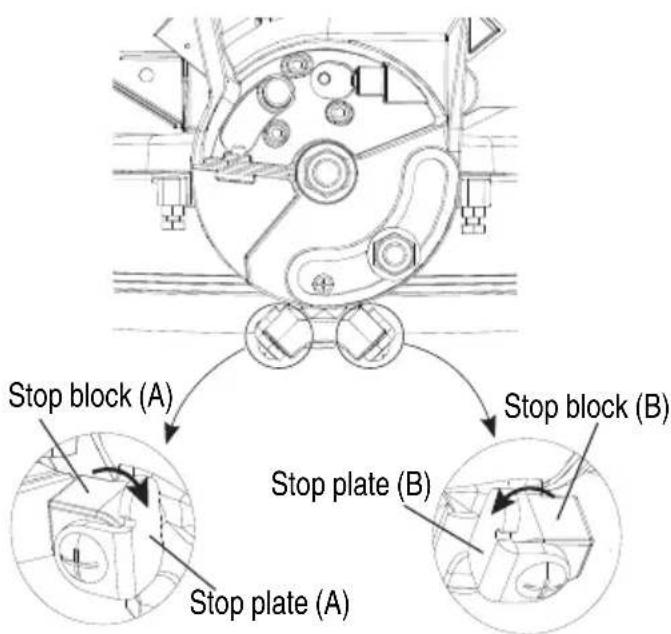
text_image
Stop block (A) Stop plate (B) Stop block (B) Stop plate (A)Fig. 35
NOTE
If 48^ left bevel is necessary, slide the bevel stop plate (A) clockwise away from the stop block (A) to achieve 48^ left bevel.
If 48^ right bevel is necessary, slide the bevel stop plate (B) counterclockwise away from the stop block (B) to achieve 48^ right bevel.
Also, use anchor plate. (see Fig. 25-b)

WARNING
When the workpiece is secured on the left or right side of the blade, the short cut-off portion will come to rest on the right or left side of the saw blade. Always turn the power off and let the saw blade stop completely before raising the handle from the workpiece.
If the handle is raised while the saw blade is still rotating, the cut-off piece may become jammed against the saw blade causing fragments to scatter about dangerously.
When stopping the bevel cutting operation halfway, start cutting after pulling back the motor head to the initial position.
Starting from halfway, without pulling back, causes the lower guard to be caught in the cutting groove of the workpiece and to contact the saw blade.

CAUTION
-
If not tightened fi rmly enough the motor head might suddenly move or slip, causing injuries. Be sure to tighten the motor head section enough so it will not move.
● Always check that the bevel lock handle is secured and the motor head is clamped. If you attempt angle cutting without clamping the motor head, then the motor head might shift unexpectedly causing injuries. -
33.9° Set pin (A) for crown mouldings (Fig. 34)
(1) Push the bevel set pin (A) in towards the rear of the machine.
(2) Loosen the bevel locking handle.
(3) Tilt the cutting head until the set pin (A) stops the bevel angle at 33.9^ on the bevel scale.
(4) Tighten the bevel locking handle to lock the cutting head in position. (see Fig. 34)
7. Miter cutting procedures
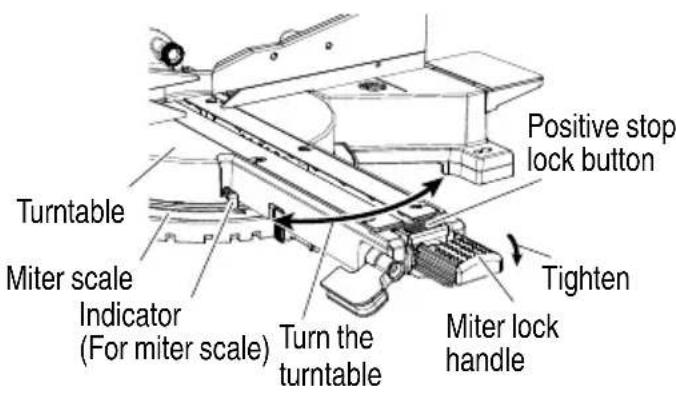
text_image
Turntable Miter scale Indicator (For miter scale) Turn the turntable Positive stop lock button Tighten Miter lock handleFig. 36
(1) Unlock the miter table by lifting up on the miter lock handle.
(2) While pressing down on the positive stop lock button, grasp the miter lock handle and rotate the table left or right to the desired angle.
(3) Once the desired miter angle is achieved, release the positive stop lock button and press down on the miter lock handle to secure the table into position.
(4) If the desired miter angle is NOT one of the nine positive stops noted below, please see the Miter detent override button section on page 23.
(5) Turn the laser guide on and position the workpiece on the table for pre-alignment of your cut.
CAUTION
Always check that the miter lock handle is secured and the turntable is clamped. If you attempt angle cutting without clamping the turntable, then the turntable might shift unexpectedly causing injuries.
NOTE
Positive stops are provided at the right and left of the 0° center setting, at 15°, 22.5°, 31.6° and 45° settings. Check that the miter scale and the tip of the indicator are properly aligned.
Operation of the saw with the miter scale and indicator out of alignment will result in poor cutting precision.
8. Compound cutting procedures
Compound cutting can be performed by following the instructions in 5 to 7 above. For maximum dimensions for compound cutting, refer to "SPECIFICATIONS" table on page 14.
CAUTION
Always secure the workpiece with the right or left hand and cut it by sliding the round portion of the saw backwards with the left hand.
It is very dangerous to rotate the turntable to the left during compound cutting because the saw blade may come into contact with the hand that is securing the workpiece.
In case of compound cutting (angle + bevel) left bevel, extend the sub-fence (B) fully before cutting operation.
In case of compound cutting (angle + bevel) by right bevel, extend the sub-fence (A) fully before cutting operation.
Please confirm that sub fence (A) (B) does no interfere with other parts before attempting compound cutting. If there is any interference, remove either sub fence (A) or (B).
- Crown molding cutting procedures
Fig. 37 shows two common crown molding types having angles of (θ) 38° and 45°.
For the typical crown molding fittings, see Fig. 38.
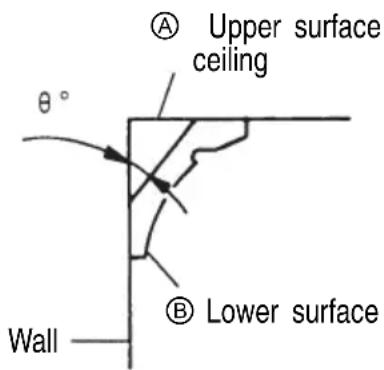
text_image
Upper surface ceiling θ° Wall B Lower surfaceFig. 37
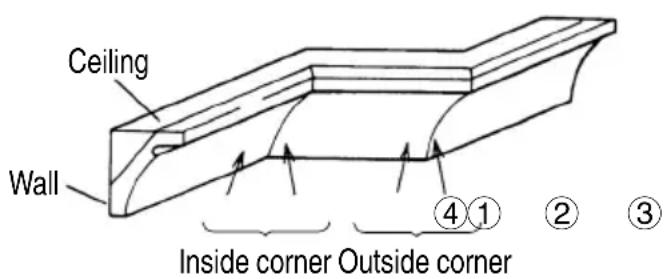
text_image
Ceiling Wall Inside corner Outside corner ④① ② ③Fig. 38
The table below shows the miter angle and the bevel angle settings that are ideal for the two crown molding types.
NOTE
For convenience, positive stops are provided for the miter setting (left and right 31.6°) positions.
For miter cut setting
If the turntable has been set to either of the angles described, move the turntable adjusting miter lock handle a little to the right and left to stabilize the position and to properly align the miter angle scale and the tip of the indicator before the operation starts.
For bevel cut setting
by Tighten the bevel lock handle and check that the position is stable and that the bevel angle scale and the tip of the indicator are properly aligned. Then by tighten the clamp lever.
| Type of Crown Molding | 45° Type | 38° Type | |
| To process crown molding at positions 1 and 4 in Fig. 38. | |||
| Miter Angle Setting | right35.3° | right31.6° | |
| Bevel Angle Setting | left30° | left33.9° | |
| To process crown molding at positions 2 and 3 in Fig. 38. | |||
| Miter Angle Setting | left35.3° | left31.6° | |
| Bevel Angle Setting | left30° | left33.9° | |
(1) Setting to cut crown moldings at positions ① and ④ in Fig. 38 (see Fig. 39; tilt the motor head to the left):
① Turn the turntable to the right and set the Miter Angle as follows:
○ For 45° type crown moldings: 35.3°
○ For 38° type crown moldings: 31.6°
② Tilt the motor head to the left and set the Bevel Angle as follows:
○ For 45° type crown moldings: 30°
○ For 38° type crown moldings: 33.9°
③ Position the crown molding so that the upper surface (A in Fig. 37) contacts the fence as indicated in Fig. 41.
(2) Setting to cut crown moldings at positions ② and ③ in Fig. 38 (see Fig. 40; tilt the head to the left):
① Turn the turntable to the left and set the Miter Angle as follows:
○ For 45° type crown moldings: 35.3°
○ For 38° type crown moldings: 31.6°
② Tilt the head to the left and set the Bevel Angle as follows:
○ For 45° type crown moldings: 30°
○ For 38° type crown moldings: 33.9°
③ Position the crown molding so that the lower surface (® in Fig. 37) contacts the fence as in Fig. 42.
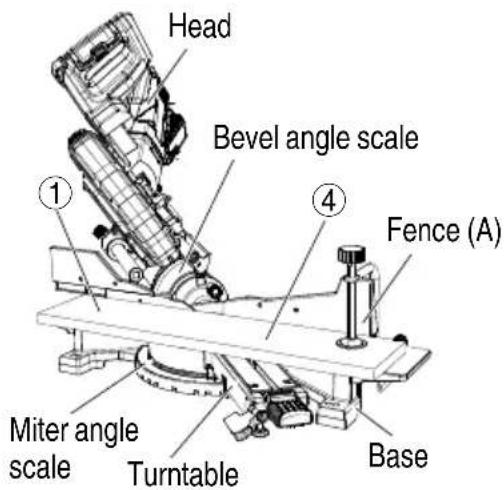
text_image
Head Bevel angle scale ① ④ Fence (A) Miter angle scale Turntable BaseFig. 39
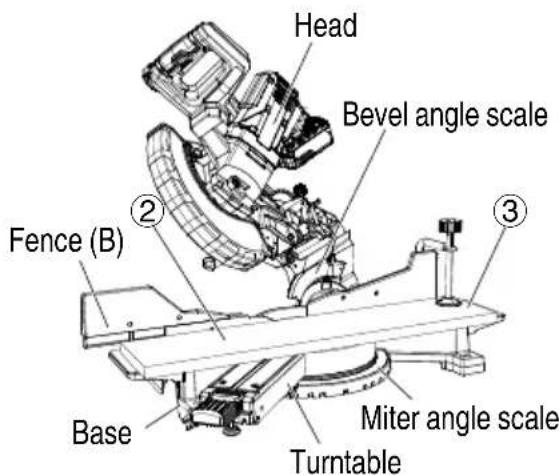
text_image
Head Bevel angle scale Fence (B) Base Miter angle scale TurntableFig. 40
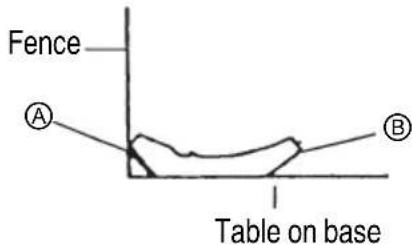
text_image
Fence A B Table on baseFig. 41
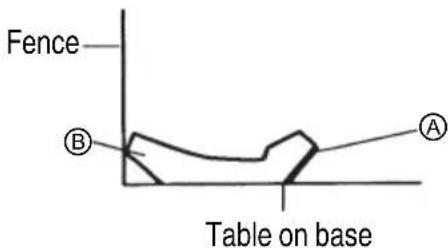
text_image
Fence B A Table on baseFig. 42
(3) Setting to cut crown moldings at positions ① and ④ in Fig. 38 (see Fig. 43; tilt the head to the right):
① Turn the turntable to the right and set the Miter Angle as follows:
○ For 45° type crown moldings: 35.3°
○ For 38° type crown moldings: 31.6°
② Tilt the head to the right and set the Bevel Angle as follows:
○ For 45° type crown moldings: 30°
○ For 38° type crown moldings: 33.9°
③ Position the crown molding so that the upper surface (⑧ in Fig. 37) contacts the fence as indicated Fig. 45.
(4) Setting to cut crown moldings at positions ② and ③ in Fig. 38 (see Fig. 44; tilt the head to the right):
① Turn the turntable to the left and set the Miter Angle as follows:
○ For 45° type crown moldings: 35.3°
○ For 38° type crown moldings: 31.6°
② Tilt the head to the right and set the Bevel Angle as follows:
○ For 45° type crown moldings: 30°
○ For 38° type crown moldings: 33.9°
③ Position the crown molding so that the lower surface (Ⓐ in Fig. 37) contacts the fence as in Fig. 46.
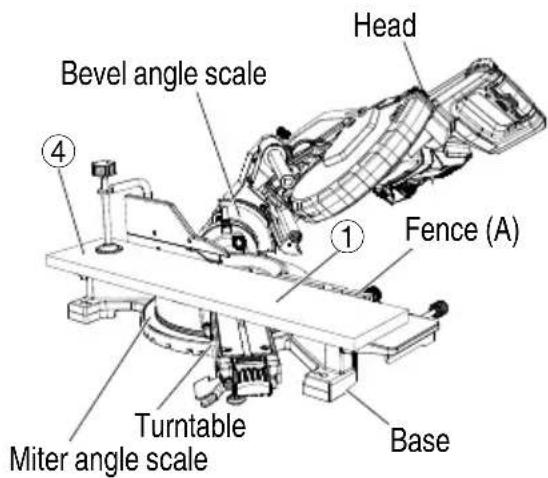
text_image
Bevel angle scale Head ④ ① Fence (A) Turntable Miter angle scale BaseFig. 43
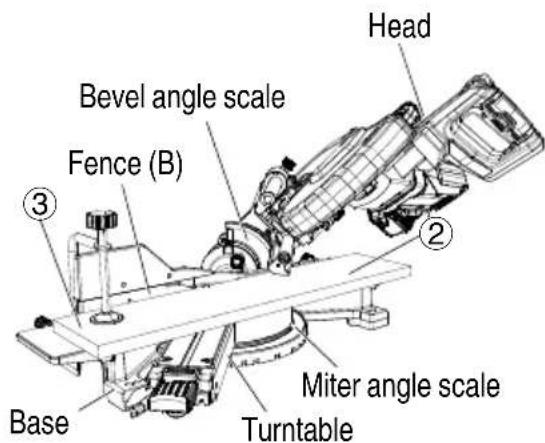
text_image
Head Bevel angle scale Fence (B) ③ ② Miter angle scale Turntable BaseFig. 44
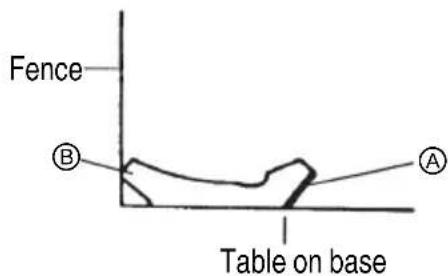
text_image
Fence B A Table on baseFig. 45
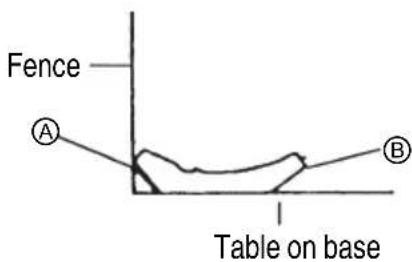
text_image
Fence A B Table on baseFig. 46
WARNING
Always firmly clamp or vise to secure the crown molding to the fence; otherwise the crown molding might be thrust from the table and cause bodily harm.
10. Groove cutting procedures
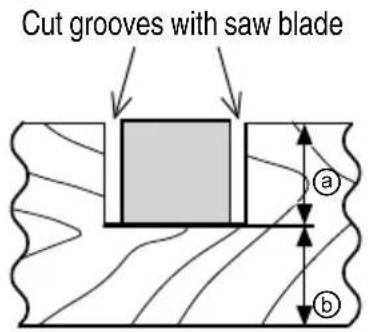
text_image
Cut grooves with saw blade a bFig. 47
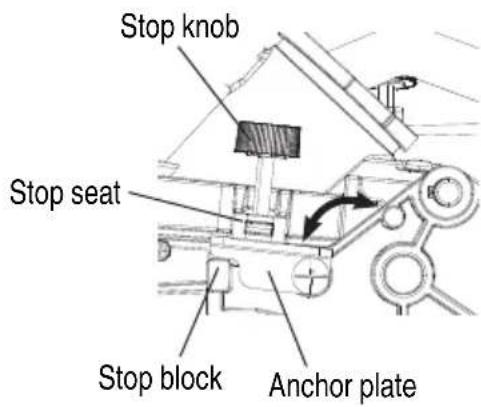
text_image
Stop knob Stop seat Stop block Anchor plate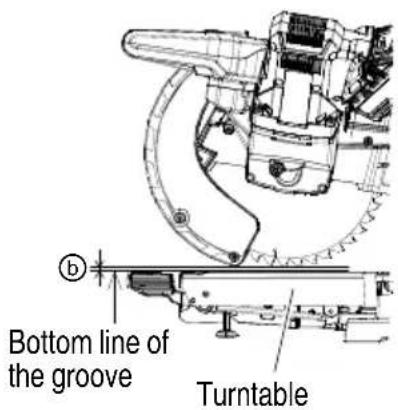
text_image
Bottom line of the groove TurntableFig. 48
Grooves in the workpiece can be cut as indicated in Fig. 47 by adjusting the stop knob.
Cutting depth adjustment procedure:
(1) Turn the anchor plate on the direction shown in Fig. 48.
Lower the motor head, and turn the stop knob by hand. (Where the head of the stop knob contacts the anchor plate.)
(2) Adjust to the desired cutting depth by setting the distance between the saw blade and the surface of the turntable (see ⑥ in Fig. 48).
NOTE
When cutting a single groove at either end of the workpiece, remove the unneeded portion with a chisel.
- Cutting easily-deformed materials, such as aluminum sash
Materials such as aluminum sash can easily deform when tightened too much in a vise assembly. This will cause ineffi cient cutting and possible overload of the motor.
When cutting such materials, use a wood plate to protect the workpiece as shown in Fig. 49-a. Set the wood plate near the cutting section.
When cutting aluminum materials, coat the saw blade with cutting oil (non-combustible) to achieve smooth cutting and a fine finish.
In addition, in case of a U-shaped workpiece, use the wood plate as shown in Fig. 49-b to ensure in the lateral direction, and clamp it near the cutting section of the workpiece and tighten it using both the vise assembly and the clamp available in the market.
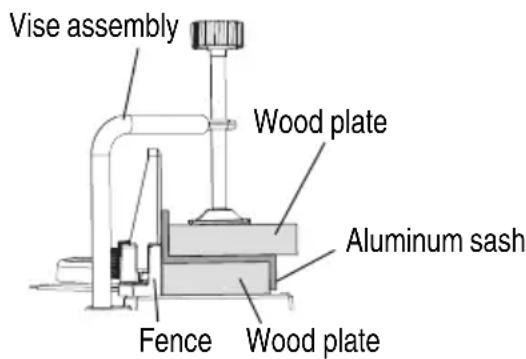
text_image
Vise assembly Wood plate Aluminum sash Fence Wood plateFig. 49-a
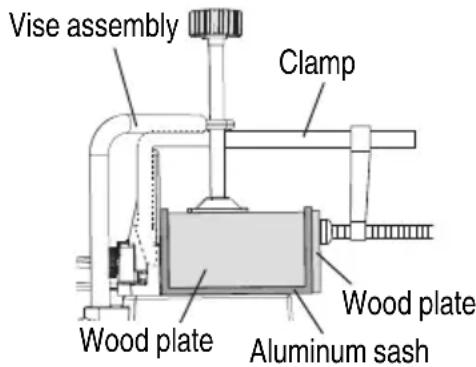
text_image
Vise assembly Clamp Wood plate Wood plate Aluminum sashFig. 49-b
SAW BLADE MOUNTING AND DISMOUNTING
WARNING
● To prevent an accident or personal injury, always turn off the trigger switch and disconnect the power plug from the receptacle and/or remove the battery pack before removing or installing a saw blade.
If cutting work is done in a state where the 8 mm bolt is not sufficiently tightened, the 8 mm bolt can get loose, the blade can come off, and the lower guard can get damaged, resulting in injuries.
Also, check that the 8 mm bolts are properly tightened before plugging the power plug into the receptacle and/or inserting the battery pack.
- If the 8 mm bolts are attached or detached using tools other than the 13 mm wrench (standard accessory), excessive or improperly tightening occurs, resulting in injury.
- Dismounting the blade (Fig. 50-a, Fig. 50-b, Fig. 50-c and Fig. 50-d)
(1) Unplug the power cord from the outlet.
(2) Raise the cutting head to the upright position and slide the cutting head completely toward the rear of the unit and tighten the slide securing knob.
(3) Raise the lower guard to the uppermost position.
(4) While holding the lower guard, remove the cover plate screw with a Phillips screwdriver.
(5) Rotate the cover plate to expose the 8 mm bolt.
(6) Place the blade end spanner over the 8 mm bolt.
(7) Locate the spindle lock on the motor.
(8) Press the spindle lock, holding it in firmly while turning the blade clockwise. The spindle lock will then engage and lock the arbor. Continue to hold the spindle lock, while turning the spanner clockwise to loosen the 8 mm bolt.
(9) Remove the 8 mm bolt, washer (B) and the blade. Do not remove the washer (A).
NOTE
○ If the spindle lock cannot be easily pressed in to lock the spindle, turn the 8 mm bolt with 13 mm wrench (standard accessory) while applying pressure on the spindle lock.
The saw blade spindle is locked when the spindle lock is pressed inward.
○ Pay attention to the pieces removed, noting their position and direction they face. Wipe the washer (B) clean from any sawdust before installing a new blade.
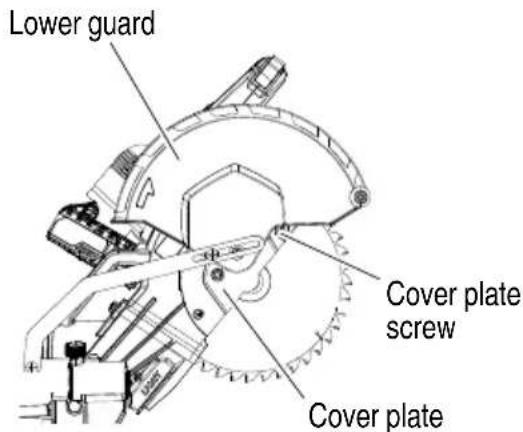
text_image
Lower guard Cover plate screw Cover plateFig. 50-a
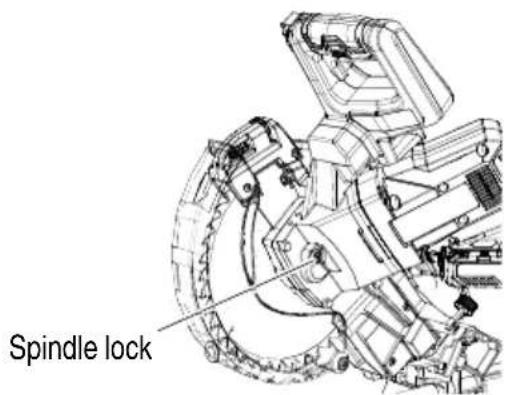
text_image
Spindle lockFig. 50-b
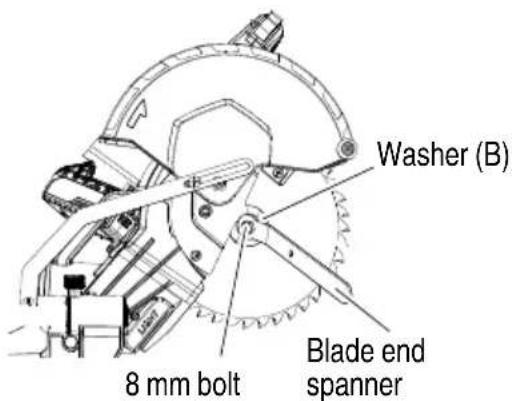
text_image
Washer (B) 8 mm bolt Blade end spannerFig. 50-c
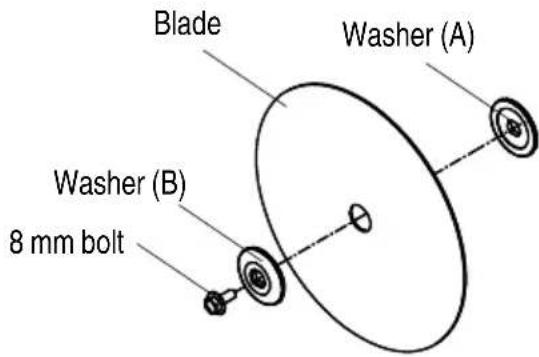
text_image
Blade Washer (A) Washer (B) 8 mm boltFig. 50-d

WARNING
When mounting the saw blade, confi rm that the rotation indicator mark on the saw blade and the rotation direction of the lower guard (see Fig. 2) are properly matched.

CAUTION
- Confi rm that the spindle lock has returned to the retract position after installing or removing the saw blade.
● Tighten the 8 mm bolt so it does not come loose during operation.
Confi rm the 8 mm bolt has been properly tightened before the power tool is started.
- Mounting the saw blade

WARNING
Unplug the miter saw before changing/installing the blade.
(1) Install a 10" (255 mm) blade with arbor, making sure the rotation arrow on the blade matches the clockwise rotation arrow on the lower guard, and the blade teeth are pointing downward.
(2) Place washer (B) against the blade. Thread the 8 mm bolt on arbor in a counterclockwise direction.
NOTE
Make sure the flats of the blade collars are engaged with the flats on the arbor shaft. Also, the flat side of the blade collar must be placed against the blade.
(3) Place the blade spanner on the 8 mm bolt.
(4) Press the spindle lock, holding it in firmly while turning the blade counterclockwise. When it engages, continue to press the spindle lock in, while tightening the 8 mm bolt securely.
(5) Rotate the cover plate back to its original position until the slot in the cover plate engages with the hole of cover plate screw.
While holding the lower guard at the uppermost position, tighten the cover plate screw with a Phillips screwdriver.
(6) Lower the lower guard and verify that operation of the guard does not bind or stick.
(7) Be sure the spindle lock is released so the blade turns freely.
CAUTION
Never attempt to install saw blades larger than 10" (255 mm) in diameter.
Always install saw blades that are 10" (255 mm) in diameter or less.
ABOUT REMAINING BATTERY INDICATOR
You can check the battery's remaining capacity by pressing the remaining battery indicator switch to light the indicator lamp. (Fig. 51, Table 5)
The indicator will shut off approximately 3 seconds after the remaining battery indicator switch is pressed.
It is best to use the remaining battery indicator as a guide since there are slight differences such as ambient temperature and the condition of the battery.
Also, the remaining battery indicator may vary from those equipped to a tool or charger.
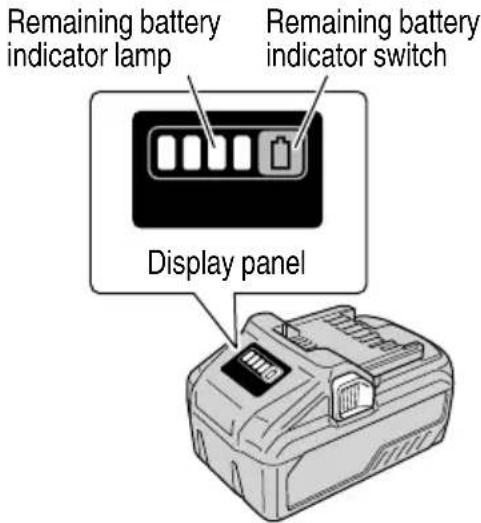
text_image
Remaining battery indicator lamp Remaining battery indicator switch Display panelFig. 51
Table 5
| State of lamp Battery Remaining Power | |
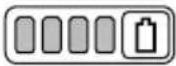 | Lights;The battery remaining power is over 75%. |
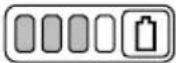 | Lights;The battery remaining power is 50% – 75%. |
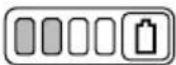 | Lights;The battery remaining power is 25% – 50%. |
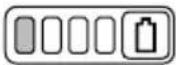 | Lights;The battery remaining power is less than 25%. |
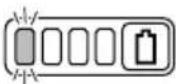 | Blinks;The battery remaining power is nearly empty. Recharge the battery soonest possible |
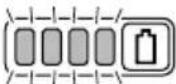 | Blinks;Output suspended due to high temperature. Remove the battery from the tool and allow it to fully cool down. |
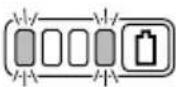 | Blinks;Output suspended due to failure or malfunction. The problem may be the battery so please contact your dealer. |
The Table 5 shows the state of remaining battery indicator lamp and the battery remaining power.
NOTE
Do not give a strong shock to the display panel or break it. It may lead to a trouble.
ABOUT ERROR LAMP OF AC/DC ADAPTER
Table 6
| Indications of the indicator lamp | |||||
| Status | Power Lamp (GREEN) | Error lamp (RED) | Indicates | ||
| Adapter | Before use | Blinks | Light off | Plugged into power source | |
| Power on | Lights | Light off | Tool can be used | ||
| Power suspended | Blinks Lights Lights | Blinks | Lights for 0.5 seconds. Does not light for 0.5 seconds. (off for 0.5 seconds) | Adapter cannot be used due to high temperature. (Can be used once the adapter is cooled) | |
| Lights for 0.1 seconds. Does not light for 0.1 seconds. (off for 0.1 seconds) | Overload | ||||
| Box | Power suspended | Blinks | Lights for 0.5 seconds. Does not light for 0.5 seconds. (off for 0.5 seconds) | Cannot be used because the temperature in the box is too high (Can be used once the box is cooled) | |
MAINTENANCE AND INSPECTION

WARNING
To avoid an accident or personal injury, alv confi rm that the trigger switch is turned OFF and pull out the battery or AC/DC adapter before performing any maintenance or inspection of this tool.
- Inspecting the saw blade
Always replace the saw blade immediately upon the first sign of deterioration or damage.
A damaged saw blade can cause personal injury and a worn saw blade can cause ineffective operation and possible overload to the motor.

CAUTION
Never use a dull saw blade. When a saw blade is dull, its resistance to the hand pressure applied by the tool handle tends to increase, making it unsafe to operate the power tool.
- About Handling the Motor (see Fig. 2)
Winding of the motor is said to be the heart of this tool. Exercise utmost caution not to damage the winding by exposing it to wash oil or water.
NOTE
Accumulation of dust and the like inside the motor can result in a malfunction.
After using the motor for 50 hours or so, carry out no-load running, and blow in the dry air from a wind hole at the motor's rear. Such action is effective to discharge dust and the like.
- Inspecting the screws
Regularly inspect each component of the power tool for looseness.
Re-tighten screws on any loose part.

WARNING
To prevent personal injury, never operate the power tool if any components are loose.
- Inspecting the lower guard for proper operation
Before each use of the tool, test the lower guard (see Fig. 15) to assure that it is in good condition and that it moves smoothly.
Never use the tool unless the lower guard operates properly and it is in good mechanical condition.
- Inspection of terminals (tool and battery or AC/DC adapter)
Check to make sure that swarf and dust have not collected on the terminals.
On occasion check prior, during and after operation.
CAUTION
Remove any swarf or dust which may have collected on the terminals.
Failure to do so may result in malfunction.
- Disposal of the exhausted battery
WARNING
Do not dispose of the exhausted battery. The battery must explode if it is incinerated. The product that you have purchased contains a rechargeable battery. The battery is recyclable. At the end of it's useful life, under various state and local laws, it may be illegal to dispose of this battery into the municipal waste stream. Check with your local solid waste offi cials for details in your area for recycling options or proper disposal.
7. Storage
After operation of the tool has been completed, check that the following has been performed:
(1) Trigger switch is in OFF position,
(2) Pull out the battery or AC/DC adapter from the tool.
When the tool is not in use, storing in a place below 104°F
(40°C) and out of the reach of children.
NOTE
Storing lithium-ion batteries
Make sure the lithium-ion batteries have been fully charged before storing them.
Prolonged storage (3 months or more) of batteries with a low charge may result in performance deterioration, significantly reducing battery usage time or rendering the batteries incapable of holding a charge.
However, significantly reduced battery usage time may be recovered by repeatedly charging and using the batteries two to five times.
If the battery usage time is extremely short despite repeated charging and use, consider the batteries dead and purchase new batteries.
- Lubrication
Lubricate the following sliding surfaces once a month to keep the power tool in good operating condition for a long time (see Fig. 2 and Fig. 3). Use of machine oil is recommended.
Oil supply points:
○ Rotary portion of hinge
○ Rotary portion of vise assembly
○ Rotary portion of holder (A)
- Cleaning
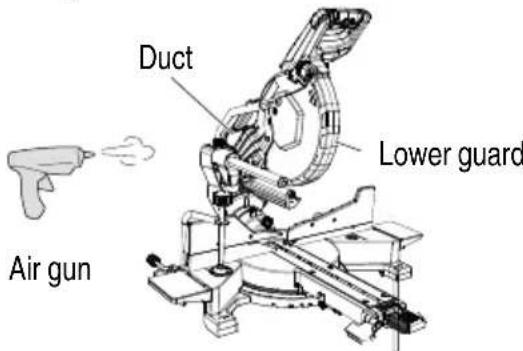
text_image
Duct Lower guard Air gunFig. 52
Clean the machine, duct and lower guard by blowing with dry air from an air gun or other tool.
Periodically remove chips, dust and other waste material from the surface of the power tool, especially from the inside of the lower guard with a damp, soapy cloth. To avoid a malfunction of the motor, protect it from contact with oil or water.
If the laser line becomes invisible due to chips and the like adhered onto the window of the laser marker's light-emitting section, wipe and clean the window with a dry cloth or a soft cloth moistened with soapy water, etc.
Important notice on the batteries for the metabo HPT cordless power tools
Please always use one of our designated genuine batteries. We cannot guarantee the safety and performance of our cordless power tool when used with batteries other than these designated by us, or when the battery is disassembled and modified (such as disassembly and replacement of cells or other internal parts).
SERVICE AND REPAIRS
All quality power tools will eventually require servicing or replacement of parts because of wear from normal use. To assure that only authorized replacement parts will be used and that the double insulation system will be all service (other than routine maintenance) must be performed by an AUTHORIZED metabo HPT POWER TOOL REPAIR CENTER ONLY.
NOTE
Specifications are subject to change without any obligation on the part of metabo HPT.
protected,
TROUBLESHOOTING GUIDE

WARNING
● To avoid injury from an accidental start, turn the switch OFF and remove the plug from the power source or remove the battery or AC/DC adapter from the main body before making any adjustments.
● All electrical or mechanical repairs should be done only by qualified service technicians. Contact metabo HPT Authorized Service Center.
- Power tool
| Problem Possible | Cause Possible Solution | |
| Tool doesn’t run No remaining battery power. Charge the battery. | ||
| Tool suddenly stopped | Tool was overburdened. | Get rid of the problem causing the overburden. |
| The battery is overheated. | Let the battery cool down. | |
| The motor was automatically stopped to prevent failure of the tool. | This is not a malfunction.The trigger switch was held down for 5 minutes or more.Switch on the power once more. | |
| Cannot be tilted | The clamp lever has not been loosened. | Loosen the clamp lever and then tilt the tool.After adjusting the loosened component, make sure to tighten it once again. |
| Cannot be tilted to the right | Set pin (A) has not been pulled out. | Tilt to the right after pulling out set pin (A). |
| The clamp lever has not been loosened. | Loosen the clamp lever and then tilt. | |
| Sawblade is dull | The sawblade is worn down or missing teeth. | Exchange with a new product. |
| Bolt is loose. | Tighten the bolt. | |
| The sawblade has been installed in reverse. | Install the sawblade in the correct direction. | |
| Cannot cut with precision The operation parts of the tool are not fully fixed. | Fully install the clamp lever and side handle. | |
| Material cannot be fixed in the correct position. | ||
| In some cases, proper position cannot be fixed due to a curve in the material.Try to fix a flat surface with the fence or turntable. | ||
| Switch cannot be pulled Switch lock is not pressed in enough. Press in the switch lock all the way until it strikes the back. | ||
| Battery cannot be installed | Attempting to install a battery other than that specified for the tool. | Please install a multi volt type battery. |
- Charger
| Symptom Possible | cause Remedy | |
| The charge indicator lamp is rapidly fl ickers purple, and battery charging doesn't begin. | The battery is not inserted all the way. | Insert the battery firmly. |
| There is foreign matter in the battery terminal or where the battery is attached. | Remove the foreign matter. | |
| The charge indicator lamp blinks red, and battery charging doesn't begin. | The battery is not inserted all the way. | Insert the battery firmly. |
| The battery is overheated. If left alone, the battery will automatically begin charging if its temperature decreases, but this may reduce battery life. It is recommended that the battery be cooled in a well-ventilated location away from direct sunlight before charging it. | ||
| Battery usage time is short even though the battery is fully charged. | The battery's life is depleted. Replace the battery with a new one. | |
| The battery takes a long time to charge. | The temperature of the battery, the charger, or the surrounding environment is extremely low. | Charge the battery indoors or in another warmer environment. |
| The charger's vents are blocked, causing its internal components to overheat. | Avoid blocking the vents. | |
| The cooling fan is not running. Contact a metabo HPT Authorized Service Center for repairs. | ||
| The USB power lamp has switched off and the USB device has stopped charging. | The battery's capacity has become low. | Replace the battery with one that has capacity remaining. |
| Plug the charger's power plug into an electric socket. | ||
| USB power lamp does not switch off even though the USB device has fi nished charging. | The USB power lamp lights up green to indicate that USB charging is possible. | This is not a malfunction. |
| It is unclear what the charging status of a USB device is, or whether its charging is complete. | The USB power lamp does not switch off even when charging is complete. | Examine the USB device that is charging to confi rm its charging status. |
| Charging of a USB device pauses midway. | The charger was plugged into an electrical socket while the USB device was being charged using the battery as the power source. | This is not a malfunction.The charger pauses USB charging for about 5 seconds when it is differentiating between power sources. |
| A battery was inserted into the charger while the USB device was being charged using a power socket as the power source. | ||
| Charging of the USB device pauses midway when the battery and the USB device are being charged at the same time. | The battery has become fully charged. This is not a malfunction.The charger pauses USB charging for about 5 seconds while it checks whether the battery has successfully completed charging. | |
| Charging of the USB device doesn't start when the battery and the USB device are being charged at the same time. | The remaining battery capacity is extremely low. | This is not a malfunction.When the battery capacity reaches a certain level, USB charging automatically begins. |
- AC/DC adapter
| Problem Possible Cause Possible Solution | ||
| The adapter's error lamp is blinking red and the tool does not operate when switched on. | Output is suspended because the tool or the AC/DC adapter is overheated. | Allow the tool and AC/DC adapter to sufficiently cool down. |
| The adapter's error lamp rapidly blinks red and the motor does not operate when the tool is switched on. | Output is suspended because the tool is overloaded. | Remove the cause of the overload. |
| During protective operation, the LED will blink diff erently for AC/DC adapter use and battery use. | This is not a malfunction. | |
ACCESSORIES
WARNING
ALWAYS use Only authorized metabo HPT replacement parts and accessories. Never use replacement parts or accessories which are not intended for use with this tool. Contact metabo HPT if you are not sure whether it is safe to use a particular replacement part or accessory with your tool.
The use of any other attachment or accessory can be dangerous and could cause injury or mechanical damage.
NOTE
Accessories are subject to change without any obligation on the part of the metabo HPT.
STANDARD ACCESSORIES
| C3610DRA(WC) | 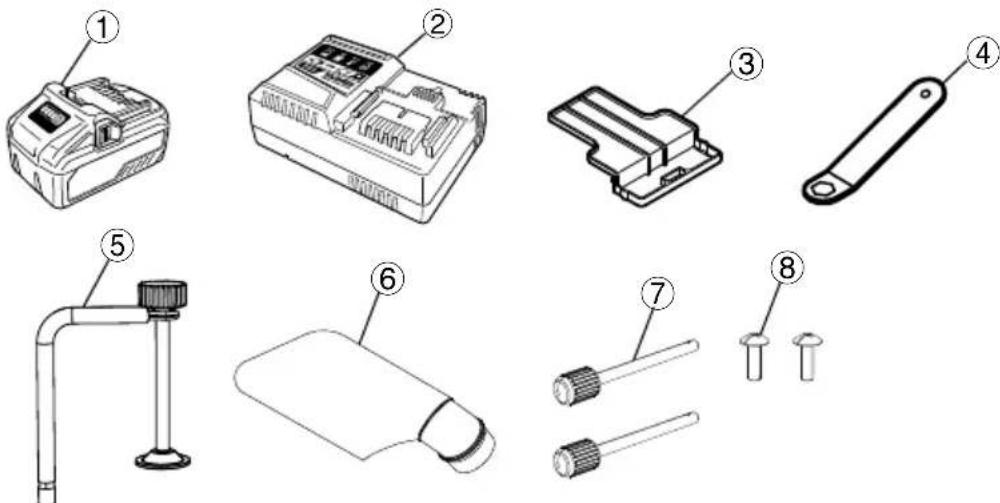 |
| 1Battery(BSL36B18)....12Battery Charger(UC18YSL3)....13Battery cover(Code No. 329897)....1413 mm Wrench(Code No. 372446)....15Vise Assembly(Code No. 372531)....16Dust bag(Code No. 373694)....17Support rod ass'y(Code No. 372571)....285 mm screw(Code No. 372464)....2 | |
| C3610DRA(NN) | 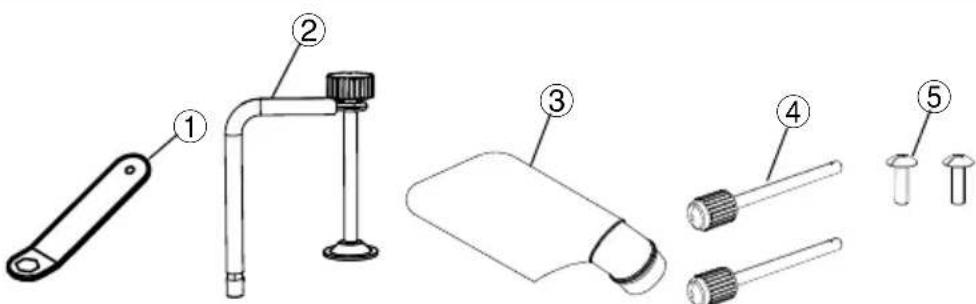 |
113 mm Wrench(Code No. 372446)....12Vise Assembly(Code No. 372531)....13Dust bag(Code No. 373694)....14Support rod ass'y(Code No. 372571)....255 mm screw(Code No. 372464)....2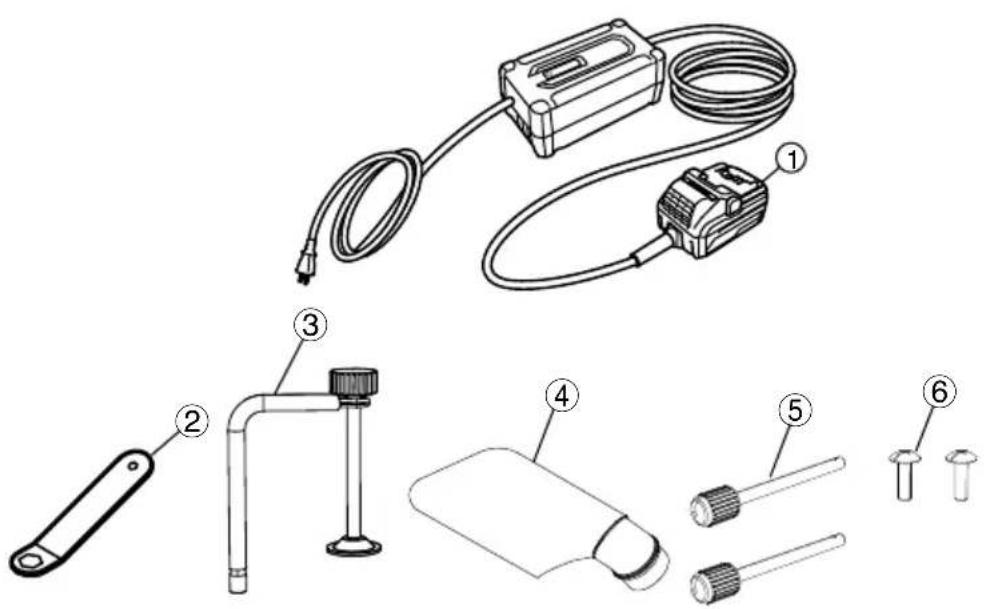 | |
| C3610DRA(NNT) | |
| 1 AC/DC adapter (ET36A)......12 13 mm Wrench (Code No. 372446)......13 Vise Assembly (Code No. 372531)......14 Dust bag (Code No. 373694)......15 Support rod ass'y (Code No. 372571)......26 5 mm screw (Code No. 372464)......2 |
INFORMATIONS IMPORTANTES DE SÉCURITÉ
CHOSES A NE PAS FAIRE
POUR GARANTIR UNE UTILISATION EN TOUTE SÉCURITÉ, NE JAMAIS VIOLER LES CONSIGNES SUIVANTES:
natural_image
Simple line drawing of a medical device with a tube, connector, and outlet (no text or symbols)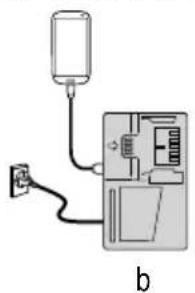
natural_image
Simple line drawing of a device with a plug and cable, no text or symbols present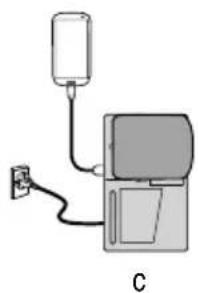
natural_image
Simple line drawing of a device with a bulb, plug, and cable (no text or symbols)Fig. 13
natural_image
Technical line drawing of a mechanical device with no visible text or symbolsnatural_image
Pure diagram of two vertical lines with arrows pointing downward (no text or symbols)Fig. 28-b
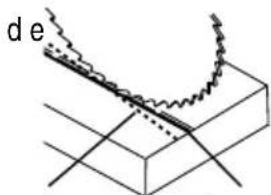
text_image
d enatural_image
Two vertical line diagrams with arrows indicating direction, no text or symbols presentFig. 28-c
APPLICATIONS PRATIQUES
⚠ AVERTISSEMENT
natural_image
Simple line drawing of a device with a bulb, cable, and power outlet (no text or symbols)a
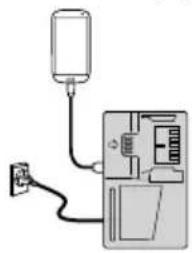
natural_image
Simple line drawing of a device with a plug and cable, no text or symbols presentb
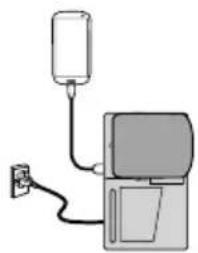
natural_image
Simple line drawing of a device with a bulb and cable, no text or symbols presentC
Fig. 13
natural_image
Technical line drawing of a mechanical assembly with arrows indicating direction (no text or symbols)natural_image
Technical line drawing of a mechanical assembly with no visible text or symbolsFig. 19
text_image
A Superfi cie superior Techo θ° Pared B Superfi cie inferiorFig. 37
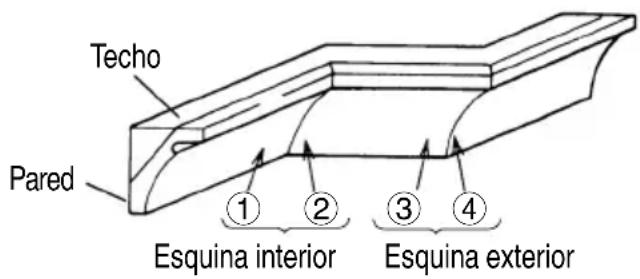
text_image
Techo Pared ① ② ③ ④ Esquina interior Esquina exteriorFig. 38
natural_image
Line drawing of a quill pen in an inkwell (no text or symbols)
natural_image
Line drawing of a quill pen in an inkwell (no text or symbols)WARNING:
Some dust created by power sanding, sawing, grinding, drilling, and other construction activities contains chemicals known to the State of California to cause cancer, birth defects or other reproductive harm. Some examples of these chemicals are:
- Lead from lead-based paints,
- Crystalline silica from bricks and cement and other masonry products, and
- Arsenic and chromium from chemically-treated lumber.
Your risk from these exposures varies, depending on how often you do this type of work. To reduce your exposure to these chemicals: work in a well ventilated area, and work with approved safety equipment, such as those dust masks that are specially designed to filter out microscopic particles.
AVERTISSEMENT:
Please contact Koki Holdings America Ltd. at 1-800-59-TOOLS (toll free), or metabo HPT AUTHORIZED POWER TOOL SERVICE CENTER regarding COLLECTION.
Pour le RAMASSAGE, contacter Koki Holdings America Ltd. au 1-800-59-TOOLS (appel gratuit), ou UN SERVICE APRÈS-VENTE D'OUTILS ÉLECTRIQUE AGRÉÉ PAR metabo HPT.
Minato-ku, Tokyo 108-6020, Japan
Distributed by
Koki Holdings America Ltd.
1111 Broadway Ave,
Braselton, Georgia, 30517
Koki Holdings America Ltd. Canadian Branch
3405 American Drive, Units 9-10,
Mississauga, ON, L4V 1T6