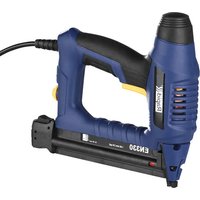
EN330 - Stapler RAPID - Free user manual and instructions
Find the device manual for free EN330 RAPID in PDF.


| Product type | Cordless electric stapler |
| Brand | RAPID |
| Model | EN330 |
| Power supply | 220-240 V~, 50 Hz |
| Power consumption | 9.6 A |
| Fastener type | Rapid T8 headless nails, length 15-30 mm |
| Magazine capacity | 110 headless nails (145 mm strip) |
| Max nailing speed | 20 strokes/min |
| Weight | 1.325 kg |
| Sound pressure level | 85.4 dB(A) (uncertainty K=3 dB(A)) |
| Sound power level | 96.4 dB(A) (uncertainty K=3 dB(A)) |
| Vibrations | 4.626 m/s² (uncertainty K=1.5 m/s²) |
| Power adjustment | 2 positions: HI (hard materials) and LO (thin/soft materials) |
| Safety features | Safety contact, on/off switch |
| Maintenance | Clean with a dry or damp cloth; do not oil; clear jams with a pin or Allen key |
| Repairability | Repair by a qualified service center only; genuine spare parts |
| Warranty | Not specified in the manual |
Frequently Asked Questions - EN330 RAPID
User questions about EN330 RAPID
0 question about this device. Answer the ones you know or ask your own.
Ask a new question about this device
Download the instructions for your Stapler in PDF format for free! Find your manual EN330 - RAPID and take your electronic device back in hand. On this page are published all the documents necessary for the use of your device. EN330 by RAPID.
USER MANUAL EN330 RAPID
Operating instructions
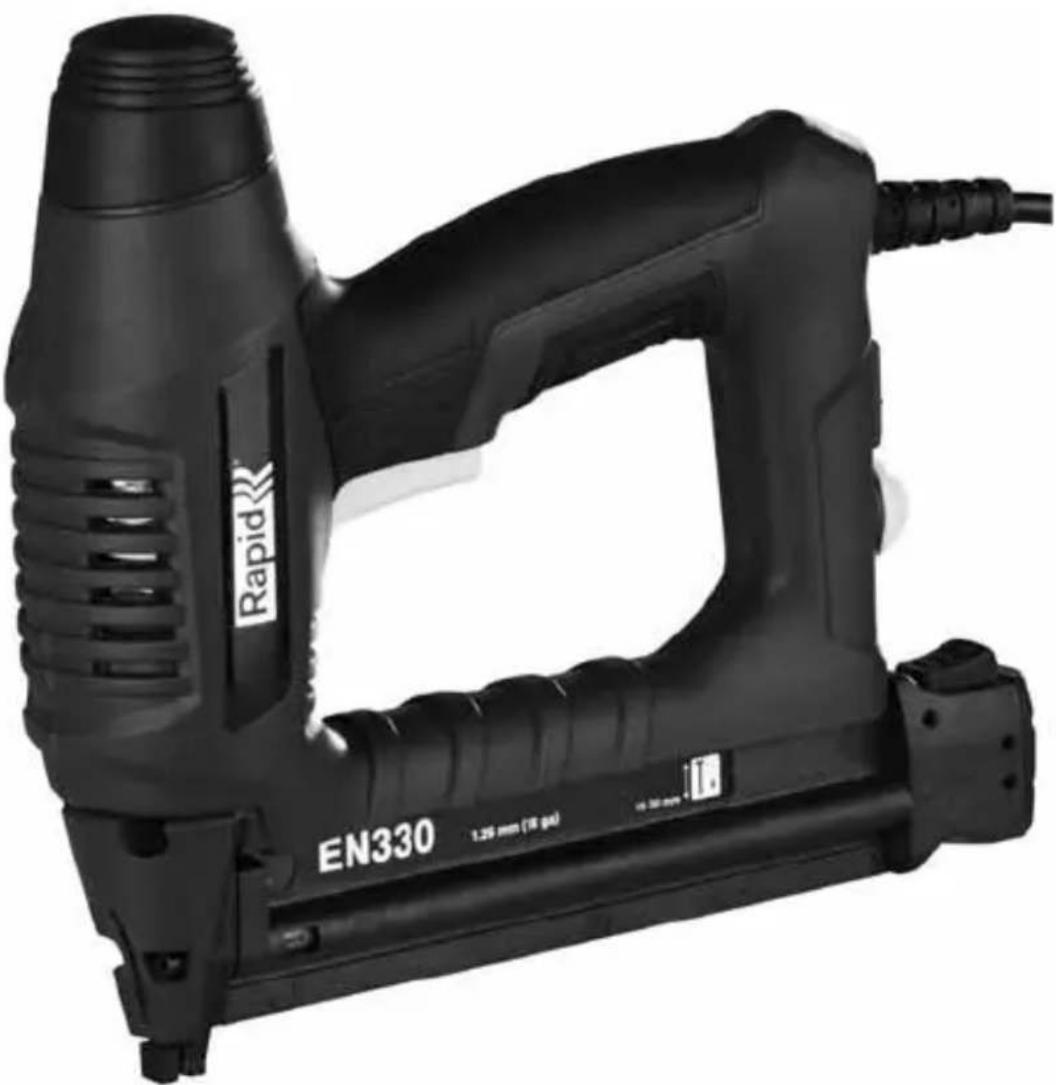
natural_image
Black Rapid 330 electric drill kit with visible model number EN330 and specifications (no text beyond branding)GB ELECTRIC NAILER
DE ELEKTRONAGLER
FR CLOUEUSE ELECTRIQUE
Complies to relevant EU directives
CE
GENERAL POWER TOOLS SAFETY WARNINGS
WARNING!! Read all safety warnings and all instructions. Failure to follow all instructions listed below may result in electric shock, fire and/or serious personal injury.

Save all warnings and instructions for future reference.

The term "power tool" in the warnings refers to your mains-operated (corded) power tool or battery-operated (cordless) power tool.
1) WORK AREA SAFETY
a) Keep your work area clean and well lit.
Cluttered benches and dark areas invite accidents.
b) Do not operate power tools in explosive atmospheres, such as in the presence of fl ammable liquids, gases, or dust. Power tools create sparks which may ignite the dust or fumes.
c) Keep bystanders, children, and visitors away while operating a power tool. Dis-tractions can cause you to lose control.
2) ELECTRICAL SAFETY
a) Power tool plugs must match the outlet. Never modify the plug in any way. Do not use any adapter plugs with earthed (grounded) power tools. Unmodified plugs and matching outlets will reduce risk of electric shock.
b) Avoid body contact with grounded surfaces such as pipes, radiators, ranges and refrigerators. There is an increased risk of electric shock if your body is grounded.
c) Do not expose power tools to rain or wet conditions. Water entering a power tool will increase the risk of electric shock.
d) Do not abuse the cord. Never use the cord for carrying, pulling or unplugging the power tool. Keep cord away from heat, oil, sharp edges or moving parts.
Damaged or entangled cords increase the risk of electric shock.
e) When operating a power tool outdoors, use an extension cord suitable for outdoor use. Use of a cord suitable for outdoor use reduces the risk of electric shock.
f) If operating a power tool in a damp location is unavoidable, use a ground fault circuit interrupter protected supply. Use of a ground fault circuit interrupter reduces the risk of electric shock.
3) PERSONAL SAFETY
a) Stay alert, watch what you are doing and use common sense when operating a power tool. Do not use a power tool while you are tired or under the influence of drugs, alcohol or medication. A moment of inattention while operating power tools may result in serious personal injury.
b) Use personal protective equipment. Always wear eye protection. Protective equipment such as dust mask, non-skid safety shoes, hard hat, or hearing protection used for appropriate conditions will reduce personal injuries.
c) Prevent unintentional starting. Ensure the switch is in the off-position before connecting to power source and/or battery pack, picking up or carrying the tool.
Carrying power tools with your fi nger on the switch or energizing power tools that have the switch on invites accidents.
d) Remove any adjusting key or wrench be-
fore turning the power tool on. A wrench
or a key left attached to a rotating part of the
power tool may result in personal injury.
e) Do not overreach. Keep proper footing and balance at all times. This enables better control of the power tool in unexpected situations.
f) Dress properly. Do not wear loose clothing or jewellery. Keep your hair, clothing and gloves away from moving parts.
Loose clothes, jewellery or long hair can be caught in moving parts.
g) If devices are provided for the connection of dust extraction and collection facilities, ensure these are connected and properly used. Use of dust collection can reduce dust-related hazards.
h) Do not let familiarity gained from frequent use of tools allow you to become complacent and ignore tool safety principles. A careless action can cause severe injury within a fraction of a second.
4) POWER TOOL USE AND CARE
a) Do not force the power tool. Use the correct power tool for your application. The correct power tool will do the job better and safer at the rate for which it was designed.
b) Do not use the power tool if the switch
does not turn it on and off. Any power tool that cannot be controlled with the switch is dangerous and must be repaired.
c) Disconnect the plug from the power source and/or the battery pack from the power tool before making any adjustments, changing accessories, or storing power tools. Such preventive safety measures reduce the risk of starting the power tool accidentally.
d) Store idle power tools out of the reach of children and do not allow persons unfamiliar with the power tool or these instructions to operate the power tool.
Power tools are dangerous in the hands of untrained users.
e) Maintain power tools. Check for misalignment or binding of moving parts, breakage of parts and any other condition that may affect the power tool's operation. If damaged, have the power tool repaired before use. Many accidents are caused by poorly maintained power tools.
f) Keep cutting tools sharp and clean.
Properly maintained cutting tools with sharp cutting edges are less likely to bind and are easier to control.
g) Use the power tool, accessories and tool bits etc. in accordance with these instructions, taking into account the working conditions and the work to be performed.
Use of the power tool for operations different from those intended could result in a hazardous situation.
h) Keep handles and grasping surfaces dry, clean and free from oil and grease. Slippery handles and grasping surfaces do not
allow for safe handling and control of the tool in unexpected situations.
5) SERVICE
a) Have your power tool serviced by a qual-ifi ed repair person using only identical replacement parts. This will ensure that the safety of the power tool is maintained.
TACKER SAFETY WARNINGS
- Always assume that the tool contains fasteners. Careless handling of the tacker can result in unexpected fi ring of fasteners and personal injury.
- Do not point the tool towards yourself or anyone nearby. Unexpected triggering will discharge the fastener causing an injury.
- Do not actuate the tool unless the tool is placed firmly against the work piece. If the tool is not in contact with the work piece, the fastener may be deflected away from your target.
- Disconnect the tool from the power source when the fastener jams in the tool. While removing a jammed fastener, the tacker may be accidentally activated if it is plugged in.
- Use caution while removing a jammed fastener. The mechanism may be under compression and the fastener may be forcefully discharged while attempting to free a jammed condition.
- Do not use this tacker for fastening electrical cables. It is not designed for electric cable installation and may damage the insulation of electric cables thereby causing electric shock or fire hazards.
TECHNICAL SPECIFICATION
| Model Number EN330 | |
| Voltage 220-240 V~, 50Hz | |
| Current 9.6 A | |
| Brad type, length Rapid T8, 15-30 mm | |
| Magazine Capacity 110 brads (145 mm) | |
| Speed, maximum continuous 20 shots/min | |
| Tool Weight 1.325 kg |
NOISE EMISSION
A-weighted sound pressure level LpA=85.4 dB(A), uncertainty K=3 dB(A)
A-weighted sound power level LwA=96.4 dB(A), uncertainty K=3 dB(A)
Recommendation for the operator to wear hearing protection.
VIBRATION
Vibration total value=4.626 m/s2, uncertainty K=1.5 m/s2
The declared vibration total value has been measured in accordance with a standard test method and may be used for comparing one tool with another.
The declared vibration total value may also be used in a preliminary assessment of exposure.
WARNING
The vibration emission during actual use of the power tool can differ from the declared total value depending on the ways in which the tool is used.

It's needed to identify safety measures to protect the operator that are based on an estimation of exposure in the actual conditions of use (taking account of all parts of the operating cycle such as the times when the tool is switched off and when it is running idle in addition to the trigger time).
ASSEMBLY
DEFINITIONS (FIGURE 1)
A: Trigger
B: Power Cord
©: On/Off Power Switch
D: Power Adjuster
E : Magazine Latch
F : Indicator Window
G: Brad Output
H: Safety Yoke
LOAD BRADS INTO THE MAGAZINE
- Turn off the power switch and unplug the nailer (Figure 2).
-
Squeeze latch and slide magazine open (Figure 3).
-
Open the magazine fully and insert the brads with the points facing the bottom of the tool. Points must rest against the bottom of the tool and the brad strip laying fl at against the magazine. (Figure 4). Use only recommended brads.
- Close magazine and make sure it is securely locked.
REMOVE BRADS FROM THE MAGAZINE
- Turn off the power switch and unplug the nailer.
- Squeeze latch and slide magazine open.
- Remove the brads from the magazine.
- Close magazine.
OPERATION
NAILING
- Plug nailer into a 220-240V\~, 50Hz power outlet.
- Turn on the power switch (Figure 2)
- Make sure the tool is in good working condition.
- Hold the nailer firmly with the brad output G at against the work piece to activate the safety yoke H Figure 5).
- Squeeze trigger Ao fi re the nailer.
- To fire the nailer again, release safety yoke and trigger then repeat step 4 and 5.
- The power adjuster has two power settings. Use the HI setting to drive brads into hard materials or use the LO setting to drive brads into thin or soft materials.
- Unplug nailer, turn off power switch after use.
NOTE: For better performance press the tool against the work piece (Figure 5).
NOTE: In case of jammed brad, read the maintenance section. DO
NOT re-fi re the tool in order to clear the jam as this may damage the tool.
NOTE: During operation, the tool may feel warm. This is normal but if the tool starts to feel hot use shall be discontinued until it cools down.
NOTE: The nailer should be used only for the intended purposes. It is designed for use on wood or similar materials in indoor environment.
GUIDELINES FOR USING EXTENSION CORDS
Recommended Minimum Wire Area (mm²) for Extension Cords
Up to 10m: 1.5 mm ^4
Up to-25m: 2.5mm ^4
Over 25m: not suitable
MAINTENANCE
STANDARD MAINTENANCE
- Unplug nailer before any maintenance.
- Inspect all screws and tighten if necessary.
- Keep all vents free from dust and dirt.
- Clean tool by a dry or damp cloth. NEVER use any solvent.
- Keep the magazine channel clean.
-
DO NOT oil or grease any parts.
-
Be sure the nailer is not damaged. Replace or repair prior to use.
CLEARING A JAMMED BRAD
- Turn off the power switch and unplug the nailer.
- Squeeze latch and slide magazine open.
- Take out the loose brads from the magazine.
- Use a pin with sharp end to remove the jammed brads.
- If a jam is difficult to clear, loosen the two Allen Head screws at the front nose of the tool with the Allen Wrench provided (Figure 6) (DO NOT REMOVE SCREWS).
- Removed jammed brad.
- Tighten the Allen Head screws.
WARNING!!
DO NOT alter parts on this nailer or attach special fixtures. This can lead to personal injury.
If the replacement of the supply cord is necessary this has to be done by a qualified service center in order to avoid a safety hazard.

ENVIRONMENT
Separate Collection. Do not dispose power tools into household waste! According to the European Directive 2012/19/EC on waste of electrical and electronic equipment.
When the tool needs to be replaced, or if it is of no further use it should be brought to a separate collection centre for recycling.
EN330
DÉFINITIONS (FIGURE 1)
VEILIGHEIDSWAARSCHUWINGEN VOOR TACKERS
INDF∅R DYKKERE I MAGASINET
1) SIKKERHET PÅ ARBEIDSOMRÅDET
a) Arbeidsområdet må holdes rent og godt belyst. Det kan lett oppstå ulykker på rotete eller mørke arbeidsområder.
SLIK FYLLES MAGASINET MED DYKKERTER
STANDARD VEDLIKEHOLD
- Unplug nailer before any maintenance.
- Inspect all screws and tighten if necessary.
- Keep all vents free from dust and dirt.
- Clean tool by a dry or damp cloth. NEVER use any solvent.
- Keep the magazine channel clean.
- DO NOT oil or grease any parts.
- Be sure the nailer is not damaged. Replace or repair prior to use.
STANDART BAKIM
- Unplug nailer before any maintenance.
- Inspect all screws and tighten if necessary.
- Keep all vents free from dust and dirt.
- Clean tool by a dry or damp cloth. NEVER use any solvent.
- Keep the magazine channel clean.
- DO NOT oil or grease any parts.
- Be sure the nailer is not damaged. Replace or repair prior to use.
- Always assume that the tool contains fasteners. Careless handling of the tacker can result in unexpected fi ring of fasteners and personal injury.
- Presupuneți întotdeauna că scula conține
NOTE: For better performance press the tool against the work piece (Figure 5).
NOTE: In case of jammed brad, read the maintenance section. DO NOT re-fi re the tool in order to clear the jam as this may damage the tool.
NOTE: During operation, the tool may feel warm. This is normal but if the tool starts to feel hot use shall be discontinued until it cools down.
NOTE: The nailer should be used only for the intended purposes. It is designed for use on wood or similar materials in indoor environment.
GUIDELINES FOR USING EXTENSION CORDS
Recommended Minimum Wire Area (mm ^2 ) for Extension Cords
Up to 10m: 1.5 mm ^4
Up to-25m: 2.5mm ^4
Over 25m: not suitable