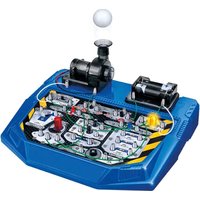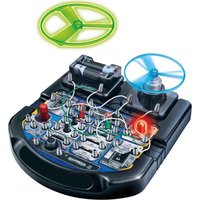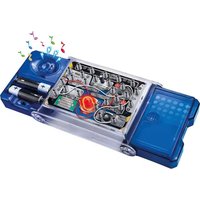
KNS100 - Educational electronic kit VELLEMAN - Free user manual and instructions
Find the device manual for free KNS100 VELLEMAN in PDF.


| Product type | Educational electronics kit |
| Brand | Velleman |
| Model | KNS100 |
| Power supply | 2 AA 1.5 V batteries (not included) |
| Number of experiments | 8 |
| Included components | Connection wires, resistors, NPN and PNP transistors, capacitor (10 µF), integrated circuit, light sensor (phototransistor), LED, speaker, switch, battery holders, touch plate, printed circuit board |
| Recommended age | 8 years and up, with adult supervision |
| Safety | Not suitable for children under 3 years (small parts). Do not use near the ear. Read instructions before use. |
| Main functions | Learning basics of electronics: voltage, current, resistance, magnetism through 8 interactive experiments (light control by sound, touch control, blinking LED, etc.) |
| Usage | Educational use at school or home with adult supervision |
| Maintenance | Clean with a dry cloth. Protect from moisture, dust and shocks. |
| Storage | Store in the provided extractable storage compartment after use |
| Warranty | 24 months (conditions at the end of the manual) |
| Warnings | Read the manual before use. Do not modify the device. Use only the provided components. Do not short-circuit the terminals. |
| Batteries | Respect polarity. Do not mix old and new batteries, nor different types. Remove used batteries from the toy. |
Frequently Asked Questions - KNS100 VELLEMAN
User questions about KNS100 VELLEMAN
0 question about this device. Answer the ones you know or ask your own.
Ask a new question about this device
Download the instructions for your Educational electronic kit in PDF format for free! Find your manual KNS100 - VELLEMAN and take your electronic device back in hand. On this page are published all the documents necessary for the use of your device. KNS100 by VELLEMAN.
USER MANUAL KNS100 VELLEMAN
natural_image
Illustration of an electronic device with internal components and sound waves, no text or symbols presentUSER MANUAL 2
HANDLEIDING 13
MODE D'EMPLOI 24
MANUAL DEL USUARIO 34
To all residents of the European Union
Important environmental information about this product
This symbol on the device or the package indicates that disposal of the device after its lifecycle could harm the environment. Do not dispose of the unit (or batteries) as unsorted municipal waste; it should be taken to a specialized company for recycling. This device should be returned to your distributor or to a local recycling service. Respect the local environmental rules.
If in doubt, contact your local waste disposal authorities.
Thank you for choosing Velleman! Please read the manual thoroughly before bringing this device into service. If the device was damaged in transit, do not install or use it and contact your dealer.
2. Safety Instructions

Read and understand this manual and all safety signs before using this appliance.
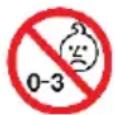
Choking hazard due to small parts. Not for children under 3 years.
8+
Recommended age: +.
- This product is intended for use for educational purposes in schools and other pedagogical contents under the surveillance of an adult instructor, such as science equipment.
- Protect from rain, moisture, splashing and dripping liquids, shocks and abuse, extreme heat, and dust.
3. Warning
Adult supervision and assistance is required.
This unit is only for use by children aged 8 years and older.
Not suitable for children under age 3 years old due to small part(s) and component(s) – CHOKING HAZARD FROM INGESTION.
Read and follow all instructions in the manual before use.
This toy contains small parts and functional sharp points on components. Keep away from children under age 3 years.
2 x AA size batteries are required (not included).
Please retain the information and this manual for future reference.
Instructions for parents are included and have to be observed.
Do not use close to the ear! Misuse may cause damage to hearing.
4. Caution
Before setting up any experiment, please double check and make sure all wiring connections you have made are correct before inserting the batteries and switching on the unit, as failure may result in damage to components or circuit board unit.
When experiment is finished, make sure the batteries are disconnected and switch off the unit before you clear away the wires.
Do not apply any components or parts to the experiment other than those provided with this kit. The toy is not to be connected to more than recommended number of power supplies.
KNS100
5. General Guidelines
• Refer to the Velleman® Service and Quality Warranty on the last pages of this manual.
- All modifications of the device are forbidden for safety reasons. Damage caused by user modifications to the device is not covered by the warranty.
- Only use the device for its intended purpose. Using the device in an unauthorised way will void the warranty.
- Damage caused by disregard of certain guidelines in this manual is not covered by the warranty and the dealer will not accept responsibility for any ensuing defects or problems.
- Nor Velleman Group nv nor its dealers can be held responsible for any damage (extraordinary, incidental or indirect) – of any nature (financial, physical...) arising from the possession, use or failure of this product.
- Keep this manual for future reference.
6. Product description
We take pleasure to welcome you to try out this ready-to-use electronic circuit kit suitable for children of 8 years old and up. "You'll be amazed" to find what you can learn as the experiment is a realistic concept of electronics and electricity. It will definitely enable you to learn about the necessary electronic components, circuits, and theories as well as the basic electronics principles – electricity, voltage, current, resistance, magnetism, other electrical circuits and theories.
This electronic circuit kit contains 8 exciting educational experiments, and it is smartly designed with a pull-out storage compartment to make the kit portable and easy for storage. All you have to do is simply connect the wires according to the wiring sequence of each experiment and follow the steps one by one. This compact size electronic circuit kit is not only portable, but also perfect for learning and experimenting anywhere.
EXPERIMENT 1 – Light control musical sound EXPERIMENT 2 – Touch control musical sound EXPERIMENT 3 – Light control musical light and sound EXPERIMENT 4 – Touch control musical light and sound EXPERIMENT 5 – Horseshoe sound EXPERIMENT 6 – Light control LED light (Light Type) EXPERIMENT 7 – Light control LED light (Dark Type) EXPERIMENT 8 – Flashing LED with sound
7. Glossary
Battery - A source of energy. It contains chemicals which will undergo chemical reaction to produce electricity when a circuit is connected.
Capacitance - A measurement of the capacity of a capacitor for storing electric charge.
Capacitor - A device consists of two conductors that are separated by an insulator. It is designed for storing electrical charge or as a filter in a circuit.
IC (Integrated Circuit) - A small electronic device made of semiconductor material and is used for a variety of devices, including microprocessors, electronic equipment and automobiles.
Light Sensor - There are different types of light sensor. The one used here is a phototransistor. When light falls on it, it is like a switch connected and so current is allowed to pass through it.
LED (Light Emitting Diode) - A diode emits light when current is passing through it.
Resistance - A measurement of the degree to which an object opposes an electric current through it.
Resistor - A device designed for possessing resistance.
Speaker - A device that changes electrical signals into sound.
Switch - A device for opening and closing power source to a circuit.
Transistor - A semi-conductor device that amplifies a signal and opens or closes a circuit.
Wire - A conductor that conducts electricity. Connecting a wire is like providing a path that allows electricity to flow though.
KNS100
8. Battery Information
Use 2 x 1.5V AA size batteries (not included)
For best performance, always use fresh batteries and remove batteries when not in use
Batteries must be inserted with the correct polarity
Non-rechargeable batteries are not to be recharged
Re-chargeable batteries are only to be charged under adult supervision
Re-chargeable batteries are to be removed from the toy before being charged
Different types of batteries or new and used batteries are not to be mixed.
Exhausted batteries are to be removed from the toy
The supply terminals are not to be short-circuited
Only batteries of the same or equivalent types are to be used
Do not dispose of the batteries in fire
Do not mix old and new batteries
Do not mix alkaline, carbon zinc and re-chargeable batteries
9. Wiring sequence and connection
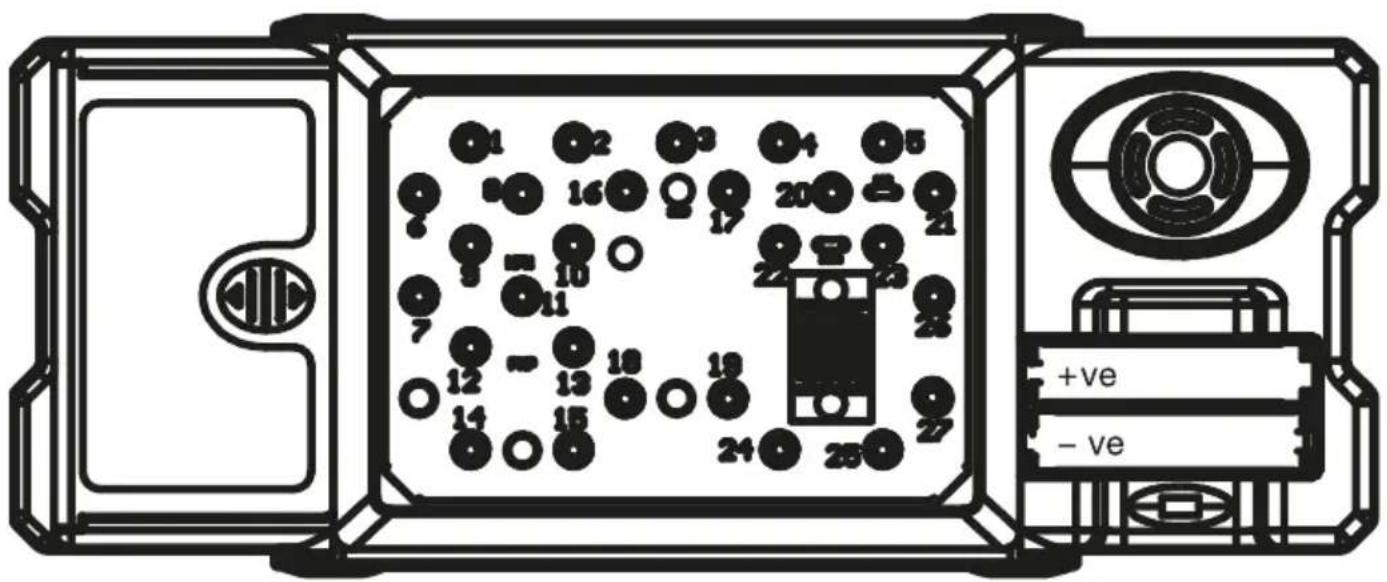
Ensure all wires are correctly connected to the numbered spring terminals of the main circuit board unit as stated wiring sequence of each experiment.
Bend the spring terminal over and insert the exposed shiny conductor part of wire into spring terminal. Make sure the wire is securely connected to spring terminal.
For example if the wiring sequence is 4-33, 1-10-32-35, 2-12, then connect a wire between spring terminal 4 and 33; and then connect a wire between spring terminal 1 and 10, and a wire between spring terminal 10 and 32, and a wire between spring terminal 32 and 35; and finally connect a wire between spring terminal 2 and 12. This is an example for reference only, not an exact circuit connection in the experiment.
If the circuit does not work, you can check the wire and spring terminal connection whether it is not well connected or insulated plastic part of a wire is inserted to spring terminal.
10. Component characteristic
In this mini experiment kit, you will learn basic circuit theory, characteristic of capacitor, IC (Integrated Circuit), LED (Light Emitting Diode), light sensor, resistor and transistor. You can learn that when transistor and capacitor work together, various light and sound effects can be made in different circuit connections.
Capacitor is a device consists of two conductors that are separated by an insulator. It is designed for storing electrical charge or as a filter in a circuit. It is a commonly used component in electronic and electrical circuits as an energy storage device or as a filter device to filter out electronic noisy or useless frequency signals. There are various types of capacitor which are designed for different electronic / electrical circuit applications.
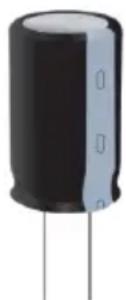
Electrolytic Capacitor
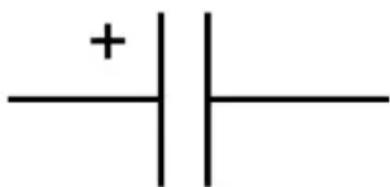
Circuit symbol
IC (Integrated Circuit) is a small electronic device made of semiconductors and is used for a variety of devices, including microprocessors, electronic equipment and automobiles. IC is made by a large number of transistors into a "chip" (silicon). It is now a critical and commonly used component in a wide variety of applications from toys, household products to state-of-the-art equipment.
KNS100
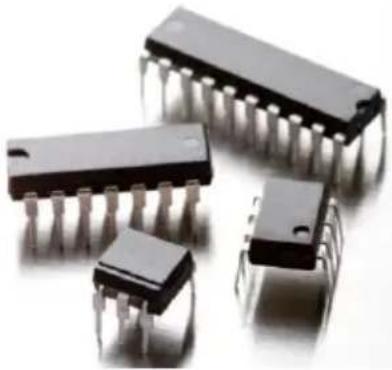
natural_image
Close-up of four black integrated circuit chips with metallic pins, arranged on a white background (no text or symbols visible)Integrated Circuit
LED (Light Emitting Diode) is a diode which emits light when electric current passes through it. LED has various light colors which depend on what kind of semi-conducting materials are used. It is a commonly used device in household and vehicle lighting appliance.
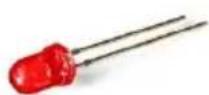
anode
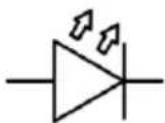
Cathode
LED (Light Emitting Diode) Circuit symbol
Light Sensor is a device that reacts to light. There are different types of light sensor. The one used here is a phototransistor. When there is no light, electric current cannot pass through it. And therefore it is like a switch that is switched off. When there is light falling on it, electric current can pass through it. It is then like a switch that is switched on. This way a light control circuit can be made.
KNS100
Resistor uses different color rings to represent the value (resistance). The 1st and 2nd rings represent the digit. The 3rd ring represents the multiplied time as table shown. The 4th ring represents tolerance that means the precision of the resistance. Example: The color rings are Brown, Red, Brown and Gold which represents resistance is 120 ohm, tolerance 5% (Ω).
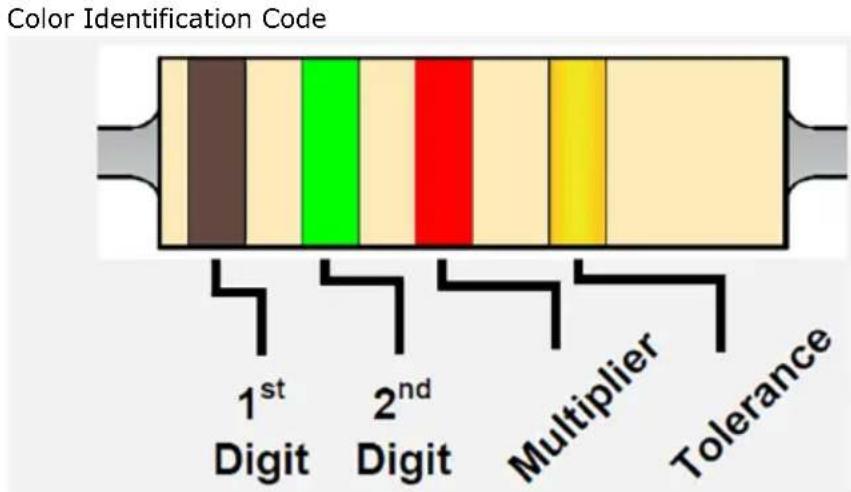
| Color | 1st | 2nd | 3^rd - multiplier | Tolerance |
| Black | 0 | 0 | x 1 | |
| Brown | 1 | 1 | x 10 | |
| Red | 2 | 2 | x 100 | |
| Orange | 3 | 3 | x 1000 | |
| Yellow | 4 | 4 | x 10000 | |
| Green | 5 | 5 | x 100000 | |
| Blue | 6 | 6 | x 1000000 | |
| Purple | 7 | 7 | ||
| Grey | 8 | 8 | ||
| White | 9 | 9 | ||
| Brown | +/- 1% | |||
| Red | +/- 2% | |||
| Gold | x 0.1 | +/- 5% | ||
| Silver | x 0.01 | +/- 10% |
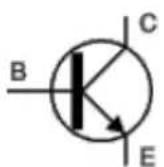
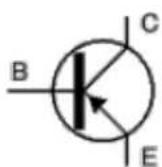
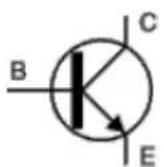
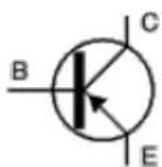
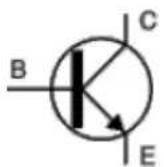
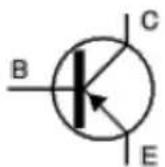
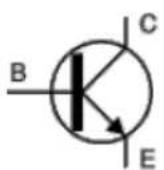
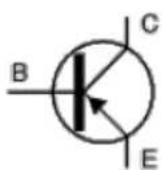
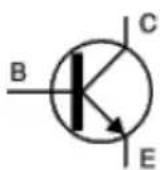
Transistor is a semi-conductor device that is used to amplify a signal and to open or close it in a circuit. There are two types of transistors, namely NPN and PNP, with similar circuit symbol. The transistor is a fundamental device commonly used in the modern electronic equipment. It has the fastest response and accurate action as amplifier and switching device, and can act as an individual device / component or as a part of IC (Integrated Circuit). IC is built of over a thousand to million transistors.
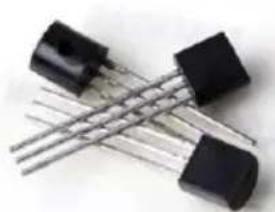
natural_image
Close-up of two black electronic components with metallic leads (no visible text or symbols)Transistor
Circuit symbol
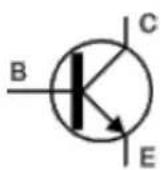
NPN
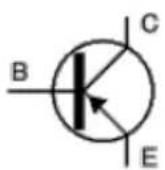
PNP
KNS100
If you have already read the above information and would like to understand more about electric circuit knowledge as well as how useful the components can be, then let's carry out the following experiments.
11. Experiments
11.1 EXPERIMENT 1 - Light control musical sound
Wiring Sequence
1-7, 2-6, 3-13, 4-14-27, 5-12-22-26, 11-15-23
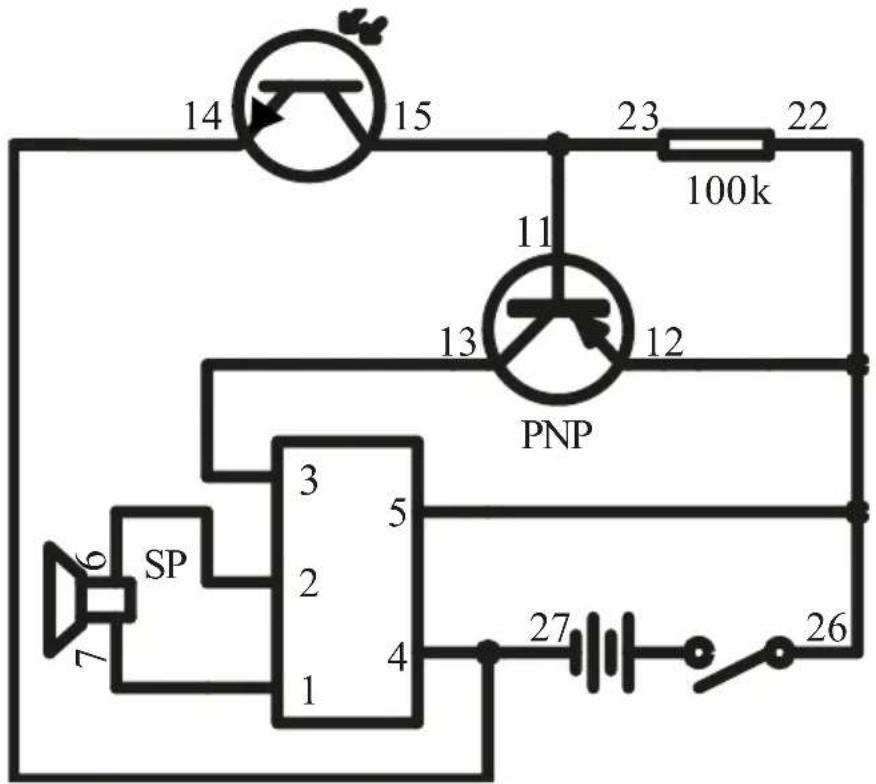
- Complete all wiring connections as indicated in the sequence.
- Switch on the main switch.
- When the light sensor is covered completely, the transistor will be turned on and trigger the IC to play the music. You can hear music coming from the speaker.
- Once the music is finished, you can repeat the experiment by covering the light sensor again.
KNS100
11.2 EXPERIMENT 2 - Touch control musical sound
Wiring Sequence
1-7, 2-6, 3-13, 4-24-27, 5-12-22-26, 11-23-25
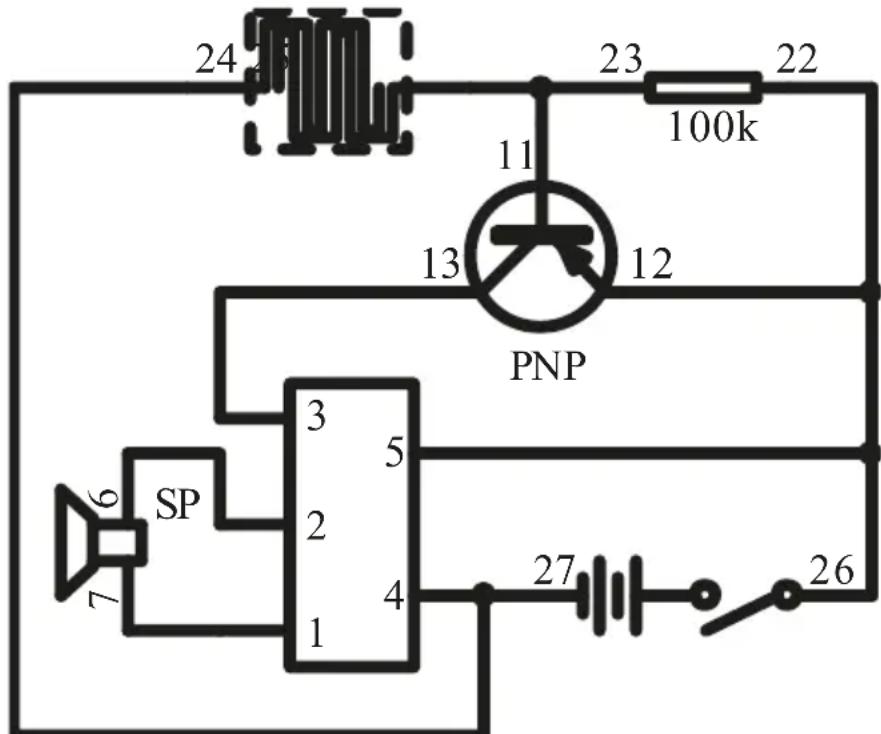
- Complete all wiring connections as indicated in the sequence.
- Switch on the main switch.
- Put your finger on the touch plate, and then the transistor will be turned on and trigger the IC to play the music. You can hear music coming from the speaker.
- Note that if there is no response, you may dampen your finger and try again.
11.3 EXPERIMENT 3 - Light control musical light and sound
Wiring Sequence
1-7-21, 2-6, 3-13, 4-9-23-27, 5-12-15-19-26, 11-14-22, 8-20, 10-18
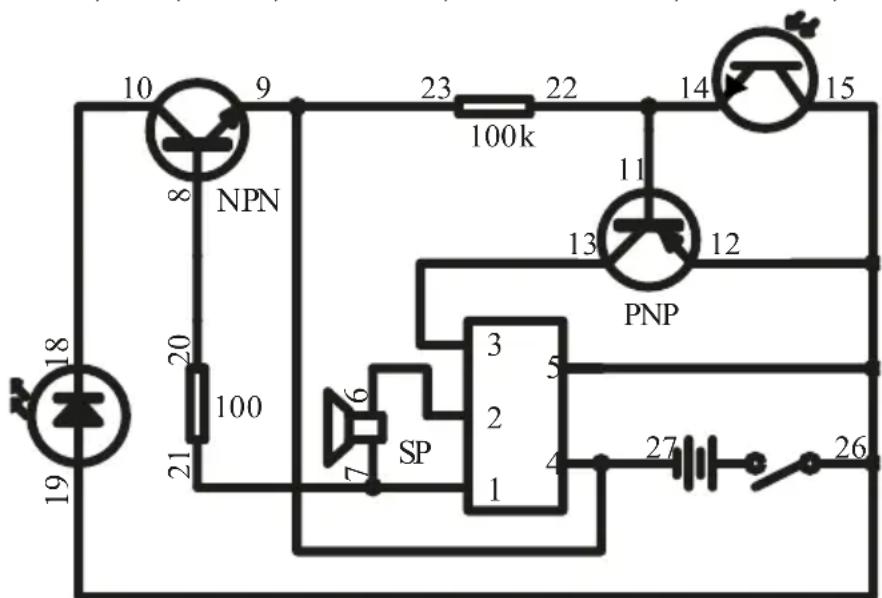
- Complete all wiring connections as indicated in the sequence.
- Switch on the main switch. Note that you may have to do this under a bright light source in order to have the kit followed the experiment description exactly.
KNS100
- When the light sensor is shone by light, and then cover it and uncovered it, the transistor will be turned on and will trigger the IC to play music. You can hear music coming from the speaker and see the LED lights up.
- Once the music is finished, you can repeat the experiment by repeating the above steps (no need to switch off the main switch).
11.4 EXPERIMENT 4 - Touch control musical light and sound
Wiring Sequence
1-7-21, 2-6, 3-13, 4-9-24-27, 5-12-26-19-22, 11-23-25, 8-20, 10-18
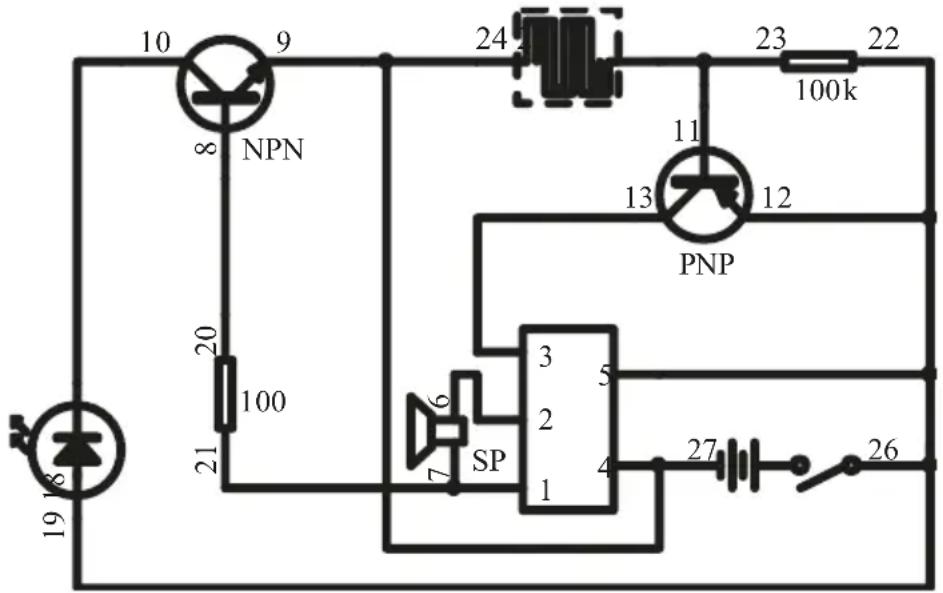
- Complete all wiring connections as indicated in the sequence.
- Switch on the main switch.
- Put your finger on the touch plate. Then the transistor will be turned on and will trigger the IC to play the music. You can hear music coming from the speaker and see the LED lights up.
- Note that if there is no response, you may dampen your finger and try again.
11.5 EXPERIMENT 5 - Horseshoe sound
Wiring Sequence
12-23-26, 7-9-27, 6-13-21, 10-11, 20-16, 8-17-22
KNS100
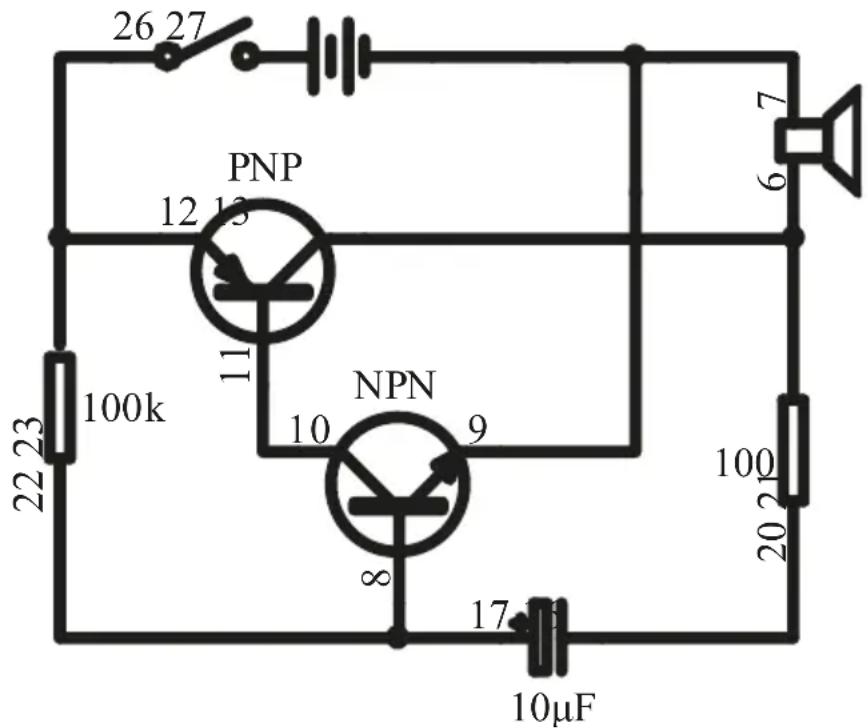
- Complete all wiring connections as indicated in the sequence.
- Switch on the main switch.
- The capacitor (10uF) works with transistor as an oscillator so that the oscillation frequency to the speaker will produce the horseshoe sound effect.
11.6 EXPERIMENT 6 - Light control LED light (Light Type)
Wiring Sequence
12-15-26, 9-13-19, 8-14-23, 10-11, 18-22-27
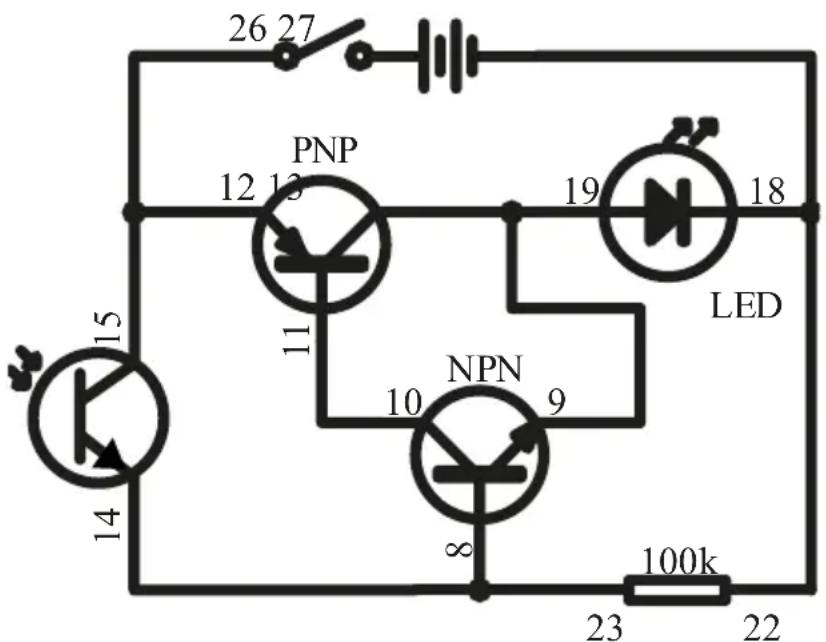
- Complete all wiring connections as indicated in the sequence.
- Switch on the main switch. You can see LED lights up.
- When the light sensor is covered completely, the LED will be turned off.
- Then when the light sensor is uncovered, the LED light will light up again.
11.7 EXPERIMENT 7 - Light control LED light (Dark Type)
Wiring Sequence
12-23-26, 9-13-19, 8-15-22, 10-11, 14-18-27
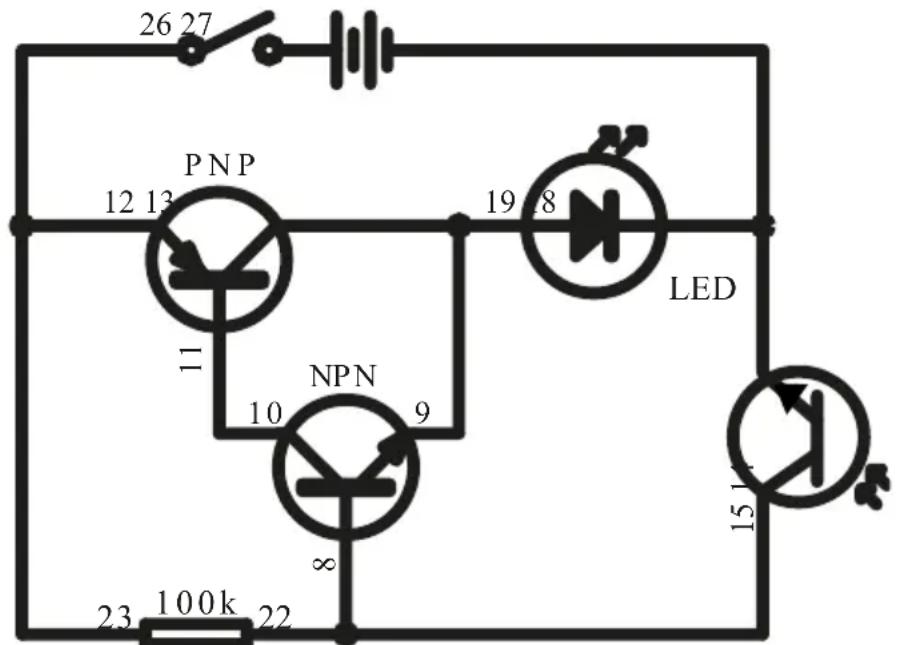
- Complete all wiring connections as indicated in the sequence.
- Switch on the main switch.
- When the light sensor is covered completely, the LED will light up.
- Then when the light sensor is uncovered, the LED will be turned off.
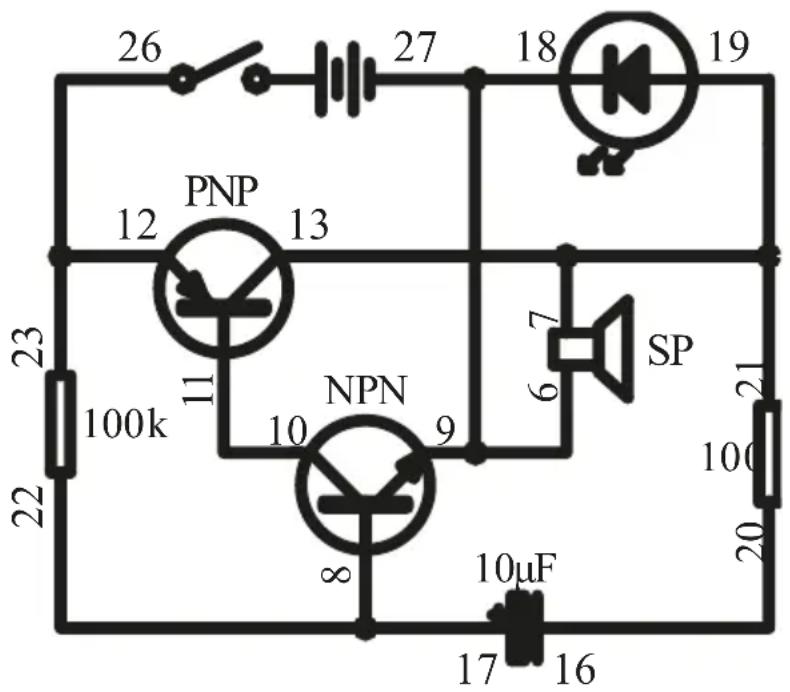
11.8 EXPERIMENT 8 - Flashing LED with sound
Wiring Sequence
12-23-26, 6-9-18-27, 7-13-19-21, 10-11, 20-16, 8-17-22
KNS100
- Complete all wiring connections as indicated in the sequence.
- Switch on the main switch.
- The capacitor (10uF) works with the transistor as an oscillator to make the LED acts like a flash light. A sound will also be made in a rhythm which coordinates with the flashing LED.
Note: If the batteries are low in power, the LED will only flash for a short time and then just glow like an ordinary LED.
© COPYRIGHT NOTICE
The copyright to this manual is owned by Velleman nv. All worldwide rights reserved. No part of this manual may be copied, reproduced, translated or reduced to any electronic medium or otherwise without the prior written consent of the copyright holder.
HANDLEIDING
1. Inleiding
natural_image
Pure electrical circuit symbol for a diode (no text or labels)Schakelsymbool
natural_image
Close-up of three black integrated circuit chips with metallic leads (no visible text or markings)natural_image
Close-up of two black electronic components with metallic leads (no visible text or symbols)Transistor
Circuit symbool
NPN
PNP
KNS100
natural_image
Close-up of four black integrated circuit chips with metallic leads, shown against a white background (no text or symbols visible)Circuit intégré
| Couleur | 1er | 2ème | 3rd - multiplicateur | Tolérance |
| Noir | 0 | 0 | x 1 | |
| Marron | 1 | 1 | x 10 | |
| Rouge | 2 | 2 | x 100 | |
| Orange | 3 | 3 | x 1000 | |
| Jaune | 4 | 4 | x 10000 | |
| Vert | 5 | 5 | x 100000 | |
| Bleu | 6 | 6 | x 1000000 | |
| Pourpre | 7 | 7 | ||
| Gris | 8 | 8 | ||
| Blanc | 9 | 9 | ||
| Marron | +/- 1% | |||
| Rouge | +/- 2% | |||
| L'or | x 0.1 | +/- 5% | ||
| Argent | x 0.01 | +/- 10% |
natural_image
Close-up of two black electronic components with metallic leads (no visible text or symbols)circuit
Transistor
Symbole du
NPN
PNP
KNS100
11. Expériences
natural_image
Pure electrical circuit lines without any symbolsCondensador electrolítico Símbolo del circuito
natural_image
Close-up of four black integrated circuit chips with metallic pins, arranged on a plain background (no text or symbols visible)| Color | 1^ | 2^a | 3^rd - multiplicador | Tolerancia |
| Negro | 0 | 0 | x 1 | |
| Marrón | 1 | 1 | x 10 | |
| Rojo | 2 | 2 | x 100 | |
| Naranja | 3 | 3 | x 1000 | |
| Amarillo | 4 | 4 | x 10000 | |
| Verde | 5 | 5 | x 100000 | |
| Azul | 6 | 6 | x 1000000 | |
| Morado | 7 | 7 | ||
| Gris | 8 | 8 | ||
| Blanco | 9 | 9 | ||
| Marrón | +/- 1% | |||
| Rojo | +/- 2% | |||
| Oro | x 0.1 | +/- 5% | ||
| Plata | x 0.01 | +/- 10% |
natural_image
Close-up of two black electronic components with metallic leads (no visible text or symbols)Transistor
NPN
PNP
circuito
natural_image
Pure electrical circuit symbol for a diode (no text or labels)natural_image
Close-up of four black integrated circuit chips with metallic pins, arranged in a row (no visible text or symbols)| Farbe | 1. | 2. | 3^rd - Multiplikator | Toleranz |
| Schwarz | 0 | 0 | x 1 | |
| Braun | 1 | 1 | x 10 | |
| Rot | 2 | 2 | x 100 | |
| Orange | 3 | 3 | x 1000 | |
| Gelb | 4 | 4 | x 10000 | |
| Grün | 5 | 5 | x 100000 | |
| Blau | 6 | 6 | x 1000000 | |
| Lila | 7 | 7 | ||
| Grau | 8 | 8 | ||
| Weiß | 9 | 9 | ||
| Braun | +/- 1% | |||
| Rot | +/- 2% | |||
| Gold | x 0.1 | +/- 5% | ||
| Silber | x 0.01 | +/- 10% |
natural_image
Close-up of two black electronic components with metallic leads (no visible text or symbols)Symbol
Transistor
Schaltkreis-
NPN
PNP
KNS100
11. Experimente
natural_image
Close-up of four black integrated circuit chips with metallic pins, arranged in a row (no visible text or markings)Układ scalony
natural_image
Close-up of two black electronic components with metallic leads (no visible text or symbols)Tranzystor
Symbol obwodu
NPN
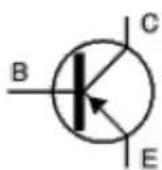
PNP
natural_image
Close-up of four black integrated circuit chips with metallic pins, arranged on a plain background (no text or symbols visible)Circuito integrado
natural_image
Close-up of three black electronic components with metallic leads, arranged diagonally (no text or symbols visible)circuito
Transístor
Símbolo do
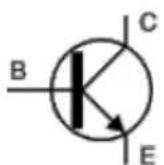
NPN

PNP
natural_image
Close-up of several black integrated circuit chips with metallic pins, arranged in a row (no visible text or markings)Circuito integrato
| Colore | 1a | 2a | 3rd - moltiplicatore | Tolleranza |
| Nero | 0 | 0 | x 1 | |
| Marrone | 1 | 1 | x 10 | |
| Rosso | 2 | 2 | x 100 | |
| Arancione | 3 | 3 | x 1000 | |
| Giallo | 4 | 4 | x 10000 | |
| Verde | 5 | 5 | x 100000 | |
| Blu | 6 | 6 | x 1000000 | |
| Viola | 7 | 7 | ||
| Grigio | 8 | 8 | ||
| Bianco | 9 | 9 | ||
| Marrone | +/- 1% | |||
| Rosso | +/- 2% | |||
| Oro | x 0.1 | +/- 5% | ||
| Argento | x 0.01 | +/- 10% |
natural_image
Close-up of three black electronic components with metallic leads, arranged diagonally (no text or symbols visible)circuito
Transistor
Simbolo del
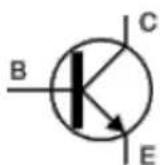
NPN
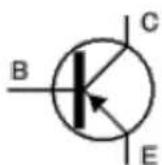
PNP
Velleman® Service and Quality Warranty
Since its foundation in 1972, Velleman® acquired extensive experience in the electronics world and currently distributes its products in over 85 countries. All our products fulfil strict quality requirements and legal stipulations in the EU. In order to ensure the quality, our products regularly go through an extra quality check, both by an internal quality department and by specialized external organisations. If, all precautionary measures notwithstanding, problems should occur, please make appeal to our warranty (see guarantee conditions).
General Warranty Conditions Concerning Consumer Products (for EU):
- All consumer products are subject to a 24-month warranty on production flaws and defective material as from the original date of purchase.
- Velleman® can decide to replace an article with an equivalent article, or to refund the retail value totally or partially when the complaint is valid and a free repair or replacement of the article is impossible, or if the expenses are out of proportion.
You will be delivered a replacing article or a refund at the value of 100% of the purchase price in case of a flaw occurred in the first year after the date of purchase and delivery, or a replacing article at 50% of the purchase price or a refund at the value of 50% of the retail value in case of a flaw occurred in the second year after the date of purchase and delivery.
- Not covered by warranty:
- all direct or indirect damage caused after delivery to the article (e.g. by oxidation, shocks, falls, dust, dirt, humidity...), and by the article, as well as its contents (e.g. data loss), compensation for loss of profits;
- consumable goods, parts or accessories that are subject to an aging process during normal use, such as batteries (rechargeable, non-rechargeable, built-in or replaceable), lamps, rubber parts, drive belts... (unlimited list);
- flaws resulting from fire, water damage, lightning, accident, natural disaster, etc....:
- flaws caused deliberately, negligently or resulting from improper handling, negligent maintenance, abusive use or use contrary to the manufacturer's instructions;
- damage caused by a commercial, professional or collective use of the article (the warranty validity will be reduced to six (6) months when the article is used professionally):
- damage resulting from an inappropriate packing and shipping of the article; - all damage caused by modification, repair or alteration performed by a third party without written permission by Velleman®.
- Articles to be repaired must be delivered to your Velleman® dealer, solidly packed (preferably in the original packaging), and be completed with the original receipt of purchase and a clear flaw description.
- Hint: In order to save on cost and time, please reread the manual and check if the flaw is caused by obvious causes prior to presenting the article for repair. Note that returning a non-defective article can also involve handling costs.
- Repairs occurring after warranty expiration are subject to shipping costs. - The above conditions are without prejudice to all commercial warranties.
The above enumeration is subject to modification according to the article (see article's manual).