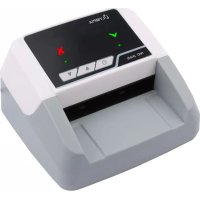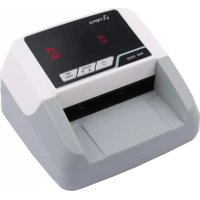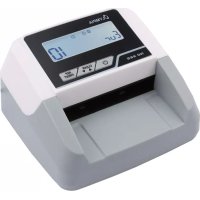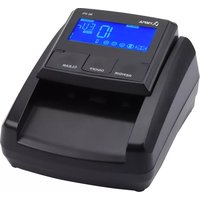
NC 375 - Coin and bill counter OLYMPIA - Free user manual and instructions
Find the device manual for free NC 375 OLYMPIA in PDF.



| Product type | Bill counter and counterfeit detector |
| Brand | Olympia |
| Model | NC 375 |
| Counting speed | More than 60 bills/minute |
| Maximum capacity value | 99,995 € / £ / $ / ₺ |
| Accepted bill thickness | 0.075 mm to 0.15 mm |
| Power supply | 100-240 V AC, 50/60 Hz via 12 V DC, 1 A adapter |
| Power consumption | 12 W |
| Optional battery | Lithium-Ion 12 V, 600 mAh, battery life 4 hours |
| Dimensions (L × W × H) | 133 × 155 × 89 mm |
| Weight | 0.53 kg |
| Detection sensors | IR (infrared and length), UV (ultraviolet), MG (magnetic), white light |
| Supported currencies | Euro, US Dollar, British Pound, Turkish Lira |
| Display | LCD |
| Interface | USB for software updates and optional printer |
| Ejection side selection | Front or rear |
| Auto-off | After 10 minutes in battery mode |
| Package contents | Bill detector, power adapter, instruction manual |
| Maintenance | Clean the sensors with a soft, lint-free cloth after each use |
Frequently Asked Questions - NC 375 OLYMPIA
User questions about NC 375 OLYMPIA
0 question about this device. Answer the ones you know or ask your own.
Ask a new question about this device
Download the instructions for your Coin and bill counter in PDF format for free! Find your manual NC 375 - OLYMPIA and take your electronic device back in hand. On this page are published all the documents necessary for the use of your device. NC 375 by OLYMPIA.
USER MANUAL NC 375 OLYMPIA
natural_image
Technical line drawing of a device rear panel with internal components and a rotation arrow (no text or symbols)The operating manual represents a component part of the device. It contains important information regarding safety, use and disposal.
Familiarize yourself with all the operating and safety information before starting to use the device. Only use the device as described and for the purpose for which it is intended. Hand over all the documents with the device if it is transferred to third parties.
Observe the Safety Information
Read and observe all the safety information to protect yourself and the environment from any harm.

WARNING!
Risk of suffocation!
Children can swallow small parts, packaging and protective foils. Risk of suffocation through batteries.
▶ Keep the product and packaging out of reach of children!
▶ Keep batteries out of reach of children. If a battery is swallowed, contact medical assistance immediately.

WARNING!
Risk of fatal injury through electric shock!
There is a risk of an electric shock!
▶ Never open or attempt to repair the device or its components!
▶ Never touch bare contacts with metallic objects.
▶ Never connect or disconnect the power adapter with wet hands.
▶ NEVER use the device if you suspect damage to the power cable or power plug or you can see damage to the power cable or power plug.

CAUTION!
Risk of entanglement!
▶ Keep fingers, hair etc. away from the infeed.
CAUTION!

Risk of tripping through improperly laid cable!
▶ Lay the cables so that nobody can trip over them.

CAUTION!
The device can be used by children from the age of 8 and persons with restricted physical, sensory or mental capabilities or a lack of experience and knowledge as long as they are supervised or have been instructed with regard to safe use of the device and are aware of the potential risks involved with its use.
▶ Children must never play with the device. Cleaning and user maintenance may not be completed by children without any supervision.

CAUTION!
Risk through batteries!
There are different risks involved when dealing with batteries.
▶ Never attempt to recharge standard batteries, never short circuit batteries and/or open batteries. Doing so leads to a potential risk of overheating, fire or explosion.
▶ Improper handling of batteries can put your health and the environment at risk. Batteries/Rechargeable batteries could contain toxic, environmentally hazardous heavy metals (Cd = cadmium, Hg = mercury, Pb = lead). Therefore, separate sorting, disposal and recycling of old batteries is essential for the environment and good health.
▶ Ensure the connection terminals are not short-circuited.
▶ Never throw batteries into a fire or water.
▶ Never expose batteries to any mechanical loads.
▶ Leaking batteries could cause damage to the device. If a battery should start to leak, remove it from the device immediately to prevent any further damage. Take the utmost care when handling damaged or leaking batteries and always wear protective gloves.
▶ Avoid any contact with the skin, eyes and mucous membranes.
Rinse any parts of the body which have come into contact with battery acid with plenty of clean water and contact a doctor immediately. Avoid extreme conditions and temperatures which could affect the batteries, e.g. by placing them on radiators or exposing them to direct sunlight.
▶ Only use batteries of the type specified.
▶ Batteries of different types or new and old batteries must not be used together.
▶ Ensure batteries are inserted with correct polarity.
▶ If the device will not be used for a longer period, switch the device off and remove the batteries.
▶ Empty batteries must be removed from the device and disposed of according to local regulations.
▶ The batteries must be removed from the device before its disposal.
▶ You are legally obliged to dispose of batteries at your dealer or collection points provided by the waste authorities responsible.

ATTENTION!
Risk of property damage!
▶ Ensure no foreign bodies, such as paper clips, rubber bands, etc. get into the infeed.
Property damage through environmental influences!
Unfavourable environmental influences such as smoke, dust, vibration, chemicals, moisture, heat or direct sunlight could damage the product.
▶ Repairs may only be carried out by properly trained specialists.
Intended Use
The bank note validator (subsequently referred to simply as the device) serves to control bank notes with regard to the most important security features. Any other use is considered unintended use. Unauthorised modification or reconstruction is not permitted. Under no circumstances open the machine or complete any repair work yourself.
Package Contents
■ Bank note validator NC 375
■ Power adapter plug
- Operating manual
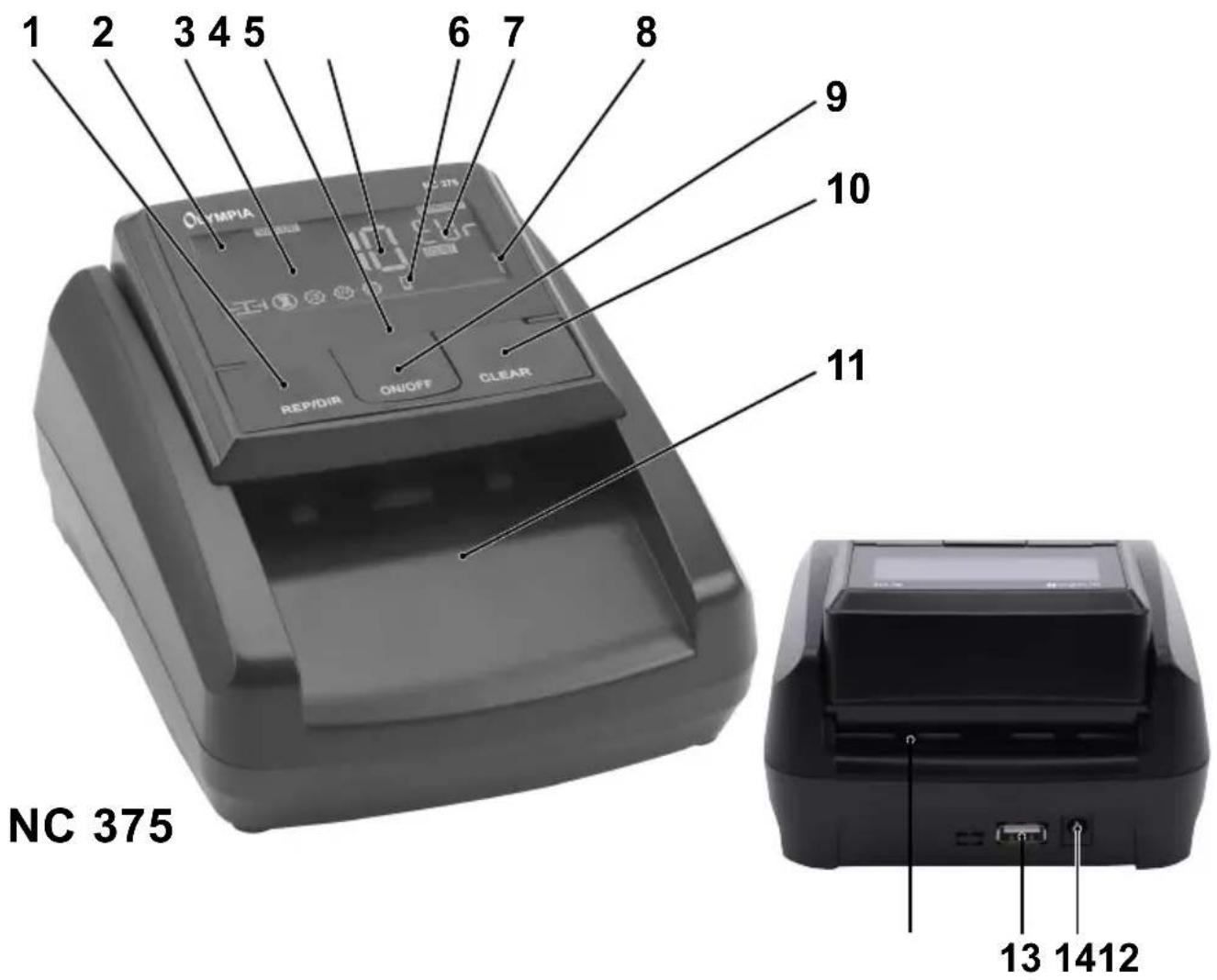
Operating Elements
text_image
1 2 3 4 5 6 7 8 Olympia ON/OFF CLEAR REP/DIR ON/OFF NC 375 10 9 11 13 14121 REP/DIR button
2 Battery status indicator (when optional battery is inserted)
3 LCD indicator
4 LED, red/blue
5 Total quantity display
6 Indicator for output side selected
7 Currency/Denomination display
8 Total sum display
9 ON/OFF button
10 CLEAR button
11 Front input/output side
12 Rear output side
13 USB port
14 Power supply socket
Bank Note Validator NC 375
This device detects the features of the Euro, US Dollar, British Pound and Turkish Lira bank notes. The detection is completed via IR (infrared & length), UV (ultraviolet), MG (magnetically) and white light.
The device detects the value of the bank notes in 4 directions and implements an automatic calibration sensor. The device can be pivoted open to complete simple maintenance and cleaning.
The device software can be updated via the USB port.
(Option: you can use a rechargeable lithium-ion battery, 12 V; 600 mAh with charging function.)
Operation
Display and Notation
1./2. Action to be completed
▶ Result of the action
REP/DIR button

Helpful information
Connecting the Device
-
Set the device down so that it stands securely on an even, horizontal surface and close to an easily accessible power socket.
-
Connect the power adapter to the device and to a properly installed power socket.
▶ The machine is ready to operate.
Switching On/Off
- Press the ON/OFF button to switch the device on.
▶ After switching the machine on, it performs a self-diagnosis. When the self-diagnosis has finished without any errors, a 0 appears in the display. If an error is detected, it is indicated in the display (refer to Error Table).
▶ An acoustic signal is issued.
▶ Arrows at the bottom of the display indicate the output side.
- Press and hold the ON/OFF button to switch the device off.
i Switch the device off if it will not be used for a longer period. The data displayed is not necessarily saved. End the working processes in good time or connect the device to an external power supply.
Preparing Bank Notes
Pay attention to the following points to prevent malfunctions:
- Check the batch of bank notes for paper clippings, paper clips, rubber bands and other foreign bodies and remove them before inserting the bank notes in the machine.
- Do not insert any damaged bank notes.
- Smooth out any creased and folded bank notes before inserting them.
Inserting Bank Notes
- Lay the bank notes individually in the tray on the input/output side with the short side at the front.
▶ The bank notes are drawn in and controlled automatically.
▶ A short acoustic signal is issued and the LED lights up blue.
i
Pay attention to the output side selected.
If a bank note is inserted the wrong way around, detected as suspicious or not detected, the LED lights up red and three short acoustic signals are issued. The bank note is rejected and returned to you.
Wait until the bank note controlled has been fully ejected from the device and remove it before inserting the next bank note to be controlled.
The best results are achieved after a warm-up phase of 3 minutes. Bright ambient light can affect the sensor and falsify results.
Selecting the Output Side
Depending on the output side you select, the bank notes are ejected at the front or rear side of the device, accordingly.
Counterfeit or unrecognised bank notes are always ejected at the front output side.
- Press and hold the REP/DIR, button to select the output side (to the front or the rear).
▶ Arrows at the bottom of the display indicate the output side selected.
Resetting the Total Sum and Total Quantity Display
You can reset the total sum and total quantity to zero in order to begin a new counting process.
- Press the CLEAR button.
▶ An acoustic signal is issued.
▶ The displays for the total sum and total quantity are reset to zero.
Indicators and Displays
The bank note is drawn in.
The value of the last bank note drawn in appears in the centre of the display.
- Press the REP/DIR button.
▶ The total value of the bank notes counted appears in the middle of the display.
- Press the REP/DIR button again.
▶ The number and total value of the individual denominations is displayed, beginning with the lowest denomination detected.
The total quantity of the bank notes counted is displayed at the bottom right of the display. Each time the button is pressed, the quantity of bank notes counted for the respective denomination appears.
i The maximum value which can be displayed is an amount of 99.995 € / £ / \$ / ₺.
You can display how many bank notes of a specific denomination have been counted up to now.
Currencies
The device can detect and validate Euros, US Dollars, British Pounds and Turkish Lira.
- Press the ON/OFF button to switch the device on.
- Press and hold the CLEAR button for approx. 3 seconds.
The abbreviation for Euro, US Dollar, British Pound or Turkish Lira appears in the currency/denomination display.
▶ Each time the CLEAR button is subsequently pressed and held for approx. 3 seconds, the currency changes.
Connecting a Printer
- You can connect a printer at the USB port. A special cable (not contained in the package contents) is available from GO Europe.
▶ All the details regarding quantities, denominations and total values of the bank notes detected are printed out.
Battery Operation
The device can also be powered for up to 4 hours without the need for an external power supply by means of a rechargeable battery (not contained in the package contents). Only use the battery specified and distributed by GO Europe.
When powered by the battery, the device automatically switches off after 10 minutes in Standby mode.
The battery icon continues to indicate that the battery is fully charged. If the icon flashes slowly, it indicates the battery is being charged. If it flashes quickly, it indicates the battery charge is low and must be recharged.
Inserting / Changing the Battery
- Open the battery compartment cover on the underside of the device.
- Connect the plug on the battery to the socket in the battery compartment.
- Insert the battery in the battery compartment.
- Close the battery compartment cover.
- Connect the power cable to a properly installed power socket.
▶ The battery status indicator in the display indicates the current battery charge level.
- Disconnect the power plug from the power socket.
- When the charging process has been completed, disconnect the external power adapter from the power supply socket on the bank note validator.
▶ The bank note validator can now be used as a portable device. - Charge and discharge the device every 15 days, otherwise the service life of the battery will be impaired.
The charging time required is one hour. A fully charged battery can test up to 500 bank notes. The battery can be used for up to 4 hours.
Software Update
You can complete a software update with the aid of a USB flash drive with a maximum of 8 GB.
i More detailed information on software updates is available at the following internet address: www.go-europe.com.
Technical Data
Model NC 375
Counting speed More than 60 pieces/minute
Capacity Maximum value: 99.995 €/£/\$/¢
Thickness of bank notes 0.075 mm to 0.15 mm
Power supply 100-240 V (AC); 50/60 Hz
Power consumption 12 W
Power adapter plug 12 V (DC); 1 A
Rechargeable battery (option) Lithium-ion battery 12 V; 600 mAh
Operating time with full battery Up to 4 hours
Temperature and rel. humidity 0 – 40 °C and 40 – 90%
Dimensions 133 × 155 × 89 mm
Weight
0.53 kg
Model NC 375
Detection sensor IR (infrared & length), UV (ultraviolet),
MG (magnetic), white light.
Currencies € / £ / \$ / ₺
Display LCD
Care Instructions
- Switch the machine off.
- Disconnect the power plug from the power socket.
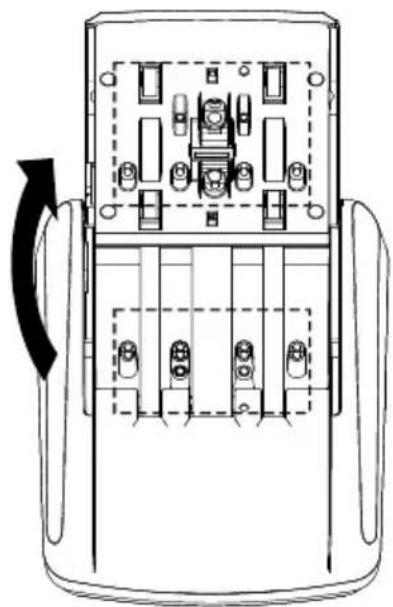
- Open the top cover by pivoting the display housing up.
natural_image
Technical line drawing of a device rear panel with internal components and a rotation arrow (no text or symbols)- Clean the sensors with a soft, lint-free cloth.
- Close the top cover by pivoting the display housing down.
- Clean the housing surfaces with a soft, lint-free cloth.
- Do not use any cleaning agents or solvents.
▶ The device has been cleaned.

Clean the sensors after each use.
Alarm Icons and Messages
If a bank note is detected as being suspicious, the (IR transmission and double note alarm) alarm icon flashes. No counting is completed and no values are entered in the detection report.
Alarm icon Message
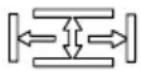 | Length and angle alarm |
 | White light alarm |
 | IR transmission and double note alarm |
 | UV alarm |
 | MG alarm |
  | IR reflection alarm |
Due to the printing, not every bank note is exactly the same.
If a bank note is detected as being invalid on its first check, it may be detected as being valid in the second or third check.
The following factors can influence the validation result:
■ The bank note is worn or damaged.
■ The bank note is drawn in askew.
■ Sudden temperature or humidity fluctuations.
■ The device has not been used for a long period.
- Switch the device off and disconnect the power plug.
- Connect the power plug and switch the device on again.
▶ The machine is ready to operate.
Calibrating the White Light and IR Sensor
If the device frequently returns the original bank note, e.g. after high and low temperature fluctuations, it must be recalibrated using the white calibration paper supplied.
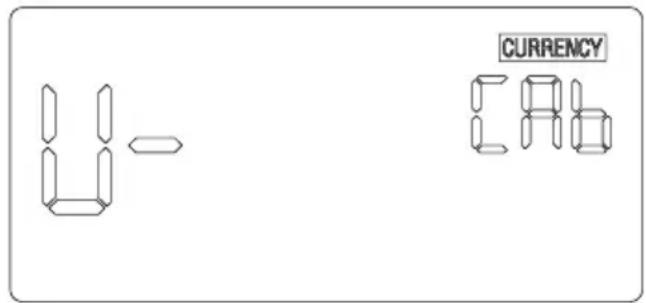
- When the device is switched off, press the "ON/OFF" and "CLEAR" buttons simultaneously in order to activate Calibration mode.
text_image
CURRENCY 8- 8.86- Slide the white calibration paper in the front infeed/output side until all the sensors are blocked.
- Press the "REP/DIR" button to start the calibration process.
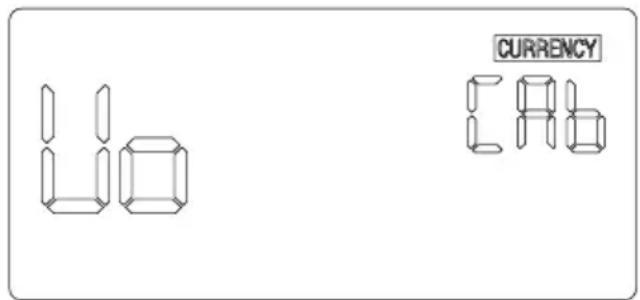
After a few seconds, the following appears in the display:
text_image
80 CURRENCY CAB▶ The calibration process has been completed successfully.
- Restart the device before using it again.
Error Table
Display LED Significance
Blue Authentic bank note
Red Suspicious or counterfeit bank note
Error code Message
FEEd Error, start sensor
COLU Error, white light sensor, top
IrU1 Error, IR reflection sensor 1, top
IrU2 Error, IR reflection sensor 2, top
IrU3 Error, IR reflection sensor 3, top
IrU4 Error, IR reflection sensor 4, top
Ird1 Error, IR reflection sensor 1, bottom
Ird2 Error, IR reflection sensor 2, bottom
Ird3 Error, IR reflection sensor 3, bottom
Ird4 Error, IR reflection sensor 4, bottom
IrtL Error, IR transmission sensor 4, left
Irtr Error, IR transmission sensor 4, right
UV Error, UV sensor
NNG Error, MG sensor
ENCD Error, encoder or motor
Declaration of Conformity
Symbol Meaning

We, GO Europe GmbH, Zum Kraftwerk 1, 45527 Hattingen, DEUTSCHLAND, declare in sole responsibility, that the product complies with the EU Directives: 2014/53/EU and 2011/65/EU. The full EU Declaration of Conformity is available online at the following website: www.go-europe.com
Manufacturer
GO Europe GmbH Zum Kraftwerk 1 D-45527 Hattingen Germany www.go-europe.com
Warranty
Dear customer,
We are delighted that you have chosen this equipment.
In the case of a defect, please return the device together with the receipt and original packing material to the point of sale.
Disposal
Symbol Meaning

Find out about the possibilities of taking back old appliances and used batteries free of charge from your dealer.

Packaging materials must be disposed of according to local regulations.
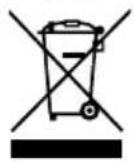
The adjacent symbol indicates laws dictate that electrical and electronic apparatus no longer required must be disposed of separate from domestic waste. Dispose of your device at a collection point provided by your local public waste authority. Packaging materials must be disposed of according to local regulations.
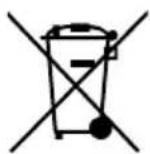
Defective or empty batteries must be recycled in accordance with Directive 2006/66/EC and its amendments. Return batteries and the device via the collection points provided.
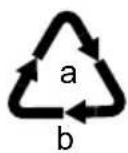
Observe the identification on the packaging materials during the waste sorting process; they are identified by abbreviations (b) and numbers (a) which have the following significance: 1–7: plastic/20–22: paper and cardboard/80–98: composite materials.
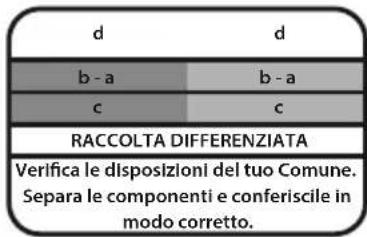
The logo is only applicable to Italy.
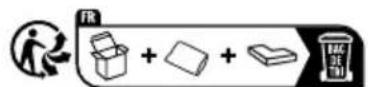
The Triman logo is only relevant for France.