HW-P 810 - Water pump Prowork - Free user manual and instructions
Find the device manual for free HW-P 810 Prowork in PDF.



| Product type | Automatic domestic water pump |
| Brand | Prowork |
| Model | HW-P 810 |
| Article number | 41.731.24 |
| Power supply | 230 V ~ 50 Hz |
| Power consumption | 500 W |
| Max. flow rate | 3100 l/h |
| Max. delivery head | 39 m |
| Max. delivery pressure | 3.9 bar |
| Max. suction height | 8.5 m |
| Cut-in pressure | approx. 1.5 bar |
| Cut-out pressure | approx. 3 bar |
| Tank capacity | 20 l |
| Pressure and suction connection | 1" IG |
| Max. water temperature | 35 °C |
| Pumped fluids | Clean water, rainwater, light washing liquid/waste water |
| Applications | Irrigation, watering, domestic water supply |
| Motor protection | Integrated thermostat (automatic shutdown in case of overload) |
| Maintenance | Regular cleaning, drain before risk of frost |
| Warranty | 2 years |
Frequently Asked Questions - HW-P 810 Prowork
User questions about HW-P 810 Prowork
0 question about this device. Answer the ones you know or ask your own.
Ask a new question about this device
Download the instructions for your Water pump in PDF format for free! Find your manual HW-P 810 - Prowork and take your electronic device back in hand. On this page are published all the documents necessary for the use of your device. HW-P 810 by Prowork.
USER MANUAL HW-P 810 Prowork
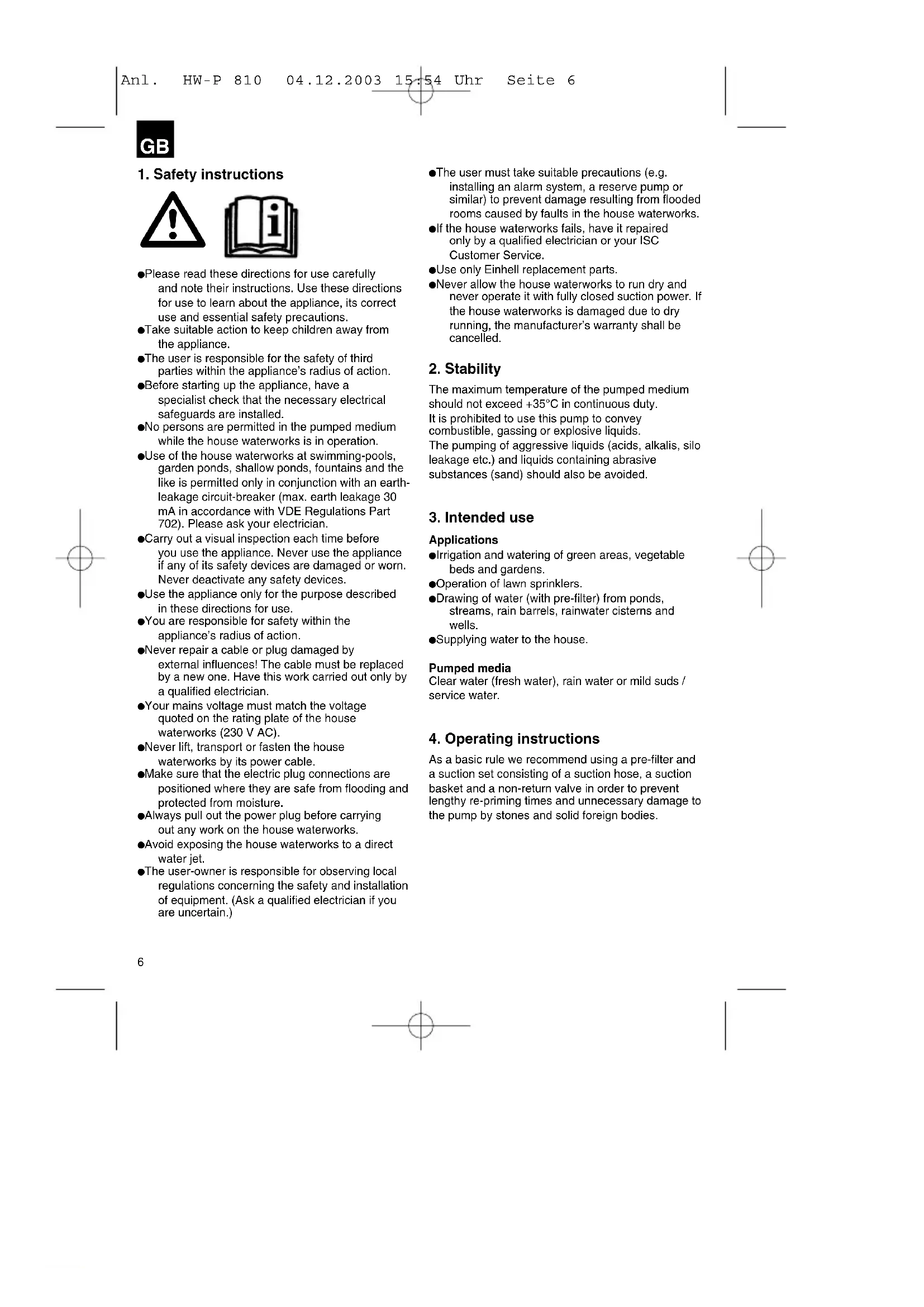
1. Safety instructions


- Please read these directions for use carefully and note their instructions. Use these directions for use to learn about the appliance, its correct use and essential safety precautions.
●Take suitable action to keep children away from the appliance. - The user is responsible for the safety of third parties within the appliance's radius of action.
●Before starting up the appliance, have a specialist check that the necessary electrical safeguards are installed.
●No persons are permitted in the pumped medium while the house waterworks is in operation. - Use of the house waterworks at swimming-pools, garden ponds, shallow ponds, fountains and the like is permitted only in conjunction with an earth-leakage circuit-breaker (max. earth leakage 30 mA in accordance with VDE Regulations Part 702). Please ask your electrician.
●Carry out a visual inspection each time before you use the appliance. Never use the appliance if any of its safety devices are damaged or worn. Never deactivate any safety devices.
●Use the appliance only for the purpose described in these directions for use. - You are responsible for safety within the appliance's radius of action.
●Never repair a cable or plug damaged by external influences! The cable must be replaced by a new one. Have this work carried out only by a qualified electrician.
●Your mains voltage must match the voltage quoted on the rating plate of the house waterworks (230 V AC).
●Never lift, transport or fasten the house waterworks by its power cable.
●Make sure that the electric plug connections are positioned where they are safe from flooding and protected from moisture.
●Always pull out the power plug before carrying out any work on the house waterworks.
●Avoid exposing the house waterworks to a direct water jet.
●The user-owner is responsible for observing local regulations concerning the safety and installation of equipment. (Ask a qualified electrician if you are uncertain.)
●The user must take suitable precautions (e.g. installing an alarm system, a reserve pump or similar) to prevent damage resulting from flooded rooms caused by faults in the house waterworks.
- If the house waterworks fails, have it repaired only by a qualified electrician or your ISC Customer Service.
●Use only Einhell replacement parts.
●Never allow the house waterworks to run dry and never operate it with fully closed suction power. If the house waterworks is damaged due to dry running, the manufacturer's warranty shall be cancelled.
2. Stability
The maximum temperature of the pumped medium should not exceed +35°C in continuous duty. It is prohibited to use this pump to convey combustible, gassing or explosive liquids. The pumping of aggressive liquids (acids, alkalis, silo leakage etc.) and liquids containing abrasive substances (sand) should also be avoided.
3. Intended use
Applications
- Irrigation and watering of green areas, vegetable beds and gardens.
●Operation of lawn sprinklers.
●Drawing of water (with pre-filter) from ponds, streams, rain barrels, rainwater cisterns and wells.
●Supplying water to the house.
Pumped media
Clear water (fresh water), rain water or mild suds / service water.
4. Operating instructions
As a basic rule we recommend using a pre-filter and a suction set consisting of a suction hose, a suction basket and a non-return valve in order to prevent lengthy re-priming times and unnecessary damage to the pump by stones and solid foreign bodies.
GB
- Technical data:
| Prowork HW -P 810 | |
| Power supply 230 V ~ 50 Hz | |
| Power consumption 500 W | |
| Delivery rate max. 3100 l/h | |
| Delivery head max. 39 m | |
| Delivery pressure max. 3,9 bar | |
| Suction head max. 8,5 m | |
| Delivery and suction connections 1" female thread | |
| Water temperature max. 35°C | |
| Tank capacity 20 l | |
| Switch-on pressure at approx. 1.5 bar | |
| Switch-off pressure at approx. 3 bar | |
| Art. No. 41.731.24 | |
6. Electrical connections
- Connect the appliance to a 230 V \~ 50 Hz socket-outlet with earthing contact. Minimum fuse 10 ampere.
●A built-in thermostat protects the motor from overloading and blocking. The pump is switched off automatically by the thermostat if overheating occurs and is switched on again automatically after cooling.
7. Suction line
●No matter whether the suction line is a hose or tube, it should have a minimum diameter of 1 inch. A diameter of 1 1/4" is recommended for suction heads of over 5 m.
●Fit the intake valve (foot valve) together with the intake basket to the suction line. If this is not possible you will have to install a non-return valve in the suction line.
●Lay the suction line at an ascending gradient from the water source to the pump. Be sure not to take the suction line higher then the pump or the priming operation will be delayed and obstructed by air bubbles in the line.
●Fasten the suction and delivery lines so that they exert no mechanical pressure on the pump.
●The suction valve should lie deep enough in the water to rule out any dry running of the pump when the water level drops.
●A leak in the suction line will draw in air and obstruct priming.
●Avoid drawing in foreign bodies (sand, etc.); fit a pre-filter if necessary.
8. Connecting the delivery line
- Attach the delivery line (min. 3/4") either directly to the pump's pressure line connection (1" female thread) or via a threaded nipple.
- With the right couplings it is also possible, of course, to use a 1/2" delivery hose. The smaller delivery hose results in a lower delivery rate.
●During the priming operation, fully open any shut-off mechanisms (spray nozzles, valves, etc.) in the pressure line so that the air can escape without obstruction.
GB
9. Starting up
- Set up the house waterworks on a firm, level and horizontal surface.
●Fill the pump case with water through the delivery line connection. Priming is accelerated if the suction line is full.
●Tightly connect the suction and delivery lines. - Close the delivery line.
- Connect up the pump - priming at max. suction head can take up to 5 minutes.
●The pump switches off when the switch-off pressure (3 bar) is reached.
●The pump switches on automatically when water is consumed and the pressure drops (switch-on pressure approx. 1.5 bar).
10. Maintenance instructions
●The house waterworks requires by and large no maintenance. Nevertheless we recommend inspecting and cleaning the appliance in regular intervals to ensure that it serves you well for many years.
Caution!
Always disconnect the house waterworks from the power supply before carrying out any maintenance. To do so, pull the pump's power plug out of the socket-outlet.
- If you are not going to use the house waterworks for a long time or wish to put it into winter storage, rinse out the pump thoroughly with water, empty it completely and store it in dry conditions.
- Be sure to empty the house waterworks completely if there is any risk of freezing temperatures.
●After a lengthy stoppage, switch the appliance on and off briefly to check whether the rotor turns. - If the house waterworks becomes clogged, connect the delivery line to the water pipe and disconnect the suction hose. Now open the water pipe and switch on the pump for several times for approx. two seconds. In most cases this will remove the blockage.
●Inside the pressure tank is an expandable water sack and an air compartment whose maximum pressure should lie at approx. 1.3 bar. Pumping water into the water sack causes the sack to expand so that the pressure in the air compartment rises to switch-off level. If the air pressure is too low, you should raise it. To do so, unscrew the plastic lid from the tank and top up the pressure to the correct level using a tyre pump with meter at the valve.
11. Replacing the power cable
Caution! Disconnect the appliance from the power supply! If the power cable is defective, have it replaced by a qualified electrician.
GB
12. Faults
The motor fails to start
| Causes Remedies | |
| No voltage Check the power supply | |
| Pump impeller is blocked - thermostat has switched off Dismantle the pump and clean it | |
The pump fails to draw in any water
| Causes Remedies | |
| Suction valve is not in the water Place the suction valve in the water | |
| No water in the pump compartment Fill water in the suction connection | |
| There is air in the suction line Check the suction line for leaks | |
| Suction valve has a leak Clean the suction valve | |
| Suction basket (suction valve) is clogged Clean the suction basket | |
| Max. suction head exceeded Check the suction head | |
Insufficient delivery rate
| Causes Remedies | |
| Suction head is too high Check the suction head | |
| Suction basket is dirty Clean the suction basket | |
| Level of water sinks rapidly Place the suction valve deeper | |
| Pump output reduced by contaminants Clean the pump and replace worn parts |
The thermostat switches off the pump
| Causes Remedies | |
| Motor overloaded - excessive friction Dismantle the pump and clean caused by foreign bodies Prevent foreign bodies from being drawn in (filter) | |
Caution!
Do not allow the house waterworks to run dry.
13. Ordering replacement parts
Please quote the following data on all orders for replacement parts:
●Type of appliance
●Art. No. of the appliance
●Ident No. of the appliance
●Replacement part No. of the part required
We wish to draw express attention to the fact that, in accordance with the Product Liability Law, we shall not be liable for any damage resulting from our appliances if said damage was caused by an incorrect repair, or if any parts were replaced by parts other than original Einhell parts or parts approved by us, or if the repair was not performed by the ISC Customer Service.

text_image
Technical diagram of a mechanical assembly with numbered components for identificationGBEC Declaration of Conformity
The undersigned declares in the name of the company that the product is in compliance with the following guidelines and standards.
The product described in these instructions comes with a 2-year warranty covering defects. This 2-year warranty period begins with the passing of risk or when the customer receives the product.
For warranty claims to be accepted, the product has to receive the correct maintenance and be put to the proper use as described in the operating instructions.
Your statutory rights of warranty are naturally unaffected during these 2 years.
This warranty applies in Germany, or in the respective country of the manufacturer's main regional sales partner, as a supplement to local regulations. Please note the details for contacting the customer service center responsible for your region or the service address listed below.
NL GARANTIE
Eschenstraße 6 · D-94405 Landau/Isar (Germany)
Info-Tel. 0180-5 120 509 • Telefax 0 99 51-26 10 und 52 50
Technical changes subject to change
Technical & Commercial Company
12, Papastratou & Asklipiou Str.
GR 18545 Piräus
Tel 0210 4136155, Fax 0210 4137692
HUS Bermas
Altufyevskoye shosse, 2A
RUS 127273 Moscow
Tel 095 7870179, Fax 095 5401750
LT Dirbita
Metalo str. 23
LT 2038 Vilnius
Tel 05 2395769, Fax 05 2395770
EST AS Baltoil
Roiu, Haaslava vald
EE 62102 Tartumaa
Tel 07 301710, Fax 07 301701
Halai Trading Co. LLC
POB 9282, Nakheel Rd. Deira, Shop No. 15
UAE Dubai
Tel./Fax 04 2279554
(in)Alborz Abzar Co. Ltd.
No. 111, Bastan Passage Imam Khomeini Ave.
IR 11146 Teheran
Tel 021 6716072, Fax 021 6727177
(RZ)I.B.G.
Belinskij-str. 102
KZ 486008 Chimkent
Tel 03252 518461, Fax 03252 570743
BIH FIS d.o.o
Poslovni Centar 96
BIH 87000 Vitez
Tel 030 715 267, Fax 030 715 320
©SMANIMEX d.o.o
Uzicke republike 93
CS 31000 Uzice
Tel 031 551 393, Fax 031 601 539
D
The reprinting or reproduction by any other means, in whole or in part, of documentation and papers accompanying products is permitted only with the express consent of ISC GmbH.