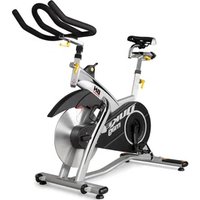
Duke Mag H923 - Exercise bike BH FITNESS - Free user manual and instructions
Find the device manual for free Duke Mag H923 BH FITNESS in PDF.



User questions about Duke Mag H923 BH FITNESS
0 question about this device. Answer the ones you know or ask your own.
Ask a new question about this device
Download the instructions for your Exercise bike in PDF format for free! Find your manual Duke Mag H923 - BH FITNESS and take your electronic device back in hand. On this page are published all the documents necessary for the use of your device. Duke Mag H923 by BH FITNESS.
USER MANUAL Duke Mag H923 BH FITNESS
natural_image
Exterior view of a Duke mag exercise bike with visible branding and seatbelt (no text-heavy elements)Instrucciones de montaje y utilización Instructions for assembly and use Instructions de montage et utilisation Montage und Gebrauchsanleitung Instruções de montagem e utilização Istruzioni di montaggio e uso Montage-en gebruiksinstrukties
Fig.1
text_image
Technical diagram of a stationary exercise machine with labeled parts and exploded viewFig.2
text_image
A 6 7 11 8 14Fig.3
text_image
A 21 20 17 17BFig.4
text_image
1 39 2 38 2A AFig.5
text_image
9L A 20 15 16 9RFig.6
text_image
22 49 10 13Fig.7
natural_image
Line drawing of a woman using an exercise bike with a numbered label (13), no text or symbols present.Fig.8
natural_image
Close-up of a mechanical component being held, showing a hand holding a tool and a blue screw (no visible text or symbols)Fig.9
natural_image
Close-up of a mechanical assembly with metallic components and a metallic rod (no visible text or symbols)Fig.10
text_image
1 2Fig.11
natural_image
Technical line drawing of a mechanical device with wheels and a curved component (no text or symbols)Fig.12
natural_image
Technical line drawing of a mechanical assembly with two parallel rods and a central fan component (no text or symbols)Fig.13
natural_image
Technical line drawing of a mechanical device with labeled part '4' (no text or symbols beyond label)Fig.14
text_image
6 5Fig.15
natural_image
Technical line drawing of a mechanical assembly with no visible text or symbolsEspañol
AVISO IMPORTANTE DE SEGURIDAD.-PRECAUCIONES.
This bicycle has been designed and constructed to provide maximum safety. Nevertheless, certain precautions should be taken when using exercise equipment.
Read the whole manual before assembling and using the bicycle. It provides you with important information about assembly, safety and use of the machine.
The following safety precautions should also be observed:
1 Keep children away from this equipment at all times. DO NOT leave them unsupervised in the room where this bicycle is kept.
2 It can only be used by one person at a time.
3 If you experience dizziness, nausea, chest pains or any other symptom while using this appliance STOP the exercise. SEEK MEDICAL ATTENTION IMMEDIATELY.
4 Use the appliance on a level, solid surface. DO NOT use the bicycle outdoors or close to water.
5 Keep your hands well away from any of the moving parts.
6 Wear clothing suitable for doing exercise. Do not use baggy clothing that might get caught up in the bicycle. Always wear running shoes or trainers when using the machine. Make sure all laces/cords are tied correctly.
7 This appliance must only be used for the purposes described in this manual. DO NOT use accessories that are not recommended by the manufacturer.
8 Do not place sharp objects near the machine.
9 Disabled people should not use the machine without the assistance of a qualified person or a doctor.
10 Do warm up stretching exercises before using the equipment.
11 Do not use the bicycle if it is not working correctly.
Caution: Consult your doctor before beginning to use the bicycle. This advice is especially important for those over 35 or suffering from health problems.
Keep these instructions safe for future use.
WARNING: Follow the steps described in this manual when performing the assembly. Do not skip, replace or modify the procedures in this assembly, as any failure to follow instructions will void the warranty.
GENERAL INSTRUCTIONS.-
1 This unit has been designed for professional use. The weight of the user must not exceed 115 kg.
2 Parents and/or those responsible for children should always take their curious nature into account and how this can often lead to hazardous situations and behaviour resulting in accidents.
Under no circumstances should this appliance be used as a toy.
3 The owner is responsible for ensuring that anyone who uses the machine is duly informed about the necessary precautions.
ASSEMBLY INSTRUCTIONS.-
The assistance of a second person is recommended when assembling this unit.

WARNING: The replacement of any component with another not supplied by BH will void the warranty.
TOOLS NEEDED.-
| Hex wrench (55) (supplied) | Loctite 242Cod 0190248 (*) |
| 2 No. 14 wrench for M8 nuts (*) | BH rust inhibitor cod 0190236 (*) |
| Torque wrench cod 0190245 (*) | Clean cloths. (*) |
| Wrench for M6 nut (*) | Multilube Wurth lubricant spray cod 0190249 (*) |
| 3 mm Allen key (*) | Meguiar's Nxt soap |
| Philips screwdriver (*) | BH indoor cycling protector cod 0190237 (*) |
(*)Not supplied. Optional.
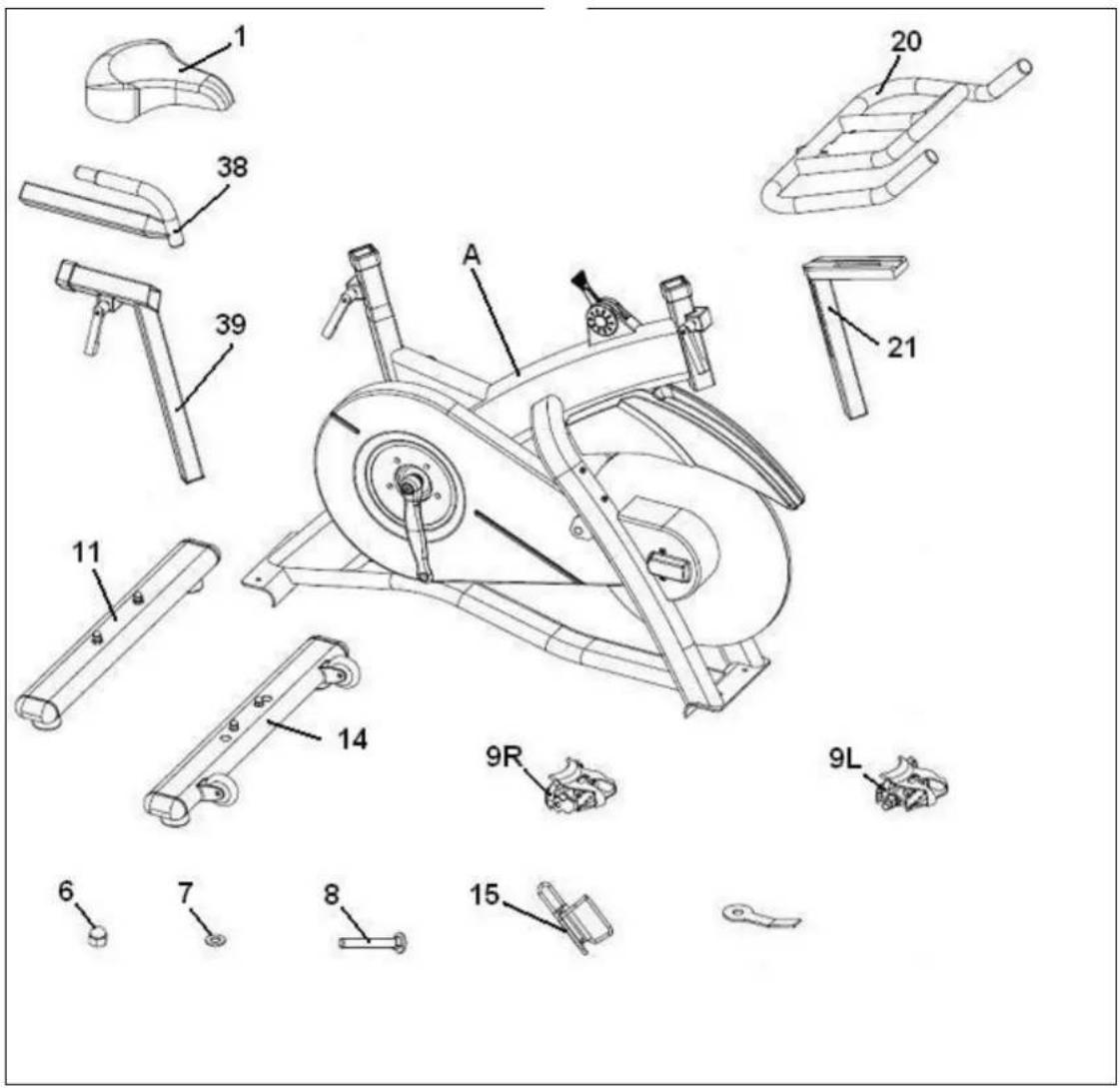
Take the unit out of its box and make sure that all of the pieces are there (Fig. 1):
(A) Main body; (20) Handlebar; (21) Handlebar stem; (39) Saddle post; (38) Horizontal saddle tube; (1) Saddle; (11) Rear stabiliser bar with adjustable feet; (14) Front stabiliser bar with wheels; (9L) Left pedal; (9R) Right pedal; (8) Slot head bolt M-10; (7) Flat washer M-10; (6) Cap nut M-10; (15) Bottle holder; Double ended spanner.
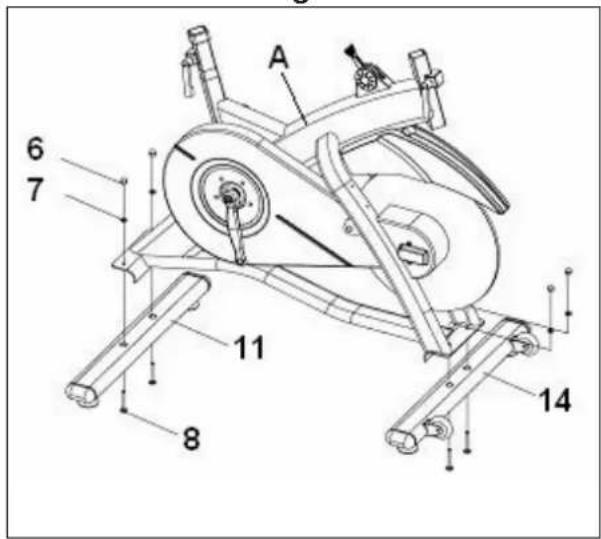
- Position the machine's rear stand on the rear stabilizer bar (11), as shown in Fig.2, insert the bolts (8), fit the flat washers (7) and cap nuts (6) and then tighten securely.
- Position the front stabiliser bar with wheels (14), paying attention to the red dots and with the wheels facing forwards, as shown in Fig.2, insert the bolts (8), fit the flat washers (7) and cap nuts (6) and tighten securely.
FITTING THE HANDLEBAR.-
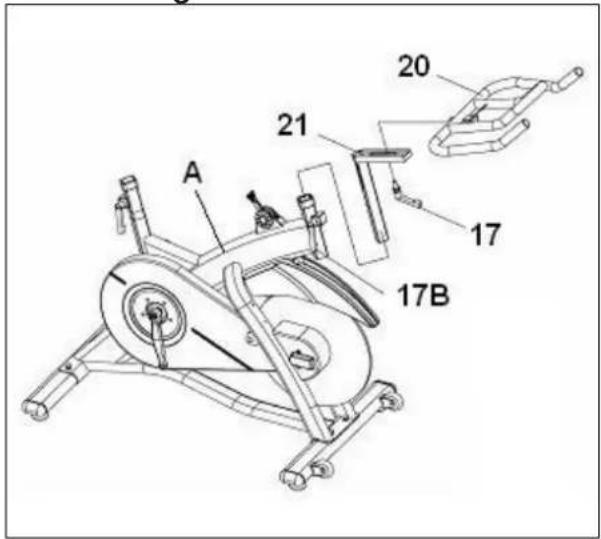
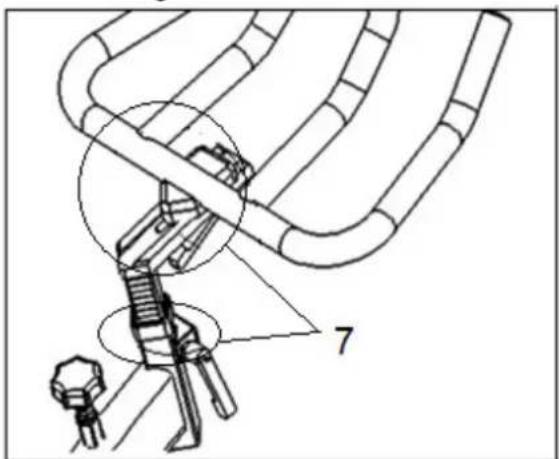
Position the handlebar (20) on the handlebar stem (21), Fig.3, tighten the knob (17) and then insert the handlebar stem (21) into the hole on the main body (A), Fig.3. Position it correctly and then tighten knob (17B) by turning it clockwise.
ADJUSTING THE HANDLEBAR HORIZONTALLY.-
Position the handlebar (20) at a comfortable distance for doing exercise, now tighten knob (17) securely, Fig.3.
ADJUSTING THE HANDLEBAR VERTICALLY.-
Position the handlebar (20) at a comfortable distance for doing exercise, now tighten knob (17B) securely, Fig.3.Stay within the references 0-14 without going beyond the "MIN INSERT" mark.
ATTACHING THE SADDLE.-
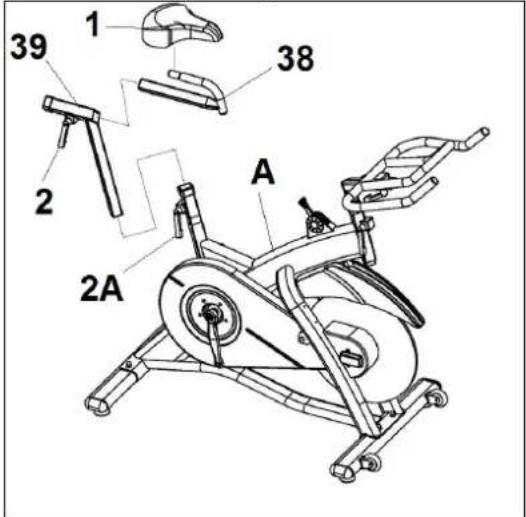
Fit the saddle bracket (1), Fig.4, onto the horizontal saddle tube (38), as shown in Fig.4, fit the saddle into position and tighten the nuts on the bracket securely. Next insert the horizontal saddle tube (38) through the hole on the saddle post (39), Fig.4, position it correctly and tighten the knob (2), Fig.4. Insert the saddle post (39) into the boss on the main body (A), position it correctly and tighten the saddle post by using the adjustment knob (2A), Fig.4, turning it clockwise.
ADJUSTING THE SADDLE HEIGHT.-
Loosen the saddle post adjustment knob (2A) slightly by turning it anticlockwise, Fig.5, move the saddle to a position comfortable for doing exercise and then tighten the adjustment knob (2A) securely by turning it clockwise.
Stay within the references 0-19 without going beyond the "MIN INSERT" mark.
HORIZONTAL ADJUSTMENT OF THE SADDLE.-
Loosen the knob (2) slightly by turning it anticlockwise, Fig.5, move the saddle to a position comfortable for doing exercise and then tighten the knob (2) securely by turning it clockwise.
Stay within the references 0-17 without going beyond the "MIN INSERT" mark.
FITTING THE PEDALS.-
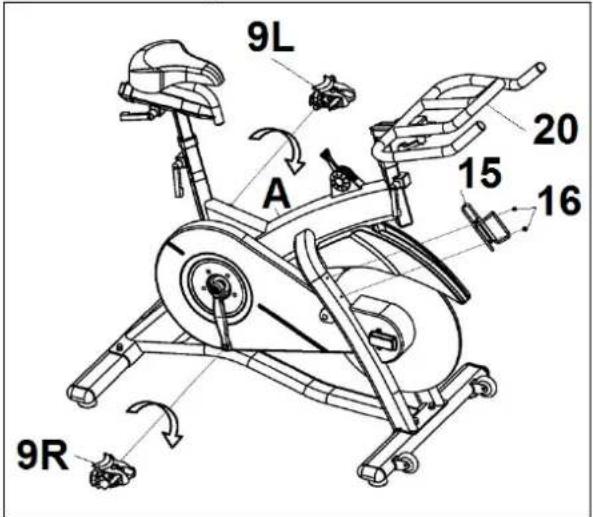
The assembly instructions for the pedals must be followed to the letter, fitting these incorrectly could damage the screw thread on either the pedal or the crank. Right and left refer to the position that the user adopts when sitting on the saddle to do the exercises. The right-hand pedal (9R), marked with the letter (R), screws onto the right-hand crank, also marked with an (R), in a clockwise direction. Tighten securely, Fig.5. The left-hand pedal (9L), marked with the letter (L), screws onto the left-hand crank, also marked with an (L), in an anti-clockwise direction. Tighten securely, Fig.5.
Remove screws (16) located on the main post (A) and fit the bottle holder (15), using the same screws (16).
EXERTION SETTINGS.-
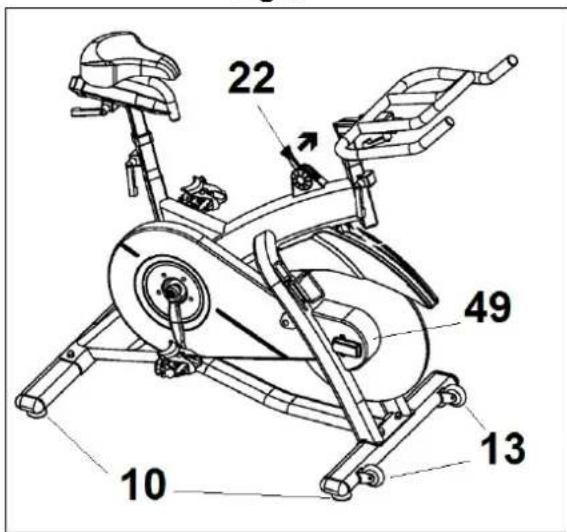
For regular control of exercise settings, this appliance is equipped with a tensioning control (22), located on the stem of the main body (A) Fig.6 which, when lifted in the direction of the arrow, indicates the resistance settings of the appliance in the monitor.
To increase the pedalling resistance, lift the tensioning control (22) until the exertion level best suits your exercise requirements.
To decrease the pedalling resistance, lower the tensioning control (22).
Important:
This tensioning control (22) has an emergency braking system which, when fully lifted in the direction of the arrow, as shown in Fig.6, causes a sudden braking force for the flywheel.
LEVELLING.-
Once the unit has been placed into its final position, make sure that it sits flat on the floor and that it is level. This can be achieved by screwing the adjustable feet (10) up or down, as shown in Fig.6.
MOVEMENT & STORAGE.-
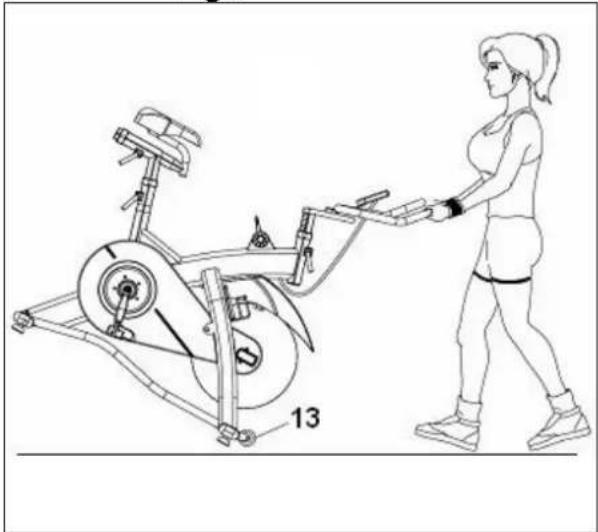
The unit is equipped with wheels (13) Fig.6, to make it easier to move. The wheels located at the front of your unit make it easier to move it into a chosen position, by lifting the rear of the unit up slightly and pushing it, as shown in Fig.7. Store your unit in a dry place, preferably not subject to changes in temperature.
OPERATIONS BEFORE BEGINNING
1.- Check that all components are properly installed: The nuts of the stands must be tightened with a torque of 20 Nm.
The pedals must have been sealed with Loctite 242 and tightened with the appropriate torque (a 46 Nm torque must be applied).
The saddle and handlebars must be properly adjusted for the user.
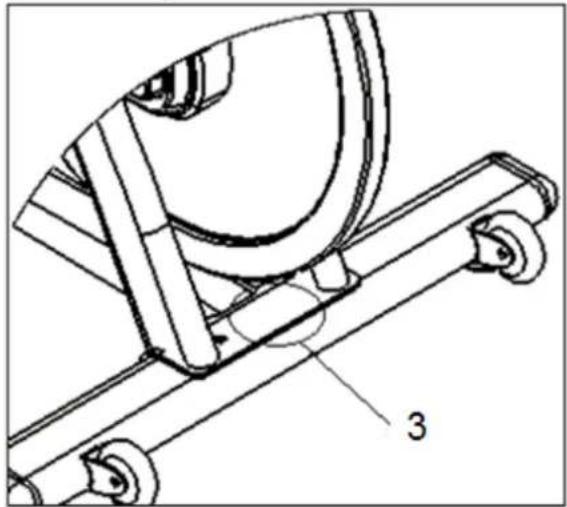
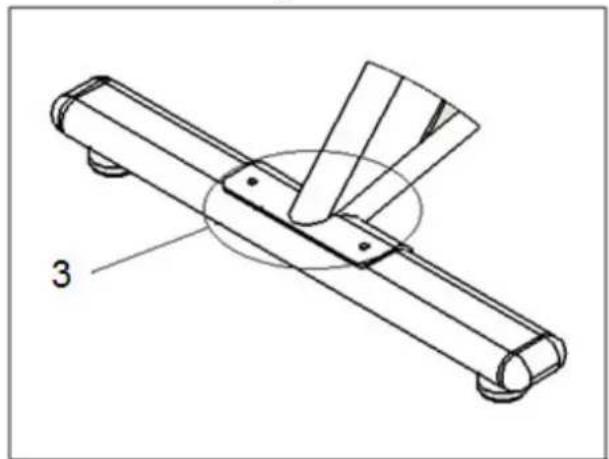
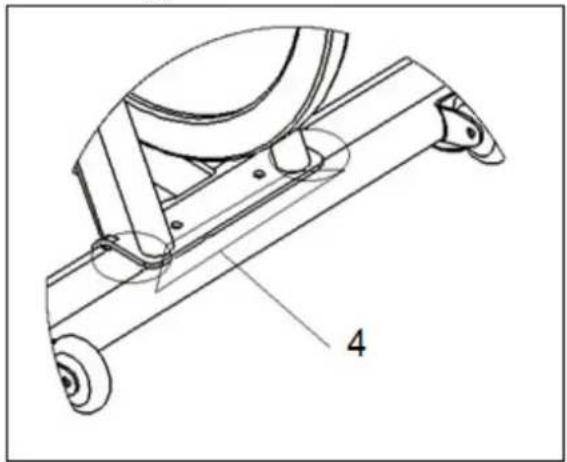
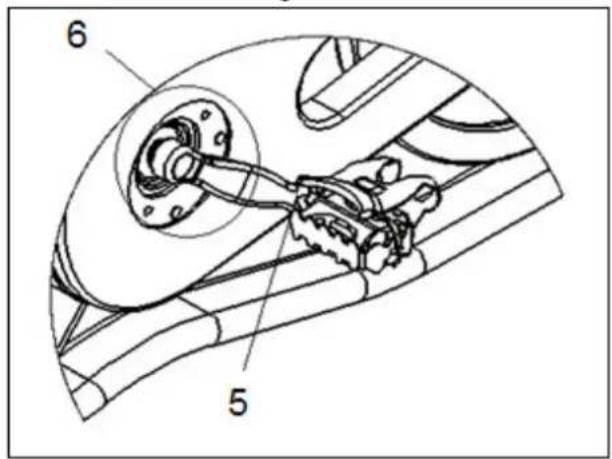
2.- BH rust inhibitor (110) must be applied to the contact surfaces indicated in Figures 10 to 15.
Points of application for BH rust inhibitor (110):
-
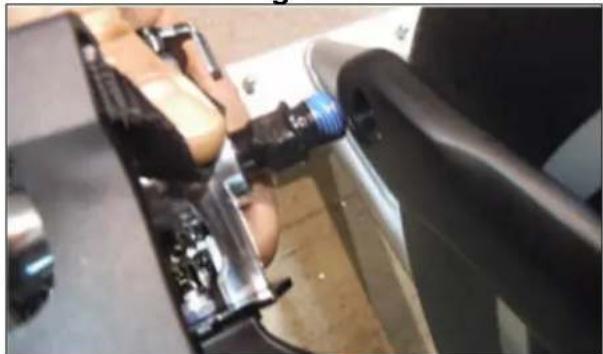
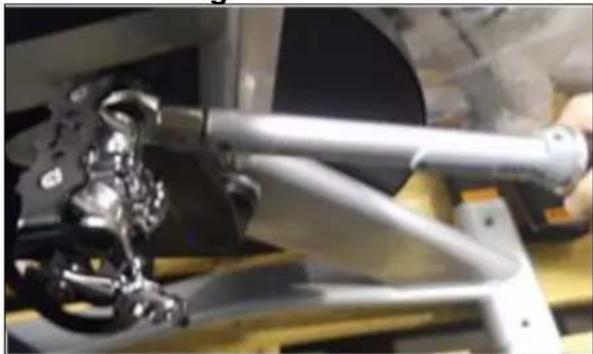
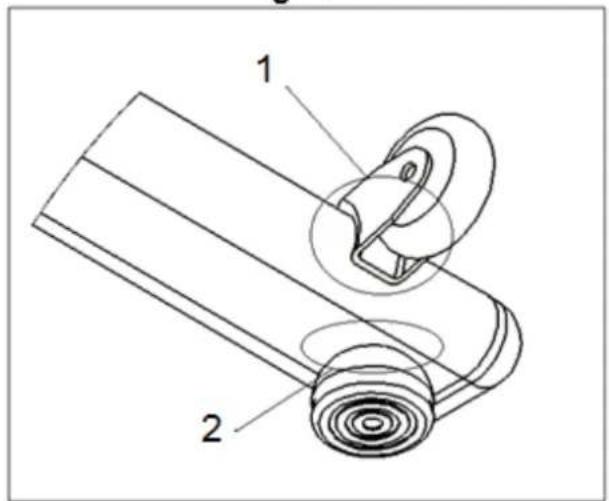
Casing of the adjustable legs of the front and rear stands. Fig 10.
-
Transportation wheels U bracket surfaces. Fig 10.
-
Front and rear stand bracket surfaces. Fig 11 and 12.
-
Area where the stands are clamped to the frame. Fig 13.
-
Joint between the pedal and the crank. Fig 14.
-
Joint between the crank and the central frame. Fig 14.
-
Chromed handlebar post surfaces and horizontal surfaces where the handlebar post is locked. Fig 15.
Application:
Shake well before using.
Hold the can 20 to 30 cm away from the surface to be sprayed using the extension tube.
Wait two minutes until the product stabilises.
Carefully spread with a clean cloth, leaving a light and uniform coat over the surface, and wipe off any excess. For areas with difficult access use a brush to apply the product. Leave to dry for about 3 hours.
Handling Precautions
Avoid all ignition sources (spark or flame).
DO NOT allow the material to come in contact with eyes or skin. Wear appropriate protective equipment during handling. Keep the container closed. Avoid breathing vapours or mists. Use only with adequate ventilation. Wash hands and contaminated clothing thoroughly after handling.
Storage
Keep the product in a cool, well-ventilated area. Avoid all ignition sources (spark or flame). Store between 4.4°C and 49°C. Store all materials in a dry, well-ventilated area. Avoid breathing vapours.
3.- Apply the BH indoor cycling protector (111) with a clean cloth to polish the product.
Application: Application should be over the entire bike while this is dry.
Spray the BH indoor cycling protector (111) over the surface to be treated.
Then spread with a clean cloth. Wipe dry with the cloth. Do not let the product self-dry.
Note: In case any part or component needs to be replaced, follow the same operations described above. Use only original BH spare parts.
PREVENTIVE MAINTENANCE OF THE MACHINE
| Every class |
| 1. The user must check that the apparatus is safe and appropriate for exercise. |
| 2. A cloth or towel should be used to remove sweat after the session has ended. |
| Weekly for the first month |
| 1. Check the tightness of the pedal and crank with a torque wrench. The tightening torque must be 46 Nm. |
| Weekly |
| 1. Thoroughly inspect each apparatus to make sure it is in safe and proper working order. Check screws, nuts and bolts, pedal cages, handlebar, saddle, knobs, worn pedal straps etc. |
| 2. Use warm water and a cloth to clean the parts that are dirty or that are in continuous contact with sweat. |
| 3. If you need to use soap, use the gentle MEGUIAR'S NXT soap, which will not damage the paint. In this case follow with the BH indoor cycling protector, cleaning the area with a clean, dry cloth. Wipe dry after. |
| Monthly |
| 1. Check the tightness of the pedal and crank with a torque wrench. The tightening torque must be 46 Nm. |
| 2. Check and adjust the belt.If the belt slips it will be necessary to tighten it:- Remove the side covers (49) and loosen the nuts a maximum of two turns, Fig 6.- Tighten the small nuts with a spanner. Make sure that the nut rotates the same number of turns on both sides of the machine (generally 2 turns will be sufficient) otherwise the drive sprocket might become skewed, creating a lot more noise and making it possible for the belt to fall off.- Tighten up the nuts again and put the side covers (49) back in place.- Whenever the tension on the machine has been adjusted, readjust the brakes as well. |
| 3. Wax those areas that are in contact with sweat.It is not necessary to wax the entire machine, but it is very important to wax those areas that are in direct contact with sweat, since these are more vulnerable to rust.Apply the BH indoor cycling protector, cleaning the area with a clean, dry cloth. Wipe dry after. |
| 4. The 3 tightening knobs should be loosened off and sprayed with Wurth lubricant to ensure that they remain operative. |
| Annually |
| 1. Clean with MEGUIAR'S NXT, adding the soap to water in a bowl. Shake to create foam. Apply with a wet sponge and dry with a cloth. |
| 2. The areas shown in Figures 10 to 15 should be protected with BH rust inhibitor following the same procedure and then left to dry for 3 hours. |
| 3. Apply the BH indoor cycling protector to the cleaned area with a clean, dry cloth. Wipe dry after application. |
WARNING: Failure to follow the cleaning and maintenance instructions could result in a reduced working life of the apparatus and serious personal injury to the user. Failure to follow these instructions will void the warranty.
NOT COVERED BY THE WARRANTY:
Improper maintenance.
Incorrect assembly by the purchaser.
Failure to follow the assembly instructions as stated in the manual provided.
Damage caused by the cleats of the shoes.
Stretching exercises should be performed in a suitable place and never on the machine.
Do not hesitate to get touch with the Technical Assistance Service if you have any queries by phoning customer services (see last page in manual)
BH RESERVES THE RIGHT TO MODIFY THE SPECIFICATIONS OF ITS PRODUCTS WITHOUT PRIOR NOTICE.
Français
IMPORTANTES CONSIGNES DE SÉCURITÉ.- PRÉCAUTIONS.
Précautions Manipulation.
LA GARANTIE NE COUVRE PAS.
Entretien inapproprié.
To order replacement parts: State the part code and Quantity
Toll free: +1 866 325 2339
No.139, Jhongshan Rd.
Daya Township
Taichung 428, Taiwan. R.O.C.
Tel.: +886 4 25609200
Fax: +886 4 25609280
e-mail: info@bhfitness.pt
BH SERVICE PORTUGAL
e-mail: info@bhfitness.pt
BH HIPOWER MEXICO
BH Exercycle de México S.A.
de CV
Eje 132 / 136
Zona Industrial, 2A Secc.
78395 San Luis Potosí
S:L:P: MÉXICO
Tel.: +52 (444) 824 00 29
Fax: +52 (444) 824 00 31
www.bh.com.mx
BH HIPOWER CHINA
BH China Co., Ltd.
Block A, NO.68, Branch Lane
455, Lane 822,
Zhen Nan RD., Li Zi Yuan,
Putuo, Shanghai 200331,
P.R.C.
Tel: +86-021-5284 6694
Fax:+86-021-5284 6814
e-mail: info@i-bh.cn
BH HIPOWER UK
Unit 12 Arlington Court
Newcastle Staffs
ST5 6SS
UK 0844 3353988
International 00441782634703
AFTER SALES - UK
e-mail: service@bh-uk.co.uk
BH HIPOWER FRANCE
SAV FRANCE
Tel : +33 0810 000 301
Fax : +33 0810 000 290
savfrance@bhfitness.com
BH Germany GmbH
Altendorfer Str. 526
45355 Essen
Tel: +49 201 450910-0
e-mail: info@bhgermany.com
SPECIFICATIONS MAY BE CHANGED WITHOUT PRIOR NOTICE DUE TO OUR PROGRAMME OF CONTINUOUS PRODUCT DEVELOPMENT.
BH SE RÉSERVE LE DROIT DE MODIFIER LES SPECIFICATIONS DE SES PRODUITS SANS PRÉAVIS.