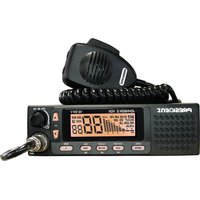
GEORGE II - Talkie Walkie PRESIDENT - Free user manual and instructions
Find the device manual for free GEORGE II PRESIDENT in PDF.


User questions about GEORGE II PRESIDENT
0 question about this device. Answer the ones you know or ask your own.
Ask a new question about this device
Download the instructions for your Talkie Walkie in PDF format for free! Find your manual GEORGE II - PRESIDENT and take your electronic device back in hand. On this page are published all the documents necessary for the use of your device. GEORGE II by PRESIDENT.
USER MANUAL GEORGE II PRESIDENT
FONCTION AVEC LA PEDALE D'EMISSION PTT 12
MENUS 12
CARACTERISTIQUES TECHNIQUES 19
GUIDE DE DÉPANNAGE 20
COMMENT ÉMETIRE OU RECEVOIR UNMESSAGE 20
GLOSSAIRE 20
CONDITIONS GENE RALES DE GARANTIE 23
DECLARATION DE CONFORMITE EU/UK SIMPLIFIÉE. 22
TABLEAUX DES FREQUENCES. 80-82
NORMES-F. 84
SUMMARY
English
INSTALLATION 44
HOW TO USE YOUR TRANSCEIVER 46
FUNCTION TURNING ON THE UNIT 50
FUNCTION WITH THE PTT SWITCH 51
MENU 51
TECHNICAL CHARACTERISTICS 57
TROUBLESHOOTING 57
HOW TO TRANSMIT OR RECEIVE AMESSAGE 58
GLOSSARY 58
SIMPLIFIED EU/UK DECLARATION OF CONFORMITY 59
GENERAL WARRANTY CONDITIONS 60
FREQUENCY TABLES. 80~82
NORMS-F 84
SUMARIO
Espanol
INSTALACION 25
UTILIZACION 27
FUNCTIONALENCENDERLAEMISORA 32
FUNCTION CON LA PALANCA DE EMISION PTT 32
MENUS 32
CHARACTERISTICAS TECNICAS. 39
GUIA DE PROBLEMAS 39
COMO EMITIR O RECIBIR UN MENSAJE 40
LEXICO 40
CONDITIONES GENERALES DE GARANTIA 42
PA (pression longue)
SCAN (pression brve)
HI-CUT (pression longue)
RF GAIN (pression longue)
ECHO SET (pression longue)
18) PÉDALE D'ÉMISSION PTT (Push To Talk)
(Configuration: EU; PL; d; EC; U; In)
SWR:Standing Waves Ratio
SW : Short waves (ondes courtes)
: Ecouter, capter, receiveor
Fine business (bon, excellent)
QRL :Je suiis occupé
QRM : Parasites, brouillage
QRM DX : Parasites Iointains
QRM 22 ;Police
https://president-electronics.com/DC/TXPR900.
CONDITIONS GENÉRALES DE GARANTIE
1-NRC led RX color verde
2-NRC led TX color rojo
3-NRC led RX+TX led Naranja
4-NRC led Off esta Off.
Ver menu AJUSTE NRC pagina 16.
18) PULSADOR DE EMISION PTT (Push To Talk)
H Hotel
1 India
JJuliet
K Kilo
L Lima
M Mike
N November
O Oscar
P Ppa
Quebe
R Romeo
Sierra
Tango
U Uniform
V Victor
WWhiskey
X X-ray
Y. Yankee
Z Zulu
TERMINOS DEL ARGOT CEBEISTA:
A.L.
ARMONICOS
AVE MARIA
BARBAS
BARRA MOVIL
BASE
BIGOTADA
BREAK
BREAKER
CAJATONTA
CHICHARRA
CORTINERO
CRUCE DE ANTENAS
DOS METROS HORIZONTALES
ENCENDER FILAMENTOS
ESPIRAS
FOTOCOPIA
FRECUENCIA
https://president-electronics.com/DC/TXPR900.
Before using, be careful never to transmit without first having connected the antenna (connection "B" situated on the back panel of the equipment) or without having set the SWR (Standing Wave Ratio)! Failure to do so may result in destruction of the power amplifier, which is not covered by the guarantee.
MULTI-NORMS TRANSCEIVER!
See function "FREQUENCYBAND SELECTION" on page 50 and the Configuration table on page 84.
The warranty of this transceiver is valid only in the country of purchase.
Welcome to the world of the new generation of CB radios. The new PRESIDENT range gives you access to top performance transceiver equipment. With the use of up-to-date technology, which guarantees unprecedented quality, your PRESIDENT GEORGE II is a new step in personal communication and is the surest choice for the most demanding of professional CB radio users. To ensure that you make the most of all its capacities, we advise you to read carefully this manual before installing and using your PRESIDENT GEORGE II.
A) INSTALLATION
1) WHERE AND HOW TO MOUNT YOUR MOBILE CB RADIO
a) You should choose a well ventilated place most appropriate setting from a simple and practical point of view.
b) Your CB radio should not interfere with the driver or the passengers.
c) Remember to provide for the passing and protection of different wires (e.g. power, antenna, accessory cabling) so that they do not in any way interfere with the driving of the vehicle.
d) To install your equipment, use the cradle (1) and the self-tapping screws (2) provided (drilling diameter 3.2mm ). Take care not to damage the vehicle's electrical system while drilling the dash board.
e) Do not forget to insert the rubber joints (3) between the CB and its support as these have a shock-absorbing effect which permits gentle orientation and tightening of the set.
f) Choose where to place the microphone support and remember that the microphone cord must stretch to the driver without interfering with the controls of the vehicle.
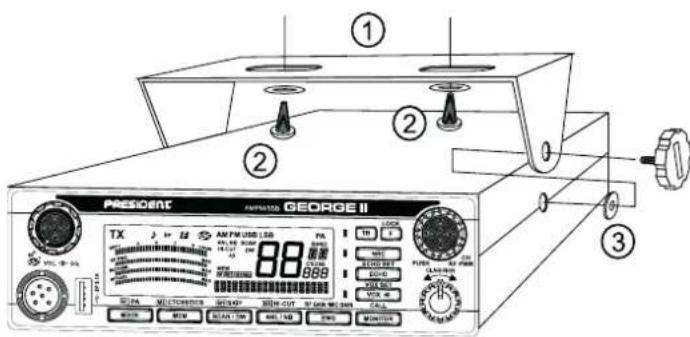

N.B.: As the transceiver has a frontal microphone socket, it can be set into the dash board. In this case, you will need to add an external loudspeaker to improve the sound quality of communications (connector EXTSP situated on the back panel: C). Ask your dealer for advice on mounting your CB radio.
2) ANTENNA INSTALLATION
a) Choosing your antenna
- For CB radios, the longer the antenna, the better its results. Your dealer will be able to help you with your choice of antenna.
b) Mobile antenna
- Must be fixed to the vehicle where there is a maximum of metallic surface (ground plane), away from windscreen mountings.
-
If you already have a radio-telephone antenna installed, the transceiver antenna should be higher than this.
-
There are two types of antenna: pre-regulated which should be used on a good ground plane (e.g. car roof or lid of the boot), and adjustable which offer a much larger range and can be used on a smaller ground plane (see § HOW TO ADJUST SWR below).
- For an antenna which must be fixed by drilling, you will need a good contact between the antenna and the ground plane. To obtain this, you should lightly scratch the surface where the screw and tightening star are to be placed.
- Be careful not to pinch or flatten the coaxial cable (as this runs the risk of break down and/or short-circuiting).
- Connect the antenna (B).
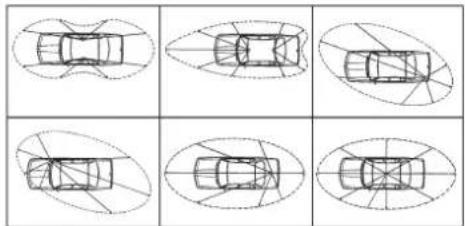
OUTPUT RADIUS PATTERN
c) Fixed antenna
- A fixed antenna should be installed in as clear space as possible. If it is fixed to a mast, it will perhaps be necessary to stay it, according to the laws in force (you should seek professional advice). All PRESIDENT antennas and accessories are designed to give maximum efficiency to each CB radio within the range.
3) POWER CONNECTION
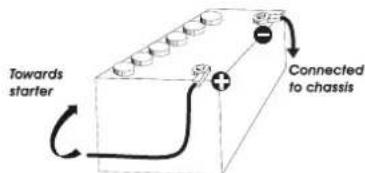
Your PRESIDENT GEORGE II is protected against an inversion of polarities. However, before switching it on, you are advised to check all the connections. Your equipment must be supplied with a continued current of 12 volts (A). Today, most cars and lorries are negative earth. You can check this by making sure that the negative terminal of the battery is connected either to the engine block or to the chassis. If this is not the case, you should consult your dealer.
a) Check that the battery is of 12 volts.
b) Locate the positive and negative terminals of the battery (+ is red and - is black). Should it be necessary to lengthen the power cable, you should use the same or a superior type of cable.
c) It is necessary to connect your CB to a permanent (+) and (-). We advise you to connect the power cable directly to the battery (as the connection of the CB cable to the wiring of the car-radio or other parts of the electrical circuit may, in some cases, increase the likelihood of interference).
d) Connect the red wire (+) to the positive terminal of the battery and the black (-) wire to the negative terminal of the battery.
e) Connect the power cable to your CB radio.
WARNING: Never replace the original fuse by one of a different value.
4) BASIC OPERATIONS TO BE CARRIED OUT BEFORE USING YOUR SET FOR THE FIRST TIME (without transmitting and without using the "push-to-talk" switch on the microphone)
a) Connect the microphone
b) Check the antenna connections.
c) Turn the set on by turning the VOL knob (1) clockwise.
d) Turn the squelch SQ knob (2) to minimum M.
e) Adjust the volume to a comfortable level.
f) Go to channel 20 by using the CH rotary knob (4) or UP/DN keys (19) on the microphone.
5) HOW TO ADJUST SWR (Standing Wave Ratio)
Warning: This must be carried out when you use your radio for the first time and whenever you re-position your antenna. This adjustment must be carried out in an obstacle-free area.
- Adjustment with internal SWR-meter
See function SWR CALIBRATION page 54.

* Adjustment with external SWR-meter (e.g. TOS-1 PRESIDENT)
a) To connect the SWR meter :
- Connect the SWR meter between the CB radio and the antenna as close as possible to the CB (use a maximum of 40~cm cable, type President CA 2C).
b) To adjust the SWR meter: - Set the CB on channel 20 in FM.
Put the switch on the SWR-meter to position FWD (calibration).
Press the PTT "push-to-talk" switch (18) on the microphone to transmit.
- Bring the Index needle to by using the calibration key.
- Change the switch to position REF (reading of the SWR level). The reading on the Meter should be as near as possible to 1. If this is not the case, readjust your antenna to obtain a reading as close as possible to 1. (A SWR reading between 1 and 1.8 is acceptable).
- It will be necessary to recalibrate the SWR meter after each adjustment of the antenna.
WARNING: In order to avoid any losses and attenuations in cables used for connection between the radio and its accessories, PRESIDENT recommends to use a cable with a length inferior to 3m .
Your transceiver is now ready for use.
B) HOW TO USE YOUR TRANSCEIVER
1) ON/OFF ~ VOLUME
Turn on: turn VOL knob (1) clockwise. If the function KEY BEEP is active (see menu KEY BEEP page 51), the radio emits a beep. The radio is "on". Display briefly shows the frequency band (see § FREQUENCY BAND SELECTION page 50) and the microphone type (consult the MICROPHONE TYPE menu page 53).
Turn Off: turn VOL knob (1) counterclockwise until radio emits click sound. Your radio is "off".
Volume Adjustment: rotate VOL knob (1) clockwise to increase the volume.
Turn the same knob counterclockwise to reduce the sound level.
2) ASC (Automatic Squelch Control) ~ SQUEELCH
Suppresses undesirable background noises when there is no communication. Squelch does not affect neither sound nor transmission power, but allows a considerable Improvement in listening comfort.
a) ASC: AUTOMATIC SQUEELCH CONTROL
Worldwide patent, a PRESIDENT exclusivity.
Turn the SQ knob (2) anti-clockwise into ASC position. As appears on LCD. No repetitive manual adjustment and a permanent improvement between the sensitivity and the listening comfort when ASC is active. This function can be disconnected by turning the switch clockwise. In this case the squelch adjustment becomes manual again. As disappears from LCD.
b) MANUAL SQUEELCH
Turn the SQ knob (2) clockwise to the exact point where all background noise disappears. This adjustment should be done with precision as, if set to maximum (fully clockwise), only the strongest signals will be received.
3) LCD
It shows all functions:
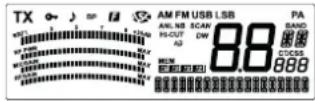
The main bargraph shows the reception level and the output power level.
The small bargraphs show Mic Gain, RF Gain and RF Power levels.
4) CHANNEL SELECTOR CH ~ RF POWER
CHANNEL SELECTOR CH
Turn the rotary CH knob (4) to move up or down a channel. A beep sound is emitted each time the channel is changed if the KEY BEEP function is activated (see KEY BEEP function on page 51).
See § UP/DN BUTTONS ON MICROPHONE page 50.
The display shows the corresponding frequency. For example "2285" for channel 20.
A long press (3 seconds) on this button (4) allows entering the MENU.
- A short press on this button (4) validates the settings in the MENU.
RF POWER (combination 18 + 4)
In TX mode, increase/decrease the output power.
- Press and hold the PTT switch (18).
Press CH (4) buttons. POUER is displayed.
Turn the rotary CH knob (4) to adjust the level using the bargraph.
5) MODE PA M1
MODE(short press)
This switch allows selecting the modulation mode AM, FM, USB, LSB; Your
modulation mode has to correspond to the one of your correspondent.
Amplitude Modulation / AM: communication on a field with relief and obstacles at middle distance (the most used).
Frequency Modulation / FM: for nearby communications on a flat open field.
In U configuration only: in FM mode, a short press on the MODE key (5) alternates between the ENG or CEPT frequency bands. "UK" is displayed when the ENG frequency band is selected (see table on page 80).
- Upper and Lower Side Band/ USB-LSB: used for long distance communications (according to the propagation conditions).
PA (Public Address) (long press)
An external loudspeaker can be connected to the unit by the PA jack plug located on the back panel PA.SP. (D). Turn the VOL knob (1) to adjust the PA volume.
Long press MODE key (5) to alternate between CB and PA mode.
For details on operating in PA mode, consult the PA SETTING menu page 53.
M1
See § MEMORY page 47.
6) MEMORY CTCSS/DCS M2
MEMORY(short press)
This CB radio allows you to memorize 4 channels with the following attributes.
To store into memory:
- Select the channel and its attributes.
Press the MEM key (6) for one second. If the KEY BEEP function is active, a beep sounds. "MEM" flashes.
Press for one second one of the keys M1 (5), M2 (6), M3 (7) or M4 (8) to memorize. "MEM" appears in the display and the number of the selected memory (M1, M2, M3 or M4) flashes. - If the KEY BEEP function is active, a long beep confirms the success of the operation.
To call a memory:
Press the MEM key (6) for one second. If the KEY BEEP function is active, a beep sounds. "MEM" flashes.
Briefly press one of the M1 (5), M2 (6), M3 (7) or M4 (8) keys to display the selected memory.
- "MEM" is displayed, the number of the selected memory (M1, M2, M3 or M4) flashes.
CTCSS/DCS
For simplicity, in this manual we will speak of CTCSS/DCS code to indicate both a CTCSS tone and a DCS code, of GENRE to indicate the kind of code (CTCSS, DCS or OFF = no code). TYPE indicates whether this is a TX transmission or an RX reception and MODE specifies the operating mode, Identical Id or different dF.
Consult the CODE SET menu page 54.
See list of codes on pages 83.
Note: Codes can only be used in FM. Each channel can have its own code.
- Press for one second one of the MEM key (6) to activate/deactivate the CTCSS/DCS function.
Activation
If a CTCSS/DCS code has been stored, it becomes active, "CTCSS" or "DCS" icon is displayed on the screen.
In MODE ld, if no CTCSS/DCS code has been stored, the device emits an error beep. Go to the CODE SET menu to store a CTCSS/DCS code.
In dF MODE, if no CTCSS/DCS code has been stored in either TYPE TX or TYPE RX, the device emits an error beep. Go to the CODE SET menu to store the CTCSS/DCS codes.
Deactivation
If a CTCSS/DCS code has been stored and "CTCSS" or "DCS" is displayed on the screen, a long press on the MEM key (6) deactivates the stored code, "CTCSS" or "DCS" disappears, a deactivation beep sounds. The memorized CTCSS/DCS code is kept in memory but no longer functions.
M2
See § MEMORY page 47.
7) SCAN DW SKIP M3
SCAN(short press)
Press the SCAN/DW key (7) to activate the SCAN function in ascending order. "SCAN" is displayed. The scanning stops as a channel is active. The scanning automatically starts 3 seconds after the end of the transmission and no key is activated. In SCANNING mode, turn the rotary CH knob (4) or use the UP/DN buttons (19) on the microphone to change scan direction. (See §SKIP below)
Press the PTT switch (18) or the SCAN key (7) to exit the SCAN function.
DW (combination 14 + 7)
Short press the F key (14). F appears on the display.
Short press the SCAN/DW key (7) activates the DW (Dual Watch) function.
"DW" is displayed. This function allows you to watch two channels..
A new short press SCAN/DW key (7) after short press F key (14) deactivates the DW function. "DW" disappears from the display.
SKIP (long press only if the SCAN function is activated)
This function allows you to skip a channel found by the SCAN function. When the scan stops on an unwanted channel, press and hold the SCAN/ DW key (7) for 1 second to store this channel in the SCAN SKIP memory. A beep sounds. The channel will no longer be scanned. See the SCAN above.
Consult the SCAN SKIP menu page 53 and the RESET menu page 57.
M3
See MEMORY page 47.
8)ANL/NB HI-CUT M4
ANL/NB (short press)
Short press the ANL/NB key (8) to activate/deactivate the filters in this order:
→ANL→NB→ANL+NB→Off
The activated filter is shown on the display.
ANL - Automatic Noise Limiter: This filter allows the reduction of background noises and some reception interferences. In AM mode only.
NB - Noise Blanker: This filter allows the reduction of back ground noise, and some reception interference.
HI-CUT (long press)
Long press the HI-CUT key (8) to activate/deactivate the HI-CUT filter. "HI-CUT" appears on the display when the filter is active.
Hi-Cut: Eliminates high frequency interferences. Has to be used in accordance with the reception conditions.
M4
See MEMORY page 47.
9) EMERGENCY CHANNELS ~ RF GAIN ~ MIC GAIN
EMERGENCY CHANNELS
(short press)
Emergency channels will be automatically selected by pressing the EMG key (9). First press: emergency channel 1 is activated. Second press: emergency channel 2 is activated. Third press: return to the current channel. "EMG" appears on the display when an emergency channel is activated.
See the table page 84 for default emergency channels.
RF GAIN (long press)
Setting the reception sensitivity. Maximum position in the case of long-distance call reception. You can decrease the RF GAIN, to avoid distortions, when the Interlocutor is near. Reduce the gain on reception in the case of a close communication with a correspondent not equipped with a RF POWER.
Long press the RF GAIN/MIC GAIN key (9). "RF GAIN" is displayed.
Turn the rotary CH knob (54) to adjust the level 01 to 10 or using the bargraph.
The normal position of this function is at maximum level. The bargraph of the RF GAIN will always be displayed in reception.
MIC GAIN (combination 18 + 9)
Adjust the microphone sensitivity level.
- Press and hold the PTT switch (18)
Press the RF GAIN/MIC GAIN key (9). "MIC GAIN" is displayed.
Turn the rotary CH knob (4) to adjust the level 01 to 10 or using the bargraph.
The normal position of this function is at maximum level. MIC GAIN bargrah will be displayed on transmission.
10) MONITOR ~ CALL
MONITOR (short press)
This function allows you to monitor the channel despite the squelch.
When ASC is active or the manual squelch level is high, press MONITOR (10) to hear the active channel.
CALL (combination 18 + 10)
Press and hold the PIT switch (18).
Press the CALL key (10) to send a preset call melody. «TX» Is displayed. (see § CALL TONE FREQUENCY, page 56).
11) VOX ~ NOISE GATE ~ VOX SETTING
VOX (short press)
The VOX function allows transmitting by speaking into the original microphone (or in the optional vox microphone) without pressing the PTT switch (18). The use of an optional vox microphone connected to the rear panel of the transceiver (E) disables the original microphone.
Short press the VOX key (11) in order to activate the VOX function. "VOX" appears on the display. Short press again the VOX key (11) to disable the function. "VOX" disappears.
NOISE GATE (combination 14 + 11)
Short press the F key (14). F appears on the display,
Short press the VOX key (11) to activate (n) or deactivate (DF) the NOISE GATE. "A3" is displayed when the function is active.
Noise Gate: Prevents amplification of background noise. This results in optimized signal levels.
VOX SETTING (long press)
- Long press the VOX key (11) to enter the VOX SETTING. "VOX" blinks, the current setting and its value appear on the display. Three parameters allow to adjust the VOX: Sensitivity SE Anti-Vox level / Vox delay R time SET,
2a. Turn the CH rotary knob (4) or use the UP/DN keys (19) on the microphone to modify the current parameter then, press the F key (14) to select next parameter or...
2b. Press first the F key (14) to select another the parameter and then turn the CH rotary knob (4) or use the UP/DN keys (19) on the microphone to modify the current parameter. - When all adjustments are done, press PTT switch (18) to store and exit. If the KEY BEEP function is activated, a long beep sounds to confirm the success of the operation (consul the KEY BEEP menu page 51).
- If no key is pressed for 10 seconds, the unit automatically exits the function VOX SETTING without save.
Sensitivity SET L: allows the adjustment of the microphone (original one or optional vox) for an optimum transmission quality. Adjustable level from 1 (high level) to 9 (low level). Default value: 5. -
Anti-Vox SET, : allows disabling the transmission generated by the surrounding noise. The level is adjustable. DF (according the squelch level) and from B (without anti-vox) to B (low level). Default value: BF.
-
Delay time SET, : allows avoiding the sudden cut of the transmission by adding a delay at the end of speaking. The level is adjustable from 1 (short delay) to 9 (long delay). Default value: 1.
VOX SETTING doesn't activate the VOX function.
12) NRC ~ REPEATER/RELAY
NRC (short press)
This switchable filter can be used to improve reception and transmission modes.
- Press the NRC key (12) to activate/deactivate the NRC in this order:
1-NRC RX LED is green
2-NRC TX LED Is red
3-NRC RX + TX LED is orange
4-NRC Off LED Is off.
See NRC SET menu page 16.
REPEATER/RELAY (combination 14 + 12)
WARNING! This function is valid only on the D frequency band. See the configuration table page 74.
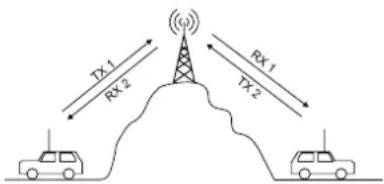
This function lets you extend the range of your transceiver by using relays... The radio receives on the current channel and transmits on the defined channel.
To activate this function you must define a TX channel (See REPEATER/RELAY SETTING menu page 55).
- Short press the F key (14). F appears on the display,
Short press the NRC key (12) to activate RPT ON or deactivate RPT OFF the REPEATER/RELAY function. The selection or "RPTx SET", if the transmission channel has not still been selected, blinks during 3 seconds.
When this function is active, the frequency of the RX receive channel and the TX transmit channel is displayed. When transmitting, the TX channel is displayed and flashes.
13)TALKBACK (short press)
This function allows you to hearyour own modulation in the optional internal or external speaker connected to the EXT.SP jack (C).
Short press the TB key (13) to activate/deactivate the TALKBACK function. When the function is active, the LED is lit.
14) F LOCK
F(short press)
Allows to set/validate functions (see for example § DUAL WATCH page 48).
This key pressed alone don't have any use.
See § FREQUENCY BAND SELECTION page 50.
LOCK (long press)
Long press F (14) keys to activate/deactivate the KEY LOCK function. When the function is active, " appears on the display.
15) ECHO ~ ECHO SETTING
ECHO(short press)
Press the ECHO key (15) to activate/deactivate the ECHO function. LED turns red.
ECHO SET (long press)
Long press ECHO key (15) to set ECHO VOLUME level and ECHO TIME. The LED blinks.
Turn the CH rotary knob (4) or use the UP/DN keys (19) on the microphone to alternately select "ECHO LEVEL" or "ECHO DELAY" in the list.
Rotate PUSH knob (6) to set the selected feature. There are 32 DELAY levels, default: 15. There are 32 "LEVEL", default: 13. LCD shows selected "DELAY" level or selected "LEVEL".
16)CLARIFIER
The function CLARIFIER (16) allows a frequency deviation during LSB/USB reception in order to improve the clearness of your correspondent's voice.
17) USB CHARGING SOCKET
The USB socket (17) can be used to charge smartphones, tablets or other rechargeable devices with 5 V - 2.1 A.
18) PTT (Push To Talk)
Transmission key, press to transmit a message, TX is displayed and release to listen to an incoming communication, TX disappears.
TOT (Time Out Timer)
If the transmission using PTT switch (18) or VOX function is longer than 3
minutes, the display starts blinking and the transmission ends. A beep will sound until the PTT switch (18) key is released.
19) UP/DN KEYS ON MICROPHONE (short press)
Press UP/DN keys (13) on the microphone to change the channel. UP to increase and DN to decrease the channel.
See ROTARY KNOB page 46.
20) 6 PIN MICROPHONE PLUG
The plug is located on the front panel of the transceiver and makes the setting of the equipment into the dashboard easier.
See Cabling Diagram page 83.
A) DC-POWER TERMINAL (13.2 V)
B) ANTENNA CONNECTOR (SO-239)
C) JACK FOR EXTERNAL OPTIONAL SPEAKER (8Ω, 03.5 mm)
D) PA SPEAKER JACK (8Ω, Φ 3.5 mm)
E) JACK FOR OPTIONAL VOX MICROPHONE ( 2.5mm)
C) FUNCTIONS TURNING ON THE UNIT
(Configuration: EU; PL; d; EC; U; In)
The frequency bands have to be chosen according to the country of use. Don't use any other configuration. Some countries need a user's licence. See table page 85.
- Turn on the power while pressing the F key (14). The letter corresponding to the current configuration is blinking.
- In order to change the configuration, use the CH rotary knob (4) on the unit or the UP/DN keys (19) on the microphone.
- When the configuration is selected, press the F key (14) during 1 second. The letter corresponding to the configuration is continuously displayed and a confirmation beep sounds.
- At this point, confirm the selection by switching off the transceiver and then switching it on again.
See the frequency bands table at pages 80 to 82 / configuration table page 84.
D) FUNCTIONS WITH THE PTT SWITCH
1) TALKBACK LEVEL
This function allows to adjust the volume level of the TALKBACK.
- Activate the TALKBACK function.
- Press and hold the PTT switch (18) then turn the CH rotary knob (4) to increase (clockwise) / decrease (counterclockwise) the volume level of the TALKBACK.
- Release the PTT switch (18).
E) MENU
The order of 23 menus is as described in this manual. However, the menu displayed by entering the MENU will be the last menu modified by user. The procedure is the same whatever the function is:
Long Press PUSH key (4) to enter the MENU. F is displayed.
- Turn the CH rotary knob (4) or use UP/DN keys (19) on the microphone to select the menu to set.
- Press PUSH key (4) to validate. The current color blinks on the display.
- Turn the CH rotary knob (4) or use UP/DN keys (19) on the microphone to modify the value of the parameter.
- New press on PUSH key (4) to validate the chosen value. The parameter stops blinking and if the function has more than one parameter, the next parameter blinks.
- If no key is pressed, the unit exits MENU after 10 seconds. F disappears from the display. Note: UP/DN keys (19) on the microphone have the same effect as the rotation of the CH rotary knob (4). PIT switch (18) validates the last setting and exists MENU F disappears.
1) COLOR
Long Press PUSH key (4) to enter the MENU. F is displayed.
1. Turn the CH rotary knob (4) or use UP/DN keys (19) on the microphone to select the C#ntenB.
2. Press PUSH key (4) to validate. The current color blinks on the display.
3. Turn the CH rotary knob (4) or use UP/DN keys (19) on the microphone to modify the color of the display.
| orange / green / blue / cyan / yellow / purple / cyan light | |
| Or | / Gr / Bl / Cy / YE / PU / CL |
- Short press PUSH key (4) to validate. a) Return to the point 1 to set another menu or b) Short press the PIT key (18) to validate and exit the MENU. F disappears from the display.
- If no key is pressed, the unit exits MENU after 10 seconds. F disappears from the display.
Default COLOR is: Or(orange).
2) DIMMER
DIMMER function allows adjusting the brightness of the lighting. 10 steps from to
Long Press PUSH key (4) to enter the MENU. F is displayed.
- Turn the CH rotary knob (4) or use UP/DN keys (19) on the microphone to select the IR EMIR
- Press PUSH key (4) to validate. The current value blinks on the display.
- Turn the CH rotary knob (4) or use the UP/DN keys (19) on the microphone to change the value of the dimmer.
- Short press PUSH key (4) to validate. a) Return to the point 1 to set another menu or b) Short press the PIT key (18) to validate and exit the MENU. f disappears from the display.
- If no key is pressed, the unit exits MENU after 10 seconds. F disappears from the display.
Dimmer default value is : 5.
3) TONE
This function allows to change the RX TONE. 11 steps from -5 to +5 Long Press PUSH key (4) to enter the MENU. Is displayed.
- Turn the CH rotary knob (4) or use UP/DN keys (19) on the microphone to select the timetou.
- Press PUSH key (4) to validate. The current value blinks on the display.
- Turn the CH rotary knob (4) or use the UP/DN keys (19) on the microphone to change the value of the tone.
- Short press PUSH key (4) to validate. a) Return to the point 1 to set another menu or b) Short press the PTI key (18) to validate and exit the MENU. f disappears from the display.
- If no key is pressed, the unit exits MENU after 10 seconds. F disappears from the display.
Tone default value is:
4) KEY BEEP
When the function is activated, a beep sounds when a key is pressed, by
changing the channel etc. "BP" appears on the display when the function is active.
Long Press PUSH key (4) to enter the MENU. F is displayed.
- Turn the CH rotary knob (4) or use UP/DN keys (19) on the microphone to select the KMenBEEP
- Press PUSH key (4) to validate. The current value blinks on the display.
- Turn the CH rotary knob (4) or use the UP/DN keys (19) on the microphone to activate (aF) / deactivate (aF) the function.
- Short press PUSH key (4) to validate. a) Return to the point 1 to set another menu or b) Short press the PTI key (18) to validate and exit the MENU. F disappears from the display.
- If no key is pressed, the unit exiis MENU after 10 seconds. F disappears from the display.
Default KEY BEEP is n
5) ROGER BEEP
When the function is active, the icon appears on the display.
The Roger Beep sounds when the PTI switch (12) on the microphone is released in order to let your correspondent speak. Historically as transceiver is a "simplex" communication mode, it is not possible to speak and to listen at the same time (as it is the case with a telephone). Once someone had finished talking, he said "Roger" In order to prevent his correspondent that it was his turn to talk. The word "Roger" has been replaced by a significant beep. There comes "Roger beep" from.
Long Press PUSH key (4) to enter the MENU. F is displayed.
- Turn the CH rotary knob (4) or use UP/DN keys (19) on the microphone to select the ROGER REEP menu.
- Press PUSH key (4) to validate. The current value blinks on the display.
- Turn the CH rotary knob (4) or use the UP/DN keys (19) on the microphone to activate (I to E*) / deactIVATE (EF) the function.
- Short press PUSH key (4) to validate. a) Return to the point 1 to set another menu or b) Short press the PTI key (18) to validate and exit the MENU. F disappears from the display.
- If no key is pressed, the unit exits MENU after 10 seconds. F disappears from the display.
*6 roger tones for ROGER BEEP.
Default ROGER BEEP is OF.
6) INDIC
Use this function to select the information to be displayed.
In RX mode:
Frequency and voltage are displayed continuously.
In TX mode:
Long Press PUSH key (4) to enter the MENU. F Is displayed.
1. Turn the CH rotary knob (4) or use UP/DN keys (19) on the microphone to select the INI/IN menu.
2. Press PUSH key (4) to validate. The current value blinks on the display.
3. Turn the CH rotary knob (4) or use the UP/DN keys (19) on the microphone to select the function to be displayed. FREQUENCY ~ SWR ~ TOT is displayed alternately. Each time the PTT is pressed, the display indicates the voltage and function selected..
4. Short press PUSH key (4) to validate. a) Return to the point 1 to set another menu or b) Short press the PTI key (18) to validate and exit the MENU. F disappears from the display.
5. If no key is pressed, the unit exits MENU after 10 seconds. F disappears from the display.
7) SCAN MODE
Allows to select the MODE of SCAN.
Long Press PUSH key (4) to enter the MENU. F Is displayed.
- Turn the CH rotary knob (4) or use UP/DN keys (19) on the microphone to select the SCAH NOB menu.
- Press PUSH key (4) to validate. The current value blinks on the display.
- Turn the CH rotary knob (4) or use the UP/DN keys (19) on the microphone to select the mode CH or _L
- Short press PUSH key (4) to validate. a) Return to the point 1 to set another menu or b) Short press PTt key (18) to validate and exit the MENU. F disappears from the display.
- If no key is pressed, the unit exits MENU after 10 seconds. F disappears from the display.
"Ch" means that the station scans all 40 channels of the active frequency band.
"€" means that the station scans memorized and priority channels only.
Default mode is: CH.
8) SCAN TYPE
Allows to select the TYPE of SCAN.
Long Press PUSH key (4) to enter the MENU. F is displayed.
- Tum the CH rotary knob (4) or use UP/DN keys (19) on the microphone to select the SCRN TYPE menu.
- Press PUSH key (4) to validate. The current value blinks on the display.
- Turn the CH rotary knob (4) or use the UP/DN keys (19) on the microphone to select the scan type 59 or E1.
- Short press the PUSH key (4) to validate. a) Return to the point 1 to set another menu or b) Short press the PTI key (18) to validate and exit the MENU. F disappears from the display.
- If no key is pressed, the unit exits MENU after 10 seconds. F disappears from the display.
" 59"means scanning stops when busy channel is founded.
"Et" means scanning stops when busy channel is founded and return to scan after 5 seconds.
Type default value is : 59.
9) SCAN SKIP
This function allows to memorize/erase a channel form the SCAN SKIP memory.
- Select a channel
- Long Press PUSH key (4) to enter the MENU. F is displayed.
- Turn the CH rotary knob (6) or use UP/DN keys (13) on the microphone to select the Sirenik:IP
- Press PUSH key (4) to validate. The current value blinks on the display.
- Turn the CH rotary knob (4) or use the UP/DN keys (19) on the microphone to alternate between n and F .
- Short press PUSH key (4) to validate. a) Return to the point 1 to set another menu or b) Short press PTI key (18) to validate and exit the MENU. F disappears from the display.
- If no key is pressed, the unit exits MENU after 10 seconds. F disappears from the display.
In memorize the current channel into the SCAN SKIP memory. When a channel is stored in the memory, SK appears on the display close to the channel number.
F erase the current channel from the SCAN SKIP memory, SK disappears from the display.
See §SKIP on page 48.
10) PA SETTING
This function allows to select the operating mode of Public Address.
Long Press PUSH key (4) to enter the MENU. F is displayed.
- Turn the CH rotary knob (4) or use UP/DN keys (19) on the microphone to select the PR SETTING menu.
- Press PUSH key (4) to validate. The current value blinks on the display.
- Turn the CH rotary knob (4) or use the UP/DN keys (19) on the microphone to select the operating mode of the PA:In,DForPR.
- Short press PUSH key (4) to validate. a) Return to the point 1 to set another menu or b) Short press PTI key (18) to validate and exit the MENU. F disappears from the display.
- If no key is pressed, the unit exits MENU after 10 seconds. F disappears from the display.
In: the modulation of the microphone is transmitted to the external loudspeaker connected to Jack PA.SP. (D). The received signal is transmitted to the internal loudspeaker (or external optional loudspeaker connected to jack EXT.SP (E). "PA" blinks alternately with the modulation mode (AM or FM).
DF: The reception is no more functional. Only the modulation of the microphone is transmitted to the Public Address loudspeaker connected to Jack PA.SP. (D). PR and level of the PA are displayed.
PR: the modulation of the microphone and the received signal are transmitted to the Public Address loudspeaker connected to jack PA.SP. (D). "PA" blinks alternately with the modulation mode (AM or FM).
Turn the VOL knob (1) to adjust the audio level of the mode PA.
Default PA setting is in.
See § PA (Public Address) page 47.
11)MICROPHONE TYPE
PRESIDENT GEORGE II can be used with both a PRESIDENT electret and dynamic 6-pin microphone (see microphone wiring on page 83). When the unit is turned on, the microphone type is displayed briefly.
Long Press PUSH key (4) to enter the MENU. F is displayed.
1. Turn the CH rotary knob (4) or use UP/DN keys (19) on the microphone to select the MIC TYPE menu.
2. Press PUSH key (4) to validate. The current value blinks on the display.
3. Turn the CH rotary knob (4) or use the UP/DN keys (19) on the microphone to select the microphone type EL (electref) or dH (dynamic).
4. Short press the PUSH key (4) to validate. a) Return to the point 1 to set another menu or b) Short press the PIT key (18) to validate and exit the MENU. E disappears from the display.
5. If no key is pressed, the unit exits MENU after 10 seconds. F disappears from the display.
Microphone type default is EL (electret).
12)SWRCALIBRATION
This function allows you to adjust the SWR by beeping.
Long Press PUSH key (4) to enter the MENU. F is displayed.
- Tum the CH rotary knob (4) or use UP/DN keys (19) on the microphone to select the SWR menu.
- Press PUSH key (4) to confirm. The radio automatically switches to TX mode without pressing the PIT switch (18) and calibration begins. Calibration time is 5 minutes maximum. A countdown is done in the display.
- Adjust the antenna.
- The beep* is continuous when the SWR value is 10. The space between the beeps becomes larger and larger as the SWR value moves away from 10.
- The volume of the beep is adjustable with VOL knob (1).
- The display shows the SWR value, for example 25.
- Press the PTT switch (18) to exit SWR CALIBRATION
*Check that the beep volume is set to a suitable level. See ADJUSTMENT OF SWR page 45.
13)NRC SET
The NRC filter can be set independently in transmission (T) as in reception (R).
Long Press PUSH key (4) to enter the MENU. F is displayed.
- Turn the CH rotary knob (4) or use UP/DN keys (19) on the microphone to select the NenThe last parameter used and its value appears on the display.
- Press the PUSH key (4) to confirm. The parameter blinks, RX or TX.
- Turn the CH rotary knob (4) or use the UP/DN keys (19) on the microphone to select fX (reception) or X (transmission).
- Press PUSH key (4) to confirm. The value of the filter blinks.
- Turn the CH rotary knob (4) or use the UP/DN keys (19) on the microphone to change the value from 0 to 05.
- Short press PUSH key (4) to validate. a) Return to the point 1 to set another menu or b) Short press PIT key (18) to validate and exit the MENU. F disappears from the display.
The default value are I (transmission) and I (reception)
See the § NRC page 49 to activate/deactivate the function.
14)CODE SET
For simplicity, In this manual we will speak of CTCSS/DCS code to indicate both a CTCSS tone and a DCS code, of GENRE to indicate the kind of code (CTCSS, DCS or OFF = no code). TYPE indicates whether this is a TX transmis
sion or an RX reception and MODE specifies the operating mode, Identical Id or different DF. See § CTCSS/DCS page 46.
This menu allows you to configure the operating mode of the CTCSS/DCS function and to store the CTCSS/DCS codes.
2 operating modes:
- Id means that the code used will be identical for transmission (TX) and for reception (RX).
- dF means that the user can use one code (or OFF = no code) for transmission (TX) and another (or OFF = no code) for reception (RX).
Long Press PUSH key (4) to enter the MENU. F is displayed.
OPERATING MODE
- Turn the CH rotary knob (4) or use the UP/DN keys (19) on the microphone to select the [O]E menu.
- Briefly press the PUSH key (4) to confirm. The operating mode flashes (1 or dF).
- Turn the CH rotary knob (4) or use the UP/DN keys (19) on the microphone to select the desired operating mode.
STORING A CTCSS/DCS CODE
Depending on the operating mode used, the procedure differs:
Identical model
- Short press on the PUSH key (4) makes the genre blink ("CTCSS", "DCS" or "DF" no genre).
- Turn the CH rotary knob (4) or use the UP/DN keys (19) on the microphone to select the genre or...
- Press the PUSH key (4) to confirm the genre. The code value flashes (unless OFF selected).
- Turn the CH rotary knob (4) or use the UP/DN keys (19) on the microphone to select the code (from 01 to 38 for CTCSS and 001 to 104 for DCS).
Different Mode dF
- Short press on the PUSH key (4) makes the type R2 blink.
- Turn the CH rotary knob (4) or use the UP/DN keys (19) on the microphone to select the RX or TX type.
- A short press on the PUSH key (4) validates the choice of type. The genre value flashes ("CTCSS", "DCS" or "UTF" no genre).
- Turn the CH rotary knob (4) or use the UP/DN keys (19) on the microphone to select the genre or...
- Press the PUSH key (4) to confirm the genre. The code value flashes (unless OFF has been selected).
- Turn the CH rotary knob (4) or use the UP/DN keys (19) on the microphone
to select the code (01 to 38 for CTCSS 001 to 104 for DCS).
- Press PUSH key (4) to confirm the selected code. The unit returns to point 5, to set the second type.
- If you don't need to set the second type, long press the PUSH key (4) to invalidate and exit the MENU.
- If no key is pressed, the device exits the MENU after 10 seconds without saving the changes.
The default mode is id (Identical). The default genre is OFF.
See the RESET menu.
15)EMERGENCY CHANNEL
Long Press PUSH key (4) to enter the MENU. F is displayed.
- Turn the CH rotary knob (4) or use the UP/DN keys (19) on the microphone to select the EMG SETTING EMG 1 menu.
- Press PUSH key (4), turn the CH knob (4) or use the UP/DN keys (19) on the microphone to select the priority channel to set [M] or [M] 2.
- Press PUSH key (4). The channel flashes in the display.
- Turn CH knob (4) or use the UP/DN keys (19) on the microphone to select the channel.
- Press MODE (5) to select AM, FM or UK (U configuration only), USB and LSB mode.
- Press PUSH key (4) again to confirm. The channel stops flashing. a) Start again at point 1 to set another function or b) Press the PTT switch (18) to exit MENU.
- If no key is pressed, the unit exits the MENU after 10 seconds. F disappears from the display.
Default Emergency channel 1 is 9 in AM.
Default Emergency channel 2 is in AM.
See § EMERGENCY CHANNELS page 48.
16) DW (DUAL WATCH)
This function allows you to customize the second channel scanned by the DUAL WATCH function.
Long Press PUSH key (4) to enter the MENU. F is displayed.
- Turn the CH rotary knob (4) or use the UP/DN keys (19) on the microphone to select the menu.
- Press the PUSH key (4). The channel flashes in the display.
-
Turn CH knob (4) or use the UP/DN keys (19) on the microphone to select the channel.
-
Press MODE (5) to select AM, FM or UK (U configuration only), USB and LSB mode.
- Press PUSH key (4) again to confirm. The channel stops flashing. a) Start again at point 1 to set another function or b) Press the PIT switch (18) to exit MENU
- If no key is pressed, the unit exits the MENU after 10 seconds. F disappears from the display.
17) REPEATER / RELAY setting
WARNING! This function is valid only on the D frequency band. See the configuration table page 84.
This function allows you to increase the range of your CB by using relays.
The radio receives on the current channel RX1 and transmits on the selected channel TX2.
- Select the RX1 channel.
- Long Press PUSH key (4) to enter the MENU. F Is displayed.
- Turn the CH rotary knob (4) or use the UP/DN keys (19) on the microphone to select the RPTX SETTING menu.
- Short press on the PUSH key (4). The current transmission channel TX2 blinks on the display.
- Turn the CH rotary knob (4) or use UP/DN keys (19) on the microphone to select the transmission channel (TX2) or id (identical, no repeater).
- New press on the PUSH key (4) to validate. a) Return to the point 1 to set another menu or b) Short press the PTI key (18) to validate and exit the MENU. F disappears from the display.
- If no key is pressed, the unit exits MENU after 10 seconds. F disappears from the display.
The default transmission channel is ld (identical RX channel).
To activate the function, see the REPEATER/RELAY page 49.
18)SPAN SETTING
When the function is active, the frequency can be adjusted continuously. Pressing the PUSH knob (4) displays a bar under the first or second decimal
of the frequency. The CH rotary knob (4) no longer acts on the channel but executes a 100kHz (first decimal place) or 10kHz (decimal second) jump frequency.
Long Press PUSH key (4) to enter the MENU. F is displayed.
- Turn the CH rotary knob (4) or use UP/DN keys (19) on the microphone to select the SPEN SETTING menu.
- Press PUSH key (4) to validate. The current value blinks on the display.
- Turn the CH rotary knob (4) or use the UP/DN keys (19) on the microphone to activate (pn) / deactivate (aF) the function.
- Short press the PUSH key (4) to validate. a) Return to the point 1 to set another menu or b) Short press the PTt key (18) to validate and exit the MENU. F disappears from the display.
- If no key is pressed, the unit exits MENU after 10 seconds. F disappears from the display.
Default SPAN is 0F
Set the FREQUENCY of the CALL tone.
Long Press PUSH key (4) to enter the MENU. F is displayed.
- Turn the CH rotary knob (4) or use UP/DN keys (19) on the microphone to select the CALL SETTING menu.
- Press PUSH key (4) to validate. The current value blinks on the display.
- Turn the CH rotary knob (4) or use the UP/DN keys (19) on the microphone to adjust the frequency.
Frequency range: 300Hz 3000Hz Step size: 10Hz Default value: 1050Hz Press the PUSH key (4) to modify the step.
- Short press the PUSH key (4) to validate. a) Return to the point 1 to set another menu or b) Short press the PTI key (18) to validate and exit the MENU. F disappears from the display.
- If no key is pressed, the unit exits MENU after 10 seconds. F disappears from the display.
20) VOLUME ACCESSORY
This function allows you to control the volume of the unit and an accessory plugged on the 6-pin plug (accessory available soon).
Long Press PUSH key (4) to enter the MENU. F is displayed.
1. Turn the CH rotary knob (4) or use UP/DN keys (19) on the microphone to select the written BCC
2. Press PUSH key (4) to validate. The current value blinks on the display.
3. Turn the CH rotary knob (4) or use the UP/DN keys (19) on the microphone
to select 00.01 or 02
- Short press the PUSH key (4) to validate. a) Return to the point 1 to set another menu or b) Short press the PTT key (19) to validate and exit the MENU. F disappears from the display.
-
If no key is pressed, the unit exits MENU after 10 seconds. F disappears from the display.
-
the vol knob (1) affects the internal speaker volume.
I- the vol knob (1) affects the accessory volume - the vol knob (1) affects both the internal speaker and accessory volume.
Default accessory volume is 00.
21) SWR PROTECTION SETTING
Set the SWR LEVEL PROTECTION.
Long Press PUSH key (4) to enter the MENU. F is displayed.
- Turn the CH rotary knob (4) or use UP/DN keys (19) on the microphone to select the SUR PROTECTION menu.
- Press PUSH key (4) to validate. The current value blinks on the display.
- Turn the CH rotary knob (4) or use the UP/DN keys (19) on the microphone to select 20 to 200.
- Short press the PUSH key (4) to validate. a) Return to the point 1 to set another menu or b) Short press the PTt key (18) to validate and exit the MENU. F disappears from the display.
- If no key is pressed, the unit exits MENU after 10 seconds. F disappears from the display.
Default value is 30
22) MAXI.VOLTAGE PROTECTION LIMIT
Set the MAXIMUM LIMIT OF VOLTAGE PROTECTION
Long Press PUSH key (4) to enter the MENU. F is displayed.
- Turn the CH rotary knob (4) or use UP/DN keys (19) on the microphone to select the VOLT PROTECTION menu.
- Press PUSH key (4) to validate. The current value blinks on the display.
- Turn the CH rotary knob (4) or use the UP/DN keys (19) on the microphone to select 90 to 160.
- Short press the PUSH key (4) to validate. a) Return to the point 1 to set another menu or b) Short press the PTt key (18) to validate and exit the MENU. F disappears from the display.
- If no key is pressed, the unit exits MENU after 10 seconds. F disappears from the display.
Default value is 150
23)RESET
This function allows to Erase the scan skip memory or restore all factory settings.
Long Press PUSH key (4) to enter the MENU. F is displayed.
- Turn the CH rotary knob (4) or use UP/DN keys (19) on the microphone to select the RESET menu.
- Press PUSH key (4) to validate. The current value blinks on the display.
- Turn the CH rotary knob (4) or use the UP/DN keys (19) on the microphone to select 5C or RL.
- Short press the PUSH key (4) to validate. a) Return to the point 1 to set another menu or b) Short press the PTt key (18) to validate and exit the MENU. F disappears from the display.
- If no key is pressed, the unit exits MENU after 10 seconds. F disappears from the display.
5 erase all the channels stored on the SCAN SKIP memory. They are now enabled to be scanned (see the SKIP page 48).
RL restore all the factory parameters.
F) TECHNICAL CHARACTERISTICS
1) GENERAL
Channels:40
- Modulation modes : AM / FM / USB / LSB
- Frequency ranges : from 26.965 MHz to 27.405 MHz
- Antenna impedance : 50 ohms
- Power supply : 13.2 V
Dimensions
Weight
- Accessories supplied
:13.2V
:1.190kg
2) TRANSMISSION
Frequency allowance
- Carrier power
Transmission interference
Audio response
- Emitted power in the adj. channel
- Microphone sensitivity
-Drain
Modulated signal distortion
185(L)×172(P)×56(H)mm
: 1 microphone electret UP/DOWN with support, mounting cradle, screws and fused power cord.
+/-200 Hz
:4WAM/4WMF/12WPEPUSBLSB
: inferior to 4 nW (-54 dBm)
: 300 Hz to 3 KHz in AM/FM/USB/LSB
: Inferior to 20~ W
:3.0mV
: <5 A max. with modulation (13.2 V)
:2%
3) RECEPTION
Maxi. sensitivity at 20 dB sinad
Frequency response
- Adjacent channel selectivity
Maximum audio power
Squelch sensitivity
0.5 μV - 113 dBm (AM)
0.35 μV - 116 dBm (FM)
0.28 μV - 118 dBm (USB/LSB)
: 300 Hz to 3 kHz in AM/FM
:60dB
:3W
: minimum 0.2 μV - 120 dBm
maximum 1 mV - 47 dBm
Frequency image rejection rate
-Intermediate frequency rel. rate : 70 dB
-Drain
: 200~600 mA maximum (13.2 V)
G) TROUBLE SHOOTING
1) YOUR RADIO WILL NOT TRANSMIT OR YOUR TRANSMISSION IS OF POOR QUALITY
- Check that the antennals correctly connected and that the SWR is properly adjusted.
- Check that the microphone is properly plugged in.
- You are using the same modulation mode than your correspondent.
- Check that the programmed configuration is the correct one (see table page 84).
2) YOUR RADIO WILL NOT RECEIVE OR RECEPTION IS POOR
- Check that the squelch level is properly adjusted.
- Check that the volume (1) is set to a comfortable listening level.
- Check that the antenna is correctly connected and that the SWR is properly adjusted.
- Check that you are using the same modulation mode as your correspondent.
- Check that the programmed configuration is the correct one (see table page 84).
Consult the VOLUME ACCESSORY menu page 56.
Check that you are not using any CTCSS/DSC code (See the § CTCSS/DSC page 47
- Check the power supply.
- Check the connection wiring.
- Check the fuse.
H) HOW TO TRANSMIT OR RECEIVE AMESSAGE?
Now that you have read the manual, make sure that your CB Radio is ready for use (i.e. check that your antenna is connected).
Press the "push-to-talk" switch (18) and announce your message "Attention stations, transmission testing" which will allow you to check the cleanness and the power of your signal. Release the switch and wait for a reply. You should receive a reply like, "Strong and clear".
If you use a calling channel (19) and you have established communication with someone, it is common practice to choose another available channel so as not to block the calling channel.
GLOSSARY
INTERNATIONAL PHONETIC ALPHABET
A Alpha
H Hotel
Oscar
V Victor
B Bravo
India
P Papa
WWhiskey
C Charlie
J Juliett
QQuebe
X X-ray
D Delta
K Kilo
R Romeo
Y. Yankee
E Echo
L Lima
$ Sierra
Z Zulu
FOXTROT
M Mike
Tango
G Golf
N November
U Uniform
TECHNICAL VOCABULARY
AM : Amplitude Modulation
CB : Citizen's Band
CH : Channel
CW : Continuous Wave
DX : Long Distance Liaison
DW : Dual Watch
FM : Frequency Modulation
GMT:Greenwich Meantime
HF : High Frequency
LF : Low Frequency
LSB : Lower Side Band
RX : Receiver
SSB : Single Side Band
SWR : Standing Wave Ratio
SWL : Short Wave Listening
SW : Short Wave
TX :CB Transceiver
UHF : Ultra High Frequency
USB : Upper Side Band
VHF : Very High Frequency
CB LANGUAGE
Advertising
Back off
Basement
Base station
Bear
Bear bite
Bear cage
Big slab
Big 10-4
Bleeding
Blocking the channel
Blue boys
Break
Breaker
Clean and green
Cleaner channel
Coming in loud and proud : Good reception
Doughnut
Down and gone
Down one
Do you copy?
DX
Eighty eights
Eye ball
Good buddy
Hammer
Handle
Harvey wall banger
How am I hitting you?
Keying the mike
Kojac with a kodak
Land line
Lunch box
Man with a gun
Mayday
: Flashing lights of police car
: Slow down
: Channel 1
: A CB set In fixed location
:Policeman
:Speeding fine
:Policestation
Motorway
: Absolutely
Signal from an adjacent channelinterfering with the transmission
: Pressing the PTT switch without talking
:Police
Used to ask permission to join a conversation
: A CBer wishing to Join a channel
Clear of police
: Channel with less interference
Good reception
Tire
:Turning CB off
: Go to a lower channel
:Understand?
: Long distance
: Love and kisses
: CBers meeting together
: Fellow CBer
:Accelerator
CBer's nickname
: Dangerous driver
How are you receiving me?
: Pressing the PTT switch without talking
Police radar
:Telephone
:CBset
:Police radar
SOS
Meat wagon : Ambulance
Midnight shopper : Thief
Modulation : Conversation
Negative copy : No reply
Over your shoulder : Right behind you
Part your hair : Behave yourself - police ahead
Pull your hammer back : Slow down
Rat race : Congested traffic
Rubberbander : New CBer
Soil boat fuel : Wind
Smokey dozing : Parked police car
Smokey with a camera : Police radar
Spaghetti bowl : Interchange
Stinger : Antenna
Turkey : Dumb CBer
Up one : Go up one channel
Wall to wall : All over/everywhere
What am I putting to you? : Please give me an S-meter
reading
SIMPLIFIED EU
DECLARATION OF CONFORMITY
Hereby, Groupe President Electronics, declares that the CB radio equipment :
Brand: PRESIDENT
Type: TXPR900
Commercial Name: GEORGE II
is in compliance with Directive 2014/53/EU.
The full text of the EU declaration of conformity is available at the following internet address:
https://president-electronics.com/DC/TXPR900.
SIMPLIFIED UK
DECLARATION OF CONFORMITY
Hereby, Groupe President Electronics, declares that the CB radio equipment :
Brand: PRESIDENT
Type: TXPR900
Commercial Name: GEORGE II
Is in conformity with the relevant regulatory requirements.
The full text of the UKCA declaration of conformity is available at the following internet address:
https://president-electronics.com/DC/TXPR900.
GENERAL WARRANTY CONDITIONS
This device is guaranteed 2 years parts and labor in its country of purchase against any manufacturing defects validated by our technical department. *The After-sales Service of PRESIDENT reserves the right not to apply the warranty if a breakdown is caused by an antenna other than those distributed by PRESIDENT, and if said antenna is at the origin of the breakdown. An extension of 3 years warranty is proposed systematically for the purchase and use of a PRESIDENT antenna, bringing the total duration of the warranty to 5 years. In order to be valid, the warranty certificate must be returned within a period of 30 days after the purchase date to the After-sales Service of the company Groupe President Electronics, or any foreign subsidiary.
It is recommended to carefully read the following conditions and to respect them under penalty of losing their benefit.
- To be valid the warranty certificate must be returned to us at the latest 1 month after the purchase.
- Please duly complete the warranty certificate on the right hand side of the page, detach it (portion to be removed marked by dotted line) and send it back.
Any repair under warranty will be free and the return delivery costs will be covered by our company. - A purchase proof must be necessarily included with the device to be repaired.
The dates listed on the warranty certificate and proof of purchase must match. - Do not proceed with the installation of the device without reading the user manual.
No spare part will be sent nor exchanged by our services under warranty.
The warranty is only valid in the country of purchase.
Exclusions (are not covered):
- Damages caused by accident, shock or inadequate packaging.
- Power transistors, microphones, lights, fuses and the non respect of the installation and use of specifications (including but not limited to antenna used with too high power, final output power transistors (SWR), inversion of polarities, bad connections, overvoltage,...)
- The warranty cannot be extended due to the non-availability of the device while it is being serviced at our technical services location, nor by a change of one or more components or spare parts.
- Transceivers which have been modified. The warranty application is excluded in case of modification or poor maintenance done by a third party not approved by our company.
If you note malfunctions:
- Check the power supply of your device and the quality of the fuse.
-
Check that the antenna, the microphone.... are correctly connected.
-
Check that the squelch level is properly adjusted; the programmed configuration is the correct one...
- In case the device is not under warranty, the repair and return of the device will be charged.
- All related documents must be preserved even after the end of the warranty period and if you resell your device, given to the new owner for the After-sales follow-up.
- In case of real malfunction, please contact your dealer first; they will decide action to be taken.
- In case of an intervention not covered by the warranty, an estimate will be established before any repair.
Thank you for your trust in the PRESIDENT quality and experience. We recommend that you read this manual carefully so that you are completely satisfied with your purchase. Do not forget to return the detachable warranty certificate on the right hand side of this page; it is very important for the identification of your device during a possible rendering of our services.
Technical Manager
and
Quality Manager

Date of purchase :
Type: CB Radio GEORGE II
Serial N°:

NOT COVERED BY THE WARRANTY
WITHOUT THE DEALER STAMP
OSTRZEJEZENIE!
Domysinawartosctonu to:
4) KEY BEEP
Domy'sny KEY BEEP to:
5) ROGER BEEP
Domyslny ROGER BEEP to: OF.
6) INDIC
DomySIny tryb to: CH.
8) SCAN TYPE
Domy'sina wartosc to: 59
9) SCAN SKIP
RL restore all the factory parameters.
https://president-electronics.com/DC/TXPR900
UPROSZCZONA DEKLARACJA ZGODNOSCI UK
https://president-electronics.com/DC/TXPR900
OGOLNE WARUNKI GWARANCJI
FREQUENCY TABLE for U (ENG)
TABLEA CZEESTOTLIWOSCI dlA U (ENG)
| N° du canal FréquenceN° Canal FrecuenceChannel FrecuenceKanal Częstotliwośc Kanal Czȩstotliwość | FréquencesNciaKancyKanai Czȩstotliwość | ||
| 1 26,965 MHz 21 | 27,215 MHz | ||
| 2 26,975 MHz 22 | 27,225 MHz | ||
| 3 26,985 MHz 23 | 27,255 MHz | ||
| 4 27,005 MHz 24 | 27,235 MHz | ||
| 5 27,015 MHz 25 | 27,245 MHz | ||
| 6 27,025 MHz 26 | 27,265 MHz | ||
| 7 27,035 MHz 27 | 27,275 MHz | ||
| 8 27,055 MHz 28 | 27,285 MHz | ||
| 9 27,065 MHz 29 | 27,295 MHz | ||
| 10 | 27,075 MHz 30 | 27,305 MHz | |
| 11 | 27,085 MHz 31 | 27,315 MHz | |
| 12 | 27,105 MHz 32 | 27,325 MHz | |
| 13 | 27,115 MHz 33 | 27,335 MHz | |
| 14 | 27,125 MHz 34 | 27,345 MHz | |
| 15 | 27,135 MHz 35 | 27,355 MHz | |
| 16 | 27,155 MHz 36 | 27,365 MHz | |
| 17 | 27,165 MHz 37 | 27,375 MHz | |
| 18 | 27,175 MHz 38 | 27,385 MHz | |
| 19 | 27,185 MHz 39 | 27,395 MHz | |
| 20 | 27,205 MHz 40 | 27,405 MHz | |
| N° du canal FréquenceN° Canal FrecuenceChannel FrecuenceKanal Częstotliwość | naces N° du canala N° Canal FrecuencyChannel FrecuencyKanal Czȩstotliwość | Fréquencesneciachywość | ||
| 1 | 27,601 | 25 MHz | 2 | 27,80 |
| 2 | 27,611 | 25 MHz | 22 | 27,81 |
| 3 | 27,621 | 25 MHz | 23 | 27,82 |
| 4 | 27,631 | 25 MHz | 24 | 27,83 |
| 5 | 27,641 | 25 MHz | 25 | 27,84 |
| 6 | 27,651 | 25 MHz | 26 | 27,85 |
| 7 | 27,661 | 25 MHz | 27 | 27,86 |
| 8 | 27,671 | 25 MHz | 28 | 27,87 |
| 9 | 27,681 | 25 MHz | 29 | 27,88 |
| 10 | 27,69125 MHz | 30 | 27,89125 MHz | |
| 11 | 27,70125 MHz | 31 | 27,90125 MHz | |
| 12 | 27,71125 MHz | 32 | 27,91125 MHz | |
| 13 | 27,72125 MHz | 33 | 27,92125 MHz | |
| 14 | 27,73125 MHz | 34 | 27,93125 MHz | |
| 15 | 27,74125 MHz | 35 | 27,94125 MHz | |
| 16 | 27,75125 MHz | 36 | 27,95125 MHz | |
| 17 | 27,76125 MHz | 37 | 27,96125 MHz | |
| 18 | 27,77125 MHz | 38 | 27,97125 MHz | |
| 19 | 27,78125 MHz | 39 | 27,98125 MHz | |
| 20 | 27,79125 MHz | 40 | 27,99125 MHz | |
FREQUENCY TABLE for d
TABLECZESTOTLIWOSCI dlad
| N° du canal FréquenceN° Canal FrecuenceChannel FrequencyKanal Częstotliwość | naces N° du canala N° Canal Frecuencia Channel FrecuencyKanal Czȩstotliwość | FréquencesNciaKanai Czȩstotliwość | |
| 1 26,965 MHz 21 | 27,215 MHz | ||
| 2 | 26,975 MHz 22 | 27,225 MHz | |
| 3 | 26,985 MHz 23 | 27,235 MHz | |
| 4 | 27,005 MHz 24 | 27,245 MHz | |
| 5 | 27,015 MHz 25 | 27,25 MHz | |
| 6 | 27,025 MHz 26 | 27,265 MHz | |
| 7 | 27,035 MHz 27 | 27,275 MHz | |
| 8 | 27,055 MHz 28 | 27,285 MHz | |
| 9 | 27,065 MHz 29 | 27,295 MHz | |
| 10 | 27,075 MHz 30 | 27,305 MHz | |
| 11 | 27,085 MHz 31 | 27,315 MHz | |
| 12 | 27,105 MHz 32 | 27,325 MHz | |
| 13 | 27,115 MHz 33 | 27,335 MHz | |
| 14 | 27,125 MHz 34 | 27,345 MHz | |
| 15 | 27,135 MHz 35 | 27,355 MHz | |
| 16 | 27,155 MHz 36 | 27,365 MHz | |
| 17 | 27,165 MHz 37 | 27,375 MHz | |
| 18 | 27,175 MHz 38 | 27,385 MHz | |
| 19 | 27,185 MHz 39 | 27,395 MHz | |
| 20 | 27,205 MHz 40 | 27,405 MHz |
| N° du canal FréquenceN° Canal Frecuencen Channel FrequencyKanal Częstotliwośc | naces N° du canala N° Canal FrecuencyChannel FrecuencyKanal Czȩstotliwość | Fréquencesencia | |
| 41 | 26,565 MHz 61 | 26,7 | 65 MHz |
| 42 | 26,575 MHz 62 | 26,7 | 75 MHz |
| 43 | 26,585 MHz 63 | 26,7 | 85 MHz |
| 44 | 26,595 MHz 64 | 26,7 | 95 MHz |
| 45 | 26,605 MHz 65 | 26,8 | 05 MHz |
| 46 | 26,615 MHz 66 | 26,8 | 15 MHz |
| 47 | 26,625 MHz 67 | 26,8 | 25 MHz |
| 48 | 26,635 MHz 68 | 26,8 | 35 MHz |
| 49 | 26,645 MHz 69 | 26,8 | 45 MHz |
| 50 | 26,655 MHz 70 | 26,8 | 55 MHz |
| 51 | 26,665 MHz 71 | 26,8 | 65 MHz |
| 52 | 26,675 MHz 72 | 26,8 | 75 MHz |
| 53 | 26,685 MHz 73 | 26,8 | 85 MHz |
| 54 | 26,695 MHz 74 | 26,8 | 95 MHz |
| 55 | 26,705 MHz 75 | 26,9 | 05 MHz |
| 56 | 26,715 MHz 76 | 26,9 | 15 MHz |
| 57 | 26,725 MHz 77 | 26,9 | 25 MHz |
| 58 | 26,735 MHz 78 | 26,9 | 35 MHz |
| 59 | 26,745 MHz 79 | 26,9 | 45 MHz |
| 60 | 26,755 MHz 80 | 26,9 | 55 MHz |
FREQUENCY TABLE for In
TABLEA CZESTOTLIWOSCI dla In
| N° du canal FréquenceN° Canal FrecuenceChannel FrequencyKanal Czestotliwośc Kanai Czestotliwość | naces N° du canala N° Canal Frecuencychannel FrecuencyKanal Czestotliwość | Fréquences encciahcywosć | |
| 1 | 26,960 MHz | 21 | 27,210 MHz |
| 2 | 26,970 MHz | 22 | 27,220 MHz |
| 3 | 26,980 MHz | 23 | 27,250 MHz |
| 4 | 27,000 MHz | 24 | 27,230 MHz |
| 5 | 27,010 MHz | 25 | 27,240 MHz |
| 6 | 27,020 MHz | 26 | 27,260 MHz |
| 7 | 27,030 MHz | 27 | 27,270 MHz |
| 8 | 27,050 MHz | 28 | 27,280 MHz |
| 9 | 27,060 MHz | 29 | 27,290 MHz |
| 10 | 27,070 MHz | 30 | 27,300 MHz |
| 11 | 27,080 MHz | 31 | 27,310 MHz |
| 12 | 27,100 MHz | 32 | 27,320 MHz |
| 13 | 27,110 MHz | 33 | 27,330 MHz |
| 14 | 27,120 MHz | 34 | 27,340 MHz |
| 15 | 27,130 MHz | 35 | 27,350 MHz |
| 16 | 27,150 MHz | 36 | 27,360 MHz |
| 17 | 27,160 MHz | 37 | 27,370 MHz |
| 18 | 27,170 MHz | 38 | 27,380 MHz |
| 19 | 27,180 MHz | 39 | 27,390 MHz |
| 20 | 27,200 MHz | 40 | 27,400 MHz |
| N° du canal FréquenceN° Canal FrecuenceChannel FrequencyKanal Częstotliwość | N° du canala N° Canal FrecuenceChannel FrecuencyKanal Czȩstotliwość | Fréquencesenciahcywość | ||
| 1 | 26,965 MHz | 2 | 27,2 | 15 MHz |
| 2 | 26,975 MHz | 22 | 27,225 MHz | |
| 3 | 26,985 MHz | 23 | 27,255 MHz | |
| 4 | 27,005 MHz | 24 | 27,235 MHz | |
| 5 | 27,015 MHz | 25 | 27,245 MHz | |
| 6 | 27,025 MHz | 26 | 27,265 MHz | |
| 7 | 27,035 MHz | 27 | 27,275 MHz | |
| 8 | 27,055 MHz | |||
| 9 | 27,065 MHz | |||
| 10 | 27,075 MHz | |||
| 11 | 27,085 MHz | |||
| 12 | 27,105 MHz | |||
| 13 | 27,115 MHz | |||
| 14 | 27,125 MHz | |||
| 15 | 27,135 MHz | |||
| 16 | 27,155 MHz | |||
| 17 | 27,165 MHz | |||
| 18 | 27,175 MHz | |||
| 19 | 27,185 MHz | |||
| 20 | 27,205 MHz | |||
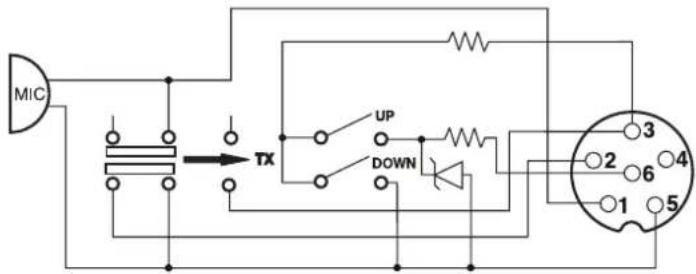
PRISE MICROA6BROCHES·CONEXIONDELMICRO6PINS 6-PINMICROPHONEPLUG·WTYKMIKROFONU6-PIN
1 Modulatlon Modulacion Modulatlon Modulacja
2RX RX RX RX
3 TX-UP/DOWN TX-UP/DOWN TX-UP/DOWN TX-UP/DOWN
4
5 Masse Masa Ground
6 Alimentation Alimentacion Power Supply Zasilanie
CTCSS TONES LIST·LISTE TONALITES CTCSS·LISTA DE TONALIDADES CTCSS·LISTA DOS TONS CTCSS
| No. | Freq. (Hz) | No. | Freq. (Hz) | No. | Freq. (Hz) |
| 00 - □F | OFF | 13 | 103.5 | 26 | 162.2 |
| 01 | 67.0 | 14 | 107.2 | 27 | 167.9 |
| 02 | 71.9 | 15 | 110.9 | 28 | 173.8 |
| 03 | 74.4 | 16 | 114.8 | 29 | 179.9 |
| 04 | 77.0 | 17 | 118.8 | 30 | 186.2 |
| 05 | 79.7 | 18 | 123.0 | 31 | 192.8 |
| 06 | 82.5 | 19 | 127.3 | 32 | 203.5 |
| 07 | 85.4 | 20 | 131.8 | 33 | 210.7 |
| 08 | 88.5 | 21 | 136.5 | 34 | 218.1 |
| 09 | 91.5 | 22 | 141.3 | 35 | 225.7 |
| 10 | 94.8 | 23 | 146.2 | 36 | 233.6 |
| 11 | 97.4 | 24 | 151.4 | 37 | 241.8 |
| 12 | 100.0 | 25 | 156.7 | 38 | 250.3 |
DCS CODE LIST·LISTE CODES DCS
LISTA DE LOS CÓDIGOS DCS·LISTA DOS CÓDIGOS DCS
| Code No. | DCS (Octal) | Code No. | DCS (Octal) | Code No. | DCS (Octal) | Code No. | DCS (Octal) |
| 1 | 023 | 27 | 152 | 53 | 311 | 79 | 466 |
| 2 | 025 | 28 | 155 | 54 | 315 | 80 | 503 |
| 3 | 026 | 29 | 156 | 55 | 325 | 81 | 506 |
| 4 | 031 | 30 | 162 | 56 | 331 | 82 | 516 |
| 5 | 032 | 31 | 165 | 57 | 332 | 83 | 523 |
| 6 | 036 | 32 | 172 | 58 | 343 | 84 | 526 |
| 7 | 043 | 33 | 174 | 59 | 346 | 85 | 532 |
| 8 | 047 | 34 | 205 | 60 | 351 | 86 | 546 |
| 9 | 051 | 35 | 212 | 61 | 356 | 87 | 565 |
| 10 | 053 | 36 | 223 | 62 | 364 | 88 | 606 |
| 11 | 054 | 37 | 225 | 63 | 365 | 89 | 612 |
| 12 | 065 | 38 | 226 | 64 | 371 | 90 | 624 |
| 13 | 071 | 39 | 243 | 65 | 411 | 91 | 627 |
| 14 | 072 | 40 | 244 | 66 | 412 | 92 | 631 |
| 15 | 073 | 41 | 245 | 67 | 413 | 93 | 632 |
| 16 | 074 | 42 | 246 | 68 | 423 | 94 | 654 |
| 17 | 114 | 43 | 251 | 69 | 431 | 95 | 662 |
| 18 | 115 | 44 | 252 | 70 | 432 | 96 | 664 |
| 19 | 116 | 45 | 255 | 71 | 445 | 97 | 703 |
| 20 | 122 | 46 | 261 | 72 | 446 | 98 | 712 |
| 21 | 125 | 47 | 263 | 73 | 452 | 99 | 723 |
| 22 | 131 | 48 | 265 | 74 | 454 | 100 | 731 |
| 23 | 132 | 49 | 266 | 75 | 455 | 101 | 732 |
| 24 | 134 | 50 | 271 | 76 | 462 | 102 | 734 |
| 25 | 143 | 51 | 274 | 77 | 464 | 103 | 743 |
| 26 | 145 | 52 | 306 | 78 | 465 | 104 | 754 |
NORMES·F-NORMAS·F-NORMS·F-NORMY·F
| No | Code | Frequency | FM Channel | AM Channel | Country | CH 19 | CH 9 |
| 1 | EU | 26.965 ~ 27.405 | 40 Ch (4W) | 40 Ch (4W) | AT, BE, BG, CH, CY, DK, EE, ES, FI, FR, GR, HR, HU, IE, IS, IT, LT, LU, LV, NL, NO, PT, RO, SE, SI | AM | AM |
| 2 | PL | 26.960 ~ 27.400 | -5 KHz 40 Ch (4W) | -5 KHz 40 Ch (4W) | PL | AM | AM |
| 3 | d | 26.565 ~ 27.405 | 80 Ch (4W) | 40 Ch (4W) | CZ, DE, SK | FM | AM |
| 4 | EC | 26.965 ~ 27.405 | 40 Ch (4W) | - | MT | FM | FM |
| 5 | U | 26.965 ~ 27.405 | 40 Ch (4W) | 40 Ch (4W) | UK | FM | FM |
| 27.60125 ~ 27.99125 | ENG 40 Ch (4W) | - | FM | FM | |||
| 6 | In | 26.965 ~ 27.275 | 27 Ch (4W) | 27 Ch (4W) | IN | AM | AM |
Remarque : Dans la configuration U : la touche AM/FM ( 4 ) permet de selectionnerla bande de frquence ENG ou CEPT . "UK" s'affiche lorsque la bande de frquence ENG est selectionnee. Lorsque la bande de frquence CEPT est selectionnee, "UK" disparait de l'affcheur (voir tableau page 80).
Observacion: En la configuracion U: la tecla AM/FM (4) permite selec tionar la banda de fecuencia ENGT o CEPT. "UK" aparece en la pantalla cuando la banda de fecuencia ENG esta selecionada. Cuando la banda de fecuencia CEPT esta selecionada, "UK" desaparece de la pantalla (Vease la tabla pagina 80).
Note: In U configuration: the AM/FM key (4) allows to select the ENG or CEPT frequency band. "UK" is displayed when the ENG frequency band is selected. When the CEPT frequency band is selected, "UK" disappears from the display (see table on page 80).
Uwaga: W konfiguraci U: Przycisk AM/FM (4) pozwala wybrać pasmo czestotliwość ENG lub CEPT. Komunikat „UK" zostanie wyświetlony, gdy wybrano czestotliwość ENG. Po wybraniu pasma czestotliwość CEPT komunikat „UK"znika z wyświetlacza (patrz tabela na stronie 80).
The frequency band and the transmission power of your transceiver must correspond with the configuration authorized in the country where it is used.
Countries in which there are particular restrictions (Licence / Register)
Please see updated table on website www.president-electronics.com, page 1The CB radios" then President Radio CB and Europe.