Knapp daneben! - Board game Schmidt - Free user manual and instructions
Find the device manual for free Knapp daneben! Schmidt in PDF.
User questions about Knapp daneben! Schmidt
0 question about this device. Answer the ones you know or ask your own.
Ask a new question about this device
Download the instructions for your Board game in PDF format for free! Find your manual Knapp daneben! - Schmidt and take your electronic device back in hand. On this page are published all the documents necessary for the use of your device. Knapp daneben! by Schmidt.
USER MANUAL Knapp daneben! Schmidt
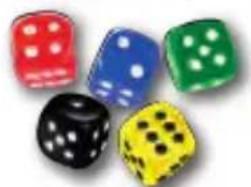
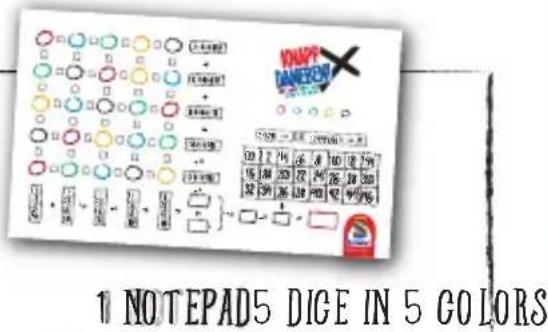
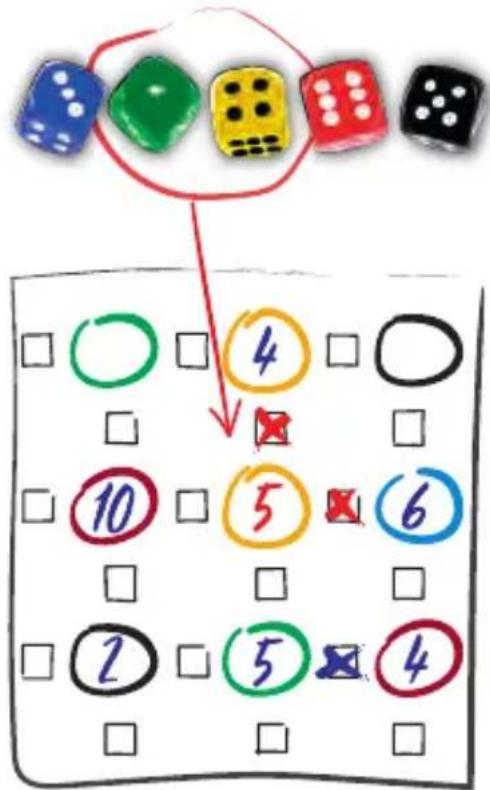
9The exciting dice game by Andreas Kuhnekath-Häbler for 1 - 5 players aged 8 and up Game Material Game Idea In this game, all of the players want to be close to the mark! Each player tries to write down consecutive numbers in adjacent circles wherever possible. Whoever manages to do this most often has the best chance of winning. Game PreParation Pens are required for this game. Each player is given a sheet from the notepad. In keeping with the idea of “Close to the mark”, the second youngest player starts. Taking turns in a clockwise direction, the players each choose a die color and cross this on their sheet. Each player must choose a different color. The starting player picks up all of the dice. And then it’s time to start! Howto play The person whose turn it is takes all five dice and rolls them once. Each player now calculates a total from the number on the die of their color and one other die of their choice. Several players can also use the same die. Each player then writes this total on their sheet in one of the circles in the respective die color – either in the color of their own die or in the color of the second die used. Each player must select two dice and write the total of both dice on their own sheet; it is not possible to skip a turn. Each player is free to choose where they write the number down. The entries do not have to be adjacent to each other.
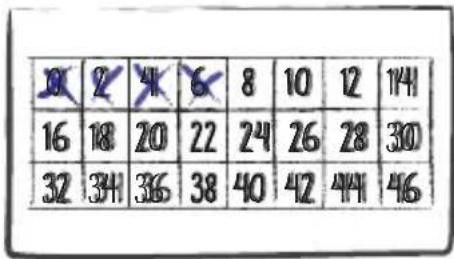
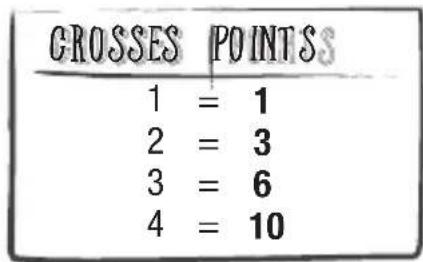
Scoring of the extreme numbers: For each 3, 4, 10 or 11, the player can cross one box in the table (in ascending order, beginning with “0”). For each 2 or 12, the player can even add two crosses. For the values 5, 6, 7, 8 and 9, there are no crosses. The next empty box then corresponds to the total number of points for extreme numbers. Example: During the game, Edgar has written a 4, a 10 and a 12 on his sheet. He can make a total of four crosses for this. One cross each for the 4 and the 10, and two crosses for the 12. The next empty box is the 8, and so Edgar gets eight points for his extreme number values. In very rare cases, if a player has crossed all 24 circles for the extreme numbers, they get 48 points. There are two additional points for each further cross. Tip: To speed up the scoring, the crosses between the circles and in the table for the extreme numbers can also be made during the game when writing down the numbers. Whoever has the most points wins. In the event of a tie, the player who has been close to the mark most often wins. This is the player who has earned more points during the scoring of the crosses between the circles. If there is still a tie, there are several winners. Solo Game “Close to the mark!” is also great for playing alone. The game preparation and game structure are the same as for the normal game. However, solo players perform all of the dice rolls by themselves. The game ends once all 25 circles have been filled. Players can see how close to the mark they are using the following table. Fairly wide of the mark. Have another go! Great! Getting there slowly... Advanced player Specialist Veteran “Close to the mark!” expert Master of all marks If consecutive numbers are written in two neighboring circles (i.e. their value is 1 higher or lower), the circle in-between is crossed. Example: Edgar is the yellow player and gets the following result after rolling the dice: All of the players now use this result at the same time. As he is the yellow player, he must use the yellow 4. Edgar decides to also use the green 1 that he rolled. He adds the two numbers together to make 5 and must write this either in a yellow or a green circle. Edgar chooses the yellow circle. As 5 is 1 less than the 6 written next to it, Edgar can cross the small box between the two numbers. He can also cross the small box above the 5 as 4 is 1 less than this. However, he cannot cross the other two small boxes (left and below) as the neighboring values are not 1 higher or lower. Edgar could also have written the 5 in the green circle, but he would have only gotten one cross for this. Once all of the players have written a number (total of both dice) on their sheet, the next player rolls all five dice and the game continues. All of the players write down their values at the same time. Each player must write a number down. It is not possible to skip a turn. A total must always be calculated from two dice. It is not possible to only write down the number from one die. End of the Game and scoring The game ends when all 25 circles have been filled. Then the score is calculated. During scoring, points are awarded for two areas: For crosses between the circles for numbers that are next to each other (A) and for extreme numbers (B). A: Scoring of the crosses between the circles: In the columns and rows, the following points are awarded for the number of crosses between the circles. The crosses do not have to be next to each other. There can be empty boxes between the crossed ones. Example: Edgar was able to add crosses in this row between two numbers. He gets a total of three points for this. 1 Notepad5 dice in 5 colors

CLOSE TO THE MARK! CI SEI QUASI! JUSTE À CÔTÉ !The exciting dice game by Andreas Kuhnekath-Häblerfor 1 - 5 players aged 8 and up Game Material Game Idea In this game, all of the players want to be close to the mark! Each player tries to write down consecutive numbers in adjacent circles wherever possible. Whoever manages to do this most often has the best chance of winning. Game PreParation Pens are required for this game. Each player is given a sheet from the notepad. In keeping with the idea of “Close to the mark”, the second youngest player starts. Taking turns in a clockwise direction, the players each choose a die color and cross this on their sheet. Each player must choose a different color. The starting player picks up all of the dice. And then it’s time to start! Howto play The person whose turn it is takes all five dice and rolls them once. Each player now calculates a total from the number on the die of their color and one other die of their choice. Several players can also use the same die. Each player then writes this total on their sheet in one of the circles in the respective die color – either in the color of their own die or in the color of the second die used. Each player must select two dice and write the total of both dice on their own sheet; it is not possible to skip a turn. Each player is free to choose where they write the number down. The entries do not have to be adjacent to each other.
Scoring of the extreme numbers: For each 3, 4, 10 or 11, the player can cross one box in the table (in ascending order, beginning with “0”). For each 2 or 12, the player can even add two crosses. For the values 5, 6, 7, 8 and 9, there are no crosses. The next empty box then corresponds to the total number of points for extreme numbers. Example: During the game, Edgar has written a 4, a 10 and a 12 on his sheet. He can make a total of four crosses for this. One cross each for the 4 and the 10, and two crosses for the 12. The next empty box is the 8, and so Edgar gets eight points for his extreme number values. In very rare cases, if a player has crossed all 24 circles for the extreme numbers, they get 48 points. There are two additional points for each further cross. Tip: To speed up the scoring, the crosses between the circles and in the table for the extreme numbers can also be made during the game when writing down the numbers. Whoever has the most points wins. In the event of a tie, the player who has been close to the mark most often wins. This is the player who has earned more points during the scoring of the crosses between the circles. If there is still a tie, there are several winners. Solo Game “Close to the mark!” is also great for playing alone. The game preparation and game structure are the same as for the normal game. However, solo players perform all of the dice rolls by themselves. The game ends once all 25 circles have been filled. Players can see how close to the mark they are using the following table. Fairly wide of the mark. Have another go!Great! Getting there slowly... Advanced player Specialist Veteran “Close to the mark!” expert Master of all marks If consecutive numbers are written in two neighboring circles (i.e. their value is 1 higher or lower), the circle in-between is crossed. Example: Edgar is the yellow player and gets the following result after rolling the dice:All of the players now use this result at the same time. As he is the yellow player, he must use the yellow 4. Edgar decides to also use the green 1 that he rolled. He adds the two numbers together to make 5 and must write this either in a yellow or a green circle. Edgar chooses the yellow circle. As 5 is 1 less than the 6 written next to it, Edgar can cross the small box between the two numbers. He can also cross the small box above the 5 as 4 is 1 less than this. However, he cannot cross the other two small boxes (left and below) as the neighboring values are not 1 higher or lower. Edgar could also have written the 5 in the green circle, but he would have only gotten one cross for this. Once all of the players have written a number (total of both dice) on their sheet, the next player rolls all five dice and the game continues. All of the players write down their values at the same time.Each player must write a number down. It is not possible to skip a turn.A total must always be calculated from two dice. It is not possible to only write down the number from one die. End of the Game and scoring The game ends when all 25 circles have been filled. Then the score is calculated.During scoring, points are awarded for two areas: For crosses between the circles for numbers that are next to each other (A) and for extreme numbers (B). A: Scoring of the crosses between the circles: In the columns and rows, the following points are awarded for the number of crosses between the circles. The crosses do not have to be next to each other. There can be empty boxes between the crossed ones. Example: Edgar was able to add crosses in this row between two numbers.He gets a total of three points for this. Clos e to the m ark
TThe exciting dice game by Andreas Kuhnekath-Häbler for 1 - 5 players aged 8 and up Game Material Game Idea In this game, all of the players want to be close to the mark! Each player tries to write down consecutive numbers in adjacent circles wherever possible. Whoever manages to do this most often has the best chance of winning. Game PreParation Pens are required for this game. Each player is given a sheet from the notepad. In keeping with the idea of “Close to the mark”, the second youngest player starts. Taking turns in a clockwise direction, the players each choose a die color and cross this on their sheet. Each player must choose a different color. The starting player picks up all of the dice. And then it’s time to start! Howto play The person whose turn it is takes all five dice and rolls them once. Each player now calculates a total from the number on the die of their color and one other die of their choice. Several players can also use the same die. Each player then writes this total on their sheet in one of the circles in the respective die color – either in the color of their own die or in the color of the second die used. Each player must select two dice and write the total of both dice on their own sheet; it is not possible to skip a turn. Each player is free to choose where they write the number down. The entries do not have to be adjacent to each other.
Scoring of the extreme numbers: For each 3, 4, 10 or 11, the player can cross one box in the table (in ascending order, beginning with “0”). For each 2 or 12, the player can even add two crosses. For the values 5, 6, 7, 8 and 9, there are no crosses. The next empty box then corresponds to the total number of points for extreme numbers. Example: During the game, Edgar has written a 4, a 10 and a 12 on his sheet. He can make a total of four crosses for this. One cross each for the 4 and the 10, and two crosses for the 12. The next empty box is the 8, and so Edgar gets eight points for his extreme number values. In very rare cases, if a player has crossed all 24 circles for the extreme numbers, they get 48 points. There are two additional points for each further cross. Tip: To speed up the scoring, the crosses between the circles and in the table for the extreme numbers can also be made during the game when writing down the numbers. Whoever has the most points wins. In the event of a tie, the player who has been close to the mark most often wins. This is the player who has earned more points during the scoring of the crosses between the circles. If there is still a tie, there are several winners. Solo Game “Close to the mark!” is also great for playing alone. The game preparation and game structure are the same as for the normal game. However, solo players perform all of the dice rolls by themselves. The game ends once all 25 circles have been filled. Players can see how close to the mark they are using the following table. Fairly wide of the mark. Have another go! Great! Getting there slowly... Advanced player Specialist Veteran “Close to the mark!” expert Master of all marks If consecutive numbers are written in two neighboring circles (i.e. their value is 1 higher or lower), the circle in-between is crossed. Example: Edgar is the yellow player and gets the following result after rolling the dice: All of the players now use this result at the same time. As he is the yellow player, he must use the yellow 4. Edgar decides to also use the green 1 that he rolled. He adds the two numbers together to make 5 and must write this either in a yellow or a green circle. Edgar chooses the yellow circle. As 5 is 1 less than the 6 written next to it, Edgar can cross the small box between the two numbers. He can also cross the small box above the 5 as 4 is 1 less than this. However, he cannot cross the other two small boxes (left and below) as the neighboring values are not 1 higher or lower. Edgar could also have written the 5 in the green circle, but he would have only gotten one cross for this. Once all of the players have written a number (total of both dice) on their sheet, the next player rolls all five dice and the game continues. All of the players write down their values at the same time. Each player must write a number down. It is not possible to skip a turn. A total must always be calculated from two dice. It is not possible to only write down the number from one die. End of the Game and scoring The game ends when all 25 circles have been filled. Then the score is calculated. During scoring, points are awarded for two areas: For crosses between the circles for numbers that are next to each other (A) and for extreme numbers (B). A: Scoring of the crosses between the circles: In the columns and rows, the following points are awarded for the number of crosses between the circles. The crosses do not have to be next to each other. There can be empty boxes between the crossed ones. Example: Edgar was able to add crosses in this row between two numbers. He gets a total of three points for this.

From 100 points: The author and publisher would like to thank all of the test players and rule readers. 2/12 3/4/10/11

EasyManual